
Note: This article contains affiliate links. If you click on these links and make a purchase, we may earn a small commission at no extra cost to you. This helps support our research and content. Read our full affiliate disclosure here.
If you live with cats, air quality can take a hit from litter box odors, fine dust, and airborne allergens. Picking the right air purifier for cat litter helps you control smells, limit respiratory irritants, and keep living spaces more comfortable for both people and pets. This guide presents seven carefully shortlisted air purifiers chosen for strong odor control, particle capture, and practical features suited to homes with litter boxes. Below we summarize how each model performs on filtration, room coverage, and daily upkeep so you can match a purifier to your room size and maintenance preferences.
Top Picks at a Glance
| Best Overall The best all-around choice for most situations | PuroAir 240 HEPA Air Purifier |  |
| Best Quality Built to a higher standard if you want something more solid | Medify Air MA-50 V3.0 |  |
| Best Value The sweet spot between price and what you get | Levoit Core 300-P |  |
| Best Budget The cheapest option that still gets the job done reliably | ICARE NegativeIon Air Purifier IC60 |  |
| Top Rated A top-rated pick with lots of positive feedback | FreAire VisionAir HAP606 |  |
| Most Popular A crowd favorite that many people choose with confidence | Levoit Core 200S-P |  |
| Best Seller A high-volume bestseller chosen again and again | VOOPNU H13 HEPA Air Purifier DH-JH12 |  |
PuroAir 240 HEPA Air Purifier

| Item model number | PuroAir 240 |
|---|---|
| Sq Ft Coverage | 1,000 sq ft |
| Filter type | HEPA & CarbonTech |
| Sleep mode | Whisper Quiet Sleep Mode |
The PuroAir 240 is a tall, tower-style HEPA air purifier built for larger rooms and multi-use spaces where pet dander, odors, and airborne particles are a concern. It uses a three-layer HEPA plus CarbonTech filter to capture dust, pollen, smoke, and pet odors, and the unit includes an air quality sensor with an auto mode that adjusts fan speeds based on detected conditions. Typical use is continuous run in living rooms or bedrooms; set it to auto for hands-off operation or sleep mode for quiet overnight use. The practical benefits are strong coverage for up to about 1,000 sq ft, targeted odor reduction from the carbon layer, and a quieter sleep setting for bedrooms. Limitations include ongoing filter replacement costs for the multi-layer cartridge and the unit size, which is not ideal for very small rooms or tabletop placement. There is also no detailed app control listed for this model, so smart features are more limited than some competitors.
Best for: Buyers who want a single, reliable purifier that handles pet dander and litter odors across larger living spaces and prefer automatic air quality adjustment for low-maintenance use.
Less Ideal for: People seeking an ultra-compact, travel-friendly purifier or those who need a model with full-featured smartphone app control and remote management.
- Three-layer HEPA plus activated carbon filter for particles and odors.
- Air quality sensor with auto mode adjusts fan speed automatically.
- Quiet sleep mode suitable for overnight use.
- Designed coverage appropriate for large rooms and open floor plans.
- Requires periodic replacement of the multi-layer filter which adds ongoing cost.
- Larger footprint makes it less convenient for small tabletops or travel.
Verdict: Choose the PuroAir 240 when you need an automatic, powerful purifier that tackles pet odors and airborne allergens across a large room.
Medify Air MA-50 V3.0

| Power Source | ac |
|---|---|
| Filter Class | HEPA H13 |
| Wattage | 70 watts |
| Particle Retention Size | 0.1 micrometer |
| Noise Level | 56 db |
The Medify Air MA-50 V3.0 is a heavy-duty air purifier built for large spaces and demanding indoor air problems like smoke, allergens, and strong odors. It uses a True HEPA H13 filter and a powerful fan to deliver a CADR that claims coverage up to 2,640 sq ft per hour, and offers four fan speeds plus sleep and timer controls via a touch panel. Practical benefits include the ability to cycle the air in very large rooms quickly, programmable operation and a child lock for household safety, and certifications from CARB, ETL, and Energy Star that back its performance claims. For cat owners dealing with litter dust and persistent odors, the H13 filtration and high airflow can noticeably reduce airborne dander and fine dust when positioned near litter areas. Important trade-offs are its size and higher maximum noise on top speed and the need to replace filters every few months under heavy use, which raises ongoing costs. The unit is best used in open or single large rooms where strong airflow and fast purification matter most.
Best for: Someone prioritizing fast, high-performance filtration to control cat dander, litter dust, and odors in larger living areas or open-plan homes.
Less Ideal for: Those who need an ultra-quiet, compact purifier for a small bedroom closet or a budget option with minimal ongoing filter costs.
- True HEPA H13 filter captures particles down to 0.1 microns
- Very high claimed coverage and CADR suitable for large rooms
- Multiple fan speeds, sleep mode, timer, and child lock for flexible operation
- Certified by CARB, ETL, and Energy Star
- Larger footprint and louder at highest fan speed
- Filter replacements are frequent with heavy use (every 3-4 months)
Verdict: Buy this if you want one of the most powerful HEPA H13 purifiers for quickly reducing cat dander, litter dust, and odors across very large rooms.
Levoit Core 300-P

| Filter Type | 3 in 1 Filtration |
|---|---|
| Floor Area | 1073 square_feet |
| Noise Level | 24 db |
| Particle Retention Size | 0.3 micron |
| Wattage | 56 watts |
The Levoit Core 300-P is a small, user-friendly HEPA air purifier meant for bedrooms and living areas where pet odors and airborne allergens are a concern. It pulls air through a three-stage original filter (pre-installed) using a 56W motor and delivers verified CADR performance that refreshes a typical 222 ft² room several times per hour and can cover larger open areas at a lower exchange rate. Controls are touch-based with a near-silent Sleep Mode rated at about 24 dB, and the display and timer can be turned off for undisturbed nights. The unit is AHAM verified and CARB and ETL certified, which supports its measured performance claims. Practical users should note it lacks smart Auto Mode on this model, so fan speed is adjusted manually, and the manufacturer recommends using factory replacement filters every 6 to 8 months for best results. For tackling litter-box dust, dander, and odor in a single room, this purifier offers strong filtration in a compact footprint, but you will need to manage fan settings manually for heavier or persistent odors.
Best for: A practical buyer who wants a compact, proven HEPA purifier to reduce litter dust, pet dander, and odors in a single room and values quiet nighttime operation and verified performance.
Less Ideal for: People needing whole-house odor control or automatic, app-driven operation should consider larger units or models with Auto Mode and smart features instead.
- True HEPA-grade three-stage filter that captures 0.1–0.3 μm particulates with 99.97% efficiency as tested
- AHAM verified CADR with documented clean-air rates for smoke, dust, and pollen supports measurable room coverage
- Very quiet Sleep Mode (around 24 dB) and dimmable/turn-off display make it suitable for bedrooms
- Compact, portable design fits easily near litter boxes or in small rooms and is ETL/CARB certified for safety
- No built-in Auto Mode or smart connectivity on this Core 300-P model so fan speeds must be set manually
- Filter replacement is required every 6–8 months for maintained performance, adding ongoing cost
Verdict: A compact, AHAM-verified HEPA purifier that quietly removes litter dust and pet allergens from a single room, ideal for buyers focused on practical, measurable results.
ICARE NegativeIon Air Purifier IC60

| Ion output | 2000/cm |
|---|---|
| Power consumption | 3W |
| Operation modes | 3 timed circulation modes |
| Ozone | Ozone-free |
The ICARE NegativeIon Air Purifier IC60 is a palm-sized, plug-in unit that targets pet and household odors using negative ion technology rather than filters. It produces up to 2000 negative ions per cm and offers three timed circulation modes so you can choose short, medium, or longer purification cycles depending on odor level. Because it is filterless and fanless, the unit runs quietly and uses about 3W of power, making it suitable to place near litter boxes, in bathrooms, or on counters without drawing attention. The design avoids ozone production and eliminates the recurring cost and maintenance of replacement filters. Limitations include its small coverage and reliance on ion settling rather than mechanical filtration, so it is best for localized odor control rather than whole-room particle removal or allergy-grade purification.
Best for: Buyers who need an inexpensive, low-maintenance way to reduce strong litter box and kitchen odors in small areas and prefer a plug-and-forget device.
Less Ideal for: Those seeking whole-room allergen removal, HEPA-level filtration, or coverage for large living spaces should consider more powerful purifiers with mechanical filters.
- Compact plug-in form fits near litter boxes and small spaces
- Filter-free design eliminates replacement costs and maintenance
- Three timed circulation modes let you match runtime to odor intensity
- Whisper-quiet, fanless operation suitable for bedrooms and nurseries
- Low power draw (~3W) keeps running costs minimal
- Not a HEPA or mechanical filter system so it does not capture airborne allergens effectively
- Small unit intended for localized odor control rather than large open areas
Verdict: A very affordable, maintenance-free plug-in deodorizer that quietly reduces strong litter box and kitchen odors in small, localized spaces.
FreAire VisionAir HAP606

| Coverage | Up to 1800 sq ft |
|---|---|
| Filtration | 3-stage H13 HEPA |
| Noise level | 20 dB (sleep mode) |
| Air changes | 4× per hour |
The FreAire VisionAir HAP606 is a HEPA air purifier built to monitor and continuously clean large indoor spaces while running quietly. It uses a 3-stage H13 filtration system plus a 360 degree intake and a high-efficiency airflow design to refresh air in rooms up to 1800 sq ft four times per hour, and it displays real-time PM2.5 readings and a color-coded AQI so you can track conditions at a glance. Practical features include an auto mode, child lock, timer, and a very quiet 20 dB sleep mode that makes it suitable for bedrooms during overnight use. The unit is compact and straightforward to set up, and brand-recommended replacement filters simplify maintenance and preserve performance. Limits to consider are that replacement filters are sold as official FreAire parts for best results and the purifier is optimized for whole-room circulation rather than targeted spot removal right next to a litter box or active dust source.
Best for: Buyers who prioritize consistent, measurable air-quality performance and dependable filtration for larger living areas and want a quiet unit they can leave running day and night.
Less Ideal for: People needing an inexpensive spot-treatment device specifically for a small area or immediate odor neutralization right at the litter box should consider supplemental solutions.
- H13 3-stage filter captures 99.97% of particles down to 0.3 μm
- Real-time PM2.5 and color-coded AQI display for instant air-quality feedback
- 360° intake plus high-efficiency airflow refreshes large rooms up to 1800 sq ft
- Very quiet operation with a 20 dB sleep mode and child lock for safe overnight use
- Best performance requires official FreAire replacement filters
- Designed for whole-room circulation so odors immediately next to a litter box may persist
Verdict: Choose the VisionAir HAP606 if you want a quiet, reliability-focused HEPA purifier that continuously monitors air quality and keeps large rooms consistently cleaner.
Levoit Core 200S-P
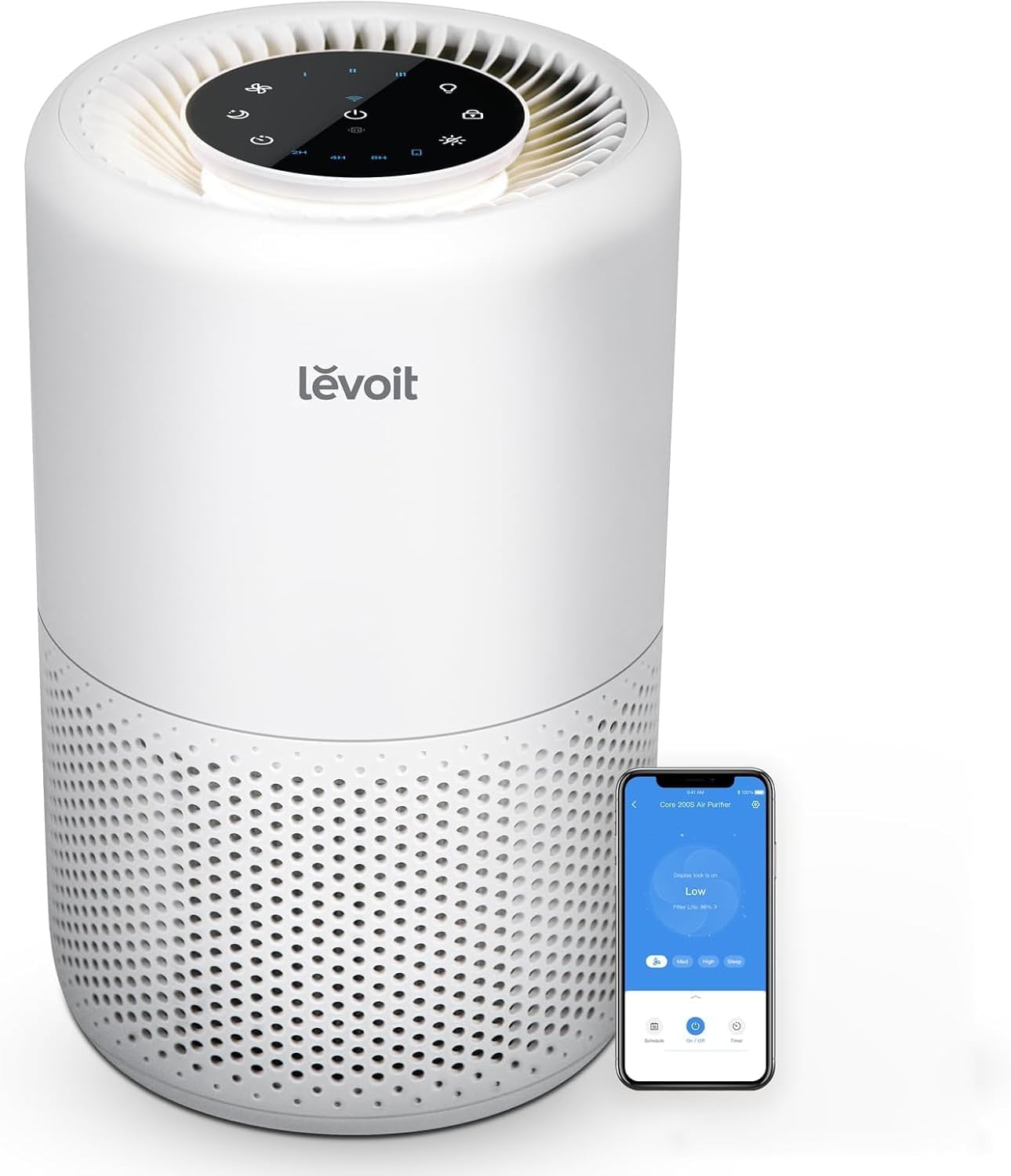
| Coverage | 140 ft² room |
|---|---|
| Filtration | Pre-filter + Activated Carbon + HEPA-grade main filter |
| Noise level | As low as 27 dB |
| Model | Core 200S-P |
The Levoit Core 200S-P is a compact smart air purifier built for everyday rooms where pets live, sleep, and play. It uses 360-degree intake and a three-stage filtration stack — pre-filter, activated carbon, and a HEPA-grade main filter — to capture large hair and dander, absorb odors from litter boxes, and remove 0.1–0.3 micron particles. The unit is AHAM-verified for performance and is rated to refresh the air in a roughly 140 ft2 room almost five times per hour, making it suitable for bedrooms and small living areas. Smart and voice controls plus an app that monitors filter life let you schedule runs and check maintenance without guessing. Noise can drop to about 27 dB in sleep mode so it can run overnight, and the Display Off button reduces light disturbance. Limitations are its room-size focus and compact motor — it is not intended for large open-plan areas and requires periodic filter replacements to maintain odor control and capture efficiency.
Best for: Buyers who want a proven, easy-to-manage purifier for bedrooms or small rooms with cats and who prioritize verified performance and simple smart controls.
Less Ideal for: Not a good choice for large living rooms, open-plan areas, or entire-home coverage where higher airflow and larger units are needed.
- Three-stage filtration including HEPA-grade main filter for particle capture
- Activated carbon layer for absorbing pet odors and fumes
- AHAM-verified performance rating for reliable air changes in small rooms
- Smart app and voice control with filter-life monitoring for convenient maintenance
- Quiet sleep mode with display-off option for overnight use
- Designed for small rooms only and won’t keep up in large open spaces
- Requires replacement filters to sustain performance and odor control
Verdict: A compact, AHAM-verified purifier with carbon and HEPA-grade filtration that makes it a practical, low-noise choice for managing cat odors and dander in small rooms.
VOOPNU H13 HEPA Air Purifier DH-JH12

| Item model number | DH-JH12 |
|---|---|
| Filter type | H13 True HEPA triple-layer |
| Coverage claim | Up to 1,076 ft² |
| Noise level | 22 dB (low) |
The VOOPNU DH-JH12 is a compact tower air purifier built around an H13 True HEPA triple-layer filter and 360 degree intake, intended to capture fine particles, pet hair, and common household odors. It is typically placed in bedrooms, living rooms, or near litter areas where continuous operation helps reduce airborne dust and litter dust; the manufacturer states it cleans 250 ft² every 15 minutes. Controls are simplified to a basic panel with three speeds, a timer, and a built-in essential oil tray if you want light scenting. It is notably quiet at down to 22 dB on low, so it can run overnight without disturbing sleeping pets or people. The unit is compact and easy to move, and certifications such as ETL, CARB, and DOE indicate it meets common safety and emissions standards. Limitations include modest control granularity and the need to run it for extended periods to see full benefits, and replacement filters follow the typical 3 to 6 month cycle depending on use and air quality. For buyers focused on steady, low-noise filtration near cat litter areas, it offers practical performance without complicated setup.
Best for: A cautious buyer who wants straightforward, certified filtration that runs quietly and reliably around the clock to reduce cat litter dust and pet dander without complex features or setup.
Less Ideal for: People who need advanced airflow controls, smart home integration, or maximum CADR for very large, open-plan homes should consider a higher-end model instead.
- H13 True HEPA filtration captures 99.97% of fine particles for effective removal of litter dust and dander.
- 360° intake and claimed coverage of up to 1,076 ft² allow placement flexibility and decent room circulation.
- Very quiet operation down to 22 dB suitable for bedrooms and night use.
- Simple controls and a compact footprint make it easy to set up and move where needed.
- Essential oil tray provides optional light scenting without additional accessories.
- Manufacturer recommends continuous long-term use for best results, which increases filter replacement frequency and energy use.
- Controls are basic with only three speeds and limited customization.
- Replacement filters require periodic purchase and follow a 3–6 month suggested cycle depending on contamination levels.
Verdict: A quiet, certified H13 HEPA tower purifier that provides simple, effective continuous filtration ideal for reducing cat litter dust and pet dander in typical rooms.
Choosing the Right Air Purifier for Cat Litter: Key Factors to Consider
Filtration Type and Efficiency
Look for a true HEPA or HEPA-equivalent filter because litter dust and dander include very fine particles that bypass lower-grade filters. A certified HEPA captures 99.97 percent of particles down to 0.3 microns, which is important for reducing airborne litter dust and microscopic allergens.
Beyond the particle stage, an adsorptive layer such as activated carbon or other gas-phase media matters for odor control. Litter box odors are caused by volatile organic compounds and gases that particle filters do not trap, so a multi-stage system with both HEPA and an effective odor media will deliver the best real-world results.
Room Size and CADR
Match the purifier's recommended room size or CADR rating to the space near the litter box and surrounding living areas. CADR indicates how quickly a unit can remove smoke, dust, and pollen; for litter situations prioritize dust and smoke CADR numbers to estimate turnover rate for airborne litter particles.
Undersizing a unit will leave odors lingering and dust levels higher, while oversizing mainly increases upfront and filter costs. Consider where the litter box is located—bathroom, laundry room, or open living area—and choose coverage that services both the box location and the nearby breathing zone.
Odor Control Media and Replaceability
Check what type of odor media the purifier uses and how often it needs replacement. Activated carbon is common, but carbon bed thickness and source quality vary widely; thicker, high-surface-area carbon beds absorb odors longer. Some units use specialized odor cartridges or add-ons specifically designed for ammonia and sulfur compounds common in urine-related smells.
Also evaluate how easy it is to replace the media. Frequent filter swaps can become costly and inconvenient, so look for clear replacement intervals and widely available filters to avoid gaps in performance.
Noise and Placement
Noise matters because you may want continuous operation near a litter box. Look for quiet low-speed performance and check how audible the unit is at typical fan settings. Some purifiers have sleep or whisper modes that keep airflow lower but still provide steady filtration without disturbing the household.
Placement affects noise perception too. Positioning the unit on the floor near the box or elevated on a stable surface can change how sound carries. Also consider whether the purifier's fan speed and noise will disturb pets; quieter continuous operation is often preferable to intermittent high-power bursts.
Maintenance, Ease of Use, and Running Costs
Maintenance frequency and simplicity influence long-term satisfaction. Expect filters to accumulate hair, dust, and tracked litter; units with pre-filters that are easy to clean extend the life of more expensive HEPA and carbon elements. Check whether the purifier provides filter-change indicators, washable pre-filters, and straightforward access for swaps.
Running costs include replacement filter prices and electricity use. A lower-watt motor that achieves adequate air changes per hour can be more economical over time than a higher-power unit that runs at the same duty cycle. Consider subscription availability for filters or standard sizes that are widely distributed to avoid supply issues.
Where to Place an Air Purifier for Best Litter Box Results
Location is critical. Place the purifier within a few feet of the litter box to capture odors and dust at the source, but avoid positioning it so that the airflow blows directly across the box and scatters litter. Elevated placement on a low table or a stable shelf can improve capture of airborne particles without interfering with the box.
If the litter box sits in a small enclosed room, center the purifier to allow even circulation. For boxes in open-plan spaces, consider using a higher CADR unit or a second small purifier nearby to prevent odors from wafting into adjacent living areas.
- Keep intake unobstructed and allow at least a few inches of clearance.
- Avoid enclosed cabinets or behind furniture where airflow is restricted.
- Consider noise when choosing proximity to sleep or living areas.
Managing Odors Beyond the Purifier
A purifier helps but is one part of an overall odor-control routine. Regular litter box cleaning, using a clumping litter that contains odors well, and maintaining proper ventilation all reduce the load on the purifier. Combined approaches produce the best results rather than relying solely on filtration.
Deodorizing additives and frequent scooping reduce volatile compounds that otherwise accumulate and overwhelm an undersized purifier. If ammonia buildup is a concern, more frequent cleaning and a higher-capacity odor media are recommended.
- Scoop daily and deep-clean the box on a schedule that suits household habits.
- Use a lidded box if appropriate to limit direct odor spread.
- Ensure the room has some passive ventilation to dilute lingering gases.
Special Considerations in Multi-Cat Households
Multiple cats increase both dust and odor loads, so expect to upsize filtration capacity or add supplementary units. More animals also increase hair and tracked litter, which clogs pre-filters faster and shortens service intervals for HEPA and odor media.
In heavy-use situations, choose units with robust pre-filters and easy filter access to simplify maintenance. Also plan for shorter replacement cycles for the odor media and HEPA element to keep performance consistent.
- Aim for higher air changes per hour when several cats share a space.
- Check whether the purifier's filters are designed to handle pet hair without frequent clogging.
- Consider portable small units for bedroom or office spaces where cats spend time.
Pet Safety and Operational Settings
Confirm that the purifier uses safe technologies appropriate for pet areas. Avoid devices that rely on ozone generation, because ozone can irritate both humans and animals. Most effective home purifiers rely on mechanical HEPA filtration combined with activated carbon or other adsorbents to manage odors.
Use stable, continuous fan settings rather than intermittent high-power bursts to reduce stress for sensitive animals. Auto modes that adjust to detected particulates can be convenient, but verify the unit responds to the types of particles produced by litter boxes and does not cycle aggressively.
- Prefer mechanical filtration with carbon media over ionizers or ozone producers.
- Choose settings that balance low noise with steady air exchange.
- Ensure the unit is stable and inaccessible to playful pets.
Filter Types and What They Actually Remove
HEPA filters remove particulate matter like litter dust, dander, and fine aerosols. Activated carbon and other gas-phase media adsorb many odor-causing molecules, but effectiveness varies by bed depth and media type. No single filter eliminates all odor compounds indefinitely, so filter capacity and replacement intervals matter.
Some advanced units include specialized odor cartridges targeted at ammonia and sulfur compounds. These can substantially improve perceived odor control but will need timely replacement in heavy-use settings.
- Check manufacturer guidance on which gases or VOCs the media targets.
- Consider combined HEPA plus carbon systems for balanced particle and odor control.
- Replace odor media proactively if odors become noticeable again.
How We Chose the Best Air Purifier for Cat Litter
We focused on real-world performance for homes with indoor litter boxes and prioritized features that directly affect odor reduction, dust containment, and pet-safe operation. Key evaluation criteria included filtration effectiveness against fine dust and odor-causing gases, CADR or equivalent particle-cleaning rate relative to recommended room size, replacement filter availability and cost, ease of maintenance for frequent filter checks, and noise behavior at typical household fan speeds. We also reviewed control features that help manage continuous operation near pets, such as auto modes, programmable timers, and low-speed quiet settings. Products were excluded if they lacked HEPA-class particle filtration, did not address odors with an adsorptive layer or gas-phase option, or were intended only for industrial use and not for typical home rooms. We favored units with clear published cleanup rates and accessible filter specifications so buyers can assess long-term ownership costs and suitability for litter-box environments.
Our full evaluation process is outlined in our review methodology.
FAQ
How close should an air purifier be to a litter box?
Place the purifier within a few feet of the litter box to capture odors at the source, but not so close that intake or exhaust interferes with the box. A small clearance and unobstructed intake deliver the best balance of capture and airflow.
Will a HEPA filter remove litter box smells?
HEPA removes dust and dander but does not trap gases that cause odors. For smells you need a purifier with an effective carbon or gas-phase adsorbent in addition to HEPA filtration.
How often should filters be changed in a home with indoor cats?
Filter life depends on usage and load, but expect pre-filters to need cleaning every few weeks and HEPA or carbon elements every 6 to 12 months under typical single-cat use. Heavy use or multiple cats will shorten those intervals.
Are ozone or ionizer purifiers safe around cats?
Ozone-generating devices and some ionizers can produce byproducts that irritate both people and pets. For litter-box areas choose mechanical HEPA plus carbon solutions and avoid technologies that intentionally emit ozone.
Can a small purifier handle an open-plan living room with a litter box?
A small unit may struggle in open-plan spaces because air exchange is higher and odors disperse across a larger area. Opt for a higher CADR model or multiple units to ensure adequate turnover and odor control.
Final Verdict
When selecting an air purifier for cat litter, prioritize true HEPA filtration for particle capture and a robust odor media such as activated carbon for volatile compounds. Size the unit to the room and litter box location, and expect higher maintenance in multi-cat or high-traffic homes. Balance noise, replacement costs, and placement to meet your daily routine. A properly matched purifier, combined with regular litter maintenance and sensible ventilation, will deliver the most consistent odor reduction and air quality improvement.