
Note: This article contains affiliate links. If you click on these links and make a purchase, we may earn a small commission at no extra cost to you. This helps support our research and content. Read our full affiliate disclosure here.
If you live with birds, airborne dander and fine feather dust can make indoor air feel gritty and trigger allergy symptoms. Choosing the right air purifier for bird dander matters because these particles are very small and often cling to surfaces and fabrics, so a unit that traps fine particulates and moves enough air for the room is essential. This guide covers seven shortlisted air purifiers selected for their ability to capture ultrafine particles, handle pet and bird-related odors, and offer practical features for everyday home use. Below we outline what we evaluated and what to look for so you can pick a model that fits the size of your space and your maintenance preferences.
Top Picks at a Glance
| Best Overall The best all-around choice for most situations | Coway Mighty AP-1512HH |  |
| Best Quality Built to a higher standard if you want something more solid | Coway Airmega 400 |  |
| Best Value The sweet spot between price and what you get | MOOKA B-D02L Air Purifier |  |
| Best Budget The cheapest option that still gets the job done reliably | Purivortex PX500 Air Purifier |  |
| Top Rated A top-rated pick with lots of positive feedback | AirDoctor AD3500 Air Purifier |  |
| Most Popular A crowd favorite that many people choose with confidence | Levoit Core 300-P Air Purifier |  |
| Best Seller A high-volume bestseller chosen again and again | Levoit Vital 200S-P Air Purifier |  |
Coway Mighty AP-1512HH

| Coverage | Up to 1,748 sq. ft. in 60 minutes |
|---|---|
| Filtration stages | Pre-filter, Deodorization, Bipolar Ionizer, HEPA |
| HEPA effectiveness | 99.97% of 0.3 μm particles |
| Filter lifespan | Up to 1 year |
| Model number | AP-1512HH |
The Coway Mighty AP-1512HH is a four-stage HEPA air purifier meant for continuous home use in medium to large spaces. It pulls air through a washable prefilter, deodorization layer, bipolar ionizer, and a true HEPA element that captures 99.97% of 0.3 micron particles, which helps remove common allergens like bird dander, pollen, and pet hair. An onboard pollution sensor and color LED let you monitor air quality in real time while Auto and Eco modes adjust fan speed for efficient runtime and lower energy use. Practical touches include a filter indicator and a timer, plus a washable prefilter to extend primary filter life. Limitations are that specialized filters for extreme smoke or highly odorous environments may be needed separately, and the unit is a standalone room purifier so whole-home coverage requires multiple units or placement strategy. Noise is low on lower speeds but increases at higher fan settings necessary for rapid cleaning in very dusty rooms.
Best for: Buyers who want a reliable, sensor-driven room purifier that removes airborne allergens like bird dander and can run continuously with low maintenance.
Less Ideal for: People seeking whole-home filtration from a single device or those who need an ultra-quiet unit at maximum airflow should consider alternative setups or quieter models.
- True HEPA filtration that captures 99.97% of 0.3 μm particles for effective allergen removal
- Real-time air quality sensor with LED indicator and Auto mode for hands-off adjustments
- Washable pre-filter and filter indicator simplify maintenance and help control running costs
- Multiple operating modes including Eco mode reduce energy use during low-pollution periods
- Replacement or specialty filters for intense smoke or odor mitigation are sold separately
- Higher fan speeds required for rapid whole-room cleaning produce noticeable noise
Verdict: A dependable, sensor-driven HEPA purifier that effectively removes bird dander and other common allergens across medium to large rooms.
Coway Airmega 400
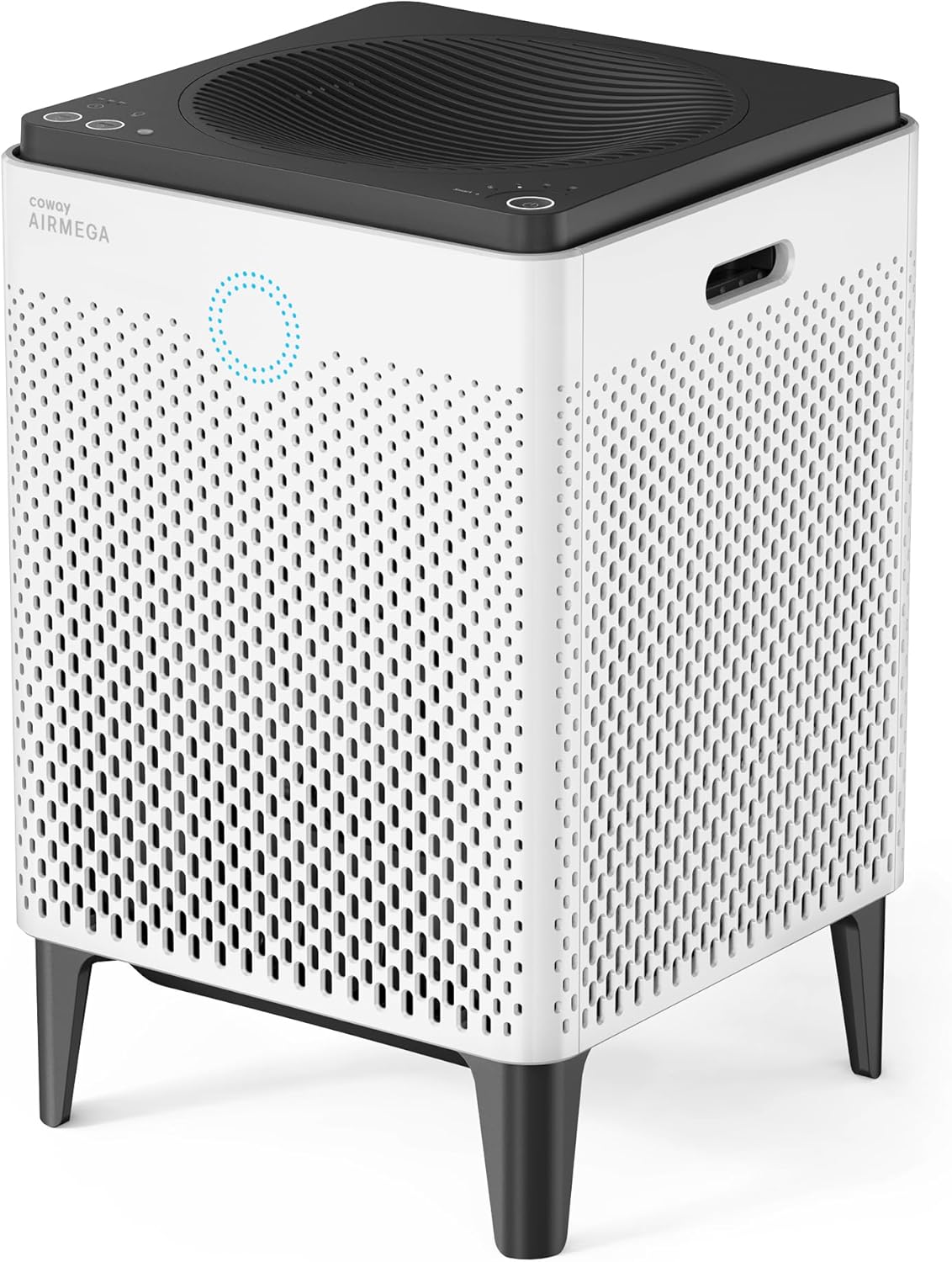
| Floor Area | 3120 square_feet |
|---|---|
| Filter Type | HEPA Filter, Active Carbon Filter, Pre-Filter |
| Particle Retention Size | 0.3 micron |
| Wattage | 66 watts |
| Special Features | Air Quality Monitor, Eco Mode, Filter Life Indicator, Smart Mode, Timer |
The Coway Airmega 400 is a high-capacity air purifier built for large spaces and persistent airborne contaminants like pet or bird dander. It combines a washable pre-filter, activated carbon stage, and a HEPA filter rated to capture 99.97% of 0.3 micron particles, and the manufacturer lists lab-tested reductions for many allergens and VOCs. In practice the unit runs in Smart Mode, adjusting fan speeds to room air quality, and offers Eco and Sleep modes that cut power and noise when conditions are clean. It also includes a built-in air quality monitor, timer, and filter life indicators that make maintenance straightforward. The purifier is relatively powerful at 66 watts and is Energy Star certified, so it balances performance with reasonable energy use for continuous operation. Trade-offs are its large footprint and weight for moving between rooms, and replacement filters and the initial unit cost are considerations for long-term ownership. For people managing heavy dander loads, the Airmega's high CADR and multi-stage filtration deliver thorough capture and odor/VOC reduction.
Best for: Buyers who prioritize maximum particulate removal in large rooms and want an appliance that automatically adapts airflow to maintain low allergen levels with minimal fiddling.
Less Ideal for: Those needing a compact, lightweight purifier for small rooms or occasional use should look at smaller, lower-capacity models instead.
- Designed to cover very large areas (up to 3,120 sq ft in 60 minutes).
- True HEPA filtration capturing 99.97% of 0.3 micron particles for effective dander removal.
- Activated carbon stage reduces odors and many VOCs common with cages and cleaners.
- Smart, Eco, and Sleep modes adjust fan speed and power for continuous but efficient operation.
- Built-in air quality monitor and filter-life indicators simplify hands-off maintenance.
- Large and relatively heavy, making it less convenient to move between rooms.
- Higher upfront cost and ongoing expense for replacement filter sets.
Verdict: If you need powerful, continuous removal of bird dander and related odors across very large rooms, the Airmega 400 delivers the coverage and HEPA-plus-carbon filtration to do the job.
MOOKA B-D02L Air Purifier
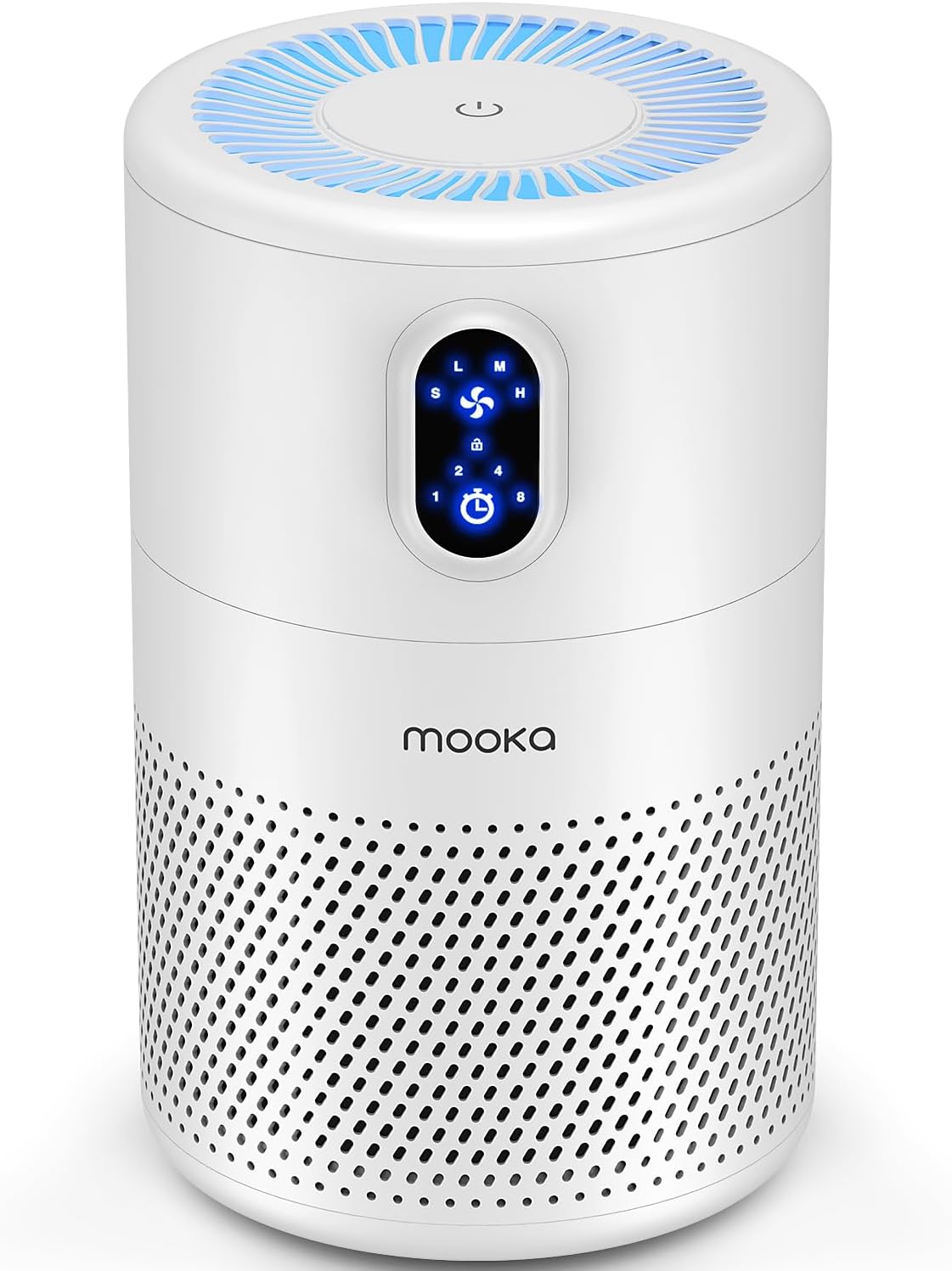
| Effective Area | Up to 1076 sq ft |
|---|---|
| Filter Type | H13 True HEPA + activated carbon |
| Fan Modes | 4 speeds |
| Timer | 1/2/4/8 hours |
The MOOKA B-D02L is a tower-style air purifier built around an H13 true HEPA filter and an activated carbon layer to capture particles, pet dander, smoke, and household odors. It is intended for use in bedrooms, living rooms, offices, or larger open spaces and advertises coverage up to 1076 sq ft with higher air-change rates in smaller rooms. Controls include four fan speeds, four timer settings, a soft night light that can be turned off, and a child lock for safety. The unit emphasizes quiet, energy-efficient operation thanks to a brushless DC motor, which makes it suitable to run overnight or during work without much distraction. Filter replacement is recommended every 3 to 6 months depending on conditions, and replacement filters are available as named accessories. Limitations to note are that real-world performance will depend on room layout and placement, and maximum coverage claims are for very low air-change rates at the far end of the range, so expect best results in medium rooms rather than large open-plan homes.
Best for: Buyers who want a quiet, energy-conscious purifier that handles pet and bird dander in bedrooms or medium living spaces and prioritizes practical features over premium extras.
Less Ideal for: Large open-plan homes that need high air-change rates across multiple connected rooms or users who want smart home connectivity or advanced sensors.
- H13 true HEPA filter captures particles down to 0.3 microns including dander and pollen.
- Activated carbon layer reduces common household odors and smoke.
- Multiple fan speeds and timer settings let you balance cleaning power and noise.
- Very low noise operation and low power draw suitable for overnight use.
- Coverage claims span a wide range and deliver more air changes in smaller rooms than in the maximum area listed.
- Requires periodic filter replacements every 3–6 months which adds ongoing cost.
Verdict: A quiet, energy-efficient HEPA purifier that offers practical particle and odor removal for bedrooms and medium rooms where consistent dander control is the priority.
Purivortex PX500 Air Purifier

| Coverage Area | Up to 880 sq.ft |
|---|---|
| Filtration | Pre-filter, HEPA, Activated carbon |
| Particle Size | Filters down to 0.1 microns |
| Fan Modes | Sleep/Low/Med/High |
| Timers | 4H/8H/12H |
The Purivortex PX500 is a compact tabletop air purifier that uses a three-layer system — pre-filter, HEPA, and activated carbon — to capture dust, smoke, pollen, pet dander, and small particles down to 0.1 microns. It is intended for whole-room use and Purivortex claims it can cycle the air in spaces up to 880 square feet in one hour and a 215 sq ft room in about 15 minutes, which makes it suitable for bedrooms, living rooms, or bird rooms where dander and fine particles are a concern. Practical features include four fan modes (Sleep/Low/Med/High), three timer settings, and multiple night-light colors for bedroom-friendly operation, while a taller 6-inch filter aims to increase airflow and run time versus shorter filters. Trade-offs are typical for units this size: it is fairly small and lightweight so filter replacement frequency and high-speed noise may be more noticeable in very large open spaces, and the carbon filter reduces light odors but will not remove strong chemical contaminants. For buyers focused on affordable, effective particle removal in rooms used by pet birds, the PX500 offers solid filtration performance in an easy-to-use package.
Best for: Buyers on a budget who need reliable particulate removal from rooms where bird dander is present and who prioritize quick purification and simple controls.
Less Ideal for: People needing industrial-strength odor or chemical removal or whole-house coverage should consider larger, specialized systems or dedicated gas-phase purifiers.
- Three-layer filtration including HEPA for particles as small as 0.1 microns
- Advertised coverage up to 880 sq ft for fast air changes in typical rooms
- Taller 6-inch filter for increased airflow and longer filter life compared with shorter filters
- Multiple fan speeds, timers, and night-light modes for flexible bedroom use
- Carbon filter reduces light household odors but is not designed for strong chemical or solvent removal
- Smaller tabletop form means reduced efficacy in very large open-plan spaces without multiple units
Verdict: A budget-friendly HEPA purifier that rapidly reduces bird dander and fine particles in typical bedrooms and living rooms.
AirDoctor AD3500 Air Purifier

| Model | AD3500 |
|---|---|
| Coverage | Up to 2,520 ft2/hr |
| Filtration | Pre-filter + Activated Carbon + UltraHEPA |
| Particle capture | 99.99% at 0.003 microns |
The AirDoctor AD3500 is built to clean large areas quickly using a three-stage system: a pre-filter, a premium activated carbon/VOC stage, and a hospital-grade UltraHEPA filter that captures down to 0.003 microns. It is intended for continuous home use in living rooms, bedrooms, and kitchens where airborne irritants like smoke, pollen, pet dander, and bird dander are a concern. The unit includes PM2.5 sensors and an AirDoctor Halo indicator that let Auto Mode adjust fan speed and trigger a Boost when air quality worsens, while a timer, filter indicator, and four fan speeds give straightforward control. Practical benefits include extensive coverage—cleaning up to 630 ft2 in 15 minutes and up to 2,520 ft2 in an hour—plus a quiet design for night use and carbon chemistry aimed at reducing odors and VOCs. Limitations to consider are the need to purchase genuine replacement filters on the manufacturer schedule and the unit's physical footprint and weight relative to small-room purifiers.
Best for: Buyers who prioritize consistent, science-backed filtration for whole rooms and want an automated, low-maintenance purifier that handles fine particles and odors reliably.
Less Ideal for: People who need a compact, ultra-portable purifier for travel or small single rooms should consider smaller, lighter models instead.
- UltraHEPA filtration rated to 0.003 microns captures very fine particles including dander and smoke
- Premium activated carbon/VOC filter reduces odors, cooking fumes, and airborne gases
- Large coverage area suitable for whole rooms or open-plan spaces
- Auto Mode with PM2.5 sensing and Halo indicator automates fan speed and boost when air quality drops
- Designed for quiet operation so it can run overnight without disturbing sleep
- Requires periodic purchase of genuine replacement filters on the recommended schedule
- Larger and heavier than typical small-room purifiers, so it needs a dedicated floor spot
Verdict: Choose the AD3500 when you need a proven, automated large-room purifier that reliably removes fine particles and odors for allergy and dander control.
Levoit Core 300-P Air Purifier

| Floor Area | 1073 square_feet |
|---|---|
| Noise Level | 24 db |
| Particle Retention Size | 0.3 micron |
| Wattage | 56 watts |
| Filter Type | 3 in 1 Filtration |
The Levoit Core 300-P is a compact, plug-in air purifier built around a three-stage HEPA-grade filtration system that targets pollen, dust, pet dander, smoke, and VOCs. It is typically used in bedrooms, living rooms, or home offices where quiet continuous cleaning is desired; Sleep Mode drops noise to about 24 dB and the display can be turned off for undisturbed nights. The unit is AHAM verified with CADR figures for smoke, dust, and pollen and is rated to refresh air in a modest-sized room multiple times per hour, making it useful against airborne allergens such as bird dander when placed where air circulation passes through it. Controls are touch-based and the purifier runs on a 56 W motor that balances cleaning power with energy efficiency. Practical benefits include a small footprint, portability, and use of Levoit original three-in-one filters to maintain the tested performance. Limitations are that this model requires manual fan-speed control (no Auto Mode) and filter longevity depends on environment and timely replacement every 6 to 8 months to sustain filtration efficiency.
Best for: Buyers who prioritize proven, independently tested filtration and want a quiet, compact purifier for bedrooms or small living areas to reduce airborne allergens like bird dander while relying on broad social proof of performance.
Less Ideal for: People needing whole-house coverage, automatic pollutant sensing, or integrated smart-home control should consider larger or feature-rich models instead.
- HEPA-grade three-stage filter certified to capture 99.97% of 0.1–0.3 μm particles
- AHAM verified CADR with measurable smoke, dust, and pollen performance
- Quiet Sleep Mode at around 24 dB and option to turn display lights off
- Compact and portable footprint suitable for bedrooms and small living spaces
- Includes one pre-installed original Levoit filter and simple touch controls
- No Auto Mode or smart connectivity on this model so fan speed must be set manually
- Filter effectiveness depends on using official replacement filters and regular changes
Verdict: A quiet, AHAM-verified HEPA purifier that reliably reduces airborne allergens like bird dander in bedrooms and small rooms, backed by strong user feedback.
Levoit Vital 200S-P Air Purifier

| Floor Area | 1875 square_feet |
|---|---|
| Filter Type | 3-Stage Filter |
| Noise Level | 27 db |
| Particle Retention Size | 0.1 micrometer |
| Wattage | 51 |
The Levoit Vital 200S-P is a smart air purifier built to tackle allergens, pet dander, dust, smoke, and odors in large spaces. It uses a three-stage filtration system with a washable pre-filter plus activated carbon and a HEPA-class stage to capture fine particles down to 0.1 micrometer, and AHAM-verified CADR numbers mean it can cycle air quickly in big rooms. Typical use is in living rooms, bedrooms, or open-plan areas where continuous monitoring and quiet operation matter — its integrated air quality monitor and app control let you check conditions and change fan speeds remotely, while Sleep mode keeps noise very low at about 27 dB. Practical benefits include strong whole-room cleaning performance, selectable replacement filters for smoke, VOCs, or pet-focused filtration, and a washable pre-filter that reduces replacement frequency. Limitations are its physical footprint and corded setup, and while the unit is powerful for large rooms, sustained use in very dusty or heavily soiled environments will still require periodic filter changes and maintenance.
Best for: Buyers who prioritize reliable, independently tested whole-room filtration and want a low-noise, smart unit they can monitor and control with minimal fuss.
Less Ideal for: People needing a tiny desktop purifier for a single small room or those who want a battery-powered or portable unit for travel.
- AHAM-verified CADR for fast whole-room air cleaning.
- Three-stage filtration including washable pre-filter and activated carbon for odors.
- Smart app control and built-in air quality monitor for hands-off operation.
- Very quiet Sleep mode at about 27 dB for bedrooms.
- Requires regular filter replacements for best performance.
- Relatively large and intended for whole-room placement rather than tight spaces.
Verdict: If you want a risk-averse, AHAM-verified purifier that quietly removes dander and small allergens across large rooms with smart monitoring, the Vital 200S-P is a dependable choice.
Choosing the Right Air Purifier for Bird Dander: Key Factors to Consider
Filtration Type and HEPA Rating
True HEPA filtration matters because bird dander and fine feather dust often fall well below one micron in size. A certified HEPA filter captures at least 99.97 percent of particles 0.3 microns in diameter, and many bird-related particles are captured even smaller than that due to diffusion effects.
Look for multi-stage filter stacks where a washable prefilter traps large feathers and hair, and a dedicated HEPA stage handles fine particulates. If odor control is important, an activated carbon or similar adsorption stage should be placed after the prefilter so the HEPA module does not become loaded with gases and particles prematurely.
Airflow and Room Coverage
Filtration only works when a purifier moves enough air through its filters. Check the unit's CADR or recommended square footage and match that to the rooms where birds spend most of their time. Running a purifier below the recommended capacity will produce only marginal improvement.
Consider where the purifier will sit relative to cages and high-traffic areas. A unit with higher airflow can be run at lower fan speeds to reduce noise while maintaining effective air changes per hour, which is particularly useful overnight or in living rooms.
Odor Control and Gas-Phase Filtration
Birds can produce odors from droppings, food, and cage bedding; these are often caused by volatile organic compounds rather than particulates. Media such as activated carbon or specialized gas traps are effective at adsorbing many odor-causing molecules.
Carbon media vary widely in quantity and pore structure. For persistent smells, look for models with thicker or replaceable carbon layers. Note that gas-phase filters saturate over time and require periodic replacement to remain effective.
Noise Levels and Continuous Use
An air purifier intended for constant operation needs to be tolerable at typical settings. Manufacturers report noise in decibels, but perceived noise depends on fan design and room acoustics. Units with multiple fan speeds and a quiet mode let you balance performance and comfort.
If you spend a lot of time near the bird room or run the purifier in a bedroom, prioritize models with low noise at the speed that still achieves the desired air changes per hour.
Maintenance, Filter Replacement, and Cost of Ownership
Filter maintenance affects long-term effectiveness and convenience. Check average filter lifespans, availability of replacement filters, and whether filters are easy to access and replace without tools.
Also consider how prefilters are cleaned and whether there are indicators that clearly signal replacement time. Frequent replacement cycles increase total cost of ownership, so balance initial unit features against ongoing filter costs.
Placement Flexibility and Practical Features
Placement flexibility matters because cage location, furniture, and human traffic patterns affect airflow. Look for units with a small footprint, the ability to place filters on multiple sides, or tabletop vs floor options depending on where you need coverage.
Additional useful features include programmable timers, air-quality sensors that auto-adjust fan speed, and washable prefilters. These make continuous operation simpler and ensure the purifier responds to activity spikes, such as when cages are cleaned.
How Much Filtration Do You Actually Need?
Estimate the size of the room where birds spend the most time and decide how many air changes per hour you want. For allergy reduction, aim for at least four to five air changes per hour in the primary room; higher rates are better for severe sensitivities.
If birds move between rooms, consider a higher-capacity unit for the main shared space rather than several smaller ones, since a single well-positioned purifier can outperform multiple underpowered units.
- Measure floor area and ceiling height to calculate cubic footage.
- Use CADR-to-room-size charts if CADR is provided.
- Prioritize higher airflow if you want lower fan speed noise.
Placement Tips to Capture Dander Effectively
Place the purifier where air naturally flows from the cage area toward the unit, not behind large obstructions. Elevating small units a few inches off the floor can help with overall room circulation, but avoid blocking air inlets or outlets.
Avoid corners and tight alcoves; an open placement on a stable surface yields more consistent airflow. If you have a multi-level home, run a separate unit where birds spend significant time rather than relying on stairway circulation alone.
- Keep at least a foot of clearance from walls for side-vent models.
- Position intake toward the cage area when practical.
- Do not place purifiers inside enclosed cabinets or behind curtains.
Managing Odors Without Sacrificing Particle Capture
Filters that target gases are important but do not replace HEPA stages for particle capture. Combine HEPA filtration with a dedicated carbon or gas-phase filter to manage odors while still removing dander.
Rotate or replace odor media on the manufacturer-recommended schedule. If odors persist after regular replacement, increase ventilation or clean cage areas more frequently to address the source.
- Consider thicker carbon layers for persistent smells.
- Look for replaceable media rather than sealed cartridges for long-term flexibility.
- Use routine cage cleaning to reduce load on the purifier.
Running the Purifier 24/7: Energy and Noise Considerations
Continuous operation is the most effective way to keep airborne dander low, but it increases energy use and requires tolerable noise. Choose units with energy-efficient motors or an eco mode to reduce power consumption over long runs.
If noise is a concern, set the unit to a lower continuous speed and bump it up temporarily during cleaning or feeding when particle bursts are likely.
- Use sleep modes overnight to keep noise down while maintaining some air changes.
- Check energy consumption specs if you run units non-stop.
- Use timers or smart plugs if scheduling features are limited.
Cleaning and Caring for Filters and Pre-Filters
Regular maintenance preserves filtration performance. Washable prefilters should be cleaned weekly to prevent large debris from reducing airflow. HEPA and carbon stages are typically replaced on a schedule; keep spares if replacements are constrained.
Inspect filters visually and watch for diminished airflow or persistent odors as signs that filter media is saturated. Clear labeling and accessible compartments make replacements faster and reduce the chance of improper installation.
- Create a maintenance calendar to track filter changes.
- Keep spare prefilters and HEPA modules on hand if possible.
- Document filter part numbers for easy ordering.
How We Chose the Best Air Purifier for Bird Dander
We focused on features and performance attributes that directly affect how well an air purifier reduces bird dander and associated allergens. Key evaluation criteria included certified HEPA filtration efficiency for submicron particles, CADR or airflow coverage relative to room size, and filter configuration that targets both particulates and odor-bearing gases. We also considered fan speed control and noise levels so the unit can run continuously in living areas or near cages without creating disruption. Maintenance practicality was important: filter life estimates, ease of replacement, and clear filter-status indicators were assessed. Additional practical factors included energy use for continuous operation and available mounting or placement options for common room layouts. Products that lacked true HEPA-grade filtration, had very low airflow for their rated room size, or used only basic particle prefilters without reliable odor-control media were excluded. We prioritized units that balance proven particulate removal with real-home usability for bird owners.
Our full evaluation process is outlined in our review methodology.
FAQ
Can an air purifier remove bird dander completely?
Air purifiers with true HEPA filtration can capture the vast majority of airborne bird dander, but they cannot remove particles that have already settled on surfaces. Regular cleaning and vacuuming complement purifier use to reduce settled allergens.
How often should I run the purifier in a room with birds?
Run the purifier continuously if possible to maintain low airborne levels. If continuous operation is impractical, operate at higher fan speeds during cage maintenance and cleaning, and maintain a lower continuous setting at other times.
Do carbon filters eliminate bird smells?
Carbon filters reduce many odor-causing compounds, but their effectiveness depends on carbon quantity and contact time. They help control smells but should be combined with good cage hygiene for best results.
Will a purifier help if I have severe allergies to birds?
An air purifier reduces airborne exposure and can lessen symptoms for many people, but it is one part of an overall strategy. Severe allergy sufferers should also address cleaning routines, use protective measures during cage care, and consult a medical professional.
How do I know when to replace filters?
Replace filters according to the manufacturer schedule or when you notice reduced airflow or persistent odors. Visual inspection of prefilters and tracking runtime hours can help determine the right replacement interval.
Final Verdict
When choosing an air purifier for bird dander, prioritize certified HEPA filtration and adequate airflow for the room where birds spend most of their time. Combine that with sufficient odor media if smells are a concern, and pick a unit you can run continuously without excessive noise. Balance filter life and maintenance ease against the purifier's ability to capture ultrafine particles. If you focus on these tradeoffs, you can select a reliable unit that meaningfully reduces airborne dander and improves indoor comfort.