
Note: This article contains affiliate links. If you click on these links and make a purchase, we may earn a small commission at no extra cost to you. This helps support our research and content. Read our full affiliate disclosure here.
When airborne microbes are a concern, selecting an air purifier that targets bacteria and viruses matters for both health and peace of mind. You want equipment that captures and reduces infectious particles without creating new maintenance burdens or excessive noise. This guide highlights seven shortlisted air purifiers chosen for their pathogen-focused filtration strategies and real-world room coverage. We evaluated options against criteria that matter most to homeowners and caretakers, including filtration technology, clean air delivery for typical room sizes, and ongoing maintenance needs. Read on to find the models that best fit the spaces and use patterns where reducing bacteria and viral particles is a priority.
Top Picks at a Glance
| Best Overall The best all-around choice for most situations | Coway Mighty AP-1512HH |  |
| Best Quality Built to a higher standard if you want something more solid | IQAir HealthPro Compact XE |  |
| Best Value The sweet spot between price and what you get | Winix 5510 Air Purifier |  |
| Best Budget The cheapest option that still gets the job done reliably | FULMINARE H13 HEPA Air Purifier |  |
| Top Rated A top-rated pick with lots of positive feedback | Levoit Core 200S-P |  |
| Most Popular A crowd favorite that many people choose with confidence | Levoit Core 300-P |  |
| Best Seller A high-volume bestseller chosen again and again | VOOPNU H13 HEPA Air Purifier DH-JH12 |  |
Coway Mighty AP-1512HH

| Coverage | Up to 1,748 sq. ft. in 60 minutes |
|---|---|
| Filtration stages | Pre-filter, Deodorization, Bipolar Ion, True HEPA |
| HEPA efficiency | 99.97% of 0.3μm particles |
| Controls | Auto, Eco, Timer, Filter indicator |
The Coway Mighty AP-1512HH is a tabletop air purifier built to clean medium to large spaces quickly using a four-stage system: a washable pre-filter, deodorization filter, bipolar ion device, and a True HEPA filter that captures 99.97% of 0.3 micron particles. It continuously monitors indoor air and adjusts fan speed in Auto mode, while a colored LED gives at-a-glance air quality feedback and can be dimmed for night use. Practical features include a timer, filter-life indicators that alert when the pre-filter needs cleaning or the main filters need replacing, and an Eco mode that reduces power when conditions are clean. The unit is effective at reducing common airborne allergens, smoke and many VOCs in lab tests and offers replacement filter options tuned for pets or smoke. Limitations are that while its filtration and bipolar device help reduce airborne particles and some gases, an air purifier cannot sterilize surfaces or guarantee complete elimination of viruses without complementary measures, and replacement filters must be purchased periodically to maintain peak performance.
Best for: Buyers who want a reliable, well-rounded purifier that automatically manages air quality in medium to large rooms and offers configurable filter choices for common household pollutants.
Less Ideal for: People expecting an air purifier to replace sterilization or surface disinfection routines, or those who need a whole-house HVAC-integrated solution.
- True HEPA filtration that captures 99.97% of 0.3 micron particles for allergen and particle removal
- Auto mode with real-time air quality monitoring and LED indicator for hands-off operation
- Washable pre-filter and filter indicator make maintenance straightforward
- Multiple filter options (pet, smoke, VOC) let you tailor performance to specific pollutants
- Does not sanitize surfaces or replace other infection-control measures
- Filters require periodic replacement to sustain effectiveness
Verdict: A versatile, automatic HEPA purifier with strong particle removal and real-time monitoring that suits buyers wanting a dependable all-around cleaner for medium to large rooms.
IQAir HealthPro Compact XE

| Filtration | HyperHEPA to 0.003 microns (99.5%) |
|---|---|
| Coverage | Up to 1240 sq ft |
| Connectivity | WiFi (IQAir AirVisual app) |
| Power | Energy efficient redesigned fan system |
The IQAir HealthPro Compact XE is a high-performance HyperHEPA air purifier built to remove very fine particles including ultrafine viruses and bacteria from large indoor spaces. It uses a compact, space-saving cabinet with a redesigned fan system to deliver strong airflow and deep filtration while consuming less energy than previous models. The unit captures 99.5% of particles down to 0.003 microns, supports smart connectivity via WiFi and the IQAir AirVisual app for remote control and real-time air quality updates, and offers automatic modes that adjust fan speed based on sensor readings to balance performance and filter life. In practice it is suited to bedrooms, living rooms, or office environments where continuous, reliable removal of allergens, smoke, and microscopic pathogens is a priority. The main compromises are that it is a premium, specialty purifier with a larger initial cost and replacement filters that are a recurring expense, and its size and weight make it less portable than small tabletop units.
Best for: Buyers prioritizing top-tier airborne pathogen and particle removal for larger rooms who want a professionally engineered, smart-connected purifier that runs continuously with automated control.
Less Ideal for: Those who need an inexpensive, highly portable tabletop purifier for occasional spot use or who prefer a minimal feature set without app connectivity.
- HyperHEPA filtration captures 99.5% of particles down to 0.003 microns, targeting ultrafine viruses and bacteria
- Designed for large rooms up to 1240 sq ft, delivering strong airflow for whole-room cleaning
- WiFi and app connectivity provide remote monitoring and real-time air quality updates
- Adaptive automatic modes adjust performance based on sensor readings to optimize filter life and energy use
- Higher upfront cost and ongoing filter replacement expenses compared with basic purifiers
- Relatively heavy and less convenient to move between rooms
Verdict: Choose the HealthPro Compact XE when you need a smart, Swiss-engineered purifier that targets ultrafine particles and pathogens across large rooms.
Winix 5510 Air Purifier

| CADR (Dust/Pollen/Smoke) | 252 / 247 / 253 |
|---|---|
| Coverage | Up to 1,882 sq ft in 1 hour (AHAM Verified at 392 sq ft) |
| Filtration stages | 4-Stage |
| Noise (low) | 23.5 dB |
| App compatibility | Winix Smart App / WiFi / Alexa / Google Home |
The Winix 5510 is a four-stage True HEPA air purifier built to move a lot of air and remove very small particles, making it a practical choice for improving indoor air quality in large rooms. It uses a washable mesh pre-filter, a True HEPA filter rated to capture particles down to 0.01 microns, and an advanced odor control carbon stage, plus Winix's PlasmaWave technology to reduce airborne pollutants. Built-in air quality sensors drive an Auto Mode that adjusts fan speed automatically and an LED air quality indicator gives a quick visual status. The unit is AHAM verified for large-room coverage and supports the Winix Smart App and voice assistants for remote monitoring and control. Sleep Mode and a near-silent low-speed operation make it usable in bedrooms. Important limitations are that PlasmaWave is not a substitute for medical-grade germicidal systems and filter replacement and electricity use are ongoing operating costs; also, claimed capture sizes and virus/bacteria reduction depend on air changes and room layout rather than the purifier alone.
Best for: Buyers who prioritize practical, automated air cleaning for large living spaces and want smart controls and easy monitoring to keep indoor air consistently better with minimal fuss.
Less Ideal for: People seeking a dedicated medical-grade sterilization device or a compact purifier for very small rooms should consider other specialized options.
- True HEPA filtration captures ultrafine particles down to 0.01 microns for comprehensive allergen and particulate removal.
- Four-stage system includes washable pre-filter and activated carbon for odor and VOC reduction.
- Smart sensors with Auto Mode and an LED air quality indicator provide hands-off, responsive performance.
- App, Wi‑Fi, and voice assistant support enable remote monitoring and control.
- Quiet Sleep Mode allows overnight use with minimal noise.
- PlasmaWave is an add-on technology and not equivalent to certified UV-C or medical sterilization for pathogens.
- Effective reduction of bacteria and viruses depends on room size, purifier placement, and air changes per hour, not just the unit’s specs.
Verdict: A practical, smart-capable True HEPA purifier that moves enough air for large rooms and provides automated monitoring to continuously reduce airborne particles, including those that carry bacteria and viruses.
FULMINARE H13 HEPA Air Purifier

| Filter type | H13 HEPA |
|---|---|
| Recommended room size | 215 ft² / 20 m² |
| Noise level (low) | ≈24 dB |
| Timers | 2, 4, 8, 10, 12 hours |
The FULMINARE H13 is a small room air purifier built around an H13 true HEPA filter and a 360 degree outlet that the maker says refreshes air up to five times per hour in rooms near 215 square feet. It is a simple plug-in unit that runs quietly on low fan speeds—noise can fall to roughly the mid-20 decibel range—so it can sit in a bedroom or office without disturbing sleep. Controls include a sleep mode, five timer options and an independent night light, which makes it convenient for use near beds or in children's rooms. The H13 filter and high circulation rate help remove fine particles that carry bacteria and viruses from the air, though this unit is sized for single rooms rather than whole-house coverage. Maintenance is straightforward but requires periodic filter replacement and removing the protective plastic from a new filter before use. If you need a budget-friendly, portable purifier for one room that emphasizes quiet operation and HEPA-level filtration, this unit delivers sensible performance with easy controls.
Best for: Buyers seeking a low-cost, room-sized purifier that prioritizes HEPA-level filtration and quiet nighttime use in bedrooms or small living spaces.
Less Ideal for: People who need whole-house coverage, high CADR for large open-plan rooms, or integrated smart/home automation features.
- H13 true HEPA filter for high-efficiency particle capture
- 360° air outlet with stated 5x/hour circulation in ~215 ft² rooms
- Very quiet operation in sleep mode suitable for bedrooms
- Independent night light and multiple timer settings for flexible use
- Designed for single-room coverage only and not for large open areas
- Requires regular filter replacements and manual filter unwrapping before use
Verdict: A budget-friendly, quiet HEPA purifier that effectively cleans air in a single bedroom or small room where low noise and simple operation matter most.
Levoit Core 200S-P
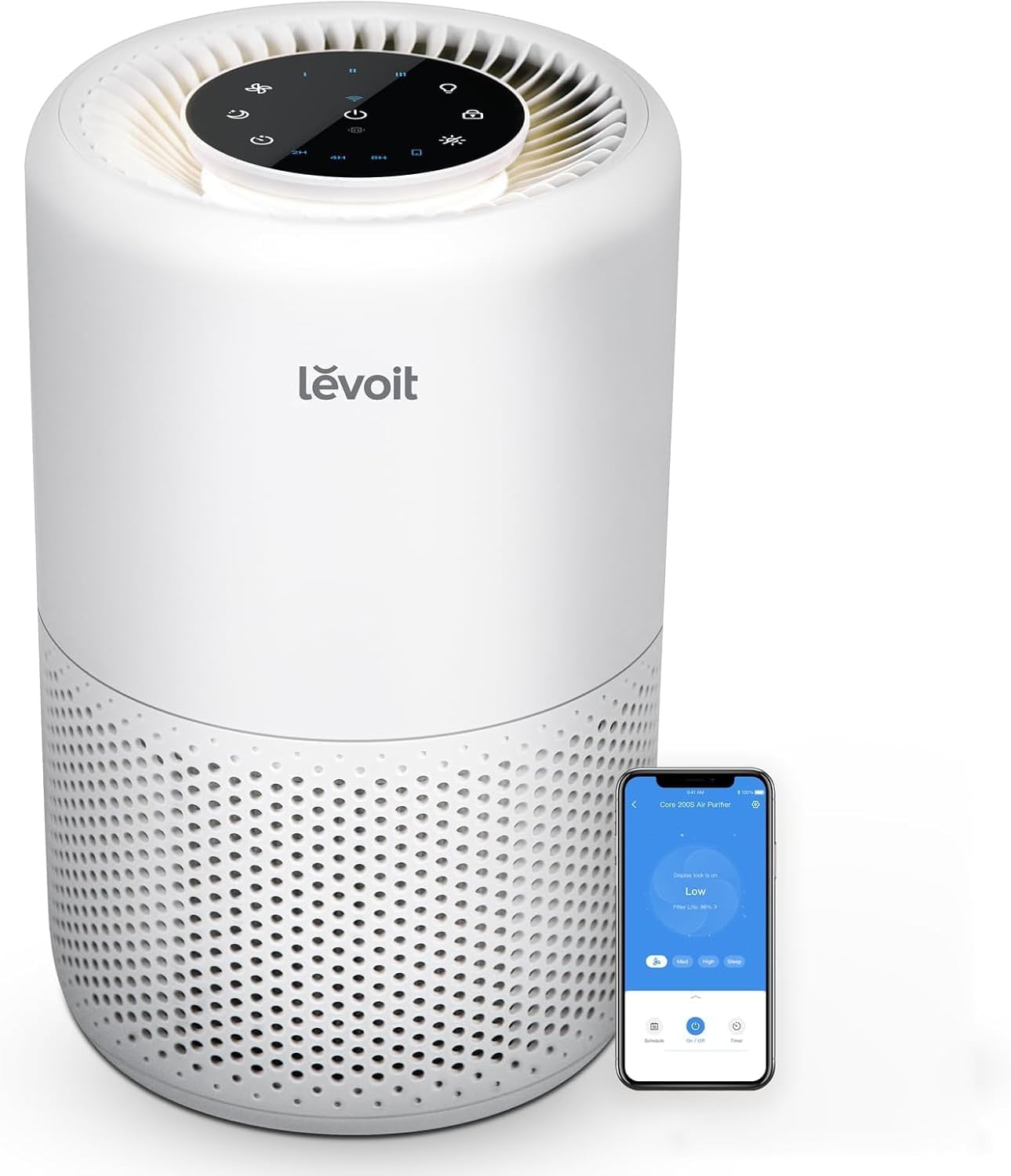
| Item model number | Core 200S |
|---|---|
| Manufacturer | Levoit |
| Air cleaning coverage | 140 ft² (refreshes air 4.8×/hour) |
| Filtration | Nylon pre-filter, activated carbon, HEPA-grade main filter |
The Levoit Core 200S-P is a small-room air purifier that combines a nylon pre-filter, activated carbon layer, and a HEPA-grade main filter to remove particles, odors, and many airborne contaminants. It pulls air through a 360-degree intake and is rated to refresh the air in a roughly 140 sq ft room multiple times per hour, which makes it useful for bedrooms, nurseries, and offices. Smart and voice controls plus an app that monitors filter life make routine maintenance straightforward, and a low-noise sleep mode keeps operation unobtrusive at night. The activated carbon helps with smells and VOCs while the main filter captures particles down to 0.1–0.3 microns at 99.97 percent efficiency, offering meaningful reduction of dust, pollen, dander, and many respiratory aerosols. It is not a medical sterilizer and does not claim to actively inactivate viruses the way UV-C or ionizing systems do, so expect particle removal rather than direct disinfection. For everyday indoor air quality and allergen control in small spaces, the Core 200S-P is an effective, easy-to-use option.
Best for: Buyers who prioritize dependable, low-maintenance particle and odor removal in bedrooms or small living spaces and want smart controls to track filter life.
Less Ideal for: People who need whole-house coverage or who require an air system that actively disinfects microbes rather than removing particles.
- Three-stage filtration (pre-filter, activated carbon, HEPA-grade main filter) for particles and odors
- Smart app and voice control with filter-life monitoring for easy maintenance
- 360-degree air intake and rated to refresh air in ~140 ft² repeatedly per hour
- Quiet Sleep Mode with noise levels reported as low as 27 dB
- Designed for small rooms and not suitable for larger open-floor spaces
- Does not actively inactivate microbes like dedicated UV-C or ionizing disinfecting systems
Verdict: A reliable, quiet small-room purifier with smart controls and HEPA-grade filtration for dependable particle and odor reduction.
Levoit Core 300-P

| Filter Type | 3 in 1 Filtration |
|---|---|
| Noise Level | 24 db |
| Wattage | 56 watts |
| Particle Retention Size | 0.3 micron |
| Floor Area | 1073 square_feet |
The Levoit Core 300-P is a compact, plug-in HEPA air purifier intended for bedrooms, home offices, and other small-to-medium rooms. It uses a 3-stage original filter (pre-installed) and a 56W motor to deliver a CADR that refreshes a 222 ft² room multiple times per hour and a 1,073 ft² room once per hour, while removing smoke, dust, pollen, pet dander, and VOCs. Controls are touch-based with a sleep mode that drops noise to about 24 dB and a display-off option for overnight use. Practical benefits include genuine Levoit replacement filters for sustained performance and AHAM verification plus CARB and ETL certifications for safety. Limitations are that smart Auto Mode is not available on this model (it requires manual fan speed changes) and the stated coverage is based on Levoit's original filters, so performance may vary with third-party cartridges. Filters also need regular replacement every 6 to 8 months depending on use and air quality.
Best for: Buyers who prioritize proven filtration performance and safety certifications and who want a quiet, easy-to-run purifier for bedrooms and living spaces backed by strong user feedback.
Less Ideal for: People seeking Wi‑Fi connectivity or automatic sensor-driven fan control or those who need a permanently unattended whole-house solution.
- True HEPA-grade filtration tested to capture 99.97% of 0.1–0.3µm particles
- AHAM verified CADR ratings with CARB and ETL safety certifications
- Very quiet Sleep Mode (around 24 dB) and option to turn display lights off
- Compact, portable design fits bedrooms and small living spaces
- Includes pre-installed 3-stage original filter and simple touch controls
- No smart Auto Mode on this model so fan speeds must be adjusted manually
- Performance claims are tied to Levoit original filters; third-party filters may not match results
Verdict: A compact, AHAM-verified HEPA purifier that reliably cleans bedroom and small-room air with whisper-quiet sleep operation and proven filtration performance.
VOOPNU H13 HEPA Air Purifier DH-JH12

| Filtration | H13 True HEPA triple-layer |
|---|---|
| Coverage (manufacturer) | Up to 1,076 ft² (laboratory tested) |
| Noise | As low as 22 dB |
| Speeds | 3 fan speeds |
The VOOPNU DH-JH12 is a small, simple-to-use air purifier that uses an H13 true HEPA triple-layer filter and 360 degree intake to capture fine particles, pet hair, pollen, smoke, and odors. It is intended for continuous daily use and is rated by the manufacturer to clean about 250 sq ft every 15 minutes, covering up to roughly 1,076 sq ft per hour in laboratory conditions. Controls are pared back to a few buttons for three fan speeds and a timer, making it easy to operate without complicated setup. Notable extras include an essential oil tray and a low-noise mode that claims operation as quiet as 22 dB for bedroom use. The unit is compact and easy to place on a desk or corner, and it carries multiple safety and efficiency certifications. Limitations are that real-world coverage will vary with room layout and pollutant levels, replacement filters are required on a schedule, and small tabletop form means it relies on continuous operation rather than one-shot heavy-duty scrubbing for very polluted spaces. For someone seeking straightforward, certified HEPA filtration with quiet operation, this model performs well.
Best for: Buyers who prefer a low-risk, easy-to-use purifier with certified HEPA filtration and quiet operation for regular, continuous use in living rooms or bedrooms.
Less Ideal for: Homes that need industrial-strength, rapid cleanup of heavy smoke, construction dust, or very large open-floor plans should consider larger commercial-grade units instead.
- H13 true HEPA triple-layer filtration captures fine particles down to 99.97% efficiency
- 360 degree intake and manufacturer CADR-style claim for rapid area turnover
- Very quiet operation down to 22 dB suitable for bedrooms
- Simple controls and timer for easy, low-effort daily use
- Essential oil tray lets you add scent without interfering with filtration
- Compact design means peak performance depends on continuous runtime and room layout
- Requires periodic filter replacements to maintain stated efficiency
Verdict: A compact, certified H13 HEPA purifier that gives cautious buyers quiet, easy continuous filtration for bedrooms and living spaces.
Choosing the Right Air Purifier for Bacteria and Viruses: Key Factors to Consider
Filtration Technology
The core capability for reducing bacteria and viruses is the filtration stage. True HEPA filters capture very small particles down to the submicron range and are the baseline for particle removal. Some units pair HEPA with prefilters to trap larger dust and activated carbon layers to remove odors and some volatile compounds.
Supplemental technologies can help but should be evaluated cautiously. Ultraviolet germicidal irradiation and photocatalytic oxidation may inactivate microorganisms when properly engineered, but effectiveness depends on UV intensity, exposure time, and system design. Avoid relying on ionizers or ozone-generating approaches as primary defenses because they can produce byproducts and often lack consistent pathogen-reduction proof in real rooms.
Airflow and Room Coverage
A high-efficiency filter matters little if the purifier cannot move enough air to clean the space. Look for CADR values or manufacturer guidance that match the room size where you plan continuous operation. Higher CADR means faster air turnover and quicker reduction of airborne load, which is especially important in higher-risk areas like bedrooms or shared living spaces.
Also consider placement and circulation patterns. Purifiers work best when positioned to draw air from polluted zones and when nothing blocks intake or exhaust. For open-plan areas, a single large-capacity unit often outperforms multiple undersized units.
Noise and Daily Use
If you plan to run a purifier for long periods, noise becomes a practical limitation. Manufacturers often list decibel levels by fan speed; compare those figures to your tolerance. Lower noise at the speeds required for effective air changes is ideal. Night modes or quiet presets let you keep the device operating while you sleep without sacrificing too much airflow.
Consider also how intuitive controls and scheduling features support continuous operation. Units that are easy to program or that integrate with smart home systems make it simpler to maintain recommended run times for pathogen reduction.
Maintenance and Filter Replacement
Regular filter changes are essential to sustain pathogen reduction performance. Check expected filter lifespans and how easy the replacements are to install. Lifetime varies with usage and local particle load; heavily used devices will need parts changed sooner. Ongoing costs include replacement filter price and any optional antimicrobial or activated carbon cartridges.
A clear indicator or timer for filter replacement helps avoid degraded performance. Also evaluate how messy or fussy filter swaps are, especially if you have allergies or are replacing filters in a sensitive area.
Safety and Byproduct Risk
Certain active technologies can create unintended chemical byproducts. For buyers focused on biological contaminants, prioritize approaches that do not introduce ozone or other reactive gases. Ensure any germicidal additions are isolated from airflow paths where byproducts could be distributed into occupied space.
Look for independent test data or third-party certifications that demonstrate safe operation at normal settings. Safety matters both for occupants with respiratory sensitivities and for long-term continuous operation.
How HEPA Works Against Microbial Particles
True HEPA filters remove particles through a combination of interception, impaction, and diffusion. Although bacteria and many viral particles are smaller than the nominal HEPA rating, they are typically carried on droplets or aerosolized clusters that HEPA media can trap effectively.
Understanding the physical capture mechanisms helps set realistic expectations: HEPA reduces airborne load rather than sterilizing a room. Consistent runtime and adequate air changes are what translate filter efficiency into meaningful reductions in exposure risk.
- HEPA targets particles, including bioaerosols attached to droplets
- Filter performance depends on airflow and runtime, not just media rating
- HEPA reduces exposure risk; it does not sterilize surfaces
Supplemental Technologies: UV and Thermal
Some purifiers incorporate ultraviolet germicidal lamps or thermal inactivation zones to inactivate microbes that pass through the airflow path. When these elements are well-designed, they add a second line of defense beyond particulate capture.
Effectiveness depends on exposure intensity and the time air spends in the treatment zone. Models that push air through too quickly will not allow sufficient UV exposure, so pairing these features with appropriate fan speeds and flow paths is critical for any claimed benefit.
- UV is an inactivation method, not a filter
- Exposure time and lamp intensity determine effectiveness
- Design matters: placement and airflow rate are crucial
Placement and Real-World Use
Place purifiers away from walls and obstructions to allow free intake and exhaust. For bedrooms, position units to pull air across the breathing zone while you sleep. In open living areas, central locations that promote circulation are best.
Operating schedule is also important. For pathogen reduction, aim for continuous low-to-moderate operation rather than intermittent bursts. Use higher fan speeds when a room is occupied by multiple people or during activities that increase aerosol generation.
- Avoid placing units directly against furniture or curtains
- Run continuously at a moderate setting for steady reduction
- Boost airflow temporarily during gatherings or higher-risk periods
Interpreting CADR and Manufacturer Claims
Clean Air Delivery Rate or equivalent airflow coverage numbers are useful but sometimes presented under ideal conditions. Compare CADR to the square footage and ceiling height of your space to estimate realistic air changes per hour.
Be cautious with broad claims about eliminating pathogens. The most reliable indicators are specific capture rates, third-party testing, and clear specifications for room size and runtime that match your intended use.
- Match CADR to room volume for realistic expectations
- Prefer transparent test data over vague performance language
- Higher CADR shortens the time to reduce airborne concentrations
Maintaining Performance Over Time
Keep intake and exhaust areas free of dust build-up and replace prefilters as recommended. Clogged filters reduce airflow and can negate the benefits of high-efficiency media. Regular exterior cleaning also prevents re-entrainment of settled particles.
Track replacement schedules and set reminders. If your unit includes washable prefilters, follow manufacturer cleaning steps to avoid damaging downstream HEPA media. Proper maintenance ensures the purifier continues to reduce microbial load effectively.
- Clean prefilters and exterior grilles regularly
- Replace HEPA and activated carbon cartridges per guidance
- Monitor airflow and noise as signs of maintenance need
How We Chose the Best Air Purifier for Bacteria and Viruses
We selected products that demonstrate specific design choices and features suited to reducing airborne bacteria and viruses. Our evaluation focused on measurable filtration performance, verified by manufacturer capture ratings or standardized test claims; airflow and coverage as expressed by CADR or equivalent room-size guidance; and the presence of technologies that complement true HEPA filtration without creating harmful byproducts. We also considered long-term usability factors: filter replacement intervals and costs, unit noise at typical operating speeds, and control options that support continuous or scheduled use. Durability and build quality were assessed via materials and warranty coverage information. Units lacking a true HEPA stage or those relying solely on unproven single-technology claims were excluded. The shortlist favors balanced designs that combine high particle capture, sufficient airflow for realistic room sizes, and manageable upkeep so buyers can maintain continuous pathogen-reduction performance over time.
Our full evaluation process is outlined in our review methodology.
FAQ
Can an air purifier completely prevent viral infections indoors?
No. Air purifiers reduce airborne concentrations of particles that can carry viruses, lowering exposure risk, but they do not eliminate all transmission routes. Combining filtration with ventilation, masking in high-risk settings, and surface hygiene provides better overall protection.
Is a true HEPA filter necessary to reduce bacteria and viruses?
True HEPA filtration is the most reliable baseline for capturing aerosolized particles associated with bacteria and viruses. Other technologies can supplement HEPA, but units without a true HEPA stage should be scrutinized for real-world effectiveness.
How long should I run an air purifier to reduce pathogens effectively?
Continuous operation at a moderate fan speed yields the best steady-state reduction. For faster reductions, increase airflow temporarily to achieve more air changes per hour. Runtime needs depend on room size, occupancy, and the device's CADR.
Are UV or ionizer features worth the extra complexity?
UV can add inactivation potential when integrated with appropriate exposure time and safety controls. Ionizers and ozone-generating approaches carry tradeoffs and may produce byproducts, so evaluate independent safety data before relying on those features.
How often should filters be replaced when targeting microbial control?
Replacement intervals vary with use and local particulate load but follow manufacturer guidance as a minimum. Expect to replace prefilters more often and HEPA cartridges less frequently; setting reminders based on runtime helps maintain consistent performance.
Final Verdict
Prioritize units that combine a true HEPA stage with sufficient airflow for the room you intend to protect. Filtration efficiency and airflow determine how quickly airborne bacteria and viruses are reduced, while noise, controls, and maintenance shape how easy it is to run the purifier continuously. Expect tradeoffs between ultra-quiet operation and rapid air changes; choose a model that balances those according to the space and the level of continuous protection you need. In short, focus first on filtration and coverage, then factor in upkeep and daily usability. That approach will help you select an air purifier that meaningfully lowers airborne pathogens without creating new complications for daily life.