
Note: This article contains affiliate links. If you click on these links and make a purchase, we may earn a small commission at no extra cost to you. This helps support our research and content. Read our full affiliate disclosure here.
If you suspect black mold in your home, choosing the right air purifier matters for immediate relief and ongoing control. An effective purifier can cut airborne mold spores, reduce musty odors, and ease respiratory symptoms while you address the underlying moisture problem. This guide shortlists seven top air purifiers for black mold and explains the practical criteria we used to evaluate them, including filtration efficiency, room coverage, and ease of maintenance. Use the explanations below to match a purifier to the affected room size and the severity of contamination, then review the shortlisted options for the best fit.
Top Picks at a Glance
| Best Overall The best all-around choice for most situations | WINIX AT40 Air Purifier |  |
| Best Quality Built to a higher standard if you want something more solid | AirDoctor AD3500 Air Purifier |  |
| Best Value The sweet spot between price and what you get | GermGuardian AC4825E 22" Tower Air Purifier |  |
| Best Budget The cheapest option that still gets the job done reliably | Purivortex PX500 Air Purifier |  |
| Top Rated A top-rated pick with lots of positive feedback | Levoit Core 300-P |  |
| Most Popular A crowd favorite that many people choose with confidence | Levoit Vital 100 Air Purifier |  |
| Best Seller A high-volume bestseller chosen again and again | WINIX 5520 Air Purifier |  |
WINIX AT40 Air Purifier

| Coverage (AHAM) | Up to 1,968 sq ft in 1 hour |
|---|---|
| Filtration stages | 4-stage system with True HEPA and PlasmaWave |
| Connectivity | Wi‑Fi with Winix Smart App |
| Included filters | 2 360° All-in-One True HEPA filter sets |
The WINIX AT40 is a 360° 4-stage air purifier built to clean large rooms quickly while giving continuous feedback on indoor air. It uses a combined True HEPA and carbon-style all-in-one filter plus Winix PlasmaWave technology to capture very small particles and help reduce airborne pollutants, and a smart sensor drives an air quality display that switches fan speed automatically in Auto mode. Wi‑Fi connectivity and the Winix Smart App let you monitor air quality and track filter life remotely, while Sleep mode keeps noise and power draw low overnight. The unit is AHAM-verified for high clean-air delivery over wide floor areas and includes two filter sets for up to two years of filtration out of the box. Expect strong particle removal for pollen, dust, pet dander, and mold spores, though PlasmaWave is an adjunct technology and not a substitute for professional mold remediation when there is active mold growth in walls or HVAC. The AT40 is straightforward to operate and maintain, but replacement filters are required on schedule to keep peak performance.
Best for: Buyers who want a simple, smart air purifier that cleans large living spaces and provides continuous air quality feedback with remote app control.
Less Ideal for: People needing a remediation tool for active structural mold infestations or those seeking a passive, maintenance-free solution.
- 360° four-stage True HEPA filter captures very small particles down to 0.01 microns
- AHAM-verified CADR performance for rapid cleaning of large rooms
- Built-in air quality sensor with color display and automatic fan adjustment
- Wi‑Fi and app control for remote monitoring and filter life tracking
- Includes two filter sets for up to two years of use out of the box
- PlasmaWave is supplemental and does not replace professional mold remediation when mold growth is structural
- Relies on periodic replacement filters to maintain verified performance
Verdict: Pick the WINIX AT40 if you want a powerful, app-connected purifier that reliably clears large rooms and continuously reports air quality.
AirDoctor AD3500 Air Purifier

| Model | AD3500 |
|---|---|
| Coverage | Up to 2,520 ft2 |
| Particle capture | 99.99% at 0.003 microns |
| Fan speeds | 4 speeds + Auto/Boost |
The AirDoctor AD3500 is a floor-standing purifier built for high-performance cleaning in large rooms and open plans. It combines a three-stage system—a pre-filter, premium activated carbon/VOC media, and an UltraHEPA filter rated to capture 99.99% of particles down to 0.003 microns—to tackle dust, smoke, pet dander, pollen, and gaseous pollutants. In everyday use the unit runs on four fan speeds, offers an Auto mode driven by PM2.5 sensors with a Halo quality indicator, and has a Boost function for rapid cleanups; the brand says it can cycle 630 ft2 in 15 minutes and up to 2,520 ft2 in an hour. Practical benefits include strong particulate removal for mold spores suspended in air and dedicated carbon media for odors and VOCs from damp environments. The design emphasizes quiet operation for continuous overnight running. Consider that replacement schedule and filter costs matter: carbon should be replaced about every six months and the UltraHEPA annually to maintain peak performance, and the unit is a substantial floor appliance in footprint and weight.
Best for: Buyers who prioritize measurable, high-efficiency particulate and gas removal in large rooms and want a purifier that can run continuously with automatic air-quality control.
Less Ideal for: People who need a compact, lightweight unit for small bedrooms or those who want a filter-free, maintenance-minimal solution should look elsewhere.
- Very high-efficiency UltraHEPA captures ultrafine particles down to 0.003 microns
- Premium activated carbon/VOC stage targets gases, odors, and smoke
- Large-area CADR-style performance that can cycle spaces up to 2,520 ft2
- Auto mode with PM2.5 sensing and a visible Halo air-quality indicator for hands-off operation
- Quiet operation suitable for overnight use
- Regular replacement of carbon and UltraHEPA filters is required to sustain performance
- Large physical footprint and weight make it less portable
Verdict: If you need a high-performance purifier for large spaces that combines ultra-fine particle removal with activated carbon for gases and odors, the AirDoctor AD3500 delivers targeted, science-backed cleaning.
GermGuardian AC4825E 22" Tower Air Purifier

| Coverage rate | 153 sq. ft. per 12.5 minutes; up to 743 sq. ft. per hour |
|---|---|
| Filter type | True HEPA with activated carbon pre-filter |
| Fan speeds | Three speeds including sleep mode |
| Optional feature | UV-C light |
The GermGuardian AC4825E is a compact tower air purifier built around a True HEPA filter, an activated carbon pre-filter, and an optional UV-C sanitizer to reduce airborne particles, odors, and some microbes. It is typically placed in bedrooms, living rooms, or basements where it runs continuously on one of three fan speeds; the manufacturer states it cycles air in a 153 sq ft room every 12.5 minutes and can serve larger spaces on a slower turnover. The HEPA filter captures very small particles down to 0.1 microns, while the carbon layer helps reduce cooking and pet scents. The optional UV-C lamp adds a sanitizing element for air passing through the unit. Practical features include straightforward controls, a quiet sleep mode for night use, and compatibility with a range of factory replacement filters and bulbs for easy maintenance. Limitations are that UV-C effectiveness depends on exposure time and the purifier is not a substitute for addressing underlying mold sources or high humidity; heavy mold outbreaks require remediation rather than an air cleaner alone.
Best for: Buyers looking for a reliable, easy-to-maintain HEPA tower purifier to reduce airborne mold spores, allergens, and household odors in bedrooms, basements, or living spaces who prioritize continuous filtration and simple upkeep.
Less Ideal for: People needing to treat active mold growth, very large open-plan spaces without multiple units, or those who depend solely on air cleaning instead of moisture control and structural remediation.
- True HEPA filter captures particles as small as 0.1 microns for effective allergen removal
- Activated carbon pre-filter reduces common household odors and VOC-related scents
- Optional UV-C light provides additional in-line sanitizing for air passing through the unit
- Three fan speeds including a quiet sleep mode for overnight use
- Compatible with multiple factory replacement HEPA and carbon filters for easy maintenance
- Not designed to remove mold growing on surfaces or to replace mold remediation and humidity control
- UV-C effectiveness is limited by air contact time and does not neutralize all biological hazards instantly
Verdict: A straightforward, well-supported HEPA tower purifier that provides continuous particle and odor reduction and simple maintenance—useful as part of a practical strategy to reduce airborne mold spores when combined with humidity control and remediation.
Purivortex PX500 Air Purifier

| Coverage Area | Up to 880 sq.ft |
|---|---|
| Filtration | Pre-filter, HEPA, Activated carbon |
| Particle Size | Filters down to 0.1 microns |
| Fan Modes | Sleep/Low/Med/High |
The Purivortex PX500 is a tower-style HEPA air purifier built to move a lot of air quickly for its size. It uses a three-layer system — pre-filter, HEPA, and activated carbon — and a taller 6-inch filter to capture particles down to 0.1 microns while also reducing light household odors. In practice the PX500 is used in living rooms or large open areas where fast turnover matters; the manufacturer claims it can clean up to 880 sq ft in one hour and a 215 sq ft room in about 15 minutes under test conditions. Controls are straightforward with four fan speeds, three timers, and four night-light modes including a sleep setting for quieter operation. Safety and compliance certifications are included and the unit carries a two-year warranty. Important limitations: it targets airborne particles and VOCs but will not remove entrenched mold growth on surfaces or address moisture sources, and real-world coverage depends on room layout and ventilation. For buyers watching their budget, the PX500 balances strong airflow and a larger-than-average filter with an accessible feature set.
Best for: Buyers on a budget who want a high-airflow HEPA purifier for larger rooms and fast particle removal without premium smart features.
Less Ideal for: People seeking a whole-home solution, moisture control, or equipment specifically for remediating active mold infestations should look at dehumidifiers or professional mold remediation instead.
- Three-layer filtration including HEPA and activated carbon for particles and light odors
- Large 6-inch filter for higher air intake compared with similar-sized units
- Multiple fan speeds and timers plus sleep mode for flexible daily use
- ETL, FCC, and CARB certifications and a two-year warranty provide safety and peace of mind
- Does not address mold growing on surfaces or fix humidity issues that cause mold
- Real-world clean-air coverage can vary with room layout and ventilation
Verdict: For budget-minded buyers who need fast, large-room particle removal, the PX500 delivers strong airflow and a taller HEPA filter for effective airborne mold spore and particle reduction.
Levoit Core 300-P

| Power Source | ac |
|---|---|
| Filter Type | 3 in 1 Filtration |
| Floor Area | 1073 square_feet |
| Noise Level | 24 db |
| Wattage | 56 watts |
The Levoit Core 300-P is a compact room air purifier that uses a three-in-one filter (pre-filter, HEPA-grade filter, and activated carbon options) driven by a 56W motor to remove fine particles, pollen, dust, pet dander, smoke and odors. It is typically placed in bedrooms, living rooms, or home offices and can refresh air in a 222 ft² room nearly five times per hour and provide whole-room circulation for up to 1,073 ft² once per hour according to AHAM-verified figures. Practical features include touch controls, a sleep mode that lowers noise to 24 dB, a timer, and a filter indicator for maintenance. The unit is corded and CARB, EPA, and ETL certified for safe home use in the U.S. Limitations are that it requires manual fan-speed control on this Core 300-P model (no auto mode), and optimal performance depends on using genuine Levoit replacement filters and timely replacements every 6 to 8 months.
Best for: Buyers who prioritize a proven, certified purifier that reliably removes fine particulates and runs quietly at night, and who value simple controls and predictable maintenance.
Less Ideal for: Users who want automatic air-quality sensing, hands-off operation, or integrated smart features should look at models with Auto Mode and connectivity instead.
- AHAM-verified CADR with proven particle removal rates for smoke, dust, and pollen
- Three-stage filtration with HEPA-grade performance capturing 0.1–0.3 micron particles at 99.97% efficiency
- Very quiet sleep mode rated at 24 dB for undisturbed nighttime use
- Simple touch controls, timer, and filter change indicator make routine operation easy
- Certified to CARB, EPA, and ETL standards for safe indoor operation in the U.S.
- No automatic air-quality sensing or auto mode on this Core 300-P model, so fan speed must be adjusted manually
- Performance depends on using Levoit original replacement filters and regular filter changes every 6–8 months
Verdict: A reliably quiet, AHAM-verified HEPA purifier that delivers proven particulate removal for homeowners focused on dependable, certified air cleaning.
Levoit Vital 100 Air Purifier

| CADR | 105 CFM |
|---|---|
| Coverage (one-hour air changes) | Up to 788 ft² |
| Noise level | As low as 24 dB |
| Filtration stages | 3-stage (washable pre-filter, particle filter, activated carbon) |
The Levoit Vital 100 is a compact three-stage air purifier built for everyday home use in bedrooms, living rooms, and kitchens. It pairs a washable pre-filter with a particle filter and activated carbon to capture hair and large debris, remove dust and pollen, and adsorb odors and some VOCs. With a reported CADR of 105 CFM and AHAM verification, it can cycle the air in modest rooms quickly, and the low-noise mode (around 24 dB) makes it suitable for overnight use. Controls are simple, including a 2/4/8-hour timer and a display-off option for sleep. Practical benefits include the washable pre-filter that reduces replacement frequency and a carry handle that makes it easy to move between rooms. Limitations are that the unit is sized for small to medium rooms rather than whole-house treatment, and while the carbon stage reduces many odors and VOCs, very heavy mold infestations or continuous high humidity require source remediation and dehumidification rather than an air purifier alone.
Best for: Buyers who prioritize proven performance and quiet, easy-to-use equipment to improve indoor air in bedrooms or living spaces and who value social proof from verified performance claims.
Less Ideal for: Homes with active, widespread mold infestations, very large open-plan areas, or situations that require humidity control rather than particle and odor removal.
- Three-stage filtration including washable pre-filter, particle filter, and activated carbon for odors and VOCs.
- AHAM-verified performance with a 105 CFM CADR for responsive air cleaning in small to medium rooms.
- Very low noise operation around 24 dB for bedroom or overnight use.
- Timer and display-off controls plus a carry handle for easy placement and quiet night use.
- Not designed to address severe mold growth at the source or to control humidity.
- Filter replacement (non-pre-filter stages) required periodically and genuine Levoit filters are recommended.
Verdict: Choose the Vital 100 when you want a quiet, AHAM-verified purifier that reliably reduces particles and odors in bedrooms and small to medium rooms.
WINIX 5520 Air Purifier
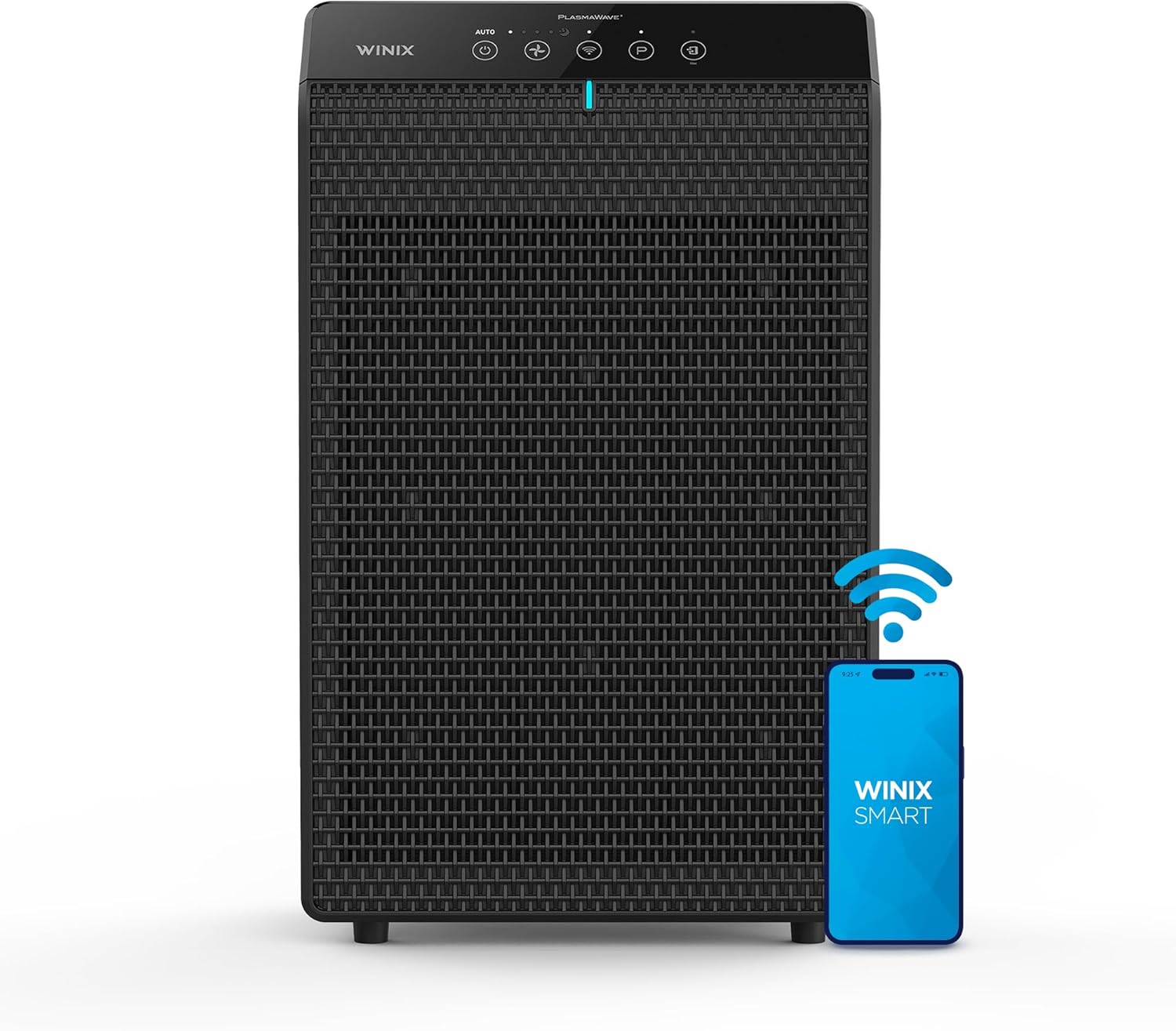
| Model | 5520 |
|---|---|
| AHAM Verified Coverage | 392 sq ft (CADR basis) |
| Noise (lowest) | 23.5 dB |
| Connectivity | Wi‑Fi / Winix Smart App |
| Filtration stages | 4-stage (pre-filter, True HEPA, carbon, PlasmaWave) |
The WINIX 5520 is a four-stage air purifier built to remove very small particles and household odors in larger rooms. It uses a washable pre-filter, a True HEPA stage that captures particles down to 0.01 microns, and an advanced carbon filter to reduce VOCs and smells, while PlasmaWave technology adds an extra layer of pollutant breakdown. Built-in smart sensors continuously monitor air quality and an LED indicator plus Auto Mode automatically adjusts fan speed, which makes it simple to run without constant input. The unit also supports Wi-Fi and the Winix Smart App for remote control, and Sleep Mode lowers noise and power use at night. Practical benefits include strong particle capture for allergy and mold-spore reduction, visible real-time feedback on air quality, and reduced odor from damp areas. Important limitations are typical for this class: it is a standalone room purifier so it only treats the air where it is placed, and filters will need periodic replacement and maintenance to retain peak performance.
Best for: Buyers who want a reliable, easy-to-use room purifier that continuously monitors air quality and reduces both fine particles and household odors in spaces prone to dampness or mold.
Less Ideal for: People who need whole-house HVAC-integrated filtration or those looking for a passive, maintenance-free solution that never requires filter changes.
- True HEPA filtration rated to capture particles as small as 0.01 microns
- Activated carbon stage for VOC and odor reduction in damp or musty rooms
- Smart sensors with LED air-quality indicator and Auto Mode for hands-off operation
- Washable pre-filter extends life of main filters and simplifies maintenance
- Wi-Fi app control and an automated sleep mode for quiet overnight use
- Designed for single-room use so multiple units are needed for whole-house coverage
- Filters require replacement over time and add to operating costs
Verdict: A dependable, sensor-driven room air purifier that combines high-efficiency HEPA capture and activated carbon odor control for buyers wanting steady, low-effort protection against mold spores and indoor pollutants.
Choosing the Right Air Purifier for Black Mold: Key Factors to Consider
Filtration Type and Particle Capture
The filter technology determines which particles the unit can remove. True HEPA filters capture at least 99.97% of particles down to 0.3 microns, which covers most mold spores and allergenic fragments. Look for multi-stage systems that combine a prefilter for large dust and a HEPA stage for fine spores.
An activated carbon stage is useful for reducing musty odors and volatile organic compounds that can accompany mold growth. Avoid relying on unproven technologies as the sole mitigation approach; filtration is the primary mechanism that physically removes spores from the air.
Room Size and Clean Air Delivery Rate
Match the purifier's CADR or recommended room size to the square footage where mold is present. CADR benchmarks how quickly a purifier can clean the air of particulates; in mold situations you typically want multiple air changes per hour to lower airborne spore counts faster.
If a unit's rated coverage is too small, it will run continuously without sufficiently reducing spore concentrations. Conversely, oversized units may cycle less frequently but still offer the benefit of rapid air turnover when needed.
Sealed Design and Leakage
A sealed airflow path ensures the air you draw into the purifier passes through the filtration media rather than leaking around it. Tight seals at filter fittings and a well-engineered cabinet prevent bypass, which can significantly reduce real-world filtration efficiency even if the filter media itself is high-performing.
When evaluating models, check for gasketed filter mounts and clear manufacturer guidance on replacement and installation to maintain a sealed system over time.
Noise Level and Continuous Operation
Because continuous or long-duration use is often necessary to control airborne mold, noise matters. Quieter units allow you to run higher fan speeds without disrupting sleep or daily life, improving overall effectiveness.
Look for published decibel levels at common fan speeds and consider whether a lower-speed setting still provides adequate CADR for the affected room. Some purifiers offer sleep modes that reduce noise while maintaining moderate filtration.
Filter Replacement and Maintenance
Even the best filter loses effectiveness if it becomes clogged or is improperly installed. Consider how easy it is to access and replace filters, the availability of replacement parts, and whether the unit has indicator lights or timers to signal when service is due.
Cost and frequency of filter replacement affect long-term usability. Also inspect whether the prefilter is washable and how straightforward routine cleaning of the exterior and intake grilles will be.
Operating Features and Controls
Practical controls like variable fan speeds, timers, and programmable schedules let you balance performance, noise, and energy use. Auto modes tied to particulate sensors can be helpful but verify what the sensor measures; many particle sensors detect dust but are less sensitive to mold fragments specifically.
Other useful features include lockable controls for households with children, remote control or app connectivity for convenience, and energy-saving certifications for long-term running costs.
How Air Purifiers Fit Into Mold Remediation
Air purifiers are a supplemental tool for reducing airborne mold spores and improving indoor air quality while you address the moisture source that allows mold to grow. They do not replace physical mold removal or repairs to plumbing, roofing, or ventilation that created the contamination in the first place.
Use purifiers as part of a broader remediation plan: run them continuously in affected rooms, combine with source control measures, and follow established protocols for cleaning or replacing contaminated materials. In occupied spaces, purifiers can reduce symptom triggers and lower the chance of spore spread to other rooms.
- Run continuously until remediation and repairs are complete
- Position the unit to promote whole-room circulation, not tucked away in a corner
- Combine with source elimination and cleaning for best results
Placement and Number of Units
Placement affects performance more than many buyers realize. Aim to place the purifier where airflow is unobstructed and between the suspected source and occupants if possible. Avoid placing units directly against walls or behind furniture where intake or outflow can be blocked.
Large or multi-room infestations may require more than one unit to produce adequate air changes. A single appropriately sized purifier may handle a single bedroom or living room, but basements and open-plan areas often benefit from dual units or a higher-capacity model.
- Center the unit in the room or near the primary source when possible
- Ensure at least 12 inches of clearance from walls for proper intake and exhaust
- Consider multiple smaller units for distributed coverage rather than one oversized unit in some layouts
When to Use High Fan Speeds and When to Slow Down
High fan speeds increase air changes per hour and reduce spore concentrations faster, making them useful during active remediation or immediately after disturbing contaminated material. However, they can be noisier and may stir dust if placed too close to the source.
Lower speeds are suitable for overnight use or when occupants need quieter conditions. Many buyers run a high speed for a set period after cleaning or during peak activity, then switch to a quieter setting to maintain a lower baseline spore concentration.
- Use high speeds during active cleanup or heavy occupancy
- Switch to low or auto modes for overnight or prolonged use
- Avoid repeatedly toggling speeds; allow the purifier to run uninterrupted for sustained effectiveness
Sensors, Indicators, and Real-World Performance
Built-in sensors that report particle counts can be helpful, but understand their limits. Many sensors detect dust and general PM2.5 levels rather than mold spores specifically, so sensor readings may not reflect mold spore concentrations directly.
Indicator lights and filter-change notifications help maintain performance, but also verify manufacturer guidance on sensor placement and calibration. In some cases a portable particle counter or professional testing is advisable to confirm remediation progress.
- Treat particle sensors as a guide, not a definitive mold detector
- Use filter indicators to keep maintenance on schedule
- Consider professional air sampling for persistent or severe infestations
Energy Use and Long-Term Running Costs
Continuous operation increases electricity consumption, so consider energy-efficient models and settings if you expect long-term use. Units with variable fan speeds, timers, and programmable schedules let you reduce runtime while maintaining effectiveness.
Check for energy certifications and compare wattage at typical operating speeds to estimate monthly costs. Factor in filter replacement frequency and cost when assessing long-term expenses.
- Estimate monthly energy based on continuous runtime at likely fan speeds
- Factor filter replacement costs into annual ownership expense
- Look for units with energy-saving modes or programmable schedules
How We Chose the Best Air Purifier for Black Mold
We focused on factors that directly affect how well an air purifier reduces airborne mold spore counts and improves indoor air in rooms affected by black mold. Primary filters and capture efficiency were required selection criteria, with preference for multi-stage systems that include true HEPA filtration because HEPA is the only commonly available filter class that reliably removes submicron particles and mold spores from the air stream. We also prioritized clean air delivery rate relative to room size so a unit can provide multiple air changes per hour in the space being treated. Other editorial filters included ease of filter replacement and maintenance, as frequent servicing affects long-term performance; noise levels at typical operating speeds, because sustained use matters for efficacy; and sealed airflow design to prevent bypass. We excluded units that rely solely on ozone generation or ionization without proven filtration, and we avoided purifiers that lack published CADR or HEPA-class filtration data. Finally, we considered energy use and run-time features because continuous operation is often necessary in mold cases.
Our full evaluation process is outlined in our review methodology.
FAQ
Can an air purifier remove black mold from surfaces?
No. Air purifiers reduce airborne mold spores but do not remove mold growing on surfaces. Surface mold must be cleaned or remediated and the moisture source corrected to fully address the problem.
Will running an air purifier stop mold from coming back?
Running a purifier lowers airborne spores but will not prevent mold regrowth if the underlying moisture problem persists. Long-term control requires fixing leaks, improving ventilation, or reducing indoor humidity in addition to filtration.
Are ionizers or ozone generators recommended for mold?
No. Ionizers and ozone generators can produce byproducts that are harmful at certain concentrations and are not a substitute for mechanical filtration. Choose units with true HEPA filtration and avoid relying solely on ozone-based devices.
How often should I replace filters when treating mold?
Filter replacement frequency depends on contamination level and runtime. In mold-affected rooms you may need to replace prefilters and HEPA filters more often than under normal conditions; monitor indicators and follow manufacturer guidance for heavy-use scenarios.
Can a purifier conceal a bigger mold problem by masking odors?
Some purifiers with activated carbon can reduce musty odors, but masking smells does not address the source. Persistent odors often indicate ongoing mold growth and should prompt inspection and remediation rather than relying solely on air cleaning.
Final Verdict
When addressing black mold, prioritize filtration efficiency and the appropriate room coverage to reduce airborne spores quickly. A true HEPA stage, sealed airflow, and sufficient CADR for the affected space are the most important attributes, while noise, ease of maintenance, and continuous-operation features determine practical usability. Balance immediate air-cleaning needs with a plan to eliminate the moisture source and perform proper remediation. Choose a purifier sized for the room, commit to running it regularly during cleanup, and maintain the filters to ensure sustained performance.