
Note: This article contains affiliate links. If you click on these links and make a purchase, we may earn a small commission at no extra cost to you. This helps support our research and content. Read our full affiliate disclosure here.
If you live with cats, removing lingering urine odor is a distinct challenge that goes beyond basic dust and pet dander control. An air purifier for cat pee smell helps reduce airborne odor molecules and volatile organic compounds, making rooms feel fresher and less persistent with urine scent. Choosing the right unit matters because not every purifier is designed to capture the gases that cause the smell or to treat the right room size. This guide shortlists the top options across common home scenarios and explains how we judged filtration, odor removal, and airflow. The picks below represent units suited to different room sizes and homeowner priorities, each evaluated on concrete performance factors. Read on to find the purifier profile that best matches the spaces where odor control matters most.
Top Picks at a Glance
| Best Overall The best all-around choice for most situations | WINIX 5510 Air Purifier |  |
| Best Quality Built to a higher standard if you want something more solid | COWAY Mighty AP-1512HH |  |
| Best Value The sweet spot between price and what you get | GermGuardian AC4825E Tower Air Purifier |  |
| Best Budget The cheapest option that still gets the job done reliably | Honeyuan H13 HEPA Air Purifier |  |
| Top Rated A top-rated pick with lots of positive feedback | DREO Air Purifier 338 |  |
| Most Popular A crowd favorite that many people choose with confidence | Levoit Core Mini-P |  |
| Best Seller A high-volume bestseller chosen again and again | Levoit Vital 200S-P |  |
WINIX 5510 Air Purifier

| Item model number | 5510 |
|---|---|
| AHAM Verified coverage | 1,882 sq ft in 1 hour |
| Filtration stages | 4-Stage |
| Connectivity | WiFi / Alexa / Google Home |
The Winix 5510 is a large-room air purifier built around a 4-stage filtration system that pairs a True HEPA filter with an advanced carbon odor-control layer and a washable pre-filter. It is designed to cycle the air of very large spaces quickly and the included smart sensors plus an AQI indicator let the unit adjust fan speed automatically in Auto Mode. Practical benefits include strong capture of fine particles down to 0.01 microns, targeted reduction of VOCs and household odors from the carbon filter, near-silent operation in Sleep Mode, and remote control through the Winix Smart App. PlasmaWave technology is offered as an additional active component to help neutralize pollutants. The unit is AHAM verified and has a filter-replacement indicator to simplify maintenance, but like all carbon filters it will need periodic replacement to remain effective against persistent odors. The purifier is substantial in size, so placement and occasional filter costs are considerations for long-term use in multiroom homes.
Best for: Homeowners who want a capable, smart air purifier that handles large rooms and balances particle removal with active odor control for everyday household smells.
Less Ideal for: People needing a compact desktop unit for a single small room or those seeking a permanent chemical remediation solution for severe, embedded pet odor problems.
- True HEPA filtration captures very small particles down to 0.01 microns
- Advanced odor-control carbon filter reduces VOCs and common household smells
- Smart sensors with Auto Mode and AQI indicator simplify hands-off operation
- Winix Smart App, WiFi, and voice assistant support enable remote control
- Quiet Sleep Mode for low-noise overnight use
- Carbon filter effectiveness declines over time and requires replacement for continued odor removal
- Large physical footprint may limit placement in smaller rooms
Verdict: Choose the Winix 5510 when you need a smart, high-capacity purifier that pairs True HEPA particle removal with active carbon odor control for large rooms.
COWAY Mighty AP-1512HH

| Coverage | Up to 1,748 sq. ft. in 60 minutes |
|---|---|
| Filtration stages | Pre-filter, deodorization, bipolar ionizer, HEPA |
| HEPA effectiveness | 99.97% of 0.3μm particles |
| Filter lifespan | Up to 1 Year |
| Model number | AP-1512HH |
The Coway Mighty AP-1512HH is a room air purifier built around a four-stage system—washable pre-filter, deodorization/activated carbon layer, bipolar ionizer, and a true HEPA filter—that targets particles, odors, and some gases. It is commonly used in living rooms, bedrooms, or other medium spaces where continuous monitoring and automatic fan adjustments are useful; the unit's auto and eco modes modulate fan speed based on the pollution sensor and the bright air-quality LED gives an instant read on conditions. For pet owners dealing with urine odors, the activated carbon stage and advertised VOC reduction are the practical features that help reduce smell when paired with timely ventilation and cleaning of the source. The machine is easy to maintain thanks to a washable pre-filter and filter-replacement indicators, and a timer and quiet low-speed operation make overnight use feasible. Important limitations are that odor removal depends on carbon filter capacity and replacement schedule, and very strong or fresh pet odors may require higher-capacity or supplemental odor-specific filters and cleaning to eliminate the source effectively.
Best for: Buyers who prioritize measurable particle removal and an automatic, low-maintenance purifier that also offers basic VOC and odor reduction for everyday pet smells.
Less Ideal for: People who need an appliance to neutralize severe, long-standing pet urine contamination without treating the source or those who want a purifier with integrated ozone-free molecular/chemically targeted cartridges for heavy industrial smells.
- True HEPA filtration captures 99.97% of 0.3μm particles for allergens and fine particulates
- Activated carbon deodorization stage and third-party tested VOC reduction for improved odor control
- Auto and Eco modes with an air-quality sensor that automatically adjusts fan speed
- Washable pre-filter and filter indicator simplify maintenance and replacement tracking
- Compact footprint with timer and quiet low-speed operation suitable for overnight use
- Carbon filter capacity is finite so heavy or persistent odors need frequent replacement or specialized filters
- Bipolar ionizer offers added cleaning but may not substitute for targeted odor treatments
Verdict: Choose the AP-1512HH if you want a proven HEPA purifier with activated carbon and automatic sensing that reduces everyday cat odors while keeping allergens under control.
GermGuardian AC4825E Tower Air Purifier

| Room coverage claim | 153 sq. ft. per 12.5 minutes; up to 743 sq. ft. per hour |
|---|---|
| Filter type | True HEPA with activated carbon pre-filter |
| Fan speeds | 3 speeds (including sleep mode) |
| Optional feature | UV-C light |
The GermGuardian AC4825E is a compact tower purifier built around a True HEPA filter, an activated carbon pre-filter, and an optional UV-C light to reduce airborne particles and some odors. It is typically placed in bedrooms, living rooms, or basements and runs on three fan speeds including a quiet sleep setting for night use. The HEPA element captures 99.97% of particles down to 0.1 microns, which removes pollen, dust, and pet dander, while the activated carbon layer helps absorb cooking and pet scents. The unit is CARB and ETL certified and is compatible with a range of GermGuardian replacement Filter B cartridges and UV-C bulbs for straightforward maintenance. Practical benefits include simple controls, modest footprint, and measured room coverage rates that let you select placement to get a full air exchange in small rooms every ~12 minutes. Limitations are that carbon pre-filters on this model are relatively small compared with dedicated heavy-odor absorbers, so very strong or persistent odors like long-standing cat urine may require additional odor-specific filtration or source cleaning to fully eliminate smells.
Best for: Buyers who want a reliable, easy-to-use purifier that reduces airborne allergens and light pet scents in bedrooms or living areas and prefer straightforward maintenance and certified performance.
Less Ideal for: People dealing with persistent, strong urine odor or high VOC loads who need heavy-duty activated carbon or specialized odor-targeting filtration should consider units built specifically for odor removal.
- True HEPA filter captures most fine allergens and pet dander down to 0.1 microns.
- Activated carbon pre-filter reduces common household scents and light pet odors.
- Three fan speeds including quiet sleep mode for overnight use.
- Compact tower design fits small rooms and easy filter replacement with genuine GermGuardian parts.
- Carbon pre-filter is modest in size and may struggle with very strong or long-standing urine odors.
- No advanced smart features like air quality sensors or automatic speed adjustment.
Verdict: A practical, certified HEPA tower purifier that cuts airborne allergens and reduces light pet scents, making it a sensible option for improving air in rooms affected by cat odors when paired with source cleaning.
Honeyuan H13 HEPA Air Purifier

| Filter type | H13 True HEPA 3-Stage |
|---|---|
| Airflow | 90-120 m³/h |
| Fan speeds | 3 |
| Noise level | 24 dB (low) |
The Honeyuan H13 HEPA Air Purifier is a small, portable unit meant to clean room air using a 3-stage filtration system centered on an H13 True HEPA filter and 360 degree intake. It is typically placed in bedrooms, nurseries, or near problem areas and run on low or medium overnight or higher for quick clearing; the maker claims it can refresh air in a large area in about 30 minutes and delivers 90–120 m3/h CADR-equivalent flow. Controls are on an LCD touch display with three fan speeds, multiple timer options, sleep mode, and a filter replacement reminder for low-maintenance operation. Practical benefits include quiet low-speed operation down to about 24 dB, a DC motor that supports 100–240V, and safety certifications including UL, CE, FCC and CARB compliance. Limitations are typical for compact units: true coverage depends on room layout and pollutant load, replacement filters are required (replacement filter B0BHVPQHY8), and peak performance will need higher fan speeds and more frequent filter changes in homes with pets or heavy odors.
Best for: Buyers wanting an affordable, easy-to-use purifier to reduce pet odors and airborne particles in bedrooms or small living spaces who prioritize quiet operation and simple controls.
Less Ideal for: Homes needing whole-house odor control or rapid heavy-duty removal of strong, persistent smells should consider larger commercial-grade systems or multiple units instead.
- H13 True HEPA 3-stage filter for capturing fine particles and allergens
- 360 degree air intake for even room circulation
- Quiet operation down to 24 dB suitable for bedrooms
- LCD touch display with timers, sleep mode, and filter reminder for easy use
- Safety certifications (UL, CE, FCC, CARB) and universal 100–240V compatibility
- Replacement filters must be purchased separately and add ongoing cost
- Manufacturer coverage claims may vary in real rooms depending on layout and source strength
Verdict: A budget-friendly, bedroom-friendly HEPA purifier that provides quiet, certified filtration and easy controls for reducing pet odors and airborne allergens.
DREO Air Purifier 338

| CADR | 115 CFM |
|---|---|
| Filtration | Pre-filter + HEPA + Activated carbon |
| PM2.5 sensor | High-precision sensor with LED AQI (0–999) |
| Modes | Auto, Turbo, Sleep, Normal; 4 fan speeds |
| Energy | ENERGY STAR (~125 kWh/yr) |
The DREO Air Purifier 338 is a home HEPA purifier built to move air efficiently while tracking indoor particle levels. It uses a 3-in-1 filter (pre-filter, true HEPA, activated carbon) and a turbo intake with 360° spiral airflow to increase intake efficiency and deliver an AHAM-verified CADR of 115 CFM, useful for speeding removal of pollen, dust, smoke, and odors. A high-precision PM2.5 sensor and four-color LED AQI readout give clear, real-time feedback, and Auto Mode adjusts fan speed as air quality changes so it runs harder when needed and quieter otherwise. The unit includes Sleep and Turbo modes plus four fan speeds, and DREO's HyperSilent design keeps noise down to about 18 dB at the lowest setting. Practical advantages are straightforward controls, an aroma box option, and ENERGY STAR-rated efficiency, while limitations include its stated coverage assumptions and the need to replace filters periodically to maintain odor control performance.
Best for: Homeowners who prioritize dependable, measured air-cleaning performance and want automatic adjustment and quiet operation for daily living spaces, especially where persistent odors need active filtration.
Less Ideal for: People needing a solution for very large open areas or whole-house ventilation should consider larger hardwired systems or multiple units rather than a single tabletop purifier.
- AHAM-verified CADR (115 CFM) for measurable particle removal performance
- 3-in-1 filter with activated carbon to capture particles and help reduce odors
- Real-time PM2.5 sensor and RGB AQI display for easy air quality feedback
- Auto, Sleep, Turbo and multiple fan speeds for flexible, low-noise operation
- Continuous odor removal depends on timely replacement of the HEPA/activated carbon filter
- Coverage figures are given as ranges and depend on ACH assumptions rather than a single realistic room size
Verdict: Choose the DREO 338 when you want a reliable, AHAM-verified HEPA purifier with real-time air monitoring and automatic, quiet operation to tackle pet odors and airborne particles.
Levoit Core Mini-P
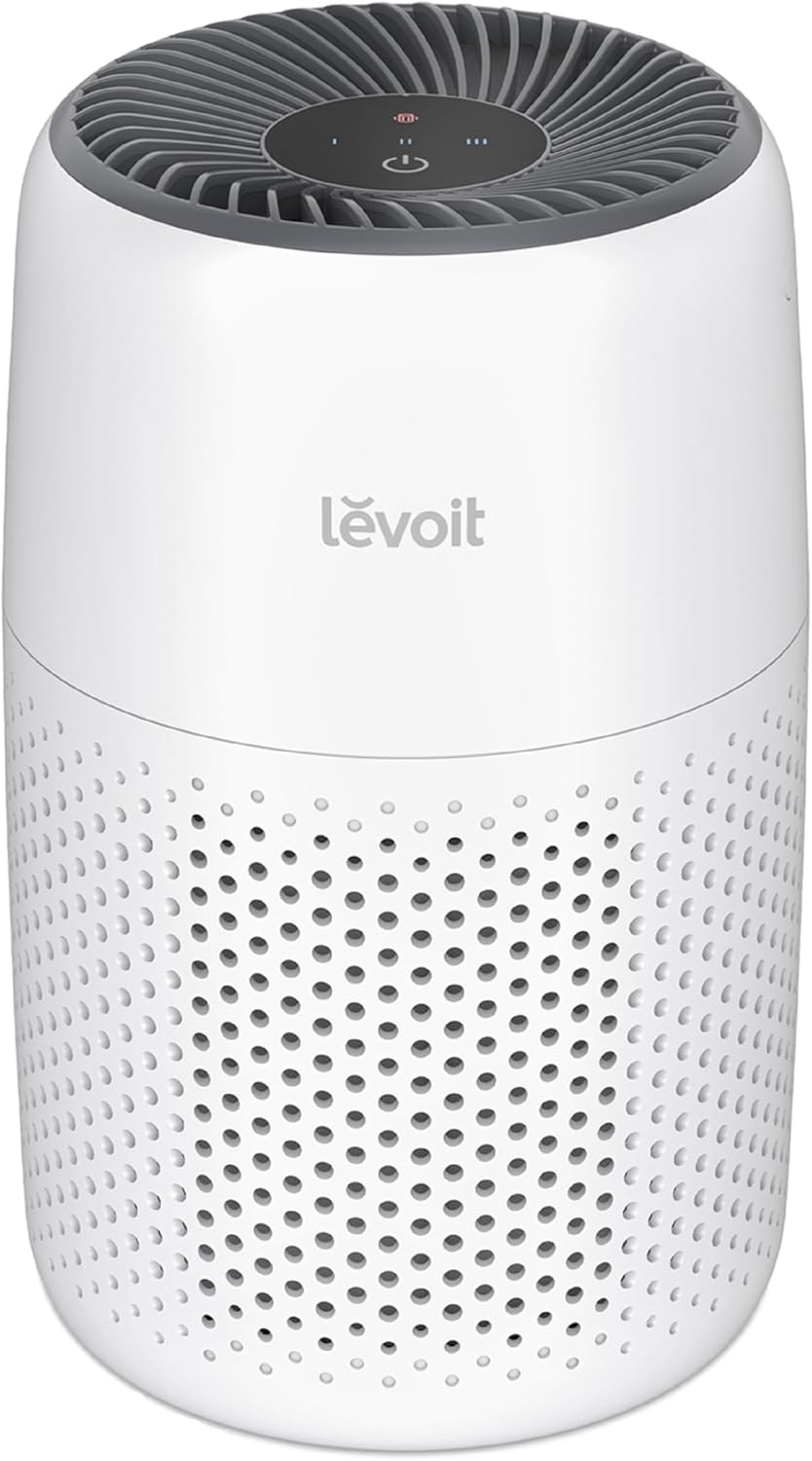
| Rated Power | 7W |
|---|---|
| Noise Level | 27–45dB |
| AHAM Verification | Yes |
The Levoit Core Mini-P is a small, plug-in air purifier intended for bedrooms, desks, and other tight spaces where pet smells and airborne allergens are a concern. It uses a pre-filter plus main filter to trap lint, hair, smoke and pet dander and includes a small aromatherapy sponge for light fragrance. The unit is quiet (27–45 dB) and has a sleep mode and auto-off display to minimize disturbance overnight, and it runs on low power (7 W) so it can stay on continuously. Its compact footprint and internal adapter make it easy to move between a bedroom, office, or near a litter area, but because it is sized for small rooms it will not replace a larger room purifier for whole-room odor elimination. Also the aromatherapy tray accepts only a few drops of oil and must be used sparingly to avoid damaging plastic parts. For buyers who want a well-reviewed, AHAM-verified small purifier to reduce pet odors and airborne particles near the source, this is a practical choice.
Best for: Buyers who prioritize proven, well-reviewed small purifiers to tackle pet odors and airborne dander close to the source and want a quiet unit suitable for bedrooms or near litter areas.
Less Ideal for: People needing whole-room odor removal in larger living areas or who want heavy aromatherapy use should consider larger-capacity purifiers or dedicated odor-absorbing solutions.
- Compact footprint for use on desks or nightstands
- AHAM-verified performance standard
- Very quiet operation suitable for sleep mode
- Low power draw (7 W) for continuous use
- Pre-filter plus main filter captures pet dander, hair, and smoke
- Designed for small rooms so limited effectiveness in larger spaces
- Aromatherapy tray accepts only minimal oil and can be damaged by overfilling
Verdict: A compact, AHAM-verified purifier built for quiet, continuous use near pet odor sources like litter areas or bedrooms.
Levoit Vital 200S-P

| Power Source | Corded Electric |
|---|---|
| Control Method | App |
| Filter Type | 3-Stage Filter |
| Floor Area | 1875 square_feet |
| Noise Level | 27 db |
The Levoit Vital 200S-P is a smart air purifier built to clean large living spaces up to 1875 sq ft using a three-stage filtration system that includes a washable pre-filter and an activated carbon layer for odors. It connects to an app for remote control and offers an air quality monitor and sleep mode that runs quietly at about 27 dB, making it suitable for bedrooms and shared rooms. The unit is AHAM certified with strong CADR figures for smoke, dust, and pollen, and a particle retention spec down to 0.1 micrometer, which helps with allergens and fine particulates. Practical benefits include fast whole-room circulation, replaceable specialized filters (pet allergy, toxin absorber, smoke remover) for targeted smells, and a washable pre-filter to catch hair and large debris. Trade-offs are its physical footprint and weight compared with compact travel purifiers and the need to buy replacement specialty filters for best odor removal rather than relying solely on the stock filter.
Best for: Buyers who prioritize reliable, certified whole-room cleaning and quiet overnight operation, especially in homes with pets where removing allergens and odor control are important.
Less Ideal for: People who need a tiny, portable purifier for very small spaces or who want the cheapest short-term solution for occasional odors.
- AHAM verified with high CADR ratings for smoke, dust, and pollen
- 3-stage filtration including activated carbon layer for odor adsorption
- App control and built-in air quality monitor for hands-off operation
- Very quiet sleep mode around 27 dB suitable for bedrooms
- Washable pre-filter captures pet hair and large particles to protect main filter
- Larger and heavier than compact travel-size purifiers
- Best odor removal may require purchasing specialized replacement filters
Verdict: A grounded, AHAM-certified whole-room purifier with quiet operation and dedicated carbon/filter options that make it a safe choice for tackling persistent cat urine odors in larger spaces.
Choosing the Right Air Purifier for Cat Pee Smell: Key Factors to Consider
Filtration Type and Activated Carbon Quality
The ability to remove cat urine smell depends heavily on chemical filtration rather than particle filtration alone. High-quality activated carbon or other dedicated adsorbent media are designed to bind and neutralize volatile organic compounds and odor-causing gases. Look for purifiers that list a high-carbon load, broad pore distribution, or supplemental odor-targeting media because these will adsorb more molecules before saturation.
Filter construction and how the media is arranged matter too. A larger carbon bed or layered media that forces more air through the adsorbent will generally perform better than a thin carbon coating. For sustained performance, understand whether the carbon is replaceable and how often it will need swapping based on your household odor sources.
Airflow Capacity and Room Coverage
A purifier's airflow rating or CADR-style metric determines how effectively it can exchange and treat the air in a given room. Odor molecules are gaseous and disperse quickly, so a unit that moves more air per hour will lower concentrations faster. Choose a purifier sized for the specific room where litter boxes or the primary odor source are located, and aim for multiple air changes per hour for noticeable improvement.
Placement affects effective coverage: situate the unit so airflow is not blocked by furniture and relatively close to the odor source when feasible. For open-plan homes, consider units with higher airflow or multiple devices rather than relying on a single small purifier.
Filter Life and Replacement Logistics
Adsorbent media become saturated over time and lose effectiveness at removing odors, so replacement cadence and cost are practical concerns. Longer-lasting filters reduce ongoing expense and maintenance time, while easy-to-find, modular replacements simplify upkeep. Check expected service life measured in months under typical household conditions and whether pre-filters are available to extend the life of carbon layers by capturing hair and dust first.
Also consider how straightforward the replacement process is. Filters that are user-serviceable and clearly labeled make regular maintenance less burdensome and help maintain consistent odor control performance.
Noise Output and Run Schedules
Owners often run purifiers continuously when dealing with persistent odors, so noise matters. Higher fan speeds produce stronger airflow but also more sound. Look for units with quiet low-speed operation suitable for nights and sleep, plus higher-speed modes for active odor events. Some purifiers offer automatic modes that balance noise and performance based on detected air quality, which can be helpful for keeping noise low while still responding to odor spikes.
Consider the typical rooms where you will place the purifier. Bedrooms and living rooms often require near-silent operation at night, while utility rooms may tolerate louder fans.
Controls, Placement Flexibility, and Sensors
Practical control options and placement flexibility influence real-world effectiveness. Timers, multiple fan speeds, and remote control or app integration make it easier to run the purifier when and where it is needed. Integrated odor or VOC sensors help automate responses to urine-related emissions, though sensors vary in sensitivity and may not detect low-level odors reliably.
Physical size, mounting options, and cord length determine where you can situate the purifier relative to the litter box or problem area. A unit that is easy to move or discreet enough for living areas will be used more consistently, improving long-term results.
Maintenance and Upkeep Practicalities
Beyond filters themselves, routine upkeep matters for sustained odor control. Pre-filter cleaning, interior dust removal, and periodic checks for media saturation keep a unit operating at peak performance. Consider how easy it is to access internal compartments and whether the manufacturer provides clear maintenance guidance.
If a purifier uses specialized media for odors beyond standard activated carbon, verify availability and lead times for replacement parts to avoid gaps in performance.
Why Cat Urine Odor Is Hard to Remove
Cat urine contains volatile organic compounds and ammonia that readily become airborne and adhere to fabrics, carpets, and porous surfaces. Because these molecules are gas-phase, they can circulate freely and persist unless they are chemically adsorbed or the contaminated materials are cleaned.
Air purifiers can help by capturing airborne particles and adsorbing odor molecules, but they are only part of the solution. Addressing source cleaning and litter-box hygiene is essential for long-term odor control; purifiers treat the air, not soiled materials.
- Urine gases can re-release from fabrics and carpets over time
- Air treatment reduces airborne smell but does not replace source cleaning
- Effective odor control combines filtration, ventilation, and cleaning
Best Placement Strategies for Odor Reduction
Placement influences how quickly a purifier can reduce localized smells. Position the unit so that intake faces the general direction of the litter area or known odor source without blocking airflow with large furniture.
If the smell originates in a confined room, place the purifier in that room and aim for a unit sized to the room area. For multiroom homes with scattered odors, smaller purifiers in multiple rooms or a single high-capacity unit in a shared space can be effective.
- Avoid corners and low-lying floor obstructions that limit intake
- Keep the unit within reasonable distance of the odor source for faster reduction
- Use higher fan speeds briefly after cleaning events, then return to quieter settings
When to Use Sensors and Automated Modes
Some purifiers offer VOC or odor sensors that trigger higher fan speeds when airborne gases rise. These can save energy and reduce noise by running quietly until an odor event occurs. However, sensor accuracy varies and may not detect subtle or intermittent smells reliably.
If you rely on automation, pair sensor-based use with scheduled manual boosts during times when litter boxes are cleaned or when guests are present. This hybrid approach balances convenience with consistent odor control.
- Automated modes help reduce runtime but validate sensor sensitivity in your environment
- Manual boosts are useful after deep cleaning or accidental accidents
- Combine sensors with routine filter checks to maintain performance
Cleaning and Source Control Best Practices
No air purifier will fully compensate for untreated soiled surfaces. Regularly clean litter boxes, promptly treat any accidents, and use enzyme-based cleaners on fabrics and carpets to break down odor-causing compounds. Washing or replacing heavily contaminated items is often necessary for long-term improvement.
Improve ventilation where possible by opening windows or using exhaust fans during cleaning. That reduces airborne concentrations and helps purifiers work more effectively.
- Use enzyme cleaners for fabrics and porous surfaces
- Wash or replace items soaked with urine when necessary
- Ventilate rooms briefly during and after cleaning to lower airborne odor load
Sizing a Purifier for Bedrooms, Living Rooms, and Basements
Room size dictates the minimum airflow you need. For bedrooms, quieter units sized to the square footage are best to avoid sleep disruption. Living rooms often require higher CADR or airflow to keep larger open areas fresh. Basements and poorly ventilated rooms may need powerful units or multiple devices to achieve adequate air changes.
When in doubt, prefer a unit rated for a slightly larger area than your room to ensure effective turnover and to allow running at lower, quieter fan speeds while maintaining performance.
- Match the purifier rating to room square footage for multiple air changes per hour
- Consider portable units for temporary problem areas
- Multiple small units can outperform a single undersized purifier in complex floor plans
How We Chose the Best Air Purifier for Cat Pee Smell
We prioritized devices that specifically address gaseous odors and fine particulates common with pet urine. Primary evaluation criteria included the presence and quality of chemical-targeting filtration, measured airflow and room coverage, and real-world maintenance needs. We also considered filter longevity and replacement cost as an owner-facing operating factor, plus practical noise levels that affect when and how people run purifiers in living spaces. Finally, we looked at control options and placement flexibility to ensure units can be used effectively near litter areas or in shared rooms. Exclusions: We excluded units that only offer particle filtration without any dedicated chemical or activated-carbon-based media because they cannot meaningfully reduce urine-related odors. We also excluded very low-airflow personal purifiers that lack the capacity to treat typical living rooms or bedrooms. The resulting shortlist balances measurable airflow and odor-adsorbing filtration with sensible upkeep and noise tradeoffs, producing recommendations that are useful for owners addressing cat urine smell in home environments.
Our full evaluation process is outlined in our review methodology.
FAQ
Can an air purifier remove the smell of old cat urine from carpets?
An air purifier can reduce airborne odor molecules but will not remove embedded urine compounds from carpets or fabrics. Cleaning the source with enzyme cleaners or replacing heavily contaminated materials is necessary for permanent removal. Use a purifier to reduce airborne spread while you treat the contamination.
Do HEPA filters remove cat pee smell?
HEPA filters capture particles like dander and dust but do not remove gaseous odor molecules effectively. For urine smells you need filtration media that targets VOCs, such as activated carbon or other chemical adsorbents in addition to HEPA.
How often should I run a purifier to control litter box odors?
Continuous operation at a low setting is common for persistent odors, with short boosts to higher speeds after litter changes or accidents. The exact schedule depends on room size and purifier capacity, but maintaining steady air changes helps keep airborne odors lower.
Are VOC sensors reliable for detecting cat urine odor?
VOC sensors can detect increases in airborne gases but vary in sensitivity and may not always register low-level or intermittent urine odors. They are useful for automation but should be supplemented with manual runs when you know odor events have occurred.
Will activated carbon filters stop the need for deep cleaning?
No. Activated carbon reduces airborne concentrations and can help mask or remove some smells, but it does not eliminate the underlying contamination in fabrics or porous surfaces. Deep cleaning and source removal remain essential for long-term odor control.
Final Verdict
When tackling cat pee smell, prioritize purifiers with substantial activated-carbon or chemical-adsorbent media and adequate airflow for the room where the odor originates. Balance filter life and replacement cost against the unit's adsorption capacity to avoid rapid saturation. Consider noise performance and control options so you can run the device consistently without disruption. Ultimately, use an air purifier as one element in a larger plan that includes source cleaning, ventilation, and sensible placement. Pick a unit sized appropriately for the problem area, and maintain filters regularly to keep odor reduction reliable over time.