
Note: This article contains affiliate links. If you click on these links and make a purchase, we may earn a small commission at no extra cost to you. This helps support our research and content. Read our full affiliate disclosure here.
Cooking can fill your home with fine particulate matter and persistent odors that linger long after the meal is finished. Choosing the right air purifier for cooking smoke matters because not all units capture the tiny particles and gaseous compounds that frying, grilling, or heavy cooking generate. You want a machine that moves enough air for the size of your kitchen, uses filters designed for smoke and odors, and is simple to run during busy cooking periods. This guide shortlists the top air purifiers for cooking smoke, explaining why each type made the list and the criteria we used to evaluate them. Read on to find options that balance filtration, airflow, and ease of use so you can breathe easier while cooking. Next, we break down what to consider before choosing a unit for your space.
Top Picks at a Glance
| Best Overall The best all-around choice for most situations | Coway Mighty AP-1512HH |  |
| Best Quality Built to a higher standard if you want something more solid | WINIX 5510 Air Purifier |  |
| Best Value The sweet spot between price and what you get | MOOKA B-D02L Air Purifier |  |
| Best Budget The cheapest option that still gets the job done reliably | VOOPNU H13 HEPA Air Purifier DH-JH12 |  |
| Top Rated A top-rated pick with lots of positive feedback | DREO Air Purifier 338 |  |
| Most Popular A crowd favorite that many people choose with confidence | Levoit Core 300-P |  |
| Best Seller A high-volume bestseller chosen again and again | Levoit Core Mini-P |  |
Coway Mighty AP-1512HH

| Model | AP-1512HH |
|---|---|
| Coverage | Up to 1,748 sq. ft. in 60 minutes |
| Filtration | Washable pre-filter, deodorization filter, bipolar device, HEPA |
| Features | Auto mode, Eco mode, Timer, Air quality indicator, Filter indicator |
The Coway Mighty AP-1512HH is a room air purifier that uses a four-stage filtration system—washable pre-filter, deodorization/carbon layer, bipolar ionizer, and a true HEPA filter—to cut particles, odors, and some gases in living spaces. It is typically placed in kitchens or open-plan rooms and run on auto mode so the built-in sensor adjusts fan speed as smoke or cooking odors rise. The purifier covers large areas quickly and the colored air quality indicator makes it easy to see when air is poor, while eco and timer modes help reduce runtime when levels are low. Filters are straightforward to maintain: the pre-filter is washable and the HEPA/carbon modules are replaceable with a filter indicator showing when service is needed. Downsides are that the bipolar ionizer can be a concern for buyers who prefer purely mechanical filtration and filter replacements are an ongoing cost, and like any single-box purifier it will be less effective at source control for heavy, continuous cooking smoke compared with range hoods or point-source ventilation.
Best for: Home cooks who want a capable room air purifier that automatically responds to cooking smoke and odors and prefers a balance of particle and odor removal with easy monitoring.
Less Ideal for: People seeking a primary solution for heavy continuous kitchen smoke should prioritize mechanical ventilation or a dedicated range hood rather than relying on a room purifier alone.
- Multi-stage system (pre-filter, deodorization, bipolar device, HEPA) tackles particles and odors
- Air quality sensor with visible LED and automatic fan control for hands-off operation
- Coverage rated for large rooms up to about 1,748 sq ft in 60 minutes
- Washable pre-filter reduces maintenance frequency and protects main filters
- Includes a bipolar ionizer which some buyers avoid in favor of filtration-only units
- Replacement HEPA/deodorization filters are a recurring expense
Verdict: A strong all-rounder for reducing cooking smoke and odors in medium to large rooms with automatic air-quality driven operation.
WINIX 5510 Air Purifier

| Filtration Stages | 4-Stage |
|---|---|
| AHAM Verified Coverage | Up to 1,882 sq ft in 1 hr |
| True HEPA | Captures down to 0.01 microns (99.99%) |
| Smart Features | WiFi / Alexa / Google Home |
| Noise (lowest) | 23.5 dB |
The WINIX 5510 is a performance-focused tower air purifier that uses a 4-stage filtration system — washable pre-filter, True HEPA, advanced carbon deodorization filter, and PlasmaWave technology — to tackle particles and odors from sources like cooking smoke and pet dander. It is AHAM-verified for rapid coverage and can clean very large rooms in about an hour while onboard smart sensors and an LED air quality indicator let the unit respond automatically by raising or lowering fan speed. Sleep mode quiets operation when the room is dark, and Wi-Fi with Winix Smart App plus voice assistant support lets you monitor and change settings remotely. Practical benefits include strong smoke and VOC reduction from the carbon stage and a washable pre-filter that extends filter life. Important limitations are that PlasmaWave is an add-on technology rather than a replacement for HEPA filtration and that replacement HEPA/carbon filters will eventually be required and add ongoing cost.
Best for: Buyers who prioritize fast, measurable air-cleaning performance for spaces where cooking smoke and strong odors are common and who want smart controls and automatic sensing to manage air quality with minimal fuss.
Less Ideal for: People who need an ultra-compact bedroom-only unit or who prefer a completely passive, filter-free purifier should consider smaller or different designs instead.
- Four-stage filtration including True HEPA and advanced carbon filter for smoke and odor reduction
- AHAM-verified coverage suitable for large rooms up to ~1882 sq ft per hour
- Smart sensors with auto mode and LED air quality indicator for hands-off performance tuning
- Winix Smart App and voice assistant support for remote monitoring and control
- Washable fine mesh pre-filter helps capture large particles and extends main filter life
- Replacement HEPA and carbon filters are required periodically and incur ongoing costs
- PlasmaWave is supplemental and should not replace proper filtration for particle removal
Verdict: A strong choice for cooks and heavy-smoke environments that need fast, app-controlled filtration and reliable odor reduction in large rooms.
MOOKA B-D02L Air Purifier
| Effective Area | 1076 sq ft |
|---|---|
| Filter Type | H13 True HEPA + activated carbon |
| Fan Modes | 4 speeds |
| Timer Settings | 1/2/4/8 hours |
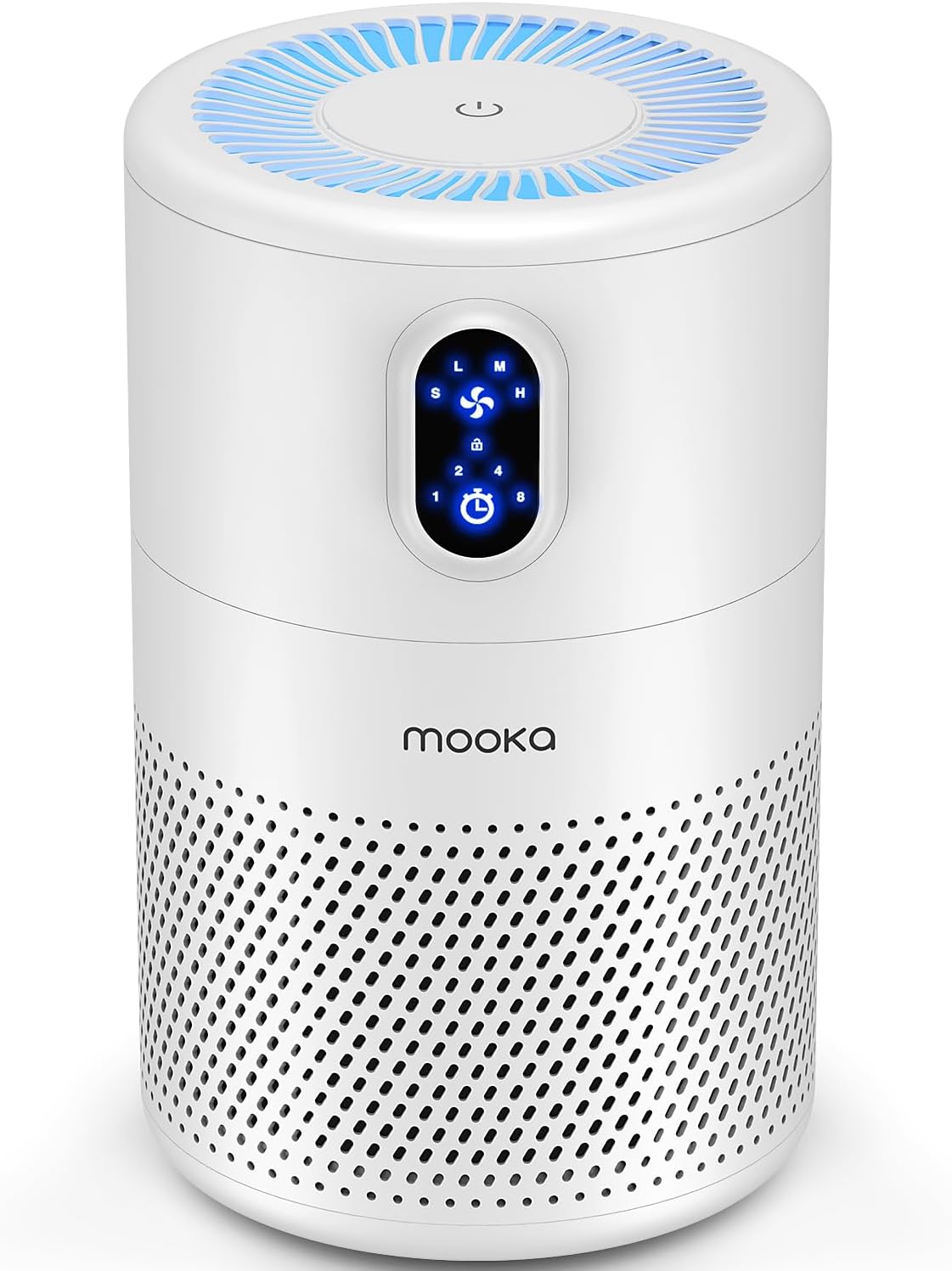
The MOOKA B-D02L is a H13 true HEPA air purifier built to remove smoke, dust, pollen and pet dander from a variety of home spaces. It combines a pre-filter, H13 HEPA element and activated carbon layer to tackle both airborne particles as small as 0.3 microns and common cooking odors, and the unit is sized to deliver multiple air changes in smaller rooms while still covering larger open areas. Controls include four fan speeds, four timer settings and a night light that can be disabled, and a child lock prevents accidental changes. The brushless motor runs quietly on low settings, making it suitable for kitchens near open living areas or for use overnight. Filter replacement every 3 to 6 months is required and replacement filters are sold separately, so ongoing maintenance is part of ownership. The unit is simple to operate and energy efficient, but buyers wanting advanced smart controls or formal CADR figures for smoke-specific performance will need to look elsewhere.
Best for: Buyers who want an efficient, no-frills purifier that reduces smoke and cooking odors in kitchens or adjoining living spaces and who prioritize quiet, easy operation over smart features.
Less Ideal for: People who require verified CADR ratings, integrated smart controls, or an appliance with extended filter life before replacement.
- H13 true HEPA plus activated carbon filter targets fine particles and common cooking odors
- Covers up to 1,076 sq ft with multiple air-change rates for smaller rooms
- Ultra-quiet brushless motor suitable for use near living spaces or at night
- Multiple timers, four fan speeds and child lock for straightforward, flexible operation
- No smart home connectivity or app control
- Manufacturer does not list formal CADR numbers for smoke removal
Verdict: A practical, quiet HEPA purifier that effectively tackles cooking smoke and odors for buyers who want simple, reliable performance without smart features.
VOOPNU H13 HEPA Air Purifier DH-JH12

| Coverage | Up to 1,076 ft² (hourly, lab-tested) |
|---|---|
| Filtration | H13 True HEPA triple-layer |
| Noise level | 22 dB (low) |
| Fan speeds | 3 speeds |
The VOOPNU DH-JH12 is a small, user-friendly air purifier that uses an H13 True HEPA triple-layer filter and 360° intake to capture particles like pet hair, pollen, smoke, and odors. It is intended for everyday placement on a desk or corner and is simple to operate from a minimal control panel with three fan speeds, a timer, and an essential oil tray for light scenting. The manufacturer reports it cleans 250 sq ft every 15 minutes and covers up to roughly 1,076 sq ft per hour in laboratory testing, making it a reasonable choice for kitchens or open living areas where cooking smoke and lingering smells are a concern. It runs quietly down to about 22 dB for night use, and the unit carries several safety and performance certifications. Expect to replace filters on a regular schedule and to run the purifier continuously for best results, since smaller compact units rely on continuous air turnover rather than one-pass removal in heavy smoke events.
Best for: Buyers looking for an affordable, compact purifier to reduce cooking odors and light smoke in small to medium open-plan kitchen and living spaces who prefer easy operation and quiet performance.
Less Ideal for: Homes that regularly produce heavy, dense cooking smoke or require rapid clearing of air in large areas should consider higher-capacity, CADR-rated machines instead.
- H13 True HEPA triple-layer filter captures 99.97% of fine particles
- 360° intake design promotes even room circulation
- Quiet operation down to 22 dB suitable for night use
- Compact footprint allows flexible placement in kitchens or small dining areas
- Simple controls plus timer and aroma tray for basic customization
- Coverage claims are lab-tested and continuous operation is recommended for best results in persistent smoke
- Compact unit may be less effective at quickly clearing heavy, concentrated cooking smoke compared with larger CADR-focused purifiers
Verdict: A budget-friendly, quiet H13 HEPA purifier that is a practical choice for reducing cooking odors and light smoke in small to medium kitchen-adjacent spaces.
DREO Air Purifier 338

| CADR (AHAM Verified) | 115 CFM |
|---|---|
| HEPA efficiency | 99.97% at 0.3 μm |
| Coverage (1 ACH) | Up to 856 sq. ft. |
| Modes | Auto, Turbo, Sleep, Normal |
The DREO Air Purifier 338 is a small, appliance-style purifier designed to remove smoke, dust, pollen, and PM2.5 from indoor air using a 3-in-1 filter (pre-filter, true HEPA, and activated carbon). It is AHAM verified with a CADR of 115 CFM and uses a 360° spiral airflow design and large intake for faster circulation, which helps clear cooking smoke and odors in typical kitchen-adjacent rooms. The unit has a high-precision PM2.5 sensor and an LED AQI display with a four-color indicator so you can see when particle levels change, and an Auto mode that ramps fan speed as needed; manual Turbo and Sleep modes and four speeds give flexible control. HyperSilent BLDC motor design keeps noise down to as low as 18 dB on low, useful for nighttime kitchen areas near living spaces. Limitations include a modest CADR that targets small to medium rooms rather than whole-house smoke removal and dependence on periodic filter replacement to maintain odor and particle removal performance.
Best for: Buyers who prioritize a reliable, validated purifier that actively monitors air quality and adapts to changes, especially for reducing cooking smoke and everyday household particles in nearby rooms.
Less Ideal for: Not the best choice for large open-plan kitchens or heavy-duty commercial cooking where higher CADR or multiple units would be needed.
- AHAM-verified CADR of 115 CFM for validated particle removal performance
- 3-in-1 filter with activated carbon layer for reducing smoke and odors
- Real-time PM2.5 sensor and LED AQI display for visible air-quality feedback
- Auto, Turbo, Sleep modes and four fan speeds for adaptive operation
- Quiet HyperSilent operation down to 18 dB for low-noise use near living and sleeping areas
- CADR is aimed at small to medium rooms and may be insufficient for large, open kitchen areas with heavy smoke
- Requires periodic filter changes to retain HEPA and odor-trapping effectiveness
Verdict: A dependable, AHAM-verified purifier with real-time monitoring and a carbon-equipped HEPA filter that reliably reduces cooking smoke and odors in small to medium rooms.
Levoit Core 300-P

| Filter Type | 3 in 1 Filtration |
|---|---|
| Floor Area | 1073 square_feet |
| Noise Level | 24 db |
| Wattage | 56 watts |
| Particle Retention Size | 0.3 micron |
The Levoit Core 300-P is a small, user-friendly air purifier built around a 3-stage filtration stack that includes a True HEPA-grade filter capable of capturing 0.1–0.3 micron particles. It uses a 56W motor with a CADR suited to typical home rooms and lists AHAM verification for measured cleaning performance, so it refreshes air quickly enough to cut down cooking smoke and airborne fine particles in kitchens or adjacent dining areas. Controls are touch-based and it offers a near-silent Sleep Mode at about 24 dB for overnight use or low-noise spaces. The unit is portable and easy to move between rooms, and Levoit recommends using their factory replacement filters for best results and longevity. Limitations include the absence of an Auto Mode on this model, so you must change fan speeds manually as smoke levels vary, and the coverage claims assume genuine Levoit filters and standard room layouts, so very large or open-plan kitchens may need multiple units or a higher-capacity purifier.
Best for: Buyers who want a compact, certified HEPA purifier they can rely on to reduce cooking smoke and fine particles in individual rooms and who value quiet, proven performance supported by broad customer use.
Less Ideal for: Homes with large open-plan kitchens or continuous heavy cooking smoke should consider higher-capacity units or multiple purifiers rather than this single compact model.
- True HEPA-grade 3-in-1 filter captures fine particles down to 0.1–0.3 μm
- AHAM-verified CADR and ETL/CARB certifications support measured cleaning performance
- Sleep Mode reduces noise to about 24 dB for quiet operation
- Portable, compact design is easy to move between kitchen, dining, and living areas
- No Auto Mode or air-quality sensor on this specific Core 300-P to adjust fan speed automatically
- Coverage and CADR benefits depend on using official Levoit replacement filters
Verdict: A compact, AHAM-verified HEPA purifier that reliably reduces cooking smoke and fine particles in single rooms while running nearly silently.
Levoit Core Mini-P
| Rated Power | 7W |
|---|---|
| Noise Level | 27–45 dB |
| Adapter Input | 100–240V, 50/60 Hz |
| Model number | LAP-C161-WUS |
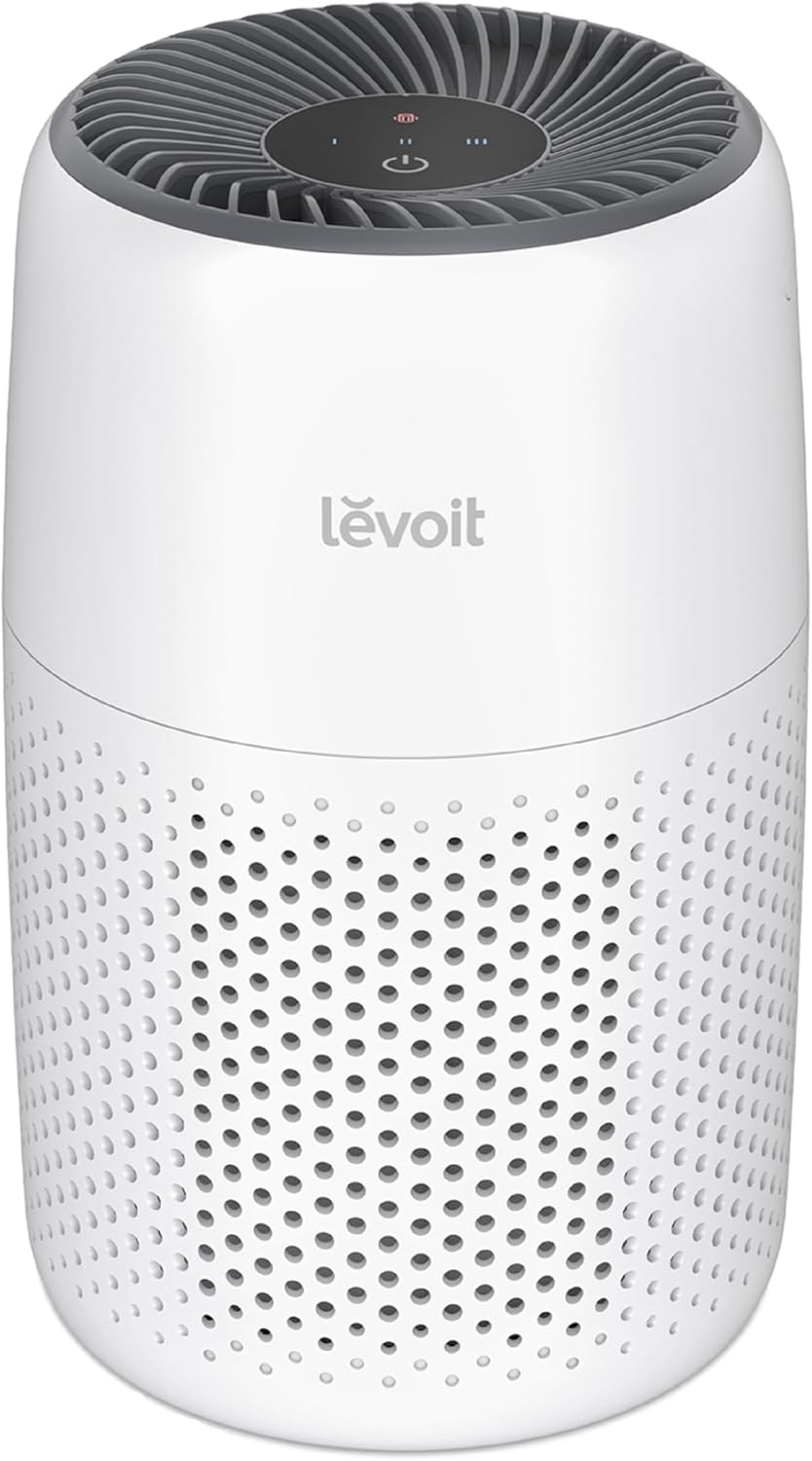
The Levoit Core Mini-P is a small, plug-in air purifier meant for desks, bedrooms, and kitchens where smoke or odors are a concern. It uses a pre-filter and main filter to capture lint, pet dander, dust, and fine particles and includes an aromatherapy sponge for light fragrance. The unit runs quietly (manufacturer noise spec 27–45 dB) and has a sleep mode and auto-off display to reduce disturbance overnight. With a rated power of 7W and an internal adapter, it is energy efficient and simple to place on a countertop or near a cooking area to help reduce lingering smells and light smoke from stovetop cooking. Limitations are its small coverage area and modest filtration capacity compared with larger, AHAM-certified room purifiers, so it is best for single-room, close-proximity use rather than cleaning heavy smoke from large or open-concept kitchens.
Best for: Buyers who want a low-noise, energy-efficient purifier for a single room or to place near a stove to reduce light cooking odors and small amounts of smoke.
Less Ideal for: Users needing to clear heavy, sustained kitchen smoke or cover large, open-plan living and cooking spaces should choose a larger, higher-capacity purifier instead.
- Compact footprint fits on countertops or desks
- Includes pre-filter and main filter to capture fine particles and pet dander
- Very quiet operation with a low-power 7W design
- Sleep mode and auto-off display minimize nighttime disturbance
- Small unit not intended to clear heavy or persistent cooking smoke from large or open kitchen areas
- Aromatherapy sponge requires careful dosing to avoid overflow
Verdict: A compact, quiet purifier that effectively reduces light cooking odors and fine particles in small, close-range spaces.
Choosing the Right Air Purifier for Cooking Smoke: Key Factors to Consider
Filtration Media and Particle Capture
Look for high-efficiency particulate filters rated for PM2.5 or better because cooking smoke contains very small combustion particles. True HEPA or equivalent filter media capture the fine particulates responsible for haze and some health effects. The depth and pleat density of the filter influence how long it maintains capture efficiency before pressure drop reduces airflow.
Particle capture alone does not eliminate gaseous cooking odors and volatile organic compounds. Many kitchen-focused purifiers pair particulate filters with activated carbon or other gas-phase media to address smells and smoke-related gases. Evaluate the presence and amount of gas-phase media and how it is integrated with the particulate stages.
Gas-Phase Odor Removal
Cooking smoke often carries volatile organic compounds and odorous molecules that a particle-only filter will not remove. A robust layer of activated carbon, impregnated carbon, or other sorbents is necessary to adsorb these gases and neutralize lingering smells. The surface area and thickness of the carbon bed determine how much odor it can capture before saturation.
Consider whether the unit uses replaceable carbon inserts or combined multi-stage filters. Replaceable cartridges make it easier to refresh gas removal capability, while permanent beds may degrade and lose effectiveness over time.
Airflow and Room Coverage
Airflow matters more in kitchens because smoke and odors are generated in short bursts and can disperse quickly through open-plan spaces. Check the clean air delivery rate or the manufacturer's room coverage estimates and match them to your kitchen's square footage and ceiling height. A unit that is undersized will do little to clear smoke during or immediately after cooking.
Also factor in placement: purifiers work best when positioned where smoke collects or where crossflow can draw contaminated air across the intake. In open-concept homes you may need a higher CADR or a second unit to achieve rapid clearing.
Noise and Fan Control
Cooking often requires higher fan speeds to remove smoke quickly, and higher speeds increase noise. Look for models with fan speed steps or an automatic boost mode that balances noise and clearing power. Check published noise levels for the speeds you plan to use; a quiet low setting is helpful for background odor control, but you will need tolerable high-speed performance during active cooking.
Useful controls include timers, scheduled runs, and simple push-button or app controls so you can increase ventilation quickly when smoke starts without fussing with complex menus.
Filter Replacement, Cost, and Ease
Regular replacement or regeneration of filters is necessary to keep performance high in a kitchen environment. Fine-particle filters load faster when exposed to oil, grease, and higher particle volumes, and carbon beds saturate with odorous compounds over time. Check expected filter life under kitchen use and how easy it is to obtain and install replacements.
Also consider whether pre-filters are washable and whether the design allows quick access for filter swaps. Lower ongoing maintenance complexity makes it more likely you will run the unit when needed.
Placement, Size, and Aesthetics
Kitchens have limited floor and counter space, and air purifiers should not obstruct workflow or ventilation. Measure available locations and choose a size that fits without blocking cooking areas or airflow paths. Taller tower designs can provide stronger vertical intake and better room mixing, while compact units are easier to tuck under counters or on walls.
Aesthetic fit matters if the unit will remain in a visible kitchen area. Durable finishes and simple controls help ensure the purifier integrates into everyday use rather than becoming a stored appliance.
How Cooking Smoke Differs From Other Indoor Pollutants
Cooking smoke is a mix of fine particulate matter, ultrafine particles, grease aerosols, and volatile organic compounds produced by heated oils and foods. That combination means you need both particle-capturing media and gas-phase adsorbents to address the full problem.
Unlike continuous low-level pollutants such as pet dander or dust, kitchen emissions are episodic and intense. This makes rapid airflow and the ability to run the purifier at higher speeds for short periods more important than steady-state filtration in many scenarios.
- Fine particles are primarily responsible for visible haze and respiratory irritation.
- Gaseous compounds produce lingering odors and can be harmful at elevated levels.
- Grease and oil can shorten filter life if the unit is not designed for kitchen use.
Placement Tips for Faster Clearing
Position the purifier where it will draw the smoke plume rather than hiding it in a corner. Common placements are near the cooking surface if safe and unobstructed, or between the stove and the rest of the living space to prevent cross-contamination.
Keep clearances around the intake and outlet as recommended by the manufacturer to avoid restricting airflow. In open-plan layouts, point the outlet toward the living area to push cleaned air outward and improve overall circulation.
- Avoid placing units behind tall objects or inside cabinetry.
- If smoke often travels to adjacent rooms, consider a unit with higher CADR or a second, smaller purifier for the adjacent space.
- Use temporary higher fan settings while actively cooking and switch back to lower-speed background cleaning afterward.
Managing Filters and Reducing Maintenance Hassles
To reduce maintenance frequency, choose models with washable pre-filters to trap large particles and grease before they reach the main filter. That pre-filtration preserves both HEPA media and carbon beds, extending service life in a smoky kitchen.
Keep a replacement schedule and check filter condition visually if the unit lacks usage-hour tracking. If your cooking style produces frequent heavy smoke, plan for more frequent carbon or HEPA replacements to maintain performance.
- Wash or vacuum pre-filters monthly if you cook often.
- Replace carbon or combined filters based on manufacturer guidance and visible odor return.
- Record filter change dates to avoid performance degradation over multiple cooking events.
When to Run Your Air Purifier
Run the purifier starting when you begin cooking and for at least 15 to 30 minutes after finishing to clear lingering smoke and odors. Starting early helps prevent particles and gases from dispersing into other rooms.
For particularly smoky events, use the purifier at the highest comfortable speed and increase ventilation by opening windows if weather permits. Continuous low-speed operation between cooking sessions helps maintain baseline air quality and reduces immediate load during the next cooking event.
- Use boost mode for frying or grilling to accelerate clearing.
- For everyday simmering or low-heat cooking, low to medium speeds are usually sufficient.
- Combine purifier use with range hoods when available for best results.
Sizing a Unit for Different Kitchen Layouts
Match the unit's clean air delivery rate or recommended room size to the actual cubic volume of the kitchen, not just floor area. Open-plan kitchens connected to living areas require higher effective coverage because the purifier must move more air to achieve the same clearing rate.
If you cook frequently and generate substantial smoke, choose a unit rated for a larger area than the kitchen's bare measurements to provide headroom for peak events.
- Calculate room volume by multiplying floor area by ceiling height.
- In open-plan designs, add the square footage of connected spaces when selecting capacity.
- When in doubt, opt for a slightly larger unit to improve response time during heavy cooking.
How We Chose the Best Air Purifier for Cooking Smoke
We selected products based on metrics that matter specifically for removing cooking smoke and kitchen odors. Key evaluation criteria included particulate filtration efficiency for PM2.5 and smaller particles, activated-carbon or equivalent gas-phase odor capture, and clean air delivery rate relative to typical kitchen footprints. We also prioritized practical features that affect everyday use: real-world airflow performance, fan speed variability and noise at cooking-relevant settings, and filter lifespan plus replacement ease and availability. We excluded units that are sized only for small bedrooms or that lack any gas-phase adsorption media, since those designs cannot handle common kitchen odors. We also ruled out devices with unverified filtration claims or with inadequate airflow for open-plan kitchen areas. The final selection reflects a balance of measurable filtration capability, usable airflow, practical controls for intermittent cooking, and maintainability over time. These criteria align with the scorecard metrics shown alongside each product so you can compare strengths and tradeoffs quickly.
Our full evaluation process is outlined in our review methodology.
FAQ
Will an air purifier eliminate all cooking odors instantly?
Not instantly. Purifiers with strong gas-phase media can significantly reduce odors, but clearing time depends on the unit's airflow and the amount of odorous compounds. Expect gradual improvement over minutes to an hour during typical use.
Can I run an air purifier while frying without a range hood?
Yes, a purifier helps reduce smoke and odors, but it cannot replace the immediate capture and exhaust a proper hood provides. Use higher fan speeds and ensure the purifier is positioned to intercept the smoke plume for best results.
How often should I change filters if I cook every day?
Filter life shortens with frequent heavy cooking. Check pre-filters monthly and expect main HEPA and carbon stages to need replacement more often than in low-usage scenarios. Follow the manufacturer's guidance and monitor for odor return or reduced airflow.
Are ozone-generating units suitable for kitchens?
No, ozone generators are not recommended for occupied indoor spaces. Ozone can irritate the respiratory system and does not safely replace adsorption media for removing cooking gases and odors.
Should I pair an air purifier with my kitchen ventilation?
Yes. Combining a purifier with mechanical ventilation or an effective range hood provides the fastest smoke removal. Purifiers are best used as a supplement when exhaust ventilation is limited or to catch residual particles and odors that escape the hood.
Final Verdict
Choosing the right air purifier for cooking smoke means balancing particle capture, gas-phase adsorption, and sufficient airflow for your kitchen layout. Prioritize units with true HEPA-level particulate filtration plus a substantial activated-carbon stage if odors and volatile compounds are your main concern. Also weigh noise at cooking speeds and the practical aspects of filter replacement so the unit stays effective over time. For most cooks, select a purifier sized a bit above your kitchen's calculated volume and use higher-speed modes during active cooking. That approach gives the best tradeoff between rapid clearing and manageable maintenance, letting you reduce lingering smoke and enjoy cleaner kitchen air.