
Note: This article contains affiliate links. If you click on these links and make a purchase, we may earn a small commission at no extra cost to you. This helps support our research and content. Read our full affiliate disclosure here.
Living in a dorm means sharing a small space where allergens, odors, and indoor pollutants concentrate quickly. Picking the right air purifier for dorm use matters because you need effective filtration without taking up a lot of space or disturbing roommates with loud fan noise. This guide collects the top short-listed options for dorm rooms and evaluates them on the factors that matter most to students: proven particle removal, quiet operation, footprint, and ease of upkeep. Read on for the top picks and a clear explanation of what to consider when matching an air purifier to a dorm layout and lifestyle.
Top Picks at a Glance
| Best Overall The best all-around choice for most situations | GermGuardian AC4825E 22" Tower |  |
| Best Quality Built to a higher standard if you want something more solid | BLUEAIR Blue Pure 511i Max |  |
| Best Value The sweet spot between price and what you get | VOOPNU DH-JH12 HEPA Air Purifier |  |
| Best Budget The cheapest option that still gets the job done reliably | MEGAWISE EPI810 Air Purifier |  |
| Top Rated A top-rated pick with lots of positive feedback | ECOSELF HAP609 Air Purifier |  |
| Most Popular A crowd favorite that many people choose with confidence | Levoit Core Mini-P |  |
| Best Seller A high-volume bestseller chosen again and again | Levoit Vital 200S-P Air Purifier |  |
GermGuardian AC4825E 22" Tower

| Room coverage (small) | 153 sq. ft. per 12.5 minutes |
|---|---|
| Room coverage (max) | Up to 743 sq. ft. per hour |
| Filter type | True HEPA with activated carbon pre-filter |
| Fan speeds | 3 speeds (includes sleep mode) |
The GermGuardian AC4825E is a compact tower purifier that uses a True HEPA filter, an activated carbon pre-filter, and an optional UV-C light to reduce dust, pollen, pet dander, odors, and some airborne particles. It is typically placed in a bedroom, dorm room, or living area and runs on three fan speeds including a quiet sleep mode for overnight use. The unit is rated to circulate air in a 153 sq ft room every 12.5 minutes and can handle medium to large areas up to about 743 sq ft on a slower cycle, making it versatile for single-room living spaces. Filter compatibility with GermGuardian replacement Filter B and available carbon and UV-C replacement parts makes maintenance straightforward. Practical benefits include noticeable odor reduction from cooking or pets, allergy relief from captured particulates, and simple controls. Important limitations are that the UV-C is optional and does not replace filtration, replacement filters and bulbs are consumables, and performance depends on fan speed and room layout so placement matters for best results.
Best for: Students and small-space dwellers who want reliable allergy and odor control in a dorm or bedroom and prefer a compact, easy-to-maintain purifier with simple controls.
Less Ideal for: Large open-plan suites or multiroom apartments needing whole-home filtration or users seeking smart features like app control or air-quality sensors.
- True HEPA filter captures 99.97% of particles down to 0.1 microns from passing air
- Activated carbon pre-filter helps reduce common household odors and scents
- Three fan speeds including a quiet sleep mode for overnight use
- Compact tower design suited to small rooms and dorm-room floor space
- Requires periodic replacement of HEPA, carbon filters, and UV-C bulb as consumables
- Effectiveness depends on fan speed and room placement, so coverage claims vary with real-world layouts
Verdict: A compact, straightforward HEPA tower that delivers dependable particulate and odor reduction for dorms and single rooms.
BLUEAIR Blue Pure 511i Max

| Filtration | HEPASilent dual mechanical + electrostatic |
|---|---|
| Coverage rate | 237 sq ft in 12.5 minutes; up to 1,138 sq ft/hour |
| Noise level | As low as 19 dB |
| Smart features | Built-in sensors and mobile app control |
The Blueair Blue Pure 511i Max is a compact smart air purifier built for quick, quiet cleaning in bedrooms, dorm rooms, and small apartments. It combines mechanical and electrostatic HEPASilent filtration to capture 99.97% of particles down to 0.1 microns, including dust, pollen, pet dander, and smoke, and its 360° intake helps circulate air efficiently. Smart sensors monitor air quality and automatically raise fan speeds when pollution increases, while the mobile app lets you check air quality, schedule runs, and get filter reminders. Measured cleaning rates—237 sq ft in about 12.5 minutes and up to 1,138 sq ft in an hour—mean it refreshes a dorm room fast, and noise levels as low as 19 dB make it sleep-friendly. The unit's compact Scandinavian design fits small spaces, but it does not include built-in humidification or specialized gas/odor adsorption beyond general particle filtration. Expect regular filter replacements for sustained performance and rely on the app for maintenance alerts.
Best for: Students or dorm residents who prioritize fast, quiet particle removal and want app-based monitoring and automatic air-quality adjustments for small rooms.
Less Ideal for: People who need a combined humidifier or dedicated odor and VOC removal in tight living spaces should consider different models or add complementary devices.
- High-efficiency HEPASilent filtration captures particles down to 0.1 microns
- Cleans a typical dorm room quickly (237 sq ft in ~12.5 minutes)
- Very quiet operation down to 19 dB suitable for sleeping
- Smart sensors and app control for automatic adjustments and maintenance reminders
- No integrated humidifier or specialized odor/gas-specific filter
- Ongoing cost and attention required for periodic filter replacements
Verdict: For dorms and small rooms where fast, quiet particle removal and smart automatic control matter, this Blueair delivers strong, low-noise performance.
VOOPNU DH-JH12 HEPA Air Purifier

| Model number | DH-JH12 |
|---|---|
| Filtration | H13 True HEPA triple-layer |
| Coverage (lab-tested) | 250 ft² per 15 minutes / up to 1,076 ft² per hour |
| Noise level | 22 dB (low) |
The VOOPNU DH-JH12 is a compact tower-style air purifier that uses an H13 True HEPA triple-layer filter and 360 degree intake to remove common indoor pollutants like pet hair, pollen, smoke, and odors. It is intended for continuous use in small to medium spaces and is laboratory-tested to clean roughly 250 ft² every 15 minutes, covering up to about 1,076 ft² per hour. Controls are simplified for one-touch operation and it offers three fan speeds, a timer, and a quiet low setting down to about 22 dB for undisturbed sleep. The unit includes a small essential oil tray for light scenting and carries multiple safety and performance certifications. Practical benefits are its small footprint for easy placement in a dorm room or desk area, effective H13 filtration for particles down to 0.3 microns, and very quiet operation at night. Limitations are that filter replacements are required on a regular schedule and the small physical size means airflow power and coverage are tuned toward rooms rather than large open areas, so placement and continuous runtime matter for best results.
Best for: Students or compact-space occupants who prioritize quiet, low-maintenance air cleaning and need a small purifier that fits on desks or in corners while running continuously.
Less Ideal for: Homes or suites needing whole-apartment purification or very large open rooms should choose a higher-capacity commercial or whole-house unit instead.
- H13 True HEPA triple-layer filter captures fine particles and allergens
- 360 degree air intake for more even room circulation
- Very quiet operation (as low as 22 dB) suitable for sleeping or studying
- Compact footprint fits easily on a desk or in tight dorm-room layouts
- Simple one-touch controls plus timer for easy daily use
- Requires periodic filter replacements to maintain performance
- Coverage claims are based on laboratory testing and real-world results depend on placement and continuous runtime
Verdict: A compact, very quiet HEPA purifier tailored for dorm rooms and small living spaces where low noise and easy placement matter.
MEGAWISE EPI810 Air Purifier

| Filter Type | HEPA |
|---|---|
| Floor Area | 250 |
| Noise Level | 32 db |
| Particle Retention Size | 0.3 micron |
| Wattage | 8 watts |
The MEGAWISE EPI810 is a compact tabletop air purifier built to clean small spaces like dorm rooms and bedside areas. It uses an H13 True HEPA 3-stage filter with an activated carbon layer to capture 99.97% of particles down to 0.3 microns and reduce common household odors, making it useful for dust, pet dander and light smoke. Controls are simple touch/button style and the unit runs extremely quietly in low or sleep mode, advertised down to about 24 dB, so it will not disturb sleep or study sessions. Its 8-watt power draw and ozone-free operation make it energy efficient for continuous use. The small footprint fits on desks or nightstands and includes a gentle night light for nighttime visibility. Limitations are that it is sized for small areas (spec'd for 250 square feet) and will not move large-room air as quickly as bigger models, and replacement filters are required periodically which adds to long-term cost. For its size and price point the purifier provides straightforward, low-noise filtration for close-range use in dorms and similar small rooms.
Best for: Students or budget-minded renters who need a quiet, space-saving purifier for a dorm bed or small study area and prioritize low noise and simple operation.
Less Ideal for: People who need to clean large living rooms or open-plan spaces or who want smart features and advanced controls beyond basic touch buttons.
- H13 True HEPA plus activated carbon captures 99.97% of particles to 0.3 microns and reduces odors.
- Very low noise in sleep mode (around 24–32 dB) suitable for bedrooms and study spaces.
- Compact, lightweight tabletop design fits dorm nightstands and small desks.
- Low power consumption (8 watts) and ozone-free operation for safe continuous use.
- Designed for small rooms up to about 250 sq ft, so airflow is limited for larger spaces.
- Requires periodic filter replacements which increase lifetime operating cost.
Verdict: A quiet, energy-efficient tabletop HEPA purifier that gives dorm students reliable, low-cost filtration for small rooms.
ECOSELF HAP609 Air Purifier

| Model | HAP609 |
|---|---|
| Coverage | Up to 1800 Ft² |
| Noise level (Sleep) | 20 dB |
| Timer | 1–24 hours |
| Sensor | PM2.5 |
The ECOSELF HAP609 is a compact HEPA air purifier built to keep bedroom and small dorm spaces fresh with minimal fuss. It draws air from all directions using a 360° intake and reports PM2.5 levels on a front display while a color ring gives an at-a-glance air quality signal. A built-in sensor adjusts fan speed automatically when dust, smoke, or pet dander rises, and a sleep mode reduces noise to about 20 dB and turns off indicator lights for overnight use. You can also set a 1–24 hour timer for scheduled operation. In practice the unit cleans quickly for its size and is simple to operate without frequent user intervention, which makes it easy to maintain a consistent clean-air environment. Limitations include its small physical footprint, which means it is intended for dorm rooms or bedrooms rather than large open areas, and replacement filter availability and cost are typical ownership considerations for any HEPA unit.
Best for: Students or renters who want a set-and-forget air purifier that reliably monitors room air and adjusts automatically to maintain clean indoor air with minimal hands-on control.
Less Ideal for: People needing to purify large living areas or whole apartments should choose a higher-capacity unit designed for greater square footage.
- 360° air intake for more even room coverage
- Built-in PM2.5 sensor with real-time display and color ring for quick status checks
- Auto mode that raises fan speed when pollutants rise
- Very quiet sleep mode at about 20 dB and lights-off operation
- 1–24 hour timer for scheduled run times
- Designed for small rooms so not effective for large open areas
- Requires periodic filter replacements which add ongoing cost
Verdict: A compact, sensor-driven purifier that reliably maintains clean air in dorms and small bedrooms with quiet, automatic operation.
Levoit Core Mini-P
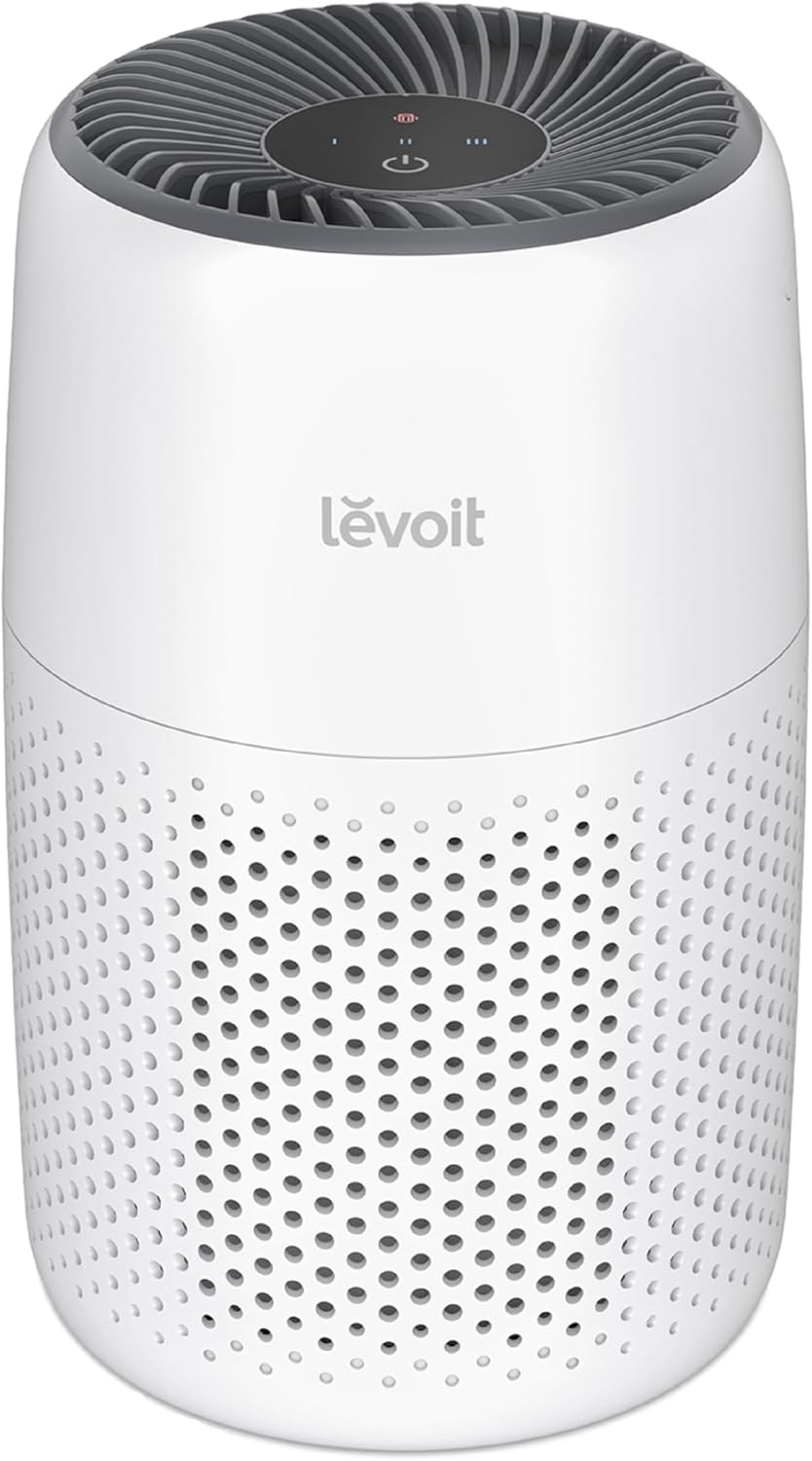
| Rated Power | 7W |
|---|---|
| Noise Level | 27-45dB |
| Adapter Input | 100-240V, 50/60Hz |
The Levoit Core Mini-P is a small, plug-in air purifier intended for dorm rooms, bedrooms, or desktop use where space is limited. It draws air through a pre-filter and a main high-efficiency filter to capture lint, pet hair, dust, smoke particles, and common allergens, and it includes a small fragrance sponge for light aromatherapy. The unit is rated for very low power draw and runs quietly in sleep mode with noise levels reported between 27 and 45 dB, making it suitable for overnight use. Controls include an auto-off display and a sleep setting to reduce disturbance, and the internal adapter stores inside the housing for tidy placement. Practical benefits are straightforward: effective local air cleaning on a small footprint, minimal energy use, and very quiet operation. Limitations are inherent to its size — it is meant for small areas and will not replace a full-room purifier for larger dorm suites, and the aromatherapy feature requires only a few drops to avoid damaging internal parts.
Best for: Students or roommates who want a trusted, quiet purifier for a dorm bed or personal workspace and who prioritize proven performance and social-proof reliability when choosing small appliances.
Less Ideal for: People needing to clean the air in larger living rooms, entire apartments, or shared suites should choose a larger-capacity purifier designed for higher square footage.
- Compact footprint fits on desks and small bedside tables
- Pre-filter plus main filter capture common allergens, dust, smoke, and pet dander
- Very quiet sleep mode suitable for overnight use
- Low power consumption with internal adapter storage for neat placement
- Designed for small spaces only and not adequate for larger rooms
- Aromatherapy sponge must be used sparingly to avoid damaging plastic parts
Verdict: A compact, quiet personal purifier that reliably cleans small dorm or bedside spaces while using very little power.
Levoit Vital 200S-P Air Purifier

| Power Source | Corded Electric |
|---|---|
| Control Method | App |
| Filter Type | 3-Stage Filter |
| Floor Area | 1875 square_feet |
| Noise Level | 27 db |
The Levoit Vital 200S-P is a Wi‑Fi enabled air purifier built for whole-room cleaning that uses a three-stage filter (pre-filter, activated carbon, HEPA) and an integrated air quality monitor to remove smoke, dust, pollen, pet dander and odors. It is typically placed in living rooms or bedrooms and runs quietly — the listed noise floor is 27 dB in sleep mode — while the app and button controls let you switch fan speeds, monitor air quality, and schedule operation. Its AHAM verification and CADR figures signal strong real-world cleaning performance for spaces up to the advertised coverage, and the washable pre-filter reduces short-term replacement costs. Practical limitations include the ongoing expense of replacement filters and the unit size and power draw that are larger than ultra-compact dorm models, so it may be overkill for very small rooms or strict space-limited setups. For buyers who want measurable performance and quiet nightly operation, it balances convenience and filtration capability well.
Best for: Students or residents who prioritize proven air-cleaning performance and quiet overnight operation and want app control and monitoring for peace of mind.
Less Ideal for: Those constrained by very small desks or cramped rooms who need an ultra-compact, low-power desktop purifier or strict budget shoppers avoiding ongoing filter costs.
- Three-stage filtration including HEPA and activated carbon for particles and odors
- AHAM-verified CADR values for smoke, dust, and pollen indicating effective whole-room cleaning
- Quiet sleep mode suitable for overnight use at low noise levels
- App and button controls plus built-in air quality monitoring for hands-off operation
- Washable pre-filter reduces dust buildup and short-term filter changes
- Replacement filters are required periodically which adds to long-term cost
- Larger footprint and higher wattage than compact desktop purifiers suited for tiny dorm rooms
Verdict: Choose the Vital 200S-P when you want a quiet, AHAM-verified purifier with smart controls and robust three-stage filtration for reliable dorm-room air quality.
Choosing the Right Air Purifier for Dorm: Key Factors to Consider
Filtration Efficiency
Dorm rooms often concentrate fine particles from cooking, smoking, campus pollen, and dust. Filtration efficiency describes how well a unit captures particles down to 0.3 microns or smaller. True HEPA or validated equivalent filters matter because they remove the most common airborne allergens and fine particulate pollution that can trigger symptoms or reduce indoor air quality.
Higher filtration efficiency shortens the time required to reduce particle counts in a small room. For dorm buyers, look for clear filter specifications and replacement schedules so you know how performance will hold up over time.
Noise Output
Dorms are shared living spaces where quiet matters for studying and sleeping. Noise output is often measured in decibels across fan speeds; low and medium settings should be tolerable for long periods. Devices with very quiet sleep modes let you run continuous filtration overnight without disturbing roommates or interfering with concentration.
Consider both subjective fan noise and any high-pitched electronics sounds. Units with variable fan speeds and programmable timers help balance filtration needs and acoustic comfort.
Coverage and Airflow (CADR)
Room coverage determines whether a purifier can cycle the air in a dorm room adequately. CADR, or the clean air delivery proxy, gives a sense of how quickly a unit can remove smoke, dust, and pollen particles from a specific room size. For dorm use, choose a purifier rated for a slightly larger area than your actual room to ensure faster turnover and better performance when the room is occupied.
Higher CADR matters when multiple pollutant sources are present, such as cooking, pets, or frequent comings and goings. Match the unit to the square footage and typical ceiling height of the dorm space.
Footprint and Placement
Dorm rooms have limited floor space and often tight furniture arrangements. Footprint and placement flexibility affect how the purifier integrates into the room. Compact, vertical designs are easier to tuck onto a desk or dresser, while slender cylinder or tower units can sit in narrow gaps.
Also consider intake and outlet locations; some units need clearance on all sides to work efficiently. Choose a form factor that fits the most practical location in your room without obstructing movement or blocking vents.
Maintenance and Filter Lifecycle
Owning an air purifier involves recurring maintenance costs and tasks. Filter replacement interval, filter cost and availability, and the ease of changing filters are important for busy students. Units with washable pre-filters reduce particulate load on the main filter and can extend replacement intervals.
Look for clear filter life estimates based on usage patterns and built-in replacement indicators. Filters that are inexpensive and widely available reduce the chance that the unit becomes costly to maintain.
Energy Use and Controls
Dorms may limit available outlets and utilities budgeting is often tight. Energy-efficient purifiers lower running costs when operated continuously. Features such as programmable timers, auto modes tied to air-quality sensors, and low-power sleep settings help manage energy use without sacrificing air quality.
Also consider control simplicity: intuitive interfaces, app controls, or basic physical buttons can make daily operation easier for students with limited time and attention.
Sizing a Purifier for Your Dorm Room
Measure the square footage of your dorm room and check the purifier's recommended coverage. For typical dorm rooms, choose a unit rated for slightly more area to ensure adequate air changes per hour, especially if the space has multiple pollutant sources or higher ceilings.
If you plan to run the purifier continuously, aim for at least two complete air exchanges per hour on average settings. A higher-rated unit will clean the air faster and is beneficial after activities that spike pollutants such as cooking or heavy foot traffic.
- Match CADR or stated room coverage to your room size.
- Favor a purifier rated above your measured square footage for faster turnover.
- Consider ceiling height; taller rooms need more airflow to achieve the same exchange rate.
Placement Tips to Maximize Performance
Place the purifier where airflow is least obstructed. Avoid corners or placing the unit directly behind furniture. Ideally position it several inches from walls so air can circulate unobstructed through intake and outflow paths.
If you want the device to remove odors from a specific source, place it closer to that area. For general whole-room cleaning, a central location or a spot near the door often yields better circulation.
- Keep 6 to 12 inches clearance on intake and outlet sides.
- Elevate small units onto a stable surface for better distribution if floor placement is blocked.
- Avoid placing directly under windows if outdoor air brings in contaminants during high-pollution periods.
Managing Filters and Upkeep in a Dorm Routine
Set a simple maintenance schedule to inspect pre-filters and clean accessible surfaces monthly. Washable pre-filters should be rinsed per manufacturer guidance to avoid dust buildup that reduces efficiency. Replace main HEPA or equivalent filters at the recommended intervals and keep a note of purchase sources so you can order replacements during breaks.
Use built-in filter indicators when available, but also learn the basic signs of a clogged filter: reduced airflow, persistent odors, or higher-than-normal fan speeds on auto mode.
- Check and clean pre-filters monthly.
- Record replacement dates and expected filter lifespan.
- Keep replacement filters on hand before heavy-use seasons like flu season.
Balancing Filtration and Quiet for Study and Sleep
Noise ratings are crucial for dorm life. Devices often perform well at high fan speeds but become disruptive. Choose a unit with a low-noise sleep mode that still provides reasonable air turnover. For study times, a medium setting with measured decibel ratings is usually adequate without creating distraction.
If you share a room, discuss acceptable noise levels with roommates and consider operation schedules and locations that reduce disturbance while maintaining air quality.
- Compare decibel ratings at different fan speeds.
- Use timers or smart schedules to run higher speeds when the room is unoccupied.
- Prioritize low-frequency fan noise over high-pitched sounds that carry further and are more distracting.
Addressing Dorm-Specific Pollutants
Dorm rooms have a mix of particulate and odor sources. Activities like reheating food or having multiple occupants raise both particle counts and volatile organic compounds. A two-stage approach that pairs a particulate HEPA filter with an activated carbon or similar odor-control stage handles both types of pollutants more effectively.
If cigarette smoke or strong cooking odors are a primary concern, make sure the purifier includes a dedicated adsorption stage and verify expected service life for that part of the filter.
- Use HEPA for particles and activated carbon for odors.
- For intermittent strong odors, run the unit at higher speed briefly to clear the air quickly.
- Ventilate when possible to reduce buildup of VOCs that filters may struggle to remove alone.
How We Chose the Best Air Purifier for Dorm
We selected the short list of air purifiers for dorms by applying practical, student-focused filters and measurable performance criteria. First, we required a clean air delivery capability suitable for small rooms, using manufacturer CADR or stated room coverage as a baseline. Second, we prioritized filtration systems that include true HEPA or equivalent particulate capture and an active odor control stage for common dorm smells. Third, noise performance at typical low-to-medium fan speeds was a key filter to ensure units work during study and sleep. Fourth, we looked for compact footprint and manageable weight so units fit typical dorm furniture and are easy to move. Finally, maintenance factors such as filter replacement frequency, availability of replacement filters, and simple filter-change procedures were considered. We excluded large-format and whole-home purifiers that are not realistic for dorm rooms, units without verified particulate filtration, and devices that rely solely on ionization without a particle filter. The final list emphasizes measurable filtration effectiveness, user-facing noise levels, physical fit for small rooms, and reasonable upkeep costs and procedures.
Our full evaluation process is outlined in our review methodology.
FAQ
How big of an air purifier do I need for a typical dorm room?
Match the purifier's rated coverage or CADR to your room's square footage and ceiling height. For most dorm rooms, choose a unit rated modestly above your measured size to ensure faster air turnover, especially if multiple pollutant sources are present.
Are there filters that are easier to maintain on a student budget?
Look for purifiers with washable pre-filters to reduce particulate load on the main filter and extend its life. Also consider models with readily available replacement filters and clear, inexpensive replacement intervals to keep ongoing costs predictable.
Will an air purifier remove odors from food or smoking?
Odors are best addressed by purifiers that include an activated carbon or adsorption stage in addition to particulate filtration. HEPA captures particles but does not remove gases and VOCs effectively without an odor-specific layer.
How loud will a dorm air purifier be at night?
Noise varies by model and fan speed. Many units offer sleep or low modes that are quiet enough for sleeping. Check decibel ratings and choose a purifier with a verified low-noise setting if nighttime operation is important.
Can I leave an air purifier running 24/7 in my dorm?
Yes, running a purifier continuously is common and helps maintain steady air quality. Use energy-saving or auto modes if available to reduce power draw, and follow recommended maintenance to prevent filter clogging from continuous use.
Final Verdict
For dorm living, prioritize filtration efficiency, quiet operation, and a compact footprint. Tradeoffs are inevitable: higher airflow and faster cleaning usually mean more noise and possibly larger size. Focus on units that offer true particulate filtration plus an odor-control stage, deliver adequate CADR for your room, and require straightforward, cost-transparent maintenance. With those priorities in mind, you can choose a purifier that keeps air fresh without dominating limited dorm space or disrupting study and sleep.