
Note: This article contains affiliate links. If you click on these links and make a purchase, we may earn a small commission at no extra cost to you. This helps support our research and content. Read our full affiliate disclosure here.
If you live with persistent dust and need cleaner air across a large room, choosing the right air purifier matters. The wrong unit will struggle to move enough air or miss fine particles that settle on surfaces and aggravate allergies. This guide focuses on top-performing air purifiers optimized for dust removal in large rooms and explains why each shortlisted model earned consideration. We evaluated units for filtration efficiency, airflow and room coverage, filter maintenance, and noise to help you pick a purifier that keeps settled dust down and improves indoor air quality. Read on to understand the tradeoffs and decide which features matter most for your space.
Top Picks at a Glance
| Best Overall The best all-around choice for most situations | BLUEAIR Blue Pure 211i Max |  |
| Best Quality Built to a higher standard if you want something more solid | COWAY Mighty AP-1512HH |  |
| Best Value The sweet spot between price and what you get | KNKA APH4000 Air Purifier |  |
| Best Budget The cheapest option that still gets the job done reliably | MOOKA B-D02L Air Purifier |  |
| Top Rated A top-rated pick with lots of positive feedback | Levoit Core 400S-P |  |
| Most Popular A crowd favorite that many people choose with confidence | Winix 5510 Air Purifier |  |
| Best Seller A high-volume bestseller chosen again and again | Levoit Vital 200S-P |  |
BLUEAIR Blue Pure 211i Max

| Room coverage (1 hour) | Up to 3,235 sq ft |
|---|---|
| Filtration technology | HEPASilent (mechanical + electrostatic) |
| Particle capture | Down to 0.1 microns |
| Sound level range | 23–53 dB |
| Air intake | 360° |
The Blueair Blue Pure 211i Max is built for large open spaces and households that need heavy-duty dust and allergen removal. It uses HEPASilent dual filtration combining mechanical and electrostatic capture to remove particles down to 0.1 microns and is rated to refresh air across very large areas (up to 3,235 sq ft per hour). The unit draws air 360 degrees around its base and adjusts fan speed automatically via onboard sensors or the Blueair mobile app, so it can run quietly in living rooms or bedrooms while ramping up during pollution events. Notable practical benefits are strong CADR performance for dust, pet dander, and smoke, app-based scheduling and filter reminders, and a minimalist design that fits modern decor. Trade-offs are its physical footprint and weight for placement in smaller rooms and the need to replace filters periodically to maintain top performance; it is also a higher-capacity choice when a smaller, lower-cost purifier would suffice for single small rooms.
Best for: Buyers who want a single, powerful purifier to manage dust, pet dander, and smoke across large living rooms or open floor plans and value automatic sensing and app control for hands-off operation.
Less Ideal for: People who need a compact, lightweight purifier for a single small bedroom or those on a tight budget who do not require whole-room coverage.
- HEPASilent dual filtration captures particles down to 0.1 microns for effective dust and allergen removal
- High area coverage with the ability to refresh air across very large open spaces quickly
- Built-in air quality sensors with auto mode for hands-off adjustment
- 360° air intake and strong airflow for even circulation in open plans
- App control with scheduling and filter-life reminders for convenient monitoring
- Large and relatively heavy compared with small-room purifiers, limiting placement options
- Requires periodic filter replacements to sustain performance
Verdict: Choose the Blue Pure 211i Max when you need a high-capacity, sensor-driven purifier that removes dust and allergens across very large rooms with minimal oversight.
COWAY Mighty AP-1512HH

| Coverage | Up to 1,748 sq. ft. in 60 minutes |
|---|---|
| Filtration stages | Pre-filter, Deodorization, Bipolar Ionizer, HEPA |
| HEPA efficiency | 99.97% of 0.3 µm particles |
| Filter lifespan | Up to 1 year |
| Indicator | Air quality LED and filter indicator |
The COWAY Mighty AP-1512HH uses a four-stage system — washable pre-filter, deodorization filter, bipolar ionizer, and a True HEPA filter — to remove particles, odors, and some gases across a reported coverage area up to 1,748 sq ft in 60 minutes. It is typically placed in living rooms or bedrooms and run continuously on Auto mode so the built-in air quality sensor adjusts fan speed as pollution levels change, while an LED ring communicates air conditions at a glance. Practical benefits include strong particle capture down to 0.3 micron, washable pre-filter to extend filter life, and filter-life indicators that simplify maintenance. Eco and timer modes help reduce noise and power when full output is not needed. Limitations are that lab-tested reductions for VOCs and specific gases will vary in real homes and that the unit is most effective when room layout and airflow allow for unobstructed circulation; very large open-plan spaces may need multiple units for uniformly low dust levels.
Best for: Buyers who prioritize measurable particle-removal performance and want a sensor-driven purifier that runs continuously with minimal monitoring in medium to large rooms.
Less Ideal for: Those who need whole-house coverage from a single device or who prefer integrated smart-home app controls and networking features.
- True HEPA filtration capturing 99.97% of 0.3 µm particles for reliable dust and allergen removal
- Built-in air quality sensor with Auto mode that adjusts fan speed in real time
- Washable pre-filter reduces maintenance cost and extends primary filter life
- Filter indicator and timer modes make upkeep and energy management straightforward
- Performance claims for VOCs and specific gases are based on lab tests and may not match real-world conditions
- Single unit may not provide even coverage in very large or complex open-plan spaces
Verdict: Choose the COWAY Mighty AP-1512HH if you want a proven, sensor-driven HEPA purifier that reliably reduces dust and allergens in medium to large rooms.
KNKA APH4000 Air Purifier

| Model number | APH4000 |
|---|---|
| CADR Smoke/Dust/PM2.5 | 226 CFM (384 m³/h) |
| CADR Pollen | 244 CFM (415 m³/h) |
| Coverage (1 ACH) | Up to 1,695 ft² |
| Noise (Sleep mode) | 22–24 dB |
The KNKA APH4000 is a large-room HEPA air purifier built to move lots of air and remove common household particles like dust, pollen, pet dander, and smoke. It uses dual front-and-back cartridges with a three-stage system—washable pre-filter, high-efficiency HEPA filter, and activated carbon—to tackle both particulates and odors, and a filter indicator reminds you when replacements are due. AHAM verification and CADR ratings (226 CFM dust/smoke, 244 CFM pollen) mean it exchanges air quickly: roughly 4.8 air changes per hour in a 350 ft² room and measurable refresh in spaces up to 1,695 ft² at a lower efficiency. Practical controls include Pet, ECO, Auto, and Sleep modes plus four fan speeds, an AQI display with color feedback, timer, child lock, and an optional aroma diffuser. Noise on the low end is very quiet (about 22–24 dB) for bedroom use, though higher fan speeds are louder. Filter replacement every 3–6 months increases ongoing cost, and the unit is substantial in footprint and weight, so plan placement accordingly. For someone who needs proven performance against dust in large rooms, this is a solid, feature-rich choice.
Best for: Buyers who prioritize efficient, certified dust removal in large rooms and want adjustable modes and clear air-quality feedback for everyday home use.
Less Ideal for: Those needing an ultra-compact or lightweight purifier for small rooms, travel, or occasional use should look at smaller, more portable models instead.
- AHAM-verified CADR for dust, pollen, and smoke supports fast, measurable air exchanges.
- Dual intake and dual outlet airflow design increases circulation for larger spaces.
- Three-stage filters (washable pre-filter, HEPA, activated carbon) address particles and odors.
- Multiple modes including PET, ECO, Auto, and quiet Sleep mode allow tailored operation.
- Real-time AQI display and filter indicator simplify monitoring and maintenance.
- Filters should be replaced every 3–6 months, adding recurring cost.
- Larger unit size and weight require a dedicated spot and may not suit small rooms.
Verdict: Choose the KNKA APH4000 if you need AHAM-verified, high-CADR performance and versatile modes to control dust and allergens across large rooms.
MOOKA B-D02L Air Purifier
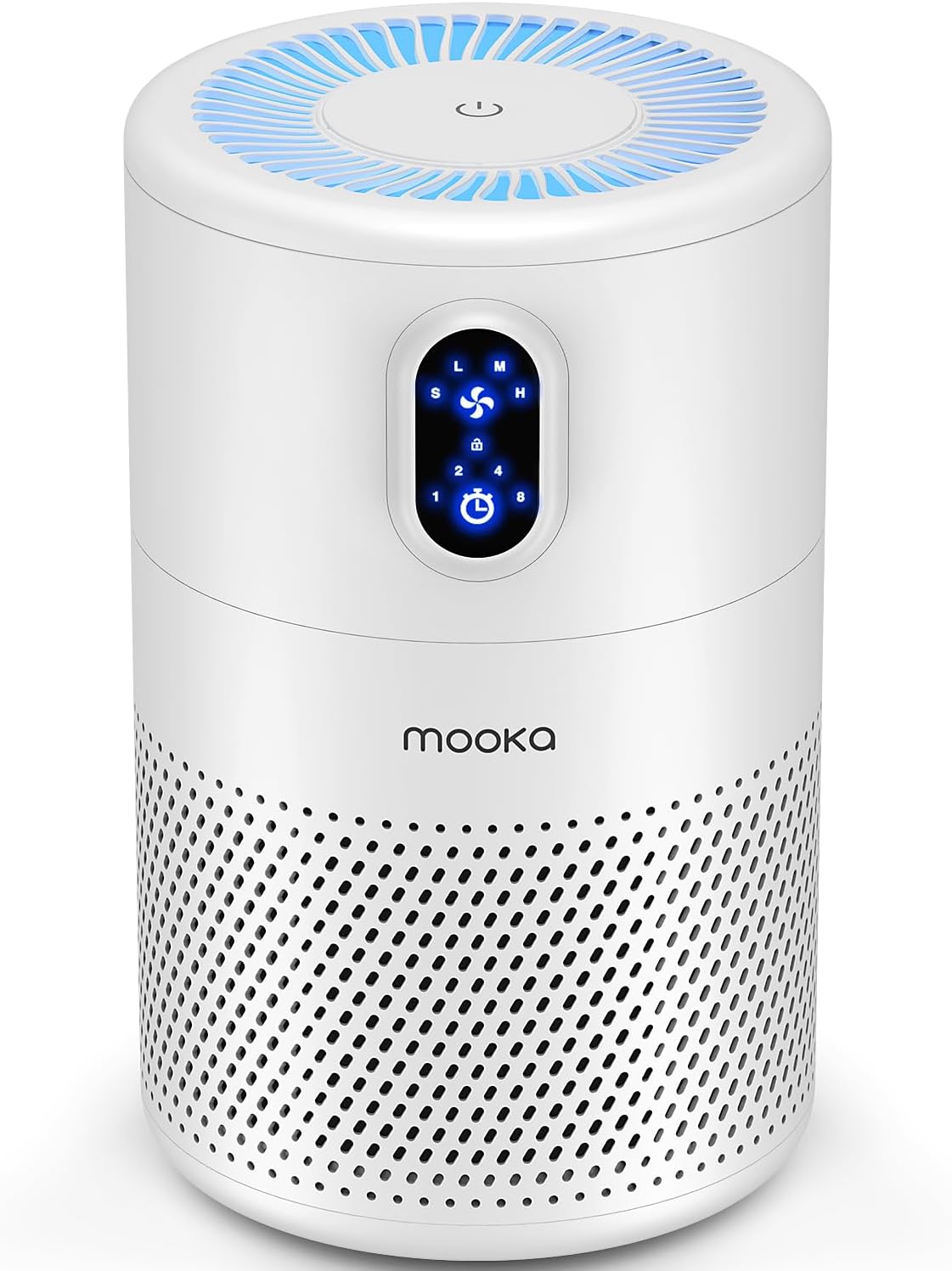
| Effective Area | 1076 sq ft |
|---|---|
| Filter Type | H13 True HEPA + activated carbon |
| Filter Lifespan | 3-6 months |
| Fan Modes | 4 speeds |
The MOOKA B-D02L is a small, budget-oriented air purifier built around an H13 True HEPA filter plus an activated carbon stage and a pre-filter to trap dust, pollen, pet dander, smoke and odors. It is typically placed in living rooms or bedrooms and is sized to deliver one air change per hour in very large rooms (up to 1076 ft²) and faster cycling in smaller spaces. Controls include four fan speeds, four timer settings and a night mode with a dimmable night light, and a child lock helps prevent accidental changes. The unit uses a brushless motor for quiet operation—MOOKA quotes around 20 dB at the lowest setting—and the filter life is expected at about 3 to 6 months depending on use. Practical advantages are straightforward: effective particle removal for everyday dust and allergens, low noise for overnight use, and simple controls. Important limitations are that true coverage and CADR are not listed on the spec sheet, replacement filters are a recurring cost, and performance for heavy smoke or very high pollutant loads will depend on placement and runtime.
Best for: A practical buyer looking for an affordable, quiet purifier that removes common household dust, pet dander and odors in large open rooms and who prioritizes low noise and simple controls over lab-grade performance.
Less Ideal for: People who need verified high-CADR performance for heavy wildfire or industrial smoke, or buyers who want the lowest long-term operating cost without recurring filter purchases should consider other options.
- H13 True HEPA filter captures particles down to 0.3 microns for dust, pollen and pet dander.
- Activated carbon layer helps reduce odors and smoke-related smells.
- Ultra-quiet brushless motor suitable for bedrooms and night use.
- Multiple timers and four fan speeds let you balance noise, runtime and cleaning intensity.
- Child lock and replace-filter reminder add simple safety and maintenance convenience.
- No CADR or standardized airflow numbers provided to directly compare cleaning speed.
- Replacement filters need changing every 3–6 months, adding ongoing cost.
- Coverage claims are broad and real-world effectiveness depends on room layout and continuous run time.
Verdict: A budget-friendly, very quiet HEPA purifier that is a practical choice for removing dust and pet allergens in large rooms when you want low-noise, easy operation.
Levoit Core 400S-P

| Floor Area | 90 square_meters |
|---|---|
| Noise Level | 24 db |
| Particle Retention Size | 0.1 micrometer |
| Wattage | 24 watts |
| Control Method | Voice |
The Levoit Core 400S-P is a smart, whole-room air purifier built to reduce dust, pollen, smoke, and odors in large spaces. It uses a 3-stage filter (pre-filter, activated carbon, HEPA) and AirSight Plus laser sensing to monitor particulate levels and show PM2.5 on the display, while Auto Mode and the VeSync app handle fan-speed adjustments automatically. The unit is AHAM verified with high CADR figures, so it moves a lot of air quickly for its size, and Sleep Mode lowers noise to about 24 dB for overnight use. Smart features include Wi‑Fi, Alexa control, and filter-life tracking, which make ongoing management easier. Practical downsides are the ongoing cost and frequency of replacement 3-in-1 filters and the fact that the purifier needs unobstructed placement to reach that large-room performance; it is not a substitute for point-source ventilation. For dust in open living rooms or large bedrooms, it delivers reliable, measurable cleaning while offering convenient remote control and quiet night operation.
Best for: Buyers who prioritize reliable, measurable dust removal in large rooms and want a smart, low-noise purifier that runs continuously with minimal monitoring.
Less Ideal for: People who need a truly portable point-source unit for small, enclosed areas or who want a no-maintenance purifier with no filter replacements.
- High verified CADR for smoke, dust, and pollen suitable for large rooms
- Three-stage filtration including HEPA and activated carbon for particles and odors
- Real-time laser particle sensor with PM2.5 display and automatic fan adjustments
- Wi‑Fi and voice control plus app-based scheduling and filter monitoring
- Very quiet Sleep Mode at about 24 dB for overnight running
- Replacement 3-in-1 filters are a recurring expense
- Large-room performance requires open placement and clear airflow
Verdict: A powerful, AHAM-verified smart purifier that reliably clears dust from large rooms while staying whisper-quiet for nightly use.
Winix 5510 Air Purifier

| Model | 5510 |
|---|---|
| Coverage | Up to 1,882 sq ft in 1 hour (AHAM verified) |
| Filtration stages | 4-Stage |
| Noise (low) | 23.5 dB |
| App compatibility | Winix Smart App, Alexa, Google Home |
The Winix 5510 is a four-stage air purifier built for large rooms and frequent use. It combines a washable pre-filter, True HEPA filtration that captures very small particles down to 0.01 microns, and an advanced carbon filter to reduce odors and VOCs, while Winix's PlasmaWave technology adds an extra layer aimed at neutralizing airborne impurities. Built-in smart sensors and an AQI LED let the unit automatically adjust fan speed in Auto Mode, and Sleep Mode lowers noise when the room is dark. The unit is AHAM verified for fast coverage and is compatible with the Winix Smart App for remote control and integration with voice assistants. Practical benefits include strong particle removal suited to dust and pet dander, visible air-quality feedback, and a washable pre-filter that reduces maintenance costs. Important limitations are the requirement to replace HEPA and carbon filters periodically and that advanced features like app control add setup and connectivity steps that may not be needed by buyers who prefer a purely plug-and-play device.
Best for: Buyers seeking a proven, fast-coverage purifier for large rooms who want visible air-quality feedback and optional smart controls backed by many user reviews.
Less Ideal for: People who need the absolute simplest possible device with no app or connectivity, or those unwilling to budget for replacement filters over time.
- True HEPA filtration captures very fine particles (claimed down to 0.01 microns)
- Advanced carbon filter reduces household odors and some VOCs
- Smart sensors with Auto Mode and AQI LED provide real-time adjustments and feedback
- Washable fine mesh pre-filter lowers routine replacement frequency
- Winix Smart App and voice assistant compatibility enable remote control
- Requires periodic HEPA and carbon filter replacements to maintain performance
- Smart features and app setup add complexity for users who want a simple plug-and-play purifier
Verdict: A high-coverage, smart-capable air purifier that reliably removes dust and allergens in large rooms while offering real-time air-quality control and feedback.
Levoit Vital 200S-P

| Filter Type | 3-Stage Filter |
|---|---|
| Floor Area | 1875 square_feet |
| Noise Level | 27 db |
| Particle Retention Size | 0.1 micrometer |
| Wattage | 51 |
The Levoit Vital 200S-P is a smart air purifier built to handle large rooms and high-traffic areas, with an AHAM-verified CADR and a three-stage filtration stack that captures fine particles down to 0.1 micrometer. It is typically used in living rooms, bedrooms, or open-plan areas where dust, pet dander, smoke, and odors are concerns; the unit pairs with a mobile app for remote control and also offers button controls and a built-in air quality monitor for on-device feedback. Notable features include washable pre-filter plus activated carbon and HEPA-class filtration, a quiet sleep mode measured at 27 dB, and a U-shaped inlet design aimed at reducing clogs from pet hair. In practice the Vital 200S-P delivers fast whole-room air changes for allergy and dust reduction while staying relatively quiet and energy efficient at 51 watts. Limitations to consider are its relatively large footprint and weight for placement flexibility, and the ongoing cost of replacement filters if used heavily in homes with pets or wildfire smoke events.
Best for: Buyers who prioritize proven, whole-room dust and allergy reduction and prefer a low-risk, independently tested purifier with smart controls and quiet operation.
Less Ideal for: People needing an ultra-compact or ultra-light travel purifier or those who want a no-maintenance, filterless solution.
- AHAM-verified CADR ratings for smoke, dust, and pollen suitable for large rooms
- Three-stage filtration including washable pre-filter and activated carbon for odors
- Quiet sleep mode at about 27 dB for nighttime use
- App control and onboard air quality monitor for easy remote and local management
- Relatively heavy and tall compared with compact purifiers, limiting placement options
- Replacement filters add recurring cost for heavy-use or pet households
Verdict: Choose the Vital 200S-P when you want a proven, AHAM-verified purifier that quietly and quickly reduces dust and allergens across large rooms with smart controls.
Choosing the Right Air Purifier for Dust Large Room: Key Factors to Consider
Filtration Stage and Particle Capture
A purifier's ability to remove dust depends on the actual filter media and how many stages the system uses. Mechanical HEPA-grade filters capture fine particles that settle as household dust; multiple stages that include prefilters for large debris plus a HEPA layer for fine particulates deliver the most consistent results.
Higher MERV or HEPA ratings generally equate to better capture of PM2.5 and PM10, which are the size ranges most relevant to settled dust and allergy triggers. Understanding the filter stages helps you estimate expected performance and the types of dust the unit will remove.
Room Size Rating and CADR
Look for a clear room coverage rating that matches your large room dimensions and a CADR or equivalent airflow number that supports multiple air changes per hour. A purifier with a CADR sized for small rooms will not move enough air to reduce dust in a large open area.
Calculate the purifier capacity against your room volume to ensure at least two to four air changes per hour for meaningful dust reduction. Overestimating coverage leads to underperformance; pick a unit with a recommended coverage slightly larger than your actual room for headroom.
Airflow Patterns and Placement
Even a high-CADR purifier can underperform if airflow is obstructed or if placement promotes short-circuiting (air drawn from and exhausted to the same area). Consider how the purifier distributes cleaned air and whether its intake/exhaust layout suits your room.
Position units where intake is unobstructed and exhaust can circulate across the room, not directly against a wall or in a corner. In very large rooms, a single large unit may still be less effective than two strategically placed purifiers working together.
Filter Life and Ongoing Costs
Filter replacement frequency and cost affect the total expense of ownership and how consistently the purifier will perform. A unit with inexpensive but frequent replacements may cost more over time than one with longer-lived filters.
Check how easy it is to access and replace filters and whether the manufacturer provides estimated runtime based on typical dust loads. If you live in a high-dust environment, plan for more frequent changes and factor that into your decision.
Noise and Continuous Operation
Dust control in large rooms often requires running the purifier much of the day. Noise levels at the speeds needed for effective coverage matter for comfort and whether the unit will actually be used. Some purifiers offer quieter but lower-flow 'night' modes that are insufficient for heavy dust loads.
Compare operational noise at the fan speeds that achieve the stated room coverage. If you need low-noise daytime operation, prioritize models with gentle but effective airflow designs or larger fans that move more air at lower RPMs.
Controls, Sensors, and Automation
Units with accurate particle or dust sensors can adjust fan speed automatically, maintaining air quality without constant manual changes. However, sensor location and sensitivity vary, and some on-board sensors can be fooled by localized dust sources.
Look for intuitive controls, reliable auto modes, and useful scheduling or app options if you want set-and-forget operation. Good controls reduce hands-on maintenance and help keep dust levels more consistently low.
Sizing Up Your Large Room
Measure the floor area and ceiling height to calculate room volume before choosing a purifier. Many specifications list square footage based on an assumed 8-foot ceiling; if your ceilings are higher, adjust the coverage downward proportionally.
Aim for an air purifier whose rated room coverage exceeds your measured space, not one that barely matches it. That buffer helps compensate for furniture, open doorways, and real-world airflow losses.
- Calculate room volume: length x width x height.
- Convert coverage specs if they assume different ceiling height.
- Allow a margin of 10 to 25 percent extra capacity for obstructions.
Running the Purifier for Best Dust Reduction
To cut down settled dust, run the purifier continuously at a speed that provides meaningful air changes per hour. Short bursts are useful for spot cleaning but do little for long-term dust accumulation.
Combine purifier use with source-control habits: frequent vacuuming with a HEPA vacuum, minimizing tracked-in soil, and controlling humidity to reduce dust mite populations all improve results.
- Continuous operation at medium speed often balances noise and effectiveness.
- Use turbo mode only for quick air-clearing after heavy dust events.
- Place the unit away from walls and large furniture for better circulation.
Maintaining Filters and Knowing When to Replace
Track filter replacement intervals based on operating hours and visible dust buildup. Some units include runtime meters or filter-life indicators, which are helpful but not foolproof in dusty environments.
Inspect prefilters more frequently than HEPA elements since they trap larger debris and protect the finer media. Cleaning or replacing the prefilter can extend HEPA life and preserve airflow.
- Keep spare prefilters on hand if they are washable or inexpensive.
- Follow manufacturer guidance for HEPA replacement but expect shorter life in high-dust homes.
- Record replacement dates to anticipate future maintenance needs.
Noise Tradeoffs and Placement Strategies
Higher fan speeds produce more noise but clear dust faster. If noise is a concern, choose a purifier with a large fan and efficient design that can move more air at lower RPMs.
Positioning the unit where air can flow freely reduces the need for higher fan speeds. In multi-use rooms, consider portable quiet units or placing the purifier farther from seating areas.
- Test noise at the speed you expect to run most often.
- Consider multiple smaller units if a single large one must be placed far from key living areas.
- Use carpets and rugs to trap settled dust while the purifier reduces airborne particulates.
Energy Use and Smart Features
Energy consumption adds up when a purifier runs all day. Look for energy-efficient motors and fan designs and check whether the unit offers eco or auto modes that reduce power draw during low-pollution periods.
Smart features such as scheduling, app controls, and integration with home automation can improve convenience but verify that sensors and auto modes are accurate enough to justify reliance.
- Balance energy-saving modes with the need for continuous dust control.
- Use scheduling to ramp up filtration during high-activity periods.
- Prefer simple, reliable smart features over bloated apps with poor sensor data.
How We Chose the Best Air Purifier for Dust Large Room
We prioritized measurable performance and practical operation for large-room dust control. Key evaluation dimensions included filtration efficiency for fine particulate matter, CADR or equivalent airflow rating to ensure effective room-wide circulation, and the size of recommended room coverage so the unit can reasonably handle large living spaces. We also assessed filter system design and maintenance demands, including replacement frequency and ease of access, since long-term upkeep affects real-world performance for dust capture. Noise levels at typical operating speeds were considered because maintaining continuous filtration often requires running the purifier at moderate fan settings. Energy use and control options were reviewed to judge cost and convenience for daily operation. Units that relied primarily on ionization without robust particulate filtration were excluded unless paired with a HEPA-grade mechanical filter. We filtered out purifiers with unclear CADR or coverage specifications or without accessible filter specification details. The end result reflects products that balance proven dust-trapping capability with practical fit for large rooms.
Our full evaluation process is outlined in our review methodology.
FAQ
How large a purifier do I need for a 300-square-foot living room?
Match the purifier's stated room coverage to your room's square footage after adjusting for ceiling height. Aim for a unit that provides at least two to four air changes per hour for meaningful dust reduction in a 300-square-foot space.
Will a purifier remove settled dust from surfaces?
A purifier reduces airborne particles that later settle, which over time lowers surface dust. It does not clean existing dust on surfaces, so combine purifier use with regular dusting and vacuuming for best results.
Are HEPA filters necessary for dust control in large rooms?
Mechanical HEPA-grade filtration is the most reliable way to remove fine dust and PM2.5 particles. Other technologies can supplement cleaning, but HEPA or comparable mechanical filters should be central to dust-focused setups.
How often should I replace filters in a dusty home?
Replacement frequency varies with dust load and runtime, but expect prefilters to need cleaning or replacement more often and HEPA filters to require change anywhere from six months to a year under heavy use. Monitor airflow and visible buildup to decide.
Can I use one purifier for an open-plan area with multiple zones?
One sufficiently large unit can serve an open-plan space if placed for optimal airflow, but very large or oddly shaped areas often benefit from two units positioned to circulate air across different zones.
Final Verdict
Prioritize a purifier with a proven mechanical filter system, adequate airflow for your measured room volume, and reasonable filter maintenance demands. Pay attention to how the unit distributes air and whether its noise profile supports continuous operation in your living space. Balancing filtration efficiency, room coverage, and ongoing costs will help you choose a purifier that meaningfully reduces dust in large rooms. Pick the capacity and features that match your daily routines and maintenance willingness for the most reliable results.