
Note: This article contains affiliate links. If you click on these links and make a purchase, we may earn a small commission at no extra cost to you. This helps support our research and content. Read our full affiliate disclosure here.
If you or someone in your household struggles with allergies or asthma, the right HEPA air purifier can make a measurable difference in daily comfort. These devices remove common airborne triggers such as pollen, pet dander, and fine dust that can exacerbate respiratory symptoms. Choosing a top-performing unit matters because filtration efficiency, room coverage, and noise levels determine whether the purifier actually improves indoor air quality where you live and sleep. This guide covers our shortlist of seven HEPA air purifiers chosen for allergy and asthma relief. We evaluate units across the most relevant criteria so you can match a purifier to your room size, sensitivity level, and lifestyle. Read on to see which features matter most and how to pick the right model for your space.
Top Picks at a Glance
| Best Overall The best all-around choice for most situations | WINIX 5510 Air Purifier |  |
| Best Quality Built to a higher standard if you want something more solid | AIRDOCTOR AD3500 Air Purifier |  |
| Best Value The sweet spot between price and what you get | Honeywell PowerPlus HPA3100 |  |
| Best Budget The cheapest option that still gets the job done reliably | Purivortex PX500 Air Purifier |  |
| Top Rated A top-rated pick with lots of positive feedback | GoveeLife Smart Air Purifier H7129 |  |
| Most Popular A crowd favorite that many people choose with confidence | Levoit Core 300-P |  |
| Best Seller A high-volume bestseller chosen again and again | Levoit Core 200S-P |  |
WINIX 5510 Air Purifier

| Item model number | 5510 |
|---|---|
| Filtration stages | 4-Stage |
| AHAM verified coverage | Up to 1,882 sq ft in 1 hour |
| App compatibility | Winix Smart App |
| Noise (slowest) | 23.5 dB |
The WINIX 5510 is a four-stage air purifier designed to reduce airborne allergens, smoke, and odors in large rooms using a True HEPA filter plus an advanced deodorization carbon stage and a washable pre-filter. It continuously monitors air quality with built-in sensors and an LED AQI indicator, and the Auto Mode adjusts fan speed to match conditions while Sleep Mode lowers noise in the dark for nighttime use. The unit also supports the Winix Smart App and voice assistants for remote monitoring and control, and Winix's PlasmaWave technology provides an extra active step intended to reduce pollutants. Practical benefits include strong single-pass cleaning for big spaces, washable pre-filter media that extends filter life, and filter-change indicators that simplify maintenance. Important limitations are typical ongoing filter replacement costs and the fact that active technologies like PlasmaWave are supplemental and do not replace effective filtration for all pollutants. Noise is very low on its quietest setting but will increase at higher fan speeds needed for rapid cleaning.
Best for: Buyers who want strong, app-controlled HEPA filtration for allergy and asthma symptom reduction in larger living spaces and value automated, low-effort operation.
Less Ideal for: People looking for a purely passive mechanical-filter-only unit with zero active technologies or those who only need a small bedroom purifier.
- True HEPA captures very small particles down to 0.01 microns according to the manufacturer
- High coverage rate suitable for cleaning large rooms quickly (AHAM-verified coverage listed)
- Smart sensors with Auto Mode and LED AQI indicator for hands-off air quality adjustments
- Advanced carbon filter reduces household odors and some VOCs
- Washable fine mesh pre-filter and filter-replacement indicator simplify upkeep
- Requires periodic replacement filters which add ongoing operating cost
- Active PlasmaWave technology is supplemental and not a substitute for filtration
- Higher fan speeds necessary for fastest cleaning will be louder than sleep mode
Verdict: A feature-rich, app-enabled True HEPA purifier that automates air cleaning for larger rooms and is aimed at buyers seeking a balanced, low-effort solution for allergy and asthma relief.
AIRDOCTOR AD3500 Air Purifier

| Model | AD3500 |
|---|---|
| Coverage | Up to 2,520 ft2 per hour |
| Filtration | Pre‑filter, Premium Activated Carbon, UltraHEPA |
| Particle capture | 99.99% at 0.003 microns |
| Fan speeds | 4 speeds plus Auto and Boost |
The AIRDOCTOR AD3500 is built to purify large open spaces quickly using a three‑stage system: pre‑filter, premium activated carbon for gases and odors, and a hospital‑grade UltraHEPA filter that captures extremely small particles. It is typically placed in living rooms, bedrooms, or kitchens to run continuously or on auto mode, where built‑in PM2.5 sensors and the Halo air‑quality indicator adjust fan speed and trigger boost when pollution spikes. The unit claims rapid coverage, capable of cleaning about 630 ft2 in 15 minutes and up to 2,520 ft2 in an hour, making it practical for whole‑room treatment and shared spaces. Quiet operation and multiple fan speeds keep noise low for overnight use, and the app/indicator tools help monitor indoor air in real time. Important considerations are its large physical footprint and weight relative to small room purifiers, and the recommendation to use genuine replacement carbon and UltraHEPA filters on a regular schedule to maintain tested performance and VOC removal.
Best for: Buyers who prioritize proven particulate removal and fast whole‑room cleaning for allergy or asthma relief in large rooms or open floor plans and who want sensor‑driven automatic control.
Less Ideal for: People who only need a compact, portable unit for a single small bedroom or who prefer a lower‑maintenance purifier with less frequent filter costs.
- Very high room coverage and fast air changes for large spaces
- UltraHEPA filtration captures extremely small particles down to 0.003 microns
- Premium activated carbon layer reduces gases, VOCs, and strong odors
- Auto mode with PM2.5 sensors and Halo indicator provides real‑time air quality management
- Quiet operation suitable for overnight or work‑from‑home environments
- Large and relatively heavy compared with small‑room purifiers
- Requires periodic genuine filter replacements to maintain VOC and particle performance
Verdict: Choose the AD3500 when you need fast, scientifically backed particle and VOC removal across large rooms for allergy and asthma symptom relief.
Honeywell PowerPlus HPA3100

| True HEPA capture | 99.97% of 0.3 microns |
|---|---|
| Recommended room size | Up to 200 sq ft (medium-large rooms) |
| Air changes | Circulates air 4.8× per hour at high |
| Cleaning levels | 4 levels + Auto mode |
| Timers | 2/4/8 hours |
The Honeywell PowerPlus HPA3100 is a compact HEPA air purifier intended to clean air in medium to large rooms up to about 200 sq ft by circulating room air roughly 4.8 times per hour at higher settings. It uses a replaceable R HEPA filter to capture 99.97% of particles 0.3 microns and larger plus an A carbon pre-filter to reduce larger particles and some odors, and it supports optional specialty odor/VOC filters sold separately. Controls include four cleaning levels, an Auto mode, timers (2/4/8 hours), a filter check/reset indicator, and a night dimmer for lower light operation. In everyday use it is straightforward to place in a bedroom or living room and run on Auto for balanced noise and cleaning, or increase speed for faster clearance after cooking or smoke events. The unit is AHAM verified for performance which helps validate its coverage claim. Limitations are that optimal circulation depends on room layout and the specialty filters for stronger odors are extra purchases, and filter replacement on a schedule is required to maintain performance.
Best for: Buyers focused on effectively reducing airborne allergens and odors in bedrooms or living areas who want a verified, easy-to-use purifier with straightforward controls and scheduled run options.
Less Ideal for: People needing whole-house purification or very large open-plan spaces should consider larger-capacity or whole-home systems instead.
- True HEPA filtration capturing 99.97% of 0.3 micron particles
- Carbon pre-filter included to reduce larger particles and some odors
- AHAM-verified cleaning performance for stated room coverage
- Multiple modes including Auto, timers, and night dimmer for flexible daily use
- Specialty odor and VOC filters are sold separately
- Coverage and actual air changes depend on room layout and placement
Verdict: A practical, AHAM-verified HEPA purifier that reliably reduces common allergens and odors in medium to large rooms.
Purivortex PX500 Air Purifier

| Coverage Area | Up to 880 sq.ft |
|---|---|
| Filtration | Pre-filter + HEPA + Activated carbon |
| Noise | 20 dB (sleep mode) |
The Purivortex PX500 is a tower-style HEPA air purifier built to move a lot of air quickly while staying compact. It uses a three-layer system with a pre-filter, a True HEPA element rated to remove 99.97% of particles down to 0.1 microns, and an activated carbon layer to reduce light odors. Purivortex claims the PX500 can clean a 215 ft² room in roughly 15 minutes and a larger space up to 880 ft² in an hour, which fits common bedroom and open-plan living room use. Controls include four fan speeds, three timer settings, and multiple night-light modes, and the unit is quiet in low or sleep modes for overnight use. The taller 6-inch filter aims to increase airflow and runtime compared with shorter filters, but replacement filters and long-term costs are considerations for ongoing ownership. Certified by ETL, FCC, and CARB and independently tested in an ISO 17025 lab, the PX500 is a practical choice for allergy and asthma sufferers seeking strong particulate removal in medium to large rooms without a large footprint.
Best for: Buyers on a budget who need a scientifically tested HEPA purifier for allergy or asthma symptom relief in bedrooms or larger living spaces and prioritize strong particulate removal over premium extras.
Less Ideal for: Users needing industrial‑strength odor or VOC removal for workshops or heavy-smoke environments should consider a model with a larger dedicated carbon or gas‑phase filter.
- True HEPA filtration rated to capture 99.97% of particles down to 0.1 microns
- Large 6-inch filter design for increased airflow and longer runtime
- Covers up to 880 sq ft in one hour, suitable for medium to large rooms
- Multiple fan speeds, timers, and quiet sleep mode make it versatile for daytime and nighttime use
- Replacement filter cost and availability will affect long-term ownership costs
- Activated carbon layer is designed for light household odors and may not fully remove strong chemical smells
Verdict: The PX500 delivers proven HEPA particle removal and high room coverage in a compact, budget-friendly package ideal for allergy and asthma relief.
GoveeLife Smart Air Purifier H7129

| CADR | 150 CFM |
|---|---|
| Coverage | 232 sq ft (5 ACH) / 581 sq ft (30 min refresh) |
| Noise level | 24 dB (Sleep Mode) |
| Filtration efficiency | 99.97% HEPA |
The GoveeLife H7129 is a tower-style HEPA air purifier built for larger rooms and continuous home use. It uses a three-stage filtration system with a detachable pre-filter and an advanced HEPA filter rated to capture 99.97% of ultrafine particles, and a CADR up to 150 CFM that supports frequent air changes in medium to large spaces. Typical use cases are bedroom or living areas where you want steady removal of pollen, pet dander, dust, and smoke; Auto Mode and a built-in air sensor adjust fan speed automatically while Turbo Mode offers a rapid clean-up when air quality worsens. The unit supports Wi-Fi app control and works with Alexa and Google Assistant for hands-free adjustments and remote monitoring, and its Sleep Mode runs very quietly at about 24 dB. Practical benefits include a detachable pre-filter for easier maintenance, app-based history and alerts, and an ambient color-changing LED that doubles as a night light. Limitations to note are lack of 5 GHz Wi-Fi support and that replacement filter costs and intervals depend on local pollution levels and usage patterns.
Best for: Buyers who prioritize consistent, reliable air cleaning in bedrooms or living spaces and want smart controls and automatic sensing to minimize hands-on management.
Less Ideal for: People who need devices that work on 5 GHz Wi-Fi networks or those wanting a budget option with minimal ongoing filter costs.
- High-efficiency HEPA filtration capturing 99.97% of ultrafine particles
- CADR up to 150 CFM suitable for regular air changes in medium to large rooms
- Auto Mode with air quality sensor for automatic, energy-conscious fan adjustments
- Very low noise Sleep Mode at about 24 dB for undisturbed nighttime use
- App and voice assistant control for remote monitoring and convenient operation
- Does not support 5 GHz Wi-Fi networks
- Filter replacement frequency and cost vary and are ongoing maintenance factors
Verdict: A reliable, smart HEPA purifier that delivers strong, quiet performance for allergy-prone bedrooms and living areas while minimizing manual intervention.
Levoit Core 300-P

| Power Source | Corded Electric |
|---|---|
| Filter Type | 3 in 1 Filtration |
| Floor Area | 1073 square_feet |
| Noise Level | 24 db |
| Wattage | 56 watts |
The Levoit Core 300-P is a small, easy-to-place HEPA air purifier built for everyday home use where allergies, pet dander, smoke, or odors are a concern. It uses a 3-in-1 Levoit Original filter (pre-installed) and a 56W motor to deliver measured CADR performance that refreshes air in typical rooms and can circulate larger open spaces at lower turnover rates. Controls are touch based and include a near-silent Sleep Mode that drops noise to about 24 dB and turns off the display for undisturbed sleeping. The unit is AHAM verified and meets CARB and ETL safety standards, and the manufacturer recommends replacing filters every 6 to 8 months to maintain performance. Practical limitations are that this model does not include Auto Mode or smart connectivity, so fan speed must be adjusted manually, and optimal CADR figures apply when using genuine Levoit filters. For buyers who want a proven, quiet bedroom or living-room purifier with strong particle removal and clear certification, the Core 300-P is a reliable, compact choice.
Best for: Buyers who prioritize proven filtration performance, quiet night-time operation, and reliable certifications and want a compact unit for bedrooms or smaller living areas backed by strong user feedback.
Less Ideal for: People who need built-in smart features, automatic air-quality sensing, or a purifier to run on large open-plan spaces continuously without manually adjusting fan speed.
- H13 HEPA-grade 3-in-1 filter captures 99.97% of 0.1–0.3 μm particles
- AHAM verified CADR with clear performance numbers for smoke, dust, and pollen
- Very quiet Sleep Mode at about 24 dB with display-off option for nighttime use
- Compact, portable design suitable for bedrooms and small living areas
- Meets CARB and ETL safety standards
- No Auto Mode or smart connectivity so fan speed is manually controlled
- Best performance depends on using Levoit original replacement filters
Verdict: Choose the Core 300-P if you want a compact, AHAM-verified HEPA purifier that quietly removes fine particles and allergens in bedrooms and smaller rooms.
Levoit Core 200S-P
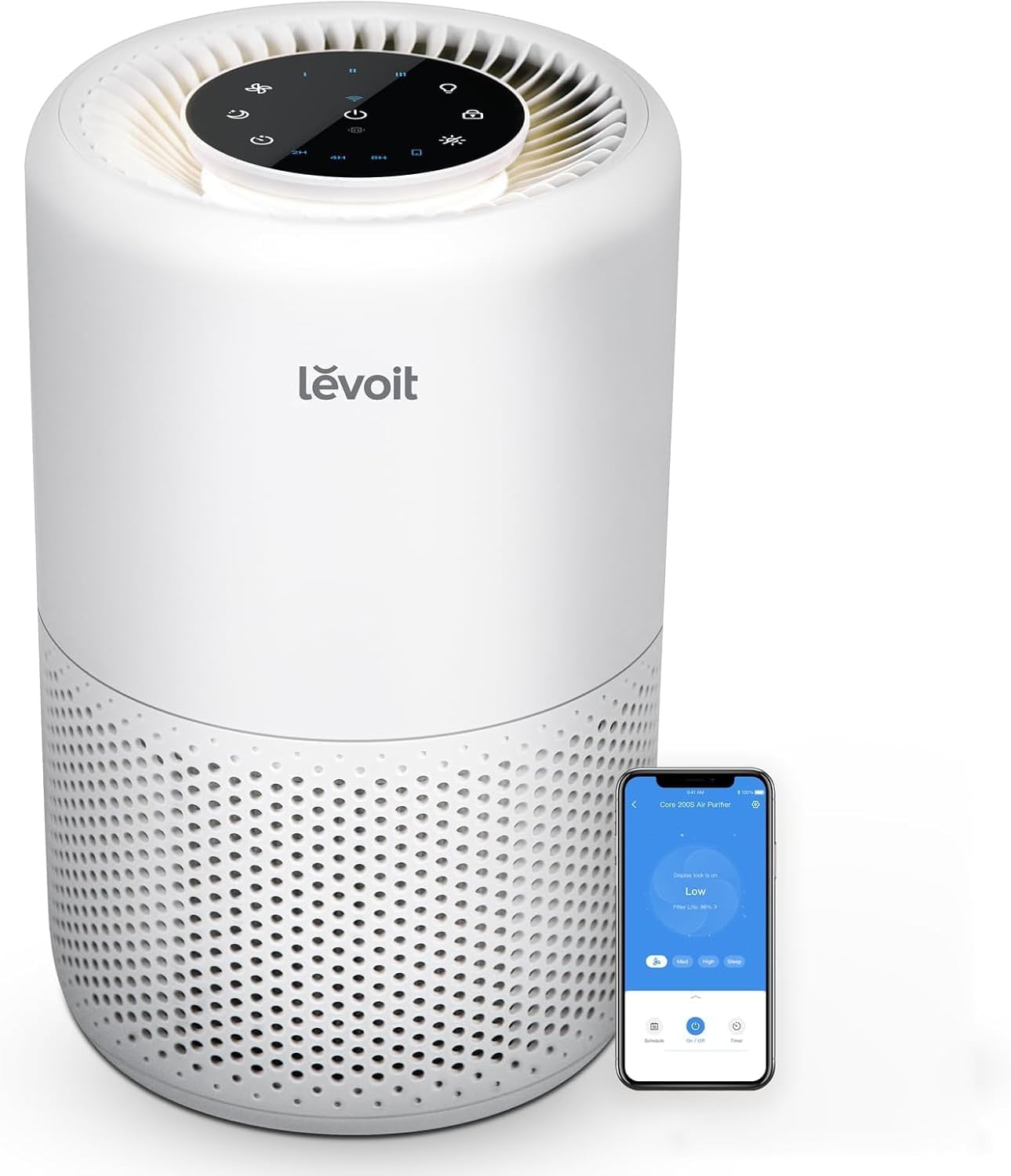
| Model | Core 200S |
|---|---|
| Room coverage | 140 ft² (refreshes 4.8×/hr) |
| Noise level | As low as 27 dB |
| Filter stages | 3-in-1 (pre-filter, activated carbon, HEPA-grade) |
The Levoit Core 200S-P is a small, smart air purifier built to capture pet dander, pollen, dust, and common household odors using a three-stage filter system including a HEPA-grade main filter and activated carbon layer. It is intended for bedrooms, nurseries, and apartments where quiet operation and automated control matter; the unit offers app and voice controls plus a Sleep Mode that reduces noise to as low as 27 dB. Practical benefits include a 360° air intake and a motorized airflow that refreshes a 140 ft² room multiple times per hour, plus an in-app filter life monitor that simplifies maintenance. Because it is compact and lightweight, it is easy to move between rooms but its coverage is limited to smaller spaces, so it will not replace a larger whole-room or whole-house system. The purifier performs well on allergens and light smoke or odors, but users with severe asthma triggers or very large rooms should opt for a higher-capacity model.
Best for: Buyers who prioritize reliable allergen removal in bedrooms or small living spaces and want quiet, app-enabled operation with clear filter maintenance indicators.
Less Ideal for: Homes needing whole-room coverage, large open living areas, or users who require medical-grade filtration for severe respiratory conditions should consider higher-capacity units.
- True HEPA-grade main filter that captures 99.97% of 0.1–0.3 micron particles
- Three-stage filtration including pre-filter and activated carbon for odors and pet hair
- Smart app and voice control plus filter life monitoring for easy, automated use
- Very quiet Sleep Mode at about 27 dB suitable for bedrooms
- Rated coverage is for small rooms only and not suitable for large open-plan areas
- Replacement filters are recommended to maintain performance and add ongoing cost
Verdict: A compact, quiet, smart HEPA purifier that reliably reduces pet allergens and common household pollutants in small bedrooms and apartments.
Choosing the Right HEPA Air Purifier for Allergies and Asthma: Key Factors to Consider
Filtration Efficiency and Media Type
High filtration efficiency is the most important factor for allergy and asthma relief because it determines how effectively the purifier removes small particles that trigger symptoms. Look for true HEPA media rated to capture at least 99.97% of particles down to 0.3 microns or manufacturers that publish equivalent third-party test results.
Different HEPA designs and prefilter stages alter how long a main HEPA element lasts and how well larger particles are trapped before reaching the fine media. Consider whether the purifier uses a true HEPA element or a HEPA-type/HEPA-style filter and prioritize true HEPA for clinically relevant allergen capture.
Room Size and Clean Air Delivery Rate (CADR)
Matching a purifier to your room size ensures it can cycle the air often enough to reduce allergen concentrations. CADR ratings indicate how quickly a purifier can remove smoke, dust, and pollen in cubic feet per minute and are the practical metric for sizing.
A unit with insufficient CADR for your bedroom or living area will provide limited relief even if its filter is excellent. For larger open-plan spaces, choose a purifier with higher CADR or plan to use multiple units to maintain effective air changes per hour.
Noise Levels and Sleep-Friendly Operation
Many people with allergies and asthma are sensitive to sleep disruption, so a purifier's sound output at typical night settings is crucial. Look for models with documented decibel levels on low and sleep modes, and check that the unit has a genuinely quiet overnight setting.
Fan speed control and automatic night modes that dim indicators and lower fan RPMs make a unit more usable in bedrooms. Keep in mind that higher filtration and higher CADR often require higher fan speeds and therefore more noise, so weigh noise versus cleaning speed for your use case.
Filter Maintenance and Running Costs
Ongoing maintenance drives the long-term value and convenience of an air purifier. Consider filter replacement frequency, the ease of removing and installing filters, the availability of replacement parts, and whether the unit uses multiple disposable stages or a mix of washable prefilters and replaceable HEPA cartridges.
Some purifiers include filter-life indicators that estimate remaining service life, which reduces guesswork. Factor in the recurring expense of replacement filters when estimating overall operating cost, since frequent replacements can make an initially inexpensive unit costly over time.
Operational Features and Controls
Practical operational features influence daily satisfaction and proper use. Useful features include variable fan speeds, programmable timers, air-quality sensors with auto mode, and clear indicator lights for filter status. Remote control or app connectivity can add convenience but is secondary to core cleaning performance.
Sensors that adjust fan speed based on detected particulates or VOCs help maintain consistent air quality without constant manual adjustments. However, auto modes vary in sensitivity, so ensure the sensor behavior aligns with your expectations for responsiveness.
Where to Place an Air Purifier in Your Home
Placement affects how quickly and thoroughly an air purifier reduces airborne allergens. For bedrooms, place the unit near the area where you spend the most time—usually close to the head of the bed—but avoid blocking airflow with curtains, furniture, or walls. In living areas, position the purifier so it can draw air across the primary breathing zone rather than tucked away in a corner.
For open-plan spaces, place the purifier centrally or use multiple units to cover distinct zones. Avoid placing purifiers directly on carpet if possible; a small bedstand, table, or dedicated stand ensures intake and exhaust are unobstructed and reduces the amount of large fibers sucked into the prefilter.
- Keep at least a few inches of clearance around intake and exhaust vents.
- Avoid placing the purifier on the floor in high-traffic areas where it can be bumped.
- Do not obstruct the airflow with curtains or furniture, and avoid placing it directly under shelves.
Understanding CADR and How It Relates to Real Rooms
CADR is a standardized measure of how quickly a purifier removes specific particle types. Use the CADR numbers for smoke, dust, and pollen as a starting point for selecting a unit that matches your room volume. To estimate effectiveness, calculate room volume and target an air change rate that suits sensitivity—people with moderate to severe allergies often benefit from higher air changes per hour.
Remember that CADR is measured in controlled conditions, so actual performance can vary with room layout, ceiling height, and sources of pollution. If you have persistent triggers like a heavy pet presence or frequent outdoor pollen, choose a unit with a higher CADR than the bare minimum for your space.
- Calculate room volume: length x width x ceiling height to judge needed capacity.
- Aim for multiple air changes per hour in bedrooms where prolonged exposure occurs.
- Consider higher CADR for rooms with active sources of allergens such as pets or smoking.
Maintenance Best Practices to Keep Performance High
Regular maintenance preserves filtration efficiency and prevents reduced airflow as filters load with particles. Replace HEPA and carbon filters per manufacturer guidance or sooner if you notice reduced airflow or increased noise. Inspect prefilters monthly and vacuum or wash washable prefilters to extend the life of the main HEPA element.
Keep the air purifier in a low-dust area when possible and avoid placing it near heavy cooking or moisture sources that can accelerate filter loading. Use the unit daily for consistent air quality rather than only when allergens spike, because continuous operation prevents accumulation of triggers.
- Check prefilters every 2 to 4 weeks and clean or replace as recommended.
- Replace HEPA cartridges on the schedule advised by the manufacturer or sooner with heavy use.
- Run the purifier continuously on a low to medium setting for steady air quality in bedrooms.
Combining Purification with Other Allergy Control Measures
An air purifier is one part of a layered approach to allergy and asthma management. Pairing a HEPA purifier with routine cleaning, mattress and pillow encasements, and regular pet grooming reduces the overall allergen load that the purifier must handle. Keep windows closed during high pollen seasons and use air conditioning when possible to limit outdoor particle infiltration.
For people with asthma, coordinate appliance use with a broader action plan that may include medication and trigger avoidance. Purifiers help lower the concentration of airborne triggers but do not remove allergens embedded in fabrics or carpets, so combine air cleaning with targeted surface cleaning.
- Use washable bedding and encase pillows and mattresses to reduce dust-mite reservoirs.
- Vacuum with a HEPA-equipped vacuum cleaner to remove settled particles from carpets and upholstery.
- Shower and change clothes after extended outdoor exposure to reduce bringing pollen indoors.
How We Chose the Best HEPA Air Purifier for Allergies and Asthma
We narrowed the field to HEPA air purifiers specifically suited for allergies and asthma by applying filters that reflect real-world use and medical-relevant performance. Selection began with certified HEPA filtration or equivalently rated true HEPA media capable of capturing 0.3 micron particles, because particle removal at that scale matters for pollen, smoke, and many allergens. We prioritized models with stated CADR or documented clean-air delivery expectations that match common room sizes for bedrooms and living rooms. Noise performance during sleep hours was another key filter, since constant high noise can negate benefits for allergy sufferers, and units with multiple fan speeds or quiet modes were favored. We also looked for practical maintenance features such as accessible filter replacement, clear filter-life indicators, and widely available replacement filters. Energy efficiency and runtime cost were considered to judge daily use implications. Excluded from the list were purifiers that rely on unproven ionization or ozone-producing technologies as primary cleaning methods, since those approaches can complicate respiratory conditions. We also excluded units that lacked transparent filtration specs or did not provide adequate room coverage data. The included criteria reflect what matters most for allergy and asthma relief: filtration effectiveness, appropriate room sizing, quiet operation, upkeep practicality, and verified air-moving performance.
Our full evaluation process is outlined in our review methodology.
FAQ
How often should I run a HEPA air purifier for allergy relief?
Run the purifier continuously if possible, with night or low modes enabled while sleeping. Continuous operation maintains a steady low concentration of airborne triggers, whereas intermittent use allows particles to build up again.
Will a HEPA purifier remove pet dander and hair?
HEPA filters effectively capture pet dander and many airborne hair particles, though visible pet hair can be trapped by prefilters. Regular grooming and cleaning are still important because hair and dander settle into fabrics and carpets where a purifier cannot reach them easily.
Can an air purifier help during high pollen season?
Yes, a HEPA purifier reduces airborne pollen indoors, especially when windows and doors are kept closed. For heavy pollen exposure, increase the purifier's fan speed or use a unit sized for a larger room to improve air turnover.
Are ozone-generating purifiers safe for people with asthma?
Ozone-generating purifiers are not recommended for people with asthma because ozone can irritate the lungs and worsen respiratory symptoms. Choose devices that rely on HEPA filtration and avoid technologies that intentionally produce ozone.
How do I know when to replace the HEPA filter?
Replace filters according to the manufacturer schedule or when the unit's filter-life indicator signals replacement. Visible discoloration, reduced airflow, or persistent odors are signs that a filter may need changing sooner.
Final Verdict
Prioritize filtration efficiency and proper room sizing when choosing a HEPA air purifier for allergies and asthma. Focus on a true HEPA media, a CADR rating that matches your room volume, and a quiet, low-speed mode that supports overnight use. Factor in filter maintenance and energy use to ensure the unit remains practical to run every day. Balancing these tradeoffs will help you pick a purifier that consistently reduces airborne triggers while fitting into your living space and routine. Choose a unit that meets your most important criteria—filtration, coverage, or quiet operation—and you will have a reliable tool to improve indoor air quality and comfort.