
Note: This article contains affiliate links. If you click on these links and make a purchase, we may earn a small commission at no extra cost to you. This helps support our research and content. Read our full affiliate disclosure here.
If dust mites trigger sneezing, congestion, or worsening allergies in your home, choosing the right air purifier can make a noticeable difference. Air purifiers designed for dust-mite control focus on capturing very small particles, reducing airborne allergen load, and supporting cleaner bedroom and living spaces where mites thrive. This guide shortlists the top options you can consider and walks through the specs and features that matter for mite reduction. Below are our top picks for air purification targeted at dust-mite reduction, followed by clear buying guidance and practical tips for getting the best performance from a purifier in your home.
Top Picks at a Glance
| Best Overall The best all-around choice for most situations | Coway Mighty AP-1512HH |  |
| Best Quality Built to a higher standard if you want something more solid | Winix 5510 Air Purifier |  |
| Best Value The sweet spot between price and what you get | Afloia KILO Air Purifier |  |
| Best Budget The cheapest option that still gets the job done reliably | MOOKA B-D02L Air Purifier |  |
| Top Rated A top-rated pick with lots of positive feedback | Levoit Core 300-P |  |
| Most Popular A crowd favorite that many people choose with confidence | Levoit Vital 100 Air Purifier |  |
| Best Seller A high-volume bestseller chosen again and again | VOOPNU HEPA Air Purifier DH-JH12 |  |
Coway Mighty AP-1512HH

| Coverage | Up to 1,748 sq. ft. in 60 minutes |
|---|---|
| HEPA effectiveness | 99.97% of 0.3μm particles |
| Filtration stages | Pre-filter, deodorization, bipolar device, HEPA |
| Model | AP-1512HH |
The Coway Mighty AP-1512HH is a room air purifier built around a four-stage filtration system (washable pre-filter, deodorization filter, bipolar ionizer, and true HEPA) that targets common household particles and odors. It is typically used in living rooms, bedrooms, or workspaces where continuous monitoring and automatic fan adjustment are helpful; the unit's air quality sensor and color LED give an instant read on pollution levels and Auto Mode adjusts fan speed as needed. Notable features include a washable pre-filter to capture large particles, a HEPA filter rated to remove 99.97% of 0.3 micron particles, a filter-replacement indicator, timer and eco functions for lower power use, and an optional ionizing stage for added removal of ultrafine particles. In practice this model is effective at reducing dust, pollen, pet dander, and many smoke or VOC odors across medium-to-large rooms, though replacement filters and the ionizer maintenance add ongoing cost and care. The unit is not the smallest or quietest purifier at high fan speeds, so expect audible operation when running aggressively to reach its stated coverage quickly.
Best for: Buyers who want a reliable, sensor-driven purifier for living spaces that removes dust, pollen, pet dander and common household pollutants with minimal daily interaction.
Less Ideal for: People seeking the absolute quietest bedroom unit or an ultra-compact purifier for very small rooms should consider smaller, lower-output models instead.
- Four-stage filtration including true HEPA that captures 99.97% of 0.3 μm particles
- Real-time air quality sensor with Auto Mode for hands-off fan speed control
- Washable pre-filter reduces dust buildup and prolongs main filter life
- Filter indicator and timer/eco modes simplify maintenance and energy use
- Higher fan speeds are noticeably audible compared with ultra-quiet designs
- Ongoing cost for replacement HEPA and custom filters over time
Verdict: Choose the Coway Mighty AP-1512HH if you want a sensor-driven, multi-stage purifier that reliably reduces dust mites and airborne allergens across medium to large rooms.
Winix 5510 Air Purifier

| Coverage (1 hr) | 1,882 sq ft |
|---|---|
| Filtration | 4-Stage (pre-filter, True HEPA, carbon, PlasmaWave) |
| Noise (low) | 23.5 dB |
| Smart features | WiFi, Winix Smart App, Alexa/Google Home |
The Winix 5510 is a four-stage air purifier built for large rooms, combining a washable pre-filter, True HEPA filter, advanced carbon odor filter, and Winix PlasmaWave technology to target allergens, smoke, and household odors. It uses built-in smart sensors and an LED air quality indicator to monitor conditions and automatically adjust fan speed in Auto Mode, and it can be controlled remotely with the Winix Smart App and voice assistants. Practical benefits include high reported CADR coverage for rapid cleaning of big spaces, a washable pre-filter that reduces replacement frequency, and a light-activated Sleep Mode for very quiet overnight operation. The advanced carbon stage helps reduce VOCs and persistent smells that can cling to fabrics and bedding. Limitations are typical for high-coverage purifiers: it is sized for larger areas so it may be overkill for small bedrooms and filter replacements and app setup add ongoing costs and minor setup effort. For buyers focused on high performance against fine particles and dust-mite allergens in open or large rooms, it delivers strong, hands-off cleaning with useful smart controls.
Best for: Buyers who prioritize fast, high-volume removal of fine particles and allergens across large open rooms and want automatic sensor-driven operation and smart controls.
Less Ideal for: People who need a compact, ultra-low-cost purifier for a small bedroom or those who want a strictly mechanical unit without app or optional plasma functionality.
- Four-stage system with True HEPA captures very small particles including dust mite allergens
- Washable fine-mesh pre-filter extends life of main filters and reduces running cost
- Advanced carbon filter reduces odors and some VOCs that trap allergen-carrying dust
- Smart sensors with Auto Mode and LED AQI indicator provide automatic, real-time adjustments
- Winix Smart App and voice control let you monitor and adjust remotely
- Designed for large rooms so may be less efficient or noisier relative to room size in small bedrooms
- Ongoing cost of HEPA and carbon filter replacements
- PlasmaWave is an added feature some users may prefer to disable due to mixed opinions on ionizing technologies
Verdict: Choose the Winix 5510 when you need a high-performance, sensor-driven purifier that rapidly removes fine particles and dust-mite allergens from large rooms.
Afloia KILO Air Purifier
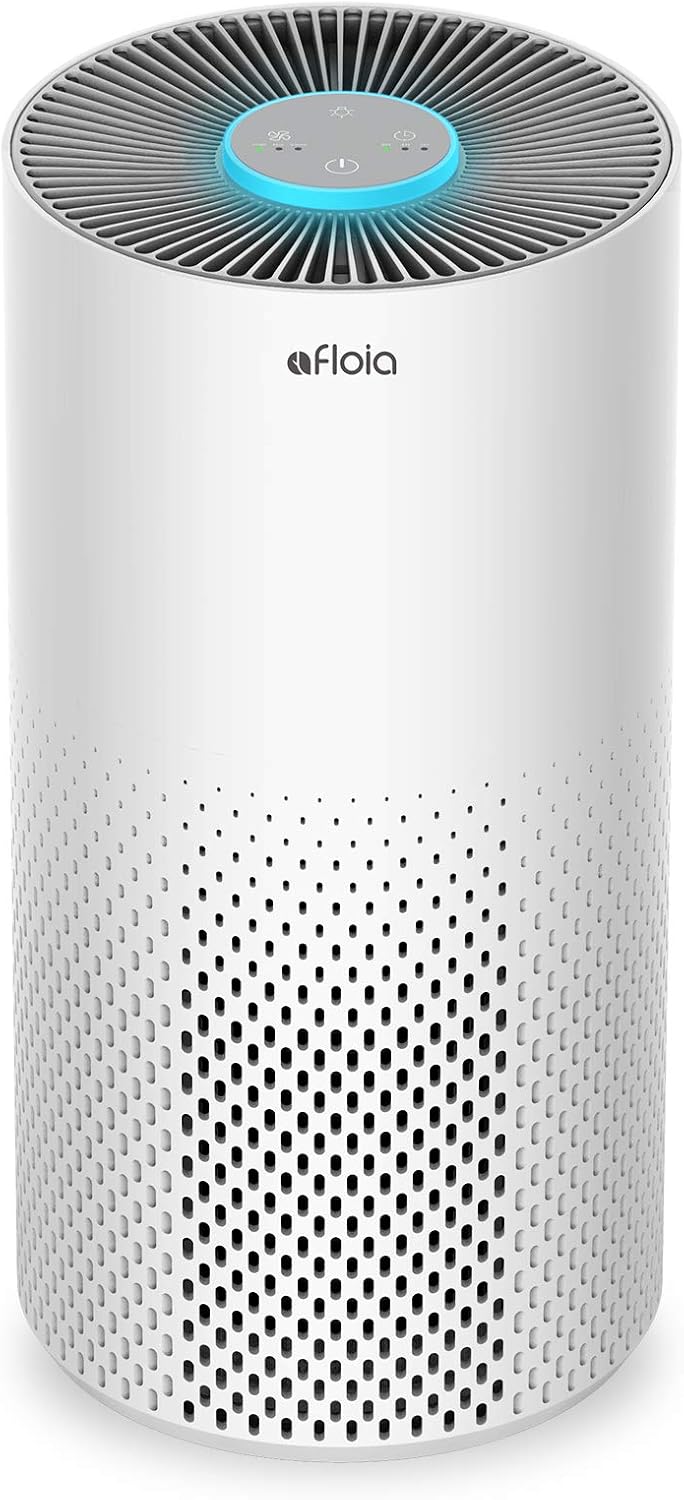
| Floor Area | 60.84 square_feet |
|---|---|
| Noise Level | 22 db |
| Particle Retention Size | 0.3 micron |
| Wattage | 23 watts |
| Filter Type | Activated Carbon |
The Afloia KILO is a compact home air purifier that uses a washable pre-filter plus multi-layer filtration to reduce dust, pet hair, pollen, odors and other common indoor particles. It is typically placed in bedrooms, living rooms or home offices and runs continuously or on a 2/4/8/16 hour timer while offering multiple fan speeds and a 22 dB sleep mode for low-noise overnight operation. Notable features include a removable washable pre-filter to trap larger debris, a 0.3 micron particle retention target appropriate for allergens, and a color-changing night light for ambient use. Practical benefits include easy upkeep because the pre-filter can be rinsed, selectable timers and quiet operation that do not disturb sleep, and documented CARB certification for emissions. Limitations are that replacement specialized filters are recommended every 4–6 months for best performance and the unit is sized for single-room use rather than whole-home filtration, so larger or multiple rooms will need more than one device to control dust mite allergens effectively.
Best for: Buyers who want a low-maintenance, quiet bedroom or small-room purifier that reduces common allergens with an easy-to-clean pre-filter and simple controls.
Less Ideal for: People who need whole-house or large open-plan coverage or those seeking a permanently filter-free solution should consider larger-capacity systems or HVAC-integrated options.
- Washable removable pre-filter captures hair and large dust for lower maintenance.
- Multi-stage filtration targeting 0.3 micron particles suitable for many allergen-sized particles.
- Very quiet 22 dB sleep mode for overnight use.
- Timer and multiple fan speeds let you balance runtime and noise.
- CARB certification indicating low emissions.
- Designed for single-room coverage so it may not suffice for large open floor plans.
- Replacement filters are recommended frequently for peak performance.
Verdict: A quiet, low-maintenance small-room purifier that uses washable pre-filtration and multi-stage filters to cut dust and common allergens in bedrooms and similar spaces.
MOOKA B-D02L Air Purifier
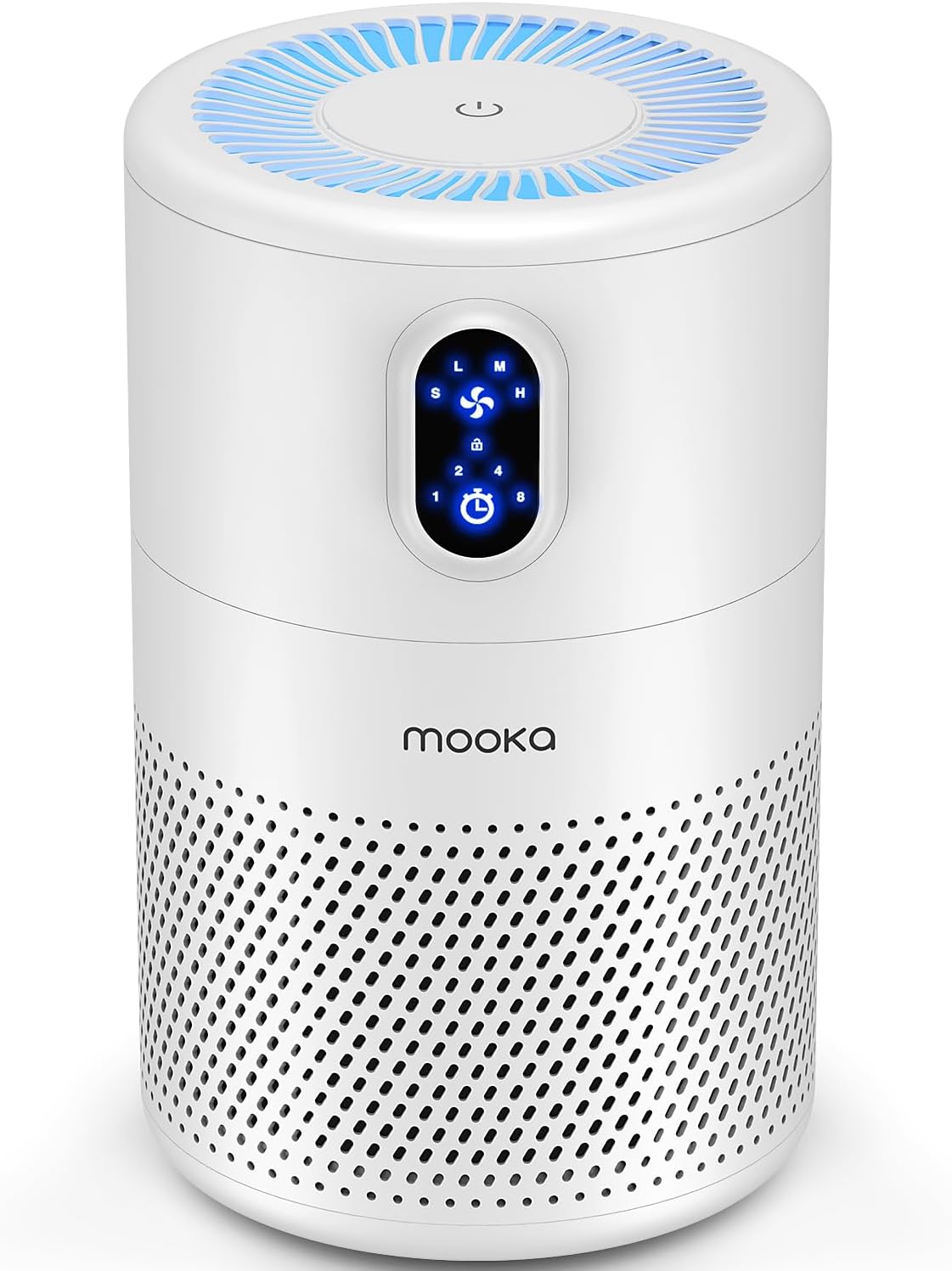
| Coverage | Up to 1076 sq ft |
|---|---|
| Filter type | H13 True HEPA + activated carbon |
| Fan modes | Sleep/Low/Med/High |
| Timer | 1/2/4/8 hours |
The MOOKA B-D02L is a budget-friendly air purifier that combines a pre-filter, H13 True HEPA element, and activated carbon to capture dust, pollen, pet dander, smoke, and odors. It is intended for use across a wide range of room sizes — the listing states coverage up to 1,076 sq ft with lower air-change rates in very large spaces and faster cycling in smaller rooms. Controls are simple: four fan speeds (including a quiet sleep mode), four timer settings, and a child lock, plus a soft night light that can be turned off. Practical benefits include an ultra-quiet brushless motor for near-silent overnight use and a washable or replaceable filter that the company recommends changing every 3 to 6 months depending on conditions. Limitations to note are that real-world performance will depend on room layout and how many air changes you need for heavy dust-mite loads, and the purifier relies on periodic filter replacement to maintain efficiency. For buyers prioritizing clean air on a tighter budget, it offers core HEPA filtration and usable controls in a compact package.
Best for: Buyers who want an affordable, straightforward HEPA purifier for improving household air and lowering allergen exposure without advanced smart features or complicated setup.
Less Ideal for: People who need medical-grade continuous filtration for severe allergies or who require integrated app control and detailed air-quality reporting should consider higher-end or specialized units.
- H13 True HEPA filter captures particles down to common allergen size including dust and dander
- Activated carbon layer helps reduce smoke and household odors
- Very quiet operation thanks to brushless motor, suitable for bedrooms
- Simple controls with four fan speeds, timers, and child lock for easy daily use
- Stated large-area coverage assumes low air-change targets so multiple units or longer run times may be needed for heavy dust-mite reduction
- Filter replacement every 3–6 months adds ongoing cost
Verdict: A cost-conscious HEPA purifier that delivers basic, quiet filtration and odor reduction for homes aiming to reduce dust and common allergens.
Levoit Core 300-P

| Filter Type | 3 in 1 Filtration |
|---|---|
| Noise Level | 24 db |
| Power Source | Corded Electric |
| Wattage | 56 watts |
| Particle Retention Size | 0.3 micron |
The Levoit Core 300-P is a small, reliable HEPA air purifier built around a 3-stage filtration system and a true HEPA-grade filter that captures 99.97% of particles down to 0.1–0.3 microns. It is used as a standalone room purifier for bedrooms, living rooms, or home offices and runs quietly in Sleep Mode at about 24 dB, so it can operate overnight without disturbing sleep. Practical features include touch controls, a timer, a check-filter indicator, and a portable footprint that makes it easy to move between rooms. Performance is backed by AHAM verification with CADR figures suitable for refreshing mid-size rooms multiple times per hour and basic certifications (CARB, ETL). Limitations are that this model lacks smart Auto Mode and requires manual fan-speed control, and Levoit recommends using official replacement filters and replacing them every 6 to 8 months to maintain rated performance.
Best for: Buyers who prioritize consistent, proven filtration and quiet overnight operation for bedrooms or living spaces and who want a straightforward, low-maintenance purifier.
Less Ideal for: Users who need app control, automatic air-quality-driven fan adjustments, or broader whole-home integration should consider models with smart Auto Modes instead.
- True HEPA-grade 3-stage filter captures 99.97% of 0.1–0.3 μm particles, effective against dust mite allergens
- AHAM-verified CADR and certifications (CARB, ETL) confirm measured cleaning performance and safety
- Very quiet Sleep Mode at approximately 24 dB suitable for overnight use
- Compact and portable design makes it easy to place in bedrooms or move between rooms
- No smart connectivity or Auto Mode, so fan speed must be adjusted manually
- Best performance depends on using official Levoit replacement filters and regular 6–8 month replacements
Verdict: Choose the Core 300-P when you want a proven, quiet HEPA purifier that reliably reduces dust mite allergens in bedrooms and similar rooms.
Levoit Vital 100 Air Purifier

| CADR | 105 CFM |
|---|---|
| Coverage | up to 788 ft² per hour |
| Filtration | 3-stage (washable pre-filter, particle filter, activated carbon) |
| Noise level | as low as 24 dB |
The Levoit Vital 100 is a compact air purifier built for everyday home use, combining a washable pre-filter, an efficient particle filter, and an activated carbon layer to tackle dust, pollen, pet hair, odors, and smoke. It is intended for bedroom or living-room placement and includes a rear carry handle and a simple control panel with a timer and display light-off option for nighttime. The Vital 100 advertises a 105 CFM CADR and claims to refresh up to 788 sq ft once per hour, which makes it useful for rooms where dust mites and airborne allergens are a concern. Noise can drop to about 24 dB on low, so it stays unobtrusive while sleeping. Practical limits are that it is a small, single-room unit and uses Levoit genuine replacement filters for best performance, so filter cost and replacement interval matter for ongoing effectiveness. The washable pre-filter helps catch larger debris and extends main filter life, but heavy dust loads will still require regular maintenance and eventual filter replacement.
Best for: Buyers who prioritize proven performance and many positive user reviews and want a compact, quiet purifier for bedrooms or living areas to reduce dust mite allergens and airborne particles.
Less Ideal for: People looking to clean multiple rooms or large open-plan spaces who need a higher-capacity or whole-home system.
- Three-stage filtration including washable pre-filter, particle filter, and activated carbon for odors
- Reported 105 CFM CADR suitable for single-room air turnover
- Very quiet operation down to 24 dB for bedroom use
- Timer and display-off control for convenient nighttime operation
- Designed for single-room use so not suited as a whole-house solution
- Requires genuine replacement filters which add to operating cost
Verdict: A compact, quiet three-stage purifier that provides effective single-room cleaning and strong user trust for reducing dust mite allergens.
VOOPNU HEPA Air Purifier DH-JH12

| Filtration | H13 True HEPA triple-layer |
|---|---|
| Coverage | Up to 1,076 ft² (laboratory tested) |
| Noise level | As low as 22 dB |
| Speeds | 3 speeds |
The VOOPNU DH-JH12 is a small footprint air purifier that uses an H13 true HEPA triple-layer filter and 360 degree intake to capture fine particles, pet hair, pollen, smoke, and odors for large rooms. It is typically placed on a desk, nightstand, or corner and left running continuously to reduce airborne dust and allergens; the manufacturer says it cleans 250 ft² every 15 minutes and can cover up to 1,076 ft² per hour in lab testing. Controls are simplified to one-touch operation with three speeds and a timer, and it runs very quietly down to around 22 dB for bedroom use. There is an essential oil tray for light scenting and a washable pre-filter option on some models, while the primary H13 filter is rated to remove 99.97% of airborne pollutants. Trade-offs include the need to replace primary filters on a recommended cycle and the unit's very compact blower design, which may require longer continuous run time to keep very dusty or high-traffic spaces consistently clear. Certifications from DOE, ETL, FCC, CARB, CE, and ROHS provide additional reassurance about safety and performance.
Best for: Buyers who prioritize dependable, certified filtration for allergy reduction and prefer a simple, quiet unit they can run continuously in bedrooms or living spaces.
Less Ideal for: Those wanting instant heavy-duty cleaning in very large or industrial spaces or users who require integrated smart-home features or app control.
- H13 true HEPA triple-layer filtration captures 99.97% of airborne particles
- Laboratory-tested coverage rate (250 ft² every 15 minutes) suitable for large rooms
- Very quiet operation down to about 22 dB for bedroom or nighttime use
- 360° surround intake and compact footprint make placement flexible
- Multiple certifications (DOE, ETL, FCC, CARB, CE, ROHS) indicating tested safety and compliance
- Primary HEPA filter requires periodic replacement according to the recommended cycle
- Compact blower may need continuous run time to maintain low particle levels in very dusty or high-traffic rooms
Verdict: A compact, quietly running H13 HEPA purifier with verified coverage and safety certifications that suits risk-averse buyers seeking reliable dust and allergen reduction for bedrooms and living rooms.
Choosing the Right Air Purifier for Dust Mites: Key Factors to Consider
Filtration Type and HEPA Rating
Mechanical HEPA filtration is the primary method that captures dust-mite allergens suspended in air. Look for true HEPA filters rated to remove at least 99.97% of particles down to 0.3 microns, and consider additional layers like prefilters for larger dust and activated carbon for odors. Higher-efficiency filters or multi-stage systems will trap more allergenic particles but can increase resistance and fan load.
Choosing the right HEPA grade matters because dust-mite fragments and fecal particles can be well under a few microns. A certified HEPA filter combined with a sealed filtration path reduces the chance that untreated air bypasses the filter and reintroduces allergens into the room.
Room Size and Clean Air Delivery Rate
An air purifier must move enough air to meaningfully lower airborne allergen concentrations in the intended space. Clean Air Delivery Rate, or equivalent room-coverage ratings, indicate how quickly a unit can filter a room. Match the CADR or manufacturer-specified square footage to the actual room where mites are problematic, and consider aiming for at least two to five air changes per hour for bedroom use.
Undersizing a unit will leave you with limited benefit even if the filter is excellent. Conversely, a unit rated for larger rooms will run quieter and at lower fan speeds while maintaining effective air turnover.
Noise and Nighttime Operation
Many people need continuous filtration while they sleep because bedrooms are common hotspots for dust-mite exposure. Noise output and low-speed fan performance determine whether you can run a purifier overnight. Check low-speed decibel ratings or user-focused quiet modes that still deliver meaningful air changes.
Excessive noise often leads owners to turn devices off, defeating their purpose. Look for settings that balance reasonable noise with adequate airflow and consider units with programmable schedules or sleep modes to maintain operation at night.
Filter Access, Replacement, and Cost
Effective long-term allergen control depends on keeping filters in good condition. Consider how easy it is to access and replace filters, whether replacement filters are widely available, and the expected service life. Some filters include integrated prefilters or washable components that reduce ongoing costs, while others require frequent proprietary replacements.
Factor in both the literal replacement cost and the frequency of changes when budgeting. Poorly maintained filters lose efficiency, so a simpler maintenance routine often yields better real-world performance.
Airflow Design and Sealed Construction
A unit's internal airflow path and overall build determine how effectively air is forced through the filter rather than leaking around it. Look for models with gasketed filter doors or sealed chambers and clear specifications about air intake and exhaust. Cylindrical or multi-directional designs can improve circulation in a room, while poorly sealed systems may allow unfiltered air to recirculate.
Good airflow design also affects distribution. A purifier that pushes treated air across the breathing zone and promotes whole-room mixing will reduce localized pockets of allergens more reliably.
Where Dust Mites Thrive In The Home
Dust mites prefer warm, humid environments and are most abundant in bedrooms, upholstered furniture, and carpets. The tiny particles that trigger allergies are often generated by bedding and fabric, so focusing purification where people spend time sleeping and relaxing delivers the biggest payoff.
Reducing humidity, washing bedding in hot water, and using tightly woven covers complement a purifier's airborne allergen reduction. A purifier cannot remove mites embedded deep in mattresses or textiles, but it does cut down airborne fragments and fecal particles that provoke reactions.
- Bedrooms and mattresses are primary hotspots
- Soft furnishings and carpets trap mite populations
- Air purifiers reduce airborne allergen load but do not replace cleaning
Placement Tips For Best Allergen Reduction
Place the purifier close to the main source of airborne allergens when possible, such as near the bed in a bedroom. Avoid tucking units behind furniture or placing them in corners where airflow is restricted. Ideally, position the intake where air can circulate freely and the outlet points toward the central area of the room.
If you have multiple rooms of concern, prioritize one high-use space rather than running a single undersized unit across the whole house. For open-plan areas, center the purifier in the main living space or use multiple units sized appropriately for each area.
- Keep intakes unobstructed for maximum CADR
- For bedrooms, place near the head of the bed but not directly blowing on sleepers
- Ensure at least several feet of clearance on intake and exhaust sides
Running Strategies And Maintenance Schedule
Continuous or near-continuous operation yields the best reduction in airborne mite allergens because it prevents accumulations between cycles. Use higher fan speeds during active periods and lower, quieter modes overnight to maintain consistent air changes. Timers and smart scheduling can automate this so filtration runs when needed without manual adjustments.
Set a routine for filter checks and replacements according to manufacturer guidance and household dust levels. Inspect prefilters monthly and plan HEPA replacements as recommended. Regular vacuuming and washing of bedding combined with purifier maintenance deliver the most consistent allergy relief.
- Run continuously if possible; use lower fan speeds at night
- Check prefilters monthly and HEPA elements according to load
- Use timers or smart modes to align operation with occupancy
When Extra Controls Matter: Humidity And Additional Technologies
Dust mites thrive in higher humidity, so pairing dehumidification or HVAC humidity control with an air purifier can be particularly effective. If humidity in your home regularly exceeds 50 percent, address moisture first because lowering humidity reduces mite reproduction.
Some units include supplemental technologies such as activated carbon for odors or UV for microbial control. These can be helpful for broader indoor-air concerns, but they do not replace mechanical HEPA filtration for allergen capture. Avoid relying on any single technology; instead, prioritize proven filtration and use extras as complementary features.
- Target humidity control alongside air filtration for best results
- Activated carbon helps with odors but not particle capture
- Supplemental tech should complement, not replace, HEPA filtration
Measuring Success: What Results You Can Expect
A correctly sized and maintained purifier will reduce airborne allergen concentrations, which often translates to fewer sneezes, less nasal congestion, and improved sleep for allergy sufferers. Expect gradual improvements rather than instant elimination, since settled dust and embedded mite populations take cleaning measures to address.
Track changes by noting symptom frequency and duration, and consider using particle counters or indoor-air monitors if you want objective data. Most users find that combining purification with bedding hygiene and humidity control produces the clearest benefits.
- Improvements are incremental and best when combined with cleaning
- Objective monitoring can confirm reductions in airborne particles
- Symptom tracking helps gauge real-world effectiveness
How We Chose the Best Air Purifier for Dust Mites
We prioritized products that are demonstrably suited to reducing airborne allergen loads associated with dust mites. Key evaluation dimensions included particulate filtration efficiency at submicron sizes, CADR or equivalent clean-air delivery for common room sizes, and sealed airflow design to prevent bypass. We also weighed fan and airflow options so units can sustain the recommended number of air changes per hour, plus noise levels for use in bedrooms and energy consumption for continuous operation. Practical maintenance factors were another filter: we favored units with accessible filter changes, clear lifespan guidance, and replacement filter availability. We excluded devices that rely solely on ozone, ionization without mechanical HEPA capture, or technologies with inadequate evidence for allergen removal. In short, our selection process focused on measurable filtration performance, real-world room coverage, user upkeep, and quiet, energy-efficient operation.
Our full evaluation process is outlined in our review methodology.
FAQ
Can an air purifier eliminate dust mites from my mattress?
An air purifier reduces airborne mite fragments and allergenic particles but cannot remove mites embedded deep in mattresses or fabrics. Direct cleaning measures, like washing bedding and using allergen-proof covers, are needed to address mites in textiles.
How large a room should the purifier cover to help with bedroom allergies?
Choose a unit with a CADR or room rating that matches the bedroom square footage and targets at least two to five air changes per hour. A larger-rated unit will deliver better turnover at lower noise levels.
Do I need HEPA filters specifically for dust-mite allergens?
Yes. True HEPA filters capture very small particles associated with dust-mite allergens much more effectively than basic mechanical or electrostatic filters. Ensure the device has a sealed airflow path so air actually passes through the HEPA element.
Will running the purifier all night reduce my symptoms?
Running a purifier overnight on a quiet setting often helps because bedrooms are major exposure sites. Continuous operation maintains lower airborne allergen levels, but pairing this with bedding hygiene and humidity control maximizes benefits.
Are ionizers or ozone generators effective against dust mites?
Ionizers and ozone generators are not reliable substitutes for mechanical HEPA filtration for allergen removal and can produce byproducts that are harmful at higher concentrations. Prioritize units with true HEPA filtration for dust-mite reduction.
Final Verdict
When selecting an air purifier for dust mites, prioritize true HEPA filtration, adequate room coverage, and a sealed airflow path. Noise, maintenance ease, and energy use are practical tradeoffs that affect whether you will run the device consistently. Pair a properly sized purifier with bedding hygiene and humidity control for the most meaningful reduction in mite-related symptoms. Focus on measurable filtration performance and realistic room coverage; that approach will help you choose a unit that actually improves indoor allergy conditions rather than one that simply looks good on paper.