
Note: This article contains affiliate links. If you click on these links and make a purchase, we may earn a small commission at no extra cost to you. This helps support our research and content. Read our full affiliate disclosure here.
If you run an indoor grow room, keeping the air clean matters for plant health, pest prevention, and odor management. The right air purifier reduces airborne particulates, removes odors, and helps maintain a stable environment so plants spend more energy on growth rather than stress recovery. This guide collects seven shortlisted air purifiers that fit common grow-room needs and explains the technical tradeoffs you should weigh. We evaluate filtration efficiency, airflow coverage, and suitability for enclosed horticultural spaces to help you pick the best option for your setup.
Top Picks at a Glance
| Best Overall The best all-around choice for most situations | LUNINO K2 HEPA Air Purifier |  |
| Best Quality Built to a higher standard if you want something more solid | Nuwave Forever Air Purifier |  |
| Best Value The sweet spot between price and what you get | Levoit Core 200S-P |  |
| Best Budget The cheapest option that still gets the job done reliably | FULMINARE H13 HEPA Air Purifier |  |
| Top Rated A top-rated pick with lots of positive feedback | ECOSELF HAP603 Air Purifier |  |
| Most Popular A crowd favorite that many people choose with confidence | Levoit Core 300-P |  |
| Best Seller A high-volume bestseller chosen again and again | VOOPNU HEPA Air Purifier DH-JH12 |  |
LUNINO K2 HEPA Air Purifier

| Item model number | K2 |
|---|---|
| Filtration stages | Washable pre-filter, H13 HEPA, activated carbon |
| Fan modes | Sleep/Auto/Low/Med/High/Turbo |
| Certifications | ETL, FCC, EPA, CARB |
The LUNINO K2 is a room-scale air purifier that uses a double-sided intake and a three-stage filtration stack (washable pre-filter, H13 HEPA, activated carbon) to remove particulates, odors, and smoke from indoor air. It is typically used running continuously or on auto mode; the built-in PM2.5 sensor adjusts fan speed based on measured air quality and the unit offers six modes including a very quiet sleep setting. The washable pre-filter lowers maintenance cost and the replaceable HEPA/carbon module handles pollen, pet dander, and common grow-room particulates and odors. Practical benefits for a controlled environment include faster circulation from the dual intake, a filter-replacement reminder, and a top aromatherapy slot that keeps oils separate from the filtration path. Important limitations are that stated coverage claims depend on room layout and source strength, the PM sensor needs time to settle after power-up, and heavy volatile organic compound loads or dense smoke may require higher-capacity or purpose-built odor remediation beyond a consumer HEPA/carbon unit.
Best for: Growers seeking a balanced, user-friendly purifier to control dust, pollen, light smoke, and mild odors in medium to large indoor grow spaces who value automatic sensing and lower maintenance.
Less Ideal for: Operations with heavy VOCs, solvent use, or very large commercial grow rooms that require industrial-scale odor or chemical scrubbing should choose purpose-built filtration systems instead.
- Double-sided air intake for quicker room circulation compared with single-intake designs
- Three-stage filtration with washable pre-filter plus H13 HEPA and activated carbon for particles and odors
- Built-in PM2.5 sensor with auto mode that adjusts fan speed to measured air quality
- Low-noise sleep mode (as low as 15 dB) suitable for quiet environments
- Filter replacement reminder and washable pre-filter reduces ongoing filter costs
- Coverage figures are idealized and actual performance varies with room layout and pollution sources
- PM2.5 readout can be inaccurate immediately after startup while the sensor stabilizes
- Not designed as an industrial VOC abatement system for very high chemical loads
Verdict: A practical, lower-maintenance HEPA/carbon purifier with automatic sensing and dual intake that fits balanced grow-room needs where particle control and modest odor reduction are the priority.
Nuwave Forever Air Purifier

| Coverage | 2,002 sq ft (1 hour) |
|---|---|
| Filtration stages | 7-stage system |
| Particle capture | Down to 0.1 microns |
| Model number | 47265 |
The Nuwave Forever Air Purifier is built for continuous heavy-duty use in large indoor spaces and uses a patented seven-stage filtration system with washable, reusable elements so you do not need replacement paper filters. It pulls air through stainless-steel prefilters and a Bio-Guard 360 stage that the brand says captures particles down to 0.1 microns, with an ozone removal stage to cut odors and residual ozone. The unit is rated to purify roughly 2,002 sq ft in one hour, and independent lab certification for particle capture and low ozone emission supports its performance claims. Practical benefits include lower ongoing filter costs, robust particle removal for smoke, dust, pollen, and pet hair, and selectable airflow via an adjustable flow panel to match room size or ventilation needs. Trade-offs are the unit size and weight that suit a fixed installation rather than portable spot use, and the upfront complexity and maintenance of multiple washable components versus simple disposable filter swaps.
Best for: Buyers prioritizing high continuous performance and low running filter costs for a dedicated grow room or large indoor space where reliable particle and odor control matters.
Less Ideal for: If you need a lightweight, easily moved purifier for small rooms or prefer the simplicity of disposable filter replacements, this is not the best choice.
- Washable, reusable filter system eliminates recurring replacement filter purchases
- Seven-stage filtration including prefilter, Bio-Guard 360, and ozone-removal stage for broad contaminant capture
- Certified to capture particles down to 0.1 microns and reported lab validation of low ozone emissions
- Large coverage area: rated to clean about 2,002 sq ft in one hour
- Adjustable flow panel lets you balance airflow and noise for different room needs
- Physically large and heavier, so not ideal for frequent relocation
- More maintenance time needed to wash and dry multiple filter components compared with disposable filters
Verdict: Choose this unit if you need a high-capacity, lab-validated purifier with reusable filters for continuous performance in a dedicated large grow room.
Levoit Core 200S-P
| Item model number | Core 200S |
|---|---|
| Manufacturer | Levoit |
| ASIN | B08FJ678YK |
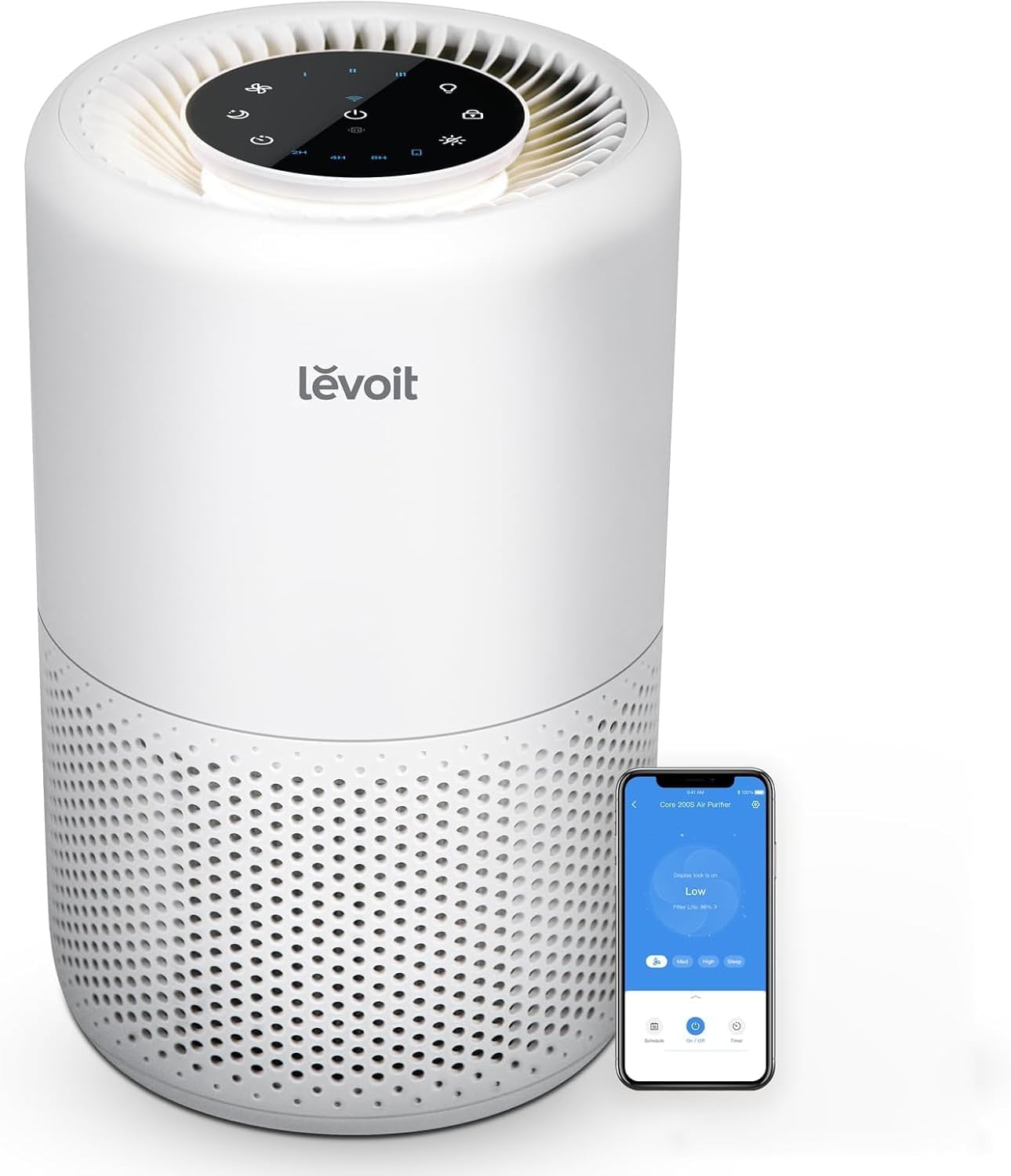
The Levoit Core 200S-P is a small, smart air purifier intended for bedrooms, offices, and similar small spaces; it uses a 3-in-1 filtration stack with a pre-filter, activated carbon layer, and a HEPA-grade main filter to capture dust, pollen, pet dander, and many fine particles. It draws air through a 360 degree intake and the company rates it to refresh the air in a roughly 140 ft² room multiple times per hour, which makes it useful where continuous low-to-moderate filtration is needed. The unit supports app and voice control so you can schedule runs, check filter life, and change fan speeds remotely, and a sleep mode plus a display-off button help keep operation quiet and unobtrusive at night. Practical benefits include genuine replacement filter availability and AHAM verification for cleaning performance. Trade-offs are its small coverage area and lightweight construction, so it is best used as a spot or supplemental purifier rather than the sole solution for larger or heavily contaminated spaces.
Best for: Buyers who want a compact, app-controlled purifier to continuously clean the air in a small, controlled grow room or a single grow tent and who prioritize quiet, automated operation.
Less Ideal for: People managing large or multiple grow rooms, heavy smoke, or very high particulate loads should choose a higher-capacity purifier designed for bigger spaces.
- Three-stage filter (pre-filter, activated carbon, HEPA-grade) removes particles and reduces odors
- Smart app and voice control with filter-life monitoring for remote scheduling and convenience
- Compact 360° intake design suited to continuous use in small rooms
- Very quiet operation with a dedicated sleep mode and display-off button
- Rated coverage is limited to small rooms, so it cannot handle large grow spaces on its own
- Lightweight, compact build limits airflow capacity compared with larger commercial purifiers
Verdict: A smart, quiet, and compact purifier that is a practical, automated choice for maintaining clean air in a single small grow room or grow tent.
FULMINARE H13 HEPA Air Purifier

| Filter type | H13 HEPA |
|---|---|
| Recommended room size | 215 ft² / 20 m² |
| Noise level | Around 24 dB (low) |
The FULMINARE H13 is a small, budget-friendly air purifier built around an H13 true HEPA filter and a 360-degree air outlet designed to refresh air in rooms up to roughly 215 ft². It is typically placed near plants or equipment to capture pet hair, smoke and common airborne particles while running quietly in low or sleep mode; the manufacturer advertises noise as low as 24 dB on its lowest setting. Controls include multiple timer options and an independent night light, and the unit uses a plug-in power design rather than batteries. Practical benefits for a grow room include continuous particle removal without a large footprint and the ability to run unobtrusively overnight. Important limitations are the modest coverage area and no explicit active carbon/odor capacity mentioned in the product details, so it may not be enough alone for heavy smell control or larger grow spaces and will require regular filter replacement as advised.
Best for: Growers on a tight budget who need a compact, low-noise purifier to reduce airborne particles in a single small grow room or tent and prefer a simple plug-and-run unit.
Less Ideal for: Large commercial or multi-room grow setups or growers whose priority is heavy odor and VOC removal should consider higher-capacity units with specified carbon filtration.
- H13 true HEPA filter captures small airborne particles
- 360° air outlet and dual-channel design for even circulation
- Very quiet low/sleep mode suitable for overnight operation
- Compact, portable footprint that fits in tight spaces
- Multiple timer settings and independent night light
- No explicit activated carbon specification for strong odor or VOC removal
- Rated coverage limited to about 215 ft², not suitable for larger grow rooms
- Requires regular filter replacements; replacement model must be purchased separately
Verdict: A low-cost, quiet HEPA purifier that works well for particle control in a single small grow room when odor control is not the primary concern.
ECOSELF HAP603 Air Purifier

| Model | HAP-603 |
|---|---|
| Coverage | Up to 2400 ft² |
| Noise level | 22 dB (Sleep Mode) |
| Filter efficiency | 99.97% capture |
The ECOSELF HAP603 is a large-room air purifier designed to move lots of air while removing fine particulates with a True HEPA system and a 2X power filtration claim for spaces up to 2400 ft². It uses a PM2.5 display and infrared sensing to monitor air quality and switch fan speeds automatically, and includes modes such as Auto, Sleep (22 dB), timer, and a filter indicator to simplify maintenance. Practical benefits for a controlled environment include strong particulate capture for smoke, dust, and pet dander, quiet overnight operation, and an aromatherapy slot for masking odors. On the other hand the unit is intended as a whole-room solution rather than a precision climate-control device, so growers relying on tight VOC control, ozone-sensitive strains, or very small localized filtration may need supplemental methods. The purifier is easy to run continuously thanks to auto mode and a visible AQI readout, but achieving the maker-stated coverage likely depends on ideal placement and unobstructed airflow and requires using genuine replacement filters to maintain performance.
Best for: Growers who prioritize reliable, low-noise particulate filtration for larger grow rooms and want an easy-to-run unit that auto-adjusts based on measured PM2.5 levels.
Less Ideal for: Those who need specialist VOC or ozone control, very localized ducted filtration, or certified lab-grade gas-phase removal should consider dedicated activated-carbon or inline scrubber systems instead.
- True HEPA filtration captures 99.97% of particles down to PM2.5 for strong particulate removal
- PM2.5 display and infrared sensor provide real-time air quality feedback and automatic fan adjustment
- Very quiet 22 dB sleep mode suitable for overnight continuous operation
- Multiple modes and a filter indicator simplify continuous use and maintenance
- Coverage claims assume ideal room layout and unobstructed airflow, which may not match real grow-room conditions
- Not specified to target or reduce VOCs or certain odors beyond general filtration and aromatherapy
- Best performance depends on using brand replacement filters
Verdict: If you need a dependable, low-noise whole-room HEPA unit that actively monitors PM2.5, the HAP603 is a practical choice for maintaining particulate-free grow rooms.
Levoit Core 300-P

| Power Source | Corded Electric |
|---|---|
| Filter Type | 3 in 1 Filtration |
| Floor Area | 1073 square_feet |
| Noise Level | 24 db |
| Wattage | 56 watts |
The Levoit Core 300-P is a small, portable air purifier built around a 3-stage HEPA-grade filter that captures 99.97% of particles down to 0.1–0.3 microns and targets smoke, dust, pollen, pet dander, odors, and VOCs. It uses a 56W motor with a CADR in the 140s CFM range, making it capable of cycling air in medium rooms multiple times per hour and providing single-hour refresh for larger open spaces. Controls are touch-based and include a sleep mode that drops noise to about 24 dB and turns off display lights for undisturbed nighttime use. The unit is AHAM verified and CARB and ETL certified, and it ships with a pre-installed Levoit original filter; the manufacturer recommends replacing filters every 6 to 8 months. Limitations to note are the manual fan-speed control on this model (no Auto Mode) and that peak CADR is oriented to standard rooms rather than specialized enclosures, so placement and multiple units may be needed for very large or densely contaminated spaces. Overall, it is a well-rounded, quiet purifier suited to everyday home and bedroom air cleaning needs.
Best for: Buyers who prioritize proven performance and wide social proof and want a compact, certified purifier for bedrooms or medium rooms that runs quietly at night.
Less Ideal for: Users needing automatic sensor-driven operation, smart app control, or a single unit to handle very large grow rooms without additional equipment.
- True HEPA-grade 3-stage filtration with 99.97% efficiency for 0.1–0.3 μm particles.
- AHAM verified CADR and certified to CARB and ETL safety standards.
- Very quiet Sleep Mode at approximately 24 dB with display lights off.
- Compact and portable footprint suitable for bedrooms or smaller rooms.
- Ships with original filter pre-installed and recommends factory replacement filters for best performance.
- Does not include Auto Mode or smart connectivity—fan speeds are manual.
- Coverage claims are room-dependent so multiple units may be required for larger or high-load spaces.
Verdict: A compact, certified HEPA purifier with quiet sleep operation and strong social-proof credentials for buyers who want reliable, proven air cleaning in bedrooms and medium rooms.
VOOPNU HEPA Air Purifier DH-JH12

| Filtration | H13 True HEPA triple-layer |
|---|---|
| Coverage | Up to 1,076 ft² per hour (manufacturer) |
| Noise level | As low as 22 dB |
| Speeds | 3 fan speeds |
The VOOPNU DH-JH12 is a small, straightforward air purifier that combines a 360 degree intake with an H13 True HEPA triple-layer filter to capture fine particles, pet hair, pollen, smoke, and common odors. It is intended for continuous use and is rated by the manufacturer to clean 250 ft² every 15 minutes, covering up to roughly 1,076 ft² per hour, which makes it suitable for medium to large rooms. Controls are simplified to one-tap operation with three fan speeds, a timer, and an essential oil tray if you want light fragrance. The unit claims very quiet operation down to 22 dB on low, so it is unobtrusive in bedrooms or workspaces. Practical strengths include its compact footprint for flexible placement and multiple safety and regulatory certifications. Limitations are typical of compact purifiers: the manufacturer-reported coverage depends on ideal conditions and continuous run time, and replacement filters are required on a regular schedule to maintain performance. For environments that need sealed negative pressure or active humidity control, this unit does not provide those functions.
Best for: A cautious buyer who wants a certified, easy-to-use HEPA purifier for regularair cleaning in medium to large indoor spaces and prefers simple controls and quiet operation.
Less Ideal for: Grow rooms that require precise humidity control, sealed negative pressure, or industrial-scale airborne contaminant removal should consider purpose-built grow-room systems instead.
- H13 True HEPA triple-layer filtration captures 99.97% of fine airborne particles
- 360° surround air intake for even room circulation
- Very quiet operation down to 22 dB for night use
- Compact footprint that fits on desks or in corners
- Simple one-touch controls plus timer and essential oil tray
- Manufacturer coverage figures assume continuous runtime and ideal conditions
- Does not include active humidity or negative-pressure features needed for grow rooms
Verdict: Choose this unit if you want a compact, certified H13 HEPA purifier with simple controls and whisper-quiet operation for regular air cleaning in medium to large indoor spaces.
Choosing the Right Air Purifier for Grow Room: Key Factors to Consider
Filtration Stages and Particle Capture
A grow-room air purifier should remove a wide range of particulates, from dust and pollen to microscopic mold spores. Multiple filtration stages matter because each stage targets different contaminants. A pre-filter captures larger debris, a true HEPA element traps small particulates, and a final stage carbon or chemisorption filter addresses odors and gaseous compounds.
Understanding filtration stages helps you choose a unit that actually reduces airborne spores and dust that can stress plants or spread disease. Higher MERV or HEPA ratings indicate stronger capture of small particles, but you should balance that against airflow needs so you still get adequate air changes per hour.
Activated Carbon Capacity for Odor Control
Grow rooms produce strong odors and volatile compounds. Activated carbon is the most common and practical method for removing these odors because it adsorbs gases rather than just trapping particulates. The thickness, surface area, and type of carbon determine how long the odor-removal stage remains effective.
When selecting a purifier, consider the carbon bed size relative to room odor load and how often the carbon filter will need replacing. A small carbon layer may work briefly but saturate quickly in high-odor scenarios, while a larger or replaceable carbon stage provides sustained performance.
Airflow and Room Coverage
Air changes per hour (ACH) are a useful way to think about purifier sizing for a grow room. Plants benefit when the air is exchanged frequently enough to dilute spores, humidity spikes, and volatile compounds. Check a purifier's cubic feet per minute (CFM) rating and calculate whether it can achieve at least 4 to 6 ACH for your room size; more intensive setups or spaces with high humidity and odor may need higher ACH.
Fan power also affects how effectively filtered air mixes through canopy layers. A unit with adjustable fan speed and directional output usually performs better across a range of room geometries.
Noise Level and Control Options
Noise matters because fans run for long periods and can affect nearby living spaces or monitoring equipment. Look for units with measured decibel levels at different fan speeds and practical controls such as timers, variable fan speeds, or smart scheduling.
Quiet low-speed operation is useful during lights-off periods when maintaining low disruption is important. Meanwhile, higher-speed bursts can be used for rapid clearing after maintenance or feeding. The presence of simple manual controls or digital scheduling makes it easier to tune the purifier to your grow cycle.
Maintenance, Filters, and Operating Cost
Operational cost and ease of maintenance influence long-term usability. Filter lifetimes vary by usage intensity and the concentration of particulates and odors in the space. Consider how often HEPA and carbon filters must be replaced, how easy replacements are to install, and whether filters are standard sizes or proprietary.
Also factor in filter availability and lead times. A purifier that is cheap to run but requires hard-to-find replacement parts can be disruptive. Clear filter life estimates and reachable replacement parts make upkeep predictable.
Placement, Integration, and Space Constraints
Where you place an air purifier affects its effectiveness. Units need clearance for intake and exhaust to achieve rated airflow. In small grow tents or multi-tiered racks, access and footprint matter because a unit that obstructs workspace or airflow pathways can reduce overall room performance.
Consider whether the purifier can be wall-mounted, floor-placed, or positioned outside the grow space with ducting. Integration with existing ventilation or using duct adapters can improve performance in tight setups, but be sure to account for added resistance and any impact on noise.
Sizing Your Purifier to Achieve Adequate Air Changes
Calculate your grow room volume and match it to a purifier's airflow rating to estimate air changes per hour. For general disease prevention and odor control aim for at least 4 ACH; more intensive or humid environments benefit from 6 ACH or higher. Use the unit CFM, convert to cubic feet per hour, and divide by room volume to determine ACH.
- Measure room length x width x height to get cubic feet.
- Multiply purifier CFM by 60 to get cubic feet per hour.
- ACH = (CFM x 60) / room cubic feet.
Placement Strategies for Best Coverage
Position the purifier so intake is unobstructed and exhaust helps mix filtered air through the canopy. For a single-unit solution place it near a central point or slightly elevated to help distribution. In long or narrow rooms consider two smaller units spaced apart rather than one large unit to reduce dead zones.
- Avoid corner placement that restricts intake.
- Keep 6 to 12 inches clearance from walls for better airflow.
- Point exhaust to encourage circulation across plant canopy.
Dealing with Odor Spikes and Heavy VOC Loads
If your grow room produces strong odors or chemical vapors, opt for units with thicker carbon beds or the option to add supplemental carbon stages. For temporary spikes, run the purifier at higher fan speeds for several hours after activities that increase VOCs, such as nutrient mixing or plant handling.
- Consider activated carbon pre-filters or replaceable carbon inserts.
- Run high-speed cycles after maintenance or feeding.
- Monitor odor levels and replace carbon filters when scent breakthrough occurs.
Integrating Purifiers with Existing Ventilation
A purifier can complement an exhaust and intake ventilation system, but it should not be treated as a substitute for fresh air exchange in systems that require CO2 management. When ducting a purifier, account for added static pressure that reduces effective CFM and may require higher fan settings or a more powerful unit.
- Use short, smooth duct runs to minimize pressure loss.
- Check manufacturer guidance before ducting to avoid overheating.
- Place purifier downstream from humidifiers to reduce filter exposure to condensate.
Monitoring Air Quality and Filter Performance
Consider adding simple air-quality monitors for particulates and VOCs so you have objective data on purifier effectiveness. Regularly inspect pre-filters and carbon stages for visible loading or odor breakthrough, and log operating hours to track when filter changes are due.
- Use particle counters or basic PM2.5 monitors for particulates.
- Record operating hours to predict filter change intervals.
- Smell tests can reveal carbon saturation but are subjective; use them alongside objective measures.
How We Chose the Best Air Purifier for Grow Room
We focused on features and performance metrics that matter most to growers running enclosed or semi-enclosed cultivation spaces. First we required true HEPA or equivalent particulate filtration combined with a dedicated carbon stage for odor and volatile organic compound removal. Next we assessed airflow capacity relative to room volume so units can complete multiple air changes per hour in typical grow rooms. Noise and controllability were included because fan speed scheduling and quiet operation affect daily environment and equipment placement. We also weighed durability and serviceability, including filter availability and the simplicity of filter replacement. Excluded from consideration were units that rely on ozone generation as a primary cleaning method or those lacking replaceable filtration media. We did not include products that are only designed for general living rooms without explicit airflow or odor-control specs. The final short list reflects devices that balance filtration, airflow, operational control, and practical maintenance for horticultural use.
Our full evaluation process is outlined in our review methodology.
FAQ
How often should I run an air purifier in a grow room?
Run the purifier continuously for consistent air quality. You can reduce fan speed during low-activity periods, but continuous operation helps maintain stable particulate and odor levels.
Can an air purifier control humidity in the grow room?
Air purifiers do not significantly change humidity. They remove particulates and odors while fans move air. Use dedicated humidifiers or dehumidifiers alongside a purifier to manage moisture.
Is activated carbon necessary for a grow-room purifier?
Activated carbon is important when odor control or VOC removal is required. Without a carbon stage, many purifiers will reduce particulates but not eliminate odors or gaseous compounds.
Will a purifier stop mold in my grow room?
A purifier reduces airborne mold spores and can lower the chance of spread, but it does not address surface mold or underlying moisture issues. Controlling humidity, sanitation, and airflow are also needed to prevent mold.
Can I duct a purifier to clean air before it enters the grow room?
Ducting is possible but increases resistance and reduces effective airflow. Use short, smooth ducts and verify the unit is rated for external ducting; expect a drop in CFM that may require upsizing.
Final Verdict
Choose a grow-room air purifier by balancing filtration efficiency, sufficient airflow for your room volume, and a robust activated carbon stage for odor control. Prioritize units that provide clear CFM ratings, adjustable fan control, and straightforward maintenance so you can sustain performance over time. Tradeoffs typically involve stronger filters that reduce airflow versus lighter filters that permit higher ACH. Match your choice to your room size, odor load, and operational preferences so you get reliable air cleaning without unnecessary complexity.