
Note: This article contains affiliate links. If you click on these links and make a purchase, we may earn a small commission at no extra cost to you. This helps support our research and content. Read our full affiliate disclosure here.
When haze from wildfires or seasonal smoke affects outdoor air, indoor air quality can decline quickly. You need an air purifier for haze that moves enough air and captures fine particles to keep living spaces safer and more comfortable. This guide shortlists the top options for removing fine particulate matter and common smoke contaminants, focusing on real-world performance for homes and apartments. We evaluated units based on filtration effectiveness, airflow capacity, operating noise, and ongoing maintenance needs. Below are the leading picks and the editorial criteria we used to narrow the field, followed by practical buying guidance so you can pick the right purifier for your space.
Top Picks at a Glance
| Best Overall The best all-around choice for most situations | WINIX 5510 Air Purifier |  |
| Best Quality Built to a higher standard if you want something more solid | Coway Airmega 400 |  |
| Best Value The sweet spot between price and what you get | MOOKA B-D02L Air Purifier |  |
| Best Budget The cheapest option that still gets the job done reliably | MEGAWISE Home Air Purifier EPI810 |  |
| Top Rated A top-rated pick with lots of positive feedback | Levoit Core 300-P |  |
| Most Popular A crowd favorite that many people choose with confidence | Levoit Vital 100 Air Purifier |  |
| Best Seller A high-volume bestseller chosen again and again | VOOPNU H13 HEPA Air Purifier DH-JH12 |  |
WINIX 5510 Air Purifier

| Model | 5510 |
|---|---|
| AHAM Verified Coverage | 1,882 sq ft in 1 hr |
| Filtration | 4-Stage (True HEPA + Carbon + Pre-filter + PlasmaWave) |
| Noise | 23.5 dB (slowest) |
The WINIX 5510 is a four-stage air purifier built to tackle airborne particles, odors, and smoke in larger rooms using a True HEPA filter plus an advanced deodorization carbon layer and a washable pre-filter. It uses built-in smart sensors and an air quality indicator to monitor conditions and automatically adjust fan speed in Auto Mode, and it offers app control for remote monitoring and settings changes. The unit also includes Winix PlasmaWave technology intended to reduce airborne pollutants and a light-activated Sleep Mode that drops noise and power use at night. Practical benefits for hazy conditions include a high AHAM-verified room coverage and CADR-class performance that moves air quickly, while the carbon filter helps cut smoke and VOCs. Expect routine filter replacements and periodic cleaning of the washable mesh pre-filter; also PlasmaWave is an add-on technology rather than a substitute for mechanical filtration. For buyers who want fast, smart cleaning of smoke and fine particles across larger spaces, the 5510 provides capable real-world performance with sensible automation and app control.
Best for: Buyers who want a balanced, automated purifier that combines strong particulate removal with odor control and smart features for large indoor spaces affected by haze or smoke.
Less Ideal for: People who need a completely maintenance-free unit or who prefer a purifier explicitly certified for industrial or medical-grade filtration.
- True HEPA filtration captures particles down to 0.01 microns for fine particulate removal
- Advanced carbon filter reduces odors, smoke, and VOCs
- Smart sensors with Auto Mode and visual AQI indicator adjust fan speed automatically
- Winix Smart App, plus Alexa and Google Home support for remote control
- Washable fine-mesh pre-filter extends life of main filters
- Requires periodic replacement of HEPA and carbon filters which adds ongoing cost
- PlasmaWave is supplemental and should not replace mechanical filtration for harmful pollutants
Verdict: A well-rounded, smart-equipped purifier that delivers fast particulate and smoke removal for large rooms, making it a strong choice for homes dealing with haze.
Coway Airmega 400
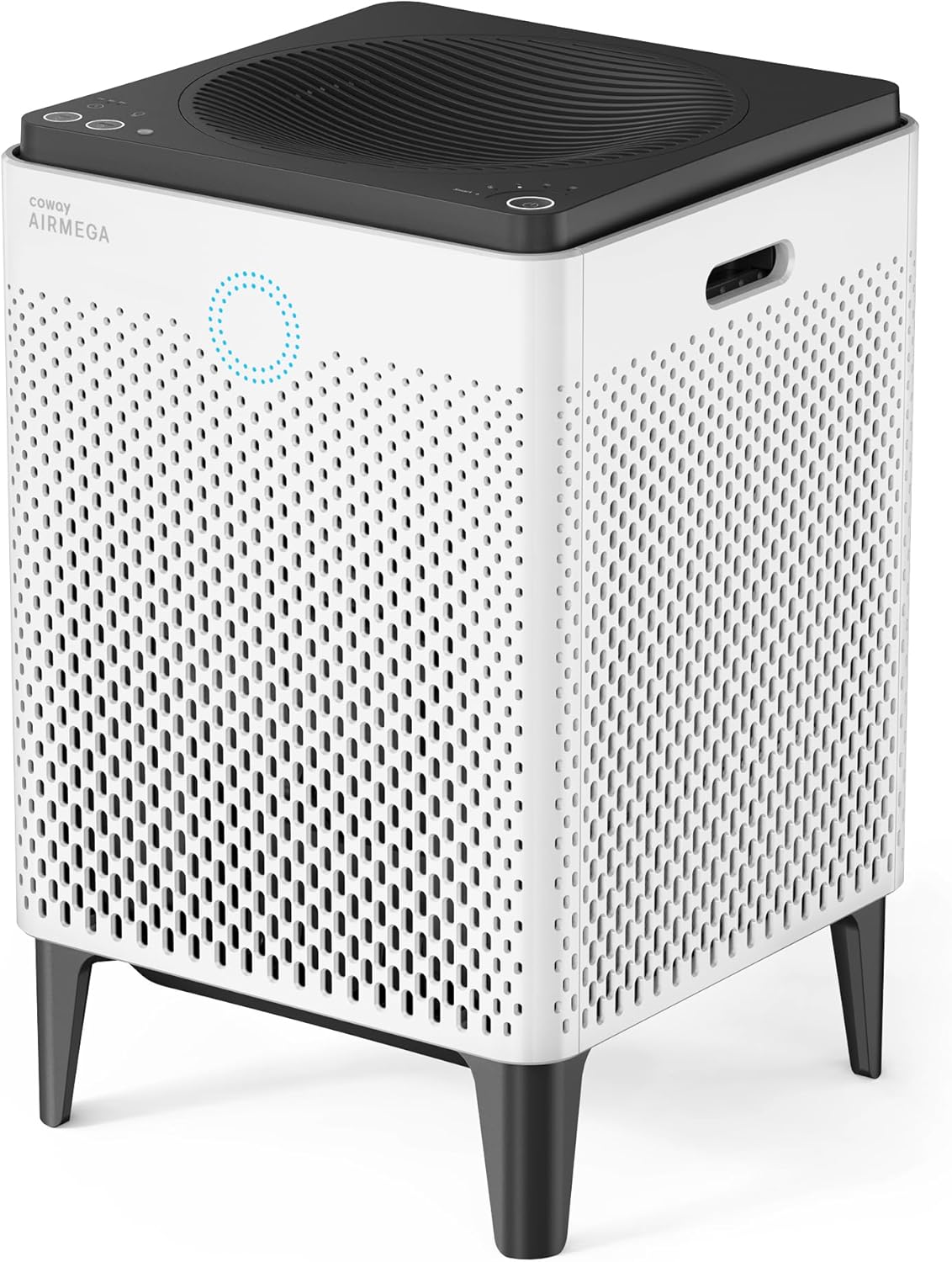
| Floor Area | 3120 square_feet |
|---|---|
| Filter Type | HEPA Filter, Active Carbon Filter, Pre-Filter |
| Noise Level | 22 db |
| Wattage | 66 watts |
| Particle Retention Size | 0.3 micron |
The Coway Airmega 400 is a high-capacity air purifier built for big spaces and sustained performance. It uses a three-stage HyperCaptive system—pre-filter, activated carbon, and HEPA—that the company says removes 99.97% of 0.3 micron particles and reduces VOCs and odors, making it suitable for haze, smoke, and allergy triggers. The unit monitors air quality in real time and adjusts fan speed via Smart Mode, and includes Eco and Sleep modes that lower power and noise when conditions permit. Practical benefits include strong one-hour coverage for large rooms, a washable pre-filter for lower maintenance, and an AQI indicator and filter-life alerts to keep operation simple. Trade-offs are size and weight, since the Airmega 400 is a substantial floor unit that requires floor space and occasional filter replacements, and it draws more power than compact models when running at high speeds. Noise levels are very low on quiet modes but can increase at peak airflow needed for rapid cleaning.
Best for: Buyers who prioritize fast, high-performance air cleaning for whole rooms or open-plan spaces and want automated modes to maintain low particle levels with minimal interaction.
Less Ideal for: People who need a compact, portable purifier for a single small bedroom or those who prefer a near-silent, ultra-low-power unit for always-on background use.
- Designed to cover up to 3,120 sq ft in 60 minutes for fast large-room cleaning
- Multi-stage filtration including HEPA and activated carbon targets particles, odors, and VOCs
- Real-time air quality monitoring with Smart, Eco, and Sleep modes for automated, efficient operation
- Washable pre-filter and filter-life indicator simplify upkeep
- Large, heavy footprint that needs dedicated floor space
- Requires replacement filters over time, adding to operating cost
Verdict: Choose the Airmega 400 when you need one of the fastest, highest-capacity purifiers available for tackling haze and smoke across large indoor areas.
MOOKA B-D02L Air Purifier
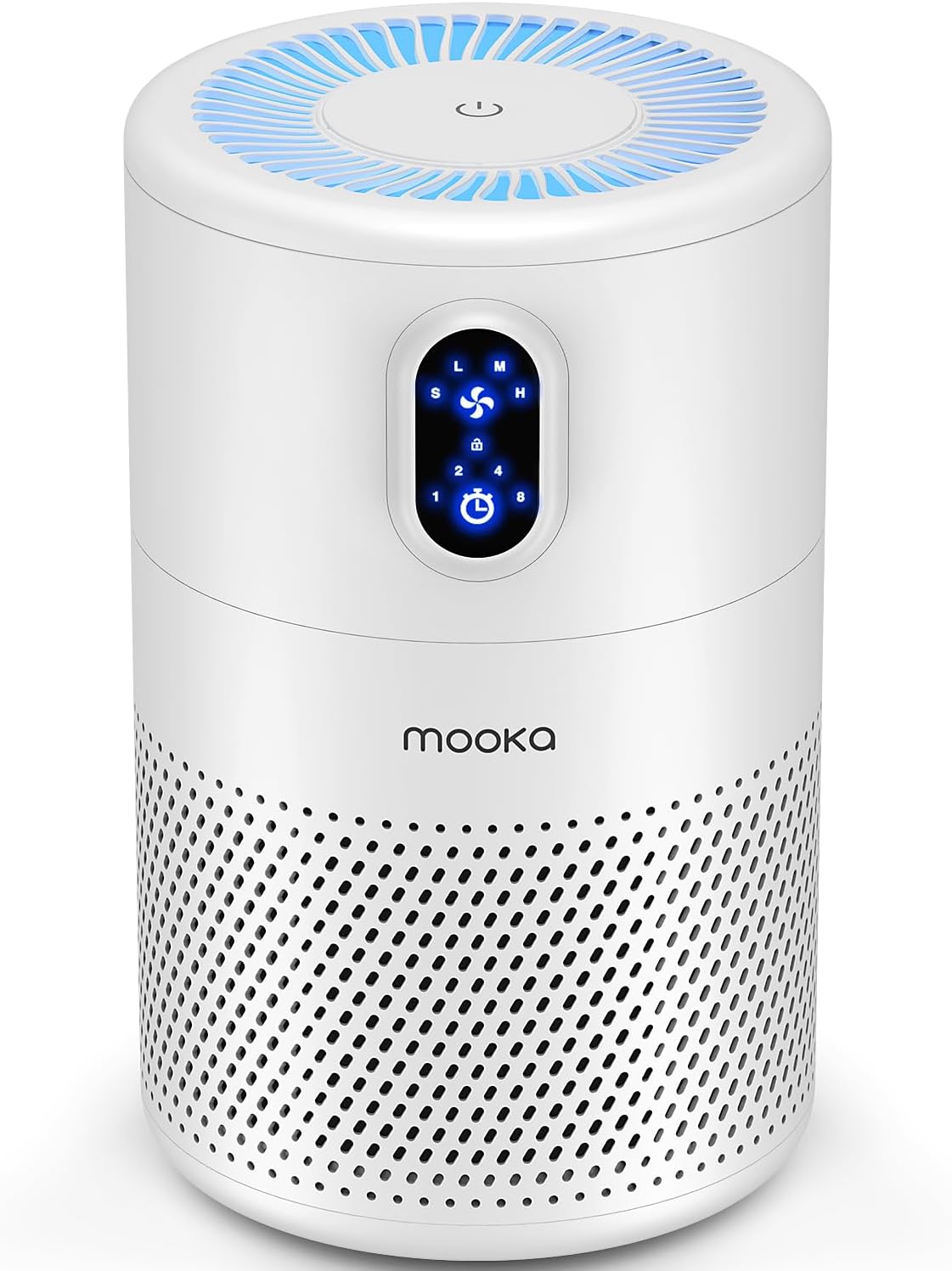
| Effective area | 1076 sq ft |
|---|---|
| Filter type | H13 True HEPA + activated carbon |
| Timer settings | 1/2/4/8 hours |
| Fan modes | Sleep/Low/Med/High |
The MOOKA B-D02L is a tabletop air purifier aimed at improving indoor air in spaces up to roughly 1,076 sq ft by combining a pre-filter, H13 true HEPA element, and activated carbon. In everyday use it runs quietly thanks to a brushless motor and offers four fan speeds, a sleep mode for near-silent nighttime operation, and timer options for 1, 2, 4, or 8 hours. The unit also includes a child lock and a soft night light that can be disabled. For haze and wildfire smoke the H13 HEPA will capture fine particulate down to 0.3 microns while the carbon layer helps reduce odors. The purifier is energy efficient and intended for continuous or scheduled use; replacement filters are recommended every 3 to 6 months depending on conditions. Limitations include its compact footprint that may require higher fan speeds to move air in very large or open-plan homes and the need to replace filters regularly to maintain peak smoke removal performance.
Best for: Buyers who want a practical, energy-conscious purifier that reliably reduces haze and smoke in bedrooms, living rooms, or home offices and who prioritize quiet continuous operation.
Less Ideal for: Homes that need a single whole-house solution for very large open floor plans where a larger, higher-output purifier would be more effective.
- H13 true HEPA filter captures particles down to 0.3 microns, suitable for smoke and haze particulates
- Activated carbon layer reduces odors and volatile compounds
- Very quiet operation with brushless motor and a dedicated sleep mode
- Multiple timers and four fan speeds allow scheduled, energy-saving use
- Smaller physical unit may need higher speeds to produce fast air changes in very large or open areas
- Filters need replacement every 3 to 6 months depending on pollution levels
Verdict: A quiet, energy-efficient HEPA purifier that is a sensible choice for reducing haze and smoke in bedrooms and living spaces.
MEGAWISE Home Air Purifier EPI810

| Coverage | 215 sq ft |
|---|---|
| Filtration | True HEPA (0.3 μm, 99.97%) |
| Fan speeds | 6 speeds |
| Noise | <25 dB (sleep mode) |
The MEGAWISE EPI810 is a small, portable air purifier that uses a True HEPA filter to capture 99.97% of particles down to 0.3 microns and is aimed at refreshing medium rooms such as bedrooms or home offices. It pulls air through a 360 degree path and offers six fan speeds plus a near-silent sleep mode under 25 dB, so you can run it overnight without disruptive noise. The unit includes an activated carbon stage for odors and a negative ion function for additional air refreshment, and a filter replacement indicator simplifies maintenance. A standout for budget buyers is the washable filter element that can be rinsed and reused to reduce ongoing costs. Trade-offs are its small footprint and consumer-grade performance, which are appropriate for single rooms up to the stated coverage rather than whole-home filtration, and the negative ion feature may not be desired by every user.
Best for: Shoppers prioritizing low upfront and running costs who need a compact purifier for a bedroom or office and want effective particle removal without noisy operation.
Less Ideal for: People seeking high-capacity or whole-home filtration or those who require strictly mechanical-only filtration without ionization features.
- True HEPA filtration captures 99.97% of particles as small as 0.3 μm
- Rated to refresh rooms up to 215 sq ft with 360° airflow
- Near-silent sleep mode under 25 dB for nighttime use
- Washable filter reduces replacement frequency and operating cost
- Six fan speeds plus activated carbon stage and negative ion option for flexible odor and smoke control
- Designed for single rooms rather than whole-house coverage
- Negative ion feature may not suit users who avoid ionizers
Verdict: A budget-friendly, room-sized True HEPA purifier with washable filter and quiet operation that suits haze-prone bedrooms and home offices.
Levoit Core 300-P

| Filter Type | 3 in 1 Filtration |
|---|---|
| Noise Level | 24 db |
| Wattage | 56 watts |
| Particle Retention Size | 0.3 micron |
| Floor Area | 1073 square_feet |
The Levoit Core 300-P is a small, intentionally simple air purifier built around a 3-stage HEPA-grade filter and a 56W motor that delivers measurable air cleaning for homes affected by haze, smoke, pet dander, and pollen. It is used by placing it in a bedroom, living room, or other occupied space and running one of the manual fan speeds; the unit is AHAM verified with CADR numbers suitable for refreshing a 222 ft² room multiple times per hour and a 1,073 ft² space once per hour. Notable features include near-silent Sleep Mode at 24 dB, a touch control panel with timer options, and a check-filter indicator, all in a compact portable housing. Benefits for haze situations are high filtration efficiency for fine particulates, CARB and ETL certifications, and compatibility with Levoit replacement filters for consistent performance. Limitations are the lack of an automatic sensor or Auto Mode on this model and reliance on manual speed selection, and replacement filters need periodic purchase to maintain performance.
Best for: Buyers who prioritize proven, reliable particle removal in bedrooms and living areas and want a compact, certified purifier that consistently filters fine haze and smoke when run at appropriate speeds.
Less Ideal for: People who need automatic sensing and hands-off operation or integrated smart features should consider models with Auto Mode or Wi-Fi connectivity instead.
- True HEPA-grade 3-stage filtration capturing 99.97% of 0.1–0.3 μm particles
- AHAM verified CADR with documented coverage figures for smoke, dust, and pollen
- Very quiet Sleep Mode (about 24 dB) suitable for bedrooms
- Compact, portable design that is easy to move between rooms
- Certified for safety and emissions (CARB, ETL, FCC)
- No built-in air quality sensor or Auto Mode on this model so fan speed must be adjusted manually
- Requires periodic replacement filters to maintain rated performance
Verdict: Choose the Core 300-P when you want a compact, certified HEPA purifier that consistently removes fine haze and smoke particles with quiet, proven performance.
Levoit Vital 100 Air Purifier

| CADR | 105 CFM |
|---|---|
| Particle retention size | 0.3 micron |
| Filtration stages | 3 (pre-filter, particle, activated carbon) |
| Timer | 2/4/8 hours |
The Levoit Vital 100 is a compact air purifier that uses three-stage filtration (washable pre-filter, efficient particle filter, and activated carbon) to remove dust, pollen, pet hair, odors, and fine particles down to 0.3 microns. It is typically set on a bedroom or living-room surface and runs quietly at night with noise levels reported as low as 24 dB, while a simple control panel provides on/off, timer (2/4/8 hours), and a check-filter indicator for basic maintenance. The purifier delivers a 105 CFM CADR and is rated to clean a room up to approximately 788 sq ft once per hour, which makes it useful for improving general indoor air quality and reducing haze-related particles over time. The washable pre-filter reduces replacement frequency for large debris, and the carbon stage helps control cooking and smoke odors. Limitations include the need to buy genuine Levoit replacement filters to maintain performance and the unit's compact design, which means very large or heavily polluted spaces may require a more powerful model or multiple units to reach the same effect quickly.
Best for: Buyers who prioritize proven performance and widespread positive feedback and want a quiet, easy-to-use purifier for bedrooms or common rooms to reduce haze and everyday pollutants.
Less Ideal for: People needing very fast clearance in large open areas or those wanting a purifier compatible with third-party filters should consider a larger or differently specified unit.
- Three-stage filtration including washable pre-filter, particle filter, and activated carbon for odors
- Quiet operation with reported noise as low as 24 dB suitable for bedrooms
- 105 CFM CADR with stated room coverage up to 788 sq ft per hour
- Simple controls with timer settings and a filter-check indicator
- Replacement filters must be genuine Levoit parts to ensure stated performance
- Compact form factor limits rapid cleanup in very large or heavily polluted rooms
Verdict: A quiet, AHAM-verified compact purifier with three-stage filtration that reliably reduces haze and everyday indoor pollutants in bedrooms and small to medium rooms.
VOOPNU H13 HEPA Air Purifier DH-JH12

| Coverage (laboratory tested) | 250 ft² per 15 minutes / up to 1,076 ft² per hour |
|---|---|
| Filter type | H13 True HEPA triple-layer |
| Noise level | 22 dB (low) |
The VOOPNU DH-JH12 is a compact air purifier that uses an H13 true HEPA triple-layer filter and 360° surround intake to capture fine particles, pet hair, pollen, smoke, and common odors. It is intended for everyday room use and is laboratory-tested to clean about 250 ft² every 15 minutes, covering up to 1,076 ft² per hour; simple controls, a timer and three fan speeds make it easy to run continuously or on a schedule. Notable features include an essential oil tray for light scenting, quiet low-speed operation down to about 22 dB for night use, and multiple certifications (DOE, ETL, FCC, CARB, CE, ROHS). Practical benefits are straightforward setup and placement thanks to the small footprint, effective particle filtration for haze or smoke when operated continuously, and a washable pre-filter option on some models. Limitations include the small physical size which may indicate less powerful airflow compared with large standalone units and the recommendation to run the unit continuously for best results, which could increase filter replacement frequency and energy use over time.
Best for: Buyers who prioritize proven filtration and easy, low-maintenance operation for everyday indoor air cleaning and want a low-noise unit that can run overnight without disruption.
Less Ideal for: Users needing the highest possible airflow for very large, open-plan spaces or industrial smoke events should consider larger commercial-grade purifiers instead.
- H13 true HEPA triple-layer filtration captures 99.97% of fine particles
- 360° surround air intake for more uniform room coverage
- Very quiet low-speed operation (~22 dB) suitable for bedrooms
- Simple controls, timer and three speeds make continuous or scheduled use easy
- Essential oil tray adds optional light scenting while running
- Small chassis may produce lower peak airflow than larger room purifiers
- Manufacturer recommends continuous operation for best results which increases runtime and filter wear
Verdict: A compact, quietly running H13 HEPA purifier that is a safe, easy-to-use choice for households seeking reliable haze and smoke particle removal during regular continuous use.
Choosing the Right Air Purifier for Haze: Key Factors to Consider
Filtration Type and Efficiency
The core job during haze events is to remove fine particulate matter, especially PM2.5 and smaller. True HEPA filters are the standard for capturing at least 99.97 percent of particles 0.3 microns in diameter, and many HEPA-class filters also perform well at smaller sizes relevant to smoke. When evaluating filtration type, check whether the unit lists tested efficiency for PM2.5 or smaller and whether it includes layered filtration such as a washable pre-filter to trap large debris and extend HEPA life.
Activated carbon layers matter when smoke brings volatile organic compounds and odors. Carbon helps absorb gases and smells that particulate filters cannot. For haze-heavy periods, a combination of true particulate filtration plus substantial carbon media provides broader protection, reducing both visible haze and the lingering smoky smell indoors.
Airflow Capacity and CADR
An air purifier's ability to clean a room depends on how much air it processes, typically measured as CADR or by volumetric airflow. Higher airflow moves more room air through the filter per hour and lowers particle concentrations faster. Match a unit's CADR or stated room coverage to your actual room volume rather than square footage alone—ceiling height and furniture layout affect circulation.
Look for a purifier that can achieve multiple air changes per hour at a moderate fan speed for your primary living space. A device that barely circulates air will struggle even if its filter is high efficiency, because contaminated air stays in the room longer.
Operating Noise and Usability
During extended haze episodes you may run a purifier continuously and sometimes at higher fan speeds. Noise becomes a quality-of-life factor for living rooms, bedrooms, and home offices. Manufacturers list decibel ratings, but perceived noise also depends on fan design and where the unit is placed. Consider units with quiet-night modes or sleep settings that still provide useful air changes.
Control layout, display brightness, and automated sensors also affect usability. Look for straightforward controls, programmable timers, and air-quality indicators so you can rely on the purifier without constant adjustment.
Maintenance, Filter Life, and Cost To Operate
Filters are consumables, and replacement frequency affects the total cost and convenience of keeping a purifier effective during prolonged haze seasons. Check manufacturer guidance for expected filter life under heavy use and how easy it is to change filters without tools. Pre-filters that are washable can reduce consumable costs.
Also factor in energy usage, especially if you plan to run the purifier 24/7. Energy-efficient designs and lower-wattage fan systems reduce utility impact. Finally, consider the availability of replacement filters in your region; hard-to-find parts can sideline a unit when you need it most.
Coverage Area and Placement
Coverage area claims are useful starting points but must be interpreted for your space. A stated room size usually assumes a specific number of air changes per hour. If you need faster clearing, choose a unit rated for a larger space than the one you intend to use it in. Placement matters too: put purifiers away from corners and obstructions, and avoid placing them directly behind furniture.
For whole-home protection consider multiple smaller units placed where people spend time rather than a single centralized unit that may not circulate air into every zone effectively. Portability and weight are worth noting if you plan to move the purifier between rooms.
How Haze Affects Indoor Air and What Filters Can Do
Haze from wildfires or heavy pollution carries fine particulate matter that can infiltrate buildings through gaps in windows, HVAC systems, and normal ventilation. These particles are small enough to bypass many common household filters and can affect breathing, sleep quality, and comfort. An effective air purifier reduces indoor concentrations by continually moving room air through a filter designed for small particles.
Beyond particulates, smoke brings odors and gases that particulate filters do not remove. That is why many home-focused purifiers combine HEPA filtration with activated carbon to address both the visible haze and the smell. During prolonged haze events, paired approaches deliver the most noticeable improvement in indoor air quality.
- Fine particles can remain suspended for hours without adequate air changes
- HEPA filters capture particulate matter, while carbon absorbs odors and gases
- Continuous operation at appropriate fan settings is key during active haze
Sizing Your Purifier to Room Volume
Room area is only part of the equation. Calculate the room volume by multiplying floor area by ceiling height to get a clearer sense of how many cubic feet of air need cleaning. Then compare that to the purifier's airflow or CADR figures to estimate air changes per hour. For living rooms and bedrooms, a target of two to five air changes per hour at a moderate fan speed is a useful guideline during haze events.
If you frequently expect heavy smoke, err on the side of a higher-capacity unit or plan to use multiple units in larger open-plan spaces. This ensures faster reduction of particle concentrations and gives you flexibility to lower fan speed when noise is an issue.
- Calculate room volume for accurate sizing
- Aim for multiple air changes per hour during active haze
- Consider multiple units for open-plan or irregular layouts
Managing Smoke Odors and VOCs
Smoke produces compounds that cause lingering odors and can include volatile organic compounds. While HEPA filters remove particles, activated carbon or specialized gas-phase media are required to reduce smells and some gases. The amount of carbon and its surface area determine how effectively a purifier handles odors, so look for generous carbon beds rather than thin foam layers.
For heavy odor control, expect to replace carbon filters more frequently. In many cases, combining source control, such as sealing drafty windows, with a purifier that includes carbon will provide the most noticeable improvement.
- Carbon media targets odors and gases, not particles
- Larger carbon beds work longer between replacements
- Sealing the room complements purifier performance
Placement Tips and Operational Best Practices
Place the purifier where people spend the most time and where airflow is least obstructed. Avoid corners, behind curtains, or directly under shelving that blocks intake or outlet vents. For bedrooms, position the unit near the head of the bed but not so close that noise or airflow is disruptive.
Run the purifier continuously during haze events, using automatic modes if the unit has a reliable sensor. If noise is a concern, increase fan speed during the day and use quiet modes at night while monitoring air-quality indicators. Periodically check pre-filters and access panels for blockage or heavy dust accumulation.
- Keep intakes and outlets unobstructed
- Use continuous operation and automatic modes for convenience
- Monitor filter condition and clean pre-filters regularly
Energy Use and Long-Term Running Costs
Because purifiers may run for extended periods during haze, energy draw matters. Compare wattage at common fan speeds and consider units with efficient motor design. Some purifiers use brushless DC motors that maintain strong airflow at lower power consumption, which reduces operating cost over time.
Also account for filter replacement frequency and cost. Lower upfront cost units with expensive, frequent filter changes can be more costly to run across a season than a slightly higher-efficiency unit with longer filter life. Factor both energy and consumables into your planning.
- Check wattage at typical fan speeds
- Brushless motors can be more efficient
- Include filter replacement costs when budgeting
How We Chose the Best Air Purifier for Haze
We prioritized products that target fine particulate matter commonly present in haze rather than general-purpose or odor-only units. Our selection filters focused on true HEPA filtration or equivalent particulate removal, verified clean air delivery rates, and practical airflow for real rooms. We also considered operational factors such as energy consumption during heavy use, noise levels at common fan settings, and maintenance accessibility including filter life and replacement ease. Evaluation criteria included measured or manufacturer-rated PM2.5 and PM0.1 capture efficiency, CADR or equivalent airflow ratings appropriate to room size, filter system design (pre-filter plus HEPA and optional activated carbon), and runtime energy draw. We excluded devices that rely solely on ionization or ozone generation without robust particulate filtration and units intended only for small lockers or single-cup spaces. Long-term usability factors like filter cost and availability and serviceability also influenced inclusion so the shortlist reflects units you can realistically maintain during prolonged haze events.
Our full evaluation process is outlined in our review methodology.
FAQ
Will an air purifier remove smoke smell from haze?
An air purifier with activated carbon or gas-phase media can reduce smoke odors, but effectiveness depends on how much carbon is used and how long the purifier runs. HEPA alone removes particles but not gases that cause odor.
How long should I run a purifier during a haze event?
Run the purifier continuously while outdoor air is smoky, using an appropriate fan speed for the room size. Continuous operation ensures the unit keeps reducing particle concentration; you can lower speed at night to reduce noise but maintain filtration.
Do air purifiers remove the smallest smoke particles?
True HEPA filters capture a very high percentage of particles down to and below 0.3 microns, which includes most smoke particles. Performance varies by filter quality and airflow, so look for verified capture efficiency for fine particles.
Can I rely on HVAC filtration instead of a standalone purifier?
A high-quality HVAC filter can help but often does not provide the same room-level air changes as a dedicated purifier, especially in spaces away from return vents. Standalone purifiers are more effective for localized, continuous removal during haze events.
How often should I change filters during heavy haze periods?
Filter life shortens when particulate loads are high. Check pre-filter and HEPA condition monthly during heavy use and follow manufacturer guidance; you may need to replace filters more frequently than under normal conditions.
Final Verdict
When selecting an air purifier for haze, prioritize true particulate filtration and enough airflow to deliver multiple air changes per hour in the rooms you use most. If smoke odors are a concern, choose a unit with a substantial activated carbon stage and be prepared for more frequent carbon replacements during prolonged events. Balance noise, energy use, and filter maintenance against required coverage to find a practical solution. Focus on measurable specs such as PM2.5 capture efficiency and CADR so you can confidently pick a purifier that will meaningfully reduce indoor smoke exposure.