
Note: This article contains affiliate links. If you click on these links and make a purchase, we may earn a small commission at no extra cost to you. This helps support our research and content. Read our full affiliate disclosure here.
If frying, searing, or heavy cooking fills your kitchen with lingering odors and a thin film of grease, the right air purifier can meaningfully improve indoor air quality. You want a unit that handles cooking-generated particles and oil aerosols, reduces smells, and is simple to keep running between heavy-use sessions. This guide shortlists the top-performing options for kitchens prone to grease, focusing on filtration efficiency, odor control, and practical upkeep. Below are our top picks for air purifiers suited to kitchens with greasy cooking. We explain the evaluation criteria and provide clear buying guidance so you can choose a unit that matches your cooking habits and kitchen layout.
Top Picks at a Glance
| Best Overall The best all-around choice for most situations | PuroAir 240 |  |
| Best Quality Built to a higher standard if you want something more solid | AIRDOCTOR AD4000 Air Purifier |  |
| Best Value The sweet spot between price and what you get | MOOKA B-D02L Air Purifier |  |
| Best Budget The cheapest option that still gets the job done reliably | TDBYWAE Air Purifier MB-032 |  |
| Top Rated A top-rated pick with lots of positive feedback | KNKA APH4000 Air Purifier |  |
| Most Popular A crowd favorite that many people choose with confidence | Coway Mighty AP-1512HH |  |
| Best Seller A high-volume bestseller chosen again and again | Winix 5510 Air Purifier |  |
PuroAir 240

| Item model number | PuroAir 240 |
|---|---|
| Sq Ft Coverage | 1,000 sq ft |
| HEPA & CarbonTech Filter | Yes |
| Air Quality Sensor | Yes |
The PuroAir 240 is a floor-standing HEPA air purifier built to reduce common household pollutants in large rooms. It uses a three-layer filtration system with HEPA plus an activated carbon stage branded as CarbonTech to capture particles, smoke, odors and some gases, and it has an auto air quality sensor with an automatic mode that adjusts fan speed. Typical use is continuous operation in living rooms, kitchens near cooking areas, or bedrooms where you want steady removal of airborne grease particles, smoke and odors; multiple fan speeds and a quiet sleep mode keep noise low overnight. The practical benefits are strong particulate capture across a broad area, integrated odor control from the carbon layer, and hands-off sensing that ramps performance when air quality worsens. Expect periodic filter replacements and slightly higher noise on max speed when the unit is working hardest, and note that carbon layers vary in how quickly they saturate with heavy grease or strong cooking odors compared with dedicated commercial odor systems.
Best for: Someone who wants a reliable, automatic purifier that handles particles and routine cooking odors across larger kitchen or open living spaces while staying quiet at night.
Less Ideal for: People needing industrial-strength grease or heavy commercial kitchen odor removal should consider dedicated commercial exhaust or specialized filtration solutions instead.
- 3-layer filtration with HEPA and activated carbon for particles, smoke and odors
- Auto air quality sensor with automatic fan adjustment for hands-off operation
- Coverage rated up to 1,000 sq ft suitable for large kitchens or open-plan areas
- Quiet sleep mode and multiple fan speeds for overnight or low-noise use
- Carbon filter will eventually saturate with heavy grease or cooking oils and needs replacement
- Higher fan speeds produce noticeable noise compared with low settings
Verdict: Choose the PuroAir 240 when you want a large-room HEPA purifier with carbon odor control and auto sensing to keep kitchen grease smoke and everyday cooking odors under control in home kitchens.
AIRDOCTOR AD4000 Air Purifier

| Model | AD4000 |
|---|---|
| Filters | Pre-Filter + Activated Carbon + UltraHEPA |
| PM2.5 Sensor | Included |
| Fan Speeds | 6 speeds + Boost |
The AirDoctor AD4000 is a high-capacity air purifier built for large rooms, basements, and open-plan spaces where strong particle and odor removal is needed. It combines a pre-filter, a Premium Activated Carbon/VOC filter treated with potassium permanganate, and an UltraHEPA stage that the brand says captures down to 0.003 microns, which targets smoke, fine cooking grease aerosols, pet dander, and pollen. Real-time PM2.5 sensing and an Auto Mode let the unit raise fan speed or trigger Boost when air quality worsens, and six manual fan speeds plus a timer give control over cleaning intensity. The AD4000 is designed to move a lot of air quickly — the product claims rapid cleaning of hundreds to thousands of square feet — while running quietly enough for night use. Maintenance is straightforward with a single all-in-one filter pack and a visible filter indicator, though replacement filters are recommended every six months. The main compromises are its large physical footprint and weight compared with small-room purifiers and the need to buy genuine replacement filters to maintain stated performance.
Best for: Buyers who prioritize measurable particle and odor removal for large kitchens, open-plan living areas, or basement cooking spaces and want responsive, science-backed filtration.
Less Ideal for: Those who need a compact, portable purifier for a small kitchen, countertop, or travel use should consider smaller, lighter models instead.
- Three-stage filtration including an UltraHEPA stage for submicron particle removal
- Premium activated carbon/VOC filter formulated to reduce cooking odors and gases
- Real-time PM2.5 sensor with Auto Mode and Boost for responsive cleaning
- High airflow capacity aimed at cleaning large rooms quickly
- Single integrated filter pack simplifies replacement and maintenance
- Physically large and heavier than compact purifiers which may limit placement options
- Requires proprietary replacement filters to maintain peak performance
Verdict: Choose the AD4000 when you need powerful, sensor-driven particle and odor removal for large kitchens and open cooking areas.
MOOKA B-D02L Air Purifier
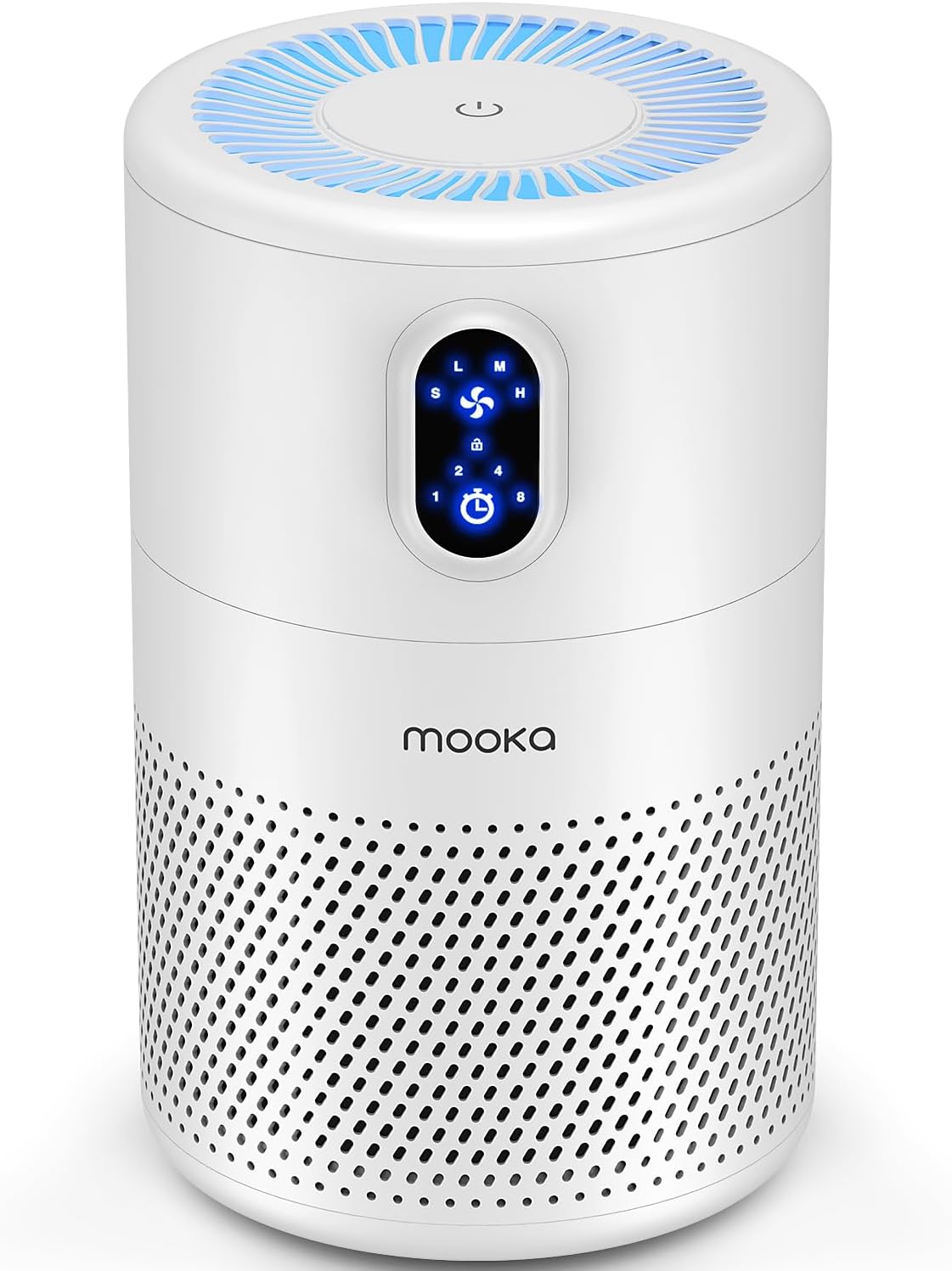
| Coverage area | Up to 1076 sq ft |
|---|---|
| Filter type | H13 True HEPA + activated carbon |
| Fan modes | 4 speeds |
| Timer | 1/2/4/8 hours |
The MOOKA B-D02L is a small, countertop air purifier that combines a pre-filter, H13 True HEPA element and activated carbon to capture fine particles, pet dander, smoke and common household odors. It is typically placed in kitchens near cooking areas or on a counter in adjacent living spaces to reduce airborne grease particles and lingering cooking smells; the carbon layer helps adsorb odors while the HEPA captures grease-laden aerosol droplets down to 0.3 microns. Controls include four fan speeds, four timer settings and a child lock, and the unit runs quietly on its low settings so it can operate during cooking without being intrusive. The washable pre-filter and replaceable HEPA/carbon cartridge simplify upkeep, though filters need replacement every 3 to 6 months depending on cooking frequency. While the unit covers very large stated areas, real-world grease removal is strongest in small to medium kitchens or when the purifier is positioned close to the cooking source; it cannot replace range hoods or capture heavy smoke at the source. For routine cooking odors and light grease aerosols it is a practical, energy-efficient supplemental solution.
Best for: Buyers who want a low-noise, easy-to-use supplemental purifier to reduce everyday cooking odors and light grease aerosols in kitchens or nearby living spaces.
Less Ideal for: People who need heavy-duty smoke or grease removal from high-heat cooking or frying should prioritize a powerful range hood or industrial-grade filtration instead.
- H13 True HEPA plus activated carbon targets both fine particles and common cooking odors
- Quiet operation that allows continuous use during cooking or at night
- Multiple fan speeds and timers give control over cleaning intensity and runtime
- Washable pre-filter and user-replaceable HEPA/carbon cartridge simplify maintenance
- Filter replacements expected every 3–6 months depending on use
- Effectiveness against heavy grease smoke is limited compared with source ventilation
Verdict: A quiet, practical countertop purifier that cuts routine cooking odors and light grease aerosols when used close to the source, making it a sensible supplement to kitchen ventilation.
TDBYWAE Air Purifier MB-032

| Coverage area | Up to 600 ft² |
|---|---|
| Power source | Type-C |
| Speed levels | 3 Speeds |
| Timer | 2H/4H/8H |
This small TDBYWAE unit is a budget-focused HEPA air purifier designed for personal rooms and short-term use in kitchens, bedrooms, and travel. It uses a three-stage filter stack—pre-filter, True HEPA, and activated carbon—to capture dust, pollen, pet dander, smoke and some odors, and the upgraded filter material and magnetic top cover make swaps straightforward. The purifier runs on Type-C power so you can use a phone charger or power bank, and it offers three fan speeds plus 2/4/8 hour timers with a simple touch panel. At its low noise sleep setting it is unobtrusive for night use. Practical limits: the unit is physically small and its real-world grease and heavy cooking odor removal will be modest compared with larger kitchen-specific models or dedicated range-hood filters, and filter replacement every 2–4 months adds ongoing cost. For light grease and lingering food smells in small kitchens, this provides an affordable, portable improvement in air quality but not a full substitute for ventilation or heavy-duty kitchen purifiers.
Best for: Shoppers on a tight budget who want an inexpensive, portable purifier to reduce particles and light cooking smells in small kitchens or nearby dining areas.
Less Ideal for: Homes that need heavy-duty grease extraction or wide-area kitchen odor removal should choose a larger, kitchen-grade purifier or improved ventilation instead.
- Three-stage filtration including True HEPA and activated carbon for particles and some odors
- Type-C power for easy use with common chargers or a power bank
- Compact, portable footprint fits on a nightstand or countertop
- Quiet sleep mode for low-noise overnight operation
- Simple touch controls and timer settings for easy daily use
- Small unit so grease and heavy cooking odors may not be fully removed in larger or busy kitchens
- Requires regular filter replacements (recommended every 2–4 months) which add ongoing cost
Verdict: A low-cost, portable HEPA purifier that helps reduce particles and light kitchen odors in small spaces without the expense of larger kitchen-grade systems.
KNKA APH4000 Air Purifier

| CADR (Smoke/Dust) | 226 CFM (384 m³/h) |
|---|---|
| CADR (Pollen) | 244 CFM (415 m³/h) |
| Room coverage (1/hr) | Up to 350 ft² (4.8 air changes/hr) |
The KNKA APH4000 is a room air purifier built around a dual three-stage filter system and a high CADR rating aimed at fast air exchange. It pulls air from both front and back intakes and exhausts from dual side outlets to boost circulation, which helps reduce airborne particles and cooking aerosols more quickly than single-intake designs. The unit includes a washable pre-filter, a high-efficiency HEPA filter, and activated carbon layers for particle and odor control, plus a filter indicator to simplify maintenance. Multiple modes—Pet, ECO, Auto, Sleep—and four fan speeds let you prioritize speed, quiet, or energy savings depending on kitchen activity; Sleep mode drops noise to the low 20s dB for overnight use away from the stove. Real-time AQI display and color-coded lights make it easy to see when grease smoke or odors are elevated. Limits include recommended filter replacement every 3–6 months and reduced single-hour efficiency in very large open layouts, so performance depends on placement and expected particulate load. For kitchens that produce frequent grease and smoke, the APH4000 provides focused circulation and carbon-backed odor reduction to keep air clearer between cooking sessions.
Best for: Buyers who prioritize dependable, certified air-cleaning performance for cooking-generated smoke and odors and who plan to place the purifier where its circulation pattern can capture kitchen aerosols.
Less Ideal for: Those who need a silent unit for placement right next to the stove during heavy frying or buyers needing whole-house ventilation rather than a room-focused purifier.
- High AHAM-verified CADR for dust, pollen, and smoke for faster air exchange
- Dual intake and dual outlet airflow design improves room circulation
- Three-stage filtration with activated carbon helps reduce cooking odors and grease aerosols
- Multiple modes (Pet, ECO, Auto, Sleep) and low-noise Sleep mode for flexible operation
- Filter replacement recommended every 3–6 months which adds ongoing cost
- Efficiency drops in very large open-plan spaces at a one-hour exchange rate
Verdict: Choose the KNKA APH4000 if you want a certified, fast-cycling HEPA purifier with activated carbon and strong airflow to cut kitchen smoke and odors in a single room.
Coway Mighty AP-1512HH

| Coverage | Up to 1,748 sq. ft. in 60 minutes |
|---|---|
| Filtration stages | Washable pre-filter, deodorization filter, bipolar device, HEPA filter |
| HEPA efficiency | 99.97% of 0.3 μm particles |
| Features | Auto mode, air quality indicator, filter indicator, timer, eco mode |
The Coway Mighty AP-1512HH is a countertop air purifier built around a four-stage filtration system that combines a washable pre-filter, deodorization/activated carbon layer, bipolar ionizer, and a True HEPA filter to capture 99.97% of 0.3 micron particles. It is intended for continuous home use and can cycle the air in spaces up to roughly 1,748 sq ft in an hour, with an auto mode that adjusts fan speed based on a built-in air quality sensor and a visible LED air quality indicator. Practical benefits include a washable pre-filter that reduces maintenance cost, an effective carbon stage for odors and some VOCs, and filter-life and alert indicators to keep performance consistent. The unit also offers eco and timer modes for quieter, lower-power operation at night. Limitations are that heavy kitchen grease is best captured by range hoods and grease filtration at the source, since this room purifier handles particulates and odors but will not replace a mechanical grease trap and filters require periodic replacement for continued VOC removal performance.
Best for: Buyers who prioritize proven performance and strong user feedback and want a reliable, sensor-driven purifier to reduce smoke, odors, and fine particles in open kitchens or nearby living areas.
Less Ideal for: Homes that need a direct solution for oily stove grease buildup or commercial kitchen exhaust filtration should look to capture-at-source solutions rather than a room air purifier.
- True HEPA filtration captures 99.97% of 0.3 μm particles for allergen and smoke removal
- Activated carbon deodorization stage reduces common kitchen odors and some VOCs
- Auto mode with real-time air quality sensor adjusts fan speed for convenience and efficiency
- Washable pre-filter lowers ongoing maintenance cost and protects main filters
- Filter indicator and timer modes make upkeep and night use straightforward
- Not designed to capture heavy oily grease at the stovetop; it addresses airborne particles and odors rather than surface-deposited grease
- Replacement filters and carbon media are required periodically to maintain VOC and odor reduction performance
Verdict: Choose the Coway Mighty AP-1512HH if you want a highly rated, sensor-driven HEPA purifier that reliably cuts fine particles and kitchen odors in medium to large home spaces.
Winix 5510 Air Purifier

| Filtration stages | 4‑Stage |
|---|---|
| True HEPA | Captures down to 0.01 microns |
| Coverage | Up to 1,882 sq ft in 1 hour |
| Smart features | WiFi, Winix Smart App, Alexa/Google |
| Noise (low) | 23.5 dB |
The Winix 5510 is a full‑size home air purifier built around a 4‑stage system that combines a washable prefilter, True HEPA capture, and a high‑deodorization carbon filter plus Winix PlasmaWave for additional pollutant control. It is intended for large rooms and is AHAM‑verified for rapid coverage, while built‑in air quality sensors and an LED AQI indicator let the unit adjust fan speed in Auto Mode so you rarely need to babysit it. Smart features include Wi‑Fi and compatibility with the Winix Smart App and common voice assistants for remote control and monitoring. Sleep Mode and a quiet low‑speed noise level make overnight use practical. For kitchen use, the advanced carbon filter and strong CADR mean it handles odors and cooking particulates better than basic HEPA‑only units, but heavy grease or very dense smoke will still require source ventilation and more frequent filter maintenance. Filter replacement indicators and washable prefilter simplify upkeep, but replacement HEPA and carbon filters are ongoing costs to factor in.
Best for: Buyers who want a reliable, easy‑to‑use purifier that removes fine particles and reduces kitchen odors in large open spaces while offering app control and automated operation.
Less Ideal for: Homes that need to remove heavy cooking grease at the source or commercial kitchens seeking industrial ventilation solutions should consider purpose‑built exhaust systems instead.
- 4‑stage filtration including True HEPA and advanced carbon for both particles and cooking odors
- AHAM‑verified coverage for large rooms with high CADR performance
- Auto Mode with smart sensors and AQI indicator reduces manual adjustments
- Wi‑Fi and Winix Smart App plus voice assistant compatibility for remote control
- Washable prefilter and filter replacement indicator simplify maintenance
- Not a substitute for immediate source ventilation with heavy grease or dense smoke
- Requires periodic replacement HEPA and carbon filters which add operating cost
Verdict: A dependable, smart 4‑stage purifier that combines strong particle removal and carbon‑based odor control for large kitchens and open living areas.
Choosing the Right Air Purifier for Kitchen Grease: Key Factors to Consider
Filtration Type and Effectiveness
Different filters target different pollutants. True HEPA filters capture fine particulate matter generated during frying and high-heat cooking. However, grease often travels as oily aerosols and can adhere to filters or bypass them when not combined with adsorption stages.
For grease-prone kitchens, look for multi-stage systems that pair a particulate filter with activated carbon or other adsorbents to reduce odors and VOCs. The filter's stated efficiency for submicron particles and any test data on VOC removal give a clearer picture of likely performance.
Grease and Aerosol Handling
Cooking oils produce sticky aerosols that can clog or coat filter media faster than dust. A purifier designed for kitchens will have pre-filters that are washable or easy to replace and intake designs that reduce buildup on critical components.
Consider how the unit manages trapped grease long-term. Removable pre-filters, grease-resistant intake grilles, and filters with protective layers extend life and maintain performance in heavy-cooking environments.
Airflow Rate and Coverage Area
Air changes per hour and cubic feet per minute (CFM) ratings determine how quickly an appliance can clear airborne particles from a space. Kitchens benefit from higher airflow to disperse and capture transient cooking plumes before they settle on surfaces.
Match the purifier's rated coverage to your kitchen's actual usable air volume, not just floor area. Open-plan layouts need higher capacity or multiple units to achieve similar results compared with closed kitchens of the same square footage.
Odor Control and VOC Reduction
Frying and high-heat cooking emit volatile compounds that cause lingering smells. Activated carbon, catalytic converters, or specialized VOC adsorbents are necessary to reduce these gases effectively.
A larger-volume or higher-quality carbon stage can extend time between replacements and improve immediate odor relief. If strong odors are a primary concern, prioritize systems with measurable VOC reduction or thicker carbon loads.
Maintenance Frequency and Cost
Keeping filters functional in a greasy kitchen requires more frequent maintenance than in low-activity rooms. Consider how often pre-filters and main filters must be cleaned or swapped, and whether the process is straightforward.
Units with washable pre-filters and readily accessible filter housings reduce ongoing effort. Factor in replacement filter availability and expected service intervals when estimating lifetime upkeep.
Noise and Operational Modes
Higher fan speeds help clear cooking plumes quickly but increase noise. If you cook while entertaining or spending time in the open-plan living area, balance high airflow modes with acceptable sound levels.
Look for units with variable fan speeds, turbo or boost modes for active cooking, and quieter sleep or low modes for noncooking periods. Practical sound levels at common operating speeds help tailor expectations.
How Kitchen Cooking Differs From Other Indoor Pollution
Cooking produces a complex mix of fine particles, oil aerosols, and volatile organic compounds that behave differently than dust or pollen. High-heat frying can generate ultrafine particles that penetrate deep into lungs and sticky aerosols that settle on cabinets and counters.
Regular home air purifiers designed for dust and allergens may not address the gaseous and oily components of cooking emissions effectively. Understanding these differences helps you choose features like activated carbon stages, washable pre-filters, and higher airflow to target cooking-specific pollutants.
- Particles from cooking are often smaller and more numerous than typical home dust.
- Oily aerosols can clog filters faster and leave residues on surfaces.
- VOCs from cooking contribute most to lingering odors and require adsorbent materials to remove.
Placement Tips for Maximum Grease Capture
Where you place the purifier affects how well it intercepts cooking plumes. Position units close to the cooking area but not so close that splatter or direct grease deposits can damage or overly contaminate the intake. A side wall or countertop near the stove works well when there is no dedicated range hood.
If you have an open-plan kitchen, place the purifier between the stove and the main living area to reduce spread. For larger kitchens consider using more than one unit or a higher-capacity model to maintain adequate air changes.
- Avoid locating the intake directly above or behind the stove where oil and steam concentrate.
- Keep at least a small clearance around the unit for unobstructed airflow.
- Elevating a portable unit a few feet off the floor can better intercept aerosols that rise during cooking.
Maintaining Performance in a Greasy Kitchen
Regular cleaning and timely filter changes preserve a purifier's ability to remove grease and odors. Check washable pre-filters weekly during heavy cooking periods and clean according to the manufacturer's guidance. Replace main filters as recommended or sooner if you notice reduced airflow or persistent odors.
Wipe down exterior grilles and sensor windows to prevent false readings or clogging. Some units include washable or replaceable pre-filters specifically to trap larger oily particles; using those reduces load on finer HEPA and carbon stages.
- Inspect pre-filters after intensive cooking sessions and rinse if designed to be washable.
- Keep spare replacement filters on hand if your kitchen generates grease frequently.
- Follow manufacturer guidance for sensor care to maintain accurate automatic modes.
When to Use Boost Mode and When to Run Low
Use high fan speeds or a boost mode during active frying or searing to capture plumes quickly. Short bursts of high airflow reduce particle concentration before they spread or settle. After cooking, run an elevated but quieter mode for an extended period to clear residual gases and fine particles.
For overnight or noncooking periods, low or sleep modes keep background filtration without adding noise. Timers can automate switched power levels so you do not need to remember to change modes after heavy use.
- Activate boost or high mode at the start of cooking for best plume control.
- Run a medium mode for 30 to 60 minutes post-cooking to clear lingering particles.
- Use low modes when not cooking to conserve filter life and reduce noise.
Sensors and Automation That Help in Busy Kitchens
Particle and gas sensors can automatically raise fan speed when cooking spikes pollutant levels. While sensor accuracy varies, a responsive unit reduces the need for manual intervention and helps capture emissions early.
Look for clear indicators of sensor type and sensitivity. Models with separate particle and gas sensors give a more reliable trigger for odor-heavy cooking events compared with those using a single composite sensor.
- Particle sensors detect fine particulate matter from smoke and oil aerosols.
- Gas sensors or VOC sensors detect odor-causing compounds and trigger carbon stages.
- Consider units that provide manual override for cooks who want immediate control.
How We Chose the Best Air Purifier for Kitchen Grease
We prioritized features that directly affect a purifier's ability to remove cooking-related pollution and stay reliable in a kitchen environment. Key evaluation criteria included particle and gas removal performance, grease and aerosol handling, and filter type and accessibility. We also weighed airflow and room coverage to match typical kitchen sizes, plus maintenance demands such as filter replacement frequency and ease of cleaning. Noise levels under typical cooking conditions and the durability of external surfaces and intake grilles were considered because kitchens have higher humidity and grease exposure than other rooms. We excluded units designed only for light-duty bedroom or office use and products without clear filtration specifications for fine particles and volatile organic compounds. Units with poor serviceability or inaccessible filters were also removed. The resulting selections emphasize measurable filtration capability, practical upkeep, and robustness for cooking-heavy households.
Our full evaluation process is outlined in our review methodology.
FAQ
Can an air purifier remove the grease that settles on kitchen cabinets?
Air purifiers reduce airborne grease aerosols before they settle, but they will not remove existing surface residue. Regular cleaning of cabinets and surfaces is still necessary. A purifier helps minimize future buildup by cutting airborne particulates.
Do I need a special filter to handle frying smoke and oil?
Yes. A multi-stage setup with a pre-filter for larger aerosols, a true HEPA for fine particles, and an activated carbon stage for odors and VOCs is ideal for frying and oily cooking. The pre-filter helps protect the HEPA and carbon media from rapid fouling.
How often should filters be changed in a kitchen-heavy environment?
Filter life depends on cooking frequency and intensity, but expect shorter intervals than in low-activity rooms. Check washable pre-filters weekly during heavy use and replace main filters at the manufacturer's interval or sooner if airflow drops or odors persist.
Will running an air purifier replace the need for a range hood?
No. An air purifier can supplement a range hood by cleaning residual particles and odors, but it does not capture and vent grease and steam at the source. For best results, use a range hood combined with a purifier to reduce airborne load and surface deposition.
Are sensors reliable for detecting cooking pollution?
Sensors vary in sensitivity and placement. Particle sensors are generally useful for detecting smoke and aerosols, while dedicated gas sensors help with odors. Sensors help automate fan speed but should be supplemented by manual boost during heavy cooking.
Final Verdict
Choose a purifier that matches the intensity of your cooking and the size of your kitchen. Prioritize true HEPA filtration paired with a robust carbon stage and washable pre-filters if you routinely fry or sear. Higher airflow and responsive sensors help intercept plumes quickly, while easy maintenance preserves long-term performance. Balance noise and boost capability based on how often you cook and whether the unit will operate during social time. With the right features and a simple maintenance routine, an air purifier can significantly reduce cooking odors and airborne grease, making cleanup easier and indoor air more comfortable.