
Note: This article contains affiliate links. If you click on these links and make a purchase, we may earn a small commission at no extra cost to you. This helps support our research and content. Read our full affiliate disclosure here.
Tall rooms change how airborne particles move and where contaminants collect. If you have vaulted ceilings, a loft, or a two-story living area, a standard purifier that works well at typical ceiling heights may leave dead zones and uneven airflow. Choosing the right air purifier for high ceilings matters because coverage pattern, fan strength, and intake/output orientation determine whether the unit actually cleans the breathing zone. This guide shortlists the top options designed to handle taller spaces and explains the practical tradeoffs you should expect. We evaluated coverage radius, airflow patterns, and filtration effectiveness to create a concise set of picks suitable for high-ceilinged rooms. Read on to find the style and performance that fits your space and needs.
Top Picks at a Glance
| Best Overall The best all-around choice for most situations | Medify MA-112 Air Purifier V3.0 |  |
| Best Quality Built to a higher standard if you want something more solid | IQAir HealthPro Plus XE |  |
| Best Value The sweet spot between price and what you get | SIESEAN AP-400 Air Purifier |  |
| Best Budget The cheapest option that still gets the job done reliably | Purivortex PX500 Air Purifier |  |
| Top Rated A top-rated pick with lots of positive feedback | AirDoctor AD3500 Air Purifier |  |
| Most Popular A crowd favorite that many people choose with confidence | Levoit Core 300-P |  |
| Best Seller A high-volume bestseller chosen again and again | Levoit Vital 200S-P Air Purifier |  |
Medify MA-112 Air Purifier V3.0

| Power Source | Plug in |
|---|---|
| Filter Type | True HEPA H13 |
| Floor Area | 4455 |
| Particle Retention Size | 0.1 micrometer |
| Wattage | 95 watts |
The Medify MA-112 V3.0 is a high-capacity air purifier built to move a lot of air and capture very small particles using dual True HEPA H13 filtration and activated carbon. It is typically placed in large open spaces or rooms with high ceilings where rapid air exchanges are needed; Medify rates it for up to 4,455 square feet per hour and reports a CADR around 1009. Controls are simple touch and button interfaces with programmable timers, sleep and auto modes, PM2.5 readout, filter indicators, and a child lock, so routine operation and monitoring are straightforward. Noise can climb at maximum fan speeds but the unit includes quieter low-speed and sleep settings for overnight use. Filters are replaceable and the included H13 unit is meant to last several months under typical use, and the machine meets CARB and ETL certifications. The MA-112 is large and relatively heavy, so it is best used as a stationary solution for big rooms rather than moving between rooms frequently.
Best for: Buyers who need a single robust purifier to service very large rooms or spaces with high ceilings and who prioritize fast air turnover and strong filtration over portability.
Less Ideal for: People seeking a compact, lightweight unit to move between rooms frequently or those who need whisper-quiet operation at peak output.
- Very high coverage rated for up to 4,455 sq ft per hour, suitable for very large rooms and high ceilings
- True HEPA H13 filtration plus activated carbon captures particles down to 0.1 microns and reduces odors and VOCs
- Simple touch and button controls with programmable timer, auto and sleep modes for flexible operation
- Certified by CARB and ETL and includes PM2.5 indicator and filter replacement alerts
- Largest fan speeds produce noticeable noise up to reported 70 dB
- Physically large and heavy, not convenient for frequent relocation
Verdict: If you need rapid, reliable air cleaning for very large rooms or high ceilings, the Medify MA-112 delivers high CADR and H13 filtration in a purpose-built, stationary package.
IQAir HealthPro Plus XE

| Coverage | Up to 1125 sq. ft. |
|---|---|
| Particle filtration | Captures ≥0.003 microns; 99.5%+ efficiency |
| Air delivery (max) | Speed 6: 300 cfm / 510 m³/h |
| App integration | AirVisual WiFi control |
The IQAir HealthPro Plus XE is built for maximum particle removal in large spaces, using IQAir's HyperHEPA filtration to capture ultrafine particles down to 0.003 microns and delivering coverage for rooms up to about 1125 square feet. It is typically used in living rooms, open-plan areas, and rooms with high ceilings where strong airflow and long-term filtration are needed. Notable features include a redesigned, energy-efficient fan system that boosts airflow while lowering power draw, an advanced particle sensor with three automatic smart modes, and WiFi integration through the AirVisual app for remote monitoring and control. In practice the unit provides steady, medical-grade filtration and quiet operation at lower speeds while offering higher flow when sensors detect pollution. Filters have long rated lifespans, and the system is made to run continuously without frequent maintenance. The main trade-offs are the large physical footprint and weight, and the upfront cost and periodic filter replacement expense that come with top-tier filtration performance.
Best for: Buyers prioritizing top-level airborne particle removal and reliable continuous performance in large rooms or spaces with high ceilings who want sensor-driven automatic operation and remote monitoring.
Less Ideal for: Those seeking a compact, budget or portable solution for small rooms, or buyers unwilling to invest in premium initial cost and replacement filters.
- HyperHEPA filtration certified to capture ultrafine particles down to 0.003 microns for very high particle removal.
- Rated coverage up to 1125 sq ft suitable for large rooms and high ceilings.
- Redesigned fan system offers higher airflow with improved energy efficiency.
- Built-in particle sensor and three smart modes provide automatic, sensor-driven speed adjustments.
- WiFi and AirVisual app integration enable remote monitoring and control.
- Large and heavy unit that requires floor space and may be awkward to move.
- High initial purchase cost and ongoing expense for genuine replacement filters.
Verdict: Choose the HealthPro Plus XE when you need top-tier ultrafine particle removal and robust airflow for large rooms and high ceilings.
SIESEAN AP-400 Air Purifier
| CADR | 235 CFM |
|---|---|
| Particle retention size | 0.1 micron (H13 True HEPA, 99.97%) |
| Sq Ft coverage | up to 3500 sq ft |
| Noise (Sleep Mode) | 30 dB |
| Energy certification | ENERGY STAR certified |
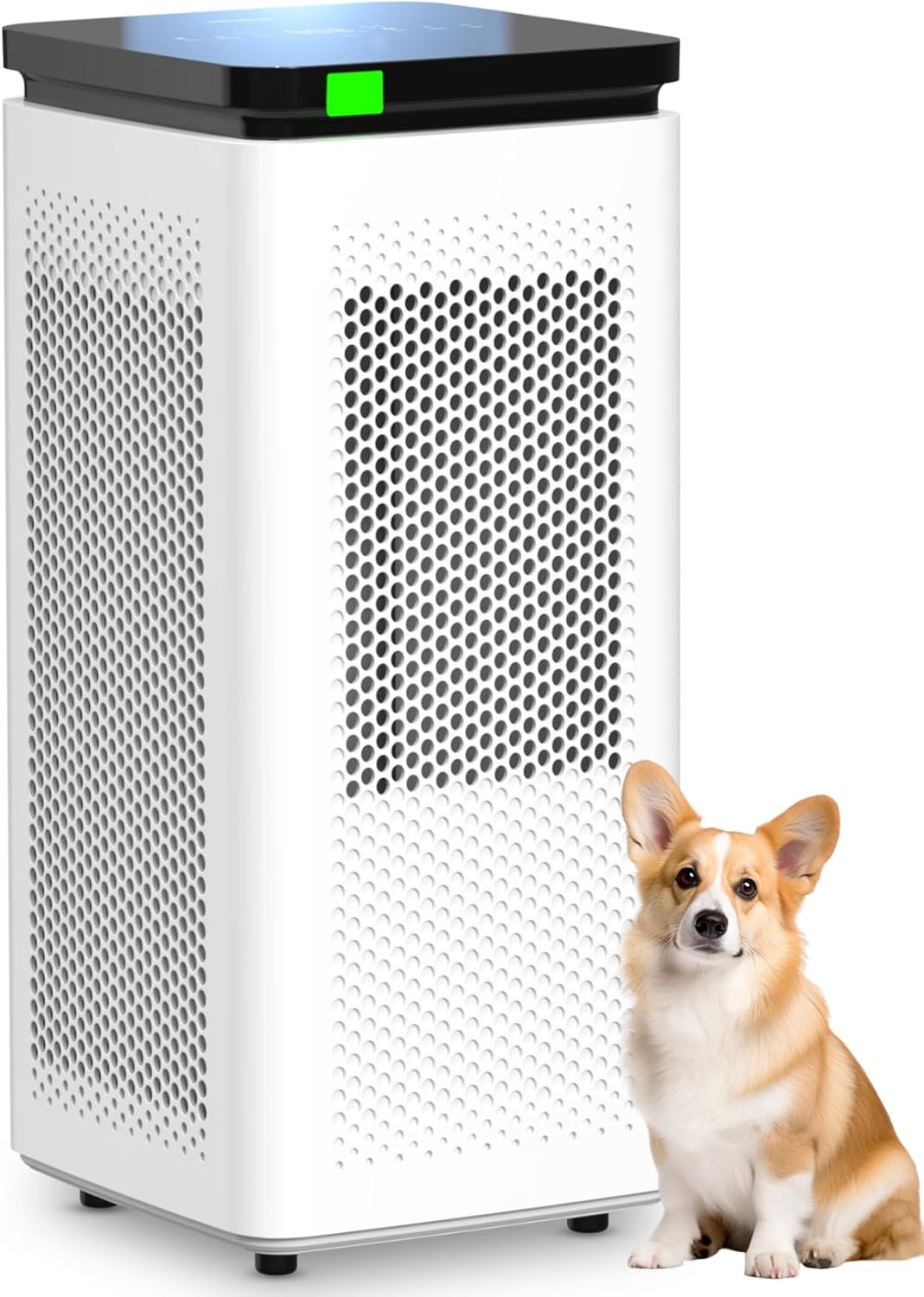
The SIESEAN AP-400 is a floor-standing air purifier built for sizable open spaces and heavy pollutant loads. It pairs an H13 True HEPA element with an activated carbon layer to tackle fine particulates, pet dander, smoke, VOCs, and odors, and its 235 CFM CADR plus dual-sided airflow aims to move air quickly through large rooms. A real-time PM2.5 display and auto mode let the unit adjust fan speed based on measured air quality, while a sleep mode drops noise to about 30 dB for nighttime use. Practical controls include a timer, child lock, and a dimmer for the display, and the unit reports a filter-replacement indicator to simplify maintenance. Certified testing and ENERGY STAR listing suggest reasonable energy use for continuous operation. Expect strong coverage in open-plan living rooms, basements, or offices, but in very tall rooms you may need multiple units or placement closer to pollutant sources to ensure circulation reaches high ceilings effectively.
Best for: Buyers who prioritize efficient, tested filtration for large open rooms and want a low-noise, energy-efficient unit that manages air quality automatically.
Less Ideal for: People needing a single solution for very tall rooms or high-ceilinged spaces where a single floor-standing unit cannot circulate air effectively to the ceiling height; those users should consider multiple units or purpose-built commercial air handlers.
- H13 True HEPA plus activated carbon removes 0.1 micron particles, smoke, and odors
- 235 CFM CADR with dual-sided airflow for faster circulation in large rooms
- Built-in PM2.5 display and auto mode for hands-off air-quality control
- Very quiet sleep mode around 30 dB suitable for bedrooms
- ENERGY STAR certified for lower daily energy use during continuous operation
- Coverage claims focus on square footage and may not account for very high ceilings or complex room shapes
- Replacement filters are required every few months for peak performance
- No explicit remote control or smartphone app listed for remote operation
Verdict: A tested, energy-smart floor-standing purifier that delivers fast particulate and odor removal for large open rooms while staying quiet enough for nighttime use.
Purivortex PX500 Air Purifier

| Coverage Area | Up to 880 sq.ft |
|---|---|
| Filtration | Pre-filter, HEPA, Activated carbon |
| Noise level | 20 db |
| Timer settings | 4H/8H/12H |
| Fan modes | Sleep/Low/Med/High |
The Purivortex PX500 is a small, tower-style HEPA purifier designed to move a lot of air for its footprint. It uses a three-stage system — pre-filter, HEPA, and activated carbon — and a taller 6-inch filter to increase intake and run time compared with typical compact units. The manufacturer claims it can purify a room up to 880 square feet in an hour and reach a 215 sq ft room in about 15 minutes, so it is aimed at larger open spaces where fast air turnover matters. Controls include four fan speeds, three timers, and multicolor night-light modes, and the unit is CARB, ETL, and FCC certified. Practical benefits are good particle removal, light odor reduction from the carbon layer, and quiet low-speed operation for bedside use. Limitations are that true performance in rooms with very high ceilings will depend on placement and airflow patterns, and the PX500 is still a single-room solution rather than whole-house HVAC filtration.
Best for: Buyers who want an affordable, higher-capacity standalone purifier for larger rooms or open living areas and prioritize fast air turnover and simple controls.
Less Ideal for: Homes needing whole-house filtration or rooms with extremely high vaulted ceilings where a single portable unit cannot circulate air effectively.
- Three-stage filtration including HEPA and activated carbon for particles and basic odors
- Tall 6-inch filter allows higher air intake and longer service life compared with smaller filters
- Rated coverage up to 880 sq ft with relatively fast air circulation times
- Multiple fan speeds and timers plus quiet low-speed operation for night use
- ETL, FCC, and CARB certifications and independent lab testing claims
- Performance in very tall rooms can be limited by circulation and requires strategic placement
- Single-room unit so it cannot replace in-duct or whole-house filtration
Verdict: Choose the PX500 when you want an inexpensive, high-capacity portable purifier that moves air quickly in large rooms.
AirDoctor AD3500 Air Purifier

| Model | AD3500 |
|---|---|
| Coverage | Up to 2,520 ft2 (1 hour); 630 ft2 (15 minutes) |
| Filtration | Pre-filter + Activated Carbon + UltraHEPA |
| Particle capture | Down to 0.003 microns |
The AirDoctor AD3500 is built to purify very large spaces quickly, delivering coverage rated at 630 sq ft in 15 minutes and up to 2,520 sq ft in an hour. It uses a three-stage system with a pre-filter, a premium activated carbon layer for gases and odors, and a hospital-grade UltraHEPA filter that the brand reports captures particles down to 0.003 microns. Real-time PM2.5 sensors feed the Halo air-quality indicator and an Auto Mode that adjusts fan speed and triggers a boost when pollution spikes. For high ceilings and large open rooms the AD3500's airflow and multiple fan speeds help move and mix air to reach elevated volumes. Practical benefits include strong smoke, pet dander, and VOC removal and quiet operation suitable for night use, plus easy maintenance with replaceable genuine filters. Important limitations are the unit's physical footprint and weight relative to smaller purifiers and the need to buy replacement filters on the stated schedule to maintain peak performance.
Best for: Buyers who prioritize dependable, science-backed filtration for large rooms or open plans with high ceilings and want a purifier that runs quietly and adjusts automatically to changing air quality.
Less Ideal for: People who need a compact, lightweight purifier for small bedrooms, travel, or tight spaces where floor footprint and weight are important.
- Rated coverage for very large areas up to 2,520 sq ft enables circulation in open rooms and high‑ceiling spaces
- Hospital-grade UltraHEPA captures ultrafine particles down to 0.003 microns according to the listing
- Premium activated carbon stage targets gases, odors, VOCs and smoke
- Auto Mode with PM2.5 sensors and Halo display provides real-time adjustments and visible air quality feedback
- Quiet operation suitable for continuous or night-time use
- Larger, heavier cabinet requires more floor space than compact purifiers
- Replacement filters are required on a schedule and are an ongoing cost
Verdict: If you need a reliable, high-capacity purifier that handles very large rooms and high ceilings with hospital-grade filtration and automatic air-quality control, the AirDoctor AD3500 is a strong choice.
Levoit Core 300-P

| Floor Area | 1073 square_feet |
|---|---|
| Noise Level | 24 db |
| Particle Retention Size | 0.1 micron |
| Wattage | 56 watts |
The Levoit Core 300-P is a small, room-focused air purifier that uses a 3-in-1 filter (pre-filter, HEPA-grade, and activated carbon options) and a 56W motor to move air efficiently. It is typically used in bedrooms, offices, or living spaces to reduce pollen, dust, pet dander, smoke, and common household odors; Levoit quotes AHAM-verified CADR numbers that make it suitable for refreshing mid-size rooms quickly. Controls are simple touch buttons with a sleep mode that drops noise to about 24 dB and an LED-off option for nighttime use. Practical benefits include proven HEPA-grade filtration down to 0.1 micron, CARB and ETL certifications, and a compact design that fits on a tabletop or shelf. Limitations are its intended coverage pattern and airflow: although CADR figures are strong for its class, the unit is sized for single-room use and will circulate air less effectively in very large open spaces or rooms with high ceilings without multiple units or placement near occupants. Filter replacement recommendations and the note that only official Levoit filters meet tested performance are additional ownership considerations.
Best for: Buyers who prioritize verified real-world performance and want a quiet, proven purifier for bedrooms or mid-size rooms where social proof and certification matter.
Less Ideal for: Those needing a single purifier to treat large open rooms with high ceilings or whole-floor coverage should consider larger-capacity units or multiple purifiers instead.
- Three-stage filtration with HEPA-grade performance for particles down to 0.1 micron
- AHAM-verified CADR ratings with documented performance for smoke, dust, and pollen
- Very quiet sleep mode with LED-off option for undisturbed nights
- Compact footprint that fits on tables or shelves and is easy to move
- Designed for single-room use so effectiveness drops in very large rooms or spaces with high ceilings
- Relies on official Levoit replacement filters for claimed CADR and filtration performance
Verdict: A certified, quiet HEPA-grade purifier that reliably cleans single rooms and appeals to buyers who value verified performance.
Levoit Vital 200S-P Air Purifier

| Floor Area | 1875 square_feet |
|---|---|
| Filter Type | 3-Stage Filter |
| Particle Retention Size | 0.1 micrometer |
| Noise Level | 27 db |
| Wattage | 51 |
The Levoit Vital 200S-P is a smart air purifier built for whole-room use in large spaces and high-ceiling rooms where stronger airflow is needed. It uses a three-stage filter stack — washable pre-filter, activated carbon, and HEPA-class filtration — to capture particles down to 0.1 micrometer and address smoke, dust, pollen, pet dander, and odors. The unit is AHAM verified with high CADR figures for smoke, dust, and pollen, and it supports app control plus an onboard air quality monitor for automatic adjustments. At its low sleep-noise setting it operates quietly for bedrooms, and the U-shaped inlet design aims to reduce clogging from pet hair. Practical benefits include straightforward filter replacement, washable pre-filter for reduced running cost, and CARB certification for indoor safety compliance. Limitations are typical for powerful purifiers: it requires wall power and takes up floor space, and replacement specialty filters for targeted problems like smoke or VOCs add ongoing expense. For very tall rooms expect circulation patterns to depend on placement since no purifier can force full mixing in extreme ceiling heights.
Best for: Buyers who prioritize reliable, independently tested air cleaning for large rooms and want a smart, low-noise purifier that runs automatically with minimal intervention.
Less Ideal for: People who need a portable battery-powered unit or who require active air mixing for extremely tall industrial ceilings should consider other solutions.
- AHAM-verified with high CADR ratings for smoke, dust, and pollen
- Three-stage filtration including washable pre-filter and activated carbon for odors
- App control and built-in air quality monitor for automatic operation
- Quiet sleep mode at low noise levels for nighttime use
- Requires continuous mains power and occupies floor space
- Specialty replacement filters for smoke, VOCs, or pet-specific filters add extra cost
Verdict: Choose the Vital 200S-P when you want a proven, smart air purifier that consistently cleans large, high-ceiling living spaces with low noise and easy maintenance.
Choosing the Right Air Purifier for High Ceilings: Key Factors to Consider
Room Volume and CADR
Square footage alone can mislead in tall rooms because the total air volume increases with ceiling height. Calculate room volume by multiplying floor area by ceiling height and compare that to the purifier's stated CADR or volumetric flow rate. A purifier that specifies coverage for standard 8-foot ceilings will underperform in a 12-foot space unless its CADR is proportionally higher.
Higher CADR values indicate the unit can exchange the room air more frequently, which is essential for tall rooms where contaminants can stratify. Look for manufacturers that provide flow or CADR numbers rather than only floor area recommendations, and plan for a higher target exchange rate to account for vertical mixing inefficiencies.
Fan Power and Air Distribution
Fan strength drives how well a purifier moves air up and down in a room. Powerful fans that can sustain higher flow rates help break up stagnant layers of air that form under high ceilings. However, raw fan power alone is not enough; the way air is directed matters.
Units with adjustable directional outlets or upward-facing discharge can push filtered air toward ceiling-level pockets and encourage mixing. Consider models with multiple fan speeds and boost modes so you can run a higher output briefly to clear buildup without constantly tolerating higher noise.
Filter Type and True HEPA Performance
Effective particulate filtration is critical for capturing allergens, smoke, and fine dust that can travel throughout tall rooms. True HEPA filters capture at least 99.97 percent of particles down to 0.3 microns and are the gold standard for most household concerns. Look for sealed filtration paths so air is forced through the filter rather than bypassing it.
Consider prefilters for large particles and activated carbon layers if odors or volatile organic compounds are a concern. Filter longevity and replacement cost also matter because units that must run at higher speeds in tall rooms will process more air and may require more frequent maintenance.
Placement and Mounting Options
Placement has an outsized effect in tall rooms. A purifier sitting on the floor may struggle to influence high-level air, while elevated placement—on a shelf or wall—can improve vertical circulation. Some designs permit wall mounting, tabletop elevation, or tall-stand installations that position intakes and outlets where they are most effective.
Think about where occupants spend time. Placing a unit near seating or sleeping areas at a mid-height can help ensure the breathing zone receives cleaner air. Also consider furniture layout and potential obstructions that could block airflow patterns.
Noise Versus Performance Tradeoffs
To achieve the higher airflow necessary in taller rooms, you will often need to run a purifier at elevated fan speeds, which increases noise output. Evaluate manufacturer noise ratings at different speeds and consider whether occasional boost modes are acceptable versus continuous high-speed operation. Some designs minimize perceived noise through larger, slower-moving fans or well-damped housings.
If the purifier will operate in living rooms or bedrooms, look for models with quiet-night modes and programmable schedules that let you increase airflow when noise impact is low. Understanding the tradeoff helps you choose a unit that you will actually run at the levels needed.
Room Aesthetics and Footprint
High-ceiling spaces often have architectural features you may want to preserve, so a purifier's size, styling, and placement flexibility matter. Slim tower units save floor space and can work well on raised surfaces, while compact canister designs may offer more intake area in a small footprint.
Consider how visible you want the unit to be and whether its dimensions will fit the intended placement. Ease of moving the purifier between rooms is also a practical consideration if you do not plan to dedicate it to a single space.
Why High Ceilings Change Airflow
Air movement in tall rooms is governed by thermal layering and the momentum of air currents. Warm air rises and can carry particulates upward, where they can linger near the ceiling unless there is sufficient mixing. Without deliberate vertical circulation, lower breathing zones may clear while upper pockets remain contaminated.
Understanding that vertical stratification exists helps you choose units and placements that actively mix the room. Look for purifiers that either draw air from a range of heights or direct filtered air upward to encourage circulation back down.
- Thermal stratification can trap contaminants near ceilings
- Strong vertical airflow breaks up stagnant layers
- Placement influences whether the unit cleans the breathing zone or only ceiling-level air
Placement Tips for Tall Rooms
Place the purifier where it can influence both low and high air layers. If possible, position it on a raised surface or wall mount about halfway between floor and ceiling to maximize vertical reach. Avoid tucking the unit behind large furniture that blocks intake or output.
If you cannot elevate the purifier, run it closer to occupants or use a model with an upward-facing outlet. In open-floor plans, consider portable options so you can move the purifier to areas where people gather.
- Elevate the unit to improve vertical mixing
- Keep at least 12 inches of clearance around intakes and outlets
- Use multiple smaller units for very large volumes instead of one undersized unit
Balancing Noise and Daytime Performance
In living spaces, you might tolerate higher noise during activities and lower noise during rest. Use programmable scheduling and higher fan speeds during the day to cycle room air aggressively, then switch to quiet modes at night. Check manufacturer noise ratings at multiple speeds so you know the expected sound level when boosting airflow.
Larger-diameter fans that spin slower can often move the same volume of air as small, high-speed fans with less noise. If silence is essential, prioritize designs engineered for efficient airflow rather than simply high-speed operation.
- Run higher speeds when rooms are empty or during the day
- Prefer larger, slower fans for quieter high-flow performance
- Use timers and occupancy sensors to automate boost cycles
When to Use Multiple Units
Very tall or irregularly shaped spaces may benefit from two or more purifiers placed to create complementary circulation paths. Multiple units can reduce the need for a single extremely powerful fan and allow quieter operation while maintaining overall exchange rates. Position them to avoid short-circuiting flow where one unit pulls air immediately from another's outlet.
For multilevel open plans, consider placing a unit on each level or near stairwells where air tends to move between floors. This layered approach helps ensure the entire vertical column of air is refreshed rather than relying on a single source.
- Multiple units create distributed airflow and lower noise
- Avoid placing units directly facing each other
- Coordinate speeds so airflow complements rather than cancels
Filters and Maintenance in High-Use Scenarios
Purifiers in tall rooms often run harder and for longer, increasing filter loading. Choose designs with accessible filter compartments and clear replacement intervals. Prefilters help capture large particles and extend the life of HEPA and carbon media, while good seals prevent unfiltered bypass.
Factor filter replacement cost and availability into ownership decisions since frequent high-speed operation will increase maintenance frequency. Keep replacement parts on hand if you rely on continuous high-level purification.
- Expect more frequent filter changes when running higher speeds
- Choose sealed-path filtration to prevent bypass
- Use prefilters to prolong main filter life
How We Chose the Best Air Purifier for High Ceilings
We focused on features that matter most when cleaning air in rooms with ceiling heights above the typical 8-foot standard. We prioritized measured airflow and coverage metrics, including CADR or equivalent flow ratings, because stronger, directed circulation is necessary to move air up from low-level sources and through the filter. Filtration efficiency was the next key filter, with attention to true HEPA performance or equivalent particulate capture down to 0.3 microns for allergens and fine dust. Coverage pattern and fan design were considered to ensure the unit can create vertical mixing rather than only horizontal circulation. Installation versatility and placement options mattered because taller rooms often benefit from elevated mounting or directional outlets. Noise versus airflow tradeoffs were examined so a unit that can run at higher speeds without intolerable sound is practical for real-world use. We excluded units that only list square footage without any airflow or CADR data and models that rely solely on ionization or ozone-producing tech. Our final list emphasizes measurable performance, proven filtration media, and practical design for tall spaces.
Our full evaluation process is outlined in our review methodology.
FAQ
How do I estimate the right CADR for a room with a 12-foot ceiling?
Calculate the room volume by multiplying floor area by the 12-foot height, then target a CADR or flow rate that provides at least four to six air changes per hour for that volume. Manufacturers sometimes list CADR directly; if not, look for airflow in cubic feet per minute and convert to hourly exchange.
Can I just place a floor purifier and expect it to clean a tall room?
A floor purifier can help but may leave upper layers unchanged if it lacks upward discharge or sufficient fan power. Elevating the unit, choosing an upward-facing outlet, or using multiple units improves vertical mixing and reduces stratification.
Are tower units better than canister designs for high ceilings?
Both can work. Tower units often provide upward-facing outlets that aid vertical mixing, while canisters may offer larger intake area. The important factors are airflow pattern and CADR rather than the enclosure style alone.
How much louder will a purifier be when running at the higher speeds needed for tall rooms?
Noise increases with fan speed, but the amount varies by design. Some units use larger fans or better acoustic damping to keep sound lower at equivalent airflow. Check noise ratings at different speeds and be prepared to run higher settings only when occupants can tolerate the sound.
Is wall mounting worth it in a high-ceiling room?
Wall mounting can position the unit at a height that improves vertical circulation without occupying floor space. It is worth considering if the unit supports secure mounting and does not obstruct intake or output paths.
Final Verdict
For high-ceiling spaces, prioritize measurable airflow and an air distribution design that encourages vertical mixing. Focus on CADR or volumetric flow ratings, true HEPA filtration, and placement flexibility so the purifier can reach both the breathing zone and ceiling-level pockets. Expect tradeoffs between noise and performance, and plan for more frequent filter maintenance if you run higher fan speeds. By matching purifier capacity and air distribution to your room volume and layout, you can confidently choose an option that meaningfully improves air quality in tall rooms.