
Note: This article contains affiliate links. If you click on these links and make a purchase, we may earn a small commission at no extra cost to you. This helps support our research and content. Read our full affiliate disclosure here.
Cooking produces a mix of short-lived and lingering odors, fine grease aerosols, and sometimes smoke that can quickly spread through your home. Picking the right air purifier for kitchen smells helps you control those odors at the source, limit residue on cabinets and surfaces, and keep adjacent rooms more comfortable after cooking. This guide shortlists seven top air purifiers suited to kitchen odor control, emphasizing real-world performance factors like filter media, airflow, and ease of maintenance. Read on to understand the evaluation criteria we used and which features matter most for everyday cooking environments.
Top Picks at a Glance
| Best Overall The best all-around choice for most situations | GermGuardian AC4825E Tower Air Purifier |  |
| Best Quality Built to a higher standard if you want something more solid | Coway Mighty AP-1512HH |  |
| Best Value The sweet spot between price and what you get | MOOKA B-D02L Air Purifier |  |
| Best Budget The cheapest option that still gets the job done reliably | AromaRoom AP100-A Air Purifier |  |
| Top Rated A top-rated pick with lots of positive feedback | ECOSELF HAP603 Air Purifier |  |
| Most Popular A crowd favorite that many people choose with confidence | Levoit Core Mini-P |  |
| Best Seller A high-volume bestseller chosen again and again | Levoit Vital 200S-P |  |
GermGuardian AC4825E Tower Air Purifier

| Room coverage rate | 153 sq. ft. per 12.5 minutes |
|---|---|
| Maximum room size (hourly) | Up to 743 sq. ft. per hour |
| Filter type | True HEPA with activated carbon pre-filter |
| Fan speeds | Three speeds including sleep mode |
The GermGuardian AC4825E is a compact tower purifier built around a True HEPA filter, an activated carbon pre-filter, and an optional UV-C lamp to address allergens, odors, and microbes in living spaces. It is meant to sit in a kitchen, bedroom, or living room and cycles air in a 153 sq ft room roughly every 12.5 minutes and can serve larger areas at a slower rate. Three fan speeds including a quiet sleep setting let you balance noise and cleaning power, while the carbon pre-filter targets cooking smells and pet scents before air reaches the HEPA media. The unit is compatible with factory replacement HEPA B filters, carbon filters, and UV-C bulbs for straightforward maintenance. Expect good performance on dust, pollen, pet dander, and common kitchen odors, but the optional UV-C is supplemental rather than a primary sterilizer and filter replacement is required periodically to maintain odor control. The tower shape saves floor space, but circulation speed and odor removal depend on placement and room size, so proper positioning near the odor source improves results.
Best for: Buyers who want an all-around, space-saving purifier that handles allergens and everyday kitchen smells with simple controls and easy-to-find replacement filters.
Less Ideal for: People needing rapid removal of heavy smoke or strong cooking odors in very large or open kitchens should consider higher-capacity commercial-style units instead.
- True HEPA filter captures fine particles down to 0.1 microns for allergy and dust reduction
- Activated carbon pre-filter reduces common kitchen and pet odors before air reaches the HEPA stage
- Optional UV-C light provides an extra sanitizing layer for airborne microbes
- Three fan speeds including a quiet sleep mode let you trade noise for faster cleaning
- Compact tower design fits in small kitchens or on counters without taking much floor space
- Odor removal effectiveness depends on filter condition and proximity to the smell source
- Not designed to instantly clear heavy cooking smoke in large open-plan kitchens
Verdict: A compact, user-friendly tower purifier that reliably reduces allergens and routine kitchen odors while offering easy maintenance with factory replacement filters.
Coway Mighty AP-1512HH

| Coverage | Up to 1,748 sq. ft. in 60 minutes |
|---|---|
| Filtration stages | Washable pre-filter, deodorization filter, bipolar device, HEPA |
| HEPA effectiveness | 99.97% of 0.3μm particles |
| Modes | Auto Mode, Eco Mode, Timer |
The Coway Mighty AP-1512HH is a room air purifier built to remove particles, odors, and common VOCs in living spaces up to roughly 1,748 sq ft within an hour. It uses a washable pre-filter, deodorization stage, bipolar ionizer, and a true HEPA filter to capture 99.97% of 0.3 micron particles while also addressing smoke and household smells. In daily kitchen use it runs in auto mode and adjusts fan speed based on the onboard pollution sensor, and the LED air quality indicator gives an immediate visual cue when odors spike. The unit includes a filter indicator and timer and offers an eco mode for lower energy and noise when air is clean. Practical limitations are that replacement filters are required for ongoing VOC and odor control, and the bipolar device may be a consideration for buyers sensitive to ionization technology. The purifier is compact and reasonably quiet on low settings, but sustained heavy cooking or grease-heavy frying will still require ventilation or source control alongside the AP-1512HH for best results.
Best for: Buyers who prioritize measurable performance and continuous air monitoring for removing smoke, cooking smells, and allergens in medium to larger kitchen-adjacent spaces.
Less Ideal for: People seeking a permanent solution for heavy commercial cooking or those who need an exhaust-style ventilation system should look to dedicated kitchen ventilation instead.
- Four-stage filtration including washable pre-filter plus true HEPA for particle removal
- Auto mode with real-time air quality sensor that adjusts fan speed
- Effective at reducing common kitchen odors, VOCs, and smoke in medium spaces
- Filter indicator and timer make maintenance and scheduling straightforward
- Performance depends on replacement custom filters for VOC and odor reduction
- Not a substitute for mechanical kitchen ventilation during heavy cooking or grease smoke
Verdict: Choose the Coway Mighty AP-1512HH when you want a performance-focused room purifier that actively monitors air quality and reduces cooking smells and smoke in medium to large kitchen areas.
MOOKA B-D02L Air Purifier
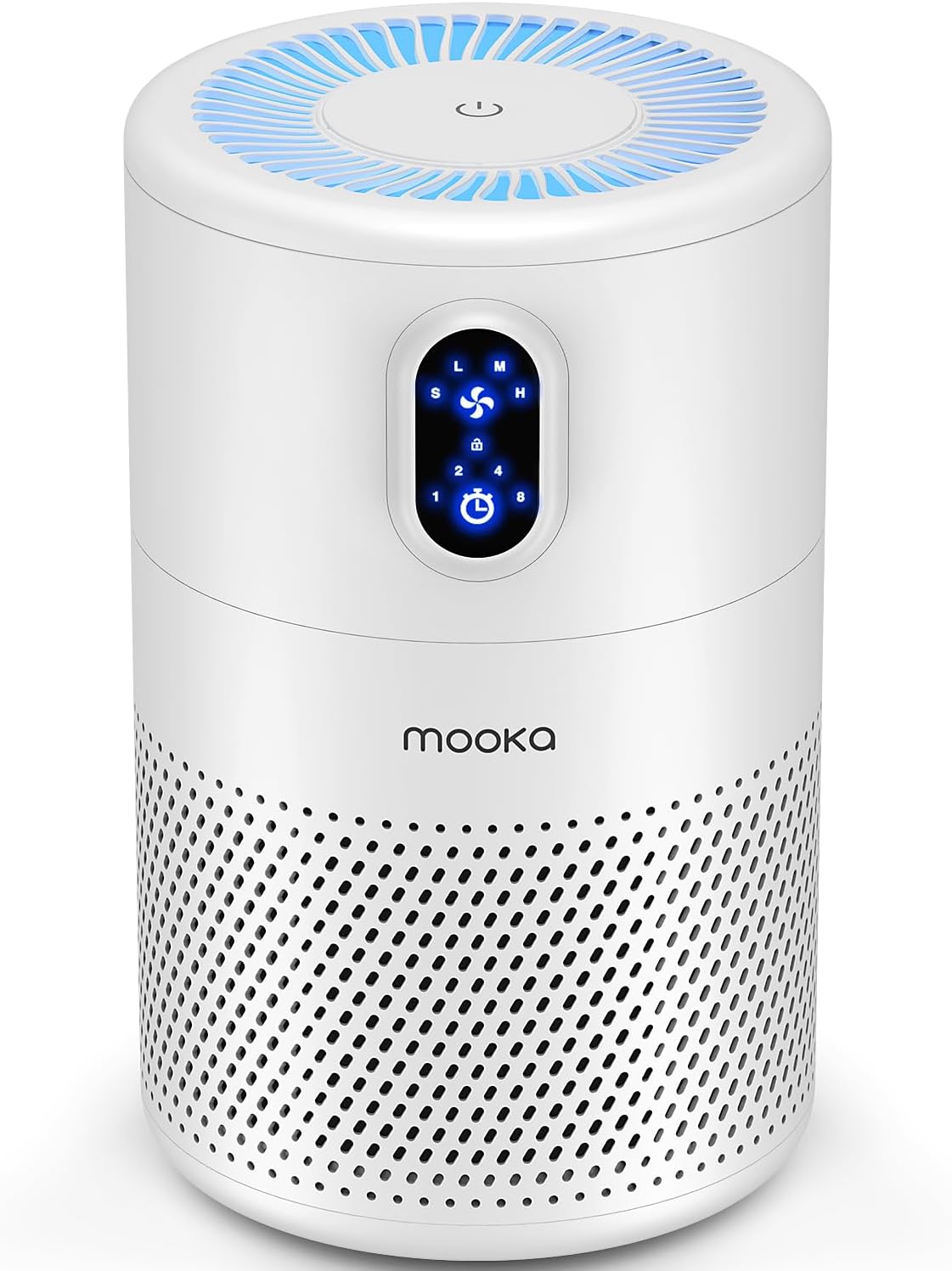
| Effective Area | 1076 sq ft |
|---|---|
| Filter Type | H13 True HEPA + activated carbon |
| Fan Modes | 4 speeds |
| Timer Settings | 1/2/4/8 hours |
The MOOKA B-D02L is a plug-in room air purifier that combines a pre-filter, H13 True HEPA, and activated carbon stage to remove dust, pollen, pet dander, smoke and common odors. It is typically placed in kitchens, living rooms or bedrooms and runs on four fan speeds with timer options to balance cleaning performance and noise. For kitchen use the activated carbon layer helps reduce cooking smells and light smoke, while the H13 HEPA captures fine particles down to 0.3 microns. The unit is compact and energy efficient thanks to a brushless motor that MOOKA says can run near-quiet at low settings and includes a child lock and night light that can be disabled. Filter replacement is required every 3 to 6 months depending on use, and you must remove the filter bag before first use. The purifier advertises coverage up to 1,076 sq ft but achieves multiple air changes per hour only in smaller rooms, so expect slower odor removal in very large open kitchens or heavy smoke conditions.
Best for: Buyers who want a practical, compact purifier that reduces cooking smells and airborne particles in everyday home kitchens and nearby living spaces while keeping power use and noise low.
Less Ideal for: Large, open-plan kitchens with heavy cooking, smoke, or frequent grease-laden odors where industrial or higher-capacity purifiers are required.
- H13 True HEPA stage captures particles down to 0.3 microns
- Activated carbon layer helps reduce common kitchen odors and light smoke
- Quiet, energy-saving brushless motor suitable for overnight use
- Multiple timers and four fan speeds let you balance cleaning rate and noise
- Large open kitchens may need longer run time or multiple units for fast odor removal
- Filter needs replacing every 3–6 months depending on usage
Verdict: A quiet, energy-efficient purifier with H13 HEPA and carbon filtration that is a smart, space-saving choice for reducing routine kitchen odors and everyday airborne particles.
AromaRoom AP100-A Air Purifier

| Filter type | True HEPA13 3-stage |
|---|---|
| Coverage | Up to 430 ft² (air change twice/hour) |
| Noise level | 22 dB (sleep mode) |
The AromaRoom AP100-A is a small, quiet air purifier designed to refresh bedroom or kitchen-adjacent spaces. It uses a 3-stage filtration system with a True HEPA13 filter plus a smoke-remover layer to capture particles down to 0.3 microns, and its 360-degree intake and brushless motor claim to circulate air twice an hour in a roughly 430 ft² room. Controls are simple and it includes an aroma pad for adding essential oils and an RGB night light for ambiance. Noise levels drop to about 22 dB in sleep mode, so it can run overnight without being intrusive. For kitchen use it helps reduce cooking odors and airborne grease particulates in small to medium areas, though the aroma feature can interfere with neutralizing strong smells if used at the same time. Replacement filters are recommended every 3 to 6 months for best performance, so ongoing filter cost is a factor to plan for. Its small footprint makes it easy to move between countertop and dining areas but limits throughput compared with larger room purifiers.
Best for: Buyers who want an inexpensive, compact purifier for small kitchens or open kitchen areas and prioritize quiet operation and occasional deodorizing with aroma pads.
Less Ideal for: Those who need rapid removal of heavy cooking smoke, grease, or odors in large kitchens should choose a higher-capacity purifier designed for bigger spaces.
- True HEPA13 3-stage filtration captures particles down to 0.3 microns
- 360-degree intake with brushless motor for efficient circulation in small rooms
- Very quiet 22 dB sleep mode suitable for overnight use
- Aroma pad and RGB night light add fragrance and ambiance options
- Small unit capacity may struggle with very strong or persistent kitchen odors
- Requires filter replacements every 3–6 months, adding ongoing cost
Verdict: AromaRoom AP100-A is a budget-friendly, whisper-quiet tabletop purifier that works well for reducing typical kitchen smells in small to medium spaces.
ECOSELF HAP603 Air Purifier

| Coverage | Up to 2400 ft² |
|---|---|
| Filtration | H13 True HEPA 3-in-1 |
| Noise level | 22 dB (Sleep Mode) |
| Air quality display | PM2.5 with infrared sensor |
The ECOSELF HAP603 is a large-room air purifier built to run steadily in living spaces and kitchens where odors, smoke, and pet dander are common. It uses a True HEPA H13 filtration system described as 2X-power filtration to capture 99.97% of airborne particles and is intended to cycle air for areas up to 2400 square feet. An infrared sensor and PM2.5 display let the unit run in smart/auto mode, adjusting fan speed as air quality changes, while sleep mode drops noise to about 22 dB for nighttime use. Practical touches include a timer, lock controls, filter indicator, and an aromatherapy option to neutralize kitchen smells or add light scent. The unit is compact and quiet enough for continuous home use, but buyers should plan on replacing official ECOSELF filters for peak performance and note that manufacturer claims about coverage assume regular filter changes. Controls and indicators are suited to hands-off operation, but actual odor-removal speed in heavy cooking environments will depend on room layout and source strength.
Best for: Buyers who prioritize a dependable, always-on purifier that senses air quality and adjusts automatically for steady odor and particle control in larger open kitchens and living areas.
Less Ideal for: People who need rapid elimination of very strong, continuous cooking fumes in tight enclosed kitchens or those wanting a solution that permanently removes heavy gases without regular filter replacement should consider alternatives.
- True HEPA H13 filtration capturing 99.97% of particles for effective particle removal
- PM2.5 display with infrared sensor and auto mode for continuous air-quality responsive operation
- Very quiet 22 dB sleep mode suitable for night use
- Built-in timer, filter indicator, and child lock for low-maintenance, uninterrupted operation
- Aromatherapy function to help mask or neutralize light kitchen odors
- Manufacturer recommends using official replacement filters for best performance which adds ongoing cost
- Coverage and removal speed for strong kitchen odors may be limited by room layout and continuous pollutant sources
Verdict: A reliable, low-noise large-room purifier that automatically responds to air quality and is built for steady odor and particle control in open kitchen-living spaces.
Levoit Core Mini-P
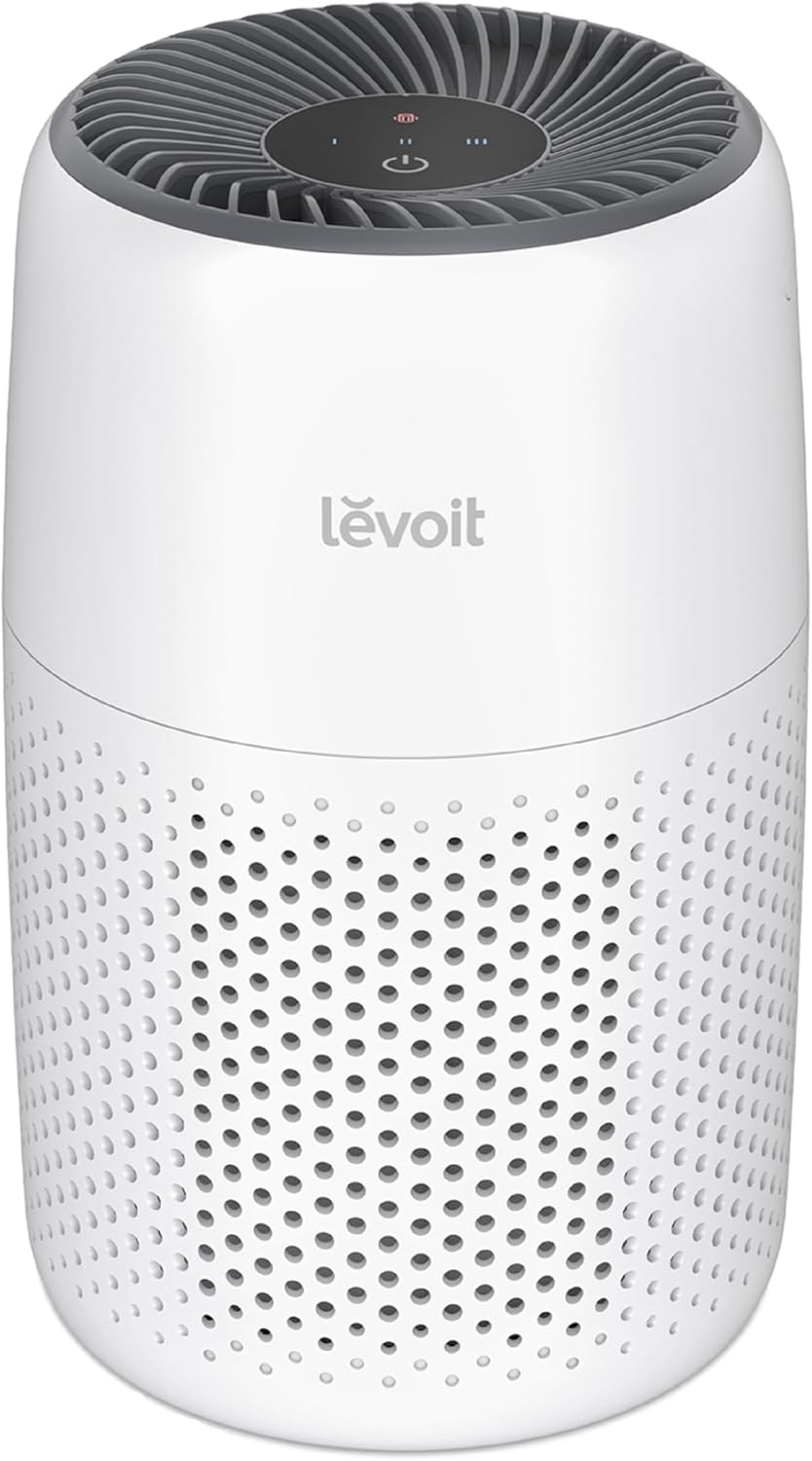
| Rated Power | 7W |
|---|---|
| Noise Level | 27-45dB |
The Levoit Core Mini-P is a small, plug-in tabletop purifier intended for bedrooms, kitchens, offices, and desktops where space is limited. It uses a pre-filter and a main high-efficiency filter to capture lint, pet dander, dust, smoke particles, and other fine airborne pollutants while an included fragrance sponge allows light aromatherapy. The unit is AHAM-verified for performance, runs quietly with a sleep mode and auto-off display to limit disturbance, and draws very little power. In practice the Core Mini-P is best at tackling localized sources of odor and small amounts of smoke or cooking smell in compact areas rather than whole-room clearance for larger kitchens. Its low noise and compact footprint make it easy to place near a stove or trash can, but you should expect slower odor removal compared with larger, higher-CADR purifiers and factor in periodic filter replacements and careful use of essential oils to avoid damaging plastic parts.
Best for: Buyers who want a validated, quiet countertop purifier to reduce cooking smells, smoke, pet dander, and everyday pollutants in small kitchens or near odor sources and who prioritize proven performance and social-proof when choosing appliances.
Less Ideal for: Large open-plan kitchens, heavy smoke situations, or anyone who needs fast whole-room odor clearance should consider a larger, higher-capacity purifier instead.
- Compact tabletop design fits small counters and desks
- Pre-filter plus main filter capture pet dander, dust, smoke particles, and lint
- AHAM-verified performance gives independent validation of cleaning ability
- Very low power draw and quiet operation with sleep mode for nighttime use
- Fragrance sponge option for light aromatherapy or odor masking
- Small coverage area so odor removal is slower in larger or open kitchens
- Essential oils can damage plastic if overfilled, limiting aromatherapy use
Verdict: Choose the Levoit Core Mini-P when you need a compact, AHAM-verified purifier to quietly reduce kitchen smells and small-area pollutants at the counter or desktop.
Levoit Vital 200S-P

| Floor Area | 1875 square_feet |
|---|---|
| Noise Level | 27 db |
| Particle Retention Size | 0.1 micrometer |
| Wattage | 51 |
| Filter Type | 3-Stage Filter |
The Levoit Vital 200S-P is a smart air purifier built to tackle allergens, pet dander, smoke and household odors across large, open rooms. It uses a three-stage filtration system with a washable pre-filter plus activated carbon to capture particles down to 0.1 micrometers while the AHAM verification and CADR ratings (smoke 250 CFM, dust 254 CFM, pollen 289 CFM) confirm strong airflow performance. Typical use is whole-room continuous cleaning in living rooms or kitchens where odors and cooking particulates circulate; the unit offers app control, an onboard air quality monitor, and a quiet sleep mode that runs near 27 dB. Practical benefits include fast air exchanges in larger spaces, specialty replacement filters for smoke or pet odors, and a washable pre-filter to reduce consumable costs. Important limitations are its physical footprint and weight relative to compact tabletop purifiers and the need to replace specialty filters for the best odor or VOC capture, which adds ongoing maintenance cost.
Best for: Buyers who prioritize verified performance and reliable whole-room odor and particulate removal for frequently used kitchens or open living areas and who prefer simple smart controls and low-noise operation.
Less Ideal for: Those needing a small, portable countertop purifier for a single cooking surface or users who want a zero-maintenance unit without periodic filter replacements.
- AHAM-verified with strong CADR ratings for smoke, dust, and pollen
- Three-stage filtration including washable pre-filter and activated carbon for odors
- App control and built-in air quality monitor for hands-off management
- Quiet sleep mode at about 27 dB suitable for bedrooms or quiet kitchens
- Larger, heavier unit compared with travel or compact purifiers
- Best VOC and strong-odor removal requires purchasing specialized replacement filters
Verdict: Choose the Vital 200S-P when you want a lab-verified, whole-room purifier with app control and carbon-enhanced filtration to cut kitchen smells and airborne particulates in larger spaces.
Choosing the Right Air Purifier for Kitchen Smells: Key Factors to Consider
Filter Media and Activated Carbon
What the purifier uses to remove odors is critical. Activated carbon or other adsorbent media trap volatile organic compounds and many cooking smells. Look for product details about carbon quantity, pore structure, and whether the carbon is combined with chemisorption additives. Higher carbon content and thicker odor-targeting layers typically extend effective life and reduce the need for very frequent replacement.
Filter construction also matters. Pre-filters that capture grease and large particles protect the carbon layer from premature fouling. If the carbon layer becomes coated in grease or soot, adsorption capacity falls and odor removal drops off quickly, so layered filter designs are preferable.
Particulate Filtration Efficiency
Cooking produces fine aerosols that include oil droplets and smoke particles that can carry odor compounds. High-efficiency particle filtration, measured by the ability to remove PM2.5 and submicron particles, reduces visible haze and helps prevent greasy films settling on surfaces. HEPA or equivalent particulate stages remove the tiny carriers that often accompany persistent smells.
Consider the purifier's specified particle capture rating and whether it uses a true HEPA element versus a lower-efficiency filter. True HEPA-level filtration will have a more reliable impact on air cleanliness in kitchens where frying or high-heat cooking is common.
Airflow, Clean Air Delivery Rate, and Room Size
A purifier's airflow determines how quickly it can exchange and clean the air in your kitchen and nearby spaces. Clean Air Delivery Rate (CADR) or stated room coverage gives a practical sense of whether a unit can keep up with odor generation during active cooking. Kitchens are often open to adjacent living areas, so consider airflow and placement to avoid dead zones.
Higher airflow settings remove contaminants more quickly but may increase noise and energy use. Look for units that combine strong airflow with effective filtration so faster passes actually translate into odor reduction, not just moving contaminated air around.
Placement, Ducting, and Ventilation Integration
How and where you place the purifier affects performance. In many kitchens, the most effective position is between the cooking source and open living areas, or close enough to capture rising fumes. Some purifiers are designed for countertop use, while others are freestanding and meant for whole-room circulation.
Also consider how the unit interacts with existing ventilation. A powerful exhaust hood may remove the bulk of smells during active cooking, leaving the purifier to handle lingering odors. If you plan to use the purifier while the exhaust is off, choose a model with sufficient coverage for the kitchen volume.
Maintenance, Filter Life, and Ongoing Cost
Regular maintenance affects long-term performance and operating costs. Filters that are easy to access and replace reduce downtime and ensure the unit continues to capture odors effectively. Check estimated filter life for both particulate and carbon stages, and whether pre-filters are washable or replaceable.
Also consider how often grease or heavy cooking will shorten filter life. Busy kitchens may need more frequent filter swaps. Clear filter-life indicators, straightforward disposal procedures, and widely available replacement elements are practical advantages for home cooks.
Noise, Control Options, and Daily Use
Noise determines whether you will run the purifier at effective settings during and after cooking. If the practical fan speeds that reduce odors are too loud for household comfort, people tend to turn the unit down and accept lingering smells. Look for units with quiet but effective low and medium modes, as well as an effective turbo or boost setting for post-cooking cleanups.
Additional control features such as timers, auto modes tied to built-in sensors, and app or remote control improve usability. Auto modes that respond to measured particle levels or VOCs help maintain air quality without constant manual adjustments.
How Kitchen Odors Differ From General Household Odors
Kitchen smells are a mix of short-lived volatile compounds and fine aerosols that can stick to surfaces. Foods, cooking oils, charred proteins, and spices produce different chemical families, some of which dissipate quickly and others that adsorb to fabrics and cabinetry. Understanding this split helps explain why odor-targeting carbon layers and particle filtration both matter.
Because kitchen contaminants include grease and soot, filters that combine a washable pre-filter with replaceable carbon and HEPA stages tend to perform best in practice. A purifier designed only for basic household dust may struggle with persistent cooking residues.
- Odors include gases (VOCs) and particle-bound compounds.
- Grease-laden aerosols can foul adsorbent media faster.
- Surface adsorption creates longer-lasting smells than airborne molecules alone.
Placement Tips for Maximum Odor Capture
Position the purifier so it intercepts rising fumes from the stove when possible. Placing the unit on a counter some distance from the exhaust hood but closer to the cooking zone often improves capture compared with tucking it in a corner.
If your kitchen opens into a living area, run the purifier near the boundary to prevent smells from spreading. For very open plans, you may need a unit rated for the combined space.
- Place between the stove and adjoining rooms when practical.
- Avoid obstructing the intake or exhaust grills.
- Elevated placement can help capture rising warm air and fumes.
Managing Filter Grease Buildup
Grease accumulation on pre-filters and activated carbon reduces long-term effectiveness. Use washable pre-filters where available and clean them on a regular schedule based on cooking frequency. For heavy frying, clean or replace pre-filters more often.
When carbon layers show visible oiling or a persistent odor despite running the purifier, it is a sign they have reached the end of useful life and need replacement. Regular maintenance prevents accelerated fouling of downstream HEPA stages.
- Wipe washable pre-filters weekly in busy kitchens.
- Inspect carbon stages monthly when cooking frequently.
- Keep a maintenance log to track replacements during high-use seasons.
When to Use Auto Modes Versus Manual Boost
Auto modes tied to sensors are convenient for continuous maintenance but can lag during sudden strong odor bursts. Use auto for everyday cooking and switch to a manual boost or high mode during heavy frying or when smoke occurs to accelerate removal.
If the purifier has a VOC sensor, test how responsive it is to real cooking events. Some sensors are more sensitive to gases while others respond primarily to particulates, so combining sensor feedback with occasional manual intervention gives the best coverage.
- Run auto mode for routine cooking and background maintenance.
- Use manual high or turbo right after heavy frying or grilling.
- Observe sensor responsiveness and adjust habits accordingly.
Integrating With Kitchen Ventilation
If you have a high-performing exhaust hood, it will remove the bulk of cooking emissions during active use, leaving the purifier to handle residual odors and fine particles. In kitchens with limited hood capability, the purifier needs to shoulder more of the burden, so choose one with higher airflow and larger carbon loads.
Think of the purifier as complementary to ventilation rather than a replacement. Good airflow and source capture remain the first line of defense; the purifier helps maintain air quality before and after active cooking.
- Use purifier plus hood for best results during heavy cooking.
- Rely on higher CADR units where exhaust performance is weak.
- Purge the room with a post-cooking boost cycle to remove lingering smells.
How We Chose the Best Air Purifier for Kitchen Smells
We focused on features that directly affect an air purifier's ability to reduce cooking odors and capture grease or particulate generated during meal preparation. Key evaluation criteria included the presence and quality of activated carbon or odor-targeting adsorbents, particulate filtration efficiency for fine cooking aerosols, delivered airflow and room coverage, and how the unit handles grease and residue in routine use. We also considered runtime behavior such as fan speed responsiveness, noise at practical settings, filter-change accessibility, and ongoing maintenance needs. Units that required specialized installation, significant room modifications, or that lacked replaceable odor-targeting media were excluded. Our shortlist favors purifiers that balance effective chemical adsorption with durable particulate filtration and straightforward upkeep so they perform well in typical home kitchen conditions.
Our full evaluation process is outlined in our review methodology.
FAQ
Will an air purifier eliminate grease smells from frying?
Air purifiers with adequate activated carbon and high-efficiency particle filtration can significantly reduce frying odors, especially when run on higher speeds during and after cooking. Heavily soaked fabrics and surfaces may still retain some smell, which requires cleaning in addition to air cleaning.
How often should I replace carbon or HEPA filters in a kitchen environment?
Replacement intervals depend on cooking frequency and the amount of frying or smoke. In busy kitchens, pre-filters may need cleaning weekly and carbon or HEPA stages may require replacement several times per year. Check manufacturer guidance and inspect filters for visible oiling or odor retention.
Can I rely on a purifier instead of using my range hood?
No. A purifier complements but does not replace proper source ventilation. Range hoods capture fumes at the source more effectively during cooking. Use a purifier to handle residual odors and particles before and after active ventilation.
Will running the purifier all the time help prevent lingering kitchen smells?
Continuous low-level operation helps maintain baseline air quality and prevents odor buildup, while short high-speed runs after heavy cooking clear lingering smells more quickly. Balance noise and energy use with scheduled boost cycles for best results.
Are VOC sensors reliable indicators of cooking odors?
VOC sensors can indicate changes in gaseous compounds, but sensitivity varies by design. Some sensors respond more to specific gases than to all cooking compounds, so treat readings as a helpful guide rather than a precise measure of odor levels.
Final Verdict
When choosing an air purifier for kitchen smells, prioritize a unit that combines substantial activated carbon for VOC and odor adsorption with a true high-efficiency particle stage to capture grease aerosols. Match airflow and room coverage to your kitchen layout and consider how the purifier will work with your existing ventilation. Tradeoffs include noise at effective settings and ongoing filter maintenance. For most home cooks, a balanced unit with washable pre-filters, clear maintenance access, and a responsive boost mode offers the best mix of performance and day-to-day convenience.