
Note: This article contains affiliate links. If you click on these links and make a purchase, we may earn a small commission at no extra cost to you. This helps support our research and content. Read our full affiliate disclosure here.
If you live in a spacious house, a small bedroom unit will not deliver the airflow or filtration needed to cut dust, pollen, and pet dander across open floorplans. Choosing the right air purifier for a large home matters because coverage, filter type, and airflow determine how quickly air in big rooms gets cleaned and how often you need to maintain the unit. This guide presents six carefully shortlisted air purifiers that suit large living areas. We evaluated each option for filtration efficiency, coverage area, noise, and upkeep to help you narrow to models that balance performance and day-to-day use. Read on to see which features matter most and which tradeoffs to expect before you buy.
Top Picks at a Glance
| Best Quality Built to a higher standard if you want something more solid | IQAir HealthPro Plus XE |  |
| Best Value The sweet spot between price and what you get | SIESEAN AP-400 Air Purifier |  |
| Best Budget The cheapest option that still gets the job done reliably | MOOKA PR1 Air Purifier |  |
| Top Rated A top-rated pick with lots of positive feedback | ECOSELF HAP603 Air Purifier |  |
| Most Popular A crowd favorite that many people choose with confidence | Levoit Core 300-P |  |
| Best Seller A high-volume bestseller chosen again and again | Levoit Vital 200S-P Air Purifier |  |
IQAir HealthPro Plus XE

| Maximum Coverage | Up to 1125 sq. ft. |
|---|---|
| Filtration Efficiency | 99.5% at 0.003 microns |
| Air Delivery | Speed 1: 40 cfm to Speed 6: 300 cfm |
| App Integration | AirVisual WiFi control |
The IQAir HealthPro Plus XE is a premium air purifier built around IQAir's HyperHEPA filtration to capture ultrafine particles down to 0.003 microns. It is intended for continuous use in large living spaces, offices, or medical environments where removing smoke, allergens, bacteria and ultrafine pollution matters. The unit pairs a multi-stage filter stack with an advanced particle sensor and three smart modes so it can run automatically or be controlled via the AirVisual app over WiFi. A redesigned fan system boosts energy efficiency while providing high airflow across six speeds, making it practical for room sizes up to about 1125 square feet. Real-world benefits include strong removal of ultrafine particulates, long filter service life, and quieter operation at low speeds. The main trade-offs are the premium price point and the unit's substantial physical size, which mean it is an investment best justified when performance in large spaces is the priority.
Best for: Buyers who prioritize top-tier particulate removal and need a durable, high-capacity purifier for whole rooms or open living areas and value sensor-driven automatic operation and app control.
Less Ideal for: People looking for a lightweight, inexpensive bedroom or desktop purifier or those who need a highly portable solution for multiple small rooms.
- HyperHEPA filtration certified to trap ultrafine particles down to 0.003 microns
- Covers large rooms up to 1125 sq ft with multiple fan speeds for strong airflow
- Built-in particle sensor and three smart modes for automatic, sensor-driven operation
- WiFi and AirVisual app integration for remote monitoring and control
- Redesigned fan system improves energy efficiency compared with prior models
- High upfront cost compared with consumer-level purifiers
- Large and heavy unit may be difficult to move or fit in small rooms
Verdict: Choose the HealthPro Plus XE when you need medical-grade ultrafine particle removal and reliable, sensor-driven performance in large rooms.
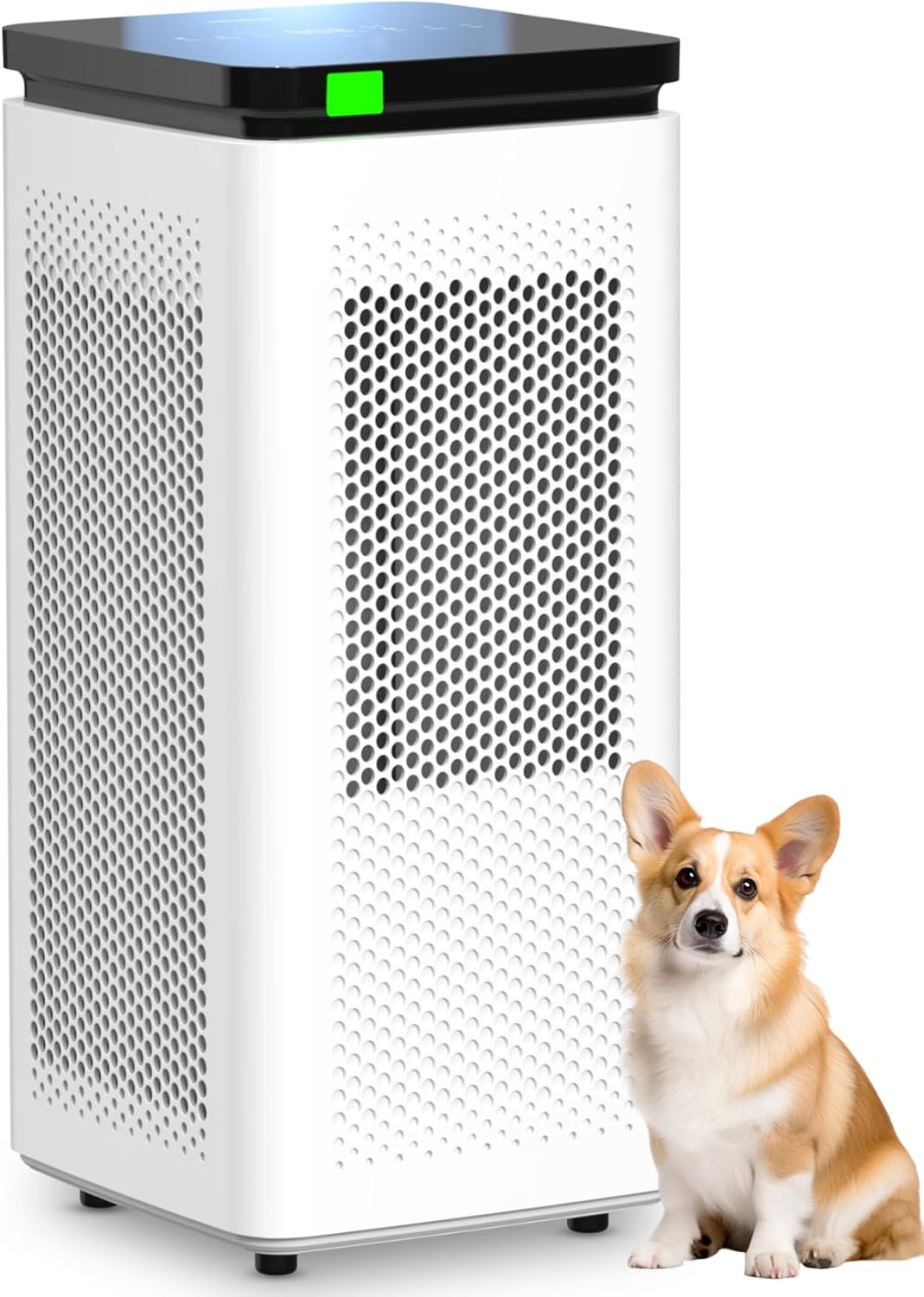
SIESEAN AP-400 Air Purifier
| CADR | 235 CFM |
|---|---|
| HEPA Type | H13 True HEPA (0.1 micron, 99.97%) |
| Coverage | Up to 3500 sq ft |
| Noise (Sleep Mode) | 30 dB |
| Energy | ENERGY STAR certified |
The SIESEAN AP-400 is a floor-standing air purifier designed to clean large open spaces quickly using an H13 True HEPA filter paired with activated carbon. Its 235 CFM CADR and dual-sided airflow claim to circulate air fast enough to clean a 500 sq ft zone in about 15 minutes while providing coverage up to 3,500 sq ft, which makes it suitable for living rooms, open plans, basements, and offices. The unit includes a PM2.5 air quality display and an auto mode that raises or lowers fan speed based on sensor readings, plus a dimmable panel, timer, and child lock for family use. Sleep mode drops noise to about 30 dB for overnight operation, and ENERGY STAR plus independent safety and performance certifications support efficient daily running. Expect routine filter swaps every few months depending on conditions and to buy genuine replacement filters for best fit. The trade-offs are typical of higher-capacity purifiers: physical footprint and periodic filter costs, and peak airflow/noise at higher speeds when rapid cleaning is needed.
Best for: Buyers who prioritize fast, whole-room cleaning and energy-efficient operation in large living spaces and want sensor-driven auto adjustments to minimize manual tinkering.
Less Ideal for: Those seeking a portable, ultra-compact purifier for small bedrooms or travelers should consider smaller tabletop models instead.
- H13 True HEPA plus activated carbon for particle and odor/VOC reduction
- 235 CFM CADR with dual-sided airflow for faster circulation in large rooms
- Built-in PM2.5 air quality display and Auto Mode for hands-off adjustments
- Very quiet sleep mode (~30 dB) and dimmer for bedroom use
- ENERGY STAR and multiple independent certifications for efficiency and safety
- Requires regular filter replacements which add ongoing cost
- Larger floor-standing footprint may not suit very small rooms or tight spaces
Verdict: A powerful, energy-efficient large-room purifier with true H13 HEPA filtration and smart sensors that suit homeowners aiming to optimize air quality across big living spaces.
MOOKA PR1 Air Purifier

| Model number | PR1 |
|---|---|
| Filter type | True H13 HEPA + activated carbon + washable prefilter |
| Noise level (Sleep) | 26 dB |
| Fan modes | 6 (Sleep/ I/ II/ III/ Auto/ Pet) |
The MOOKA PR1 is a large-room air purifier that uses a True H13 HEPA filter plus an activated carbon stage and a washable prefilter to tackle pet dander, smoke, pollen, and odors across big spaces. It pulls air through a wide sided inlet and offers six fan settings including Auto, Pet, and a very quiet Sleep mode that drops to about 26 dB, making it suitable for bedrooms and living areas. The unit shows live PM2.5/AQI readings via a digital display and will ramp fan speed automatically in Auto mode; there is also a timer, child lock, and an aroma pad for essential oils. Practical benefits include a washable prefilter to reduce replacement frequency and a filter-replacement reminder to simplify maintenance. Limits to consider are that the primary filtration beyond the washable prefilter is consumable and needs periodic replacement, and the large coverage claims require proper placement and run time to achieve the stated air changes in big open rooms.
Best for: Buyers who need a budget-minded large-room purifier that still provides H13 HEPA performance, easy maintenance with a washable prefilter, and useful automatic modes for pet owners and bedrooms.
Less Ideal for: Those who want a permanently maintenance-free purifier or the absolute quietest premium unit available should consider higher-end models with longer-life filters or lower noise signatures.
- True H13 HEPA filtration plus activated carbon targets particles and odors
- Wide-sided air inlet and high airflow for large-room coverage
- Washable prefilter reduces short-term replacement cost
- Multiple modes including Auto, Pet, and a 26 dB Sleep setting for quiet overnight use
- Digital PM2.5/AQI display and automatic fan adjustment for hands-off operation
- Main HEPA/activated carbon filter is replaceable and will add ongoing maintenance cost
- Large claimed coverage requires continuous operation and correct placement to meet air-change targets
Verdict: A cost-conscious large-room choice that pairs H13 HEPA filtration with a washable prefilter and pet-focused auto modes to deliver strong performance without high ongoing expense.
ECOSELF HAP603 Air Purifier

| Coverage | Up to 2400 ft² |
|---|---|
| Filter | True HEPA H13 |
| Noise level | 22 dB (Sleep Mode) |
| Air quality sensor | PM2.5 display with infrared sensor |
The ECOSELF HAP603 is a large-room air purifier built to keep living areas free of smoke, dust, pet dander, and odors. It uses a True HEPA H13 filtration system and a 2X-Power Filtration claim to cycle air in big spaces, while a PM2.5 display and infrared sensor let the unit adjust fan speed automatically in Auto or Smart mode. Practical features include a 22 dB Sleep mode for near-silent nighttime use, timer and lock controls, and an aromatherapy tray to add mild scent. Maintenance is straightforward with a filter indicator that reminds you when to replace the cartridge, and the brand recommends using official replacement filters for best performance. Limitations to consider are that the stated 2400 ft² coverage is ambitious and depends heavily on room layout and pollutant levels, and aromatherapy and ultra-quiet modes trade some airflow for low noise. For buyers who prioritize consistent, low-noise filtration in large spaces, this model delivers useful monitoring and convenience features, but expect to budget for genuine replacement filters to maintain peak performance.
Best for: Buyers who want a dependable, low-noise purifier for large living spaces and who value automatic air-quality sensing and easy maintenance routines.
Less Ideal for: People needing guaranteed performance in unusually large open-plan homes or industrial smoke conditions should look at higher-capacity commercial units instead.
- True HEPA H13 filtration captures fine particles and allergens.
- PM2.5 display and infrared sensor enable automatic fan adjustments for changing air quality.
- Very quiet 22 dB Sleep mode suitable for bedrooms or night use.
- Filter indicator and timer/auto modes simplify routine operation and maintenance.
- Coverage claim up to 2400 ft² may not be achievable in all floor plans or heavy-pollution conditions.
- Aromatherapy function can reduce airflow effectiveness when in use.
- Requires official replacement filters for best performance which adds ongoing cost.
Verdict: A quiet, sensor-driven HEPA purifier designed to give reliable large-room air cleaning with easy maintenance and automatic modes.
Levoit Core 300-P

| Power Source | ac |
|---|---|
| Filter Type | 3 in 1 Filtration |
| Floor Area | 1073 square_feet |
| Noise Level | 24 db |
| Wattage | 56 watts |
The Levoit Core 300-P is a small, well-engineered air purifier that uses a three-stage filter (pre-filter, HEPA-grade filter, and activated carbon option) driven by a 56W motor to clean air in rooms up to 1,073 sq ft at a slower cycle or refresh smaller rooms multiple times per hour. It is typically placed in living rooms or open-plan spaces where continuous filtration is needed; fan speeds are set manually and a sleep mode drops noise to about 24 dB for overnight use. Notable features include AHAM verification with CADR figures for smoke, dust, and pollen, a touch-control panel, timer settings, and a light-off option for undisturbed nights. Practical benefits are strong particulate capture down to 0.1 micron and a compact footprint that blends into a room. Important limitations are the lack of automatic sensing or Auto Mode on this model and reliance on Levoit original filters for the published CADR and performance, which means you should plan on periodic filter replacements to maintain rated performance.
Best for: Buyers who value independently verified performance and quiet operation for larger open rooms and want a compact purifier backed by large numbers of positive reviews and certifications.
Less Ideal for: Users who want a purifier with automatic sensing and fan control tied to real-time air quality, or those seeking a unit that covers very large homes rapidly without running at higher sustained fan speeds.
- AHAM verified CADR with specific ratings for smoke, dust, and pollen
- HEPA-grade filtration capturing particles down to 0.1 micron with 99.97% efficiency in the tested range
- Very quiet Sleep Mode at about 24 dB for nighttime use
- Compact footprint that fits into bedrooms or living areas without occupying much space
- No Auto Mode or built-in air quality sensor on this model
- Performance claims depend on using Levoit original replacement filters
Verdict: Choose the Core 300-P if you want a compact, AHAM-verified HEPA purifier that reliably reduces fine particulates while running whisper-quiet at night.
Levoit Vital 200S-P Air Purifier

| Control Method | App |
|---|---|
| Filter Type | 3-Stage Filter |
| Floor Area | 1875 square_feet |
| Noise Level | 27 db |
| Particle Retention Size | 0.1 micrometer |
The Levoit Vital 200S-P is a smart air purifier built for large open rooms and homes with pets or allergy sufferers. It pairs app control and a built-in air quality monitor with a three-stage filtration system that includes a washable pre-filter and an activated carbon layer to trap hair, odors, and fine particles down to 0.1 micrometers. Its AHAM-verified CADR figures for smoke, dust, and pollen and a stated coverage of 1875 sq ft mean it moves a lot of air quickly, and the 27 dB sleep mode keeps operation quiet at low speed. Practical benefits include the washable pre-filter to reduce replacement frequency and the option to choose specialty replacement filters for smoke or pet-heavy homes. Expect typical trade-offs for a large-room purifier: it is relatively heavy and tall compared with tabletop units and will need periodic filter replacements for peak performance, and higher fan speeds produce noticeable airflow noise and power draw compared with whisper-quiet bedroom-only models.
Best for: Buyers who prioritize proven whole-room air cleaning and quiet night operation for allergy or pet-prone households and want a smart, monitored solution with easy maintenance options.
Less Ideal for: Those who need an ultra-portable or budget bedside unit, or who only need a very small-room purifier for single-room use.
- AHAM-verified CADR and stated coverage for whole-room cleaning
- Three-stage filtration with washable pre-filter and activated carbon for odors
- App control and onboard air quality monitor for hands-off operation
- Low-noise sleep mode rated at 27 dB for nighttime use
- Larger and heavier than compact purifiers which can limit placement options
- Requires periodic replacement of middle/activated carbon filters to maintain performance
Verdict: Choose the Vital 200S-P when you need a smart, AHAM-verified purifier that reliably cleans large rooms and handles pet allergens while staying quiet enough for night use.
Choosing the Right Air Purifier for Large Home: Key Factors to Consider
Coverage Area and Air Changes Per Hour
For a large home the most important factor is how much space a purifier can effectively cover. Manufacturers typically state a recommended square-foot range; choose a unit rated for at least the size of the room where it will run most often. Air changes per hour expresses how many times the unit can circulate all the air in a room; higher ACH numbers mean faster removal of airborne particles.
If you plan to run a purifier in an open-plan living area, prioritize units with higher CADR and wider coverage ratings. You may need more than one unit to achieve consistent air changes throughout a large home, so consider placement and whether the model's coverage claims are realistic for open layouts.
Filter Type and Particle Removal
True HEPA filtration is the baseline for capturing fine particles like pollen, smoke, and pet dander. Some models combine HEPA with activated carbon to absorb odors and gaseous pollutants; others add prefilters to trap larger particles and extend HEPA life. Evaluate filter stage design and certified particle capture levels to match common household pollutants.
Filter efficiency affects both immediate air quality and long-term maintenance. Models with washable prefilters reduce HEPA replacement frequency, while higher-efficiency HEPA filters may need replacement more often if you have heavy particulate loads.
Clean Air Delivery Rate (CADR) and Airflow
CADR ratings quantify how quickly a purifier removes specific pollutants from the air and are useful for comparing real-world performance. Look for CADR numbers for smoke, pollen, and dust to understand strength across particle sizes. Strong airflow patterns help distribute cleaned air across open floorplans rather than creating zones of stagnation.
A purifier with good CADR but poor air distribution may underperform in a large, irregularly shaped room. Consider units with multi-directional outlets or higher fan speeds if you need faster whole-room circulation.
Noise and Fan Speed Control
Large-home units often need higher fan speeds to move sufficient air, which can increase noise. Check measured decibel ratings at different fan settings and whether the unit offers quiet or night modes. Variable speed controls and programmable schedules let you balance performance and comfort across daily activities.
If the purifier will run in living rooms or open-plan spaces where people gather, prioritize models with tolerable mid-range noise and good low-noise performance for overnight or work-from-home periods.
Maintenance, Filter Lifespan, and Operating Cost
Filter replacements are the primary ongoing expense. Compare expected HEPA and carbon filter lifespans and whether prefilters are washable. Some units use proprietary filter modules while others offer widely available replacements; consider ease of purchase and replacement frequency when estimating lifetime cost.
Also factor in energy usage. Units with higher airflow and multiple fan speeds will use more power, particularly if run continuously to maintain air changes in large spaces. Look for energy-efficient settings that still meet your air-change goals.
Placement Flexibility and Aesthetics
Where you can place a purifier affects its effectiveness in a large home. Tall ceilings, open stairways, and long sightlines influence airflow patterns. Choose a unit that fits the intended location without blocking outlets or pathways and that has intake and outlet orientations suitable for your layout.
Aesthetics matter in living spaces. Sleeker units are easier to keep visible and running, while bulky designs may be tucked away and therefore less effective. Consider weight and casters if you plan to move the purifier between rooms seasonally.
Sizing Units for Open-Plan Areas
Open-plan living areas are common in modern homes and present a challenge because a single purifier must move air across a larger, continuous volume. Rather than relying solely on square-foot ratings, estimate the total cubic feet by multiplying floor area by ceiling height and match that to the unit's recommended ACH.
If one unit cannot sustain adequate air changes, plan for a pair of purifiers placed to create opposing airflow paths. Placing a unit near pollutant sources, such as cooking areas or pet zones, improves overall effectiveness even when the device is not centrally located.
- Calculate cubic feet for more accurate sizing.
- Consider multiple units for very large or multi-level spaces.
- Place purifiers near pollutant sources for best results.
Dealing with Odors and VOCs in Large Homes
Odors and volatile organic compounds require activated carbon or specialized adsorbent stages in addition to particle filtration. In large homes, the volume of air dilutes odor concentration but also demands greater adsorbent capacity to capture gases effectively.
Look for purifiers that combine robust HEPA filtration with a significant carbon stage or that allow easy carbon replacement. For chronic odor issues, schedule higher fan speeds for periods when odors are expected and run lower speeds continuously to keep background levels down.
- Activated carbon is essential for persistent smells.
- Larger carbon beds or replaceable modules scale better for big spaces.
- Temporary boosts to fan speed help remove episodic odors.
Noise Management Strategies
Noise becomes more noticeable in open areas because sound travels without many barriers. When selecting a purifier, balance CADR and measured decibel output. A model with higher maximum noise but excellent low-speed performance is often preferable to a loud unit with no quiet setting.
Use scheduling and zoned operation to keep noisy high-speed runs limited to times when the room is unoccupied. Combining a quieter secondary unit in adjacent rooms can maintain air quality while minimizing disturbance in main living spaces.
- Check decibel ratings across fan speeds.
- Use timers to run high speeds when rooms are empty.
- Combine units to spread workload and reduce individual fan noise.
Placement and Airflow Tips for Multi-Level Homes
Air moves vertically between floors, so purifiers on lower levels can still influence upstairs air and vice versa. Consider placing units near stairwells or hallways that naturally channel airflow between levels. Avoid placing purifiers directly against walls or in corners where intake or exhaust will be restricted.
If bedrooms are on a separate floor, either place a smaller unit there or position a larger unit to support circulation toward stair openings. Monitor pollutant hotspots, such as kitchens or pet areas, and prioritize those zones when placing equipment.
- Use stairwells to assist cross-floor circulation.
- Keep intakes and outlets unobstructed for best performance.
- Target pollutant hotspots with secondary units if needed.
Maintenance Routines for High-Use Environments
Large homes often require continuous operation, which increases filter loading. Set a maintenance schedule that checks prefilters monthly and HEPA or carbon modules according to manufacturer recommendations or sooner if you notice reduced airflow or odors. Vacuuming around unit intake areas reduces dust buildup and prolongs filter life.
Record replacement dates and keep spare filters on hand to avoid performance lapses. For homes with pets or heavy particulate loads, factor in more frequent HEPA replacements and budget for higher operating costs.
- Inspect prefilters monthly in high-use environments.
- Track filter change dates to prevent lapses in efficiency.
- Keep spare filters accessible for uninterrupted operation.
How We Chose the Best Air Purifier for Large Home
We focused on attributes that directly affect performance in large, open spaces and day-to-day ownership costs. Primary evaluation criteria included clean air delivery rate at multiple particle sizes, rated coverage area in square feet, and consistent airflow to ensure whole-room circulation. We also weighed filter type and lifespan to estimate ongoing maintenance, plus fan speed ranges and measured noise so units remain livable in common areas. We excluded compact or personal desktop units and any purifier designed only for small bedrooms, since those cannot sustain effective circulation in large rooms. We also filtered out models without replaceable HEPA-class filtration or without clear CADR or coverage specifications. Final picks balance proven filtration performance, durable filter systems, realistic coverage claims, and reasonable noise and maintenance expectations for large-home use.
Our full evaluation process is outlined in our review methodology.
FAQ
How many air purifiers do I need for a large home?
It depends on your floor plan, ceiling height, and occupancy. Many large homes benefit from a primary unit in the main living area and one or two secondary units for bedrooms or dens to ensure consistent air changes throughout the house.
Can a single high-CADR unit clean an entire open-plan space?
A single high-CADR unit can handle large open rooms if its coverage and airflow are rated for the space. However, airflow distribution matters; in irregular layouts you may still need multiple units to avoid dead zones.
Do I need activated carbon for typical household smells?
Often yes. HEPA filters capture particles but not gases or odors. An activated carbon stage helps reduce cooking smells, VOCs, and some chemical odors that HEPA alone will not remove.
How noisy are large-room air purifiers on high fan speeds?
Noise varies by model, but higher fan speeds generally increase decibel output noticeably. Look for measured noise ratings and models with effective low-noise modes if sound is a concern during gatherings or nighttime use.
How often should I change HEPA and carbon filters in a large home?
Filter life depends on usage and pollutant load, but expect more frequent changes in large, continuously run setups. Check prefilters monthly and plan on HEPA replacements per manufacturer guidance or sooner if you observe reduced airflow or odor persistence.
Final Verdict
For large homes prioritize units with proven CADR, generous coverage ratings, and multi-stage filtration that includes true HEPA and carbon where odors are a concern. Balance airflow and noise so the purifier can run long enough to achieve meaningful air changes without becoming a nuisance. Decide whether one high-capacity unit or multiple strategically placed units will deliver better circulation for your layout. Focus on realistic coverage, filter maintenance, and placement to ensure consistent performance across the whole house.