
Note: This article contains affiliate links. If you click on these links and make a purchase, we may earn a small commission at no extra cost to you. This helps support our research and content. Read our full affiliate disclosure here.
Choosing the right air purifier for your living room matters because this is where family and guests spend the most time and airborne particles have the biggest daily impact. The right unit reduces allergens, dust, pet dander, and lingering odors while fitting your room size and daily routines. This guide shortlists seven top-performing air purifiers for living room use. We focus on filtration performance, coverage and noise, ease of maintenance, and energy use so you can pick a model that keeps the main living area healthier and more comfortable. Read on to see the picks and the criteria we used to evaluate them.
Top Picks at a Glance
| Best Overall The best all-around choice for most situations | Winix 5510 Air Purifier |  |
| Best Quality Built to a higher standard if you want something more solid | Coway Mighty AP-1512HH |  |
| Best Value The sweet spot between price and what you get | MOOKA KJ190H Air Purifier |  |
| Best Budget The cheapest option that still gets the job done reliably | FULMINARE H13 HEPA Air Purifier |  |
| Top Rated A top-rated pick with lots of positive feedback | DREO Air Purifier 338S |  |
| Most Popular A crowd favorite that many people choose with confidence | Levoit Core 300-P |  |
| Best Seller A high-volume bestseller chosen again and again | Levoit Core 200S-P |  |
Winix 5510 Air Purifier

| Model | 5510 |
|---|---|
| Filtration | 4-Stage (Pre-filter, True HEPA, Carbon, PlasmaWave) |
| AHAM Verified Coverage | 1,882 sq ft in 1 hr |
| Noise (low speed) | 23.5 dB |
| Smart Features | WiFi, Winix Smart App, Alexa/Google Home |
The Winix 5510 is a tower-style air purifier built for large living spaces, using a 4-stage system (washable pre-filter, True HEPA, high-deodorization carbon filter, and PlasmaWave) to capture fine particles, reduce odors, and address smoke and pet allergens. It uses built-in air quality sensors and an LED indicator to show real-time conditions and can run in Auto Mode to adjust fan speed as air quality changes; Sleep Mode cuts noise when the room is dark for overnight use. The unit is Wi-Fi enabled and works with the Winix Smart App plus voice assistants for remote monitoring and control, which is handy if you want scheduled or out-of-room management. Practical benefits include strong CADR/coverage for large rooms, washable pre-filter to extend HEPA life, and quiet low-speed operation. Expect regular HEPA and carbon filter replacements and occasional app setup steps; the PlasmaWave feature is supplemental and not a substitute for filtration. The purifier is relatively tall and meant as a stationary living-room appliance rather than a portable bedroom unit.
Best for: Buyers who want a single, powerful air purifier to run mostly in a living room and value automated air-quality sensing, app control, and effective odor and particle removal.
Less Ideal for: People who need a compact, highly portable unit for moving between rooms or who prefer a budget model without smart features.
- High room coverage and strong CADR suitable for large living rooms
- True HEPA filtration captures very small particles down to 0.01 microns
- Built-in washable pre-filter and carbon filter reduce large debris and household odors
- Smart sensors with Auto Mode and LED air-quality indicator simplify hands-off operation
- Wi‑Fi and Winix Smart App support plus voice control for remote monitoring and adjustments
- Requires periodic replacement of HEPA and carbon filters which adds ongoing cost
- Large footprint and height make it less convenient to move frequently
Verdict: A powerful, smart-capable purifier built to keep large living rooms clean with automated sensing and strong HEPA-plus-carbon filtration.
Coway Mighty AP-1512HH

| Coverage | Up to 1,748 sq. ft. in 60 minutes |
|---|---|
| Filtration stages | Pre-filter, deodorization filter, bipolar ionizer, HEPA |
| HEPA efficiency | 99.97% of 0.3μm particles |
| Features | Air quality indicator, Auto & Eco modes, timer, filter indicator |
The Coway Mighty AP-1512HH is a room air purifier built around a four-stage filtration system that combines a washable pre-filter, deodorization filter, bipolar ionizer, and a true HEPA filter to capture 99.97% of 0.3 micron particles. It is typically placed in living rooms or open-plan spaces where continuous monitoring and automatic adjustment are useful; the built-in air quality sensor drives Auto mode so the fan speed changes with pollutant levels and a colored LED gives at-a-glance feedback. Practical benefits include a washable pre-filter that lowers running costs, a timer and eco mode for energy-aware operation, and filter indicators that remind you when maintenance or replacements are needed. The unit is rated to cover large areas in an hour and operates quietly on lower speeds for night use. Limitations are that replacement filters are consumables that add ongoing cost and the bipolar ionizer may be a concern for buyers who prefer only passive filtration methods, so those users should research that feature before buying.
Best for: Buyers who prioritize reliable particle removal and active air-quality control for living rooms and open-plan spaces and want a unit that adjusts performance automatically to changing conditions.
Less Ideal for: People who want a zero-maintenance purifier with no filter replacements or those who prefer only passive filtration technologies without ionization.
- True HEPA filtration captures 99.97% of 0.3 micron particles
- Auto mode with air quality sensor adjusts fan speed in real time
- Washable pre-filter reduces dust load and recurring filter changes
- Quiet operation on low speeds suitable for sleeping or TV rooms
- Replacement filters are ongoing consumable costs
- Includes a bipolar ionizer, which some users prefer to avoid
Verdict: Choose the Coway Mighty AP-1512HH for living rooms when you want automatic, high-efficiency HEPA cleaning with real-time air quality sensing and quiet day-to-night performance.
MOOKA KJ190H Air Purifier

| Model | KJ190H |
|---|---|
| Filter type | H13 HEPA + activated carbon |
| Noise level (sleep) | 20 dB |
| Timer | 2/4/6/8 hours |
The MOOKA KJ190H is a room air purifier aimed at capturing pet hair, dust, pollen, smoke, and odors across open living areas by combining a washable pre-filter, H13 HEPA filter, and activated carbon. It pulls air through wide side and front inlets for higher intake and offers an auto mode driven by a built-in PM2.5 sensor so fan speed adjusts to real-time air quality. Users can choose between sleep/quiet mode for nighttime or higher speeds and timers for 2/4/6/8-hour automatic shutoff. Practical touches include a filter life reminder, child lock, energy-efficient operation, and an aromatherapy pad for light scenting. The washable pre-filter reduces replacement frequency and helps extend HEPA life, but buyers should expect periodic HEPA filter replacement (manufacturer suggests roughly every 6–12 months depending on use) and the unit is sized for single-room or open-plan use rather than whole-home central filtration. For living rooms the unit balances fast circulation and low-noise overnight operation, though heavy-smoke or industrial-level contamination will still need multiple passes or larger commercial systems.
Best for: Buyers who want an energy-conscious, practical living-room air purifier that automates fan speed based on measured PM2.5 and minimizes filter cost with a washable pre-filter.
Less Ideal for: People needing whole-house or commercial-grade filtration or those who want a unit that never requires HEPA replacement should consider larger or specialized systems.
- H13 True HEPA plus activated carbon for particles and odors.
- Washable pre-filter reduces ongoing filter cost and extends HEPA life.
- Built-in PM2.5 sensor with auto mode adjusts fan speed to air quality.
- Very quiet 20 dB sleep mode and display-off option for bedrooms.
- Timer, child lock, and aromatherapy pad add convenience and safety.
- HEPA filter still requires replacement roughly every 6–12 months depending on usage.
- Coverage claims are for high intake per hour but performance depends on room layout and placement.
- Not designed as a whole-house central system, best for single rooms or open living areas.
Verdict: A practical living-room purifier that balances strong particle removal, low operating noise, and lower running costs thanks to a washable pre-filter.
FULMINARE H13 HEPA Air Purifier

| Filter type | H13 HEPA |
|---|---|
| Recommended room size | 215 ft² / 20 m² |
| Noise level (low) | ~24 dB |
| Power | Plug-in (no battery) |
The FULMINARE H13 is a compact bedroom and living-room air purifier built around an H13 HEPA filter and 360 degree airflow to refresh air in spaces up to about 215 sq ft. It is typically placed on a table or countertop and left running to reduce dust, pet hair, smoke and household odors; the manufacturer recommends use within the specified room area for best results. Controls include a near-silent sleep mode that lowers noise to the mid-20 dB range, five timer options, and an independent night light for use in bedrooms or nurseries. The unit uses a plug-in power design rather than batteries and has a removable base to access the filter, which should be unwrapped before use and replaced on a routine schedule. Expect straightforward operation and easy placement, but remember its coverage is aimed at single rooms rather than open-plan living areas, and periodic filter replacements are required to keep performance steady.
Best for: Buyers who want an affordable, easy-to-place purifier for a single bedroom or living room and prioritize quiet operation and simple setup.
Less Ideal for: People needing whole-house or large open-plan air cleaning or those who prefer devices with built-in battery operation or smart home integration.
- H13 true HEPA filter for high-efficiency particle removal
- 360° air outlet with dual-channel design for even circulation
- Very low-noise sleep mode suitable for light sleepers
- Independent night light and multiple timer settings for flexible use
- Compact and portable for easy placement in bedrooms or living rooms
- Coverage limited to rooms up to about 215 sq ft, not suited for large open areas
- Requires regular filter replacements and manual filter unwrapping before first use
Verdict: A budget-friendly, quiet HEPA purifier that reliably improves air in a single bedroom or living room.
DREO Air Purifier 338S

| CADR | 115 CFM |
|---|---|
| Coverage (1 ACH) | up to 856 sq. ft. |
| Air change rate (example) | refreshes air every 12.4 minutes in 178 sq. ft. (4.8 ACH) |
| Sensor | PM2.5 high-precision sensor |
| Power estimate | ~125 kWh annually (ENERGY STAR) |
The DREO Air Purifier 338S is a small, smart HEPA purifier designed to clean living-room air and track particulate levels in real time. It uses a 3-in-1 filter (pre-filter, true HEPA, activated carbon) to capture particles down to 0.3 μm and reduce odors while a high-precision PM2.5 sensor drives an LED AQI readout and automatic fan adjustments. The unit offers Auto, Turbo, Sleep, and Normal modes plus four fan speeds and remote control by app or voice, with scheduling, filter-life reminders, and 30-day air quality reports for ongoing visibility. AHAM-verified CADR of 115 CFM and DREO TurboPure intake geometry mean faster circulation for typical living-room footprints, and ENERGY STAR-rated efficiency keeps electricity use modest. Trade-offs are its modest CADR relative to much larger units and the need to replace filters periodically, but for a reliability-minded household it provides consistent automatic control, clear status feedback, and smart notifications that simplify dependable operation day to day.
Best for: Buyers who want a dependable, low-maintenance living-room purifier that actively monitors air quality and uses smart controls to keep cleaning consistent without constant attention.
Less Ideal for: People needing maximum airflow for very large or open-plan rooms who should choose a higher-CADR, larger-capacity unit instead.
- AHAM-verified CADR (115 CFM) for validated cleaning performance
- 3-in-1 HEPA filter captures particles down to 0.3 μm and reduces odors
- Real-time PM2.5 sensor with LED AQI indicator and app history for clear air status
- Wi-Fi and voice control plus scheduling and filter-life notifications for hands-off operation
- ENERGY STAR rated for lower annual energy use
- Not as powerful as larger purifiers for very large open-plan spaces
- Requires periodic filter replacements to maintain performance
Verdict: A smart, AHAM-verified purifier that reliably monitors and maintains cleaner living-room air with automatic control and clear status feedback.
Levoit Core 300-P

| Power Source | Corded Electric |
|---|---|
| Filter Type | 3 in 1 Filtration |
| Floor Area | 1073 square_feet |
| Noise Level | 24 db |
| Particle Retention Size | 0.3 micron |
The Levoit Core 300-P is a compact, plug-in HEPA air purifier built to clean rooms quickly and quietly. It uses a 3-in-1 original filter and a 56W motor to deliver strong airflow and AHAM-verified CADR numbers that refresh typical living spaces—the listing states a CADR of 143 CFM for smoke and coverage calibrated so a 222 ft² room is cycled nearly five times per hour. Controls are touch-based with timer and display on/off options, and Sleep Mode drops noise to about 24 dB for night use. Practical benefits include proven HEPA-grade filtration down to 0.1–0.3 μm, certification for safety and indoor-air standards, and portability so you can move it between living room and bedroom. Limitations include manual-only fan control on this model (no Auto Mode), reliance on official Levoit replacement filters for advertised performance, and modest power draw that corresponds to its room-size suitability rather than whole-home cleaning. If you need a quiet, certified purifier for a living room or bedroom that handles smoke, pollen, and pet dander, this unit is a reliable choice with clear performance claims backed by certifications and many user reviews.
Best for: Buyers who prioritize proven, certifiable air-cleaning performance and quiet nighttime operation and who want an easy-to-use purifier that backs claims with measurable CADR and many user experiences.
Less Ideal for: Homes that need continuous whole-house or very large open-plan coverage should consider larger commercial or higher-CADR units instead.
- AHAM-verified CADR ratings for smoke, dust, and pollen indicating measurable cleaning performance
- True HEPA-grade 3-in-1 filter capturing down to 0.1–0.3 μm particles
- Very quiet Sleep Mode at about 24 dB suitable for bedrooms
- Touch controls with timer and display-off option for undisturbed nights
- Compact and portable design for moving between rooms
- No Auto Mode on this model, so fan speed requires manual adjustment
- Performance depends on using official Levoit replacement filters
- Not intended to purify very large open-plan spaces continuously
Verdict: A compact, AHAM-verified HEPA purifier that reliably cleans living rooms and bedrooms while staying whisper-quiet for nighttime use.
Levoit Core 200S-P
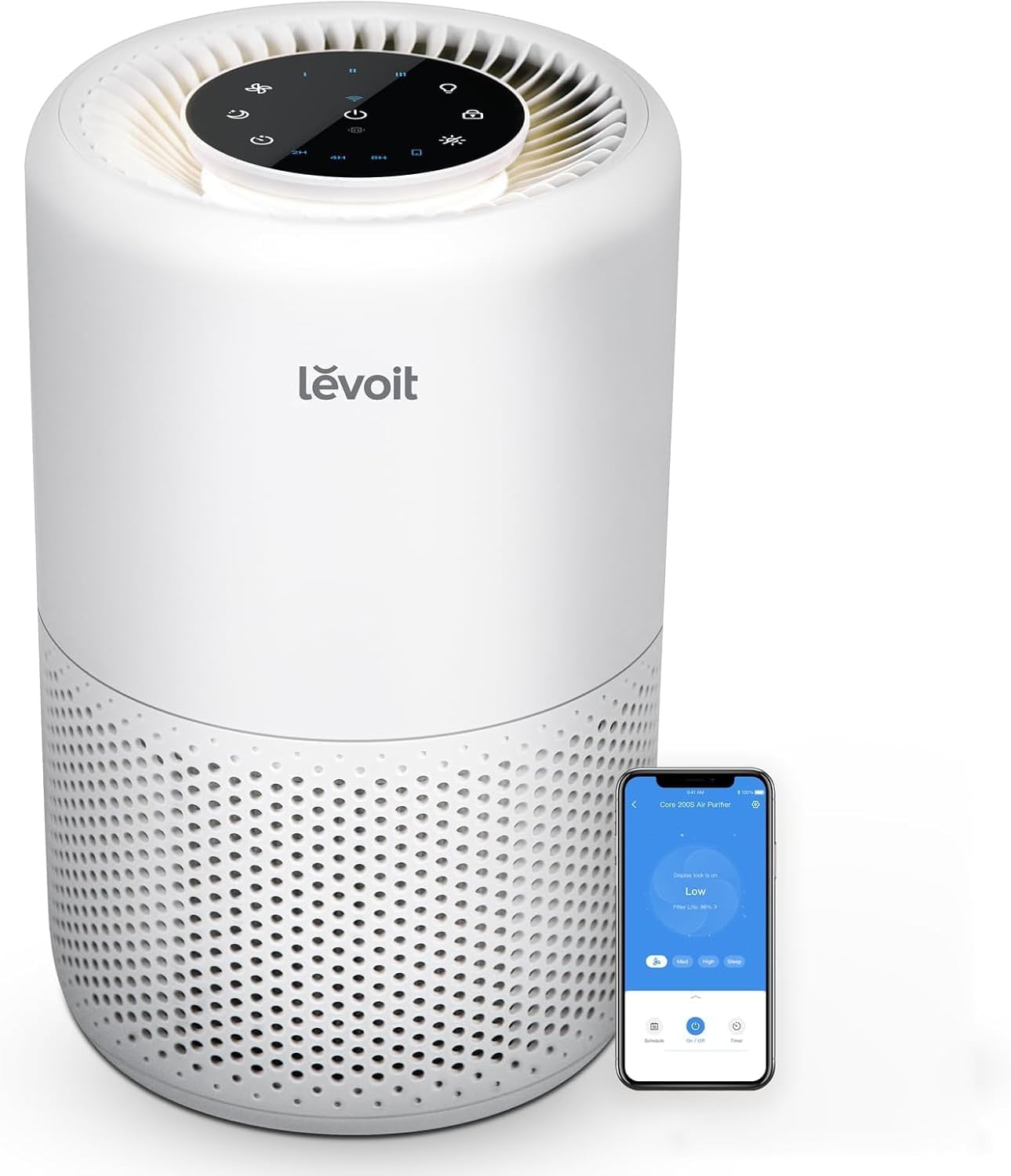
| Model | Core 200S |
|---|---|
| AHAM Verified | Yes |
| Rated room coverage | 140 ft² (4.8 air changes/hr) |
| Noise level | As low as 27 dB |
The Levoit Core 200S-P is a compact tabletop air purifier built for everyday indoor use in spaces like living rooms, bedrooms, nurseries, and offices. It pulls air in 360 degrees through a three-stage system: a nylon pre-filter for large particles, an activated carbon layer for odors and fumes, and a HEPA-grade main filter that captures 99.97% of particles down to 0.1–0.3 microns. It is AHAM verified and rated to refresh the air in a 140 ft² room about 4.8 times per hour, making it suitable for small to medium rooms. Smart and voice control support plus an in-app filter-life monitor make maintenance and operation convenient, and the unit is quiet at lower fan speeds with sleep mode dipping to about 27 dB. Trade-offs are its compact coverage—not intended for large open-plan living rooms—and replacement filters are a recurring cost to maintain performance. The lightweight, unobtrusive design and simple controls mean it integrates easily into living areas without being obtrusive.
Best for: Buyers who prioritize reliable, independently verified filtration and quiet, easy-to-manage operation for smaller living rooms or bedrooms will appreciate this unit.
Less Ideal for: People needing whole-room or whole-apartment purification for large open-plan living spaces should consider a larger capacity purifier instead.
- Three-stage filtration including a HEPA-grade main filter that captures 99.97% of 0.1–0.3 micron particles
- AHAM verified performance and rated to refresh air in a 140 ft² room ~4.8 times per hour
- Smart app and voice control plus filter-life monitoring for easy operation and maintenance
- Very quiet operation down to about 27 dB, suitable for bedrooms and night use
- Coverage is limited to small to medium rooms and is not designed for large open living areas
- Requires periodic replacement filters to keep performance at factory levels
Verdict: A quiet, smart, AHAM-verified purifier that reliably cleans the air in small to medium living spaces.
Choosing the Right Air Purifier for Living Room: Key Factors to Consider
Filtration Technology and Particle Removal
Look for true HEPA or equivalent high-efficiency particulate filters because they capture the smallest common allergens and fine particles that affect indoor air quality. Filter media, stage count, and the presence of prefilters influence how effectively the unit removes dust, pollen, pet dander, and smoke.
Higher-efficiency filters last longer when paired with a prefilter that traps larger debris. Some units add activated carbon layers to reduce common living room odors and VOCs. Understanding the filter stack helps you estimate long-term maintenance needs and which contaminants the purifier will actually remove.
Room Coverage and CADR
Match a purifier's published CADR or recommended room-square-foot rating to your living room size to ensure meaningful air changes per hour. A unit sized too small will fail to reduce pollutants effectively, while an oversized unit can be more costly and may produce unnecessary noise.
Consider typical furniture layout and open-plan flow because air exchange between connected spaces affects effective coverage. Manufacturers often list recommended room sizes at specific air-change-per-hour targets; aim for a unit that achieves at least two to four air changes per hour for steady living room use.
Noise Performance During Daily Use
Because the living room is used for conversations, media, and relaxation, noise produced by the purifier is a critical factor. Check measured decibel levels for low, medium, and high fan speeds. The perceived loudness and frequency profile matter more than raw dB numbers: low-frequency hums are less annoying than high-frequency whines.
Look for purifiers with a quiet or sleep mode for overnight or TV-time use. Controls that let you fine-tune fan speed or an effective auto mode can keep noise low while maintaining air quality.
Ease of Maintenance and Filter Costs
Regular filter changes and occasional cleaning are inevitable. Evaluate how easy it is to access and replace filters without tools, how often replacements are needed under normal living room conditions, and whether consumables are widely available.
Filter cost affects long-term ownership economics. Units with washable prefilters or longer-life main filters reduce recurring expenses and hassle. Clear status indicators and straightforward filter-change procedures make upkeep less disruptive.
Control Options and Smart Features
Consider the control interface that best matches how you use the living room. Simple manual dials are straightforward, while digital displays, app control, or voice integration can add convenience for scheduled operation or remote adjustments.
Air quality sensors and an effective auto mode can keep performance optimized without frequent manual intervention. However, weigh the value of smart features against privacy preferences and potential added points of failure.
Placement, Design, and Aesthetics
A living room air purifier needs to fit physically and visually. Check unit footprint, height, and airflow orientation so it can be positioned for unobstructed intake and exhaust without becoming a trip hazard.
Design matters because the purifier will be in a visible room. Choose finishes and shapes that complement decor while ensuring vents are not blocked by furniture. Removable casings and simple lines make occasional cleaning easier.
Sizing Your Living Room and Calculating Air Changes
Measure the usable square footage of your living room and note the ceiling height to calculate volume. Most room ratings assume an 8-foot ceiling, so adjust if your room is taller. Use the purifier's CADR rating or recommended square footage to estimate how many air changes per hour it will provide.
Aim for at least two full air changes per hour for general comfort and up to four or more if occupants have allergies or if there are persistent odors. If your living room is open to adjacent spaces, factor in the additional volume and possible sources of pollutants when choosing capacity.
- Calculate room volume: length x width x ceiling height.
- Check CADR ratings for smoke, pollen, and dust where available.
- Prefer units specifying air changes per hour for clarity.
Placement Tips to Maximize Performance
Position the purifier away from walls, furniture, and corners to allow free airflow into both intake and exhaust. Centering the unit on an open wall or near the main pollutant source, such as a pet area or TV, improves capture efficiency.
Avoid placing the unit directly behind a sofa or tucked tightly into shelving. Slight elevation off the floor can help with intake of finer particles that remain suspended. If you use multiple rooms, consider a slightly larger unit or add a second unit rather than relying on airflow between rooms.
- Keep at least a few inches clearance on all sides.
- Place near pollutant sources for faster capture.
- Avoid enclosed cabinets or blocked vents.
Understanding Filter Indicators and When To Replace
Many purifiers include filter-life indicators based on run time or estimated pollutant load. Use these indicators as a baseline but also inspect filters visually if you notice reduced airflow or persistent odors. Heavily soiled prefilters are easy to spot and should be cleaned regularly.
Frequency of replacement varies with use and local air quality. Homes with pets, smokers, or high outdoor pollution will need more frequent replacement. Keep a spare filter on hand if the replacement cycle is long or the indicator system is absent.
- Follow manufacturer guidance but verify visually.
- Clean washable prefilters every few weeks in high-use homes.
- Watch for increased fan noise or reduced airflow as signs of clogging.
Mitigating Odors and VOCs in Living Areas
If odors, cooking fumes, or household chemicals are a concern, prioritize units that include an activated carbon stage. Carbon removes many common volatile organic compounds and smells, though capacity and replacement interval depend on load.
For homes with intermittent strong odors, periodic high-speed operation can help clear the air quickly. Remember that carbon filters saturate and must be replaced to remain effective, so factor that into maintenance planning.
- Carbon filters are best for odors and many VOCs.
- Run a short boost cycle after heavy cooking or cleaning.
- Replace carbon filters on the schedule recommended for your usage.
Energy Use and Continuous Operation
Many living room purifiers run continuously, so check energy ratings and standby draw. Look for units with efficient fans and low-watt sleep modes to keep electricity costs down during long run times.
A purifier that is slightly oversized but operated on a lower, energy-saving fan speed can be more efficient than a small unit running constantly at high speed. Timers and scheduling help balance air quality needs with energy consumption.
- Compare wattage at typical operating speeds.
- Use timers or scheduling to reduce runtime when the room is empty.
- Consider Energy Star or efficiency-focused designs where available.
How We Chose the Best Air Purifier for Living Room
We screened units specifically for living room use and prioritized features that matter in a shared, frequently occupied space. Primary filters and particulate removal rates were required to be industry-standard or better. CADR or equivalent real-world coverage data was used to identify models capable of handling typical living room square footage. Noise performance at different fan speeds was considered so a purifier can run during conversation, TV watching, or overnight without becoming a nuisance. We also evaluated ease of filter replacement and accessibility, real-world energy consumption during normal operation, and the availability of user controls such as timers and auto modes that adjust to room air quality. Construction quality and warranty terms were reviewed to ensure reasonable longevity and serviceability. Units that relied solely on unproven technologies, lacked measurable filtration data, or were unsuitable for typical living room coverage were excluded. The final shortlist balances effective filtration, quiet operation, and practical day-to-day upkeep.
Our full evaluation process is outlined in our review methodology.
FAQ
How often should I run an air purifier in the living room?
Run the unit continuously if possible for the most consistent air quality. If continuous operation is not practical, run it during occupied hours and use an auto mode or higher speed during activities that increase pollutants, such as cooking or cleaning.
Will an air purifier remove pet odors and dander?
A true HEPA filter will capture pet dander and hair-borne allergens effectively. For odors, you need an activated carbon stage; carbon helps reduce smells but requires periodic replacement depending on intensity of odor sources.
Can I rely on a living room purifier to protect against wildfire smoke?
A purifier with a high CADR for fine particles and a true HEPA filter can reduce fine smoke particles. For heavy smoke events, run the purifier at higher speeds and keep windows closed to limit incoming outdoor particles.
Where is the best place to put an air purifier in a living room?
Place the unit where airflow is not blocked by furniture and near likely pollutant sources when possible. Keep several inches of clearance around all sides and avoid enclosed spaces to allow proper intake and exhaust.
How do I know when to replace the filter?
Replace filters according to the manufacturer's recommended interval or when indicators show end of life. Also replace if you notice reduced airflow, increased noise, or persistent odors despite normal operation.
Final Verdict
For living room use, prioritize a purifier that matches your room size, delivers proven particulate removal, and operates quietly enough for daily activities. Balance filtration performance against noise and maintenance costs to find a unit you can run regularly without hassle. Focus on true HEPA-level filtration, adequate CADR for your space, and straightforward filter upkeep to keep your main living area healthier and more comfortable.