
Note: This article contains affiliate links. If you click on these links and make a purchase, we may earn a small commission at no extra cost to you. This helps support our research and content. Read our full affiliate disclosure here.
Indoor air quality affects sleep, allergies, and general comfort. A properly sized HEPA air purifier removes airborne particles such as dust, pet dander, and pollen so you breathe cleaner air throughout the day and night. This guide collects our top shortlisted HEPA air purifiers that cover a range of room sizes and common home needs. Below you will find units chosen for filtration performance, real-room coverage, noise and maintenance characteristics, and energy use. Use the quick summaries to match a model to your space, then read the detailed criteria to understand tradeoffs between power, upkeep, and quiet operation.
Top Picks at a Glance
| Best Overall The best all-around choice for most situations | WINIX 5520 Air Purifier |  |
| Best Quality Built to a higher standard if you want something more solid | Medify Air MA-50 V3.0 |  |
| Best Value The sweet spot between price and what you get | GermGuardian AC4825E Tower Air Purifier |  |
| Best Budget The cheapest option that still gets the job done reliably | FULMINARE H13 HEPA Air Purifier |  |
| Top Rated A top-rated pick with lots of positive feedback | Levoit Core 300-P Air Purifier |  |
| Most Popular A crowd favorite that many people choose with confidence | Levoit Core Mini-P |  |
WINIX 5520 Air Purifier
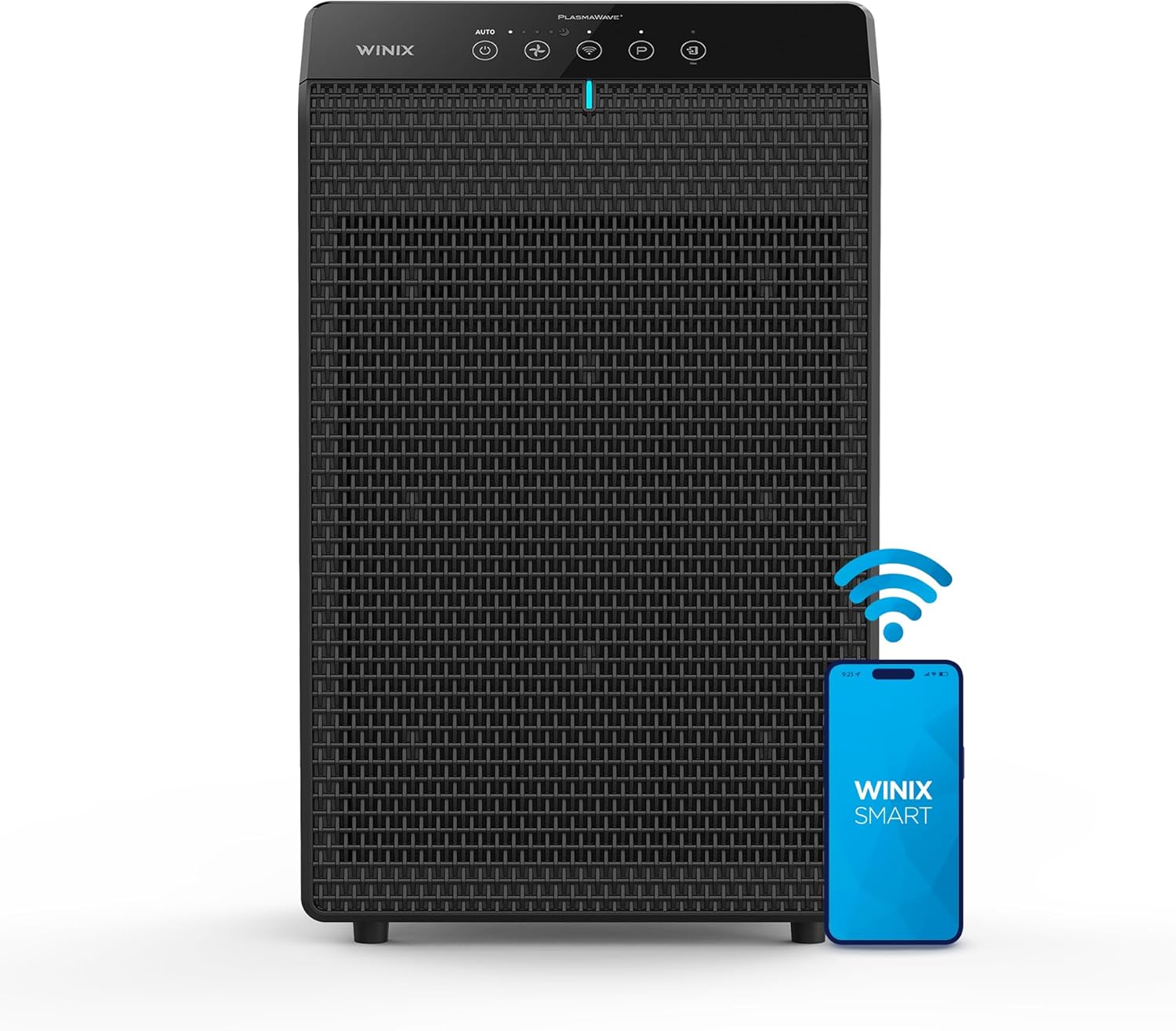
| Coverage (1 hr) | Up to 1,882 sq ft |
|---|---|
| Filtration stages | 4-stage system |
| Particle capture | As small as 0.01 microns |
| Noise (lowest) | 23.5 dB |
| Certifications | AHAM Verified, UL Certified |
The WINIX 5520 is a tower air purifier designed to clean large rooms quickly using a four-stage system: washable pre-filter, True HEPA filter, advanced carbon deodorization layer, and Winix PlasmaWave technology. It is typically used in living rooms or open-plan spaces where fast air turnover matters and features AHAM verification for CADR performance. Smart sensors constantly monitor air quality and the LED indicator gives a visual status while Auto Mode adjusts fan speed to respond to pollution spikes, which helps reduce manual intervention and energy use. The unit also supports the Winix Smart App for remote control and has an automated Sleep Mode that quiets operation when the room is dark. Practical benefits include strong particle capture down to very small sizes, odor reduction from the carbon filter, and simple maintenance with a washable pre-filter and replaceable cartridges. Expect a relatively tall footprint and the need to replace HEPA and carbon filters periodically, and PlasmaWave is an added technology rather than a substitute for filtration.
Best for: Buyers who want a reliable, easy-to-use purifier that handles large rooms and prefers automated operation with real-time air quality feedback.
Less Ideal for: Those looking for a compact purifier for very small spaces or users who need model-specific low-cost one-time filters instead of regular cartridge replacements.
- Four-stage filtration including True HEPA for submicron particle capture
- Advanced carbon filter for reducing VOCs and household odors
- Built-in air quality sensor with LED indicator and Auto Mode for hands-off operation
- Washable pre-filter simplifies maintenance and extends filter life
- Wi‑Fi app control and automated Sleep Mode for quiet overnight use
- Requires periodic replacement of HEPA and carbon filters
- PlasmaWave is supplemental and should not replace filter maintenance
Verdict: A strong all-around choice for people needing a smart, high-performance HEPA purifier that cleans large rooms with minimal fuss.
Medify Air MA-50 V3.0

| Filter Class | HEPA H13 |
|---|---|
| Coverage Area | 2,640 sq ft per hour (CADR 598) |
| Particle Retention Size | 0.1 micrometer |
| Wattage | 70 watts |
| Noise Level | 22 – 59 dB |
The Medify Air MA-50 V3.0 is a large-room air purifier built around a True HEPA H13 filter and a high-CADR fan to move a lot of air quickly. It is intended for whole-room cleaning in homes, offices, classrooms, or commercial spaces and claims coverage up to 2,640 sq ft per hour (CADR 598), which makes it suitable for rapid removal of smoke, pollen, pet dander, and odors. Controls include a touch panel with timer, four fan speeds, sleep mode, filter replacement indicator, and child lock for straightforward daily use. The unit is ETL, CARB, and Energy Star certified and offers a lifetime warranty from the manufacturer; replacement filters are rated for roughly 2,500 hours (about 3–4 months). On the downside the top fan speeds can be audible (up to the high 50s dB range), and the device is substantial in footprint so placement matters for optimal circulation. If you need aggressive particulate removal in large open areas and value a certified HEPA H13 filtration platform, this model delivers strong, practical performance.
Best for: Buyers who prioritize fast, high-volume particulate removal for whole rooms or shared spaces and want a certified HEPA H13 system with simple programmable controls.
Less Ideal for: Those looking for an ultra-compact, ultra-quiet bedroom-only unit or users who need infrequent filter changes and minimal maintenance.
- Very high coverage capacity (up to 2,640 sq ft per hour) for large rooms and open spaces
- True HEPA H13 filtration captures particles down to 0.1 microns
- Multiple fan speeds plus sleep mode and programmable timer for flexible use
- Certified to CARB, ETL, and Energy Star standards and backed by a lifetime warranty
- Higher fan speeds can be noticeably loud for quiet living areas
- Replacement filters need changing every few months under normal use
Verdict: Choose the MA-50 V3.0 when you need certified, high-capacity HEPA H13 performance to clean large rooms quickly.
GermGuardian AC4825E Tower Air Purifier

| Filtration | True HEPA with activated carbon pre-filter |
|---|---|
| UV Option | Optional UV-C light |
| Coverage | Circulates 153 sq ft every 12.5 minutes; up to 743 sq ft hourly |
| Fan Speeds | 3 speeds (including sleep mode) |
The GermGuardian AC4825E is a compact tower purifier that uses a True HEPA filter with an activated carbon pre-filter and optional UV-C light to reduce dust, pollen, pet dander, odors, and some airborne particles. It is typically placed in bedrooms, living rooms, or offices and circulates air for a 153 sq ft room every 12.5 minutes or can cover larger areas up to 743 sq ft on slower cycles. Three fan speeds, including a quiet sleep mode, make it usable overnight, and compatible replacement HEPA, carbon filters, and UV-C bulbs are available for routine maintenance. The carbon pre-filter helps reduce cooking and pet smells while the HEPA media captures very small particles down to around 0.1 microns as air passes through the filter. Trade-offs are that the design is a single-unit tower without smart connectivity or advanced sensors, and performance depends on placing the unit appropriately for room airflow and changing filters on schedule. For buyers focused on straightforward HEPA filtration with optional UV sanitizing in a proven form factor, this model is a practical, easy-to-maintain choice.
Best for: Buyers who want a reliable, no-frills HEPA purifier that cleans air effectively in bedrooms, living rooms, or offices and who prioritize straightforward maintenance and proven filtration performance.
Less Ideal for: Those who need integrated smart features, automatic air-quality-driven operation, or a multi-unit solution for large open-plan homes should look elsewhere.
- True HEPA filter captures 99.97% of particles down to 0.1 microns from air passing through the filter media
- Activated carbon pre-filter reduces common household odors like cooking and pet smells
- Optional UV-C light adds an extra sanitizing step for airborne particles
- Three fan speeds including a quiet sleep mode for nighttime use
- Proven coverage claims for small rooms and larger spaces up to 743 sq ft on slower cycles
- No built-in air quality sensor or smart connectivity for automatic speed adjustments
- Single tower design limits placement flexibility for very large or irregular rooms
Verdict: A practical, easy-to-maintain HEPA tower purifier with carbon odor control and optional UV-C sanitizing for buyers who want reliable air cleaning without smart features.
FULMINARE H13 HEPA Air Purifier

| Filter type | H13 HEPA |
|---|---|
| Recommended room size | 215 sq ft / 20 m² |
| Noise level | ≈24 dB (low/sleep mode) |
| Timers | 2, 4, 8, 10, 12 hours |
The FULMINARE H13 is a small, budget-friendly air purifier built around an H13 HEPA filter and a 360 degree outlet that refreshes air in rooms up to about 215 sq ft. It is typically used on a bedroom or office nightstand where low noise matters; sleep mode claims noise around 24 dB and an independent night light provides a soft glow for children or light sleepers. The unit offers multiple timer settings (2, 4, 8, 10, 12 hours) and a plug-in power design so there is no battery to recharge. Practical benefits include straightforward placement thanks to its compact footprint, reasonably strong circulation for its class, and simple filter replacement when needed. Limitations are expected given the small size: it is intended for single-room use rather than whole-house filtration, and higher fan speeds may increase noise and reduce the discreetness of the night light. Buyers should also remember to remove the filter packaging before first use and plan on periodic filter replacements.
Best for: Buyers seeking an affordable, compact HEPA purifier for a bedroom or small office who prioritize quiet nighttime operation and simple plug-and-play setup.
Less Ideal for: People who need whole-house or large-open-space air cleaning or who want cordless/portable battery operation should consider larger or different models.
- H13 HEPA filter for high-efficiency particle removal
- 360° air outlet with dual-channel design for steady circulation in small rooms
- Very low noise in sleep mode (around 24 dB) suitable for bedrooms
- Independent night light and multiple timer options for convenience
- Coverage is limited to roughly 215 sq ft so not suitable for larger open areas
- No battery operation; requires plug-in power and adapter stored in base
- Filter replacements are required every few months under typical use
Verdict: A cost-conscious choice for clean, quiet bedroom or small-room air filtration with H13 HEPA performance and simple controls.
Levoit Core 300-P Air Purifier

| Power Source | Corded Electric |
|---|---|
| Filter Type | 3 in 1 Filtration |
| Floor Area | 1073 square_feet |
| Noise Level | 24 db |
| Wattage | 56 watts |
The Levoit Core 300-P is a small, corded HEPA air purifier built to deliver dependable filtration in bedrooms, home offices, or other living spaces. It uses a three-stage original filter (pre-installed) and a 56W motor to provide AHAM-verified CADR performance for smoke, dust, and pollen, which translates into multiple air changes per hour in typical rooms and single-pass refresh for larger open areas. Controls are touch-based with a dedicated sleep mode that drops noise to a quoted 24 dB and lets you turn off display lights for undisturbed nights. Practical benefits include reliable removal of particles down to 0.3 micron at 99.97% efficiency, portability between rooms, and simple filter-replacement indicators; Levoit recommends using its official replacement filters for best results. Limitations include manual fan-speed control on this model (no Auto Mode) and the need to replace filters every 6 to 8 months depending on use, so maintenance costs should be considered for long-term reliability.
Best for: Buyers who prioritize a proven, consistent cleaner for bedrooms and small-to-medium rooms and want simple, quiet operation without complex smart features.
Less Ideal for: People who need a smart, auto-adjusting purifier with remote control or whole-house coverage should consider larger or networked models instead.
- AHAM-verified CADR ratings for smoke, dust, and pollen provide measurable cleaning performance
- H13/HEPA-grade filtration captures 99.97% of 0.1–0.3 μm particulates
- Sleep Mode reduces noise to about 24 dB and allows display lights off for nighttime use
- Compact and portable design makes it easy to move between rooms
- Touch controls and a filter check indicator simplify daily operation and upkeep
- No Auto Mode or smart connectivity on this model so fan speed must be set manually
- Requires regular replacement of official filters every 6–8 months for peak performance
Verdict: Choose the Levoit Core 300-P when you want a compact, AHAM-verified HEPA purifier that reliably cleans bedroom and home air with quiet, straightforward operation.
Levoit Core Mini-P
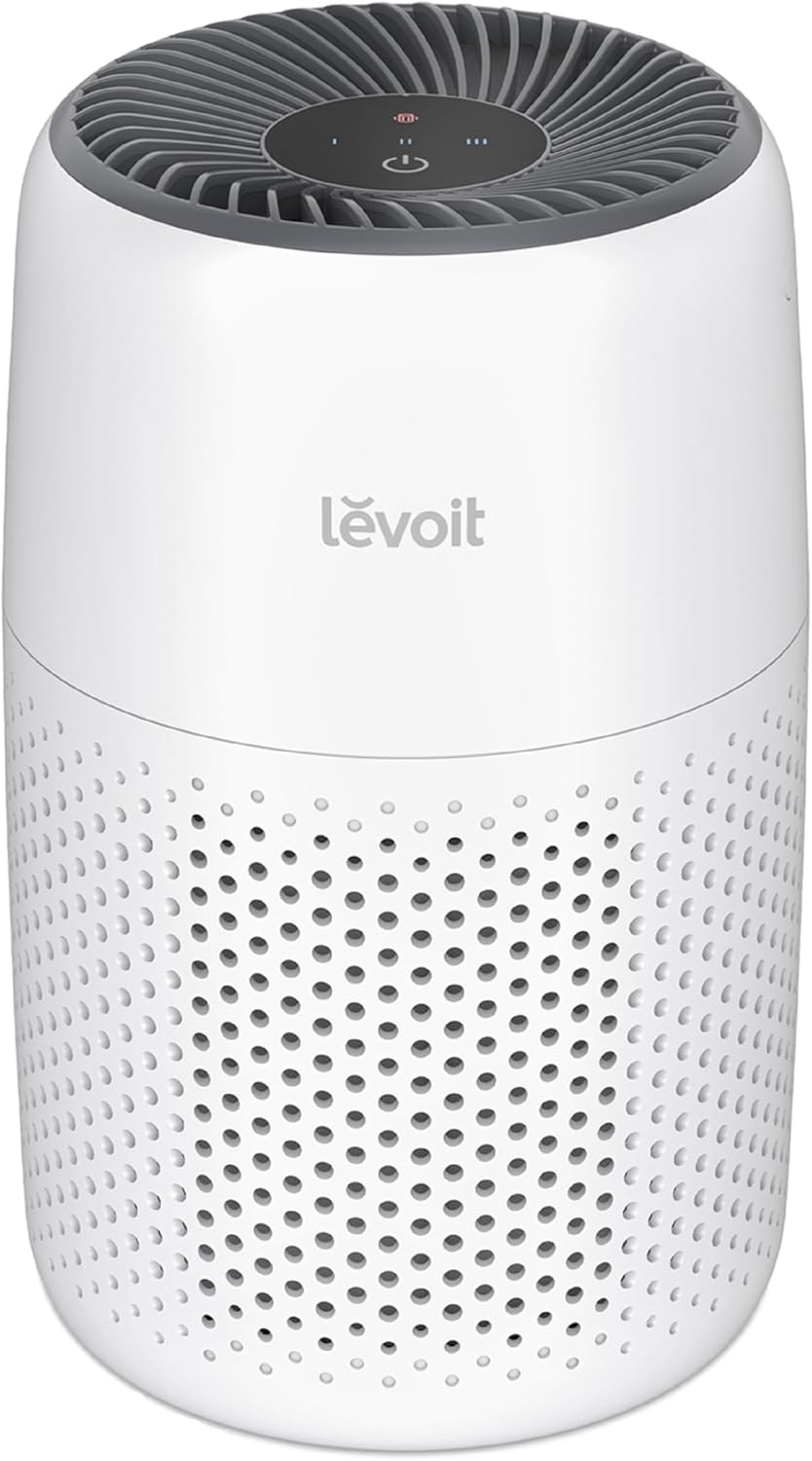
| Rated Power | 7W |
|---|---|
| Noise Level | 27–45dB |
| Particle Retention Size | 0.3 micron |
| Model | LAP-C161-WUS |
The Levoit Core Mini-P is a small HEPA-style air purifier intended for bedrooms, offices, and desktop use where space is limited. It uses a pre-filter and main filter to capture lint, pet dander, smoke, and other fine particulates while offering a sleep mode and low noise operation (about 27–45 dB) so it can run overnight without being intrusive. The unit accepts an aromatherapy sponge for light scenting and includes an internal adapter; rated power is 7W which keeps energy use low. Practical benefits include compact footprint, simple controls with an auto-off display, and AHAM-verified cleaning performance for reliable results in small spaces. Limitations are its small coverage area so it is not suitable for whole-home cleaning, replacement filters are required periodically, and aromatherapy requires only a few drops to avoid damaging internal parts. If you need a low-power, quiet purifier for a single room or desk, this model does that well, but larger rooms will need a higher-capacity unit.
Best for: Buyers who rely on community feedback and want a proven, compact purifier for a bedroom, dorm, or desk where quiet, reliable operation matters.
Less Ideal for: People seeking a single purifier for large open living spaces or whole-home coverage should choose a higher-capacity model instead.
- AHAM-verified performance for consistent small-room air cleaning
- Very quiet operation suitable for sleep mode (27–45 dB)
- Low power draw (7W) keeps energy use minimal
- Compact desktop footprint fits bedrooms, offices, and dorm rooms
- Aromatherapy sponge for light scenting without separate diffuser
- Not designed for large rooms or whole-home purification
- Requires periodic filter replacements to maintain performance
- Aromatherapy can damage internal parts if overfilled
Verdict: Choose the Levoit Core Mini-P when you need a quiet, AHAM-verified HEPA purifier for a single small room or desktop where proven performance and low power use matter.
Choosing the Right HEPA Air Purifier: Key Factors to Consider
Filtration Efficiency
How well a purifier captures particles determines its core effectiveness. True HEPA filtration targets particles down to 0.3 microns, which includes common allergens, smoke particles, and many airborne contaminants. Look for clear statements about HEPA-stage filtration or measured particle removal efficiency to avoid units that use only prefilters or non-HEPA claims.
Efficiency also ties to multi-stage filtration. Units that combine a washable prefilter, HEPA stage, and a carbon or adsorption layer handle both particles and some odors or VOCs. Understanding the specific filtration stages helps set realistic expectations for performance in homes with pets, smokers, or heavy cooking odors.
Room Size and CADR
A purifier's Clean Air Delivery Rate (CADR) and recommended room size determine how quickly it can reduce particulate levels. A unit that is powerful enough for the room will complete multiple air changes per hour. For bedrooms or offices, aim for a purifier sized to the square footage of the room; for larger open-plan spaces, choose a higher CADR or multiple units.
Underpowering the space is a common mistake. Manufacturers sometimes list 'maximum' coverage under ideal conditions, so factor in ceiling height and open layouts when applying coverage numbers to your home.
Noise and Fan Control
Noise matters because a purifier that is too loud will be turned down or off, negating its benefits. Check published decibel ranges and whether the unit has a low-night mode or sleep setting. Multiple fan speeds and programmable schedules let you run the purifier at higher speeds when you are away and lower, quieter settings while sleeping.
Also consider fan design and how noise scales with speed. Some designs maintain reasonable noise at mid speeds while still offering good air changes; others are noisy even at lower settings. If you are sensitive to sound, prioritize units with verified quiet modes and soft LED or dim options.
Maintenance and Ongoing Cost
Filter replacement frequency and the cost of replacement filters are a major part of lifetime ownership. HEPA filters typically last anywhere from 6 months to 12 months depending on use and air quality. A washable prefilter can extend the life of more expensive HEPA cartridges and reduce long-term cost.
Also consider ease of accessing and replacing filters, and whether the unit provides filter-life indicators. Energy consumption is part of operating cost too, so units with efficient motors or eco modes can lower monthly electricity use.
Controls, Placement, and Usability
How you interact with the purifier affects daily use. Intuitive controls, clear filter indicators, remote or app controls, and programmable timers make it easier to maintain continuous protection. Placement guidance is also important: purifiers work best when not shoved into corners and when intake and outflow are unobstructed.
If you plan to use the purifier in a bedroom, look for dimmable displays and night modes. For shared living spaces, consider units with simple touch panels or smartphone control for household members who prefer remote operation.
Matching Purifier Size to Your Room
Start by measuring the square footage of the room where the purifier will be used most. Multiply the room area by the ceiling height to estimate volume when ceilings are higher than average. Compare that volume or square footage to the manufacturer's stated CADR or recommended room coverage to ensure adequate air changes per hour.
When in doubt, choose the next larger capacity. A slightly oversized unit will run at lower fan speeds and produce less noise while still delivering faster particle removal when needed.
- Measure floor area and ceiling height for accurate sizing
- Aim for at least 4 to 5 air changes per hour in high-allergy or problem rooms
- Consider two smaller units for zoned coverage in open-plan spaces
Using a HEPA Purifier with Pets and Allergy Concerns
Homes with pets benefit from a combination of a strong particle filter and a washable prefilter. Pet hair and large particles load filters quickly, so a prefilter helps prolong HEPA life. If allergies are the main concern, prioritize higher CADR for pollen and fine particles and run the purifier continuously during peak seasons.
Also keep realistic expectations: purifiers reduce airborne allergens but do not remove allergens embedded in carpets, upholstery, or bedding. Pair air cleaning with regular vacuuming and washable bedding to get the best results.
- Run purifiers continuously during allergy season for best effect
- Use washable prefilters to catch large debris and extend HEPA life
- Complement with regular surface cleaning and ventilation
Placement Tips for Best Performance
Place the unit where it can draw air freely and where people spend the most time. Avoid cramming a purifier into a corner, behind furniture, or directly against curtains. A clear intake and outflow path improves circulation and effective coverage.
For bedrooms, position the unit several feet from the bed and set a quiet night mode. In living rooms place the purifier centrally or near the main seating area to lower particulate exposure where occupants spend time.
- Keep several feet clearance on intake and output sides
- Elevate small units off the floor for better room mixing
- Avoid placing the purifier directly against walls or curtains
Understanding Carbon and Odor Removal
HEPA filters target particles, but odors and many volatile organic compounds need an adsorbent stage. Activated carbon or other adsorption media help reduce cooking smells, pet odors, and some VOCs but vary widely in capacity and effectiveness.
If odor control is important, look for purifiers with a substantial carbon stage and replaceable media. Keep in mind that carbon filters saturate over time and will require replacement more frequently when used for smoke or strong odors.
- Carbon stages handle odors but have finite capacity
- Consider larger carbon canisters for smoke-heavy environments
- Track replacement intervals if odor removal is a priority
Energy Use and Long-Term Running Costs
Running a purifier constantly adds to household energy use. Compare published wattage and look for eco or low-power modes for overnight operation. Higher fan speeds and larger motors draw more power but may be necessary to rapidly clear particulate spikes.
Factor in filter replacement frequency and costs as part of total ownership expense. A model that is slightly less efficient but uses inexpensive, long-life filters can be cheaper over several years than a more powerful unit with costly cartridges.
- Check wattage and look for eco modes
- Estimate annual filter replacement costs before buying
- Balance energy draw with the need for rapid air cleaning
How We Chose the Best HEPA Air Purifier
We prioritized measurable filtration performance and real-world usability when shortlisting HEPA air purifiers. First, filtration efficiency was a central filter: we looked for units designed to capture 0.3 micron particles with true HEPA-stage filtration or equivalent tested performance. Second, room coverage and clean air delivery rate estimates were required to ensure a unit can achieve multiple air changes per hour in common room sizes. Third, noise and fan control mattered for bedroom and living-room use, so models with multiple speed settings and documented decibel ranges ranked higher. Fourth, maintenance and running costs were considered by assessing filter lifespan, availability of replacement filters, and typical energy draw. Finally, controls and user experience including intuitive interfaces, timers, and filter-change indicators were weighed. We excluded units that rely solely on electrostatic or ion-only purification without true HEPA filtration, and we did not consider devices that lack published coverage specs. The resulting list emphasizes units that balance verified particle removal, practical room coverage, manageable noise, and predictable upkeep needs.
Our full evaluation process is outlined in our review methodology.
FAQ
Do HEPA air purifiers remove smoke and odors?
HEPA stages remove fine particles from smoke but not odors. For smells and some VOCs you need a dedicated adsorption stage such as activated carbon. The effectiveness depends on carbon quantity and how often it is replaced.
How often should I replace HEPA filters?
Filter life depends on usage and air quality, but HEPA filters commonly last six to twelve months with typical home use. Homes with pets, smoke, or heavy pollution may require more frequent replacement. Prefilters that are washable can extend HEPA cartridge life.
Will a purifier protect me from viruses?
HEPA filtration captures many respiratory droplets and some aerosolized particles, which can reduce exposure to airborne virus-containing particles. Filtration is one layer of protection and should be combined with ventilation and hygiene practices for the best results.
Can I run a purifier 24/7?
Yes. Continuous operation provides steady particle removal and is common in homes with allergies or pets. Use lower fan speeds or eco modes at night to reduce noise and energy use while maintaining baseline air cleaning.
Where should I place a purifier in a bedroom?
Place the purifier several feet from the bed with unobstructed intake and output. Use a quiet night setting and avoid placing the unit directly against walls or under beds where airflow will be restricted.
Final Verdict
Choose a HEPA air purifier that matches your room size and primary concern. Prioritize filtration efficiency and CADR for particle-heavy issues like allergies, and include a carbon stage if odors or VOCs matter. Balance noise and maintenance: a slightly larger unit running quieter at low speeds often delivers better daily results than a smaller one running at maximum fan. Weigh the tradeoffs between upfront capacity and ongoing filter and energy costs. Focus on realistic coverage, usable controls, and predictable maintenance so your purifier will be used regularly and deliver the clean-air benefits you expect.