
Note: This article contains affiliate links. If you click on these links and make a purchase, we may earn a small commission at no extra cost to you. This helps support our research and content. Read our full affiliate disclosure here.
A musty basement can mean persistent odors, higher humidity, and airborne mold spores that affect comfort and indoor air quality. Choosing the right air purifier for a musty basement matters because basements often have limited airflow, higher particle loads, and variable humidity that challenge ordinary room purifiers. This guide shortlists seven top air purifiers that are suited for musty basement conditions and explains the practical tradeoffs you should weigh. We evaluate filtration effectiveness, airflow and coverage, and features that matter for lower-level spaces. Read on to see which options fit different basement sizes and maintenance preferences.
Top Picks at a Glance
| Best Overall The best all-around choice for most situations | WINIX 5510 Air Purifier |  |
| Best Quality Built to a higher standard if you want something more solid | COWAY Airmega Mighty2 AP-1512N |  |
| Best Value The sweet spot between price and what you get | PuroAir 240 Air Purifier |  |
| Best Budget The cheapest option that still gets the job done reliably | VOOPNU HEPA Air Purifier DH-JH12 |  |
| Top Rated A top-rated pick with lots of positive feedback | ECOSELF HAP603 Air Purifier |  |
| Most Popular A crowd favorite that many people choose with confidence | Levoit Core 300-P |  |
| Best Seller A high-volume bestseller chosen again and again | Levoit Vital 200S-P Air Purifier |  |
WINIX 5510 Air Purifier

| Max room coverage (AHAM) | 1,882 ft² in 1 hr |
|---|---|
| Filtration stages | 4-Stage |
| HEPA | True HEPA (captures down to 0.01 microns) |
| Noise (lowest) | 23.5 dB |
| Smart features | WiFi, Winix Smart App, Alexa and Google Home compatible |
The Winix 5510 is a 4-stage tower air purifier that combines a True HEPA filter, advanced carbon odor control, a washable pre-filter, and Winix PlasmaWave technology to reduce particles and common indoor odors. It is typically used in larger open spaces or basements where dust, pet dander, smoke, and musty smells are concerns; built-in sensors and an AQI LED provide real-time feedback while Auto Mode adjusts fan speed automatically. The unit supports the Winix Smart App plus voice assistants for remote control, and a light-activated Sleep Mode keeps noise very low at night. Practical benefits include strong particle capture down to 0.01 microns, targeted VOC and odor reduction from the carbon stage, and washable pre-filter media that can extend filter life. Important limitations are that ongoing operating cost depends on replacement filters and that a single purifier may not fully eliminate persistent mold sources or very high humidity, so it works best alongside moisture control. Setup and day-to-day use are straightforward, and the app/sensor combination makes it easy to keep basement air quality monitored and managed.
Best for: Buyers who want a balanced, feature-rich purifier for larger rooms or basements that removes particles and reduces odors while offering smart controls and quiet night operation.
Less Ideal for: Homes with active mold or persistent dampness that needs dehumidification and remediation before air purification will be fully effective.
- True HEPA filtration captures very small particles down to 0.01 microns
- Activated carbon stage reduces VOCs, cooking and musty odors
- Smart sensors with Auto Mode and AQI indicator simplify hands-off operation
- Washable pre-filter helps trap large debris and can extend filter life
- Winix Smart App and voice assistant support for remote control
- Requires periodic filter replacements which add to lifetime cost
- Does not address high humidity or active mold growth — moisture control needed separately
Verdict: A balanced, smart-capable purifier that combines strong HEPA particle removal and carbon odor control to keep large basements and open rooms noticeably fresher and easier to monitor.
COWAY Airmega Mighty2 AP-1512N
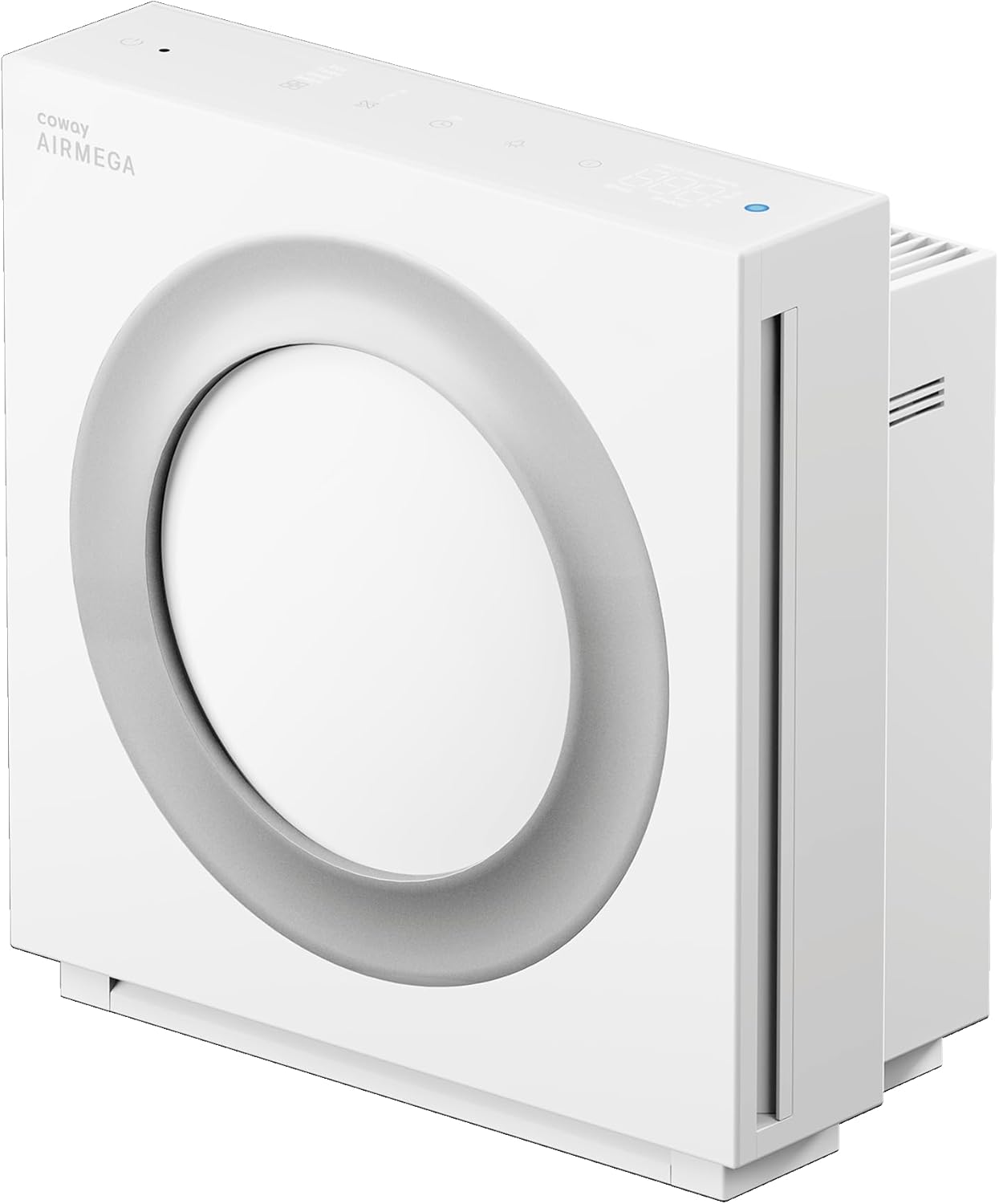
| Coverage (1 hr) | 1,800 sq. ft. |
|---|---|
| CADR (Smoke/Dust/Pollen) | 240 / 242 / 249 |
| HEPA Effectiveness | 99.97% at 0.3μm |
| Power Consumption | 56 W |
The Coway Airmega Mighty2 is a performance-focused room purifier built around an IEST-certified HEPA + activated carbon Max2 filter, a washable pre-filter, and a laser sensor that tracks PM1, PM2.5, and PM10 in real time. In practice it runs in Smart Mode to automatically boost airflow when pollutants rise and revert to an energy-saving Eco or Sleep mode when levels drop, making it easy to leave running in a basement or open family area. Coway rates the unit to clean 900 sq ft in 30 minutes (1,800 sq ft in 60 minutes) with CADR numbers tuned for dust, smoke, and pollen, and the unit reports precise numeric PM values plus a four-color LED for at-a-glance status. Maintenance is straightforward thanks to a slide-out washable pre-filter and a digital filter-life readout for the Max2 cartridge. Noise on the lowest setting is very quiet and the motor efficiency helps keep power draw modest. The main limits are that deep, persistent mold sources or heavy damp odors require source remediation and sometimes a larger commercial dehumidifier or an industrial air cleaner; this is optimized for continuous air cleaning, not active remediation of extreme contamination.
Best for: Buyers wanting a high-performance, sensor-driven purifier to continuously reduce airborne particles and odors in large basement or living spaces and who prioritize measurable air-quality feedback and quiet operation.
Less Ideal for: Homes with active water intrusion, visible mold colonies, or severe damp odor that need remediation or commercial-grade dehumidification rather than a consumer air purifier.
- IEST-certified HEPA and activated carbon Max2 filter remove fine particles and many VOCs
- Megascan laser sensor reports PM1/2.5/10 with numeric readout and 4-color LED for instant feedback
- Rated to clean up to 1,800 sq ft in 60 minutes with strong CADR for dust, smoke, and pollen
- Washable pre-filter and digital filter-life indicator make maintenance predictable and simple
- Very low noise at sleep settings and efficient motor that reduces power draw
- Not a substitute for fixing mold or moisture sources in a musty basement
- Max2 replacement filter required over time which adds recurring maintenance cost
Verdict: Choose the Mighty2 when you need a quiet, sensor-driven purifier that reliably clears fine particles and odors across large basement spaces while giving precise real-time air quality feedback.
PuroAir 240 Air Purifier

| Model | PuroAir 240 |
|---|---|
| Coverage | Up to 1,000 sq ft |
| Filter | 3-layer HEPA with CarbonTech |
| Air quality sensor | Yes |
The PuroAir 240 is a tower HEPA purifier built to run in larger living spaces and bedrooms where odors, dust, smoke, and allergens are a concern. It uses a three-layer HEPA plus CarbonTech filter to capture particulates and reduce smells, and an onboard air quality sensor with auto mode adjusts fan speed based on measured conditions. Typical use is continuous operation in a main living area or basement to circulate and clean air for people and pets; the unit also offers multiple fan speeds and a quiet sleep mode for night use. Practical benefits include long runtime capability for extended continuous filtration, active odor reduction from the carbon layer, and hands-off control when auto mode responds to changing air quality. Trade-offs are that it is a floor-standing tower that needs clear space around it to move air effectively and replacement filters are required periodically to keep performance optimal.
Best for: Buyers who want a maintenance-focused solution to improve air in damp or musty basements and value automatic air-quality adjustments and effective odor reduction.
Less Ideal for: People who need a truly portable or ultra-compact purifier to move between very small rooms or for tight, cluttered spaces where floor clearance is limited.
- Three-layer HEPA plus carbon filter for particles and odors
- Air quality sensor with auto mode that adjusts fan speed
- Quiet sleep mode suitable for overnight use
- Covers up to about 1,000 sq ft for whole-room cleaning
- Requires periodic replacement filters to maintain effectiveness
- Large footprint needs open placement for best air circulation
Verdict: A strong choice for treating musty basements because it combines HEPA particulate filtration with activated carbon odor control and an auto mode that keeps air quality steady with minimal fuss.
VOOPNU HEPA Air Purifier DH-JH12

| Model | DH-JH12 |
|---|---|
| Coverage (claimed) | Up to 1,076 ft² per hour |
| Filtration | H13 True HEPA, multi-stage |
| Noise level | 22 dB (low) |
The VOOPNU DH-JH12 is a small, easy-to-use air purifier that uses an H13 true HEPA multi-stage filter and 360° intake to capture particulates, pet hair, pollen, smoke, and common household odors. It is controlled by a simple panel with three fan speeds and a timer, and it includes an essential oil tray if you want light scenting. Laboratory claims show it cleans roughly 250 ft² every 15 minutes and can cover up to about 1,076 ft² per hour, so a single unit can continuously circulate air in a typical basement room when run steadily. The unit operates quietly down to about 22 dB, which is useful in finished basements where low noise matters, and certifications (ETL, CARB, DOE, FCC, CE, ROHS) support safety and emissions standards. Because it is compact, placement is flexible but filter replacement on a small-frame unit may be more frequent than on larger machines, and the modest physical size suggests lower raw airflow compared with full-size commercial purifiers for very large, open basement spaces. For damp, musty basements you may still need to address humidity and source moisture alongside filtration to fully control odors and mold spores.
Best for: Buyers seeking an affordable, easy-to-operate purifier to reduce dust, pet dander, and odors in a finished basement room and who prioritize low noise and compact placement.
Less Ideal for: People with very large, open, or highly damp basements that need industrial airflow or dedicated dehumidification should consider larger-capacity units or combined dehumidifier solutions instead.
- H13 true HEPA filtration captures 99.97% of fine particles for effective particulate removal.
- 360° air intake and lab-tested coverage support continuous cleaning of rooms up to roughly 1,076 ft² per hour.
- Very quiet operation down to 22 dB suitable for sleeping or low-noise basement use.
- Simple controls and a compact footprint make placement and daily use straightforward.
- Includes an essential oil tray for optional scenting without extra accessories.
- Compact size means smaller filter capacity and potentially more frequent filter replacements for heavy-duty spaces.
- Not a standalone solution for moisture, humidity, or active mold growth in damp basements.
Verdict: A compact, budget-friendly HEPA purifier that quietly handles particulates and odors in a finished basement room when run continuously.
ECOSELF HAP603 Air Purifier

| Model | HAP-603 |
|---|---|
| Coverage | Up to 2400 ft² |
| Noise level (Sleep Mode) | 22 dB |
| Filter efficiency | Captures 99.97% of airborne particles |
The ECOSELF HAP603 is a tower-style air purifier built for large spaces, using a 2X-power filtration system and a True HEPA filter to capture fine particles and common odors. It is typically placed in living rooms, basements, or bedrooms and run continuously on Auto or Smart mode where the PM2.5 sensor adjusts fan speed as air quality changes. Notable features include a PM2.5 air quality display, a very quiet 22 dB sleep mode for overnight use, timer and lock controls, and an aromatherapy tray for light scenting. Practical benefits are solid particle removal across large areas up to the manufacturer-stated coverage and easy maintenance via a filter indicator that flags replacements. Important limitations are reliance on factory replacement filters for best performance and that claimed coverage figures are vendor-stated rather than independently verified; very heavy mold infestations or persistent damp odors may need source remediation or a dehumidifier alongside this purifier. For routine removal of dust, smoke, pet dander, and typical basement mustiness it performs as a convenient, low-noise solution.
Best for: Buyers who prioritize a reliable, low-noise purifier for continuously improving air in large, lived-in spaces and who value automatic air-quality sensing and simple maintenance routines.
Less Ideal for: People dealing with active water leaks, extensive mold growth, or very high humidity should address moisture sources or use a dehumidifier first, since an air purifier alone will not stop mold spread.
- True HEPA filtration for capturing fine particles and allergens
- PM2.5 display and infrared sensor for automatic fan-speed adjustment
- Very quiet 22 dB sleep mode suitable for overnight operation
- Filter indicator and simple controls make maintenance straightforward
- Manufacturer recommends using official replacement filters rather than third-party alternatives
- Coverage and performance claims are vendor-stated and may vary with room layout and pollutant source
Verdict: A quiet, sensor-driven HEPA purifier built to run continuously in large rooms and reduce common basement mustiness while requiring only straightforward filter upkeep.
Levoit Core 300-P

| Filter Type | 3 in 1 Filtration |
|---|---|
| Floor Area | 1073 square_feet |
| Noise Level | 24 db |
| Wattage | 56 watts |
| Particle Retention Size | 0.3 micron |
The Levoit Core 300-P is a compact room air purifier that uses a three-stage filter (pre-filter, HEPA-grade media, and activated carbon) driven by a 56W motor to capture 99.97% of particles down to 0.1–0.3 microns. It is typically placed on a tabletop or floor in bedrooms, living rooms, or basements to reduce dust, pollen, pet dander, smoke and common odors. Notable features include AHAM verification for CADR performance, a near-silent 24 dB Sleep Mode, a touch control panel with timer settings, and a check-filter indicator that simplifies maintenance. In practice it cycles air quickly in small to medium rooms and is easy to move between spaces thanks to its lightweight portable design. Limitations are that it lacks Auto Mode and smart connectivity on this specific Core 300-P variant, so fan speeds must be adjusted manually, and best-in-class coverage for very large or heavily contaminated basements may require multiple units or a higher-CADR model. Replacement filters are recommended every 6 to 8 months to keep performance high.
Best for: Buyers who prioritize proven, independently tested particulate removal and quiet overnight operation and who value social proof from certification and strong customer feedback.
Less Ideal for: Homeowners needing autonomous smart features or a single purifier to cover a very large, heavily musty basement should consider higher-CADR or smart models instead.
- True HEPA-grade filtration capturing 99.97% of 0.1–0.3 μm particles.
- AHAM-verified CADR with documented smoke, dust, and pollen ratings for measured performance.
- Very quiet Sleep Mode (about 24 dB) suitable for overnight use.
- Compact and portable design makes it easy to move between rooms.
- Touch controls with timer and filter indicator simplify operation and upkeep.
- No Auto Mode or smart connectivity on this Core 300-P model, requiring manual speed changes.
- Coverage per hour is modest for large, very damp basements—may need multiple units for full-room turnover.
Verdict: A compact, AHAM-verified HEPA purifier that offers quiet, reliable particle and odor reduction for small to medium basement spaces where proven performance and low noise matter.
Levoit Vital 200S-P Air Purifier

| Floor Area | 1875 square_feet |
|---|---|
| Filter Type | 3-Stage Filter |
| Noise Level | 27 db |
| Particle Retention Size | 0.1 micrometer |
| Wattage | 51 |
The Levoit Vital 200S-P is a smart air purifier built to move a lot of air and reduce common indoor pollutants in large spaces. It uses a three-stage filtration system with a washable pre-filter plus activated carbon and a HEPA-grade stage to capture dust, pet hair, dander, smoke and odors while an air quality monitor reports conditions to the unit and app. Practical features include Wi-Fi/app control, a button controller on the unit, an ultra-quiet sleep mode rated at 27 dB, and CARB plus AHAM verification and CADR numbers for smoke, dust and pollen that support its performance claims. For basement use the high CADR and a U-shaped inlet design help pull particulates and pet hairs without clogging quickly, and the washable pre-filter reduces ongoing filter costs. Trade-offs are its physical footprint and weight for a basement-focused machine and the requirement to replace or select specialized replacement filters for heavy VOC or smoke scenarios.
Best for: Buyers who prioritize verified, predictable air-cleaning performance and simple smart controls and want a unit that can handle large, musty basement areas without loud operation.
Less Ideal for: Those needing an ultra-compact, lightweight purifier for very small crawlspaces or who want a no-maintenance unit that never needs filter replacements.
- AHAM verified with CADR ratings for smoke, dust and pollen supporting whole-room cleaning
- Three-stage filtration with washable pre-filter plus activated carbon for odors and pet issues
- App and button controls plus integrated air quality monitor for easy monitoring and automation
- Very quiet sleep mode at 27 dB suitable for noise-sensitive spaces
- Relatively large and heavier than compact basement models which may limit placement options
- Requires periodic replacement of non-washable filter stages for sustained performance
Verdict: A verified, high-CADR smart purifier with washable pre-filter and odor control that gives risk-averse buyers confidence for cleaning musty basement air
Choosing the Right Air Purifier for Musty Basement: Key Factors to Consider
Filtration Stage and HEPA Performance
Basements often contain higher concentrations of mold spores, dust, and fine particulate matter. A true HEPA stage or medically equivalent particulate filter is essential because it can capture particles down to 0.3 microns, which includes many common mold spores and allergenic fragments. Multiple filtration stages—such as a washable pre-filter to trap hair and large dust, followed by HEPA—extend filter life and maintain airflow.
When assessing HEPA performance, check the specifications for particle capture efficiency and whether the system uses sealed airflow paths so unfiltered air does not bypass the filter media. Better HEPA implementation reduces the need for repeated cleaning and lowers airborne allergen levels more reliably.
Activated Carbon and Odor Adsorption
Musty smells in basements are often driven by volatile organic compounds and odors released from damp materials. An active adsorption stage with adequate activated carbon is important to reduce that stale smell; look for media volume and whether the carbon is impregnated or treated for enhanced VOC removal.
Carbon filters do wear out as they become saturated, so consider replacement cadence and whether the unit design makes swapping cartridges straightforward. For persistent odors, models with larger carbon loads or replaceable odor cartridges will perform noticeably better than particulate-only purifiers.
Airflow Capacity and Room Coverage
Basements can have awkward layouts, open stairwells, and lower ceilings, all of which affect how air circulates. A purifier with higher CADR (clean air delivery rate) or stronger airflow will clear particles faster and help mix air across the room. Choose a unit rated for a higher square footage than the basement room size if the area is open to other spaces or has poor passive airflow.
Multiple fan speeds and directional outlets help adapt to specific layouts. Also factor in how frequently you plan to run the unit; running at a higher setting for short durations may be more effective than a low setting that never shifts air well.
Humidity and Moisture Management
Basement humidity influences both pollutant behavior and purifier durability. High relative humidity makes mold more active and may reduce the lifetime or effectiveness of some filters. Select units that tolerate higher humidity or that include features reducing moisture buildup on filter surfaces, such as protective pre-filters or hydrophobic housings.
If humidity is chronically high, pairing a purifier with a dehumidifier is often the best approach. Also consider how easily the purifier's exterior and intake grills can be cleaned if dust and dampness cause surface buildup.
Maintenance, Filter Cost, and Accessibility
Regular maintenance keeps an air purifier working well in a basement environment that can be dusty or humid. Look for units with accessible filter doors, clear replacement indicators, and affordable filter kits. Washable pre-filters reduce running costs and extend the life of HEPA and carbon stages.
Also consider how often filters need replacement under heavy use. Basements in active homes or used for projects may require more frequent changes, so budget for replacement filters and prefer designs that make swaps quick and tool-free when possible.
Noise and Placement Flexibility
Basements are used for diverse activities—sleeping, media rooms, workshops—so noise output is an important decision factor. Choose purifiers with multiple fan speeds and verified low-noise modes for overnight use. Check manufacturer noise ratings at different speeds and prefer units that maintain decent airflow while staying relatively quiet on lower settings.
Also evaluate physical footprint and placement options. Slim or vertically oriented units can fit tight stair landings or corners, while units with top discharge may work better in obstructed spaces. Portability and weight matter if you plan to move the purifier between rooms.
Sizing the Purifier to Your Basement Layout
Measure the primary basement space where you will place the purifier and consider adjacent open areas that share air. Use the purifier's recommended square footage or CADR to pick a unit rated slightly above your measured area if airflow is restricted.
If the basement is divided into multiple rooms or has a large open plan, consider multiple smaller purifiers placed strategically rather than a single oversized unit. Placement near likely pollutant sources such as laundry, stored fabrics, or the perimeter where dampness enters will improve results.
- Place units so intake and exhaust are not blocked by walls or furniture.
- Avoid corners that trap stagnant air; aim for central or pathway placement.
- For stairwell-linked basements, put one unit near the stair opening to limit circulation of basement air to the rest of the house.
Combining Purification with Dehumidification
Purifiers reduce particles and some VOCs but do not lower relative humidity. In musty basements with RH above 50 percent, a dehumidifier is often necessary to address the root cause of mold growth and musty odors. Running both devices together improves air quality and limits recontamination of filters.
If you already run a dehumidifier, choose an air purifier that tolerates the typical humidity level and place the two devices to maximize cross-flow rather than competing airflow directions.
- Aim to reduce basement humidity to the mid-40s percent range to inhibit mold growth.
- Empty or maintain dehumidifier drains regularly to prevent secondary odor sources.
Filter Maintenance Best Practices for Basements
Basement environments can deposit more dust and larger particles on pre-filters, so follow a routine cleaning schedule. Check pre-filters monthly in dusty environments and vacuum or rinse them according to manufacturer guidance.
Replace HEPA and carbon filters on the schedule recommended for heavy use, and keep replacements on hand so you do not delay changes when filters become saturated. Note filter-change indicators but also perform occasional manual inspections.
- Label replacement dates and note how conditions affect service intervals.
- Rotate filters gently during installation to avoid damaging seals or gaskets.
Dealing with Persistent Odors and Surface Mold
Persistent musty smells often indicate an active moisture source or surface mold growth rather than airborne particles alone. Address visible mold by fixing leaks, improving drainage, and cleaning affected surfaces with appropriate cleaners before relying solely on an air purifier.
Air purifiers with robust carbon stages will reduce airborne odors but cannot remove mold growing on surfaces. Use the purifier as part of a broader remediation plan that includes moisture control and targeted cleaning.
- Inspect hidden areas like behind stored boxes, under carpets, and around window wells for mold.
- Use protective gear when cleaning mold and ventilate the area well during remediation.
Placement and Safety Considerations
Do not place purifiers directly against damp walls or on floors that collect water. Elevate units slightly if basement floors are cold or prone to surface moisture. Keep electrical cords away from potential puddles and out of walkways.
Ensure the unit has stable footing and that intake/exhaust grills are unobstructed. If you have pets or children in the home, select models with child locks or tamper-resistant controls.
- Avoid enclosed cabinets or built-in shelving that restrict airflow.
- Keep at least a few inches clearance around all sides unless the manual specifies otherwise.
How We Chose the Best Air Purifier for Musty Basement
We prioritized features and performance characteristics that actually matter when dealing with musty basements. First, filtration capability was a primary filter: units had to include true HEPA or equivalent particulate filtration to capture mold spores and fine dust. Second, airflow and coverage were assessed because basements often require higher cubic feet per minute (CFM) or multiple fan speeds to move air effectively through low-ceiling and partitioned spaces. Third, odor control mattered for mustiness, so we looked for activated carbon or specialized adsorption stages that target VOCs and stale smells. Fourth, humidity and maintenance considerations were included: units that tolerate higher relative humidity, have washable pre-filters, or simple filter-replacement processes scored higher. Finally, noise and user controls were considered since basements are often used for living, work, or storage and may need quiet operation overnight. We excluded units that rely solely on ionization without particulate capture, small desktop purifiers undersized for basement volumes, and devices that require frequent professional servicing. The short list reflects practical, homeowner-friendly options that balance filtration, airflow, odor reduction, and ease of ownership.
Our full evaluation process is outlined in our review methodology.
FAQ
Will an air purifier remove mold growing on basement walls?
No. Air purifiers remove airborne spores and particles but do not eliminate mold colonies on surfaces. You must address the moisture source and clean or remediate surface mold directly to stop ongoing releases of spores.
How large of an air purifier do I need for a finished basement?
Select a unit rated for the square footage of the room where it will run, and choose a slightly higher capacity if the basement has limited ventilation or an open plan. Look at CADR and manufacturer coverage as guides rather than relying on single-room labels.
Can I use a purifier in a damp, unfinished basement?
You can, but choose models that tolerate higher humidity and avoid units sensitive to moisture. For consistently damp environments, pair a purifier with a dehumidifier to protect filters and reduce mold activity.
How often should I change filters in a basement environment?
Under heavy use or dusty basement conditions, check washable pre-filters monthly and replace HEPA or carbon filters more frequently than the nominal schedule. Expect shorter replacement intervals if the basement is a workshop or storage area.
Will running an air purifier stop the musty smell immediately?
A purifier with good carbon filtration can noticeably reduce airborne odors within hours, but persistent musty smells caused by surface mold or ongoing moisture will require remediation and humidity control for a lasting fix.
Final Verdict
For musty basements, prioritize a purifier that combines true HEPA particulate capture with a substantial activated carbon stage and sufficient airflow to move basement air effectively. Addressing humidity and surface mold is often the determining factor in long-term odor and spore reduction, so consider using a dehumidifier alongside the purifier. Balance maintenance needs, filter replacement costs, and noise when selecting a unit. If you focus on filtration efficiency, odor adsorption, and coverage for your basement layout, you will choose a solution that meaningfully improves air quality and comfort.