
Note: This article contains affiliate links. If you click on these links and make a purchase, we may earn a small commission at no extra cost to you. This helps support our research and content. Read our full affiliate disclosure here.
If you smoke indoors and want to cut lingering smoke, odor, and particulates, picking the right air purifier matters. Smoke puts fine particles and volatile compounds into the air that ordinary filters or small units often cannot fully capture. The right purifier reduces visible haze, removes most fine particulate matter, and lowers odors so your living spaces feel and smell cleaner. This guide highlights six shortlisted air purifiers designed for smoking indoors and explains the features that matter. We evaluated filtration methods, room coverage, airflow, noise, and maintenance to help you choose the unit that suits your space and habits. Read on for the key tradeoffs and practical tips for using a purifier effectively with indoor smoking.
Top Picks at a Glance
| Best Overall The best all-around choice for most situations | WINIX 5510 Air Purifier |  |
| Best Quality Built to a higher standard if you want something more solid | Levoit Core 600S-P |  |
| Best Value The sweet spot between price and what you get | VOOPNU H13 HEPA Air Purifier DH-JH12 |  |
| Best Budget The cheapest option that still gets the job done reliably | AromaRoom AP103-A Air Purifier |  |
| Top Rated A top-rated pick with lots of positive feedback | ECOSELF HAP603 Air Purifier |  |
| Most Popular A crowd favorite that many people choose with confidence | Levoit Core 300-P |  |
WINIX 5510 Air Purifier

| Model | 5510 |
|---|---|
| Filtration | 4-Stage (Pre-filter, True HEPA, Carbon, PlasmaWave) |
| Coverage | Up to 1,882 sq ft in 1 hour |
| App Compatibility | Winix Smart App / WiFi / Alexa / Google Home |
| Noise (low) | 23.5 dB |
The Winix 5510 is a four-stage air purifier built to clear large rooms quickly while also giving remote control via the Winix Smart App. It combines a washable pre-filter, True HEPA that captures particles down to 0.01 microns, and an advanced deodorization carbon filter to cut smoke and household odors, backed by Winix PlasmaWave technology for additional air treatment. Smart sensors and an LED air quality indicator let the unit run in Auto Mode, raising fan speed when pollution is detected and switching to a very quiet Sleep Mode in the dark. Practical benefits include AHAM verification for stated coverage, a filter replacement indicator, and app/voice integration for scheduled or hands-off operation. Trade-offs are typical for high-CADR, multi-stage purifiers: replacement HEPA and carbon filters are ongoing costs and the unit is larger and heavier than compact bedroom models, which matters if floor space is limited.
Best for: Buyers who want a capable, smart purifier that removes smoke and household odors from large living spaces and prefer automated, app-managed operation.
Less Ideal for: People seeking a compact, budget or travel purifier for small bedrooms or occasional use should consider smaller, lighter units instead.
- High CADR and AHAM-verified coverage suitable for large rooms and rapid smoke removal
- True HEPA filtration rated to capture ultrafine particles down to 0.01 microns
- Activated carbon deodorization filter reduces VOCs and smoky odors
- Smart sensors, Auto Mode and app/voice control simplify hands-off operation
- Washable pre-filter extends life of main filters and reduces maintenance frequency
- Replacement HEPA and carbon filters are recurring expenses
- Larger footprint and weight may be impractical for small rooms or tight spaces
Verdict: If you need a smart, AHAM‑verified purifier that quickly removes smoke and odors from large rooms, the Winix 5510 delivers powerful filtration and convenient app control.
Levoit Core 600S-P

| Filter Type | 3-In-1 Filtration |
|---|---|
| Floor Area | 2933 square_feet |
| Noise Level | 26 db |
| Particle Retention Size | 0.1 micron |
| Wattage | 66 watts |
The Levoit Core 600S-P is a high-capacity smart air purifier built for extra-large rooms and open floor plans where strong, continuous cleaning is needed. It uses a three-stage 3-in-1 filter and VortexAir Technology to deliver a high CADR and remove fine particles down to 0.1 micron, which helps reduce smoke, PM2.5, pollen, dust, and pet dander. The unit offers Auto Mode with a PM2.5 sensor, a Sleep Mode that dims lights and lowers fan noise to around 26 dB, and smart control through the VeSync app plus voice commands via Alexa or Google Assistant. Energy Star and AHAM verification speak to its efficiency and measured performance for coverage claims. Practical benefits for smokers include substantial hourly air exchanges in large spaces and dedicated replacement filter options aimed at smoke and VOCs. Trade-offs are its physical size and weight compared with small-room purifiers and the need to use genuine Levoit filters to maintain certified CADR and coverage figures.
Best for: Buyers who prioritize measurable, high-capacity performance for removing smoke and fine particles from big living areas and want smart controls to monitor and automate air quality.
Less Ideal for: People looking for a compact, lightweight purifier for single small rooms or those who want an all-in-one unit that guarantees VOC removal without selecting a specialized filter.
- Designed for extra-large rooms with a high CADR and VortexAir circulation for fast air exchanges
- Three-stage 3-in-1 HEPA-grade filtration captures particles down to 0.1 micron
- Auto mode with PM2.5 monitoring and Sleep Mode that reduces noise and dims lights
- Smart app control and voice compatibility for remote monitoring and schedule automation
- Energy Star and AHAM verification indicate tested efficiency and performance
- Large footprint and heavier than small-room purifiers, making placement and moving less convenient
- Optimal performance depends on using genuine Levoit replacement filters
- Not specifically rated for VOC removal beyond filter options that must be selected separately
Verdict: If you need a proven, high-capacity purifier with smart controls to tackle indoor smoke across large open spaces, the Core 600S-P is built for that job.
VOOPNU H13 HEPA Air Purifier DH-JH12

| Coverage | Up to 1,076 ft² (lab-tested 250 ft² per 15 minutes) |
|---|---|
| Filter | H13 True HEPA triple-layer |
| Noise | 22 dB (quiet setting) |
| Speeds | 3 fan speeds |
The VOOPNU DH-JH12 is a small, user-friendly air purifier built around a 360° intake and H13 true HEPA triple-layer filtration to capture fine particles and smoke. It is intended for continuous operation and, per lab claims, can clean roughly 250 sq ft every 15 minutes, making it suitable for moderate-size rooms or focused use where smoke or odors are present. Controls are simplified to one-tap operation plus three fan speeds and a timer, and the unit includes a washable pre-filter option and an essential oil tray for light scenting. Noise is low, with a quoted 22 dB on the quiet setting, which helps for overnight use. Practical limitations include its small footprint and implied modest CADR relative to very large open-plan spaces, so multiple units or placement near the smoke source may be necessary for heavy indoor smoking. Filter replacement intervals are listed at roughly 3 to 6 months depending on edition, so plan for ongoing filter costs and occasional maintenance.
Best for: Buyers who want a low-noise, easy-to-use purifier to reduce smoke and odors in one room and who prioritize compact placement and straightforward operation.
Less Ideal for: People seeking whole-house removal of heavy cigarette or cannabis smoke or who need a high CADR unit for very large open-plan spaces should consider larger commercial-grade purifiers instead.
- H13 true HEPA triple-layer filter captures 99.97% of fine particles including smoke
- 360° surround intake improves room circulation and helps pull air from multiple directions
- Very quiet operation down to about 22 dB, suitable for bedrooms and overnight use
- Simple controls and compact footprint make placement and everyday use easy
- Designed for single-room use so performance drops in very large or multiple connected rooms
- Replacement filters recommended every 3–6 months, adding recurring cost
Verdict: A compact, very quiet H13 HEPA purifier that fits optimizers wanting straightforward, single-room smoke and odor reduction.
AromaRoom AP103-A Air Purifier
| Coverage | 323 ft² (30 m²) |
|---|---|
| Filter type | H13 HEPA 3-in-1 with smoke removal |
| Noise (sleep mode) | 22 dB |
| Timer | 2/4/8 Hours |
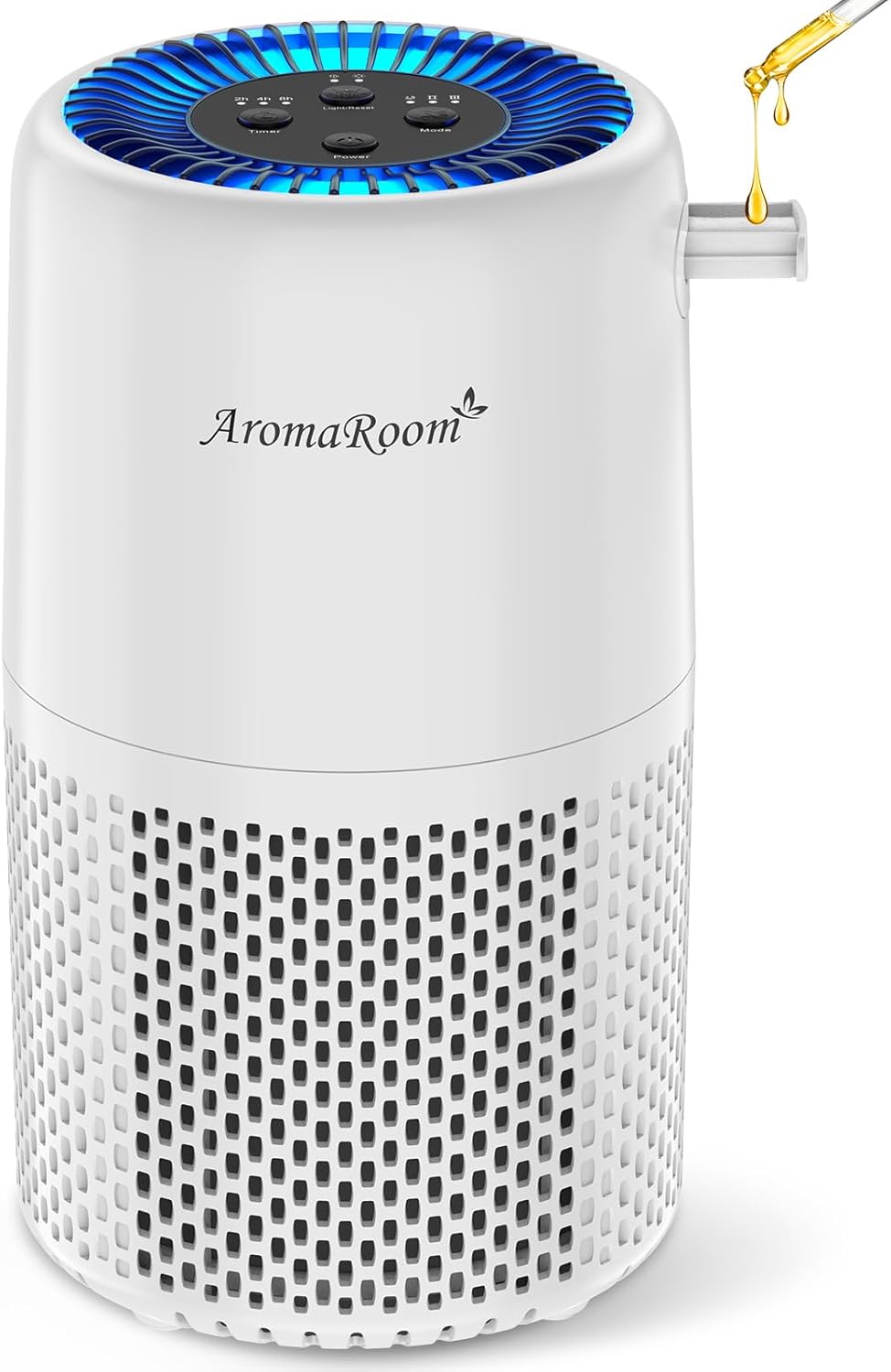
The AromaRoom AP103-A is a compact tabletop air purifier built around a True H13 HEPA 3-in-1 filter and a dedicated smoke-removal stage, intended to reduce smoke, pollen, dust, and pet dander in rooms up to about 323 ft². It circulates room air roughly twice per hour and offers three timer settings plus a sleep mode that drops noise to around 22 dB for overnight use. The unit also accepts an aroma pad so you can add essential oils for a mild fragrance while it runs. Practical benefits include effective particulate capture for fine smoke and allergens, low noise on its lowest setting, and simple timed operation for intermittent use. Limitations are its small footprint and airflow rate relative to larger purifiers, so it will take longer to clear heavy smoke in open-plan or very large spaces, and the fragrance feature may not suit users sensitive to added scents. Filters require periodic replacement for best performance and must be unwrapped before installation.
Best for: Buyers on a budget who want a quiet, compact purifier that improves indoor air quality and reduces smoke and fine particles in bedrooms or small living spaces.
Less Ideal for: People who smoke heavily in large or open-plan rooms or need rapid clearance after continuous smoking should choose a higher-capacity purifier with stronger airflow.
- True H13 HEPA filtration captures particles down to 0.1–0.3 microns including fine smoke and pollen
- Rated to circulate air twice per hour in rooms up to ~323 ft², suitable for bedrooms or small living areas
- Very quiet sleep mode rated at about 22 dB for overnight use
- Built-in aroma pad lets you add essential oils for a light fragrance
- Simple timer options (2/4/8 hours) for scheduled use
- Airflow and CADR are modest, so clearing heavy or continuous indoor smoking will be slower than larger room purifiers
- Aroma pad can introduce scents that some users may find undesirable
- Replacement filters are recommended every 3–6 months which adds ongoing cost
Verdict: AromaRoom AP103-A is a budget-friendly, very quiet HEPA purifier that helps reduce smoke and fine particles in small to medium rooms while adding optional aromatherapy.
ECOSELF HAP603 Air Purifier

| Coverage | Up to 2400 ft² |
|---|---|
| Filtration | H13 True HEPA |
| Noise level | 22 dB (Sleep Mode) |
| Air quality sensor | PM2.5 display with infrared sensor |
The ECOSELF HAP603 is built to scrub large living spaces, using a True H13 HEPA filtration system and a 2X-power circulation claim to handle smoke, dust, pet dander, and odors across up to 2400 sq ft. It runs in Auto/Smart mode using a PM2.5 sensor and display to adjust fan speed, which helps it react to wildfire smoke or indoor cigarette smoke without constant manual changes. Practical features include a very quiet 22 dB Sleep mode, a timer, lock controls, and a filter indicator that makes upkeep straightforward; the unit also offers an aromatherapy slot if you want light scenting. The main limitations are that the coverage claim is aggressive for continuous heavy smoke in open-plan homes and performance depends on timely use of genuine replacement filters, which the brand recommends. The unit is fairly portable and simple to use, but buyers should plan on regular filter replacements to maintain high capture efficiency in smoking environments.
Best for: Buyers who prioritize consistent, sensor-driven removal of smoke and small particles in larger living areas and want a quiet, low-maintenance machine that adapts automatically to air quality.
Less Ideal for: People who need an industrial or whole-house solution for constant heavy smoking or who prefer units that integrate with specific smart home ecosystems not mentioned by the brand.
- True H13 HEPA filtration captures fine particles and common smoke pollutants.
- PM2.5 sensor with real-time display and Auto mode adjusts operation to changing air quality.
- Very quiet 22 dB Sleep mode suitable for bedrooms or overnight use.
- Filter indicator, timer, and lock controls simplify routine operation and maintenance.
- Coverage claim up to 2400 ft² may be optimistic for continuous heavy indoor smoking.
- Requires branded replacement filters for best performance as recommended by the manufacturer.
Verdict: A sensor-driven HEPA purifier with very quiet operation and features tuned for smoke-prone large rooms, making it a solid reliability-focused choice for indoor smoking scenarios.
Levoit Core 300-P

| Power Source | Corded Electric |
|---|---|
| Filter Type | 3 in 1 Filtration |
| Floor Area | 1073 square_feet |
| Noise Level | 24 db |
| Wattage | 56 watts |
The Levoit Core 300-P is a small, mains-powered HEPA air purifier built to tackle smoke, dust, pollen, pet dander, and odors in home rooms. It uses a three-stage original filter with HEPA-grade performance that the manufacturer says removes 99.97% of 0.1–0.3 micron particles, and a 56 W motor that produces up to 143 CFM CADR for fast air turnover in typical living spaces. Controls are touch-based with a quiet Sleep Mode that lowers noise to about 24 dB and an option to turn the display lights off for night use. Practical benefits include verified AHAM performance metrics, CARB and ETL certification for safe indoor operation, and a compact footprint that is easy to move between rooms. Limitations are manual-only fan control (no Auto Mode on this variant) and reliance on genuine replacement filters for rated performance, which means ongoing filter purchases and periodic replacements every 6–8 months for best results. For indoor smoking situations it provides effective particle capture but requires regular filter changes under heavy use.
Best for: Buyers who want a compact, independently verified purifier that reliably reduces smoke and fine particles and who value third-party certifications and broad social proof when choosing indoor air cleaning gear.
Less Ideal for: Large open-plan homes or users who prefer fully automatic sensor-driven operation and hands-off fan control.
- HEPA-grade 3-in-1 filter that captures 0.1–0.3 μm particles with 99.97% efficiency (manufacturer tested)
- AHAM VERIFIED CADR ratings (143 CFM smoke) for measurable smoke and particle removal
- Very quiet Sleep Mode at approximately 24 dB suitable for bedroom use
- Certified to CARB and ETL standards for safe home operation
- No Auto Mode on this model so fan speeds must be adjusted manually
- Performance depends on using official Levoit replacement filters and regular changes
Verdict: A compact, AHAM-verified HEPA purifier that reliably reduces smoke and fine particles for buyers who prioritize proven performance and trusted certifications.
Choosing the Right Air Purifier for Smoking Indoors: Key Factors to Consider
Filtration Technology
How a purifier captures smoke particles and removes odors determines its baseline effectiveness. True HEPA filtration is essential for trapping fine particulate matter produced by smoking, including PM2.5 and smaller aerosols. An activated-carbon stage or other high-surface-area adsorbent is important for reducing the volatile organic compounds and smell that HEPA filters do not capture.
Some units combine prefilters, HEPA, and thicker carbon layers to balance particle removal with odor control. When evaluating technology, look for clear manufacturer specifications for particle removal efficiencies and descriptions of the carbon stage rather than marketing claims alone.
Room Size and CADR
Match the purifier's stated room coverage and Clean Air Delivery Rate to the actual space where you smoke. CADR for smoke is the most relevant figure because it reflects how quickly a unit removes smoke-sized particles from the air. If you plan to run the unit intermittently, choose a higher CADR so it can bring the room back to clean air faster.
Undersized purifiers simply run at top speed without effective results and produce more noise and higher energy use. Consider ceiling height and open floor plans, which increase volume and may require a unit rated for a larger area or multiple units for best results.
Noise and Daily Use
Many people run purifiers for extended periods when smoking indoors, so noise levels are a practical concern. Higher fan speeds typically deliver better cleaning but are louder. Evaluate documented dB levels at common fan settings and consider whether the unit has an effective auto mode that raises speed only when needed.
If the purifier will sit in a bedroom or living room where conversation or TV happens, prioritize quieter operation at moderate speeds. Some units have night modes or specially tuned fans that reduce perceived noise without huge sacrifices in airflow.
Filter Life and Maintenance
Regular maintenance affects long-term cost and convenience. Smoking deposits tar and residue that can clog prefilters and carbon layers more quickly than normal dust, shortening effective life. Check expected filter lifetimes, whether prefilters are washable, and how easy it is to replace cartridges.
Transparent replacement intervals and reasonable availability of filters make continued use less burdensome. Also consider whether the unit has filter-change indicators and whether those indicators measure actual sensor data or simple runtime estimates.
Operational Safety and Emissions
Some air-cleaning technologies produce byproducts like ozone, which can worsen respiratory irritation. For indoor smoking environments, avoid units that rely on ozone generation or unproven charge-based particle precipitators without robust HEPA backing. Look for safety certifications and explicit statements about low or zero ozone emissions.
Also consider electrical safety for continuous operation. Units designed for long run times and with thermal protections reduce risk if you plan to run the purifier during long smoking sessions.
How Often to Run an Air Purifier When Smoking Indoors
Run the purifier continuously while smoking and for at least 30 to 60 minutes afterward to clear lingering particulates and gases. Continuous operation prevents peaks in particulate concentration and reduces surface deposition that causes long-term odors and residue.
If continuous runtime is not possible, run the purifier at a high setting during smoking and then at a medium setting afterward until airborne levels return to baseline. Use an air-quality sensor or the unit's indicator to guide how long the higher speed is needed.
- Start the purifier before a session if possible to pre-clean the air.
- Place the unit near the smoking area but not blocked by furniture.
- Combine purifier use with basic ventilation when feasible to accelerate VOC removal.
Best Placement and Room Layout Tips
Place the purifier so it has unobstructed airflow into and out of the unit — a few feet from walls is ideal. Positioning near the source of smoke improves capture efficiency, but avoid corners or behind tall furniture that restricts intake.
In open-plan spaces, one central higher-CADR unit often works better than several small units. In contrast, separate enclosed rooms benefit from dedicated units sized for each space.
- Avoid putting the purifier on the floor beneath heavy objects that block exhaust.
- For rooms with ceiling fans or HVAC, coordinate placement so purifier airflow complements room circulation.
Managing Odor Versus Particulate Removal
HEPA filtration will address airborne particulate matter effectively, but odors require adsorption. Units with thicker or higher-grade carbon filters will reduce smell more than thin carbon layers. If odor control is a priority, look for models that specify carbon weight or describe the carbon type and treatment.
Keep expectations realistic: strong, embedded odors in fabrics, curtains, and upholstery may persist after airborne VOCs are reduced. Regular cleaning of surfaces and laundering textiles is often needed alongside purifier use to fully eliminate lingering smells.
- Replace carbon filters more frequently in heavy-smoking environments.
- Consider combined strategies like surface cleaning and short ventilation bursts to lower residual odors.
Using Sensors and Auto Modes Effectively
Air-quality sensors help adjust fan speed to changing conditions, but not all sensors are equally sensitive to smoke. Look for units that explicitly list PM2.5 sensing or smoke detection rather than only general particle or odor sensors.
Auto modes can conserve energy and reduce noise by increasing speed only when airborne particles rise. Validate a unit's auto response by watching its indicator during a short smoke test to ensure it ramps up promptly.
- Sensors may lag in response to sudden bursts of smoke; manual boost may be necessary for immediate clearing.
- Clean sensors per manufacturer guidance to prevent false low readings caused by surface dust buildup.
Common Misconceptions About Purifiers and Smoking
A purifier cannot eliminate stains or deeply embedded tar on surfaces. While it reduces airborne particles and slows redeposition, it cannot replace cleaning upholstery and fabrics. Expect to combine purifier use with targeted cleaning for the best results.
No single-stage filter will both trap all fine particles and fully eliminate strong odors. Effective smoke control generally requires a multi-stage approach and regular maintenance to keep filters performing.
- Do not rely on ionization-only devices for smoke — they often fail to capture particles adequately.
- High CADR does not guarantee odor elimination; check carbon/adsorption specs separately.
How We Chose the Best Air Purifier for Smoking Indoors
We prioritized units that address the two main hazards from indoor smoking: fine particulate removal and odor or volatile compound reduction. Selection focused on filtration systems proven to capture PM2.5 and smaller particles, combined with activated-carbon or comparable adsorption stages for odors. We also weighted clean-air delivery rate relative to intended room size so the unit can cycle the air frequently without running constantly at maximum fan speed. Practical usability factors included measurable noise levels at common fan speeds, filter replacement accessibility and cost, and the availability of multiple fan speeds or an automatic mode driven by an air-quality sensor. Energy efficiency and run-time cost were considered to reflect units likely to be used for hours each day. Units were excluded if they relied solely on ionization without adequate particulate capture, used ozone-emitting technologies, or lacked clear specification for CADR or room coverage. In short, we filtered for effective multi-stage filtration, adequate airflow for realistic room sizes, manageable noise and maintenance, and safety regarding ozone emissions. Those dimensions shaped the scoring and final shortlist.
Our full evaluation process is outlined in our review methodology.
FAQ
Will an air purifier completely remove cigarette smell from my room?
An air purifier can significantly reduce airborne smoke and some odors, but deeply embedded smells in fabrics and surfaces may persist. Combining purifier use with cleaning and brief ventilation usually gives the best result.
How large a unit do I need for a living room where I smoke?
Choose a unit with a CADR and stated coverage area slightly larger than your room volume, accounting for ceiling height. If you smoke frequently, prioritize higher CADR so the device can cycle the air faster at moderate fan speeds.
Are ozone-generating purifiers safe to use while smoking indoors?
Avoid ozone-generating purifiers. Ozone can irritate the respiratory system and may react with smoke byproducts to form additional pollutants. Select units that state low or zero ozone emissions and rely on HEPA plus adsorption stages.
How often should I change filters in a smoking environment?
Filter life will be shorter with regular indoor smoking. Expect prefilters and carbon stages to need replacement or cleaning more frequently than in non-smoking homes. Check manufacturer guidance and inspect filters monthly for heavy buildup.
Can I run a purifier on high all the time to speed clearance?
Running at high speed clears smoke faster but increases noise and energy use and may shorten filter life. Using auto mode or running high only during and immediately after smoking balances effectiveness with longevity and comfort.
Final Verdict
When choosing an air purifier for smoking indoors, prioritize true HEPA filtration paired with a substantial adsorption stage for odors and VOCs. Match CADR to your room volume, favor units with measurable performance data and sensible noise levels, and plan for more frequent filter service. Balancing filtration effectiveness, airflow, and maintenance cost will help you pick a unit that meaningfully reduces smoke and odor without excessive noise or upkeep. Focus on proven filtration stages and realistic placement and you will get the clearest benefit from using a purifier in smoking spaces.