
Note: This article contains affiliate links. If you click on these links and make a purchase, we may earn a small commission at no extra cost to you. This helps support our research and content. Read our full affiliate disclosure here.
Choosing the right air purifier for a nursery matters because infants are more sensitive to airborne particles and to sleep disruption from noisy machines. You want a unit that removes allergens, dust, and volatile compounds while running quietly and safely around a crib. This guide shortlists seven top air purifiers suited to nursery use and explains the practical tradeoffs buyers face. We evaluated models on filtration performance, sound output at low speeds, and safety features so you can pick a unit that supports cleaner air and restful sleep. Read on for our concise buyer guidance and decision criteria before the product list.
Top Picks at a Glance
| Best Overall The best all-around choice for most situations | GermGuardian Tower AC4825E |  |
| Best Quality Built to a higher standard if you want something more solid | BLUEAIR Blue Signature Air Purifier |  |
| Best Value The sweet spot between price and what you get | BLUEAIR Blue Pure 511i Max |  |
| Best Budget The cheapest option that still gets the job done reliably | FULMINARE H13 HEPA Air Purifier |  |
| Top Rated A top-rated pick with lots of positive feedback | Levoit Core 300-P |  |
| Most Popular A crowd favorite that many people choose with confidence | Levoit LV-H132 Air Purifier |  |
| Best Seller A high-volume bestseller chosen again and again | VOOPNU HEPA Air Purifier DH-JH12 |  |
GermGuardian Tower AC4825E

| Room coverage cycle | 153 sq. ft. every 12.5 minutes; up to 743 sq. ft. hourly |
|---|---|
| Filter type | True HEPA with activated carbon pre-filter |
| Fan speeds | Three speeds with sleep mode |
| Model number | AC4825E |
The GermGuardian 22" Tower AC4825E is a compact tower-style purifier that uses a True HEPA filter, activated carbon pre-filter, and an optional UV-C light to reduce dust, pollen, pet dander, odors, and airborne particles down to 0.1 microns. It circulates air in a 153 sq ft room roughly every 12.5 minutes and can serve much larger spaces on a slower cycle, with three fan speeds including a quiet sleep mode for nighttime use. The carbon pre-filter helps reduce cooking and pet smells while the HEPA element captures common allergens; replacement parts are widely available from the same brand for straightforward maintenance. Practical strengths are its proven filtration, simple controls, and small footprint that fits a nursery without dominating the room. Limitations include basic controls with no smart connectivity, and because the unit is ventilative it should be placed away from walls and bedding to keep airflow unobstructed; the UV-C option adds complexity and requires occasional bulb replacement. For parents prioritizing allergy reduction and low noise, this model is an easy, dependable choice for a nursery environment.
Best for: Parents who want a quiet, proven air purifier to reduce allergens and odors in a nursery while keeping installation and operation simple.
Less Ideal for: Families who need smart home integration or app-based scheduling and remote control should consider models with Wi‑Fi features instead.
- True HEPA filter captures 99.97% of particles down to 0.1 microns
- Activated carbon pre-filter reduces odors from cooking and pets
- Three fan speeds including a quiet sleep mode suitable for nighttime use
- Compact tower design fits small rooms and nurseries without taking much floor space
- No Wi‑Fi or app connectivity for remote monitoring or scheduling
- Requires periodic replacement of HEPA filters and UV-C bulb to maintain performance
Verdict: A quiet, compact HEPA tower that reliably reduces allergens and odors, making it a sensible choice for a nursery focused on clean air and low noise.
BLUEAIR Blue Signature Air Purifier

| Room coverage | Up to 3,385 sq ft/hour |
|---|---|
| Filtration | 7-stage HEPASilent |
| Particle capture | Down to 0.1 micron |
| Noise level | 23–55 dB |
| App control | Blueair mobile app with Auto Mode |
The Blueair Blue Signature is designed to move a lot of air quietly while removing particles, odors, and gases from large open spaces. It uses Blueair's HEPASilent 7-stage filtration and OdorFence technology to capture down to 0.1 micron particles and reduce VOCs, and its RealTrack algorithm estimates filter life so replacements come at sensible intervals. Built-in sensors and Auto Mode adjust fan speed automatically and the Blueair app gives remote control, schedules, and filter reminders. In practical use the unit can clear a nursery-sized room very quickly at low noise levels — it operates as quiet as 23 dB on low and remains under 55 dB on high — and the furniture-inspired design helps it blend into a child's room. The main compromises are its large coverage focus and premium positioning: it is built for very large rooms and will be overkill for tiny spaces, and replacement filters are an ongoing cost. For parents prioritizing fast, quiet, app-connected performance in a nursery, this unit delivers strong, real-world air cleaning.
Best for: Parents and caregivers who prioritize strong, fast air cleaning and quiet operation in a nursery and want app-based monitoring and automatic control.
Less Ideal for: Those with a very small nursery or tight budget who need a compact, lower-cost purifier designed specifically for single small bedrooms.
- Very high clean-air delivery able to refresh very large rooms quickly
- HEPASilent 7-stage filtration captures particles down to 0.1 microns and reduces odors and VOCs
- Quiet operation starting at 23 dB, suitable for sleep and nursery use
- Smart sensors, Auto Mode, and mobile app allow remote control and real-time air quality monitoring
- Optimized for very large spaces so it is larger and more powerful than needed for small nurseries
- Replacement filters represent a recurring expense
Verdict: Choose the Blueair Blue Signature when you need fast, whisper-quiet, app-controlled purification for a nursery and want top-tier particle and odor removal.
BLUEAIR Blue Pure 511i Max

| Cleaning coverage | Up to 1,138 sq ft per hour |
|---|---|
| Particle removal | 99.97% down to 0.1 microns |
| Noise level | As low as 19 dB |
| Controls | Built-in sensors with app control and auto mode |
The Blueair Blue Pure 511i Max is a compact smart air purifier built for bedrooms, nurseries, and other small rooms where quiet, effective filtration matters. It combines mechanical and electrostatic filtration (HEPASilent) to capture 99.97% of particles down to 0.1 microns, which helps reduce pollen, pet dander, dust, smoke, and other common indoor pollutants. The unit pulls air in 360 degrees and can refresh 237 sq ft in about 12.5 minutes or clean up to 1,138 sq ft in an hour, so it moves air quickly for its size. Built-in air quality sensors and the Blueair app let you monitor conditions, schedule runs, and get filter reminders, while auto mode adjusts fan speed as needed. Noise levels are very low on the lowest setting, making it suitable for sleeping infants and light sleepers. The trade-offs are standard for a small-room purifier: it is optimized for bedrooms and nurseries rather than whole-apartment use, and replacement filters are an ongoing cost; there is no humidification feature. For parents prioritizing quiet, effective particle removal and simple smart controls, this model is a practical choice.
Best for: Parents or caregivers who want a quiet, effective purifier for a nursery or bedroom and value automatic air-quality sensing and simple app control to maintain cleaner air with minimal fuss.
Less Ideal for: Households seeking whole-apartment coverage or an integrated humidifier should consider larger or combined models instead.
- HEPASilent filtration captures 99.97% of particles down to 0.1 microns
- Quick room turnover rate suitable for typical nursery sizes
- Very quiet operation down to 19 dB for undisturbed sleep
- Smart sensors and mobile app with auto mode and filter reminders
- Compact 360° intake fits into small rooms without taking much space
- Designed for small rooms so not ideal as a single unit for large open areas
- Requires periodic filter replacements which add to long-term cost
Verdict: Reliable, very quiet smart purification designed to keep nursery and bedroom air cleaner with minimal intervention.
FULMINARE H13 HEPA Air Purifier

| Filter type | H13 HEPA |
|---|---|
| Recommended room size | Up to 215 ft² / 20 m² |
| Noise level (low) | Around 24 dB |
| Power | Plug-in adapter (no battery) |
The FULMINARE H13 is a compact bedroom-style air purifier built around an H13 true HEPA filter and a 360° dual-channel outlet that the manufacturer says refreshes air up to five times per hour in rooms near 215 square feet. It is intended for tabletop or floor placement in nurseries, bedrooms, or small living spaces and includes a near-silent sleep mode that drops noise to around 24 dB for overnight use. The unit also includes an independent night light and selectable timers (2, 4, 8, 10, 12 hours), making it convenient for parents who want continuous low-profile filtering while a child sleeps. Practical benefits include simple placement, portable size, and straightforward controls; filters are replaceable and the product uses a plug-in adapter so there is no internal battery to manage. Expect limitations in larger rooms since performance is rated for about 215 ft² and filter replacement is recommended periodically, typically every few months under heavier use. The night light is useful but may not be fully dimmable for all nursery preferences.
Best for: Parents or caregivers looking for an affordable, compact air purifier to keep a nursery or small bedroom quiet and filtered overnight while providing a soft night light.
Less Ideal for: Households needing whole-home or large-room purification, or buyers wanting adjustable/dimmable ambient lighting integrated with the purifier.
- H13 true HEPA filter captures fine particles including pet hair, smoke and odors
- 360° dual-channel outlet designed to circulate air across a room up to ~215 ft²
- Near-silent sleep mode (around 24 dB) suitable for overnight use in nurseries
- Built-in night light and multiple timer options for convenient nighttime operation
- Coverage and circulation are limited to small-to-medium rooms and not intended for whole-house use
- Filter requires regular replacement under frequent use which adds ongoing cost
Verdict: A budget-friendly, quiet H13 HEPA purifier with a night light and timers that fits small nurseries and bedrooms where low noise and compact size matter.
Levoit Core 300-P

| Filter Type | 3 in 1 Filtration |
|---|---|
| Floor Area | 1073 square_feet |
| Noise Level | 24 db |
| Particle Retention Size | 0.3 micron |
| Wattage | 56 watts |
The Levoit Core 300-P is a small, user-friendly air purifier built around a 3-stage HEPA-grade filter and a 56W motor to clean bedroom- and nursery-sized spaces. It circulates air efficiently with AHAM-verified CADR figures and is rated to refresh a 222 ft² room multiple times per hour while still qualifying as whisper-quiet in Sleep Mode at about 24 dB. Controls are simple touch buttons with a timer and a filter-check indicator, and the unit ships with a pre-installed genuine Levoit filter to simplify setup. The Core 300-P is portable and energy efficient for continuous operation, and the display can be turned off at night to avoid disturbing a sleeping child. Limitations include the lack of Auto Mode or smart connectivity on this model, so fan speed must be adjusted manually, and it relies on Levoit original filters for the stated CADR and filtration performance.
Best for: Parents who prioritize a dependable, quietly running purifier for a nursery and want a straightforward, easy-to-operate unit that uses factory filters for consistent performance.
Less Ideal for: People who need app control, automatic air-quality sensing, or multi-room smart integration should consider models with Auto Mode and connectivity instead.
- True HEPA-grade 3-stage filtration captures 99.97% of 0.1–0.3 μm particulates
- AHAM-verified CADR with strong smoke, dust, and pollen performance for fast air changes
- Very quiet Sleep Mode at about 24 dB suitable for night use in nurseries
- Compact, portable design with simple touch controls and timer
- No Auto Mode or smart connectivity on this model, requiring manual speed changes
- Performance claims depend on using Levoit original replacement filters
Verdict: A quiet, reliable HEPA purifier that delivers proven filtration and low-noise night operation ideal for keeping nursery air clean.
Levoit LV-H132 Air Purifier
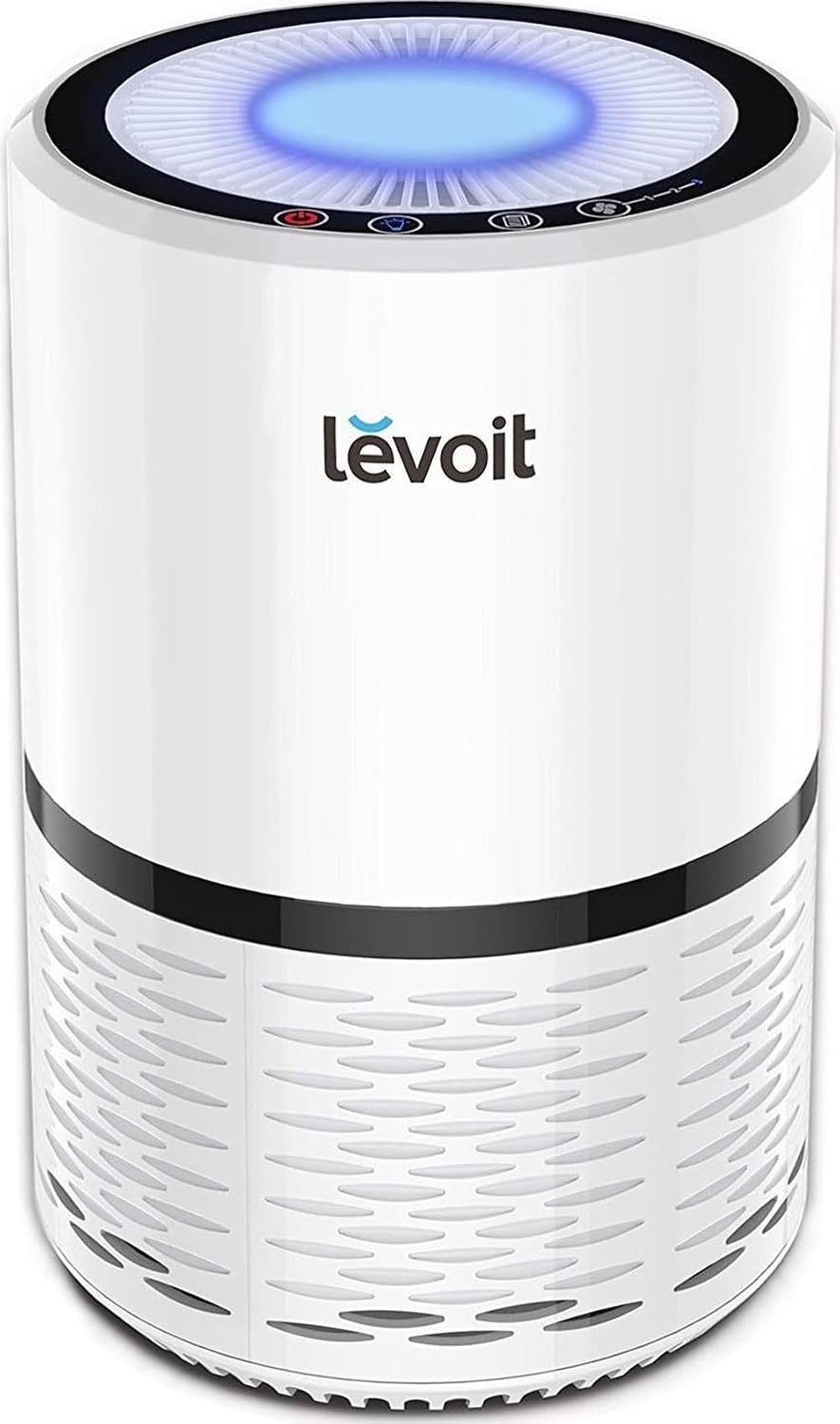
| Model | LV-H132 |
|---|---|
| Particle retention size | 0.3 micron |
| Noise level | as low as 28 dB |
| Filtration stages | 3-stage (pre, main, activated carbon) |
The Levoit LV-H132 is a small, straightforward air purifier built for bedroom or nursery use where low noise and simple maintenance matter. It pulls air through a three-stage system — pre-filter, efficient main filter, and activated carbon — which captures larger particles, fine particulates down to 0.3 micron, and common odors or VOCs. Operation is basic: three fan speeds and an optional night light let you balance cleaning power against quiet running, with noise levels reported as low as 28 dB on the lowest setting so it can run overnight without disturbing sleep. The unit is AHAM verified and carries ETL, FCC, and CARB listings, which supports its performance and safety claims. Its compact footprint fits small rooms but also means coverage is limited compared with larger models, and replacement filters are a recurring cost; the manufacturer recommends genuine LV-H132 filters for best results. If you want a simple, proven purifier for a nursery that emphasizes quiet operation and certified performance, this model delivers those basics in a compact package.
Best for: Parents or caregivers who prioritize a quiet, certified air cleaner for a small nursery or bedroom and value proven performance and strong user feedback.
Less Ideal for: Families needing high-capacity cleaning for large or open-plan spaces should choose a larger purifier with greater CADR and room coverage.
- Three-stage filtration including activated carbon for odors and VOCs
- Runs quietly down to about 28 dB suitable for overnight use
- AHAM verification and multiple safety certifications support stated performance
- Compact footprint fits small rooms and bedside placement
- Designed for small rooms so it may not clean large nurseries effectively
- Requires periodic replacement filters which add ongoing cost
Verdict: A compact, quietly running, AHAM-verified purifier that is a practical choice for keeping nursery air cleaner night and day.
VOOPNU HEPA Air Purifier DH-JH12

| Filter type | H13 True HEPA + activated carbon |
|---|---|
| Coverage | Up to 1,076 ft² (manufacturer claim) |
| Noise level | 22 dB (low) |
The VOOPNU DH-JH12 is a small, easy-to-use air purifier designed for continuous home use and marketed for rooms up to roughly 1,076 square feet. It draws air through a 360 degree intake and passes it through an H13 true HEPA multi-layer filter and activated carbon stage to capture common particles, pet hair, odors, pollen, and smoke. Controls are simplified to a basic panel with three fan speeds, a timer, and a quiet low setting that runs as low as 22 dB, making it suitable for bedrooms or nurseries where sleep noise matters. It also includes a small essential oil tray if mild scenting is wanted. Certifications listed include DOE, ETL, FCC, CARB, CE, and ROHS, which support safety and emissions expectations. Limitations to note are the compact footprint that suggests lower airflow compared with larger room purifiers despite the stated coverage, and replacement filters are recommended every 3–6 months depending on use and air quality. Continuous operation is recommended to maintain best results.
Best for: Parents and caregivers who prioritize low-noise, certified filtration and want a simple, low-maintenance purifier for a nursery or bedroom where quiet continuous operation and basic odor removal are needed.
Less Ideal for: Homes that require heavy-duty continuous filtration for very large open-plan areas or severe smoke and allergen loads should choose a higher-CADR, larger purifier instead.
- H13 true HEPA filtration plus activated carbon for particle and odor removal
- 360° intake design for more even air capture from the room
- Very quiet low-speed operation (around 22 dB) suitable for sleep or nursery use
- Simple controls and timer make it easy to run continuously without fuss
- Multiple safety and emissions certifications (ETL, CARB, DOE, FCC, CE, ROHS)
- Stated coverage (up to 1,076 sq ft) may be optimistic for continuous high-efficiency cleaning in large open areas given the unit’s compact size
- Essential oil tray can introduce scents that some infants or sensitive people may not tolerate
Verdict: A compact, certified HEPA purifier built for quiet, continuous nursery or bedroom use where low noise and straightforward operation are top priorities.
Choosing the Right Air Purifier for Nurseries: Key Factors to Consider
Filtration Type and Particle Capture
True HEPA filtration captures at least 99.97% of particles down to 0.3 microns, which matters for removing common nursery irritants such as dust, pet dander, and many respiratory aerosols.
Some units add an activated carbon stage to reduce odors and volatile organic compounds from paints, cleaners, or off-gassing furniture. Look for a clear description of the filter stages and whether the HEPA element is genuine rather than a generic "HEPA-like" claim.
Room Size and CADR
Clean air delivery rate, or CADR, is the measurement that links purifier capacity to real room size. Choose a purifier whose recommended coverage matches or slightly exceeds the nursery square footage for multiple air changes per hour.
Undersized purifiers will run continuously and may fail to reduce particle concentrations adequately, while oversized units can create unnecessary noise and energy use for small rooms.
Noise Output During Sleep
Infants and toddlers are sensitive to ambient noise, and loud fans can disrupt sleep. Check measured or manufacturer-stated decibel levels at low and medium fan speeds, and prioritize units with a 'sleep' mode that reduces fan speed and indicator light brightness.
White-noise–style airflow can be helpful, but abrupt changes in speed, loud boost modes, or noisy motors are problematic during overnight use.
Safety Features and Design
Nursery equipment should minimize hazards. Choose purifiers with stable bases, guarded intakes and outlets, and no exposed heating elements or high-voltage plates. Child-lock functions, recessed controls, and tamper-resistant filter doors reduce the chance of curious hands accessing internal components.
Consider placement safety too: low-tip designs and models that can be wall-mounted or placed out of reach help keep cords and units away from crawling infants.
Filter Replacement Frequency and Cost
Filters are consumables. Understand the expected lifetime of pre-filters, HEPA elements, and carbon cartridges under continuous nursery use. More frequent replacements increase running cost and maintenance time.
Also check how easy filters are to source and swap. Tool-free access and clear replacement indicators reduce the chance that a purifier runs with a clogged or missing filter, which hurts performance.
Energy Use and Continuous Operation
Nursery purifiers often run 24/7. Energy-efficient fans and motors reduce electricity draw and heat generation. Look for low-watt sleep modes or Energy Star ratings where applicable.
Lower energy use also means less wasted heat in small rooms, which helps maintain comfortable sleep temperatures for infants and reduces overall household energy costs.
Positioning the Purifier in a Nursery
Placement affects performance more than many buyers expect. For best results, put the purifier where airflow is not obstructed by curtains, furniture, or the crib. Aim to elevate smaller tabletop units a few feet off the floor so return and supply flows are less impeded by floor-level dust.
Keep the intake at least a few inches from walls and avoid corners where air circulates poorly. If you plan to run white-noise machines or humidifiers in the same room, leave space between devices to prevent interference with airflow and to reduce combined noise.
Consider cord management and outlet placement. Do not drape cords across crib rails or within reach of small children. Use outlet covers and secure cords to baseboards where possible.
- Center or offset the unit in the room rather than tucking it into a corner
- Avoid placing directly behind heavy drapes or furniture
- Position intake at baby breathing height when feasible
Understanding Filter Indicators and Maintenance Reminders
Many modern purifiers include electronic indicators for filter life, often based on runtime or airflow sensors. Treat these as helpful cues, not absolute guarantees. Check filters visually if the room still smells or if particles seem to persist despite indicator status.
Routine cleaning of pre-filters and vacuuming around the unit extends the life of primary filters. Keep a small schedule for filter checks, for example monthly for pre-filters and quarterly for HEPA inspections in higher-pollution environments.
- Reset filter timers only after the filter is actually replaced
- Vacuum exterior grilles monthly to maintain airflow
- Store replacement filters in a dry place so they are ready when needed
Balancing VOC Control and Particle Removal
Activated carbon stages remove many common odors and volatile organic compounds that can come from cleaners, paints, and new furniture. If the nursery has frequent odor sources, prioritize a model with a robust carbon stage in addition to HEPA.
Keep in mind that carbon cartridges become saturated and require replacement, sometimes more often than HEPA elements. If VOCs are not a primary concern, a strong HEPA-only setup can still provide significant health benefits by removing particles that trigger allergies and respiratory irritation.
- Use carbon filters where off-gassing or strong odors are present
- Combine ventilation with filtration for best VOC reduction
- Replace carbon cartridges proactively in odor-prone rooms
Power Use, Timers, and Smart Controls
Smart features can improve convenience in a nursery. Timers, app control, or integration with a home automation system let you schedule lower overnight speeds and higher daytime cleaning cycles. Some units adjust fan speed based on built-in air-quality sensors.
However, smart features add complexity. Prioritize firmware stability and intuitive controls over novelty. Ensure that night modes truly reduce display brightness and sound, and that schedules do not inadvertently switch the purifier to a louder setting at night.
- Use timers to run higher speeds when the nursery is empty
- Confirm night mode dims indicators and reduces fan noise
- Prefer reliable, simple scheduling over many rarely used smart features
When to Combine Filtration with Other Measures
Air purifiers reduce airborne particles but do not address all indoor air issues. For mold or moisture problems, fix the source and control humidity with proper ventilation or a dehumidifier where needed. For strong VOC sources, increase ventilation and limit exposure while the purifier helps lower concentrations.
Regular cleaning, washing bedding, and vacuuming with a HEPA-equipped vacuum complement a nursery air purifier. These actions reduce the load on filters and help maintain the highest air quality for infants.
- Address moisture and mold before relying solely on filtration
- Use a HEPA vacuum and frequent dusting to reduce airborne load
- Ventilate after painting or using strong cleaners even with a purifier running
How We Chose the Best Air Purifier for Nurseries
We focused on features and performance metrics that matter in a nursery setting. Key evaluation points included filtration effectiveness against particles and VOCs, measured or reported CADR and true HEPA filtration, and verified low-noise performance at settings intended for sleeping infants. We also prioritized safety and usability: child-safe designs, lack of exposed heating elements, simple controls or remote/timer functions for overnight use, and ease of maintenance like accessible filters and clear replacement indicators. Power consumption and energy-efficiency were considered because units often run continuously in a nursery. We excluded devices that rely primarily on ionization without adequate particle capture, and units with high operating noise or known safety concerns. We did not include large commercial-grade purifiers unsuitable for a small bedroom, nor single-purpose dehumidifiers or fans. Final selections balance clean-air performance, quiet operation, and features that reduce daily upkeep for caregivers.
Our full evaluation process is outlined in our review methodology.
FAQ
How loud should an air purifier be in a nursery?
A good nursery purifier runs quietly at night, typically below conversational levels. Look for sleep-mode noise ratings or measured decibel numbers and test at the lowest setting to confirm it will not disturb infant sleep.
Do I need a purifier with a carbon filter for my nursery?
Carbon filters are useful if the nursery has odors, new furniture, or frequent use of cleaners that produce VOCs. If odors are minimal, a strong HEPA filter will still reduce allergens and particles that affect respiratory health.
How often should I replace filters in a nursery purifier?
Replacement intervals vary by use and pollution levels. Pre-filters may need cleaning monthly, while HEPA and carbon filters often last several months to a year. Follow manufacturer guidance and replace sooner if performance drops or odors persist.
Can I run the purifier all night in a baby room?
Yes. Continuous operation is common and helps maintain steady air quality. Choose an energy-efficient unit with a sleep mode and low-noise operation designed for overnight use.
Where should I place the purifier in relation to the crib?
Place the purifier where airflow is unobstructed and not directly blowing into the crib. Maintain a safe distance from the crib and keep cords out of reach. Elevating smaller units slightly can help distribute cleaned air more evenly.
Final Verdict
Prioritize a purifier that combines genuine HEPA filtration with proven low-noise performance and safe, child-focused design. Match capacity to the nursery size, and factor in filter replacement cadence and energy use for continuous operation. Balancing filtration effectiveness, nighttime quiet, and straightforward maintenance will give you the best outcome for infant health and sleep. Focus on those tradeoffs to pick a unit that delivers clean air without adding disruption to the nursery environment.