
Note: This article contains affiliate links. If you click on these links and make a purchase, we may earn a small commission at no extra cost to you. This helps support our research and content. Read our full affiliate disclosure here.
If you live with persistent cooking smells, pet odors, or musty air, the right air purifier for odor elimination can make your home feel fresher and healthier. You want a unit that captures odor-causing particles and gases quickly without being loud or high-maintenance. This guide shortlists seven top-performing air purifiers chosen for strong odor control, reliable room coverage, and practical upkeep. Below are our top picks, followed by clear buying factors and practical advice to help you match a purifier to the size of your space, the kinds of smells you face, and how much maintenance you are willing to do.
Top Picks at a Glance
| Best Overall The best all-around choice for most situations | Levoit Core 300-P |  |
| Best Quality Built to a higher standard if you want something more solid | Winix 5510 Air Purifier |  |
| Best Value The sweet spot between price and what you get | MOOKA B-D02L Air Purifier |  |
| Best Budget The cheapest option that still gets the job done reliably | FULMINARE H13 True HEPA Air Purifier |  |
| Top Rated A top-rated pick with lots of positive feedback | ECOSELF HAP603 Air Purifier |  |
| Most Popular A crowd favorite that many people choose with confidence | Levoit Core Mini-P |  |
| Best Seller A high-volume bestseller chosen again and again | VOOPNU HEPA Air Purifier DH-JH12 |  |
Levoit Core 300-P

| Power Source | Corded Electric |
|---|---|
| Filter Type | 3 in 1 Filtration |
| Noise Level | 24 db |
| Wattage | 56 watts |
| Particle Retention Size | 0.3 micron |
The Levoit Core 300-P is a small, user-friendly air purifier built around a three-stage filtration system that targets dust, pollen, pet dander, smoke, and household odors. It uses a high-torque 56W motor and delivers solid CADR numbers for smoke, dust, and pollen, making it suitable for bedrooms, living rooms, or home offices; the unit refreshes air in a 222 ft² room multiple times per hour and can handle larger open areas at a lower turnover rate. Controls are touch-based and include a near-silent Sleep Mode that drops noise to about 24 dB and turns off display lights for undisturbed overnight use. The purifier is AHAM verified and certified to U.S. safety and emissions standards, and Levoit recommends using its genuine replacement filters for consistent performance. Trade-offs are its lack of Auto Mode or smart connectivity on this model, so you must manually adjust fan speeds, and filter replacements are a recurring cost. For buyers who want straightforward, effective odor and particle removal with very quiet operation, the Core 300-P is a practical choice.
Best for: Buyers wanting a balanced, dependable purifier that quietly removes smoke, pet and household odors, and fine particles in bedrooms or living spaces without needing smart features.
Less Ideal for: Users who need built-in smart controls, automatic air-quality sensing, or whole-house centralized purification should consider other solutions.
- Three-stage HEPA-grade filtration that captures 0.1–0.3 μm particles and reduces smoke and odors
- AHAM verified CADR performance for smoke, dust, and pollen with measurable room refresh rates
- Very quiet Sleep Mode with display lights off for overnight use
- Compact, portable footprint and safe certifications (ETL, CARB) for home use
- No Auto Mode or smart connectivity on this model so fan speeds must be adjusted manually
- Requires periodic replacement of proprietary filters to maintain rated performance
Verdict: Choose the Core 300-P if you want a compact, AHAM-verified purifier that reliably reduces odors and fine particles while running almost silently.
Winix 5510 Air Purifier

| Model | 5510 |
|---|---|
| AHAM verified coverage | 1882 sq ft/hr |
| Particle capture | Down to 0.01 microns |
| Noise (lowest mode) | 23.5 dB |
| Connectivity | WiFi, Alexa, Google Home |
The Winix 5510 is a 4-stage air purifier designed for large rooms and focused on removing fine particles and household odors. It combines a washable pre-filter, True HEPA filter that captures particles down to 0.01 microns, and an advanced deodorization carbon filter to reduce VOCs, smoke, cooking smells, and pet odors. Built-in smart sensors and an AQI indicator let the unit run in Auto Mode, adjusting fan speed as air quality changes, while Sleep Mode drops noise and power use when the room is dark. The unit is AHAM verified for large-room coverage and is compatible with the Winix Smart App and voice assistants for remote control. Practical benefits include strong CADR-style performance for rapid room cleaning and a washable pre-filter that helps extend main filter life. Limitations are the need for periodic replacement of the HEPA and carbon filters and the footprint typical of higher-capacity purifiers, which may be overkill for small bedrooms or offices.
Best for: Buyers who prioritize fast, proven odor and particle removal in large living spaces and want automatic, app-enabled control to keep air quality low-effort.
Less Ideal for: Those who need a compact, low-cost purifier for a single small bedroom or who prefer a unit with minimal ongoing filter maintenance.
- Four-stage system with True HEPA for very small particle capture
- Advanced carbon deodorization filter for VOCs, smoke, and pet odors
- Smart sensors with Auto Mode and visible AQI indicator for hands-off operation
- Washable pre-filter that reduces maintenance cost and prolongs HEPA life
- App and voice assistant compatibility for remote monitoring and control
- Higher-capacity design is larger and may be unnecessary for small rooms
- HEPA and carbon filters require periodic replacement to maintain performance
Verdict: If you need a smart, high-capacity purifier that actively reduces odors and microscopic particles in large rooms, the Winix 5510 delivers reliable, automated performance.
MOOKA B-D02L Air Purifier
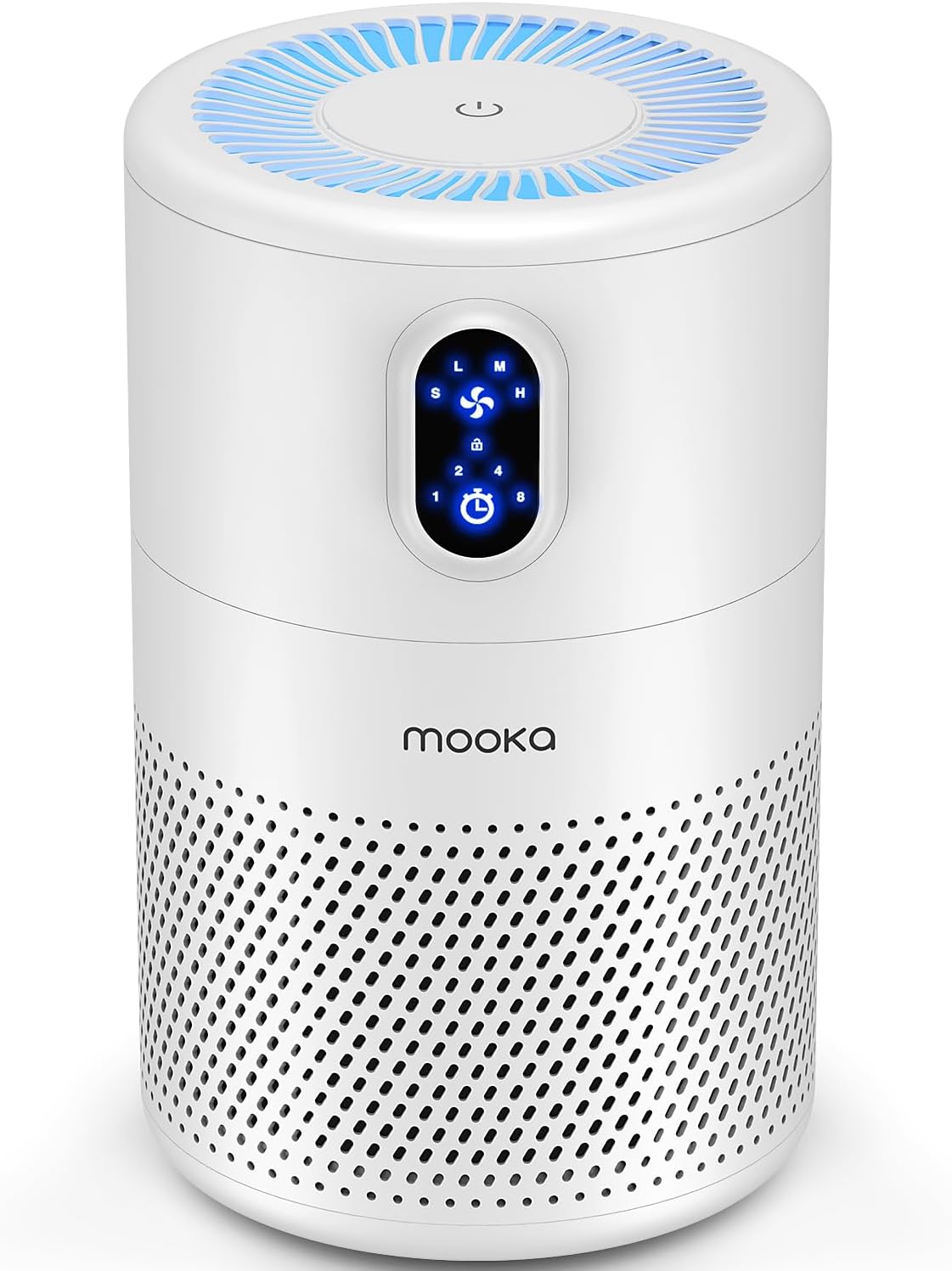
| HEPA Filter | H13 HEPA |
|---|---|
| Effective Area | 1076 sq ft |
| Filter Lifespan | 3-6 months |
The MOOKA B-D02L is a tabletop air purifier built around an H13 true HEPA filter plus an activated carbon stage to tackle smoke, pet dander, pollen, dust and common household odors. It is sized and rated to cover up to roughly 1,076 sq ft (with lower air changes in the largest rooms) and offers four fan speeds, four timer settings, a child lock, and a soft night light. In everyday use the unit is straightforward: place it in a living room or bedroom, choose a fan speed or timer, and let the brushless motor run quietly—MOOKA cites noise as low as 20 dB on sleep mode—while the combo filter captures particles down to 0.3 microns and the carbon layer helps reduce smells. Maintenance is simple but recurring: replace the filter every 3 to 6 months depending on use. The purifier is energy efficient and includes a filter reminder, but buyers should expect the usual limits of a single-room unit—it will take longer to clear very large open areas and filters are a consumable cost.
Best for: Buyers who want a practical, easy-to-use purifier that balances strong particle filtration with odor reduction and low operating noise for everyday home rooms.
Less Ideal for: Homes needing whole-house air cleaning or rapid clearance of heavy smoke or extreme odors should consider more powerful or multiple-unit solutions instead.
- H13 true HEPA plus activated carbon filters capture particles to 0.3 microns and reduce common odors
- Covers large rooms up to the listed 1,076 ft² with multiple fan speeds for faster air changes in smaller areas
- Very quiet brushless motor with a low-noise sleep mode suitable for bedrooms
- Simple controls including timers, child lock, and a filter-replacement reminder
- Replacement filters need changing every 3–6 months, creating ongoing maintenance cost
- Single-unit performance slows in very large open-plan spaces despite the high coverage rating
Verdict: Choose the MOOKA B-D02L if you want a quiet, efficient room purifier that combines true HEPA filtration with activated carbon to reduce both particles and everyday household odors.
FULMINARE H13 True HEPA Air Purifier

| Filter type | H13 HEPA |
|---|---|
| Recommended room size | up to 215 sq ft / 20 m² |
| Noise level (low) | around 24 dB |
| Power | plug-in (no battery) |
The FULMINARE H13 is a small bedroom/office air purifier that combines an H13 True HEPA filter with a 360 degree outlet and dual-channel circulation to refresh air in spaces up to about 215 sq ft. It is straightforward to use: plug it in, remove the filter packaging, pick a fan speed or sleep mode, and set one of five timer options. The unit advertises very low noise at the lowest setting, making it suitable for light sleepers, and the built-in night light offers a soft glow for kids or bedrooms. Practical benefits include effective particle capture from pets, smoke, and general odors when used in the manufacturer recommended room size, plus portability so you can move it between rooms. Limitations are its small-room coverage — you will need a larger or additional unit for open-plan areas — and replacement filters should be changed on a regular schedule to maintain performance. The design is simple with plug-in power and no battery operation, so it is best as a stationary bedside or desktop purifier rather than a truly mobile device.
Best for: Home users looking for an affordable, simple-to-use purifier for a bedroom, nursery, or small office who prioritize quiet operation and basic odor and particle removal.
Less Ideal for: People needing whole-home or large open-plan odor elimination or those who want smart features and battery-powered portability.
- H13 True HEPA filter captures fine particles including pet dander and smoke
- 360° air outlet with dual-channel circulation refreshes air in rooms up to about 215 sq ft
- Very quiet sleep mode suitable for bedrooms with reported noise around 24 dB
- Built-in night light and multiple timers for flexible overnight use
- Coverage limited to small rooms, not intended for large open-plan spaces
- Requires regular filter replacements to sustain filtration performance
Verdict: A budget-friendly bedroom purifier that quietly reduces particles and common odors in small rooms with an H13 HEPA filter.
ECOSELF HAP603 Air Purifier

| Coverage | Up to 2400 ft² |
|---|---|
| Filter type | H13 True HEPA (multi-stage) |
| Noise level | 22 dB (Sleep Mode) |
| Sensor | PM2.5 display with infrared sensor |
The ECOSELF HAP603 is built to clean large living spaces by combining a True HEPA H13 filtration stage with a 2X-power circulation design and a PM2.5 sensor that drives an auto mode. In everyday use it sits on the floor and continuously monitors air quality, automatically raising fan speed when particles or odors increase and returning to a whisper-quiet 22 dB sleep mode at night. The unit also includes a timer, fan speed steps, child lock, an aroma tray for light scenting, and a filter indicator to simplify upkeep. For odor control it targets smoke, pet smells, and general household odors by cycling room air more frequently and using activated carbon in the multi-stage filter (manufacturer recommends genuine replacement filters for best results). Trade-offs are that effective coverage claims are high—real performance will depend on room layout and source intensity—and replacement filters are a recurring expense if you run the unit constantly.
Best for: Buyers who prioritize consistent, monitored air cleaning for large living areas and want an appliance that runs quietly overnight while automatically responding to changing air quality.
Less Ideal for: People who need a portable or very compact purifier for small rooms, or those seeking an ultra-low-cost unit without ongoing filter expenses.
- True H13 HEPA filtration combined with 2X circulation for frequent air changes in large rooms
- PM2.5 display and infrared sensor enable automatic speed adjustment based on measured air quality
- Very quiet 22 dB sleep mode suitable for nighttime use
- Aromatherapy tray adds mild scenting while purifying
- Onboard features like timer, lock, and filter indicator simplify daily operation and maintenance
- 2400 ft² coverage is an idealized figure and may not match real-world layout or heavy odor sources
- Requires proprietary replacement filters to maintain rated performance, adding ongoing cost
Verdict: Choose the HAP603 if you need a quiet, sensor-driven purifier built to handle odors and particulates across very large rooms with frequent air turnover.
Levoit Core Mini-P
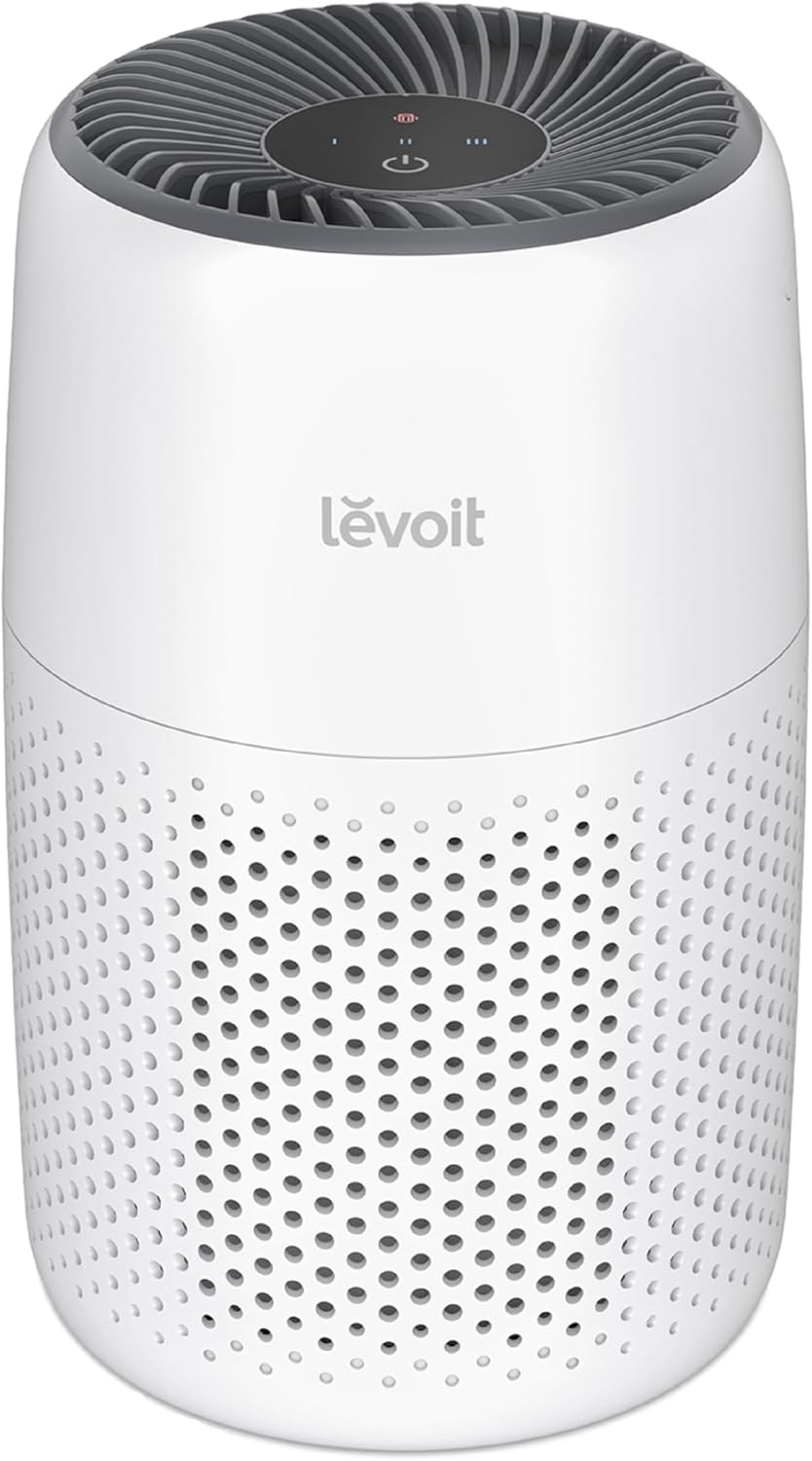
| Rated Power | 7W |
|---|---|
| Noise Level | 27–45 dB |
| Power Adapter Input | 100–240V, 50/60 Hz |
The Levoit Core Mini-P is a small, plug-in air purifier built for desktops, bedrooms, and other tight spaces where odors, pet dander, and dust are a nuisance. It uses a pre-filter and main filter to trap lint, hair, smoke particles, and fine airborne pollutants and includes a small fragrance sponge for light aromatherapy. Practical features include a sleep mode and an auto-off display for low-interruption nighttime use, and the unit runs quietly at 27–45 dB which keeps it unobtrusive in bedrooms or offices. With a rated power of 7W and a universal 100–240V adapter stored inside, it is energy efficient and easy to place anywhere with an outlet. Limitations are its small coverage area—this is meant to improve air locally rather than replace whole-room systems—and the fragrance sponge requires careful dosing to avoid damaging plastic components. Replacement filters and correct maintenance are necessary to maintain performance over time.
Best for: Buyers who prioritize proven performance and social proof over experimental features and want a quiet, compact purifier to reduce odors and visible particles in a personal space.
Less Ideal for: People seeking whole-room odor elimination or high CADR performance for large living areas should choose a larger, higher-capacity purifier instead.
- Compact footprint fits on desks and nightstands
- Quiet operation (27–45 dB) suitable for sleep or focused work
- Includes pre-filter and main filter to capture pet dander, dust, and smoke
- Low power draw (7W) and wide input voltage for flexible placement
- Aromatherapy sponge provides light odor masking when used sparingly
- Not intended to purify large rooms or open-plan living areas
- Aromatherapy sponge can overflow if overfilled and may damage plastic parts
Verdict: Choose the Levoit Core Mini-P if you need a quiet, energy-efficient tabletop purifier that reliably reduces odors and airborne particles in small personal spaces.
VOOPNU HEPA Air Purifier DH-JH12

| Coverage (claimed) | Up to 1,076 ft² |
|---|---|
| Filtration | H13 True HEPA triple-layer |
| Noise | 22 dB (low) |
The VOOPNU DH-JH12 is a small, user-friendly air purifier built around an H13 True HEPA triple-layer filter and a 360 degree intake to capture particles, pet hair, pollen, smoke, and common odors. It is intended for continuous use in living rooms, bedrooms, or pet areas where steady odor reduction and particulate removal are needed; laboratory claims show it can clean 250 ft² every 15 minutes. Controls are simple with three fan speeds, a timer, and a quiet low setting that the brand rates as low as 22 dB, making it suitable for overnight operation. A built-in tray accepts a few drops of essential oil for scenting while filtering. The unit carries multiple certifications (DOE, ETL, FCC, CARB, CE, ROHS) which supports its compliance with common safety and performance standards. Expect regular filter replacements on a roughly 3–6 month cadence depending on use and indoor pollution; the purifier's small footprint makes placement flexible but also indicates a compact fan and motor that may be less powerful than larger, high-CADR machines for heavy, persistent odors in very large open-plan spaces.
Best for: A cautious buyer who prioritizes certified performance, quiet overnight operation, and straightforward controls for maintaining cleaner air and reducing everyday odors in bedrooms, small living rooms, or pet areas.
Less Ideal for: Not the best choice for customers needing maximum odor removal in very large open-plan spaces or for industrial-strength smoke and heavy cooking odors where a higher-CADR, larger unit is required.
- H13 True HEPA triple-layer filter captures 99.97% of fine particles.
- 360° air intake for more even room circulation.
- Quiet operation down to 22 dB suitable for bedrooms and overnight use.
- Simple controls and timer make it easy to run continuously.
- Certified to multiple safety and emissions standards (CARB, ETL, DOE, FCC, CE, ROHS).
- Compact form factor limits raw airflow compared with larger, higher-CADR purifiers.
- Filter replacement recommended every few months which adds to operating cost.
- Essential oil tray can introduce particles or residues that may require cleaning.
Verdict: Choose the VOOPNU DH-JH12 if you want a compact, certified HEPA purifier that quietly reduces household odors and particles with simple, no-fuss operation.
Choosing the Right Air Purifier for Odor Elimination: Key Factors to Consider
Activated Carbon Capacity and Quality
Activated carbon is the primary material that adsorbs volatile organic compounds and many common household odors. Carbon works by trapping gases on its porous surface, so a larger bed of quality carbon generally provides stronger and longer-lasting odor reduction. Look for specifications that describe carbon weight or density rather than vague claims of "odor control." A thin carbon coating on a filter will not perform as well as a substantial carbon layer or dedicated carbon canister.
Carbon quality also matters. Some carbon is treated with additional chemistries to target specific gases such as formaldehyde or sulfur compounds. If you frequently deal with particular smells like smoke or pet urine, consider units that specify the carbon treatment or offer replaceable carbon canisters sized for your room.
Clean Air Delivery Rate and Real Room Coverage
CADR measures how quickly a purifier reduces airborne particles in a room, and when paired with manufacturer room-size guidance it indicates whether a unit can cycle the air often enough to noticeably reduce odors. For odors, more frequent full-room air exchanges help remove scent molecules faster, so choose a purifier with CADR suitable for your actual room dimensions rather than nominal square footage.
Also consider placement and airflow paths. A unit rated for a large room will still underperform in obstructed layouts or rooms with poor circulation. Think about how the purifier will be positioned relative to odor sources and seating areas to ensure the airflow carries contaminated air into the intake.
Particle Filtration Versus Gas Adsorption
HEPA filtration is excellent at removing particles that can carry odor compounds, such as smoke residue or pet dander, but HEPA alone will not remove gaseous odors. Effective odor elimination typically requires both HEPA for particulates and activated carbon or other adsorbents for gases. When evaluating options, check that the purifier pairs a true HEPA-grade particle filter with a substantive gas-adsorbing stage.
If a model emphasizes only particle removal or uses an unquantified "odor filter," treat those claims cautiously. Performance for odors depends on the combined effectiveness of both filter types.
Noise Levels and Usability During Daily Life
A high-speed fan will clear odors faster but can be disruptive in living rooms and bedrooms. Noise characteristics matter because many people run purifiers overnight or while relaxing. Look for published decibel ratings at different fan speeds and consider whether the purifier has a quiet or sleep mode that still provides adequate air exchange for odor control.
Usability features such as an auto mode driven by smell or VOC sensors, easy-to-read indicators for filter life, and simple control interfaces reduce friction. If a unit is difficult to operate, it is less likely to get used at the settings needed to control smells.
Filter Life, Replacement Ease, and Operating Cost
Filters that need frequent replacement increase long-term costs and the likelihood that you will run the purifier on reduced settings. Evaluate typical filter lifespans, what conditions shorten that life, and how easy it is to replace filters. Some units provide separate replaceable carbon modules so you can change only the spent carbon rather than the whole filter assembly, which can lower costs.
Also consider whether replacement parts are commonly available and whether the design makes filter swaps straightforward. Units with transparent filter compartments or easy-release latches simplify maintenance and encourage regular servicing.
Sensor Accuracy and Control Modes
Automatic control driven by accurate sensors helps maintain odor control without constant manual adjustments. Look for purifiers that use reliable VOC or particulate sensors and that clearly indicate when elevated odor levels are detected. Good auto modes will boost fan speed when needed and reduce it when air quality improves, balancing odor removal and noise.
Some units let you set timers or link to smart-home systems for scheduled operation. While not essential, these features make it easier to run purifiers in a way that matches daily routines and peak odor times such as cooking periods.
How Odors Travel and What Purifiers Can Do
Odor molecules are gases or volatile particles that disperse through the air and cling to fabrics and surfaces. A purifier does not instantly erase smells on carpets or upholstery, but it reduces airborne concentrations so fewer molecules reattach to surfaces and so smells become less perceptible over time.
For persistent odors, combine purifier use with source control and surface cleaning. A purifier accelerates recovery by continuously removing airborne odorants, which helps prevent the room from smelling as strongly between cleanings.
- Odors originate from particles and gases; both need addressing for full effect
- Purifiers lower airborne odor concentration but do not deep-clean fabrics
- Placement near the odor source speeds removal
Placement Tips to Maximize Odor Reduction
Position the purifier so its intake faces the likely path of odorous air. In a kitchen, that might be closer to the cooking surface or an open doorway. In a living room, place it near where pets spend time or near entry points for outdoor smells.
Avoid tucking the purifier into a corner or behind furniture where airflow will be restricted. Small adjustments in placement often yield bigger improvements than upgrading to a larger unit.
- Keep several feet clearance from walls for unobstructed intake and exhaust
- Place on a firm, level surface rather than on soft furnishings
- Consider multiple smaller units for open-plan homes rather than one oversized unit
When to Run at High Fan Speeds and When to Use Auto Modes
Run the unit on high when odors spike, such as during or immediately after cooking, smoke events, or strong pet odor episodes. High fan speeds increase air exchanges and get odor molecules to the carbon stage faster.
Use auto modes or lower steady settings for background control, especially overnight. A well-calibrated auto mode will increase speed temporarily when sensors detect elevated VOCs, then return to quieter operation once levels fall.
- Use high speed for rapid odor mitigation at source
- Auto mode balances noise and effectiveness for continuous use
- Sleep or quiet modes are useful but may not remove strong odors quickly
Maintaining Carbon Filters for Ongoing Odor Performance
Carbon filters can become saturated with odor molecules and lose effectiveness over time. Regularly inspect filters for heavy discoloration or odor transfer; some units provide change indicators based on hours run or sensed performance.
If your unit uses replaceable carbon canisters, swap those at the recommended interval and keep spare modules on hand if your home has frequent odor events. For integrated filter assemblies, replace the entire cartridge as suggested by the manufacturer to maintain consistent odor control.
- Keep a maintenance schedule to avoid saturated carbon
- Consider filter storage and disposal when planning replacements
- Check whether partial replacements are possible to reduce waste
Addressing Specific Odor Sources
Different odor sources sometimes require complementary steps. For cooking smells, use source ventilation and run the purifier during and after cooking. For pet odors, regular cleaning of bedding and litter areas combined with targeted purifier placement works best.
For smoke or strong chemical smells, expect to run the purifier at higher speeds for longer durations and to change filters more frequently. Persistent or embedded smells on fabrics may require shampooing or professional cleaning in addition to purification.
- Combine purifiers with source cleaning for best results
- Run continuous purification after high-odor events until levels normalize
- Seek additional remediation for smells that have penetrated fabrics or padding
How We Chose the Best Air Purifier for Odor Elimination
We evaluated candidates using measurable, appliance-relevant criteria to find air purifiers that actually reduce odors in real rooms. Key factors included filtration breadth, measured as the combination of activated-carbon capacity and particle filtration; clean air delivery rate and room coverage to ensure the unit can cycle air often enough for noticeable odor reduction; airflow design and fan speeds so the purifier moves contaminated air through filters efficiently without excessive noise; maintenance needs and filter life to estimate ongoing upkeep and operating cost; and convenience features such as programmable schedules, sensor-driven auto modes, and intuitive controls for everyday use. We excluded units that relied solely on ionization without substantive filtration, because those approaches do not consistently remove odor-causing gases. Units with insufficient carbon media relative to stated room size were also filtered out. The shortlist focuses on purifiers that pair effective gas adsorption with HEPA-grade particle removal, sensible airflow engineering, and realistic service intervals so the chosen models perform reliably in typical home environments.
Our full evaluation process is outlined in our review methodology.
FAQ
Can an air purifier eliminate pet odors completely?
Air purifiers can significantly reduce airborne pet odors, especially when they combine HEPA filtration with substantive activated carbon for gases. However, odors embedded in fabrics or pet bedding require cleaning; the purifier helps by lowering airborne odor levels but does not replace washing or vacuuming.
How often should I change carbon filters for odor control?
Filter life depends on usage and odor load, but many carbon modules need replacement every 3 to 12 months. Heavier odor exposures shorten lifespan. Follow the unit's guidelines and monitor performance; if smells return sooner, replace the carbon sooner.
Are ionizers or ozone generators good for removing smells?
Ionizers and ozone generators may reduce some odors in specific conditions but are not a reliable replacement for activated carbon plus HEPA filtration. Ozone can be harmful at elevated levels and is not recommended for regular home use. Choose mechanical filtration with carbon for consistent odor reduction.
Will a purifier help with cooking odors in an open-plan kitchen?
A purifier sized appropriately for the combined open area can reduce cooking smells, particularly if placed near the cooking zone. For best results, use alongside ventilation such as range hoods and run the purifier on higher settings during and after cooking.
Do bigger rooms require multiple purifiers for odor elimination?
Large or irregularly shaped rooms often benefit from multiple smaller purifiers placed strategically rather than a single large unit. Multiple units reduce dead zones and create more effective airflow paths to capture odors at their sources.
Final Verdict
Prioritize a purifier that combines true HEPA particle capture with a substantial activated carbon stage, sized to deliver frequent air exchanges for your room. Balance noise and run-speed: use higher speeds for active odor removal and dependable auto or quiet modes for continuous background control. Treat purifier selection as part of a broader odor-management plan that includes source cleanup, ventilation, and regular filter maintenance. Focus on filtration capability, CADR versus your actual room, and practical upkeep when choosing confidently.