
Note: This article contains affiliate links. If you click on these links and make a purchase, we may earn a small commission at no extra cost to you. This helps support our research and content. Read our full affiliate disclosure here.
If lingering cooking smells, pet odors, or musty air bother you, the right air purifier can make a noticeable difference. An air purifier for removing odors focuses on filtering and neutralizing volatile compounds and particulates that cause bad smells, not just dust. In this guide we shortlisted the top models that consistently perform well at scent reduction across typical home rooms. You will find options suited to different room sizes and noise preferences. We evaluated filtration systems, airflow and coverage, and ongoing maintenance needs to identify the best choices. Read on for concise buying guidance and practical tips before the product list.
Top Picks at a Glance
| Best Quality Built to a higher standard if you want something more solid | Coway Mighty AP-1512HH |  |
| Best Value The sweet spot between price and what you get | VOOPNU HEPA Air Purifier DH-JH12 |  |
| Best Budget The cheapest option that still gets the job done reliably | AromaRoom AP100-A Air Purifier |  |
| Top Rated A top-rated pick with lots of positive feedback | ECOSELF HAP603 Air Purifier |  |
| Most Popular A crowd favorite that many people choose with confidence | Levoit Core 300-P |  |
| Best Seller A high-volume bestseller chosen again and again | Levoit Core Mini-P |  |
Coway Mighty AP-1512HH

| Coverage | Up to 1,748 sq. ft. in 60 minutes |
|---|---|
| Filtration | Washable pre-filter, deodorization (carbon), bipolar device, HEPA |
| HEPA effectiveness | 99.97% of 0.3 μm particles |
| Modes | Auto and Eco modes with timer and filter indicator |
The Coway Mighty AP-1512HH is a tabletop air purifier built around a four-stage filtration system that combines a washable pre-filter, deodorization/activated carbon media, a bipolar ionizer, and a true HEPA filter to remove particulates and many odors. It is typically set in living rooms, kitchens, or shared spaces where continuous monitoring is helpful; the unit automatically adjusts fan speed in Auto mode based on the built-in pollution sensor and displays air quality with a colored LED. Practical benefits include strong particle removal (HEPA-rated for 0.3 micron at 99.97%), targeted VOC and odor reduction from the carbon/deodorization stage, and a filter indicator plus washable pre-filter to reduce maintenance cost. The unit covers up to about 1,748 sq ft for whole-room cleaning in an hour, yet is compact enough to sit on a table or shelf. Limitations are that persistent or very high VOC sources may need specialized filters or supplemental ventilation, replacement filters are required over time, and the bipolar ionizer may be a concern for buyers preferring only passive filtration technologies.
Best for: Buyers who prioritize fast, measurable odor and particle removal in living areas and want automatic operation with real-time feedback to keep indoor air visibly cleaner.
Less Ideal for: People needing industrial-strength chemical gas removal or continuous capture of very high VOC concentrations should consider dedicated gas-phase or commercial solutions instead.
- Multi-stage filtration including true HEPA for 99.97% of 0.3 μm particles
- Activated carbon/deodorization stage that reduces common household odors and VOCs
- Auto mode with real-time air quality sensor and visible LED indicator
- Washable pre-filter and filter-change indicator simplify upkeep and extend filter life
- Compact footprint while claiming large-room coverage (up to ~1,748 sq ft in 60 minutes)
- Does not include specialized filters for heavy industrial or chemical VOCs
- Replacement filters are consumables that add ongoing cost
- Ionizer feature may concern users who prefer strictly passive filtration
Verdict: Choose the Coway Mighty AP-1512HH when you want a compact, sensor-driven purifier that reliably reduces common household odors and particles in medium to large rooms.
VOOPNU HEPA Air Purifier DH-JH12

| Filtration | H13 True HEPA triple-layer |
|---|---|
| Coverage | Up to 1,076 ft² |
| Noise level | 22 dB (lowest) |
| Airflow | 360° surround intake |
The VOOPNU DH-JH12 is a small, user-friendly air purifier built around an H13 true HEPA multi-layer filter and 360 degree intake to capture fine particles, pet hair, and common odor sources. It is simple to operate with a minimal control panel, three fan speeds, and a timer, and it is quiet enough for bedrooms thanks to a low 22 dB claimed noise level. VOOPNU rates the unit to clean 250 ft² every 15 minutes and lists coverage up to 1,076 ft², which makes it suitable for single rooms or medium open-plan spaces where you want steady odor reduction. The purifier includes an activated carbon stage and an essential oil tray so you can add fragrance while it filters, and certifications such as CARB and ETL indicate compliance with safety and emissions standards. Limitations are its small physical footprint and implied need for continuous runtime to reach best results, and buyers should plan for periodic filter replacements since sustained odor removal depends on the carbon and HEPA media.
Best for: Buyers who want a compact, easy-to-use purifier that quietly reduces pet, smoke, and household odors in a single room or medium open space and prefer a straightforward, low-maintenance appliance.
Less Ideal for: Large homes or whole-house odor problems where multiple units or HVAC-integrated solutions would be more appropriate.
- H13 true HEPA filtration captures 99.97% of fine particles for cleaner air.
- 360° intake design promotes even room circulation and faster cleaning.
- Quiet operation down to 22 dB suitable for bedrooms and sleeping areas.
- Activated carbon stage and large coverage make it effective at reducing common household odors.
- Compact footprint and simple controls make placement and daily use easy.
- Best performance requires continuous long-term operation rather than short bursts.
- Filter replacements are necessary to maintain odor removal effectiveness.
Verdict: A compact, quiet HEPA purifier with carbon filtration that is a practical choice for steadily reducing household odors in single rooms or medium open-plan spaces.
AromaRoom AP100-A Air Purifier

| Filter type | True HEPA 13, 3-stage |
|---|---|
| Coverage | Up to 430 ft² (twice/hour air change claimed) |
| Noise level | 22 dB (sleep mode) |
The AromaRoom AP100-A is a small, budget-friendly air purifier designed for bedrooms, dorms, or offices where quiet operation and odor control matter. It pulls air through a 3-stage filtration stack with a True HEPA 13 element and a smoke-remover stage to capture fine particulates, pollen, pet dander, and many odor-carrying particles down to 0.3 microns. The unit uses a brushless motor with 360-degree intake and claims to refresh air about twice an hour in a roughly 430 ft² room, and its low 22 dB sleep mode makes it easy to run overnight. Practical extras include an aroma pad for adding essential oils and an RGB night light for ambiance. Expect straightforward maintenance: filter replacement every 3–6 months for steady performance. Limitations are its small footprint and modest coverage compared with larger room purifiers, so it is best for localized odor reduction rather than whole-house use, and aromatherapy may not remove strong chemical smells as effectively as dedicated activated-carbon heavy units.
Best for: Buyers looking for an inexpensive, quiet bedroom purifier that reduces common odors, smoke traces, and allergens while adding mild aromatherapy for personal spaces.
Less Ideal for: People who need heavy-duty odor removal for large open rooms, kitchens, or persistent chemical smells should choose a larger unit with substantial activated-carbon capacity instead.
- True HEPA 13 filtration captures particles down to 0.3 microns
- Includes a smoke-remover filter stage aimed at wildfire and smoke particulates
- Very quiet 22 dB sleep mode suitable for bedrooms
- Aroma pad lets you add essential oils for scent control and ambiance
- Limited coverage compared with larger purifiers so not ideal for open-plan or whole-house odor removal
- Aromatherapy pad provides scent but does not replace heavy activated-carbon odor absorption
Verdict: A compact, low-noise HEPA 13 purifier that delivers effective small-room odor and smoke reduction at a budget-friendly price.
ECOSELF HAP603 Air Purifier

| Coverage | Up to 2400 ft² |
|---|---|
| Filter type | H13 True HEPA + activated carbon |
| Noise level (sleep) | 22 dB |
| Air quality sensor | PM2.5 infrared sensor |
The ECOSELF HAP603 is built to clean air in large spaces by combining a True HEPA H13 filter, activated carbon layers, and a 2X power circulation system that the brand says can cover up to 2400 ft². It typically sits in a living room or open-plan area and runs in Auto/Smart mode using the PM2.5 sensor to adjust fan speed as air quality changes, or it can be set to manual fan speeds, a timer, or the ultra-quiet 22 dB sleep mode for night use. The unit includes an aromatherapy slot for light scenting and a filter indicator to remind you when to replace the genuine ECOSELF filter. In practice this model is strong on odor control because of the activated carbon stage and constant sensing, and the quiet operation makes it easy to leave running overnight. Expect routine filter replacements for continued performance and prioritize official replacement filters to match the factory filtration spec.
Best for: Buyers who prioritize dependable, sensor-driven odor and particle removal for large living areas and want a quiet, low-maintenance purifier they can set-and-forget.
Less Ideal for: People needing a compact bedside unit for a single small bedroom or those who want a purifier with heavy-duty industrial smoke handling beyond residential scope.
- True H13 HEPA filtration captures fine particles and allergens.
- Activated carbon stage and 2X circulation help reduce odors and smoke in large rooms.
- PM2.5 display and automatic Smart Mode adjust performance to real-time air quality.
- Very quiet 22 dB sleep mode suitable for night-time use.
- Filter indicator and multiple modes (timer, fan speeds, lock) simplify operation and upkeep.
- Requires periodic genuine replacement filters to maintain advertised performance.
- Coverage claim (up to 2400 ft²) may overstate real-world performance in heavily polluted spaces.
Verdict: Choose the HAP603 when you need a quiet, sensor-driven purifier that focuses on reliable odor and fine-particle removal in large rooms.
Levoit Core 300-P

| Power Source | Corded Electric |
|---|---|
| Filter Type | 3 in 1 Filtration |
| Floor Area | 1073 square_feet |
| Noise Level | 24 db |
| Wattage | 56 watts |
The Levoit Core 300-P is a small, user-friendly air purifier built around a three-stage HEPA-grade filter and a 56W motor that delivers up to 143 CFM CADR for fast air cleaning. It is typically used in bedrooms, living rooms, or offices to cut smoke, pollen, pet dander and household odors; the unit features touch controls, a timer, and a near-silent Sleep Mode that reduces noise to about 24 dB. Practical benefits include AHAM verification and certifications (CARB, ETL) that back the stated coverage and performance, and the filter claims 99.97% removal efficiency for 0.1–0.3 μm particles when using genuine Levoit filters. Limitations to consider are that Core 300-P lacks smart/auto modes found on other Core 300 variants so fan speeds must be set manually, and the listed coverage figures are tied to Levoit original filters and lab conditions so real-room results will vary with placement and room layout. The unit is portable and straightforward to maintain, but buyers should plan on periodic replacement filters for sustained odor and particle control.
Best for: Buyers who want a certified, quiet purifier that demonstrably reduces fine particles and common household odors and who value independent verification and wide positive user feedback.
Less Ideal for: People who need smart features, automatic air-quality sensing, or automated fan control for hands-off operation should consider models with built-in Auto Mode and app connectivity instead.
- Three-stage HEPA-grade filtration with 99.97% efficiency for 0.1–0.3 μm particles when using Levoit filters
- AHAM verified CADR ratings and safety certifications (CARB, ETL) that support performance claims
- Very quiet Sleep Mode at about 24 dB suitable for night use
- Compact, portable footprint that is easy to move between rooms
- Touch controls, timer, and filter indicator for simple operation and maintenance
- No smart connectivity or automatic mode on this P model so fan speeds are manual only
- Performance and coverage rely on using original Levoit filters and lab-tested conditions
Verdict: A compact, AHAM-verified HEPA purifier that reliably reduces odors and fine particles for buyers who prioritize proven performance and quiet night operation.
Levoit Core Mini-P
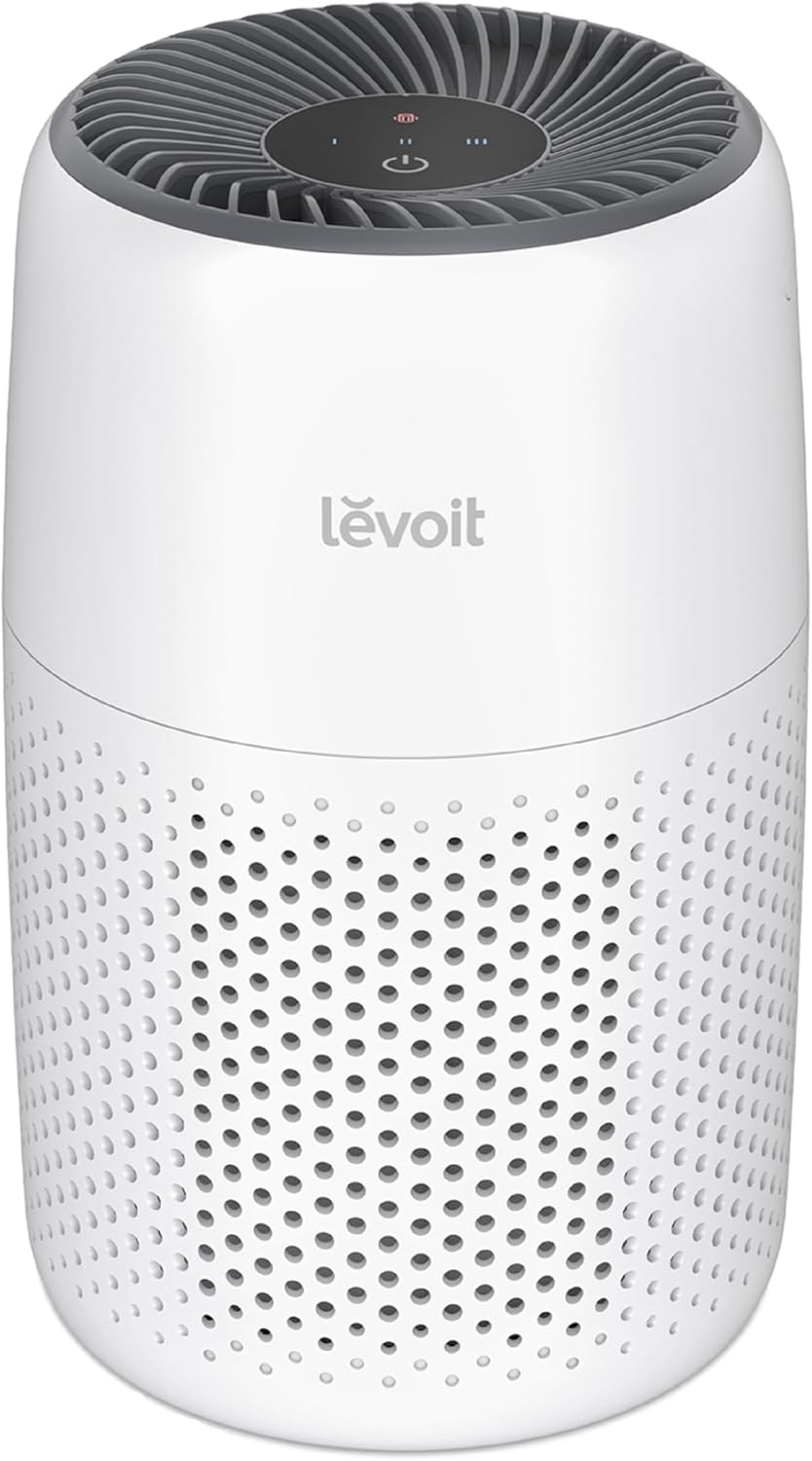
| Rated Power | 7W |
|---|---|
| Noise Level | 27–45 dB |
| Adapter Input | 100–240V, 50/60 Hz |
| Model | LAP-C161-WUS |
The Levoit Core Mini-P is a small desktop air purifier meant for bedrooms, offices, or kitchens where space is limited and continuous odor control is wanted. It uses a pre-filter plus a main high-efficiency filter to capture lint, hair, pet dander, fine particles and smoke, and includes an aroma sponge for light fragrance. The unit is AHAM-verified for cleaning performance and runs quietly in sleep mode, making it suitable for overnight use. It draws little power (listed rated power 7W) and has an auto-off display to reduce distractions. Practical benefits include simple placement on a desk or nightstand, low noise (27–45 dB range), and a user-friendly routine of replacing the Core Mini-P filter when needed. Limitations are inherent to its size: it is intended for small spaces only and will not move large-room air quickly, and the aromatherapy feature requires careful dosing to avoid overflowing plastic parts. The result is a discreet, energy-efficient purifier that tackles common household odors and airborne irritants in close-range settings.
Best for: Buyers who prioritize proven air-cleaning performance and quiet, low-power operation in small rooms and want a hassle-free, compact purifier for bedrooms, dorms, or desktops.
Less Ideal for: Those needing to purify large living rooms or whole-floor spaces should choose a higher-capacity unit built for larger square footage.
- AHAM-verified cleaning performance for reliable pollutant removal
- Compact footprint suitable for bedside or desktop placement
- Very low power draw (7W) for continuous use
- Quiet sleep mode operation (27–45 dB) minimizes disturbance
- Aroma sponge option adds light odor masking or pleasant scent
- Sized for small rooms only, not effective for large open areas
- Aromatherapy requires only 2–3 drops and can damage parts if overfilled
Verdict: A compact, AHAM-verified purifier that quietly reduces odors and common airborne particles in small rooms while using very little power.
Choosing the Right Air Purifier for Removing Odors: Key Factors to Consider
Filtration Technology and Adsorbents
A purifier's ability to remove odors depends on both particulate filtration and chemical adsorption. True HEPA filters capture smoke and airborne particles that can carry odor molecules, while activated carbon or other adsorbent media trap volatile organic compounds and gaseous smells.
Look for models that specify the type and quantity of adsorbent. More carbon weight or specialized media such as impregnated carbons and catalytic coatings often perform better on stubborn smells. Filtration alone may reduce particulates but will not fully neutralize many odor-causing gases unless paired with effective adsorption.
Airflow Rate and Room Coverage
Even the best filters cannot remove odors if the purifier cannot process enough air. Check the clean air delivery rate and recommended room size to confirm the unit can provide multiple air exchanges per hour for your space.
Higher airflow is important in kitchens, entryways, or rooms with frequent odor sources. For bedrooms or living rooms where quiet operation matters, consider whether the purifier can maintain adequate circulation at lower fan speeds or use a schedule to run stronger cycles when needed.
Noise and Placement Considerations
Because odor control often requires continuous or long-run operation, noise matters. A unit that is loud at effective fan speeds will be turned down or off, reducing its usefulness. Evaluate published decibel ratings and whether the manufacturer lists sound levels at multiple fan speeds.
Placement also impacts perceived noise and performance. Positioning near the source of odors improves effectiveness and may allow using lower overall fan speeds. Measure how the unit performs in the space you plan to use it in rather than relying solely on specs.
Maintenance Frequency and Filter Costs
Regular filter replacement is essential for sustained odor removal because saturated adsorbents lose effectiveness. Understand recommended change intervals and the availability of replacement filters before buying.
Filter cost and how easy the unit is to access influence total ownership cost and the likelihood you will maintain the purifier as recommended. Some units include washable pre-filters that reduce particulate load and extend carbon life; others use modular cartridges that simplify swaps but may be more costly.
Special Features and Control Options
Features such as automatic odor sensors, variable fan speeds, scheduling, or app controls can make an air purifier more effective and convenient. An automatic mode that responds to detected VOCs or particles helps maintain low odor levels without constant manual adjustments.
Consider whether extras like child locks, night modes, or integrated air-quality displays are worth the premium for your use. Simpler units can work well if you prioritize low maintenance and straightforward operation.
Energy Use and Long-Term Operation
Because odor removal often benefits from continuous operation, the unit's energy consumption affects running cost and environmental footprint. Look for energy-efficient motors and settings that maintain air turnover without excessive power draw.
Lower power usage also reduces heat output in small rooms and can make it practical to run a unit around the clock, which is often the best way to prevent odor buildup rather than repeatedly treating strong smells.
How Odors Travel and How Purifiers Tackle Them
Odors are airborne compounds that attach to particles or exist as gases. Cooking smoke and pet dander often travel on aerosols, while volatile organic compounds evaporate and circulate as gases. Effective odor control treats both pathways.
Air purifiers remove aerosols with particle filters and remove or neutralize gases with adsorbents or catalytic media. Positioning close to the source and running the purifier at a suitable airflow rate increases the chance of capturing odor molecules before they disperse through the room.
- Particulate capture reduces smell carriers like smoke and dander.
- Adsorbents trap gaseous molecules responsible for many odors.
- Placement near odor sources shortens the time molecules circulate.
Kitchen Odors: Practical Use Tips
Kitchens are frequent sources of transient strong smells from frying, garlic, or smoke. A portable purifier with higher airflow will clear odors faster than a low-power bedroom unit. Use the purifier near the stove while cooking and run a higher-speed cycle for 15 to 30 minutes afterward.
Combine a purifier with existing ventilation. The purifier helps reduce lingering smells that hood vents miss, and running it continuously at low speed can prevent odor buildup between cooking sessions.
- Run short, high-speed cycles after strong cooking events.
- Keep the unit within a few feet of the stove or main odor source when possible.
Pet Odors and Continuous Use Strategies
Pet smells often come from dander, saliva, and occasional urine incidents. Regular vacuuming and cleaning are primary steps, but an air purifier reduces airborne dander and absorbs volatile compounds that contribute to persistent pet odors.
For homes with pets, choose a purifier designed for continuous operation and with a substantial adsorbent bed. Schedule filter changes based on higher particle loads and consider models with washable pre-filters to trap hair and extend main filter life.
- Use continuous low-speed operation to keep airborne dander levels down.
- Combine purifier use with room cleaning to address both airborne and surface odor sources.
When Sensors Help and When They Don't
Auto-sensing purifiers can boost fan speed when VOC or particle sensors detect changes, which helps address sudden odors without manual intervention. Sensors are most useful for intermittent sources like cooking or guest traffic.
However, sensors vary in sensitivity and may not detect low-level, persistent odors well. Do not rely solely on sensors for continuous odor control; ensure the unit performs acceptably at a steady low setting for background use.
- Use auto modes for hands-off response to sudden smells.
- Verify the sensor sensitivity suits the types of odors you face.
Placement and Multiple-Unit Strategies
One purifier can work for an average-sized room, but large or oddly shaped spaces may need multiple units or placement in high-traffic areas. Position units where airflow is unobstructed and near likely odor sources.
For whole-home coverage without ducted systems, distribute smaller units in sum-of-room approaches instead of relying on a single oversized unit in one spot.
- Avoid placing units behind furniture or in corners that block intake or exhaust.
- Consider a small purifier in the kitchen plus one in a nearby living area for best results.
How We Chose the Best Air Purifier for Removing Odors
We selected products that demonstrate measurable capability against common household odor sources and that match realistic daily use. Key evaluation criteria included filtration technology and adsorbent media effectiveness, verified by spec sheets and independent lab data where available; airflow rate and room coverage to ensure sufficient air exchanges; noise levels at typical operating speeds for living-room and bedroom use; and maintenance needs including filter life and replacement ease. We also considered energy efficiency and the cost of routine upkeep because long-term operating costs affect how often users will run a unit, which in turn influences odor control. Units that relied solely on ionization without substantial filtration were excluded, as were models with unverified claims about permanent odor elimination. The final list focuses on practical performance, realistic maintenance, and versatility for common household odor problems.
Our full evaluation process is outlined in our review methodology.
FAQ
Can an air purifier completely eliminate strong odors?
Often it reduces and neutralizes many odors but rarely eliminates every smell instantly. Persistent or heavy-source odors may require source removal plus a purifier running at higher airflow for longer periods.
Is activated carbon necessary for odor removal?
Usually yes. Carbon or other adsorbent media capture gaseous molecules that HEPA filters alone do not. The amount and type of adsorbent affect how well the unit handles stubborn smells.
How often should I replace filters when targeting odors?
It depends on usage and pollutant load but expect more frequent replacements in homes with pets or frequent cooking. Check manufacturer intervals as a baseline and replace earlier if smells return or airflow decreases.
Do air purifiers with ionizers help with odors?
Ionizers can reduce some particles but do not reliably adsorb gases responsible for many odors. Relying on ionization alone is not recommended for consistent odor control.
Will running a purifier 24/7 shorten its lifespan?
Continuous operation increases filter consumption but does not necessarily shorten the unit's mechanical lifespan if it is designed for continuous duty. Expect higher maintenance costs due to more frequent filter changes.
Final Verdict
Focus on filtration and adsorbent capacity first, then match airflow and room coverage to your space. Consider noise, maintenance cadence, and energy use as practical tradeoffs. For most homes, a unit with true HEPA filtration plus substantial activated carbon and the ability to run quietly at low speed is the most reliable path to sustained odor reduction. Choose a purifier that fits the rooms you spend most time in, plan for realistic filter replacements, and use short high-speed cycles after strong odor events. Prioritize practical performance over novelty features to confidently reduce unwanted smells in your home.