
Note: This article contains affiliate links. If you click on these links and make a purchase, we may earn a small commission at no extra cost to you. This helps support our research and content. Read our full affiliate disclosure here.
If household smells, cooking aromas, or pet odors are lingering in your living space, a specialist air purifier can make a noticeable difference. Selecting the right air purifier for odors matters because not all units are optimized for the gases and volatile compounds that cause persistent smells. You want a device with the right filtration combination and adequate room coverage so the machine actually treats the air where you live. This guide covers seven shortlisted air purifiers that excel at odor control and includes the criteria we used to evaluate them. We focus on filtration effectiveness, coverage, and practical features that affect everyday use. Read on to find an option that fits the size of your room and your sensitivity to smells.
Top Picks at a Glance
| Best Overall The best all-around choice for most situations | Winix 5510 Air Purifier |  |
| Best Quality Built to a higher standard if you want something more solid | Coway Mighty AP-1512HH |  |
| Best Value The sweet spot between price and what you get | GermGuardian AC4825E 22" Tower |  |
| Best Budget The cheapest option that still gets the job done reliably | FULMINARE H13 HEPA Air Purifier |  |
| Top Rated A top-rated pick with lots of positive feedback | FreAire VisionAir HAP606 |  |
| Most Popular A crowd favorite that many people choose with confidence | Levoit Core 300-P Air Purifier |  |
| Best Seller A high-volume bestseller chosen again and again | Levoit Core Mini-P |  |
Winix 5510 Air Purifier

| Model | 5510 |
|---|---|
| Filtration stages | 4-Stage |
| AHAM verified coverage | 1,882 sq ft in 1 hour |
| Noise (lowest) | 23.5 dB |
The Winix 5510 is a home air purifier built around a 4-stage filtration system that combines a washable pre-filter, True HEPA capture, and an enhanced carbon deodorization layer to tackle airborne particles and common household odors. It is typically placed in living rooms or open-plan spaces and can cycle air in large rooms quickly while its smart sensors and LED air quality indicator let the unit adjust fan speed automatically in Auto Mode. App, WiFi, and voice integrations allow remote monitoring and control, and Sleep Mode reduces noise when the room is dark. Practical benefits include strong particle capture down to very small sizes and a separate carbon stage that helps reduce cooking, pet, and smoke smells while also protecting the HEPA element. Important limitations are that effective odor removal depends on the carbon filter size and replacement schedule, and while the unit covers very large areas in an hour, localized strong odors may need source control or supplemental ventilation for fastest clearing.
Best for: Buyers who want a balanced, all-around purifier that pairs strong particle filtration with dedicated odor control and smart features for everyday home use.
Less Ideal for: People who need immediate elimination of heavy chemical or construction odors should consider industrial-grade ventilation or larger activated-carbon solutions rather than a residential purifier alone.
- Four-stage system with True HEPA captures very small particles down to 0.01 microns
- Advanced carbon filter designed to reduce VOCs and common household odors
- Built-in air quality sensor and Auto Mode adjust fan speed for efficient cleaning
- WiFi and Winix Smart App support plus voice assistant compatibility for remote control
- Sleep Mode offers very quiet operation when the room is dark
- Odor removal speed is dependent on carbon filter capacity and will decline as filter loads without replacement
- Large-room coverage quoted for whole-room cycles may be slower for clearing intense, localized smells
Verdict: Choose the Winix 5510 if you want a smart, balanced air purifier that combines True HEPA particle removal with an upgraded carbon filter for better everyday odor control.
Coway Mighty AP-1512HH

| Model | AP-1512HH |
|---|---|
| Coverage | Up to 1,748 sq. ft. in 60 minutes |
| HEPA Effectiveness | 99.97% of 0.3μm particles |
| Filtration Stages | Pre-filter, Deodorization, Bipolar Device, HEPA |
The Coway Mighty AP-1512HH is a compact air purifier built around a four-stage system (washable pre-filter, deodorization filter, bipolar ionizer, and true HEPA) that targets particles, odors, and some VOCs across medium to large spaces. It is typically used in living rooms, kitchens, or open-plan areas where odor control and allergen reduction matter; the unit monitors air quality and automatically adjusts fan speed in Auto Mode while an LED indicator shows current pollution levels. Practical benefits include strong HEPA filtration rated at 99.97% for 0.3 micron particles, a washable pre-filter to catch larger debris, and filter indicators that simplify maintenance. The deodorization stage and third-party lab testing cited for gas and odor reduction make it a sensible pick for households worried about cooking smells, pet odors, or occasional smoke. Expect noise and airflow changes when the fan ramps up on higher settings, and replacement filters are required over time, so ongoing filter costs and occasional maintenance should be planned for.
Best for: Buyers focused on strong performance against odors and allergens who want automatic, sensor-driven cleaning for medium to large living spaces and are willing to maintain replaceable filters.
Less Ideal for: People who need an ultra-quiet bedroom unit for all-night sleeping or those who want a completely maintenance-free air solution.
- True HEPA filtration captures 99.97% of 0.3 micron particles
- Multi-stage system includes deodorization filter and bipolar ionizer for odor and VOC reduction
- Real-time air quality sensor with Auto Mode adjusts fan speed automatically
- Washable pre-filter reduces need for frequent full-filter replacements
- Fan noise increases noticeably on higher speeds
- Requires periodic replacement of HEPA/deodorization filters
Verdict: Choose the Coway Mighty AP-1512HH when you need a performance-focused purifier that actively reduces odors and allergens in medium to large rooms with automatic air-quality driven operation.
GermGuardian AC4825E 22" Tower

| Model number | AC4825E |
|---|---|
| Room coverage | 153 sq. ft. (air changes every 12.5 min) / up to 743 sq. ft. hourly |
| Filter type | True HEPA with activated carbon pre-filter |
| Fan speeds | 3 speeds (including sleep mode) |
The GermGuardian AC4825E is a compact tower air purifier that combines a True HEPA filter, activated carbon pre-filter, and optional UV-C sanitizer to cut allergens and common household odors. It is typically placed in bedrooms, living rooms, or offices and runs on three fan speeds including a quiet sleep mode for nighttime use. The HEPA filter captures particles down to 0.1 microns while the carbon layer helps reduce cooking smells, pet odors, and volatile scent compounds, and the UV-C option adds an extra sanitizing step for airborne microbes. The unit is CARB and ETL certified and is sized to circulate air in a 153 sq ft room every 12.5 minutes or handle larger spaces up to 743 sq ft on a slower cycle. Maintenance is straightforward with user-replaceable GermGuardian Filter B cartridges and compatible UV-C bulbs. Limitations include basic manual controls without smart connectivity and that odor reduction depends on filter condition and the specific odor source rather than active odor neutralization technology.
Best for: A practical buyer who wants reliable HEPA filtration with basic odor reduction for bedrooms, living areas, or home offices and values proven performance and easy maintenance.
Less Ideal for: People who need app control, automated scheduling, or active odor-neutralizing technology for persistent chemical or heavy smoke odors should consider a different model.
- True HEPA filtration captures 99.97% of particles down to 0.1 microns
- Activated carbon pre-filter reduces common household odors and scents
- Optional UV-C light provides additional airborne sanitizing capability
- Three fan speeds including a quiet sleep mode for overnight use
- No Wi‑Fi or app controls for remote monitoring or scheduling
- Odor removal is passive and depends on carbon filter saturation and timely replacement
Verdict: Buy this if you want a compact, easy-to-maintain HEPA tower that reliably reduces allergens and household odors with proven filtration and simple controls.
FULMINARE H13 HEPA Air Purifier

| Filter type | H13 HEPA |
|---|---|
| Coverage | Up to 215 ft² / 20 m² |
| Noise level | About 24 dB (low) |
| Power | Plug-in (no battery) |
The FULMINARE H13 is a small, budget-friendly air purifier designed for bedrooms and small living spaces. It uses an H13 HEPA filter and a 360° outlet with dual-channel airflow to refresh the air in rooms up to about 215 sq ft, making it useful for reducing pet hair, smoke particles, and common odors. Controls include multiple fan speeds, a near-silent sleep mode that can reach about 24 dB, five timer settings, and an independent night light, which makes the unit convenient for nighttime use or a child's room. The purifier is plug-in powered and the filter is replaceable; the manufacturer recommends routine replacement (roughly every three months under typical use). Trade-offs are expected for the price: the unit is sized for small rooms only and will be less effective in open-plan or large spaces, and filter life will depend on pollutant levels. For buyers focused on affordable odor and particle reduction in a single room, it is a practical option.
Best for: Buyers wanting an inexpensive, compact purifier to reduce odors and airborne particles in a single bedroom or small living area and who prioritize quiet night operation and simple controls.
Less Ideal for: People who need whole-room or whole-home odor removal, heavy smoke filtration for large spaces, or a smart/Wi-Fi connected purifier should consider more powerful or feature-rich models.
- H13 HEPA filtration captures fine particles and helps reduce smoke and pet-related odors
- 360° air outlet with dual-channel airflow refreshes air in rooms up to about 215 sq ft
- Very quiet sleep mode around 24 dB suitable for night use
- Built-in night light and five programmable timer options for convenience
- Designed for small rooms only and will not adequately cover large open areas
- Filter replacements are required regularly and add to ongoing cost
Verdict: A cost-conscious choice for quietly reducing odors and particles in a single bedroom or small room with H13 HEPA filtration and simple controls.
FreAire VisionAir HAP606

| Coverage claim | Up to 1800 sq ft (manufacturer claim) |
|---|---|
| Filtration | 3-stage H13 HEPA with activated carbon |
| Noise level | Sleep mode ~20 dB |
| Air changes | 4 air changes per hour (claimed) |
The FreAire VisionAir HAP606 is a room air purifier aimed at continuous, low-noise purification in bedrooms and large living spaces. It uses a 3-stage H13 HEPA filtration with an activated carbon stage to capture particles down to 0.3 μm and reduce common odor sources like smoke and pet smells. The unit pulls air through a 360 degree intake and the manufacturer claims it refreshes air in large rooms up to 1800 sq ft four times per hour, with four fan speeds plus an auto mode and a child lock for family environments. A real-time PM2.5 numeric display and color-coded AQI indicator make it easy to see current air quality, and a sleep mode drops noise to around 20 dB for nighttime use. Practical limitations include reliance on genuine replacement filters for best performance and the modest physical footprint that may require strategic placement to treat very large open-plan areas effectively. For odor control this model pairs HEPA filtration with carbon-stage adsorption, but intense or persistent smells may need higher-capacity or dedicated activated-carbon systems.
Best for: Buyers who prioritize reliable, quiet continuous filtration and visible air-quality feedback for family rooms or bedrooms where odors from pets, cooking, or smoke are a regular concern.
Less Ideal for: People who need industrial-strength odor removal for garages, workshops, or commercial spaces should look at specialized high-carbon or larger-capacity systems instead.
- H13 HEPA three-stage filter captures 99.97% of particles down to 0.3 μm
- Activated carbon stage to help reduce smoke, cooking, and pet odors
- Real-time PM2.5 numeric display and color-coded AQI for easy monitoring
- 360° intake and claimed rapid circulation for large rooms
- Very quiet sleep mode (~20 dB) suitable for bedrooms
- Claims of coverage and air changes are manufacturer-stated and may vary with room layout and placement
- Best performance depends on using the official replacement filters
Verdict: Choose the VisionAir HAP606 if you want a quiet, family-friendly HEPA purifier with carbon-stage odor reduction and visible PM2.5/AQI feedback for large rooms.
Levoit Core 300-P Air Purifier

| Filter Type | 3 in 1 Filtration |
|---|---|
| Floor Area | 1073 square_feet |
| Noise Level | 24 db |
| Particle Retention Size | 0.3 micron |
| Wattage | 56 watts |
The Levoit Core 300-P is a small, user-friendly air purifier built around a 3-in-1 original filter and a 56W motor that delivers strong airflow for its size. It pulls air through a pre-filter, HEPA-grade media and an activated carbon layer to capture dust, pollen, pet dander, smoke and odor-causing VOCs, and it is AHAM verified for CADR performance. Typical use is in bedrooms, living rooms or home offices where you want quieter operation; Sleep Mode drops noise to about 24 dB and the display can be turned off for undisturbed nights. Practical benefits include simple touch controls, a timer function, a filter check indicator and portable footprint that fits on tables or shelves. Important limitations are that smart auto modes are not available on this specific Core 300-P model, so fan speed must be adjusted manually, and Levoit recommends using its genuine replacement filters and swapping them every 6 to 8 months for best results. Overall, it is a reliable, certified option for households that need effective particulate and odor reduction without a large unit or complicated setup.
Best for: Buyers who prioritize proven, quiet odor and particle removal backed by certifications and many user reviews, and who want a compact purifier that is easy to operate and maintain.
Less Ideal for: Those who need Wi‑Fi control, automatic sensor-driven speed adjustment, or a purifier specifically for very large single-room coverage without running at higher manual speeds.
- AHAM-verified CADR for smoke, dust and pollen provides proven cleaning performance
- Three-stage filter with HEPA-grade media plus activated carbon reduces fine particles and many household odors
- Very quiet Sleep Mode at about 24 dB suitable for nighttime use
- Compact and portable design fits on tables or shelves and is easy to move between rooms
- Touch controls, timer and filter check indicator make daily use straightforward
- No built-in smart connectivity or automatic Auto Mode on this Core 300-P model
- Best performance depends on using official Levoit replacement filters and regular filter changes
Verdict: A compact, AHAM-verified purifier that reliably reduces odors and fine particles with quiet operation and simple controls.
Levoit Core Mini-P
| Rated Power | 7W |
|---|---|
| Noise Level | 27-45 dB |
| Particle Retention Size | 0.3 micron |
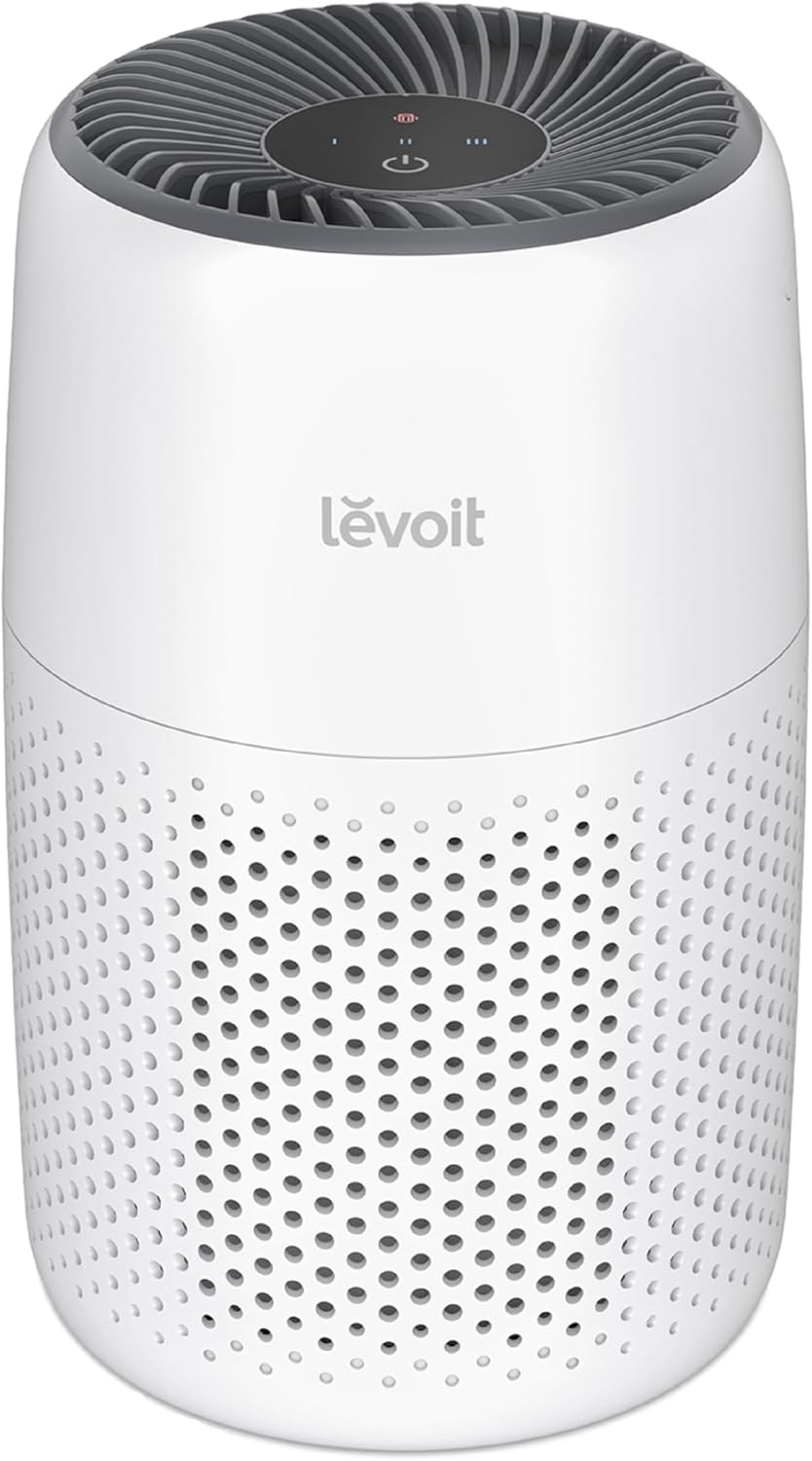
The Levoit Core Mini-P is a small plug-in air purifier meant for desks, bedrooms, or other tight spaces where odors, pet hair, and fine particles are a nuisance. It uses a pre-filter and main filter to capture lint, pet dander, dust, and smoke and includes an aromatherapy sponge for light scenting. Noise is low enough for night use, and sleep/auto-off display modes minimize disturbance. At 7 watts rated power it is energy efficient and the built-in adapter stores inside the unit for tidy placement. Practical benefits include fast placement on a desktop or nightstand, simple controls, and a modest noise footprint that still delivers continuous circulation. Limitations are inherent to its size: it is intended for small rooms and will not move air fast enough for larger living areas, and aromatic use requires careful dosing to avoid overflowing the sponge or interacting with plastic parts. Replacement filters are required periodically to keep performance consistent.
Best for: Buyers who want a low-noise, energy-efficient purifier for close-range odor and particle control in bedrooms, offices, or dorm rooms and prefer a simple, worry-free appliance.
Less Ideal for: People looking to purify large living rooms or whole apartments or those who need robust VOC or industrial odor removal should choose a larger, higher-capacity unit.
- Compact footprint for desktop or bedside placement
- Pre-filter plus main filter capture pet hair, dust, smoke and other fine particles
- Quiet operation with a sleep mode for overnight use
- Built-in aromatherapy sponge for light odor masking and scenting
- Sized for small rooms only and not effective for large open areas
- Aromatherapy requires careful dosing to avoid overflowing and damaging plastic parts
Verdict: Choose the Core Mini-P when you need a quiet, energy-sipping tabletop purifier that reduces odors and particles in small personal spaces.
Choosing the Right Air Purifier for Odors: Key Factors to Consider
Gas-Phase Filtration
Odors are often caused by volatile organic compounds and gases that particulate filters do not capture. Gas-phase filtration uses activated carbon, impregnated carbon blends, or other adsorbents to trap or neutralize smell-causing molecules. You should check the type and amount of adsorbent media because thicker beds or specialty-treated carbon can extend effective odor removal.
Because adsorbents become saturated over time, pay attention to how the manufacturer describes breakthrough or saturation and whether the unit offers replaceable or refillable media. The presence of a prefilter and particulate HEPA stage is useful, but it does not replace the need for a robust gas-phase stage when odors are the priority.
Clean Air Delivery Rate and Room Size
How quickly a purifier can exchange and filter the air in a room determines whether it will noticeably reduce smells. CADR figures and stated room coverage give a practical sense of performance. For persistent odors you will usually want a purifier that can provide multiple air changes per hour for the space where the smell is strongest.
Measure your room footprint and compare it to recommended coverage. A unit underpowered for the room will run constantly and still leave odors present, while a properly sized unit will clear smells more quickly and run more efficiently.
Filter Replacement Frequency and Cost
Adsorbent filters and HEPA elements have finite lifespans and their effectiveness declines with exposure to airborne contaminants. Replacement intervals vary with usage, odor load, and filter capacity. Consider the expected filter life in hours or months and whether replacement filters are easy to source.
Also account for cost and the convenience of changing filters. Some systems use combined cartridges that streamline replacement, while others require separate HEPA and carbon pieces. Longer-lived cartridges or modular refill options can reduce lifetime cost and maintenance effort.
Noise and Continuous Operation
Because odor control often requires continuous or extended runtime, noise levels are a practical concern. Fans running at high speed produce more noise but clear smells faster. Look for purifiers with a wide fan-speed range and measured decibel ratings so you can balance performance and comfort.
Consider placement and whether you need quiet overnight operation. Some units offer a sleep or quiet mode that lowers fan speed while still providing modest odor reduction, which can be helpful in bedrooms and living rooms.
Controls, Sensors, and Automation
Manual control is useful, but models with reliable sensors and automatic modes can adjust airflow in response to changes in air quality or detected odors. True odor sensors that detect gas-phase pollutants are more relevant than simple particulate sensors when smells are the issue.
Also evaluate the clarity of status indicators and the ease of using smart features or timers. Automation that raises fan speed during high-odor events and relaxes it when air is clear improves convenience and can extend filter life.
Placement and Airflow Pattern
Where you position a purifier affects how effectively it treats smells. Odor sources next to or behind a purifier can overwhelm its capacity, while central placement or positioning near the source with unobstructed airflow improves performance. Consider the intake and outlet orientation when choosing a location so cleaned air circulates through the occupied zone.
Avoid placing purifiers inside cabinets or blocked behind furniture. For open-plan spaces you may need multiple smaller units or a single unit with higher CADR placed to encourage cross-room circulation.
How Odors Differ From Particles
Many buyers assume particle filtration alone will solve odor problems, but smells and particles are different. Odors are often caused by gaseous molecules that can pass through HEPA material but bind to activated carbon or other adsorbents. Understanding this difference helps you choose a purifier that targets the actual cause of the problem.
Selecting a purifier with a dedicated gas-phase stage is the reliable way to address odors. In practical terms, that means checking for activated carbon volume, specialized adsorbent blends, or add-on odor cartridges rather than relying on HEPA alone.
- Particles: trapped by mechanical filters like HEPA
- Odors: absorbed or neutralized by gas-phase media
- Ionizers: may reduce particles but rarely address gases effectively
Choosing the Right Size for Your Room
Match the purifier's stated coverage or CADR to your room for best results. For kitchen smells or open-plan living areas, prioritize higher airflow to achieve more air changes per hour. If a unit is underpowered, it will struggle to remove odors even if it has strong adsorbent media.
If you plan to move the unit between rooms, consider the largest space you will use it in and select accordingly. Portable units with higher CADR ratings offer more flexibility across different rooms.
- Measure room square footage before choosing
- Aim for multiple air changes per hour for persistent odors
- Portable high-CADR units work for multi-room use
Maintaining Adsorbent Effectiveness
Adsorbent media lose capacity over time as they capture gas molecules. Regularly replacing or regenerating the carbon stage is essential to maintain odor-removal performance. Some units provide indicators showing when the adsorbent is saturated; others rely on time-based replacement intervals.
If you live with frequent strong odors, expect shorter filter life and plan maintenance accordingly. Keeping prefilters clean also helps extend the life of downstream adsorbent and HEPA layers.
- Check manufacturer guidance for replacement intervals
- Prefilters prolong carbon and HEPA life by capturing large particles
- High odor loads require more frequent media changes
Noise Management Strategies
When addressing odors you may need to run a purifier at higher speeds. To keep living spaces comfortable, use a unit with a quiet low-speed mode for background operation and a higher-speed boost for short periods when smells are worst. Timing boosts around cooking or cleaning events can reduce continuous high-noise exposure.
Look for measured decibel specs and reviews noting real-world noise levels. Placement also affects perceived loudness; positioning the purifier away from seating or sleeping areas can help.
- Use boost mode for short durations to clear odors quickly
- Run quiet modes overnight if noise is a concern
- Place units to minimize direct sound toward occupants
When to Consider Specialized Odor Cartridges
Some situations, like smoke, pet urine, or strong chemical smells, respond better to specialized adsorbent blends or replaceable odor cartridges designed for that type of contaminant. These cartridges often use treated carbon or combined catalysts that target specific compounds more effectively than generic carbon beds.
If you routinely face a particular odor source, check whether compatible specialty cartridges are available and how easy they are to swap. This approach can offer stronger, targeted control without upsizing the whole unit.
- Specialty cartridges can target smoke or ammonia-based odors
- Ensure cartridge availability and straightforward replacement
- Use specialty media when generic carbon underperforms
How We Chose the Best Air Purifier for Odors
We evaluated candidates for their ability to reduce common household odors by focusing on concrete, measurable technical and practical attributes. First, filtration capability: we prioritized systems with dedicated gas-adsorbing media and multi-stage filtration that target volatile organic compounds and odor-causing gases. Second, room coverage and airflow: we looked for clean air delivery rates and stated coverage that match typical room sizes so a purifier can turnover air often enough to reduce smells. Third, maintenance and consumables: we considered filter life, replacement accessibility, and clear maintenance intervals since adsorbent media effectiveness declines with use. Fourth, noise and real-world usability: effective odor control needs to be tolerable to run for extended periods, so fan speed range and measured sound levels matter. Fifth, controls and sensing: we favored units with reliable air quality indicators or odor sensors that adjust performance automatically. We excluded units that rely solely on ionization without adsorbent filtration and devices with no data on gas-phase removal. Our final shortlist includes only models that demonstrate both gas adsorption capability and adequate airflow for typical indoor rooms.
Our full evaluation process is outlined in our review methodology.
FAQ
How long does it take an air purifier to remove household odors?
It depends on the purifier's airflow and room size. In a properly sized room with high airflow you can see noticeable reduction within 30 to 60 minutes, but persistent or strong odors may take longer and require repeated cycles.
Does HEPA filtration remove smells?
HEPA removes particles but not most gaseous odor molecules. For smells you need gas-phase filtration such as activated carbon or specialty adsorbents designed to adsorb or neutralize volatile compounds.
How often should I replace odor filters?
Replacement frequency varies with odor load and filter capacity. Light household use may last several months, while heavy odor exposure can require replacements every 1 to 3 months. Follow the manufacturer's guidance and watch for saturation indicators if provided.
Can I use an air purifier in the kitchen to control cooking smells?
Yes, but choose a unit with strong gas-phase filtration and sufficient CADR for the kitchen area. Run the purifier on higher speed during cooking and allow it to run afterward to clear residual odors.
Are ozone generators a good choice for odor removal?
Ozone generators can react with odor molecules but produce ozone that can be harmful to occupants. For routine household odor control, filtration-based solutions with activated carbon or specialty adsorbents are the safer and more practical choice.
Final Verdict
When targeting odors, prioritize a purifier with a substantial gas-phase filtration stage and enough airflow to service the room where smells are present. Balance filter capacity and replacement intervals against the strength and frequency of the odors you face. Consider automation and noise characteristics so you can run the unit as needed without disrupting daily life. Focusing on adsorbent media, CADR and sensible maintenance habits will help you choose confidently and keep indoor air smelling fresher.