
Note: This article contains affiliate links. If you click on these links and make a purchase, we may earn a small commission at no extra cost to you. This helps support our research and content. Read our full affiliate disclosure here.
An office environment needs reliable air cleaning that removes particles, reduces odors, and stays quiet during the workday. Picking the right air purifier for office space matters because poor air quality can reduce focus, increase sick days, and make shared areas uncomfortable. This guide presents our shortlist of the seven best air purifiers for office use, selected for steady filtration, manageable noise levels, and energy efficiency. Below you will find the top picks and an explanation of how we evaluated them, plus practical buying factors to help you choose the model that fits your workspace and daily routine.
Top Picks at a Glance
| Best Overall The best all-around choice for most situations | Winix 5510 Air Purifier |  |
| Best Quality Built to a higher standard if you want something more solid | Coway Mighty AP-1512HH |  |
| Best Value The sweet spot between price and what you get | MOOKA B-D02L Air Purifier |  |
| Best Budget The cheapest option that still gets the job done reliably | MEGAWISE Portable Air Purifier EPI810 |  |
| Top Rated A top-rated pick with lots of positive feedback | ECOSELF HAP609 Air Purifier |  |
| Most Popular A crowd favorite that many people choose with confidence | Levoit Core Mini-P |  |
| Best Seller A high-volume bestseller chosen again and again | VOOPNU HEPA Air Purifier DH-JH12 |  |
Winix 5510 Air Purifier

| AHAM verified coverage | 1,882 sq ft in 1 hour |
|---|---|
| Filtration stages | 4-Stage |
| Noise (low) | 23.5 dB |
| Smart features | WiFi / Alexa / Google Home |
| Certification | AHAM Verified, UL Certified |
The Winix 5510 is a four-stage air purifier built to cover large indoor spaces quickly while removing very small particles and common odors. It uses a washable pre-filter, True HEPA filtration that captures particles down to 0.01 microns, and an advanced carbon filter for VOCs and smells, plus Winix PlasmaWave technology for additional air treatment. Built-in air quality sensors and an LED AQI indicator let the unit run in Auto Mode, where fan speeds adjust automatically, and a light-activated Sleep Mode drops noise and power use at night. Wi-Fi support and the Winix Smart App add remote monitoring and voice control with Alexa and Google Home. Practical benefits for an office include strong coverage, quiet low-speed operation, and visual air-quality feedback for occupants. Important limits are typical for this class: it is a floor-standing unit that needs space and periodic filter replacements, and advanced features like PlasmaWave are supplemental rather than replacements for filtration.
Best for: Office buyers seeking a balanced, capable purifier that combines strong large-room performance, automatic air-quality sensing, and smart controls for shared workspaces.
Less Ideal for: People who need a tiny desktop unit for a single cubicle or who want a purely passive, maintenance-free device.
- Four-stage system with True HEPA that captures ultrafine particles down to 0.01 microns
- Advanced carbon filter reduces VOCs and common indoor odors
- Smart sensors with Auto Mode and LED air quality indicator for hands-off operation
- Wi‑Fi and Winix Smart App compatibility plus Alexa and Google Home voice control
- Quiet operation on low speed suitable for office environments
- Requires regular filter replacements to maintain performance
- Larger footprint than compact desktop purifiers, needing floor space
Verdict: A feature-rich, quiet large-room purifier with smart sensing and app control that suits shared office spaces needing reliable, automatic cleaning.
Coway Mighty AP-1512HH

| Coverage | Designed to clean up to 1,748 sq. ft. in 60 minutes |
|---|---|
| Filtration stages | Washable pre-filter, deodorization filter, Bipolar Device, HEPA filter |
| HEPA effectiveness | 99.97% of 0.3μm particles |
| Indicators | Air quality LED and filter change indicator |
The Coway Mighty AP-1512HH is a room air purifier that combines a washable pre-filter, deodorization carbon layer, bipolar ion device, and a true HEPA filter to remove particles, odors, and many VOCs. It is intended for continuous use in home or office spaces up to the stated coverage, with an auto mode that adjusts fan speed based on real-time air quality readings and an LED indicator that reports pollution levels. The unit offers practical features for an office: a timer, eco mode to save power, a filter change indicator, and a washable pre-filter that reduces replacement frequency. Performance-oriented buyers will appreciate the HEPA-rated capture of 0.3 micron particles and lab-backed reductions for specific gases and allergens noted in testing. Trade-offs are its physical footprint and weight relative to small desktop purifiers and the need to replace disposable filters periodically to sustain peak performance, but for workspace air cleaning the AP-1512HH balances measurable filtration with user-friendly controls and reliable automatic operation.
Best for: Office managers or workers who prioritize measurable, automatic air cleaning for shared or medium-size workspaces and want a unit that runs reliably with minimal manual adjustments.
Less Ideal for: People who need an ultra-compact, highly portable purifier for moving between desks or very small personal spaces should consider smaller units instead.
- True HEPA filtration removes 99.97% of 0.3 micron particles for cleaner air
- Auto mode with real-time air quality monitoring adjusts fan speed automatically
- Washable pre-filter reduces maintenance cost and frequency of filter replacements
- Multiple modes including Eco and timer help balance performance and energy use
- Heavier and larger than compact desktop purifiers, so less portable
- Requires periodic disposable filter replacements to maintain certified performance
Verdict: A performance-focused, automatic HEPA purifier that reliably cleans medium office spaces while offering energy-saving modes and straightforward maintenance.
MOOKA B-D02L Air Purifier
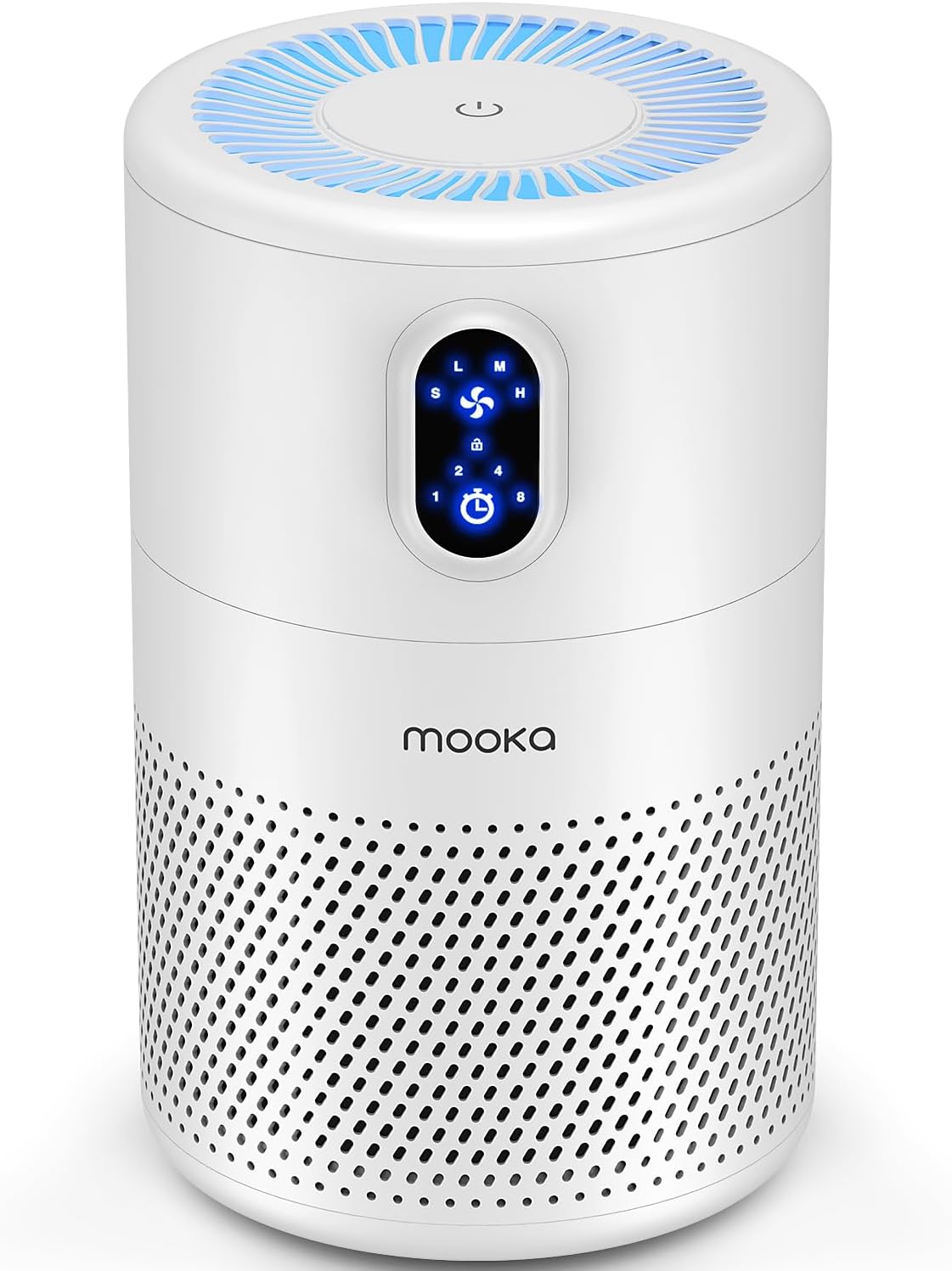
| Coverage | Up to 1076 sq ft |
|---|---|
| Filter type | H13 True HEPA + activated carbon |
| Fan modes | 4 fan speeds |
| Timer options | 1/2/4/8 hours |
The MOOKA B-D02L is a portable HEPA air purifier built around an H13 true HEPA filter plus an activated carbon stage and a washable pre-filter, intended to remove smoke, pollen, pet dander, dust and odors. In an office setting you typically set it on low or medium continuously and use the timer or sleep mode overnight; the unit claims up to six air changes per hour in a 215 sq ft space and one air change per hour across its maximum advertised coverage. Controls include four fan speeds, a child lock, filter-replacement reminder and a soft night light that can be disabled. Its brushless motor is quiet at low settings, which helps maintain concentration in shared work areas, and the DC power design keeps energy use low. Limitations are typical for compact purifiers: claimed coverage figures assume ideal placement and continuous run time, and filter replacements are required every 3 to 6 months depending on pollution and usage. The B-D02L is best used as a local room or office cleaner rather than a whole-building solution.
Best for: Buyers who want a compact, energy-efficient room purifier to lower airborne particles and odors in private offices or small shared workspaces while keeping noise minimal.
Less Ideal for: Not suited for buyers needing whole-floor or whole-building air cleaning or those who want a smart/Wi-Fi connected purifier with advanced automation.
- H13 true HEPA plus activated carbon and pre-filter for particulate and odor removal
- Quiet operation on low and sleep modes suitable for offices
- Multiple timers and four fan speeds for flexible scheduling
- Child lock and filter reminder add convenience and safety
- Advertised maximum coverage assumes ideal conditions and continuous operation
- Filter replacement every 3–6 months increases ongoing cost
Verdict: A quiet, energy-efficient HEPA purifier that provides flexible runtime and effective particulate and odor removal for individual offices and small workspaces.
MEGAWISE Portable Air Purifier EPI810

| Filter Type | HEPA |
|---|---|
| Floor Area | 250 |
| Noise Level | 32 db |
| Particle Retention Size | 0.3 micron |
| Wattage | 8 watts |
The MEGAWISE Portable Air Purifier EPI810 is a small, energy-efficient tabletop unit built to improve air quality in bedrooms, offices, or dorms. It uses a three-stage H13 True HEPA filter with an activated carbon layer to capture 99.97% of particles down to 0.3 microns and to reduce common household odors from cooking and pets. The machine is very quiet on low, advertised at 24 to 32 dB depending on mode, which makes it suitable for overnight or office use without causing distraction. Controls are simple touch and button inputs and the unit draws only 8 watts, so it can run continuously without a meaningful power impact. Its compact footprint fits on desks and nightstands and includes a gentle night light for low-light environments. Limitations include coverage geared to small spaces (spec lists 250 square feet) and a minimal control set with no smart connectivity, so it is not ideal for whole-home use or remote scheduling. Filter replacements will be an ongoing cost as with any HEPA purifier.
Best for: Buyers seeking an inexpensive, compact purifier for a single office, bedroom, or dorm who prioritize quiet, energy-efficient daily operation.
Less Ideal for: People needing to treat large open-plan offices or whole apartments or who require Wi-Fi control and advanced scheduling features.
- H13 True HEPA plus activated carbon captures fine particles and reduces odors
- Very low noise in sleep mode suitable for office desks or bedrooms
- Low power draw (8 watts) for continuous use
- Compact tabletop design fits small workspaces and nightstands
- Coverage limited to smaller rooms (spec lists 250 sq ft)
- No smart features or advanced controls for remote scheduling
Verdict: A quiet, energy-efficient tabletop HEPA purifier that gives effective small-room particle and odor control without a big upfront cost.
ECOSELF HAP609 Air Purifier

| Model number | HAP609 |
|---|---|
| Noise level (Sleep Mode) | 20 dB |
| Timer | 1–24 hours |
| Sensor | PM2.5 sensor with display |
The ECOSELF HAP609 is a compact HEPA air purifier designed for continuous use in home offices and bedrooms. It draws air from all directions with a 360° intake, passes particles through a multi-stage filter, and shows real-time PM2.5 readings on a color ring so you can see air quality at a glance. Auto mode uses the built-in sensor to step fan speed up when pollutants spike and step back down when levels fall, which helps minimize needless noise and energy use. Sleep mode disables lights and drops noise to about 20 dB for unobtrusive night and focused-work use, and the 1–24 hour timer makes scheduled runs easy. Because it is small and lightweight, it is easy to move between rooms but may require more frequent placement adjustments in larger open-plan offices to maintain coverage. The unit balances quiet operation, clear feedback, and automatic control, making it a practical choice for reliable daily air cleaning in single rooms or small office spaces.
Best for: Someone who prioritizes consistent, low-noise air cleaning and clear, automatic feedback in a single office or small workspace and who wants a unit that runs reliably with minimal attention.
Less Ideal for: Large open-plan offices or shared conference rooms where a single compact purifier cannot provide sufficient coverage across the whole space.
- 360° air intake improves circulation and speeds room-wide cleaning
- Built-in PM2.5 sensor with color ring provides immediate, easy-to-read air quality feedback
- Auto mode adjusts fan speed automatically to respond to pollution spikes
- Sleep mode drops noise to about 20 dB and turns off lights for undisturbed rest or focused work
- 1–24 hour timer enables scheduled operation without manual intervention
- Small, lightweight design may not deliver uniform coverage in large open-plan office areas
- Product documentation and specification details are limited in the listing
Verdict: A quiet, sensor-driven HEPA purifier that reliably keeps a single office or small workspace visibly monitored and automatically cleaned.
Levoit Core Mini-P
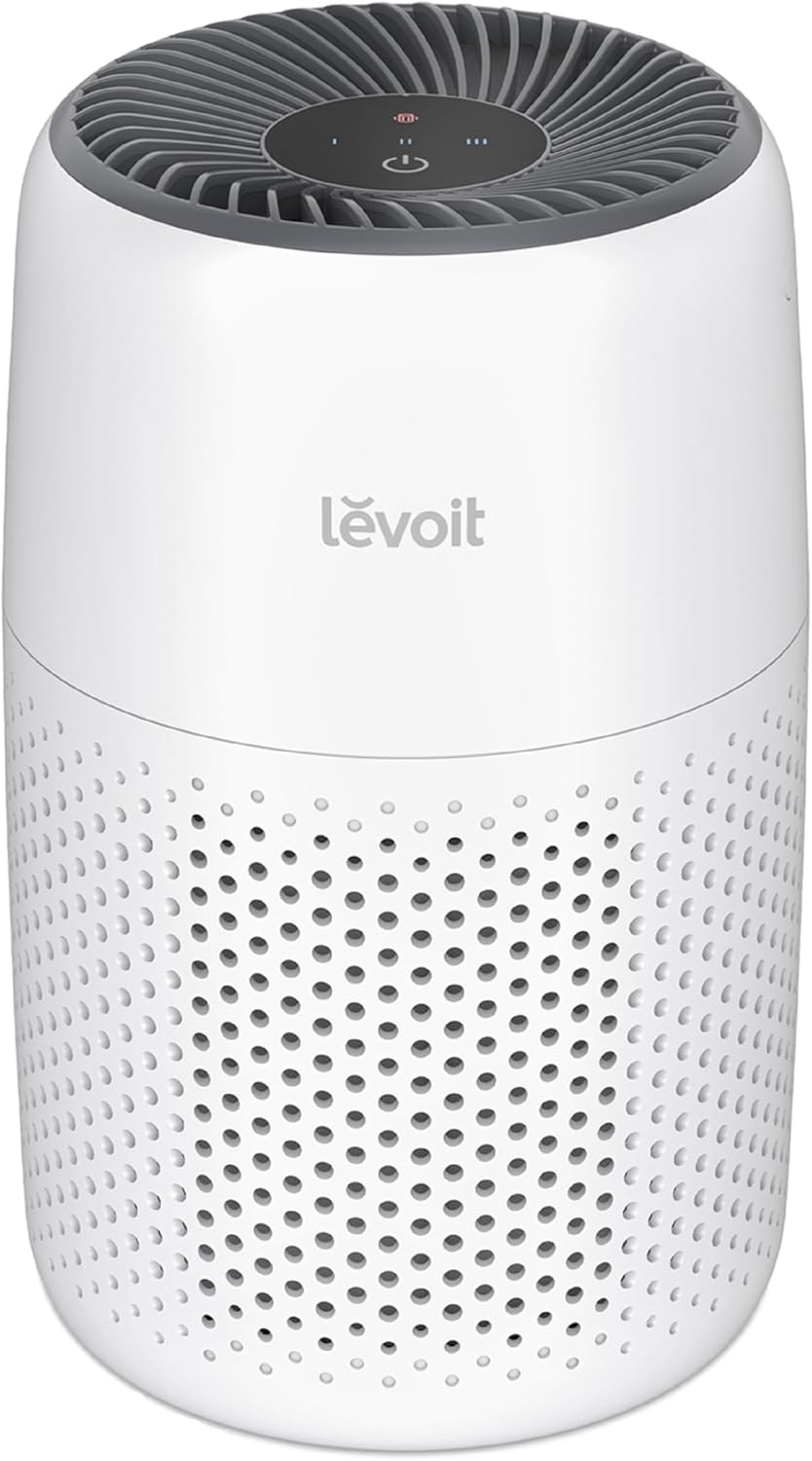
| Rated Power | 7W |
|---|---|
| Noise Level | 27-45dB |
| Adapter Input | 100-240V, 50/60Hz |
| Particle Retention Size | 0.3 micron |
The Levoit Core Mini-P is a small, low-power desktop air purifier intended for bedrooms, offices, and other close-range spaces. It uses a pre-filter and main HEPA-style filter to capture lint, pet dander, smoke and fine particles, and includes a fragrance sponge for light aromatherapy. Rated power is 7W and noise ranges from about 27 to 45 dB, so it runs quietly enough for a desk or nightstand and offers a sleep mode and auto-off display to reduce distraction. The unit is AHAM-verified for cleaning performance which gives confidence in real-world effectiveness for small areas, and the internal adapter stores away for neat placement. Limitations are inherent to its size: it is built for single-person zones rather than whole rooms, and the tiny fragrance reservoir requires only a few drops to avoid overflow. If you need stronger coverage for open-plan offices or larger rooms, a larger purifier will be necessary, but for personal workspaces this delivers reliable, whisper-quiet filtration and simple maintenance.
Best for: Buyers who want a proven, compact purifier that runs quietly at a desk or in a small private office and value verified performance and low energy use.
Less Ideal for: People who need to clean air in large rooms, open-plan offices, or whole suites should choose a higher-capacity purifier instead.
- AHAM-verified performance for predictable air cleaning results
- Very low power draw (7W) for energy-efficient continuous use
- Quiet operation (27–45 dB) with sleep mode suitable for desks and bedrooms
- Compact design with built-in adapter storage for tidy placement
- Includes pre-filter and main filter to capture pet dander, dust, and smoke
- Small coverage area not suited for larger offices or open spaces
- Fragrance sponge requires only 2–3 drops to avoid overflow which limits heavy scent use
Verdict: A compact, energy-efficient desktop purifier with AHAM-verified performance that reliably improves air at a personal workspace.
VOOPNU HEPA Air Purifier DH-JH12

| Coverage | Up to 1,076 ft² |
|---|---|
| Filtration | H13 triple-layer HEPA |
| Noise level | 22 dB (low) |
| Airflow design | 360° intake |
| Model | DH-JH12 |
This compact VOOPNU purifier is built for straightforward, everyday use in small offices and workspaces where quiet, continuous filtration matters. Its 360° intake and H13 triple-layer system capture fine particles and common indoor pollutants, and the company reports it can clean 250 ft² every 15 minutes, which scales to the stated 1,076 ft² coverage. Controls are simple and the unit includes a small essential oil tray if you want light scenting. The purifier is notably quiet at its lowest setting (around 22 dB), making it easy to run overnight or during focused work without distraction. Certifications from DOE, ETL, FCC, CARB, CE, and ROHS provide additional assurance about safety and testing. Expect to replace filters periodically and to run the unit continuously for best results, which is typical for portable purifiers and adds ongoing filter costs and energy use. The small footprint makes placement flexible but also means it is aimed at single rooms rather than whole-building ventilation.
Best for: Buyers who prioritize a low-risk, tested air cleaner for a private office or small meeting room and want a quiet, easy-to-use unit they can run continuously without fuss.
Less Ideal for: Large open-plan offices or shared work areas that need high-capacity commercial filtration or integrated HVAC solutions should choose a more powerful, building-scale system.
- H13 triple-layer filtration captures 99.97% of airborne particles
- 360° surround air intake improves room circulation from any placement
- Very quiet operation down to 22 dB suitable for offices and bedrooms
- Compact footprint that fits on a desk or in tight corners
- Multiple certifications (ETL, CARB, FCC, CE, ROHS, DOE) support safety and compliance
- Recommended continuous operation for peak effectiveness increases filter replacement frequency and energy use
- Small unit is tuned for single-room use and may not perform like larger commercial-grade purifiers in open-plan offices
Verdict: A compact, quietly operating HEPA purifier with broad room coverage and strong safety certifications that suits cautious buyers seeking reliable single-room air cleaning for an office.
Choosing the Right Air Purifier for Office Space: Key Factors to Consider
Filtration Type and Efficiency
The core of any office air purifier is the filtration technology. True HEPA filtration removes at least 99.97 percent of particles 0.3 microns in size, which includes most dust, pollen, and many respiratory aerosols. Some models add activated carbon layers to capture odors and volatile organic compounds common in office settings, such as cleaning product fumes and breakroom smells.
Choosing the right filtration affects how well the device handles particulates and smells. If allergy mitigation or fine particle removal is a priority, prioritize true HEPA. If odors from food or office chemicals are frequent, look for a sizable activated carbon stage and clear guidance on how often that media needs replacement.
Noise Levels During Typical Use
Noise matters in a workspace because constant or fluctuating sounds can disrupt concentration and calls. Manufacturers typically report decibel levels at different fan speeds; the lowest practical noise setting is most relevant for open offices and meeting rooms. Some purifiers include a quiet or sleep mode that reduces fan speed and sound output but also lowers clean-air delivery.
Consider where the unit will be placed relative to desks or conference tables. A model that is whisper-quiet at a setting that still provides adequate air exchanges per hour is ideal. Also check whether the unit produces tonal noises or variable-pitch sounds that people find more irritating than plain broadband noise.
Room Size and Clean Air Delivery Rate (CADR)
CADR and recommended room size indicate how quickly a purifier can refresh the air in a given space. Offices come in many sizes, from small private rooms to larger open-plan areas. Match the purifier's rated CADR or square-foot coverage to the actual volume of the room, not just floor area, to ensure the device can achieve your desired air changes per hour.
If you want faster clearance of particles after high-occupancy events or cooking in a nearby break area, choose a unit with a higher CADR than the bare minimum for the room. For continuous background cleaning in a small office, a lower CADR may be acceptable if it runs quietly and continuously.
Energy Consumption and Operating Modes
Air purifiers often run for long periods, so energy efficiency affects operating cost and sustainability. Look for models with multiple fan speeds, ECO or auto modes that adjust to measured air quality, and programmable schedules. Energy-efficient motors and smart controls can substantially lower electricity use over months of continuous operation.
If the purifier will run overnight or during extended open-office hours, prioritize units with low-watt standby or low-speed operation. Confirm whether energy usage is reported for the different modes so you can estimate monthly power draw based on expected run hours.
Filter Life, Replacement Cost, and Maintenance
Long filter life reduces ongoing maintenance hassle and cost. Manufacturers usually estimate lifespan in months based on typical daily use; however, office pollution loads vary, so plan for faster replacement if the space has high occupancy or frequent particulate sources. Check whether filters are easy to access and replace without tools, and whether pre-filters are washable to extend HEPA life.
Also review how clearly replacement schedules are communicated and whether the unit provides filter-change indicators. Availability of replacement filters and the simplicity of the replacement process are important for maintaining performance over time.
Controls, Placement, and Integration
Practical control options determine how easily you can run the purifier in an office setting. Touch panels, remote controls, or app-based scheduling let managers set quiet hours or adapt to meeting times. Units with air-quality sensors and auto modes lower the need for frequent manual adjustments.
Placement flexibility is also important. Compact units that can sit on a credenza or larger floor-standing models both have roles depending on desk layout. Consider cord length, the direction of air intake and outlet, and whether the purifier's footprint or height will fit in the chosen location without obstructing movement or ventilation.
Sizing a Purifier to Your Office Layout
Measure the room volume, not just square footage, when matching a purifier to office space. Multiply the floor area by ceiling height to estimate cubic feet, then compare that to the purifier's recommended coverage or CADR to determine achievable air changes per hour.
Place purifiers near the primary source of pollutants when possible, such as near a kitchenette or printer station, and avoid blocking intakes or outlets. In larger open-plan offices, multiple smaller units distributed throughout the space may outperform one centrally located unit.
- Calculate cubic footage: floor area × ceiling height.
- Aim for at least 4 to 6 air changes per hour in shared areas.
- Use multiple units for even coverage in open-plan layouts.
Using Auto Modes and Sensors Effectively
Auto modes and onboard sensors can maintain air quality with minimal management. Particulate or VOC sensors trigger higher fan speeds when they detect worsened conditions and reduce fan speed when air is clean. Relying on these features helps balance air quality and noise without constant manual tuning.
Keep in mind that sensor placement matters. Sensors can be fooled if the unit is tucked away or if vents blow directly at the sensor. For best results, position the purifier where it samples representative room air.
- Prefer units with validated particulate and VOC sensors.
- Avoid blocking sensor inlets with furniture or walls.
- Use scheduling to lower speed during meetings if needed.
Maintenance Routines That Keep Performance Consistent
Set a calendar-based maintenance routine that fits the expected use pattern of the office. Even with long-life filters, occasional inspections for dust buildup and pre-filter cleaning extend effective life and ensure steady airflow. Replace carbon and HEPA filters according to the manufacturer's guidance or sooner if odors or particle counts return.
Document filter part numbers and suppliers to simplify procurement. For multi-unit deployments, keep spare filters on hand to avoid downtime and ensure continuous protection.
- Inspect pre-filters monthly in dusty environments.
- Record replacement dates and expected next-change intervals.
- Keep spare filters for uninterrupted operation.
Placement Considerations for Shared and Private Offices
In private offices, a single well-sized unit can often deliver the needed air changes while staying near a desk for minimal noise impact. Place it so airflow does not blow directly on occupants during long calls or focused work.
In shared spaces, distributed placement reduces dead zones and keeps everyone benefiting from improved air. Consider routing power and cable management needs when siting multiple units to maintain a tidy workspace.
- Avoid placing units behind large cabinets or under desks.
- Orient outlets and intakes to encourage cross-room circulation.
- Ensure units are accessible for filter replacement without moving heavy furniture.
When to Use Additional Odor Control
If the office regularly experiences cooking smells, tobacco drift in adjacent spaces, or chemical fumes from cleaning, look for purifiers with a substantial activated carbon stage. Carbon media absorbs VOCs and odors but saturates over time, so consider the replacement interval and whether the model supports modular carbon packs.
For intermittent odor events, portable odor absorbers or complementary filtration near the source can supplement general-purpose purifiers without oversizing the whole-office unit.
- Use carbon filtration for persistent odors and VOCs.
- Plan for more frequent carbon replacement in high-odor scenarios.
- Supplement with source-control measures where possible.
How We Chose the Best Air Purifier for Office Space
We focused on practical, measurable attributes that matter in office environments. Our selection filtered for models with published clean air delivery rates appropriate to typical office room sizes, verified true HEPA or comparable particulate filtration, and documented low operational noise at normal settings. We also prioritized energy consumption data and the availability of useful controls such as programmable timers or eco modes. Excluded from our list were units that rely solely on unproven technologies, devices designed only for single-person desktop use with negligible CADR, and products that lack transparent filter replacement guidance. The final shortlist favored machines that balance filtration efficiency, quiet operation, filter life and replacement logistics, and long-term operating costs. Each candidate was judged by the same criteria so readers can compare tradeoffs between coverage, sound levels, and upkeep requirements.
Our full evaluation process is outlined in our review methodology.
FAQ
How large of an air purifier do I need for a typical private office?
Choose a purifier whose recommended coverage meets or exceeds the room's cubic volume. For a standard private office, pick a unit that achieves multiple air changes per hour at a quiet operating speed rather than just the maximum CADR rating.
Are air purifiers effective against viruses and bacteria in an office?
High-efficiency particulate filters capture many aerosolized particles that can carry pathogens, which reduces airborne exposure risk. Filtration is one layer of protection and works best alongside ventilation, vaccination, hand hygiene, and surface cleaning.
Will running a purifier all day increase energy bills a lot?
Energy impact depends on the model and fan speed. Units with efficient motors and auto or eco modes typically use modest power. Estimating based on wattage and expected daily run hours gives a practical sense of added cost.
How often should I change filters in an office environment?
Filter change frequency varies with occupancy and pollutant levels. Inspect pre-filters monthly and plan HEPA and carbon replacements per manufacturer guidance, often every 6 to 12 months for moderate use. Increase frequency if you notice reduced airflow or persistent odors.
Can one purifier handle an open-plan office?
Large open-plan areas often need multiple units to avoid dead zones and ensure even air exchanges. Distributed purifiers provide more consistent performance than a single central unit unless that central machine is sized well above the room's minimum requirement.
Final Verdict
Prioritize filtration effectiveness, appropriate room coverage, and low noise when choosing an air purifier for office space. Tradeoffs are common: higher CADR and faster particle removal often means higher noise or energy use, while very quiet operation may limit cleaning speed. Consider where the unit will sit, how long it will run daily, and the maintenance cadence you can support. Focus on models that offer proven particulate filtration, sensible energy and noise profiles, and straightforward filter maintenance. Matching the purifier to the room volume and your noise tolerance will deliver the best balance of clean air and a productive workplace.