
Note: This article contains affiliate links. If you click on these links and make a purchase, we may earn a small commission at no extra cost to you. This helps support our research and content. Read our full affiliate disclosure here.
If you keep parrots indoors, airborne dust, feather dander, and odors can affect both bird health and household air quality. Choosing the right air purifier for parrots matters because birds are sensitive to small particles and to noise that can stress them. The picks in this guide are shortlisted for homes with parrots, focusing on real-world factors like particle capture, quiet operation, and suitability for aviary or living-room use. We evaluated options across filtration efficiency, noise output, airflow coverage, and maintenance needs so you can find an effective, low-stress unit for your bird space. Read on for practical guidance and our top selections for parrot owners.
Top Picks at a Glance
| Best Overall The best all-around choice for most situations | Winix 5510 Air Purifier |  |
| Best Quality Built to a higher standard if you want something more solid | Oransi Mod+ Air Purifier |  |
| Best Value The sweet spot between price and what you get | MOOKA PR1 Air Purifier |  |
| Best Budget The cheapest option that still gets the job done reliably | VEWIOR H13 True HEPA Air Purifier |  |
| Top Rated A top-rated pick with lots of positive feedback | PuroAir 100i HEPA Air Purifier |  |
| Most Popular A crowd favorite that many people choose with confidence | GermGuardian AC4825 22" Tower |  |
| Best Seller A high-volume bestseller chosen again and again | Levoit Vital 200S-P Air Purifier |  |
Winix 5510 Air Purifier

| Item model number | 5510 |
|---|---|
| AHAM verified coverage | 1,882 sq ft in 1 hr |
| Noise (slowest) | 23.5 dB |
| Filtration stages | 4-Stage |
| Smart features | WiFi / Alexa / Google Home |
The Winix 5510 uses a four-stage system—washable pre-filter, True HEPA, advanced carbon, and PlasmaWave technology—to capture very small particles and reduce odors common in homes with birds. Built-in air quality sensors and an LED AQI indicator let the unit run in Auto Mode, adjusting fan speed as airborne particle levels change, and Sleep Mode drops noise when the room is dark. With Winix Smart App compatibility plus voice control through common smart assistants, you can monitor and schedule cleanings remotely. Practical benefits for parrot owners include strong particulate capture down to very small sizes and a dedicated carbon stage to help control smells from cages and bedding. Limitations are typical for high-coverage purifiers: to be effective near a bird cage place it close to the source, and replacement filters and periodic prefilter washing are required to maintain performance.
Best for: Parrot owners who want a reliable, smart air purifier that aggressively captures fine dust and dander while helping control cage odors in larger rooms.
Less Ideal for: People looking for a compact, travel-friendly unit for very small spaces or those who prefer a purifier with no ongoing filter maintenance.
- True HEPA filtration captures very small airborne particles down to 0.01 microns
- Advanced carbon filter reduces household odors and VOCs from cages and bedding
- Smart sensors with Auto Mode and AQI indicator automatically adjust fan speed
- Winix Smart App and voice assistant support enable remote monitoring and control
- Washable pre-filter lowers maintenance cost by catching larger debris first
- Large-room capacity means optimal placement near the bird cage is needed for fastest local clearing
- Filter replacements are required periodically to retain peak performance
Verdict: Choose the Winix 5510 if you want a smart, high-coverage purifier that reduces fine dander and cage odors for parrots in larger rooms.
Oransi Mod+ Air Purifier

| Floor Area | 1361 square_feet |
|---|---|
| Noise Level | 28 db |
| Particle Retention Size | 0.02 micrometer |
| Wattage | 93 watts |
| Filter Type | 3-in-1 Filter |
The Oransi Mod+ is built for high-performance cleaning in very large rooms; its AHAM-verified CADR (363) and stated coverage make it suitable for living rooms, basements, and other open spaces where rapid air changes are needed. It uses a single 3-in-1 HEPA plus carbon filter that captures particles down to 0.02 micrometers while also reducing odors, VOCs, and wildfire or cooking smoke. The unit runs at up to 93 watts and claims quiet operation with minimal indicator lights so it can run overnight without disturbing sleep. Filters are designed to last up to 12 months under typical use and are straightforward to replace. Practical limitations are its physical size and weight for moving between rooms, and the replacement filter is the sole consumable so buyers should factor ongoing filter cost into long-term operation. The Mod+ is AHAM and CARB certified, which supports its performance and safety claims for homes with pets or frequent smoke exposure.
Best for: Buyers who prioritize measurable, high CADR performance for cleaning large open spaces or homes exposed to smoke and strong odors and who want a robust, certified purifier that runs quietly.
Less Ideal for: People who need a compact, lightweight purifier for small bedrooms, travel, or frequent room-to-room portability should consider smaller models instead.
- High CADR (363) and AHAM verification for measurable large-room performance
- 3-in-1 HEPA plus carbon filter captures very small particles (0.02 micrometer) and reduces odors/VOCs
- Designed to clean very large areas rapidly with specified square-foot coverage and air change rates
- Quiet operation with minimal lights suitable for overnight use
- Filters are user-replaceable and rated up to 12 months of use
- Large and relatively heavy, making it less convenient to move between rooms
- Single integrated filter means replacement cost is the main ongoing expense
Verdict: If you need a proven, high-CADR purifier for very large rooms or homes affected by smoke and strong odors, the Oransi Mod+ delivers reliable, quiet performance.
MOOKA PR1 Air Purifier

| Filter type | True H13 HEPA |
|---|---|
| Coverage | Up to 2200 ft² |
| Fan speeds | 6 speeds (including Auto, Pet, Sleep) |
| Noise | Sleep mode as low as 26 dB |
The MOOKA PR1 is a large-room air purifier built around a True H13 HEPA filter and a multi-stage system that targets fine particles, pet dander, smoke, and odors. It is used as a continuously running room unit: set it to Auto for automatic fan adjustments based on the PM2.5 sensor or switch to Pet Mode for more aggressive filtration where animals live. The unit offers six fan speeds including a very quiet 26 dB sleep setting, an aroma pad, timer, child lock, and a washable pre-filter to trap hair and large debris before they reach the HEPA media. Practical features like a filter replacement reminder, washable pre-filter, and an energy-aware design make maintenance straightforward for busy households. Important limitations are that the aroma function and essential-oil pad could irritate sensitive birds, so avoid adding oils around parrots, and the purifier's stated coverage is for large open spaces so placement and room airflow still affect real-world effectiveness.
Best for: Parrot owners who prioritize continuous particle removal and easy upkeep and want an appliance that can run quietly in living areas while handling dander, dust, and common household smoke or odors.
Less Ideal for: Homes that rely on essential oils or scented pads near birds should avoid using those features with this unit, and very small or tightly sealed single-room enclosures may be better served by a smaller, closer-proximity purifier.
- True H13 HEPA filtration captures particles down to 0.3 microns including dander and dust
- PM2.5 sensor with real-time air quality display and Auto mode for hands-off operation
- Washable pre-filter reduces hair buildup and lowers ongoing filter costs
- Six fan speeds including a 26 dB sleep mode for quiet overnight use
- Aroma pad and essential-oil feature present a potential respiratory irritant for parrots
- Real-world coverage depends on room layout and airflow despite large-area rating
Verdict: A practical, low-maintenance HEPA purifier that removes parrot dander and household particles quietly while offering automatic sensor-based control.
VEWIOR H13 True HEPA Air Purifier

| Filtration stages | Pre-filter, H13 True HEPA, Activated carbon |
|---|---|
| Room coverage | Up to 1,200 sq.ft (listed) |
| Noise level | As low as 18 dB (sleep mode) |
| Timer settings | 2H, 4H, 6H, 8H, 10H, 12H |
The VEWIOR H13 True HEPA Air Purifier is a compact purifier that uses a three-stage system (pre-filter, H13 True HEPA, activated carbon) to remove airborne particles and reduce odors. It is intended for continuous home use in bedrooms, living rooms, nurseries, or offices and can cycle a listed room size multiple times per hour. Controls are via a high-resolution LED touch panel that displays PM2.5 readings, fan speed, and a 6-setting timer (2–12 hours). There are three fan speeds plus an ultra-quiet sleep mode that can drop noise to the low 20s dB range, making it suitable close to sleeping birds. A small built-in sponge lets you add essential oil for light fragrance distribution. Practical limits include the modest physical size and recommended frequent filter changes (every 3–6 months) to maintain performance, and the aromatherapy feature should be used cautiously around parrots because essential oils can be harmful to birds. The unit runs on a low-voltage DC adapter and emphasizes energy-saving timer options.
Best for: Buyers seeking an affordable, compact HEPA purifier that provides measurable air quality feedback and quiet operation for rooms where parrots live, while prioritizing budget and energy savings.
Less Ideal for: Homes where owners plan to use scented oils around birds regularly or very large spaces that exceed the stated coverage, since this unit is meant for moderate room sizes and cautious fragrance use.
- H13 True HEPA plus activated carbon and pre-filter for particle and odor reduction
- Built-in PM2.5 air quality sensor with numeric display for real-time feedback
- Six timer settings for scheduled operation and energy savings
- Ultra-quiet operation and sleep mode suitable for night use
- Includes aromatherapy sponge which can pose risks for parrots if used with essential oils
- Filter replacement every 3–6 months adds ongoing maintenance cost
Verdict: If you want a budget-friendly, quiet HEPA purifier with visible PM2.5 monitoring for a parrot room, this model gives solid filtration and scheduling at a low upfront cost.
PuroAir 100i HEPA Air Purifier
| Model | PuroAir 100i |
|---|---|
| Coverage | Up to 550 sq ft (one hour) |
| Filtration | Pre-filter, True HEPA, Activated Carbon |
| Connectivity | Wi-Fi / App enabled |
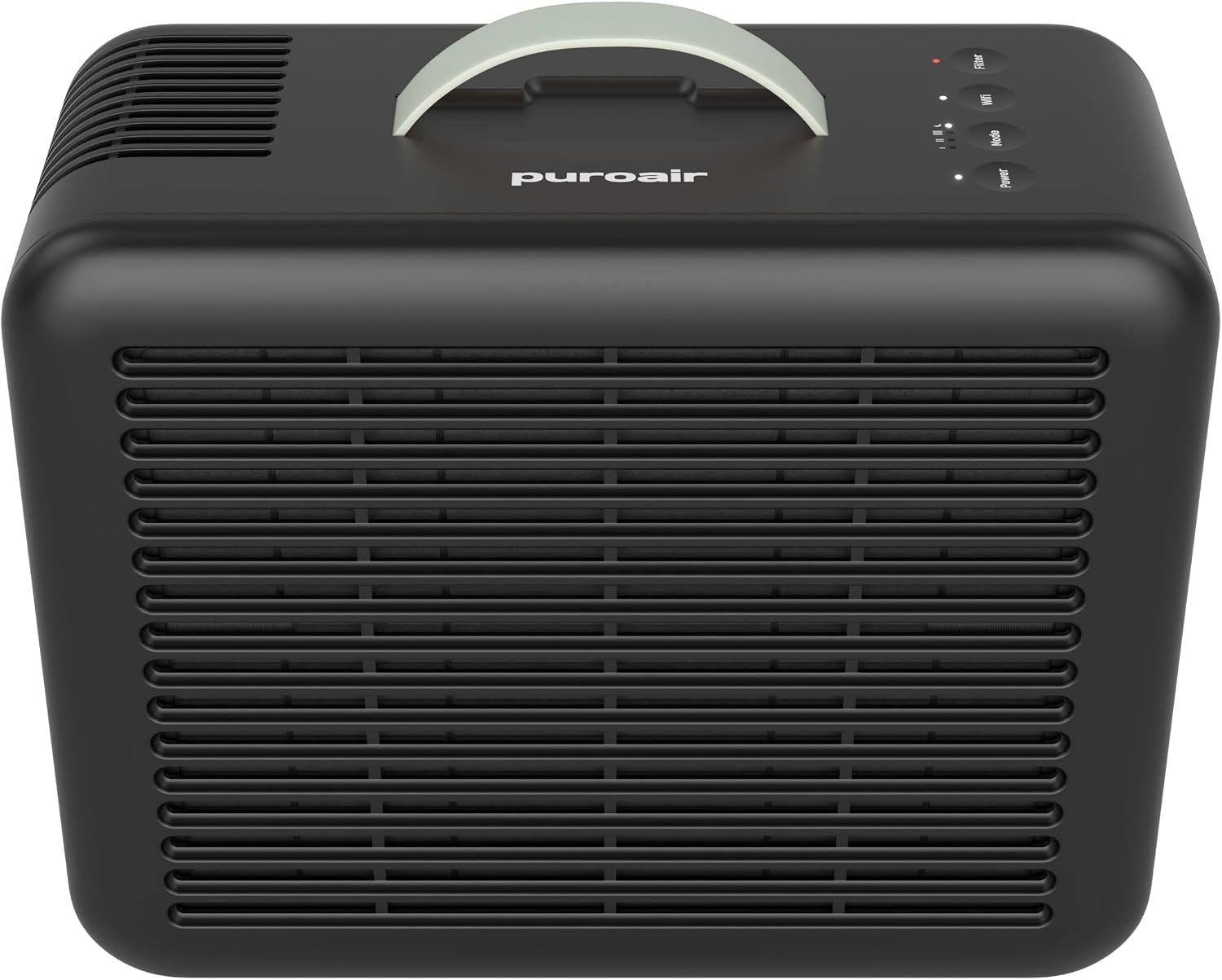
The PuroAir 100i is a small, app-controlled HEPA air purifier made for bedrooms, offices, and other rooms up to about 550 sq ft; it pulls air through a three-layer system (pre-filter, True HEPA, activated carbon) to capture dust, pollen, smoke, pet dander and odors. Typical use is plug-and-run on a tabletop or shelf where its multiple fan speeds and sleep/quiet mode let you balance cleaning speed and noise, while the Wi-Fi app lets you adjust settings remotely. Practical benefits include proven lab-tested filtration performance and a compact footprint that is easy to move between rooms, plus subscription options for genuine replacement filters. Limitations are that it is sized for small-to-medium rooms only and depends on periodic filter replacements to maintain performance, and advanced features like an air quality sensor or auto mode are not available on this model so it needs manual control or app scheduling to react to changes in air quality. For someone prioritizing straightforward, reliable filtration with smart remote control, it is a strong small-room choice.
Best for: Buyers who want a dependable, lab-tested small-room purifier that delivers consistent particle and odor removal and can be managed remotely.
Less Ideal for: People needing whole-home coverage, integrated air quality sensing, or a purifier with fully automatic response to changing room conditions.
- Three-layer filtration with True HEPA plus activated carbon for particles and odors
- Rated to clean rooms up to about 550 sq ft in one hour based on lab testing
- Wi-Fi and app control for remote speed and scheduling adjustments
- Compact, portable design that is easy to move between rooms
- No built-in air quality sensor or automatic auto mode on this model
- Requires regular filter replacements to maintain stated performance
Verdict: A dependable, lab-tested small-room HEPA purifier that combines strong particulate and odor filtration with easy app control.
GermGuardian AC4825 22" Tower

| Model | AC4825W |
|---|---|
| Coverage | Up to 743 sq. ft. (hourly) |
| Filter type | True HEPA with activated carbon pre-filter |
| Fan speeds | 3 speeds |
The GermGuardian AC4825 is a compact tower purifier that uses a genuine True HEPA filter, an activated carbon pre-filter, and an optional UV-C light to capture airborne particles and reduce odors in living spaces. It is typically used in bedrooms, offices, or larger rooms where it circulates air frequently — the manufacturer states it refreshes a 153 sq ft room every 12.5 minutes and can cover up to 743 sq ft hourly. Controls are simple with three fan speeds including a quiet sleep mode for nighttime use. The HEPA filter captures very small particles down to 0.1 microns, which helps with dust, pollen, and pet dander, while the carbon layer reduces cooking and pet smells. Maintenance is straightforward with compatible replacement filters and UV-C bulbs available. Limitations include basic controls without smart connectivity and reliance on periodic filter and bulb replacement to maintain performance, and the UV-C feature is optional rather than integrated into every cycle.
Best for: Buyers who prioritize proven filtration performance and want a well-reviewed, tested unit that reliably reduces airborne dust, dander, and odors in rooms where parrots live or spend time.
Less Ideal for: People who need Wi-Fi enabled controls, automatic air-quality sensing, or full-room coverage claims without monitoring should consider models with those built-in features instead.
- True HEPA filter captures particles down to 0.1 microns for effective allergen removal
- Activated carbon pre-filter helps reduce household odors from cooking and pets
- Three fan speeds including a quiet sleep mode for nighttime operation
- Compact tower design fits easily in bedrooms, offices, or small living areas
- No smart features or app connectivity for remote monitoring
- Performance depends on regular replacement of filters and UV-C bulb
Verdict: A reliable, well-tested HEPA tower purifier that provides strong particle filtration and odor reduction for rooms where parrots live.
Levoit Vital 200S-P Air Purifier

| Floor Area | 1875 square_feet |
|---|---|
| Noise Level | 27 db |
| Particle Retention Size | 0.1 micrometer |
| Power Source | Corded Electric |
| Wattage | 51 |
The Levoit Vital 200S-P is a whole-room air purifier built to move plenty of air while keeping noise low, which matters if you need a unit that runs near sensitive animals. It uses a three-stage filter (pre-filter, activated carbon, HEPA-grade stage) and an air quality monitor to capture dust, pet dander, smoke, and odors, and the company lists CADR scores suitable for rapid cleaning of large spaces. You can control it via onboard buttons or the app and run a quiet sleep mode at 27 dB for overnight use. The washable pre-filter helps trap hair and large particles before they reach the higher-efficiency media, and replacement specialty filters are available for smoke, toxins, or pet allergies. Trade-offs are typical for high-flow purifiers: the unit is relatively tall and needs periodic filter replacements to maintain performance, and the activated carbon capacity limits how long it will neutralize strong avian-safe odors before swapping filters. For bird owners focused on steady, low-noise filtration across a large living area, this model balances performance, monitoring, and quiet operation.
Best for: Parrot owners who prioritize quiet, continuous air cleaning in a main room and want monitored, reliable removal of dust, dander, and airborne particulates with smart controls.
Less Ideal for: Owners needing a compact travel or cage-side purifier for small enclosures or those who want a zero-maintenance device without filter changes.
- AHAM-verified CADR performance for fast whole-room cleaning
- Three-stage filtration with washable pre-filter reduces hair and large particles
- Low noise sleep mode at 27 dB suitable for overnight operation
- App control and built-in air quality monitor for ongoing feedback
- Available specialty replacement filters for smoke, toxins, or pet allergies
- Requires regular filter replacements to sustain HEPA and odor performance
- Activated carbon capacity may be limited for prolonged strong odors
Verdict: Choose the Vital 200S-P when you need a quiet, AHAM-verified purifier that continuously filters large rooms and gives clear air-quality feedback for sensitive parrots.
Choosing the Right Air Purifier for Parrots: Key Factors to Consider
Filtration Efficiency
Parrots produce a lot of fine feather dust and dander that can remain airborne for long periods. Filtration efficiency matters because higher-efficiency filters trap smaller particles that are more likely to irritate respiratory systems. A true HEPA-grade or equivalent particulate filter is usually the baseline to look for.
Higher-efficiency filters often require stronger fans or larger units to maintain adequate airflow. That tradeoff between capture and airflow affects how quickly an air purifier can cycle the air in the room, so consider both filter class and the unit's clean air delivery rate when evaluating performance.
Noise Level
Birds are sensitive to sound, and constant high-frequency or loud noise can increase stress and alter behavior. Look for published decibel ratings or user reports measured at head height and typical operating speeds. Units with multiple speed settings and a low-noise or night mode let you balance filtration with a calmer environment.
Noise matters not just for the birds but for human caregivers who spend time near the cage. Lower-noise units may use larger fans running slower to move equivalent air, which can be a better design for parrot rooms.
Room Coverage and Airflow
An air purifier's stated coverage should match the size of the room where the birds spend most of their time. Effective cleaning depends on air changes per hour, so a unit sized for the room will dilute dander and odors more quickly. Also consider unit placement: intake and exhaust should be arranged to avoid blowing directly across perches or onto the bird, which can be uncomfortable.
Airflow design influences whether the purifier creates drafts or circulates air gently. For multi-bird aviaries or open-plan living areas, higher CADR or multiple units may be necessary to ensure even distribution.
Ease of Maintenance
Frequent filter changes or complicated access can make upkeep onerous and reduce real-world effectiveness. Check how easy it is to reach and swap filters, whether the unit uses multi-stage filters that require periodic prefilter cleaning, and if there are indicator lights for filter life. Simpler maintenance means the purifier is more likely to be kept in optimal condition.
Also consider the availability and cost of replacement filters and whether filters are proprietary. Long filter life and easy cleaning for prefilters help keep running costs manageable.
Safety and Build Quality
Air purifiers used around parrots need solid construction and safe designs. Look for stable bases to prevent tipping near cages, rounded edges, and controls that cannot be easily accessed by curious birds. Avoid units that advertise ionizers or ozone output since ozone can be harmful to avian respiratory systems.
Durable materials and a sealed filter chamber reduce the chance of dust escaping during operation or filter changes. Consider units that include child-lock or control-panel covers if your birds frequently interact with nearby surfaces.
Why Standard Home Units May Not Suit Parrots
Not all consumer air purifiers are designed with avian sensitivity in mind. Some models rely on ionization or ozone generation that can irritate birds, while others trade quiet operation for raw airflow. Understanding these distinctions helps you avoid units that might clear dust but cause stress or respiratory harm.
Evaluate the unit's filtration method and noise profile, and check whether the manufacturer publishes particle-capture ratings and decibel levels. If that information is missing, rely on independent testing or user reports from other bird owners.
- Avoid devices that intentionally produce ozone or rely solely on ionization
- Confirm true HEPA or equivalent particulate filtration is used
- Prefer larger, slower fans to high-speed small fans for quieter operation
Placement and Room Setup for Best Results
Placement affects both effectiveness and bird comfort. Position the purifier so its intake is clear of obstructions and its exhaust does not blow directly at cages or perches. Ideally, place the unit a few feet from the cage at roughly the room's occupant height to capture dust where it becomes airborne.
For larger rooms or multi-cage setups, using two smaller units often yields more even coverage than a single oversized machine. Also, avoid corners where airflow can stagnate and consider leaving a few inches of clearance on all sides to maintain efficient circulation.
- Keep intake several feet from the cage to reduce direct dust geysers
- Do not place purifier immediately behind or under a cage
- Use multiple units for long or wide spaces to improve air changes
Maintenance Routines That Keep Filters Effective
Set a recurring maintenance schedule based on how dusty your birds are and how often the unit runs. Check prefilters weekly in heavy-dander environments and vacuum or wash them if the design allows. Replace primary HEPA or equivalent filters according to the manufacturer's guideline, or sooner if airflow drops or indicator lights signal replacement.
Track filter costs and lead times before committing to a specific unit so you can maintain continuous protection. Keeping spare filters on hand prevents long gaps in filtration while you wait for replacements to arrive.
- Inspect prefilters weekly and clean as recommended
- Monitor airflow and change primary filters early if performance drops
- Keep spare filters available to avoid downtime
Noise Management Strategies
If a unit is noisy at higher fan speeds, run it at a lower continuous speed and use scheduled boost periods during cleaning or when guests arrive. Night or sleep modes often reduce fan speed and lights, which helps minimize stress for birds that are sensitive to noise and light.
Consider adding soft furnishings or acoustic panels to the room to absorb sound, and test units at typical perch height before committing to long-term placement.
- Use lower continuous fan settings with occasional boosts
- Test and verify noise at perch level, not just manufacturer specs
- Look for units with designated night modes and dimmable displays
Addressing Odors and Airborne Microbes
Parrot environments can have odors from food, droppings, or cage cleaners. While particulate filters remove dander and dust, activated carbon stages help reduce volatile organic compounds and odors. If smells are a primary concern, prioritize multi-stage units that include a dedicated carbon layer.
HEPA filters do not disinfect air. If microbial control is important, focus on ventilation and hygiene practices alongside filtration. Good cage-cleaning routines and adequate ventilation work with purifiers to reduce microbial load.
- Choose units with an activated carbon stage for odor control
- Do not rely on particulate filters alone for microbial reduction
- Maintain ventilation and cleaning routines for best results
How We Chose the Best Air Purifier for Parrots
We selected units that balance particle removal and bird-friendly operation. Key evaluation criteria included filtration performance for fine particulates, measured or reported noise levels at typical fan speeds, and airflow coverage relative to common room sizes used for parrots. We also considered maintenance demands such as filter replacement frequency and filter accessibility, plus build quality and safety features like sealed housings and stable feet. Exclusions: We excluded generic room air devices that lack true HEPA or equivalent particulate filtration or that list ozone generation as a feature. We also left out units with unreliable user-reported noise control or designs that place intake/exhaust ports dangerously close to perches. What mattered: Quantifiable particle capture (HEPA or comparable filtration), low decibel operation at useful fan speeds, clean airflow patterns for even coverage, and straightforward upkeep that keeps ongoing costs and downtime low. These filters align with the scoring criteria used throughout the article.
Our full evaluation process is outlined in our review methodology.
FAQ
Can air purifiers remove feather dust effectively?
Yes, units with true HEPA or equivalent filters capture fine feather dust effectively. Efficient capture depends on matching the unit's coverage to the room size so the purifier cycles air frequently.
Are ionizers or ozone generators safe around parrots?
No, ionizers and ozone generators can produce compounds that irritate avian respiratory systems. It is safer to choose mechanical filtration like HEPA and activated carbon stages instead.
How often should I replace filters in a parrot room?
Replacement frequency depends on bird density and dust levels but expect to check prefilters weekly and replace primary filters somewhat more often than in a typical home. Monitor airflow and filter indicators to determine exact timing.
Will an air purifier eliminate cage odors completely?
Air purifiers with activated carbon reduce many odors, but no purifier alone will eliminate all smells. Regular cage cleaning, ventilation, and litter management are essential alongside filtration.
What noise level is acceptable near a parrot?
Acceptable noise varies by bird, but aim for the lowest practical continuous decibel rating and avoid high-frequency tonal noise. Night modes and larger, slower fans usually produce more comfortable sound profiles.
Final Verdict
Choosing the right air purifier for parrots means balancing high particulate capture with quiet, noninvasive operation. Prioritize true HEPA or equivalent filtration, low noise at typical operating speeds, and good room coverage so the unit can cycle air frequently. Also weigh maintenance needs and the presence of an activated carbon stage if odors are a concern. By focusing on filtration efficiency, noise level, and ease of upkeep, you can pick a unit that improves air quality without stressing your birds. Match the purifier to your room size and maintenance capacity for reliable, long-term results.