
Note: This article contains affiliate links. If you click on these links and make a purchase, we may earn a small commission at no extra cost to you. This helps support our research and content. Read our full affiliate disclosure here.
If you spend time in a room without a window, airborne particles and stale air can accumulate quickly. A properly chosen air purifier reduces dust, allergens, and odors while keeping noise low so the room remains comfortable for sleeping, working, or relaxing. This guide covers the top shortlisted air purifiers for rooms without windows, with a focus on filtration efficiency, noise performance, and suitability for enclosed spaces. Below we evaluate each pick against practical criteria that matter in windowless rooms: how well it cleans the air, how quietly it runs at low fan speeds, how simple it is to maintain, and how safely it operates in confined conditions.
Top Picks at a Glance
| Best Overall The best all-around choice for most situations | BLUEAIR Blue Pure 511i Max |  |
| Best Quality Built to a higher standard if you want something more solid | WINIX AT40 Air Purifier |  |
| Best Value The sweet spot between price and what you get | GermGuardian AC4825E Tower Air Purifier |  |
| Best Budget The cheapest option that still gets the job done reliably | FULMINARE H13 HEPA Air Purifier |  |
| Top Rated A top-rated pick with lots of positive feedback | Levoit Core 300-P |  |
| Most Popular A crowd favorite that many people choose with confidence | Levoit Core Mini-P |  |
| Best Seller A high-volume bestseller chosen again and again | VOOPNU HEPA Air Purifier DH-JH12 |  |
BLUEAIR Blue Pure 511i Max

| Coverage | Up to 1,138 sq ft/hour |
|---|---|
| Particle capture | 99.97% down to 0.1 microns |
| Noise level | As low as 19 dB |
| Air intake | 360° intake |
The Blue Pure 511i Max is a compact smart air purifier designed to refresh air in bedrooms, nurseries, home offices, and other small spaces. It combines mechanical and electrostatic HEPASilent filtration to capture 99.97% of particles down to 0.1 microns, including dust, pollen, pet dander, smoke, and mold spores. Built-in air quality sensors and an app let the unit run in auto mode and adjust fan speeds when pollution rises, and the 360° intake helps circulate air evenly in rooms without windows. It delivers fast clean-air delivery—237 sq ft in about 12.5 minutes and up to 1,138 sq ft in an hour—while remaining quiet at low settings (as low as 19 dB), which makes it suitable for sleeping areas. The Scandinavian-inspired compact design fits tight spots and the app provides filter reminders and scheduling. The main trade-offs are that it's targeted at small rooms rather than open-plan living areas and replacement filters and smart features add ongoing costs and dependency on the app for advanced control.
Best for: Buyers who want a quiet, smart air purifier that reliably cleans bedroom-sized rooms or windowless spaces and who value automatic air-quality sensing and app-based control.
Less Ideal for: People who need whole-house or large open-plan coverage or who prefer a simple non-connected purifier without app features.
- HEPASilent filtration captures particles down to 0.1 microns and removes common allergens and smoke.
- Fast clean-air delivery suitable for small rooms and bedrooms.
- Very quiet at low settings, appropriate for sleep and nurseries.
- Built-in air sensors with automatic fan adjustment and mobile app control for scheduling and reminders.
- Compact 360° intake design fits in small rooms without obstructing airflow.
- Optimized for small rooms and not intended for large open-plan spaces.
- Requires periodic filter replacements which add ongoing operating cost.
Verdict: A quiet, app-enabled purifier that quickly cleans bedroom-sized and windowless rooms with high-efficiency HEPASilent filtration.
WINIX AT40 Air Purifier

| Coverage (1 hr) | Up to 1,968 sq ft in 1 hour |
|---|---|
| Filtration | 360° 4‑stage (True HEPA, carbon, pre‑filter, PlasmaWave) |
| Smart features | Wi‑Fi with Winix Smart App |
| Air quality feedback | Digital display + color LED indicator |
| Included filters | 2 years of filter sets |
The WINIX AT40 is a compact tower purifier that uses a 360° 4‑stage system—True HEPA, carbon, PlasmaWave technology, and pre-filter—to remove fine particles, odors, and common household pollutants. It is designed for continuous home use: the Smart Sensor watches air quality and an auto mode ramps fan speed as needed, while a sleep mode keeps noise and energy use low overnight. A combined digital display and color LED give at‑a‑glance air quality feedback, and built‑in Wi‑Fi lets you monitor air quality, change settings, and track filter life from the Winix app. The unit is AHAM‑verified for high coverage rates and ships with two years of filter sets, which reduces near‑term running costs. Tradeoffs are typical for high‑performance purifiers: active purification can be audible at higher fan speeds and replacement filters are a recurring cost, and PlasmaWave uses ionizing chemistry that some users prefer to avoid. For spaces without windows the AT40's strong CADR and automatic sensing make it a practical choice for keeping air refreshed when ventilation is limited.
Best for: Buyers who prioritize measurable, fast air cleaning in large interior rooms without reliable ventilation and want automatic sensing plus remote monitoring to maintain indoor air quality.
Less Ideal for: People who need an ultra‑quiet bedroom unit for sensitive sleepers or those who prefer only non‑ionizing purification methods should consider alternatives.
- 360° all‑in‑one 4‑stage filtration including True HEPA for very fine particles
- AHAM‑verified coverage claims for fast cleaning of large rooms
- Built‑in air quality sensor with color display for real‑time feedback
- Wi‑Fi and app control for remote monitoring and filter life tracking
- Includes two years of filter sets to lower initial operating cost
- Higher fan speeds produce noticeable noise compared with low‑power operation
- PlasmaWave ionizing technology may not appeal to users who avoid ions or ozone‑related approaches
Verdict: For large, poorly ventilated rooms, the WINIX AT40 delivers fast, measurable air cleaning with smart sensing and app control that keeps indoor air quality managed without constant attention.
GermGuardian AC4825E Tower Air Purifier

| Coverage claim | 153 sq. ft. per 12.5 minutes; up to 743 sq. ft. per hour |
|---|---|
| Filter type | True HEPA with activated carbon pre-filter |
| Speeds | Three fan speeds (including sleep mode) |
The GermGuardian AC4825E is a compact tower air purifier that combines a True HEPA filter, an activated carbon pre-filter, and an optional UV-C light to reduce airborne particles, odors, and some microbes. It is typically placed in bedrooms, offices, basements, or other windowless rooms where steady air circulation matters; on its medium setting the unit cycles the air in a 153 sq. ft. room roughly every 12.5 minutes and can reach larger areas up to 743 sq. ft. on a slower schedule. Controls are simple with three fan speeds including a quiet sleep mode, and the design accepts factory replacement HEPA B filters, carbon filters, and UV-C bulbs for straightforward upkeep. Practical benefits include measurable allergen capture down to 0.1 microns and odor reduction from the carbon pre-filter, plus certifications that confirm low ozone output. Trade-offs are that the unit is a single-room tower so it needs to be sized and positioned appropriately for full-room coverage, and replacement filters and bulbs are an ongoing operating cost.
Best for: Buyers who want a compact, no-frills purifier that reliably reduces allergens and household odors in individual rooms and prefer easy maintenance with factory replacement parts.
Less Ideal for: People seeking whole-house air cleaning or an ultra-quiet, near-silent unit for very small nurseries should consider other solutions or different models.
- True HEPA filtration capturing 99.97% of particles as small as 0.1 microns
- Activated carbon pre-filter reduces common household smells and VOCs
- Optional UV-C light adds another layer of airborne particle reduction
- Three fan speeds including a quiet sleep mode for nighttime use
- Compatible with factory replacement HEPA, carbon filters, and UV-C bulbs for reliable maintenance
- Single-room coverage means it must be matched to room size for effective cleaning
- Requires periodic replacement filters and UV-C bulbs, adding ongoing costs
Verdict: A compact, practical tower purifier that reliably reduces allergens and odors in single rooms while using factory replacement filters for predictable maintenance.
FULMINARE H13 HEPA Air Purifier

| Filter type | H13 HEPA |
|---|---|
| Recommended coverage | 215 ft² / 20 m² |
| Noise level (low) | ~24 dB |
| Power | Plug-in (no battery) |
The FULMINARE H13 HEPA air purifier is a small, portable unit intended for single rooms up to about 215 sq ft. It pulls air through an H13-grade HEPA filter and uses a 360° outlet with dual-channel circulation to refresh room air multiple times per hour, while offering a near-silent sleep mode rated around 24 dB. Controls include five preset timers and an independent night light, which makes it suitable for bedrooms and nurseries where low noise and a soft glow are helpful. The product is plug-in powered and requires periodic filter replacement roughly every three months under normal use. Practical benefits are straightforward: effective particle capture for pet hair, smoke, and odors in a compact footprint, easy placement, and simple timer and night-light functionality for overnight use. Limitations include coverage restricted to smaller rooms and the need to buy replacement filters separately, which adds ongoing cost; the design and features are basic compared with larger or smart-enabled purifiers.
Best for: Buyers seeking an affordable, no-frills air purifier for a bedroom or small living space who prioritize quiet operation and simple controls over smart features.
Less Ideal for: People who need whole-room or multi-room purification, integrated smart controls, or the lowest long-term operating cost should consider larger or higher-capacity units instead.
- H13 True HEPA filter for high-efficiency particle capture
- 360° outlet with dual-channel circulation for even room airflow
- Very quiet sleep mode around 24 dB suitable for light sleepers
- Independent night light and multiple timer settings for bedroom use
- Compact, portable design that is easy to place in small rooms
- Coverage limited to rooms up to about 215 sq ft so not suitable for larger spaces
- Requires replacement filters sold separately, increasing operating cost
Verdict: A compact, budget-friendly HEPA purifier that quietly cleans the air in a single bedroom or small room and doubles as a night light.
Levoit Core 300-P

| Power Source | Corded Electric |
|---|---|
| Filter Type | 3 in 1 Filtration |
| Floor Area | 1073 square_feet |
| Noise Level | 24 db |
| Wattage | 56 watts |
The Levoit Core 300-P is a compact, plug-in air purifier that uses a 3-stage filtration system with a True HEPA-grade filter to remove particles down to 0.3 micron and capture smoke, pollen, dust, pet dander, and VOCs. It is intended for tabletop or floor placement in bedrooms, living rooms, or other indoor spaces and is straightforward to operate with touch controls, a timer, and a display that can be turned off for night use. The unit is AHAM verified and delivers a strong CADR for smoke, dust, and pollen, driven by a 56W motor that refreshes air quickly in typical rooms; Levoit recommends using official replacement filters every 6 to 8 months to maintain performance. Notable practical strengths are the near-silent 24 dB Sleep Mode and the compact footprint that fits in windowless rooms where portable purification is needed. Limitations include manual fan-speed control only on this model (no Auto Mode) and dependence on Levoit original filters for the rated CADR and verified performance.
Best for: People who prioritize a reliable, proven air-cleaning solution for bedrooms or small windowless rooms and want a quiet, easy-to-use purifier that consistently removes fine particles.
Less Ideal for: Buyers who need automatic sensor-driven operation or integrated smart home controls should consider other models with Auto Mode and connectivity features.
- True HEPA-grade 3-stage filtration captures 99.97% of 0.1–0.3μm particles
- AHAM verified CADR with strong rates for smoke, dust, and pollen
- Very quiet Sleep Mode down to 24 dB for overnight use
- Compact and portable design fits small or windowless rooms
- Touch controls, timer, and display-off option for undisturbed operation
- No Auto Mode or smart connectivity on this specific model
- Best performance requires Levoit original replacement filters
Verdict: A compact, AHAM-verified HEPA purifier that reliably cleans bedroom or small windowless-room air while remaining whisper quiet.
Levoit Core Mini-P
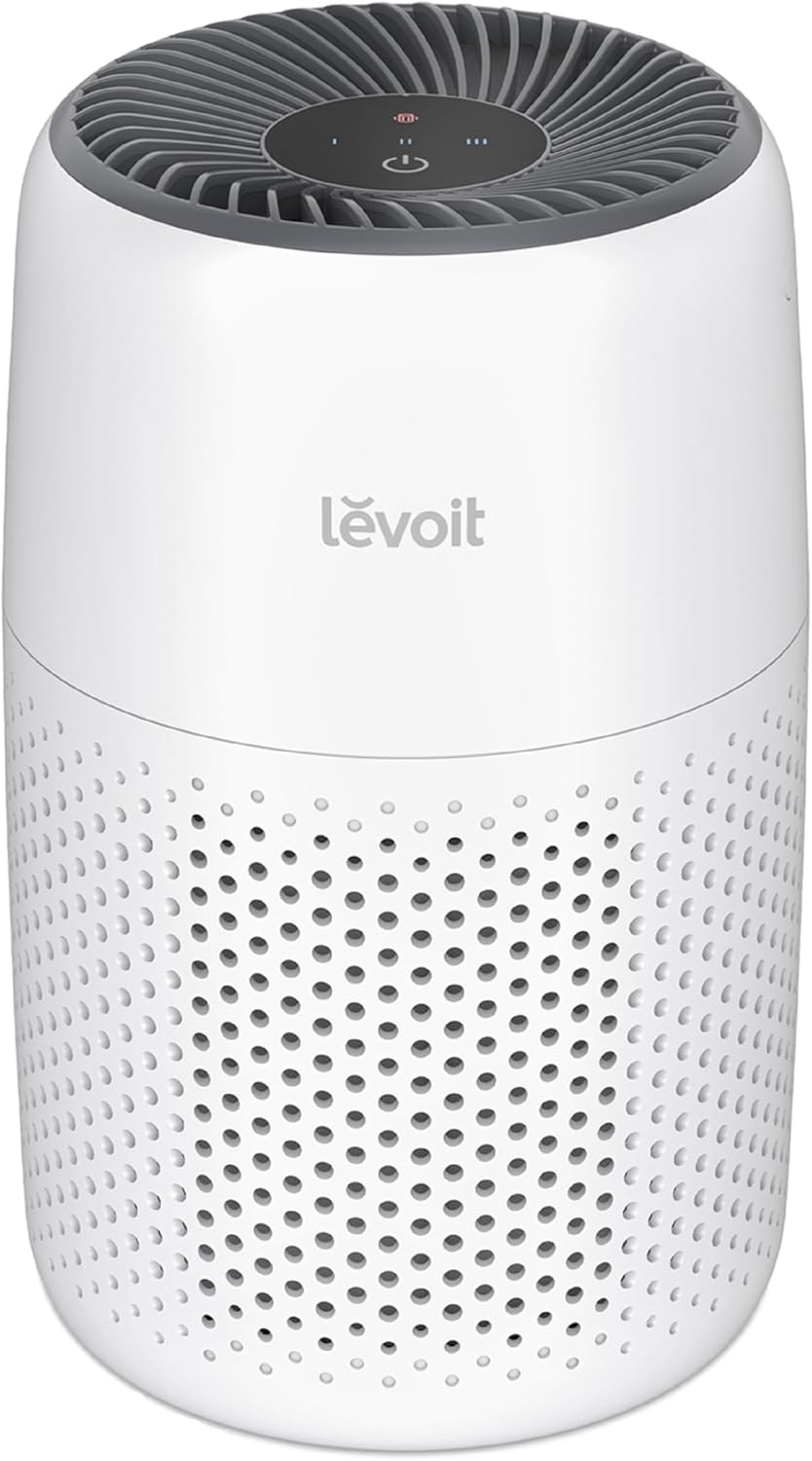
| Rated Power | 7W |
|---|---|
| Noise Level | 27-45dB |
| Adapter Input | 100-240V, 50/60Hz |
| Particle Retention Size | 0.3 micron |
The Levoit Core Mini-P is a small, low-power air purifier meant for close-range use in bedrooms, dorms, or offices without windows. It uses a pre-filter and main HEPA-style filter to capture lint, pet hair, pet dander, smoke and fine airborne particles while an included fragrance sponge lets you add a few drops of essential oil for a subtle scent. With rated power around 7W and a quoted noise range of roughly 27 to 45 dB it runs quietly enough for sleep mode or focused work, and the unit's compact footprint makes it easy to place on a nightstand or desk. The purifier includes an auto-off display and basic controls rather than smart-home connectivity, and filter replacements are required to keep performance steady. Because it is optimized for very small spaces, it will not be effective as a whole-room solution for larger open-plan areas, but it is strong where short-distance air cleaning and quiet operation matter most.
Best for: Buyers who want a proven, compact purifier to improve air right where they spend time and who prioritize quiet, low-power operation backed by strong user ratings.
Less Ideal for: People seeking an appliance to clean large rooms, open-plan living areas, or whole-apartment coverage should consider larger capacity purifiers instead.
- Compact desktop form factor fits on nightstands and desks
- Quiet operation with sleep mode suitable for bedrooms
- Captures pet dander, dust, smoke and other fine particles with staged filtration
- Low power draw around 7W for continuous use
- Simple aromatherapy option with a fragrance sponge
- Designed for very small rooms or near-source cleaning rather than whole-room purification
- No advanced connectivity or app control
Verdict: If you need a quiet, energy-efficient purifier for a bedroom or desk in a windowless room, the compact Core Mini-P delivers focused, reliable particle removal.
VOOPNU HEPA Air Purifier DH-JH12

| Filtration | H13 triple-layer HEPA |
|---|---|
| Noise level | 22 dB (low) |
| Coverage (lab) | 250 ft² per 15 minutes / 1,076 ft² per hour |
| Intake | 360° surround |
This compact VOOPNU purifier is built to run continuously in small rooms and bedrooms where window ventilation is limited. It draws air from all sides with a 360° intake and passes it through an H13 triple-layer filter that the brand says captures 99.97% of particles, which should help with pet dander, pollen, smoke, and odors. Controls are simple and the unit is quiet enough for bedrooms, with a low setting around 22 dB, and it includes a small essential oil tray if you want light scenting. Laboratory figures claim it cleans 250 ft² every 15 minutes and covers up to about 1,076 ft² per hour, making it suitable for single rooms or dorms. The purifier is compact and easy to place on a desk or shelf, and VOOPNU offers dedicated replacement filters including a pet-care option. Limitations are typical for small units: actual room performance will depend on placement and continuous run time, and replacement filters are an ongoing cost for sustained efficiency.
Best for: Buyers who prioritize a low-risk, easy-to-use bedroom or dorm-room air purifier that runs quietly and reliably without complicated setup.
Less Ideal for: People needing whole-house purification or high-volume coverage for open-plan living spaces should consider larger, higher-CADR systems instead.
- H13 triple-layer HEPA filtration captures fine particles and common allergens
- 360° surround intake for flexible placement in small rooms
- Very quiet operation down to about 22 dB suitable for bedrooms
- Compact footprint makes it easy to set on a desk, nightstand, or shelf
- Includes essential oil tray and offers factory replacement filters including a pet-care edition
- Coverage claims are lab-based and real-world results vary with room layout and continuous use
- Replacement filters are required periodically and add to operating cost
Verdict: A compact, quiet HEPA purifier that provides confident, fuss-free air cleaning for single rooms and bedrooms with limited ventilation.
Choosing the Right Air Purifier for Room Without Window: Key Factors to Consider
Filtration Technology and True HEPA Capture
A purifier's filtration technology determines what particles it actually removes. True HEPA filters capture at least 99.97% of particles down to 0.3 microns, which covers dust, pollen, and many fine particulates. For rooms without a window, relying on mechanical filtration is important because you cannot supplement ventilation with natural airflow.
Also consider whether the unit includes a prefilter or activated carbon stage. A prefilter traps larger debris and extends the life of the main HEPA element. An activated carbon layer helps reduce odors and volatile organic compounds that can linger in enclosed spaces.
Noise Output at Typical Settings
Noise matters more in windowless rooms where you are likely to spend long periods working or sleeping. Check manufacturer sound ratings at the low and medium fan speeds since those settings are used most of the time. Lower noise at night supports restful sleep while still providing continuous air cleaning.
Look for purifiers with a true low-noise mode and clear decibel ratings. Some designs achieve quieter operation through larger fans running at lower RPM or via optimized airflow channels that reduce turbulence.
CADR and Realistic Coverage Area
CADR ratings indicate how quickly a purifier removes smoke, dust, and pollen from the air. For a room without a window, choose a unit whose CADR and recommended square footage match the enclosed space so air is exchanged multiple times per hour. Overrated coverage claims lead to underperforming results in closed rooms.
Also consider ceiling height. Most coverage specs assume standard 8-foot ceilings. If your room is higher or unusually shaped, reduce the effective coverage accordingly and target a higher CADR to maintain similar air-change rates.
Filter Replacement and Maintenance
Maintenance frequency affects both long-term cost and continued performance. Check how accessible replacement filters are, whether they are easy to swap without tools, and whether standard or proprietary filters are used. Units that lock or seal filters well prevent bypass of untreated air, which is critical in a closed room.
Also note filter life estimates and whether the unit provides clear end-of-life indicators. In windowless rooms with continuous use, filter life may be shorter, so consider both lifespan and replacement ease when choosing.
Energy Use for Continuous Operation
Because rooms without windows often rely on purifiers for continuous air quality control, energy draw becomes a practical concern. Look for devices that deliver high clean-air delivery per watt, and check power consumption at typical low and medium settings to estimate daily running cost.
Units with programmable timers, eco modes, or automatic sensor-driven adjustments can reduce energy use by lowering fan speed when the room air is already clean. These features are especially valuable if you plan to run the purifier overnight or while away for extended periods.
Safety and Stable Operation in Enclosed Spaces
Safety features matter when a device runs for long hours in a sealed room. Important considerations include thermal protection to prevent overheating, a stable base that resists tipping, and a design that prevents foreign objects from entering the intake. Avoid purifiers that produce ozone or rely primarily on unproven ionizing methods in closed environments.
Also review certifications and documented safety testing where available. Models intended for continuous indoor use should be designed to maintain performance without generating secondary pollutants that could accumulate in a room without ventilation.
How Much Air Exchange You Actually Need
Air-change rate is a practical way to think about purifier sizing. For bedrooms and small enclosed rooms, aim for at least 4 to 6 air changes per hour when occupants are present. This target removes the majority of airborne particulates and helps control odors and CO2-related stuffiness when combined with other ventilation strategies.
To calculate needed CADR roughly, multiply the room volume by the desired air changes per hour and convert to cubic feet per minute. Many buyers find it easier to pick a purifier rated for the stated square-foot coverage that aligns with their room size, then confirm the CADR supports the desired exchange rate.
- Smaller rooms need less total CADR but still benefit from higher air-change targets if occupancy or pollutant load is high.
- Open-plan spaces with interior air mixing may require stepping up to a higher rated unit to achieve the same effective exchange in the specific enclosed area.
Placement Tips for Rooms Without Windows
Placement affects performance more than most people expect. Position the purifier away from corners and obstructions so intake and outlet airflow are not blocked. In narrow rooms, placing the unit near the center of the occupied zone or along the wall opposite the main doorway improves mixing.
Avoid placing the purifier directly on carpets or soft surfaces that can restrict bottom intakes. If the room includes a bed or desk, position the device so airflow moves across the breathing zone rather than directly at a wall or piece of furniture.
- Keep at least several feet of clearance on the intake side.
- Avoid enclosing the device inside a cabinet or behind curtains.
Managing Odors and VOCs in Sealed Spaces
Enclosed rooms tend to accumulate odors and volatile organic compounds from furniture, finishes, and daily activities. While HEPA filters remove particulates, they do not remove gases. For odor control, seek units with an activated carbon or specialized adsorption stage sized for the room's pollutant load.
Carbon filter effectiveness depends on the amount and type of carbon used. For persistent smells, look for thicker or replaceable carbon modules. Combining routine source control, such as limiting strong odor sources, with a carbon-equipped purifier yields the best results.
- Replace carbon filters on the manufacturer's recommended schedule for sustained odor control.
- Run the purifier at higher fan speeds when odors are introduced, then return to quieter settings once the air clears.
Night Use and Sleep-Friendly Features
If you plan to run the purifier overnight in a windowless bedroom, prioritize models with genuinely quiet low modes and a dimmable or lockable display. Some purifiers advertise 'sleep mode' but still emit fan and electronics noise that can disturb light sleepers.
Also consider units with programmable schedules or smart sensors that reduce fan speed once particles fall below set thresholds. These features keep the room quiet during deep sleep stages while maintaining adequate air cleaning.
- Check measured decibels at low settings; below 35 dB is typically unobtrusive for most sleepers.
- Avoid bright status LEDs near the bed or look for a physical display-off option.
Maintenance Habits That Keep Performance High
Regular vacuuming of prefilters, timely replacement of HEPA and carbon elements, and occasional exterior cleaning preserve airflow and filtration efficiency. In windowless rooms where continuous operation is common, maintenance intervals may be shorter than the nominal ratings listed by manufacturers.
Keep a simple maintenance log or set calendar reminders for filter checks. This small habit ensures the purifier continues to meet its rated performance and avoids reduced airflow or bypass that can occur when filters become heavily loaded.
- Inspect prefilters monthly in heavy-use environments.
- Record date of filter changes to compare actual lifespan against estimates.
How We Chose the Best Air Purifier for Room Without Window
We selected devices that specifically address the challenges of ventilating and cleaning air in rooms without windows. Key filters for inclusion were proven multi-stage filtration that includes true HEPA or equivalent particulate capture, low-noise performance at typical night and day settings, and appropriate CADR or stated coverage for small to medium enclosed rooms. We prioritized units with straightforward maintenance, accessible replacement filters, and safety features that reduce risk in continuously operated settings, such as thermal protection and stable housings. Excluded items included purifiers that rely primarily on ionization without substantial mechanical filtration, devices intended only for whole-house or HVAC integration, and models with inconsistent or unverifiable performance claims. Our evaluation emphasized measurable filtration capacity, sound level at low and medium fan speeds, filter life and replacement convenience, and energy use suitable for extended operation in closed rooms.
Our full evaluation process is outlined in our review methodology.
FAQ
Can an air purifier fully replace ventilation in a room without a window?
An air purifier reduces particulates, allergens, and some odors but does not replace fresh-air ventilation. Purifiers do not remove carbon dioxide buildup or provide fresh outdoor air, so consider intermittent ventilation of adjacent spaces or scheduled breaks to reduce CO2 levels when possible.
How loud will a purifier be if I run it all night?
Noise depends on the model and fan speed. Many units have low or sleep modes designed for overnight use that register under about 35 decibels and are unobtrusive for most people. Check the low-speed decibel rating and look for features like display dimming to reduce disturbance.
How often should I change filters in a continuously run purifier?
Filter life varies with pollutant levels and runtime. In a room without a window where the unit may run constantly, expect prefilters to need cleaning monthly and HEPA or carbon modules to require replacement more frequently than the nominal interval, possibly every 6 to 12 months depending on use.
Are ozone-generating purifiers safe for closed rooms?
Ozone-generating devices are not recommended for closed spaces because ozone can be irritating and harmful at elevated concentrations. For an enclosed room, choose purifiers that use mechanical filtration and certified safety features rather than ionization or ozone emission as primary cleaning methods.
Will a purifier remove household odors from a room with no ventilation?
A purifier with an adequately sized activated carbon stage can reduce many common odors, but effectiveness depends on the carbon amount and the odor source intensity. Persistent or chemical odors may require source control in addition to a carbon-equipped purifier.
Final Verdict
When choosing an air purifier for a room without a window, prioritize true HEPA-level filtration, appropriate CADR coverage for the enclosed volume, and quiet operation at low fan speeds. Balance filtration and carbon adsorption needs against maintenance frequency and energy use for continuous operation. Focus on units that make filter upkeep simple and provide verifiable noise and coverage specs. That approach helps you choose confidently and ensures sustained air quality in rooms where natural ventilation is limited.