
Note: This article contains affiliate links. If you click on these links and make a purchase, we may earn a small commission at no extra cost to you. This helps support our research and content. Read our full affiliate disclosure here.
If you live with wildfire haze, frequent cooking smoke, or occasional cigarette smoke, choosing the right air purifier for smoke matters to your daily comfort and health. A smoke-focused purifier reduces visible haze, removes tiny combustion particles that irritate lungs, and cuts lingering odors so rooms feel livable again. This guide shortlists seven top air purifiers for smoke, each chosen for measurable filtration performance, real-room coverage, and practical features like fan speed and quietness. Read on to see which models fit small bedrooms to larger living spaces and which features matter most for smoke removal.
Top Picks at a Glance
| Best Overall The best all-around choice for most situations | Medify MA-40 Air Purifier |  |
| Best Quality Built to a higher standard if you want something more solid | AirDoctor AD3500 Air Purifier |  |
| Best Value The sweet spot between price and what you get | Levoit Core Mini-P |  |
| Best Budget The cheapest option that still gets the job done reliably | FULMINARE H13 HEPA Air Purifier |  |
| Top Rated A top-rated pick with lots of positive feedback | ECOSELF HAP603 Air Purifier |  |
| Most Popular A crowd favorite that many people choose with confidence | Levoit Core 300-P Air Purifier |  |
| Best Seller A high-volume bestseller chosen again and again | VOOPNU DH-JH12 Air Purifier |  |
Medify MA-40 Air Purifier

| Coverage Area | 1,793 sq ft per hour |
|---|---|
| Filter Class | HEPA H13 |
| Particle Retention Size | 0.1 micron |
| Wattage | 95 watts |
| Noise Level | 46 db |
The Medify MA-40 is a plug-in air purifier built for sizable spaces, rated to clean up to 1,793 sq ft in an hour using a True HEPA H13 filter. It operates with a touch control panel offering multiple fan speeds, a timer, sleep mode, and a child lock for simple daily use in living rooms, open-plan homes, or offices. The H13 filter captures particles down to 0.1 microns, which helps with smoke, wildfire particulate, pet dander, pollen, and common odors, and the unit is certified by CARB and ETL. Noise is modest on lower speeds but can reach higher levels at maximum power, so placement and speed selection matter in bedrooms. Filters are replaceable and rated for roughly six months of typical use, and a filter indicator makes maintenance straightforward. The MA-40 is relatively large and draws notable wattage at full speed, so it is best when you need aggressive, continuous cleaning rather than a small, ultra-quiet bedside device.
Best for: Buyers who want a robust, high-coverage purifier to reduce smoke, wildfire particulate, and household allergens across large rooms or open layouts and value proven HEPA filtration and straightforward controls.
Less Ideal for: People seeking a compact, ultra-quiet bedside purifier or a low-power option for very small rooms should consider smaller models instead.
- High coverage with CADR suitable for large rooms and open spaces
- True HEPA H13 filtration captures particles down to 0.1 microns, effective against smoke and fine pollutants
- Touch controls with timer, sleep mode, and child lock for flexible operation
- CARB and ETL certification and a filter replacement indicator for safety and ease of maintenance
- Relatively large footprint and heavier than small-room purifiers
- Noise can be noticeable at highest fan speeds
- Filter replacement frequency (around 4-6 months) requires ongoing cost
Verdict: Choose the MA-40 when you need powerful, H13 HEPA-grade smoke removal for large rooms and open spaces.
AirDoctor AD3500 Air Purifier

| Model | AD3500 |
|---|---|
| Coverage | Up to 2,520 ft2 |
| Filtration | Pre-filter, Activated Carbon, UltraHEPA |
| Particle capture | 99.99% at 0.003 microns |
The AirDoctor AD3500 is a large-room purifier built for rapid removal of particles and smoke across wide spaces. It uses a three-stage system—pre-filter, premium activated carbon, and an UltraHEPA filter rated to capture 99.99% of particles down to 0.003 microns—to tackle smoke, dust, pet dander, pollen, and VOCs. The carbon layer is formulated to reduce gases and odors from cooking, wildfire smoke, and other emissions, and the unit includes PM2.5 sensors with an AirDoctor Halo display so Auto Mode can boost fan speed when air quality worsens. In practice the AD3500 moves air fast enough to cover hundreds of square feet quickly, and quiet operation makes it usable overnight. Maintenance is straightforward but requires replacing carbon every six months and the UltraHEPA yearly to keep peak smoke-removal performance. The unit is relatively large and heavier than small-room purifiers, so it is best placed in a central spot rather than moved often. For buyers focused on performance against smoke and gases, the AD3500 delivers measurable filtration power across very large rooms.
Best for: Buyers who prioritize strong, science-backed performance for removing smoke and airborne chemicals across large rooms and want a purifier that runs quietly and adjusts automatically.
Less Ideal for: People who need a lightweight, highly portable purifier for small bedrooms, desks, or travel should consider smaller, more compact models instead.
- Very high room coverage up to 2,520 sq ft for whole-room or open-plan use
- UltraHEPA filter captures extremely small particles down to 0.003 microns
- Premium activated carbon layer targets odors, VOCs, and smoke gases
- Auto mode with PM2.5 sensors and Halo display adjusts fan speed based on real-time air quality
- Quiet enough for continuous overnight or daytime use
- Large and relatively heavy compared with small-room purifiers
- Requires periodic replacement of carbon and UltraHEPA filters to maintain top performance
Verdict: If you need a high-performance purifier that rapidly reduces smoke, odors, and ultrafine particles across very large rooms, the AirDoctor AD3500 is engineered for that job.
Levoit Core Mini-P
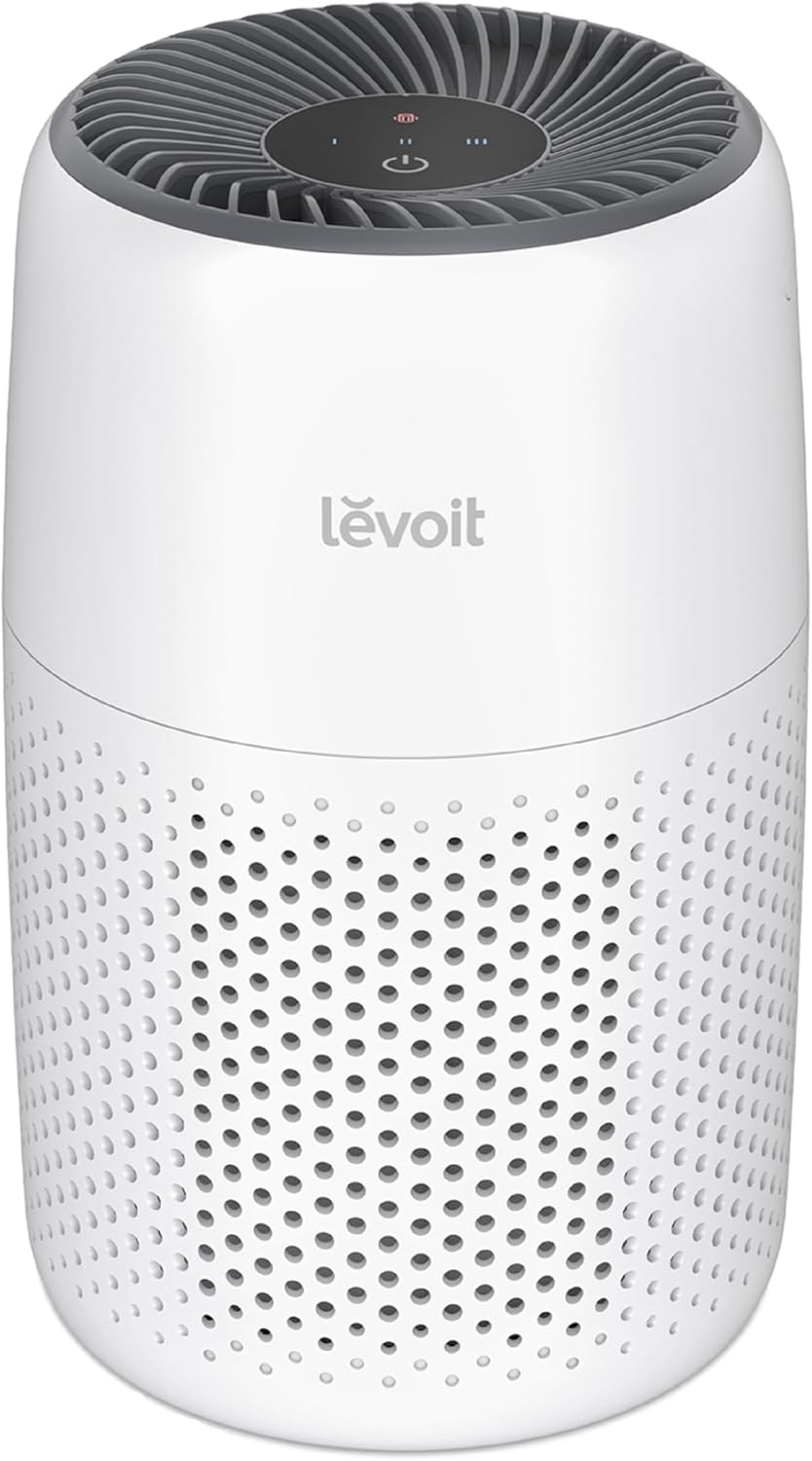
| Rated Power | 7W |
|---|---|
| Noise Level | 27-45dB |
| AHAM Verified | Yes |
The Levoit Core Mini-P is a small, plug-in air purifier aimed at personal spaces like bedrooms, offices, and desktops. It uses a pre-filter and a main high-efficiency filter to capture lint, pet dander, smoke particles, and other fine airborne pollutants, and it includes an aromatherapy sponge for light scenting. The unit is AHAM verified for performance, draws low power (listed at 7W), and runs quietly in sleep mode with noise levels reported around 27 to 45 dB, which makes it suitable for overnight use. Practical features include an auto-off display, simple controls, and a built-in adapter storage. Because it is compact, it focuses on localized cleaning rather than whole-room coverage, so it works best when placed near the pollution source or used for spot treatment of smoke and odors. Filter replacement and aromatherapy require occasional upkeep, and the small fragrance reservoir needs only a few drops to avoid overflow. For buyers who need a quiet, efficient purifier for small spaces or to tackle smoke close to the source, this is a sensible choice.
Best for: Someone who prioritizes efficient, low-noise air cleaning in small, frequently used spaces and wants a compact, energy-conscious unit for spot treatment of smoke or odors.
Less Ideal for: Households seeking whole-room or multi-room smoke removal or higher CADR performance should choose a larger purifier with greater coverage.
- Compact footprint fits on desks, nightstands, and small rooms
- Multi-stage filtration captures pet dander, dust, and fine smoke particles
- Very quiet operation with a low-noise sleep mode suitable for bedrooms
- Low power draw (7W) and AHAM verification for tested cleaning performance
- Designed for spot or small-space use and not intended to purify larger rooms
- Small aromatherapy reservoir requires careful dosing to avoid overflow
Verdict: Buy this if you need a quiet, energy-efficient purifier to remove smoke and odors in small, personal spaces.
FULMINARE H13 HEPA Air Purifier

| Filter type | H13 HEPA |
|---|---|
| Coverage | Up to 215 ft² / 20 m² |
| Noise level | Around 24 dB (low) |
| Timers | 2, 4, 8, 10, 12 hours |
The FULMINARE H13 is a small, budget-friendly air purifier designed for single rooms where smoke, pet dander, and common odors are a concern. It uses an H13 True HEPA filter and 360 degree outlet with dual-channel intake to circulate air up to five times per hour in spaces up to about 215 ft², making it suitable for bedrooms and home offices. Practical controls include a near-silent sleep mode reportedly around 24 dB, an independent night light, and five timer options for unattended use. The unit is portable and plugs in via a bottom-mounted adapter, and replacement filters are available separately. Expect straightforward operation and noticeably reduced airborne particles in modestly sized rooms, but do not expect rapid clearance in large open-plan areas or heavy wildfire smoke conditions where higher CADR or larger units are needed. Filter replacements are periodic and necessary to maintain performance.
Best for: Buyers who prioritize an affordable, compact purifier for a bedroom or small living space and want quiet overnight operation with simple controls.
Less Ideal for: People needing heavy-duty smoke removal for large rooms, open floor plans, or wildfire smoke exposure should choose a higher-capacity purifier with a documented CADR for smoke.
- H13 True HEPA filter capable of removing fine particles including smoke and pet dander
- 360° air outlet and dual-channel intake for even circulation in small rooms
- Very quiet low-speed operation suitable for light sleepers
- Independent night light and multiple timers for flexible overnight use
- Designed for rooms up to about 215 ft² so effectiveness drops in larger or very smoky spaces
- Requires periodic replacement filters sold separately
- Plug-in adapter stored under base can be inconvenient to access
Verdict: A budget-friendly, quiet bedroom air purifier with an H13 HEPA filter that handles light to moderate smoke in small rooms effectively.
ECOSELF HAP603 Air Purifier

| Coverage | Up to 2400 ft² |
|---|---|
| Filter efficiency | Captures 99.97% of particles |
| Noise level | 22 dB (Sleep Mode) |
| Sensors | PM2.5 display and infrared sensor |
The ECOSELF HAP603 is a large-room air purifier designed to scrub smoke, dust, pet dander, and odors from open living spaces. It uses a 2X-power filtration approach with a True HEPA H13-rated filter to capture 99.97% of airborne particles and is claimed to purify up to 2400 ft² twice per hour, which suits wildfire or indoor-smoke situations. A PM2.5 display and infrared sensor let the unit run in auto mode and ramp fan speed when air quality worsens, and a 22 dB sleep mode plus an aromatherapy option make it easy to leave running overnight. Practical touches include a filter indicator, timer, child lock, and simple controls for routine maintenance. The size and footprint are compact for a high-capacity purifier, and the brand emphasizes using official replacement filters for consistent performance. Buyers should note that high stated coverage figures are manufacturer claims and actual clean-air delivery depends on room layout and placement, and replacement filters are required to maintain peak performance.
Best for: Buyers who prioritize a quietly running, sensor-driven purifier to manage smoke and airborne particles in large living areas and want straightforward automatic control and maintenance features.
Less Ideal for: People who need verified CADR figures or lab-tested performance reports for precise engineering comparisons should consider models with published CADR measurements.
- True HEPA (H13) filter captures 99.97% of particles for effective smoke and allergen removal
- PM2.5 display and infrared sensor enable real-time air-quality monitoring and automatic speed adjustment
- Low-noise 22 dB sleep mode suitable for overnight continuous use
- Filter indicator, timer, and lock controls simplify maintenance and daily operation
- Coverage and 2X purification rate are manufacturer claims that vary with room layout and placement
- Requires official replacement filters to maintain stated performance
Verdict: Choose the HAP603 if you want a sensor-driven, quiet HEPA purifier focused on removing smoke and fine particles from large rooms with easy automatic operation.
Levoit Core 300-P Air Purifier

| Filter Type | 3 in 1 Filtration |
|---|---|
| Floor Area | 1073 square_feet |
| Noise Level | 24 db |
| Wattage | 56 watts |
| Particle Retention Size | 0.3 micron |
The Levoit Core 300-P is a small, portable HEPA air purifier built to pull smoke, pollen, dust, pet dander, and odors out of living spaces. It uses a 3-stage original filter (preinstalled) and a 56W motor that the manufacturer rates with AHAM-verified CADR figures, meaning it refreshes a 222 ft² room multiple times per hour and can address larger open areas up to the stated coverage rate. Practical features include a near-silent Sleep Mode that drops noise to about 24 dB, a simple touch control panel, a timer, and a filter-change indicator. The unit is CARB and ETL certified and designed for U.S. 120V outlets. Expect straightforward plug-and-play operation and noticeably reduced visible smoke and dust in small to medium rooms, but keep in mind that peak performance depends on using Levoit original filters and replacing them according to the recommended schedule. The Core 300-P lacks smart or auto modes found on some variants, so fan speeds must be adjusted manually to respond to changing smoke levels.
Best for: Buyers who prioritize proven, independently verified smoke removal and want a quiet, easy-to-use purifier backed by strong customer adoption and safety certifications.
Less Ideal for: If you need automatic air-quality sensing and hands-off operation or coverage for very large open-plan homes, consider models with smart Auto Mode or higher-capacity units.
- AHAM-verified CADR for smoke, dust, and pollen supports measurable room turnover
- True HEPA-grade filtration capturing particles down to 0.3 micron with 99.97% efficiency
- Very quiet Sleep Mode (~24 dB) suitable for bedrooms
- Compact, portable design that is easy to move between rooms
- Certified to CARB and ETL safety standards
- No built-in Auto Mode or air quality sensor for automatic fan adjustment
- Relies on manufacturer filters for rated CADR and optimal performance
- Coverage figures are based on specific testing conditions and may vary in real-world smoky environments
Verdict: Choose the Core 300-P when you want an AHAM-verified, quiet HEPA purifier that reliably reduces smoke and fine particles in bedrooms and mid-size rooms.
VOOPNU DH-JH12 Air Purifier

| Filter | H13 True HEPA triple-layer |
|---|---|
| Coverage | Up to 1,076 ft² per hour (250 ft²/15 minutes) laboratory tested |
| Noise level | Down to 22 dB |
| Speeds | 3 fan speeds |
The VOOPNU DH-JH12 is a small but capable air purifier that uses an H13 true HEPA triple-layer filter and 360° intake to capture fine particles, pet hair, pollen, smoke, and common household odors. It is intended for continuous daily use and the manufacturer states laboratory-tested coverage of up to 1,076 ft² per hour (250 ft² every 15 minutes), which makes it suitable for living rooms, bedrooms, and spaces affected by smoke. Controls are simple with three fan speeds, a timer and a quiet low setting that can run as low as 22 dB, and there is a small essential oil tray for fragrance if desired. The unit is compact and easy to move, and it carries multiple safety and performance certifications. Expect to replace disposable filters on a roughly 3–6 month cycle depending on use and air quality, and note that real-world CADR values are not listed on the product page so performance against heavy smoke events may vary compared with higher-CADR machines. The DH-JH12 is a straightforward option if you want low-noise, simple operation and HEPA-grade filtration in a small footprint.
Best for: Buyers who prioritize straightforward, low-noise HEPA filtration and want a compact purifier that can run continuously in living spaces to reduce smoke and common indoor pollutants.
Less Ideal for: People who need rapid clearing of heavy smoke in large open-plan areas or who require published high CADR ratings for wildfire or heavy-smoke scenarios should consider larger, higher-CADR units instead.
- H13 true HEPA triple-layer filter removes 99.97% of fine particles
- 360° air intake for more even air capture from the room
- Very quiet operation down to 22 dB for nighttime use
- Compact and portable footprint makes placement flexible
- Simple controls with three speeds and timer for easy daily use
- Manufacturer lists coverage claims but does not provide a CADR number on the product page
- Small unit may struggle to clear very smoky rooms as quickly as larger high-CADR purifiers
Verdict: A quiet, compact HEPA purifier for steady daily reduction of smoke and particles in bedrooms and medium rooms.
Choosing the Right Air Purifier for Smoke: Key Factors to Consider
Filtration Efficiency for Fine Particles
Smoke particles are often smaller than 2.5 microns and can penetrate deep into the lungs. Choose a purifier with a true HEPA or equivalent mechanical filter rated to capture PM2.5 or finer. The higher the capture efficiency for submicron particles, the faster visible haze will clear and the lower the particle load will remain over time.
Pay attention to the test data or specification language that documents particle removal percentages at PM2.5 or smaller. Filters that rely mainly on electrostatic attraction may show reduced effectiveness over time or with high load. For consistent smoke removal, favor mechanical filtration with documented efficiency.
Clean Air Delivery Rate and Room Coverage
A filter's effectiveness depends on how much air it processes. Clean Air Delivery Rate, or an equivalent manufacturer-stated room coverage, shows how quickly a purifier can cycle the air in a given space. Match the purifier's coverage to the room where you spend most of your time and consider a model rated for a slightly larger area if you use it in an open-plan space.
Also consider how often you need full air exchanges to control smoke levels. Rapid removal requires higher CADR or more frequent cycles at higher fan speeds, which affects noise and energy use. Look for clear, realistic coverage figures rather than vague claims.
Activated Carbon and Gas-Phase Filtration
Smoke carries volatile organic compounds and odors that penetrate beyond particulate filters. An activated carbon stage or other gas-phase media helps adsorb odor molecules and some combustion gases. The amount and type of carbon, plus how it is integrated, determine how effective the unit will be at reducing smell and VOC concentrations.
For heavy-smoke environments, deeper carbon beds or specialized gas-phase cartridges provide noticeably better odor control. Note that carbon capacity is a consumable resource that becomes saturated and needs periodic replacement to maintain performance.
Noise and Fan Speed Control
Higher fan speeds remove smoke faster but generate more noise. Evaluate how loud the purifier is at both its low and high settings, and whether it includes a quiet or sleep mode for overnight use. If you plan to run the unit continuously during smoke events, lower noise at effective fan speeds improves comfort and increases the chance you will keep it running when needed.
Variable fan speeds, programmable timers, and automatic modes that react to measured particle levels let you balance noise against performance without constant manual adjustments.
Filter Longevity and Ongoing Cost
Filters and gas-phase media require replacement; frequency depends on smoke intensity and runtime. Verify recommended replacement intervals and the relative cost of replacement filters. Longer-life filters or larger carbon capacities can increase upfront costs but lower long-term expenses, especially if smoke events are frequent.
Also consider how easy filter replacement is and whether the unit provides filter-life indicators. Access to replacement supplies and clear maintenance guidance makes ownership simpler and keeps performance reliable.
Placement, Footprint, and Energy Use
Where you place the purifier matters. Units with 360-degree intake or tall, tower designs may be more flexible in room placement, while wide-canister designs benefit from central floor placement. Check the unit's physical footprint and weight if you plan to move it between rooms.
Continuous operation during smoke events increases energy use. Look for models with efficient motors and multiple power settings to help manage electricity consumption while achieving the filtration you need.
How Smoke Differs From Other Indoor Pollutants
Smoke is a complex mixture of ultrafine particles, gases, and odorous compounds that behave differently than dust or pet dander. The smallest smoke particles remain airborne longer and are more likely to pass through lesser filters, which is why true HEPA-class capture matters for smoke control.
Ozone and some ionizing approaches target gases or change particle charge but do not replace mechanical filtration for particle removal. Effective smoke mitigation uses both particle capture and gas-phase adsorption to reduce visible haze and lingering smell.
- Ultrafine particles require high-efficiency mechanical filtration.
- Gases and odors need activated carbon or other adsorbents.
- Placement and adequate airflow determine real-room performance.
Sizing Your Purifier for Different Rooms
Start by identifying the primary room where you will run the purifier. Bedrooms, living rooms, and open-plan kitchens have very different volumes and airflow needs. Use the manufacturer's room coverage or CADR as a guide and aim for a unit rated slightly above the room size for faster smoke clearing.
If you move the unit between rooms, select a model with a manageable weight and footprint, and consider two smaller units rather than one oversized unit to provide targeted removal where you need it most.
- Match rated coverage to room square footage and ceiling height.
- Consider two units for whole-home comfort instead of one central unit.
Running the Purifier During Smoke Events
During active smoke events, run the purifier at higher fan speeds until particle counts drop. Many units include auto modes tied to particle sensors that increase fan speed when airborne particles rise. Continuous operation is often necessary until outdoor air quality improves and indoor sources are removed.
Use closed windows and doors to prevent fresh infiltration of smoke. Also, be mindful of maintenance: heavy smoke loads shorten filter life and may require earlier replacement or additional pre-filter cleanings.
- Use automatic or high-speed modes for rapid reduction.
- Seal the room as much as practical to limit new smoke entry.
- Monitor filter indicators and expect increased replacement frequency after heavy smoke exposure.
Managing Odors and VOCs From Smoke
Activated carbon filters reduce many smoke-related odors and certain volatile organic compounds, but their capacity is finite. For persistent smells after a major smoke event, replacing or regenerating the carbon stage is often necessary to restore performance.
Some purifiers use blended gas-phase media targeted at specific gases. If odor control is a priority, prioritize units that specify carbon quantity or type and offer easy replacement cartridges so you can maintain adsorption performance over time.
- Carbon capacity matters more than a marketing mention of carbon.
- Expect carbon media to require more frequent replacement in smoky conditions.
Maintenance Tips to Keep Performance High
Regularly inspect pre-filters and clean or replace them according to the manufacturer schedule. Pre-filters capture larger particles and extend the life of HEPA and carbon stages. In smoky environments, vacuum or swap pre-filters more often to prevent loading.
Keep intake and outlet grilles free of obstructions and avoid placing the unit directly against walls. Track filter-life indicators and have replacement filters on hand during wildfire season or periods of frequent smoke exposure to avoid downtime.
- Clean pre-filters monthly during heavy smoke use.
- Store replacement filters in a dry place and swap as soon as indicators suggest.
- Avoid using ozone generators or other unproven devices near purifiers.
How We Chose the Best Air Purifier for Smoke
We evaluated models that specifically address smoke removal and airborne combustion particles. Selection focused on measurable filtration capability, airflow and room coverage, contaminant removal speed, reliability for continuous operation, and noise and runtime characteristics. We prioritized units with true high-efficiency mechanical filtration capable of capturing fine particulate matter, supported by adequate clean air delivery for common indoor room sizes. Practical factors such as filter life and replacement ease, control options and fan speeds, and energy use under continuous operation were also weighted. Excluded items included devices that rely solely on ozone or ionization without proven particulate capture, units intended only for odor masking, and products lacking clear specification for particulate removal or room CADR-equivalent performance. Final picks balance lab-style filtration metrics with real-world usability for people trying to reduce smoke and smell in their homes.
Our full evaluation process is outlined in our review methodology.
FAQ
How quickly will an air purifier remove smoke from a room?
Removal speed depends on room size, purifier airflow, and the particle load. A properly sized purifier running at a high fan speed can reduce visible smoke and particle counts in under an hour in a typical bedroom; larger open spaces will take longer.
Do HEPA filters remove smoke odor?
HEPA filters capture particulate matter but do not remove gases and many odor molecules. A gas-phase stage, typically activated carbon, is needed to reduce smell and some volatile compounds associated with smoke.
Can I run an air purifier continuously during wildfire season?
Yes. Continuous operation is common during smoke events, but it increases filter wear. Choose models with efficient motors, monitor filter life closely, and ensure you have replacement filters available when usage spikes.
Is a higher CADR always better for smoke?
Higher CADR generally clears smoke faster, but it also increases noise and energy use. Balance CADR with acceptable noise levels and choose a unit rated for a slightly larger space than your primary room for better performance.
Are ionizers or ozone-producing devices suitable for smoke removal?
Devices that rely on ozone or unproven ionization are not recommended as a primary smoke control method because they do not reliably remove fine particles and may introduce health concerns. Mechanical filtration combined with carbon adsorption is the safest, most effective approach.
Final Verdict
When choosing an air purifier for smoke, prioritize proven particle-capture capability and adequate airflow for the rooms you occupy most. Add meaningful activated carbon capacity if odor and gas-phase compounds are a concern, and balance fan speed against acceptable noise for continuous use. Plan for shorter filter life during heavy smoke exposure and factor in replacement availability and cost. Focus on matching coverage to room size, ensuring true HEPA-class capture for PM2.5, and maintaining the unit regularly. Those priorities will deliver the clearest indoor air and the most consistent relief from smoke and smell.