
Note: This article contains affiliate links. If you click on these links and make a purchase, we may earn a small commission at no extra cost to you. This helps support our research and content. Read our full affiliate disclosure here.
If you or someone in your household smokes indoors, picking the right air purifier can dramatically reduce visible smoke, microscopic particles, and persistent odors. You need a unit that targets both fine particulate matter and volatile organic compounds so the air feels cleaner and surfaces smell fresher. This guide focuses on the top short-listed air purifiers for smokers, chosen for strong particulate capture, activated-carbon odor control, and practical room coverage. Below you will find our best picks with clear notes on performance, noise, and maintenance. Use the evaluation criteria to match a model to your room size and daily habits.
Top Picks at a Glance
| Best Overall The best all-around choice for most situations | Winix 5510 Air Purifier |  |
| Best Quality Built to a higher standard if you want something more solid | Coway Airmega 400 |  |
| Best Value The sweet spot between price and what you get | GermGuardian 22" Tower AC4825E |  |
| Best Budget The cheapest option that still gets the job done reliably | MEGAWISE True HEPA Air Purifier EPI810 |  |
| Top Rated A top-rated pick with lots of positive feedback | ECOSELF HAP609 Air Purifier |  |
| Most Popular A crowd favorite that many people choose with confidence | Levoit Core 300-P Air Purifier |  |
| Best Seller A high-volume bestseller chosen again and again | Levoit Vital 200S-P Air Purifier |  |
Winix 5510 Air Purifier

| Model | 5510 |
|---|---|
| Filtration Stages | 4-Stage |
| Smart Features | WiFi / Alexa / Google Home |
| AHAM Verified Coverage | 1,882 Ft² in 1 Hr |
The Winix 5510 is a four-stage air purifier aimed at large rooms and households dealing with fine particulates and odors. It uses a washable pre-filter, True HEPA filtration that captures ultrafine particles down to 0.01 microns, and an advanced deodorization carbon filter to reduce VOCs and smoke smells. Smart sensors feed an LED air quality indicator and enable Auto Mode so the fan speed adjusts to changing conditions, and the unit also supports the Winix Smart App plus voice assistants for remote control. PlasmaWave technology adds an extra layer intended to reduce airborne impurities, and Sleep Mode lowers noise when the room darkens. For smokers, the combination of high CADR performance, targeted carbon filtration, and automatic response to poor air quality makes this model effective at cutting smoke and lingering odors in larger spaces, though carbon filters will need periodic replacement to maintain odor control and the unit is a mid-size tower that requires floor space and occasional filter maintenance.
Best for: Smokers or households exposed to frequent smoke who want a responsive, app-enabled purifier that balances strong particulate removal with targeted odor control in larger rooms.
Less Ideal for: People seeking a tiny, desk-sized purifier for a single small room or those who want a maintenance-free unit without periodic filter replacements.
- True HEPA filtration captures particles as small as 0.01 microns for strong smoke and particulate removal
- Advanced carbon filter targets household odors and VOCs common with tobacco or cooking smoke
- Smart sensors with Auto Mode and LED air quality indicator provide hands-off, responsive cleaning
- Winix Smart App and voice assistant compatibility allow remote control and monitoring
- Ultra-quiet Sleep Mode for low-noise operation overnight
- Effective odor removal depends on timely carbon filter replacement
- Relatively large footprint compared with compact bedroom purifiers
- PlasmaWave is supplemental and not a substitute for regular filtration
Verdict: Choose the Winix 5510 if you need a smart, high-performance purifier that combines True HEPA filtration and an advanced carbon filter to tackle smoke and odors in large rooms.
Coway Airmega 400
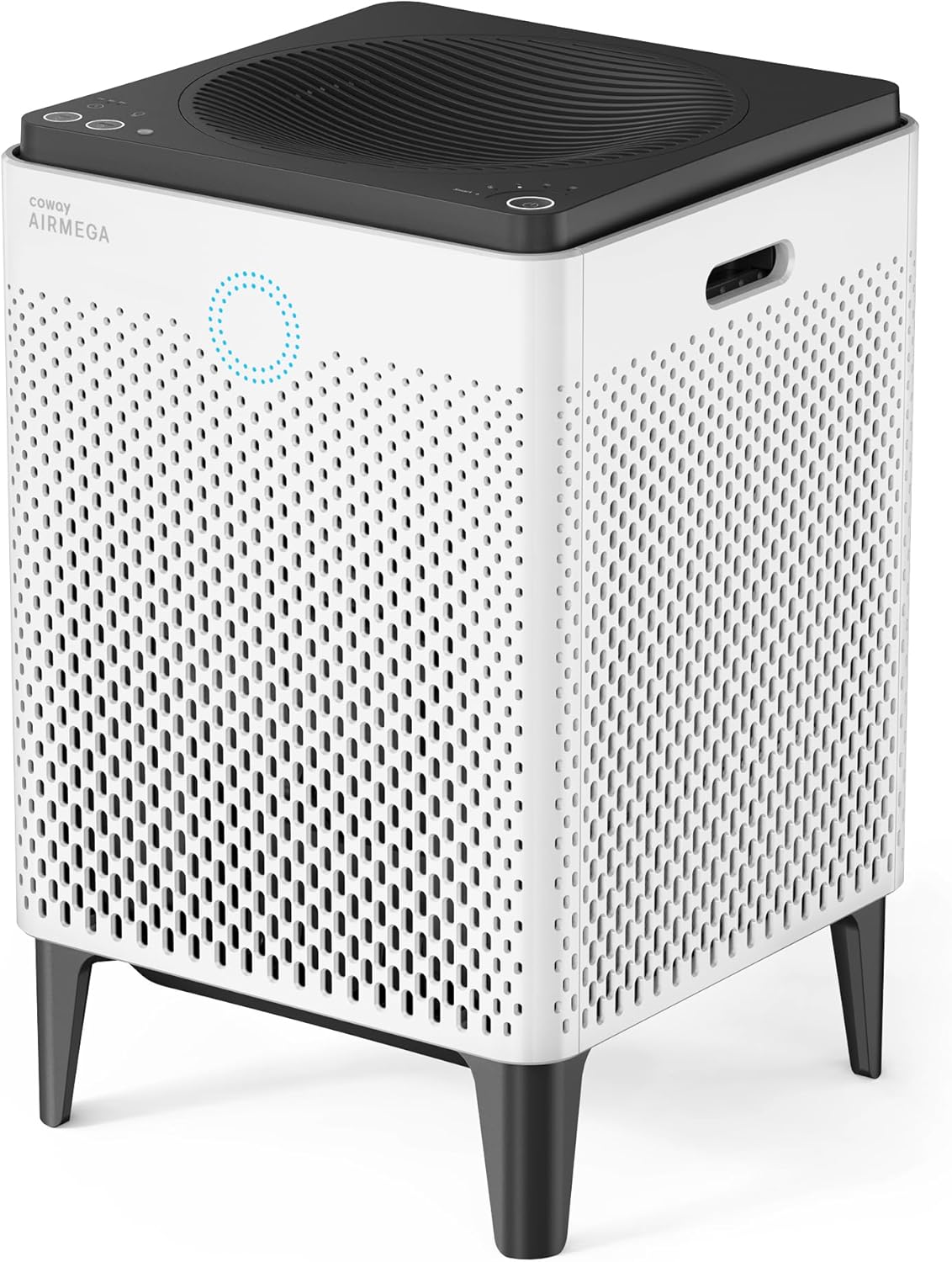
| Floor Area | 3120 square_feet |
|---|---|
| Filter Type | HEPA Filter, Active Carbon Filter, Pre-Filter |
| Particle Retention Size | 0.3 micron |
| Noise Level | 22 db |
| Wattage | 66 watts |
The Coway Airmega 400 is a heavy-duty air purifier built to handle large spaces and persistent pollutants like smoke. It combines a washable pre-filter, activated carbon filter, and HEPA stage rated to capture 99.97% of 0.3 micron particles, while the carbon layer targets odors and VOCs common with tobacco and wildfire smoke. The unit monitors air quality in real time and offers Smart, Eco, and Sleep modes that automatically adjust fan speed to balance performance and energy use, plus a timer and filter life indicator for maintenance. At its higher settings it moves a lot of air (designed for up to 3,120 sq ft per hour) and still claims a relatively low starting noise figure, though you should expect louder operation when addressing heavy smoke. It is a large, relatively heavy appliance and requires replacement filters over time, but for rooms where smoke is a recurring problem the combination of strong particle capture, gas adsorption testing, and automatic AQI-driven control makes it a practical, high-performance choice.
Best for: Buyers who prioritize fast, measurable removal of smoke and VOCs in large living areas and want an automated system that adapts to changing air quality.
Less Ideal for: People who need a small, lightweight purifier for a single bedroom, travel, or infrequent use should choose a compact model instead.
- High coverage suitable for very large rooms (up to 3,120 sq ft in 60 minutes).
- Multi-stage filtration with HEPA plus activated carbon to capture particles and reduce smoke odors and VOCs.
- Real-time air quality monitor and Smart/Eco/Sleep modes automate performance and energy use.
- Energy Star and safety certifications indicate tested efficiency and compliance.
- Large footprint and weight make it less portable between rooms.
- Higher fan speeds required for heavy smoke will raise noise and power draw.
Verdict: If you need a high-capacity purifier that aggressively cuts smoke particles and odors across large rooms, the Airmega 400 delivers the performance and automated controls to do it.
GermGuardian 22" Tower AC4825E

| Coverage refresh rate | 153 sq ft every 12.5 minutes; up to 743 sq ft per hour |
|---|---|
| Filter type | True HEPA with activated carbon pre-filter |
| Fan speeds | Three speeds with sleep mode |
| Optional feature | UV-C light (optional) |
The GermGuardian 22" Tower AC4825E is a compact tower purifier built around a True HEPA filter, an activated carbon pre-filter, and an optional UV-C light for additional sanitizing. It is intended for whole-room circulation: the manufacturer rates it to refresh air in a 153 sq ft room every 12.5 minutes and cover up to 743 sq ft at slower turnover. Typical use is continuous placement in living rooms, bedrooms, or dens where it runs on one of three fan speeds including a quiet sleep mode. The HEPA media captures fine allergens and particulates down to 0.1 microns while the carbon layer reduces cooking and pet odors and some smoke compounds, and compatible replacement filters and UV bulbs are available for straightforward upkeep. Trade-offs are that the UV-C is optional rather than integrated into every cycle and performance for heavy cigarette smoke or very large open areas will depend on placement and runtime, so multiple units or higher-capacity models may be needed for persistent, high-volume smoke sources.
Best for: Buyers who want a practical, easy-to-maintain purifier for living spaces that reduces allergens, pet smells, and light-to-moderate smoke odors while prioritizing predictable filter replacement.
Less Ideal for: People needing a dedicated, high-capacity solution for heavy, continuous tobacco smoke in large or poorly ventilated spaces should consider larger commercial-grade units or multiple purifiers.
- True HEPA filter captures very small particulates down to 0.1 microns
- Activated carbon pre-filter helps reduce odors and some smoke-related scents
- Three fan speeds including a quiet sleep mode for nighttime use
- Compact tower design fits in bedrooms or living rooms and is easy to position
- Uses compatible factory replacement HEPA, carbon filters, and UV-C bulbs for predictable maintenance
- Not specifically optimized for heavy continuous cigarette smoke in large open-plan areas
- UV-C function is optional and not a substitute for more powerful filtration in extreme smoke conditions
Verdict: A practical, easy-to-service tower purifier that cuts allergens and light-to-moderate smoke odors while fitting well in bedrooms and living rooms.
MEGAWISE True HEPA Air Purifier EPI810

| Filtration | True HEPA (99.97% at 0.3 μm) |
|---|---|
| Coverage | Up to 215 sq ft |
| Fan speeds | 6 speeds |
| Noise level | <25 dB (sleep mode) |
This compact MEGAWISE purifier uses a True HEPA filter to capture 99.97% of particles down to 0.3 microns, which makes it well suited for reducing smoke, dust, and pet dander in medium rooms. The unit pushes air in a 360° pattern and offers six fan speeds plus a negative ion mode so you can dial airflow up for heavy smoke or run near-silent sleep mode (<25 dB) overnight. A filter replacement indicator and a washable pre/filter (remove packaging before use) lower ongoing costs, and its small, lightweight design fits nightstands or desks for targeted use. Expect practical performance for smoke mitigation in bedrooms, nurseries, or home offices, though the compact size means it is optimized for rooms up to about 215 sq ft and may need multiple units for whole-house coverage. The feature set favors value and quiet operation over advanced smart controls or multi-stage commercial filtration.
Best for: Buyers prioritizing an affordable, quiet purifier to reduce smoke and fine particles in single rooms such as bedrooms or home offices who prefer low running costs over smart connectivity.
Less Ideal for: People seeking whole-house smoke protection, integrated smart home controls, or commercial-grade multi-stage filtration should consider higher-capacity or feature-rich alternatives.
- True HEPA filtration removes 99.97% of particles down to 0.3 μm, effective against smoke and fine particulates
- 360° airflow and six fan speeds let you adjust circulation for different smoke levels
- Near-silent sleep mode under 25 dB for overnight use
- Washable filter and replacement indicator reduce operating costs
- Coverage is limited to about 215 sq ft, so larger areas may require multiple units
- Lacks advanced smart features like Wi-Fi app control or scheduling
Verdict: A budget-friendly, quiet True HEPA purifier that effectively reduces smoke and fine particles in single rooms while keeping operating costs low.
ECOSELF HAP609 Air Purifier

| Model | HAP609 |
|---|---|
| PM2.5 Display | Yes |
| Sleep Mode Noise | 20 dB |
| Timer | 1–24 hours |
The ECOSELF HAP609 is a small tower-style HEPA air purifier built to continuously scrub indoor air using a 360° intake and a multi-stage filter system. It is typically placed in bedrooms or living rooms where it runs on Auto to adjust fan speed based on its PM2.5 sensor, or in Sleep mode to drop to about 20 dB and turn off lights for undisturbed rest. The real-time PM2.5 display and color ring make it easy to see air quality at a glance, and the 1–24 hour timer helps schedule operation when you need it most. For smoke-heavy environments the unit's automatic ramp-up helps handle transient spikes without manual intervention. Trade-offs are its compact footprint and consumer-grade design, which suit single-room coverage rather than whole-house purification, and replacement filters will be a recurring cost. Noise performance and the discreet display make it a solid bedside or apartment option for reducing smoke, dust, and pollen exposure.
Best for: Buyers who prioritize reliable, automatic removal of smoke and fine particles in bedrooms or apartments and who want clear real-time air-quality feedback with minimal fuss.
Less Ideal for: Households needing whole-house or multi-room coverage, or buyers who want a heavy-duty commercial-grade smoke filtration system.
- 360° air intake for more even room circulation
- Built-in PM2.5 sensor with color ring and numeric display for real-time feedback
- Auto mode that increases fan speed automatically during pollution spikes
- Very quiet Sleep mode at about 20 dB and lights-off for overnight use
- Programmable 1–24 hour timer for scheduled operation
- Compact design limits effective coverage to single rooms rather than whole-house use
- Requires periodic replacement filters which adds ongoing cost
Verdict: Choose the ECOSELF HAP609 if you want an easy, reliable bedroom or apartment air purifier that automatically detects and reduces smoke and fine particles with whisper-quiet overnight operation.
Levoit Core 300-P Air Purifier

| Filter Type | 3 in 1 Filtration |
|---|---|
| Floor Area | 1073 square_feet |
| Noise Level | 24 db |
| Wattage | 56 watts |
| Particle Retention Size | 0.3 micron |
The Levoit Core 300-P is a small, consumer-grade air purifier built around a three-stage Levoit filter and a 56W motor that produces a CADR suited for rooms up to about 222 sq ft for frequent air changes and can refresh much larger spaces more slowly. It is typically used in bedrooms, living rooms, or home offices to cut smoke, pollen, pet dander, dust, and odors. Notable features include H13-level HEPA-grade filtration with 99.97% capture of 0.1–0.3 μm particles, AHAM verification for CADR performance, a near-silent Sleep Mode that drops noise to about 24 dB, and simple touch controls with a timer and filter check indicator. Practical benefits are strong particle removal for smoke and allergens in personal rooms, low noise for nighttime use, and portability between rooms. Limitations are that this model lacks smart Auto Mode and connectivity found on some variants, so fan speed must be managed manually, and peak CADR is modest compared with larger whole-house purifiers, so expect slower clearing in very large open spaces.
Best for: Buyers who want a proven, quiet purifier to reduce smoke and fine particles in bedrooms or single rooms and who prioritize verified performance and many user reviews when choosing.
Less Ideal for: People seeking whole-house filtration, integrated smart home control, or the fastest possible clearing in very large open-plan spaces should consider larger or networked units instead.
- HEPA-grade 3-in-1 filter captures 99.97% of 0.1–0.3 μm particulates
- AHAM verified CADR with specific ratings for smoke, dust, and pollen
- Very quiet Sleep Mode at about 24 dB suitable for bedrooms
- Compact and portable design for moving between rooms
- Touch controls with timer and filter indicator for easy operation
- No smart connectivity or automatic Auto Mode on this model
- Smaller unit with limited CADR compared to larger purifiers for whole-house cleanup
Verdict: A compact, AHAM-verified HEPA purifier that delivers quiet, reliable smoke and fine-particle removal for bedrooms and single rooms.
Levoit Vital 200S-P Air Purifier

| Floor Area | 1875 square_feet |
|---|---|
| Noise Level | 27 db |
| Particle Retention Size | 0.1 micrometer |
| Power Source | Corded Electric |
| Wattage | 51 |
The Levoit Vital 200S-P is a smart air purifier built to handle large living spaces and homes with pets and smoke concerns. It uses a three-stage filter (washable pre-filter plus activated carbon and HEPA-style media) and an elevated CADR to cycle air quickly across rooms up to 1875 sq ft. Typical use is continuous indoor filtration: set it on auto or sleep mode for quiet overnight operation at about 27 dB, or use the app for remote control and scheduling. Notable features include AHAM verification, a built-in air quality monitor, and a U-shaped additional air inlet intended to reduce hair clogs. Practically, the combination of high airflow and an activated carbon layer makes it effective at reducing airborne smoke particles and common odors, while smart controls simplify hands-off operation. Limitations to consider are ongoing filter replacements for peak smoke and VOC removal and the unit's footprint and weight compared with compact travel purifiers, which may be overkill for very small rooms.
Best for: Buyers who prioritize proven, whole-room smoke removal and want a quiet, app-controlled purifier that runs reliably in living rooms or bedrooms without frequent hands-on adjustments.
Less Ideal for: People looking for a tiny travel or desktop purifier for single small rooms or those who want a purely budget, non-smart unit with minimal maintenance.
- AHAM-verified performance with high CADR for smoke, dust, and pollen
- Three-stage filtration including activated carbon for odors and smoke-related gases
- Quiet sleep mode at about 27 dB suitable for bedrooms
- Smart app control and air quality monitoring for automated operation
- Filter cartridges need periodic replacement to maintain smoke and VOC removal effectiveness
- Larger and heavier than small/portable purifiers, so less convenient to move frequently
Verdict: Choose the Vital 200S-P if you want an AHAM-verified, whole-room purifier with strong smoke and odor filtration and smart controls for worry-free operation.
Choosing the Right Air Purifier for Smokers: Key Factors to Consider
Filtration Technology
The core of any air purifier for smokers is its filtration stack. A true HEPA or HEPA-equivalent filter captures the fine particulate matter produced by tobacco smoke, including PM2.5 and ultrafine particles. Layered systems that add prefilters protect the HEPA media from larger debris and extend life.
Complementary media such as granular activated carbon or impregnated carbon beds are necessary to adsorb nitrogenous and volatile organic compounds that create lingering smoke odor. Units that rely only on electrostatic or ionizing modules often fail to remove gases effectively, so prioritize models with both particulate and gas-handling stages.
Room Size and CADR
Match the purifier's rated room coverage or CADR figures to the space where smoking occurs, not to the whole home. CADR (clean air delivery rate) estimates how fast a unit can remove smoke particles from a specific-sized room. Using a purifier undersized for the smoking room will leave odors and particles lingering and require continuous high-speed operation.
Consider placement too: a single powerful purifier in the room where smoking happens is usually more effective than distributing several small units across the home. For open-plan areas, choose a model with a higher CADR and documented coverage for larger square footage.
Odor Control & Gas Adsorption
Smoke contains gases and tars that cause persistent smells on fabrics and in carpets. Activated-carbon filters, especially thicker beds or those with higher surface area, adsorb many of the volatile compounds responsible for odor. Some carbon media are treated or impregnated to target specific compounds more effectively.
Assess how often you'll need to replace the carbon media: heavy smokers will saturate adsorption beds faster, reducing odor removal over time. A model that allows easy, affordable carbon refresh or has replaceable inserts will be more practical in high-use situations.
Noise, Speed Settings, and Usability
People who smoke indoors often run purifiers for long stretches, so noise output at different fan speeds is a key comfort factor. Look for units with low-noise sleep modes and a high-efficiency low-speed setting that still moves adequate air. Intuitive controls, programmable timers, and automatic sensors that respond to airborne particles reduce the need for constant adjustment.
Practical features such as filter-change indicators, washable prefilters, casters for portability, and straightforward filter ordering simplify ownership. Consider whether the unit's controls and indicators are easy to access where you plan to place it.
Operating Cost and Filter Lifespan
Upfront cost is only part of ownership. Smokers accelerate filter loading, especially of prefilters and carbon beds, so recurring replacement costs can become significant. Check typical filter lifespans under moderate to heavy smoking conditions and whether the manufacturer sells replacement filters at reasonable intervals.
Energy consumption matters if the purifier runs continuously. Models with efficient motors or auto modes that shift speed based on particle sensors tend to use less power overall. Factor both filter replacement frequency and expected electricity use into long-term cost estimates.
Safety and Emissions
Avoid purifiers that intentionally produce ozone or rely on high-level ionization as their primary cleaning method. Ozone can irritate airways and worsen indoor air quality. Choose units that meet recognized safety standards and that specify negligible ozone generation.
Also consider whether the purifier's materials and construction are suitable for continuous operation in a smoky environment. Durable housings and filters designed for heavy particulate loads reduce the chance of mechanical issues that prevent effective cleaning.
How Smoke Particles Differ From Everyday Dust
Tobacco smoke carries a higher proportion of ultrafine particles than typical household dust. Those smaller particles penetrate deeper into the lungs and are more difficult for basic filters to capture. Understanding this helps explain why not all air purifiers perform equally well in smoking environments.
Look for machines that specify efficiency at PM2.5 and below because those ratings reflect real-world smoke removal capability. Prefilters and multi-stage filtration systems help by removing larger material first and preserving the fine-particle media.
- Ultrafine particles travel farther and linger longer than larger dust.
- HEPA-level capture is essential for meaningful smoke reduction.
- Separate carbon stages address odors and gaseous compounds.
Placement Tips for Maximum Effectiveness
Place the purifier near the usual smoking area and not tucked into a corner or behind furniture. Direct airflow across the source helps catch smoke before it disperses into the rest of the room. For multiple seating areas, place the unit centrally or use two units sized appropriately for each space.
Avoid placing purifiers on the floor under low shelves where circulation is restricted. Elevated surfaces that still maintain safety are often better, provided the unit's intake and exhaust are unobstructed.
- Keep at least a few feet clearance around intakes and exhausts.
- Center the unit relative to the smoking zone whenever possible.
- Consider doorways and open-plan flow when positioning models in shared spaces.
Maintaining Filters Under Heavy Use
Smoking environments load filters faster, which degrades performance if not addressed. Inspect prefilters regularly and vacuum or wash washable prefilters per manufacturer guidance. Replace HEPA and carbon stages at the recommended intervals or sooner if odor and particle removal declines.
Track filter replacement dates and keep spares on hand if you expect heavy use. Some units have modular filter systems that make swaps quick and reduce downtime. Regular maintenance preserves airflow, lowers noise caused by working harder, and ensures sustained odor control.
- Check prefilters every 1 to 3 months in heavy-use scenarios.
- Expect shorter carbon-media life when controlling smoke odors.
- Maintain records of replacements to manage long-term costs.
Sensor Features and Auto Modes
Smart sensors that detect particulate levels can adjust fan speed automatically, delivering higher airflow during smoking sessions and quieter operation afterward. This automation conserves energy and reduces the need to manually switch settings during social situations.
When choosing a sensor-equipped purifier, verify whether the sensors are optimized for smoke particles. Some optical sensors are tuned to larger particles and may under-report smoke levels, which can result in lower-than-needed fan speeds.
- Prefer models with particle-sensing that explicitly mention fine-particle detection.
- Auto modes are useful for balancing performance and noise during varied use.
- Manual override should be easy when immediate high airflow is needed.
Common Misconceptions About Odor Removal
Many buyers expect a purifier to eliminate all smoke smell permanently from fabrics and carpets. In reality, while activated-carbon stages reduce airborne odor molecules, persistent smells embedded in textiles often require targeted cleaning. A purifier reduces recontamination and airborne transfer but is seldom a total solution for bound odors.
Combining filtration with cleaning soft surfaces and improving ventilation gives the best overall outcome. Use the purifier to limit airborne redeposition while addressing source materials directly.
- Air purifiers reduce airborne odor but do not remove odors already absorbed by fabrics.
- Regular cleaning of upholstery and soft surfaces complements purifier use.
- Ventilation plus filtration is more effective than filtration alone for persistent odors.
How We Chose the Best Air Purifier for Smokers
We evaluated models against criteria that matter specifically for indoor smoking environments. Priority went to filtration systems that combine high-efficiency particulate capture with effective gas and odor adsorption. We also considered CADR or equivalent airflow performance for removing smoke particles quickly from realistic room sizes, and tested reported noise and airflow settings to ensure the purifier can run continuously without being intrusive. Maintenance factors such as filter lifespan, ease of replacement, and visible filter-change indicators were important because smokers typically accelerate filter loading. Energy use and available speed modes were included to balance running cost and overnight comfort. We excluded units that lack a true HEPA-level particle filter or that rely solely on ionization without adequate particulate capture, as well as purifiers rated only for very small rooms. The end result is a short list of units that perform well at removing PM2.5 and smaller particles, control smoke odors through activated-carbon or equivalent media, and offer practical controls for daily use.
Our full evaluation process is outlined in our review methodology.
FAQ
How large a purifier do I need for a smoking room?
Choose a purifier with CADR and room-coverage ratings that match or exceed the room where smoking occurs. For open-plan areas, size up to handle the combined space rather than a single zone.
Will an air purifier remove nicotine stains or residue?
No. Purifiers reduce airborne particles and odors but do not clean nicotine residues or stains on surfaces. Those require manual cleaning of walls, fabrics, and other materials.
How often will filters need replacing if someone smokes indoors daily?
Filter life shortens with daily indoor smoking. Expect prefilters to need attention every 1 to 3 months and carbon or HEPA stages sooner than under light-use scenarios. Monitor performance and replace when airflow or odor control declines.
Are ozone-generating purifiers safe for smoke removal?
No. Purifiers that produce ozone can irritate the respiratory system and are not recommended. Choose units that explicitly state negligible ozone emission and rely on mechanical filtration and carbon adsorption instead.
Can I run the purifier while guests are smoking?
Yes. Running at a higher fan speed during smoking helps capture particles and reduce immediate odor. Use louder high speeds during sessions and switch to quiet or auto modes afterward to maintain air quality.
Do sensor-based purifiers detect cigarette smoke reliably?
Some sensors detect fine particles well, but others are optimized for larger dust and may under-report smoke. Look for models that specify sensitivity to fine particulate matter or include PM2.5 readouts.
Final Verdict
When choosing an air purifier for smokers, prioritize systems that combine true HEPA-level particle capture with substantial activated-carbon or equivalent gas adsorption. Match CADR and room coverage to the smoking area, and expect heavier maintenance and faster filter turnover in active smoking environments. Balance noise, energy use, and ongoing filter cost against performance needs. Ultimately, pick a purifier that fits the space and offers replaceable carbon media and clear maintenance indicators. That approach gives the best practical reduction in airborne smoke and odors while keeping operating effort and surprises to a minimum.