
Note: This article contains affiliate links. If you click on these links and make a purchase, we may earn a small commission at no extra cost to you. This helps support our research and content. Read our full affiliate disclosure here.
If you spend time in a room where people smoke, you need an air cleaner that actually captures fine smoke particles and reduces lingering odor. Picking the right air purifier for smoking room use matters because cigarette and vape aerosols include very small particulates and volatile compounds that are harder to trap than everyday dust. This guide shortlists the top options for smoking-room use and explains the evaluation criteria we used, including filtration effectiveness and room coverage. Read on to see which models make the cut and why they might suit your space and usage pattern.
Top Picks at a Glance
| Best Overall The best all-around choice for most situations | Winix 5510 Air Purifier |  |
| Best Quality Built to a higher standard if you want something more solid | Sans True HEPA Air Purifier |  |
| Best Value The sweet spot between price and what you get | MOOKA B-D02L Air Purifier |  |
| Best Budget The cheapest option that still gets the job done reliably | MEGAWISE True HEPA Air Purifier EPI810 |  |
| Top Rated A top-rated pick with lots of positive feedback | Levoit Core 300-P Air Purifier |  |
| Most Popular A crowd favorite that many people choose with confidence | GermGuardian AC4825E 22" Tower |  |
| Best Seller A high-volume bestseller chosen again and again | Levoit Vital 200S-P Air Purifier |  |
Winix 5510 Air Purifier

| Max room coverage (AHAM) | 1,882 sq ft/hr |
|---|---|
| Filtration | 4‑stage with True HEPA |
| Noise (low) | 23.5 dB |
| Smart features | WiFi, Alexa, Google Home |
The Winix 5510 is a four-stage air purifier built to clear airborne particles and odors in larger rooms. It combines a washable pre-filter, True HEPA capture down to 0.01 microns, and an advanced carbon deodorization layer to tackle smoke, pet odors, and VOCs, while Winix's PlasmaWave technology adds an extra ionic-style air treatment. Built-in sensors and an LED air quality indicator let the unit run in Auto Mode, adjusting fan speeds to current conditions, and a light-sensitive Sleep Mode keeps noise low at night. Wi-Fi plus app, Alexa, and Google Home compatibility let you monitor and control the purifier remotely. Practical benefits include strong smoke and odor reduction for smoking rooms, easy maintenance with a washable pre-filter, and automated operation for hands-off use. Important limitations are that PlasmaWave is not a replacement for proper ventilation and filter maintenance is required to sustain CADR performance over time.
Best for: Buyers who want a capable, automated purifier that handles smoke and strong odors in larger rooms and value app control and quiet night operation.
Less Ideal for: People who need a portable, ultra-compact unit for very small rooms or those who prefer filterless purifiers should consider other options.
- True HEPA filtration capturing very fine particles down to 0.01 microns
- Activated carbon deodorization layer for reducing smoke and household odors
- Smart sensors with Auto Mode and LED air quality indicator for automatic, efficient operation
- Wi‑Fi and app support plus voice assistant compatibility for remote monitoring and control
- Requires periodic filter replacements to maintain performance
- PlasmaWave is an auxiliary technology and should not substitute for ventilation
Verdict: Choose the Winix 5510 when you need a smart, high-capacity purifier that effectively reduces smoke and odors in large rooms.
Sans True HEPA Air Purifier

| Filtration | Pre-filter, True HEPA, Activated carbon |
|---|---|
| Coverage | Up to 1,854 sq. ft. |
| Noise level | 25 dB (Auto/Sleep) |
The Sans True HEPA Air Purifier is a tower-style unit built to clean large open spaces using a three-stage system: a pre-filter for hair and large debris, a medical-grade True HEPA filter for submicron particles, and a heavy-duty activated carbon layer to absorb odors and smoke. It is intended for continuous home use with smart sensors that auto-adjust fan speed based on air quality and a quiet sleep mode for low-noise operation. The purifier claims coverage up to 1,854 square feet, so it is suited to living rooms, open-plan areas, or dedicated smoking rooms where you want fast particle removal across a wide footprint. Practical benefits include dedicated pet-hair capture, an onboard filter-replacement indicator, and a design that prioritizes quieter running at night. Limitations to consider are the physical size and weight for placement in smaller rooms and the need to replace filters periodically to maintain high capture efficiency for smoke and VOCs.
Best for: Buyers who prioritize strong smoke and particle removal across large open areas and want a unit that runs quietly and adjusts automatically to air quality.
Less Ideal for: People who need a compact or ultra-portable purifier for small bedrooms, offices, or travel where floor space and weight are critical constraints.
- Medical-grade True HEPA filter captures very small particles down to 0.1 microns
- Heavy-duty activated carbon layer reduces smoke, cooking odors, and VOCs
- Smart sensors with auto-mode adjust fan speed for efficient continuous operation
- Sleep mode and low-noise operation suitable for night use
- Onboard indicator and quick filter replacement for simple maintenance
- Large unit that may be cumbersome in smaller rooms or tight layouts
- Requires periodic filter replacement to retain peak smoke and odor removal performance
Verdict: Choose this unit when you need a high‑coverage purifier that combines True HEPA and heavy carbon filtration to tackle smoke and odors in very large rooms.
MOOKA B-D02L Air Purifier
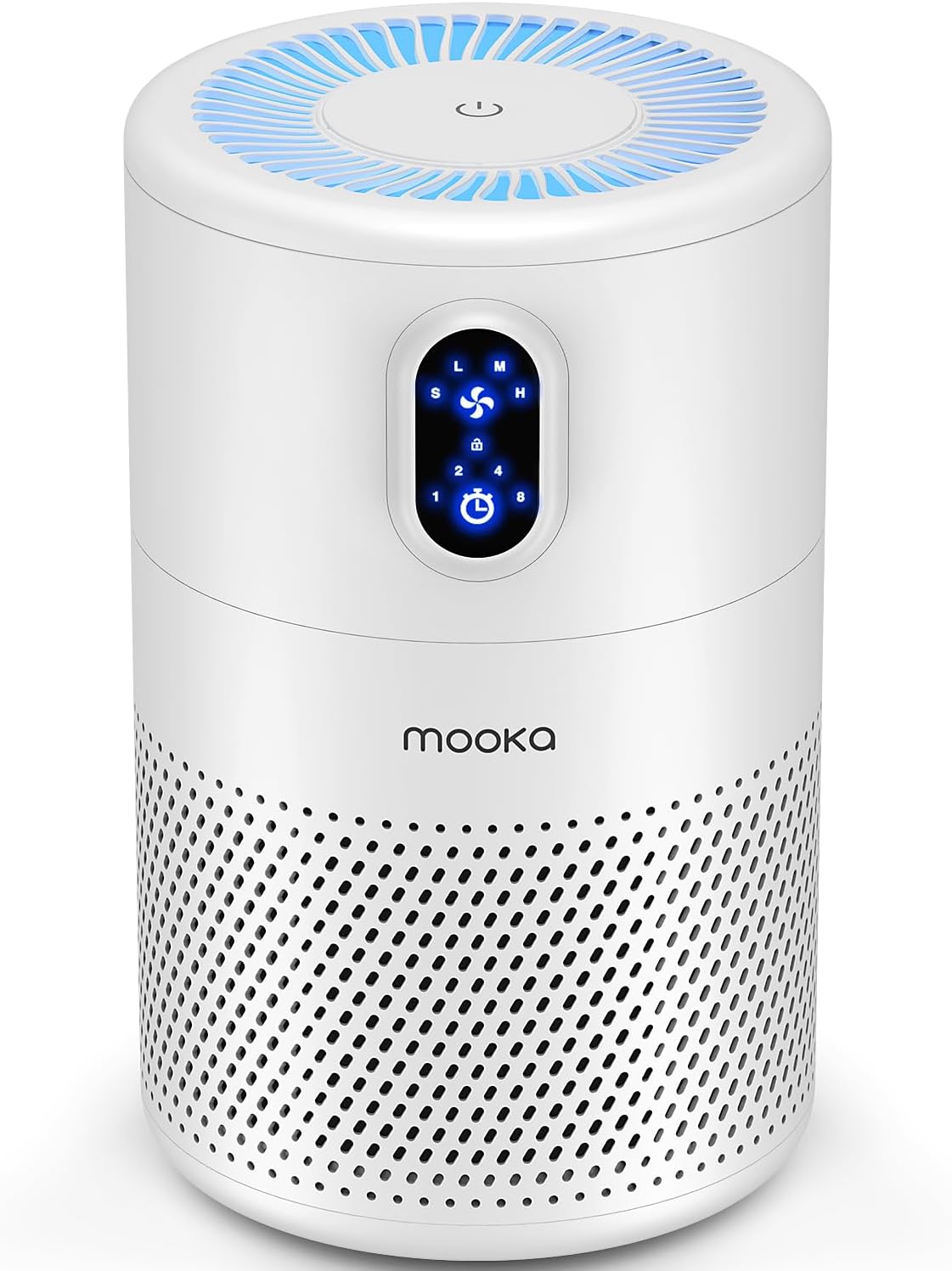
| Effective area | 1076 sq ft |
|---|---|
| Filter type | H13 True HEPA + activated carbon |
| Filter lifespan | 3-6 months |
| Fan modes | 4 speeds |
The MOOKA B-D02L is a tower-style air purifier built around an H13 True HEPA filter plus an activated carbon stage, aimed at removing smoke, pollen, pet dander, and dust in medium to large rooms. It pulls air through a pre-filter, HEPA element and carbon layer, and the manufacturer rates it for up to 1076 ft² with lower air-change rates at the maximum area and faster circulation in smaller rooms. Controls include four fan speeds, a night/sleep mode, a child lock, a filter-replacement reminder and four timer options. The unit uses a brushless motor for quiet operation—MOOKA cites noise as low as 20 dB—and runs on low power for energy savings. Practical features like a soft night light and an accessible bottom filter compartment make maintenance straightforward, though the replacement filter interval of 3–6 months will be a recurring cost for heavy smoke use. For smoking rooms the activated carbon helps with odors but persistent heavy smoke will require frequent filter swaps to maintain performance.
Best for: Buyers who want a low-noise, energy-efficient purifier with true HEPA and carbon filtration for tackling smoke and everyday pollutants in living rooms or bedrooms and who prioritize easy maintenance and sensible controls.
Less Ideal for: People needing continuous heavy-duty smoke removal for very smoky spaces or commercial smoking rooms should choose a higher-capacity unit with larger carbon capacity and faster clean-air delivery.
- H13 True HEPA filter captures particles down to 0.3 microns.
- Activated carbon layer reduces smoke and household odors.
- Quiet brushless motor suitable for night use.
- Multiple fan speeds, timers and child lock for flexible, safe operation.
- Replacement filters need changing every 3–6 months, increasing operating cost with heavy smoke exposure.
- Rated coverage (1076 sq ft) corresponds to low air-change rate at the top end, so performance is stronger in smaller rooms.
Verdict: A quiet, energy-efficient true HEPA purifier with carbon filtration that suits home smoking rooms when you want low-noise operation and straightforward maintenance.
MEGAWISE True HEPA Air Purifier EPI810

| Coverage | Up to 215 sq ft |
|---|---|
| Filtration | True HEPA (99.97% at 0.3 μm) |
| Fan Speeds | 6 speeds + Sleep Mode |
| Noise Level | <25 dB in Sleep Mode |
The MEGAWISE EPI810 is a small, portable air purifier built around a True HEPA filter that captures 99.97% of particles down to 0.3 microns, making it useful for reducing smoke, dust, and pet dander in a single-room setting. It draws air through a 360° intake and uses dual-channel airflow plus six speed settings to adjust cleaning power for cooking smells, wildfire or cigarette smoke, or everyday particulates. A near-silent sleep mode runs under 25 dB for night use, and a negative ion function is available for added air freshening. The unit is compact and lightweight so it fits on a desk or nightstand, and the washable filter lowers ongoing maintenance cost compared with disposable-only designs; a filter replacement indicator helps you know when to service it. On the downside the small footprint limits coverage to one room up to the stated area, and washable filters can lose peak efficiency over long use compared with replaceable multi-stage cartridges. For a budget-focused smoker or renter looking to improve single-room air, it offers a strong set of features for the price.
Best for: Buyers on a tight budget who need a portable, low-cost purifier for a single smoking or living room and prioritize running cost savings and quiet night operation.
Less Ideal for: Households that need whole-home filtration or sustained heavy smoke filtration should consider higher-capacity or multi-stage systems instead.
- True HEPA filtration capturing 99.97% of particles down to 0.3 μm
- 360° dual-channel airflow for even circulation in rooms up to 215 sq ft
- Six fan speeds plus a near-silent sleep mode for flexible noise vs performance balance
- Washable filter reduces recurring filter purchase costs
- Compact and lightweight design that fits on desks or nightstands
- Coverage limited to a single room up to the stated square footage
- Washable filter may degrade in efficiency over long-term use compared with replaceable multi-stage filters
Verdict: A budget-friendly, compact True HEPA purifier that quietly improves single-room smoke and particle levels while keeping ongoing costs low with a washable filter.
Levoit Core 300-P Air Purifier

| Power Source | ac |
|---|---|
| Filter Type | 3 in 1 Filtration |
| Floor Area | 1073 square_feet |
| Noise Level | 24 db |
| Wattage | 56 watts |
The Levoit Core 300-P is a small, well-built air purifier aimed at improving indoor air in bedrooms and larger living spaces. It uses a 3-in-1 Levoit Original filter (pre-filter, HEPA-grade layer, and activated carbon options) and a 56W motor that delivers AHAM-verified CADR figures suitable for removing smoke, dust, and pollen across rooms up to 1,073 square feet at a lower exchange rate or repeatedly in smaller rooms. Controls are touch-based with a near-silent Sleep Mode around 24 dB and an option to turn off display lights, making it unobtrusive at night. Practical benefits include proven filtration efficiency down to 0.1 micron and compatibility with specialized replacement filters for odors, smoke, or pet dander. Limitations are that this model lacks Auto Mode and smart connectivity found on some variants, so fan speed must be adjusted manually, and long-run effectiveness depends on timely use of genuine Levoit replacement filters as recommended by the manufacturer.
Best for: Buyers who prioritize consistent, proven air-cleaning performance and a quiet operation for living rooms or smoking rooms, and who plan to use factory replacement filters and manual controls.
Less Ideal for: Users who need Wi-Fi control, automated air-quality sensing, or hands-off automatic speed adjustments should consider models with smart features instead.
- AHAM-verified CADR with strong particle removal suitable for smoke and dust
- HEPA-grade filtration capturing particles down to 0.1 micron with 99.97% efficiency for 0.1–0.3 μm range
- Very quiet Sleep Mode at about 24 dB and option to turn off display lights for undisturbed night use
- Supports multiple Levoit replacement filter types (smoke remover, toxin absorber, pet allergy) for targeted cleaning
- No Auto Mode or smart connectivity on this Core 300-P variant so fan speed is manual
- Performance and CADR values apply to genuine Levoit filters and may not hold with third-party replacements
Verdict: Choose the Core 300-P when you want a reliable, AHAM-verified HEPA purifier that quietly tackles smoke and fine particles using factory filters.
GermGuardian AC4825E 22" Tower

| Coverage (small room air cycle) | 153 sq. ft. per 12.5 minutes |
|---|---|
| Coverage (max) | Up to 743 sq. ft. per hour |
| Filter type | True HEPA with activated carbon pre-filter |
| Speeds | 3 fan speeds |
The GermGuardian AC4825E is a compact tower purifier built to reduce airborne particles and household odors in bedrooms, living rooms, and other indoor spaces. It uses a genuine True HEPA filter that captures 99.97% of particles down to 0.1 microns, an activated carbon pre-filter for scents and smoke-related odors, and an optional UV-C lamp aimed at reducing airborne microbes. Use it on one of three fan speeds to balance noise and cleaning speed; the unit circulates air in a 153 sq. ft. room roughly every 12.5 minutes and can move air for larger spaces up to 743 sq. ft. at a slower rate. Practical benefits include simple controls, widely available replacement filters and bulbs, and CARB and ETL testing for safety. Limitations are its modest size and airflow relative to high-capacity purifiers, so it may need multiple units or longer run times to tackle very smoky rooms or whole-home coverage, and the UV-C option requires occasional bulb replacement to remain effective.
Best for: Buyers who prioritize proven filtration, safety certifications, and lots of user feedback and want a reliable room-level purifier to improve air quality in smoking or odor-prone rooms.
Less Ideal for: Do not choose this if you need whole-house throughput or rapid smoke clearing in very large spaces without running multiple units.
- True HEPA filter captures very small particles down to 0.1 microns
- Activated carbon pre-filter reduces cooking and smoke odors
- Three fan speeds including a quiet sleep mode for night use
- Compatible with widely available GermGuardian replacement filters and UV-C bulbs
- Air exchange rate is modest for very large or heavily smoky rooms
- UV-C lamp adds maintenance and must be replaced periodically
Verdict: A well-tested, widely reviewed tower purifier with HEPA plus carbon filtration that is a safe, reliable choice for improving air in single rooms where smoke and odors are a concern.
Levoit Vital 200S-P Air Purifier

| Floor Area | 1875 square_feet |
|---|---|
| Filter Type | 3-Stage Filter |
| Noise Level | 27 db |
| Particle Retention Size | 0.1 micrometer |
| Power Source | Corded Electric |
The Levoit Vital 200S-P is a Wi‑Fi–enabled air purifier built to tackle whole-room cleaning in spaces up to about 1875 square feet. It uses a three-stage filter (pre-filter, activated carbon layer, and HEPA-class media) and a U-shaped inlet design to capture fine particles, pet hair, odors, and smoke with a stated particle retention down to 0.1 micrometer. Typical use is in living rooms, bedrooms, or open layouts where you want continuous background purification: set it with the app or onboard buttons, let it run in sleep or auto modes, and the built-in air quality monitoring adjusts fan speed as needed. Notable features include AHAM verification and reported CADR figures for smoke, dust, and pollen that support faster air changes in large rooms, plus a washable pre-filter to extend main filter life. Practical benefits are strong smoke and odor reduction for households with smokers or recent wildfire smoke and low operating noise at sleep settings. Limitations are that replacement filter costs and periodic maintenance are required, and the unit's physical footprint and power draw reflect its large-room focus rather than a compact, low-power personal purifier.
Best for: Buyers who prioritize proven, whole-room smoke and odor removal and want a set-and-forget smart purifier that runs quietly in occupied spaces.
Less Ideal for: Those needing a tiny, ultra‑low-power personal unit for a desk or travel or buyers unwilling to budget for replacement filters over time.
- AHAM-verified performance with CADR ratings suitable for smoke removal in large rooms
- Three-stage filtration including activated carbon for odor and VOC reduction
- App and button controls plus built-in air quality monitoring for automated operation
- Washable pre-filter reduces frequency of main filter replacements
- Low noise sleep mode for overnight use
- Requires periodic replacement filters which add to lifetime cost
- Larger footprint and higher wattage than small personal purifiers
Verdict: Choose the Vital 200S-P when you want a verified, smart whole-room purifier that effectively reduces smoke and odors in large living spaces.
Choosing the Right Air Purifier for Smoking Room: Key Factors to Consider
Filtration Type and Efficiency
Filtration is the core of smoke removal. True HEPA filters capture at least 99.97 percent of particles down to 0.3 microns, which covers most smoke particulates, but efficiency at smaller sizes and the full system design matter too. Look for verified HEPA performance and clear manufacturer information about removal of ultrafine particles.
An effective smoking-room purifier pairs particle filtration with odor adsorption. The filter stack and airflow path determine whether smoke is drawn through the HEPA and carbon stages rather than bypassing them.
Activated Carbon and Odor Adsorption Capacity
Smoke carries volatile organic compounds and smell molecules that HEPA media do not trap. A substantial activated carbon stage or other dedicated adsorbent media is necessary to reduce odors and VOCs. Check for explicit carbon content, layer thickness, or specialty adsorbents designed for smoke.
Higher carbon volume generally improves odor longevity, but it also increases filter size and potential replacement cost. Consider whether the purifier offers replaceable carbon inserts or a combined particle-plus-carbon cartridge for simpler servicing.
Room Size and CADR (Clean Air Delivery Rate)
CADR and the manufacturer's recommended room coverage give a practical sense of how quickly a unit can clear smoke from the air. For smoking rooms you will often need higher CADR values than for standard dust removal because smoke particles are generated continuously when people smoke.
Match the purifier's recommended square footage or CADR to your actual room size and ceiling height. If the room is used by multiple people or smoking is frequent, choose a unit rated above your room size to maintain acceptable air quality between smoking events.
Noise and Fan Speed Behavior
A purifier in a smoking room may need to run at higher speeds for extended periods. Noise becomes a real factor if the room is used for conversation, TV, or relaxation. Compare measured noise levels at different fan speeds and check for practical features such as a night mode or a whisper-quiet low setting.
Also note how noise scales with increased fan speed. Some designs are louder but move a lot more air, while others remain moderate but have limited high-speed performance. Decide whether quieter continuous operation or intermittent high-power bursts fit your usage pattern.
Filter Replacement Interval and Ongoing Cost
Smoking loads filters faster than typical household use, meaning replacement intervals and cost become important. Look for published estimated filter life under heavy-use conditions and whether the manufacturer offers economy packs or subscription options.
Assess the ease of changing filters and whether standard sizes are available from multiple sources. Also consider whether the unit exposes used filters during replacement and how often you will need to handle smoky filters.
Maintenance, Placement, and Airflow Design
Proper placement affects a purifier's effectiveness in a smoking room. Units that intake and exhaust on opposite sides create better circulation, while top-down or 360-degree designs can be more forgiving in tight layouts.
Maintenance includes prefilter cleaning, sensor upkeep, and occasional exterior wiping. Choose a design that lets you access filters without tools and that has washable prefilters to extend HEPA and carbon life. Also consider whether the unit's footprint and weight fit your intended location.
How Smoking Changes Air Quality Needs
Smoke raises the concentration of fine and ultrafine particles and adds odor molecules and gases that typical dust-focused purifiers may not address. Persistent smoke can stick to fabrics and surfaces, so an air purifier is only one part of an overall strategy to reduce airborne contaminants.
Because smoking produces both particles and VOCs, a successful smoking-room approach combines strong particle capture with dedicated odor adsorption. Expect filter cartridges to require more frequent replacement than in low-pollution environments.
- Smoking creates continuous particulate generation when in use, so look for high CADR for sustained clearance
- Odor molecules are chemically different from particulates and need activated carbon or specialty adsorbents
- Surface contamination is separate from airborne removal; ventilation and cleaning are complementary measures
Placement Tips for Best Smoke Removal
Position the purifier so its intake is near the smoking source when possible, and ensure the exhaust directs cleaned air toward the rest of the room. Avoid placing units in corners or behind large furniture that blocks airflow.
If the room has one dominant seating area, place the purifier between that area and any open doorways to help prevent smoke from spreading to adjacent spaces. For larger rooms, use more than one unit or a higher-capacity model to achieve even coverage.
- Keep at least 12 inches of clearance around intakes and exhausts
- Avoid low-placement in rooms with high ceilings; elevated placement can aid circulation
- Do not block sensors or control panels with covers or decor
Managing Filters and Maintenance in Smoking Rooms
Expect prefilters and carbon layers to darken and saturate more quickly in smoking environments. Clean washable prefilters weekly or replace disposable prefilters on the schedule recommended for heavy use to protect the HEPA stage.
When handling used filters, place them in a sealed bag for disposal to limit residual odors. Keep replacement filters on hand to avoid running a unit with reduced capacity for extended periods.
- Check smoke-exposed units monthly for visible buildup
- Follow manufacturer guidance for sensor cleanings to avoid false air-quality readings
- Record filter change dates to track actual life under your usage pattern
Complementary Strategies: Ventilation and Surface Cleaning
An air purifier reduces airborne particles and some VOCs, but it cannot remove smoke residues adhered to walls, curtains, or upholstery. Regular cleaning and using ventilation when possible will greatly improve results.
Combine purifier use with opening windows, using exhaust fans, and cleaning soft surfaces to minimize lingering smells. In rooms where smoking is frequent, plan for deeper cleaning intervals for fabrics and painted surfaces.
- Use exhaust fans or brief cross-ventilation when weather and building rules allow
- Vacuum and launder soft furnishings to remove settled smoke particles
- Consider surface-safe deodorizing methods after thorough cleaning if odors persist
Sensor Accuracy and Auto Modes
Many purifiers include particle sensors and auto modes that adjust fan speed based on detected pollution. In smoking rooms sensors can be triggered frequently, which is helpful but also means filter life will be shorter.
If you rely on auto modes, verify whether the unit reports PM2.5 or other particle measurements and whether it filters or masks sensor readings. Consistent sensor performance ensures the purifier responds quickly when smoking starts.
- Auto modes conserve energy during low-activity periods but can lead to constant high-speed operation in smoking rooms
- Some sensors respond better to larger smoke particles than to ultrafine aerosol, so check sensor specifications if available
How We Chose the Best Air Purifier for Smoking Room
We focused on features and performance metrics that matter specifically when treating smoke and associated odors. Evaluation emphasized true HEPA filtration or equivalent particle capture, activated carbon or other adsorbent capacity for VOCs and odors, and CADR-rated airflow to ensure real-world smoke clearance. Noise output was considered because smoking rooms are often used for conversation or relaxation, so a unit must perform well at tolerable sound levels. We also weighed filter life and replacement cost, since smoking environments load filters faster, and assessed ease of maintenance for frequent servicing. Excluded from consideration were units that only advertise ionization or ozone generation without demonstrable particulate and odor removal, because those technologies can be ineffective or produce byproducts. We filtered out purifiers with insufficient coverage relative to typical room sizes or with poor documented airflow. The final list reflects devices that balance particle removal, odor control, reasonable noise, and sustainable upkeep for smoking-room conditions.
Our full evaluation process is outlined in our review methodology.
FAQ
Will a standard HEPA air purifier remove cigarette smoke odor?
A HEPA filter captures fine smoke particles but does not remove most odor molecules. To reduce smell you need a purifier with substantial activated carbon or other odor adsorbents in addition to HEPA filtration.
How often will filters need replacing in a smoking room?
Filter life depends on usage intensity, but expect prefilters and carbon layers to require replacement or cleaning much sooner than in smoke-free homes. Monitor performance and visually inspect filters monthly under heavy use.
Is ionization or ozone generation a good way to clean smoke?
Ionization can reduce airborne particles but may not address odors effectively and some ionizers produce ozone as a byproduct. Ozone can be harmful at elevated levels, so prioritize mechanical filtration plus carbon adsorption instead.
Can one purifier handle a large living room where people smoke?
It depends on the purifier's CADR and recommended room size. For frequent smoking or multiple people, choose a unit rated above the room's square footage or use multiple units to maintain adequate turnover.
Should I run the purifier continuously in a smoking room?
Running the purifier continuously or during and after smoking sessions will keep particle levels lower, but continuous high-speed operation accelerates filter wear. Balance runtime with replacement costs and consider using a higher-capacity unit to avoid constant top-speed operation.
Final Verdict
For smoking-room use prioritize units that combine verified particle removal with a substantial activated carbon stage. Give weight to CADR relative to your room size and to realistic noise levels for the space where the purifier will run. Expect faster filter wear and plan for more frequent maintenance and replacement. Choosing a slightly oversized purifier or multiple smaller units will reduce runtime at maximum speed and extend filter life while maintaining cleaner air. Focus on filtration and adsorption capacity first, then balance noise and ongoing costs to pick a practical solution for your smoking room.