
Note: This article contains affiliate links. If you click on these links and make a purchase, we may earn a small commission at no extra cost to you. This helps support our research and content. Read our full affiliate disclosure here.
Choosing the right air purifier with an activated carbon filter makes a noticeable difference in home comfort. These units do more than trap dust and pollen; the carbon stage specifically adsorbs odors, smoke byproducts, and many volatile organic compounds that particle filters miss. Picking the right model matters because room size, filter capacity, and noise output determine whether the unit handles your space effectively and stays usable day to day. This guide covers our six shortlisted air purifiers with activated carbon filter stages. We evaluate models on filtration effectiveness, airflow and coverage, long-term maintenance, and living-room practicality. Read on to find the option that matches your space, sensitivity to odors, and tolerance for upkeep.
Top Picks at a Glance
| Best Overall The best all-around choice for most situations | Winix 5520 Air Purifier |  |
| Best Value The sweet spot between price and what you get | Daikin MCB50YSAU Air Purifier |  |
| Best Budget The cheapest option that still gets the job done reliably | YARIKI P280 Air Purifier |  |
| Top Rated A top-rated pick with lots of positive feedback | Jafanda JF260 Air Purifier |  |
| Most Popular A crowd favorite that many people choose with confidence | PuroAir 400 HEPA Air Purifier |  |
| Best Seller A high-volume bestseller chosen again and again | Levoit Core 300-P |  |
Winix 5520 Air Purifier
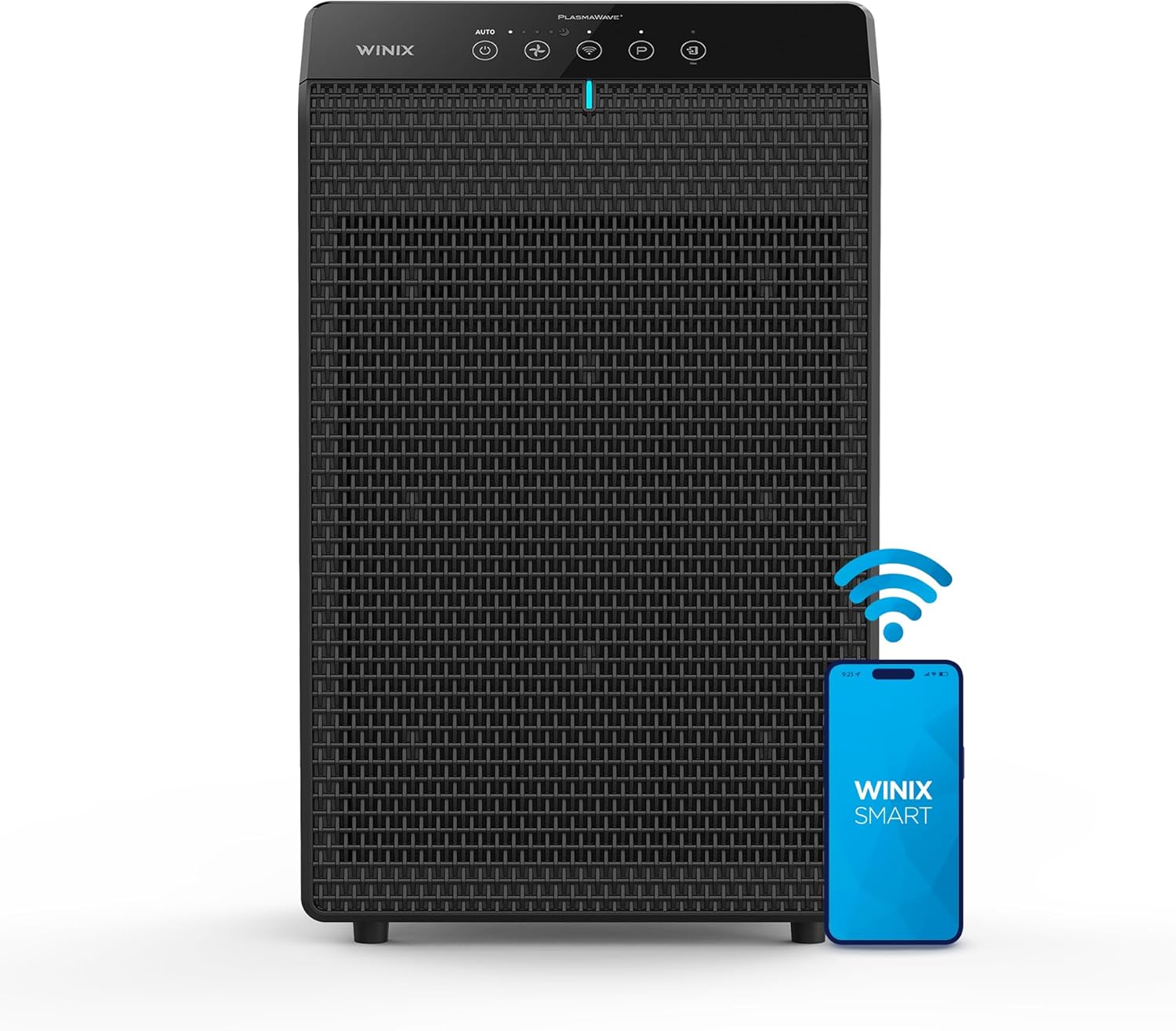
| AHAM verified coverage | up to 1882 sq ft per hour |
|---|---|
| Particle capture | captures particles as small as 0.01 microns |
| Noise (lowest) | 23.5 dB |
| Controls | Smart sensors, Auto Mode, Sleep Mode |
| App compatibility | Winix Smart App |
The Winix 5520 is a four-stage air purifier designed to clean large rooms quickly while managing odors and airborne particles. It pairs a washable pre-filter, True HEPA filter that captures very small particles, and an advanced carbon deodorization filter to reduce cooking, pet, and smoke odors, while PlasmaWave technology assists in breaking down pollutants. Built-in smart sensors and an LED air quality indicator let the unit run in Auto Mode, automatically adjusting fan speed based on real-time readings, and a light-sensitive Sleep Mode keeps operation nearly silent at night. The unit is AHAM verified and UL certified, and it supports remote monitoring through the Winix Smart App. Practical strengths are fast coverage and convenient automatic operation, but its performance depends on keeping filters replaced on schedule and PlasmaWave is an assisting technology rather than a standalone disinfectant. The purifier is a solid choice where continuous odor control and automatic air-quality adjustments matter most, though users should plan for periodic filter maintenance.
Best for: Buyers who want a dependable, low-maintenance air purifier that automatically monitors air quality and reduces household odors in larger rooms.
Less Ideal for: People who need a purifier for medical-grade sterilization or users who prefer units with built-in HVAC integration or specialized germicidal claims.
- True HEPA stage captures very small particles down to 0.01 microns for allergy and smoke removal
- Advanced carbon filter targets VOCs and household odors from cooking, pets, and smoke
- Smart sensors with LED air-quality indicator and Auto Mode adjust fan speed for hands-off operation
- Washable pre-filter extends main filter life and reduces replacement frequency
- Sleep Mode offers very quiet operation for nighttime use
- Requires replacement filters over time to maintain performance
- PlasmaWave is an assistive technology and should not be relied on as a primary sterilization method
Verdict: Choose the Winix 5520 when you want automatic, large-room odor control plus True HEPA filtration and real-time air-quality adjustments.
Daikin MCB50YSAU Air Purifier

| Item model number | MCB50YSAU |
|---|---|
| Floor Area (Sq. Ft.) | 245 |
| UVC LED Light | Yes |
| Fan Operation (Quiet Mode) | 21 dB |
| 4 Fan Speeds | Yes |
The Daikin MCB50YSAU combines a three-stage filtration stack—pre-filter, HEPA, and activated carbon—with an internal UVC LED to target particles, odors, and microorganisms captured by the HEPA stage. It is meant for single rooms and uses a four-speed fan with a whisper-quiet mode (about 21 dB) for overnight use. Controls are touch-based and the unit includes dust and odor sensors plus a digital display, making it easy to set and forget while sensors adjust performance. The carbon stage and advertised formaldehyde reduction improve odor and VOC handling compared with particle-only purifiers, and filters are user-replaceable. Limitations: coverage is AHAM-verified for about 245 sq ft at 4.8 ACH so it is not intended as a whole-home solution, and the UVC function works on contaminants trapped in the filter rather than disinfecting open air directly. The design is portable with side handles but you should factor periodic filter replacements for continued performance.
Best for: Buyers who want a compact, low-noise purifier that removes particles and common household odors and prefers simple sensor-driven operation for a bedroom or living room.
Less Ideal for: Those seeking whole-home or multi-room purification or very high CADR for large open-plan spaces should consider larger-capacity systems instead.
- Three-stage filtration with HEPA plus activated carbon for particles and odors
- UVC LED integrated to inactivate microbes trapped in the HEPA filter
- Very quiet low-speed operation (about 21 dB) suitable for bedrooms
- Sensor-driven operation with dust and odor sensing and a simple digital touch control
- Designed for single-room coverage (AHAM 245 sq ft) so not suitable for large open layouts
- UVC LED acts on the captured contaminants inside the filter rather than sanitizing room air directly
Verdict: A quiet, compact room purifier that pairs HEPA and activated carbon filtration with UVC LED for effective particle and odor control in bedrooms and small living spaces.
YARIKI P280 Air Purifier

| CADR | 280 m3 |
|---|---|
| Filter type | H13 HEPA + activated carbon + washable pre-filter |
| Noise level | 22 dB |
| Coverage | Up to 1500 sq ft |
The YARIKI P280 is a tower-style air purifier built around an H13 HEPA filter plus a washable pre-filter and activated carbon layer to capture pet hair, dander, smoke and household odors. It is designed for continuous use in living rooms or bedrooms and claims a CADR of 280 m3 and coverage up to 1500 sq ft, so it moves a lot of air quickly and can noticeably reduce particulates within minutes. Practical touches include a brushless motor for quiet 22 dB operation, a child lock, and low power draw for energy-conscious households. The washable pre-filter reduces running costs between HEPA replacements, though the HEPA/carbon module still needs swapping every few months depending on use. The unit is ETL/CE/FCC/ROHS/CARB certified and does not produce ozone. Downsides are that replacement HEPA/carbon filters are consumables and the high coverage claim means the unit may be larger or more powerful than necessary for small rooms.
Best for: Buyers who want a powerful, low-noise purifier with HEPA and activated carbon filtration that can handle pet hair, smoke, and large open rooms while keeping operating costs lower with a washable pre-filter.
Less Ideal for: People needing a tiny or ultra-compact bedroom unit for a single small room should consider smaller purifiers designed specifically for limited square footage.
- H13 HEPA plus activated carbon stage for particles and odors
- High CADR (280 m3) suitable for large-room air circulation
- Washable pre-filter lowers frequency of full filter replacements
- Very quiet 22 dB operation suitable for bedrooms
- Certifications (ETL/CE/FCC/ROHS/CARB) and no ozone emission
- Replacement HEPA/activated carbon filters must be purchased periodically
- Coverage claims may exceed real-world room layouts so placement matters
Verdict: If you need a quiet, high-CADR purifier with H13 HEPA and activated carbon that can tackle pet dander, smoke, and large rooms on a budget, the YARIKI P280 is a strong value choice.
Jafanda JF260 Air Purifier

| CADR | 153 CFM |
|---|---|
| Filtration system | True HEPA & Activated Carbon |
| Coverage | Up to 1190 ft² (one air change per hour) |
| Noise level | 23 dB (Sleep Mode) |
| Filter lifespan | 4-6 Months |
The Jafanda JF260 is a tower-style air purifier built for whole-room cleaning in larger spaces, combining a True HEPA filter with a heavy activated carbon layer and a PM2.5 sensor. It is typically placed in living rooms or bedrooms to run continuously; the unit offers five fan speeds, an Auto mode that adjusts output based on the PM2.5 reading, and a Sleep mode that reduces noise to as low as 23 dB. The 3-in-1 filter package targets dust, pollen, pet dander, smoke, and odors, and the CADR of 153 CFM is tuned to cycle air multiple times per hour in medium-to-large rooms. Practical benefits include straightforward controls, a visible air-quality readout, and relatively frequent filter replacement intervals typical for dense carbon media. Limitations to expect are the absence of smart app or voice control on this model and a focus on single-room coverage rather than whole-house integration, so users should size the unit to the specific room for effective performance.
Best for: Buyers who prioritize straightforward, dependable air cleaning for bedrooms or living areas and want a unit that runs quietly with visible air-quality feedback.
Less Ideal for: People who need multi-room or whole-house integration, advanced smart-home controls, or a purifier sized for very large open-floor plans.
- True HEPA filtration plus a 300 g activated carbon layer for particle and odor removal
- Built-in PM2.5 sensor with Auto mode that adjusts fan speed to air quality
- Very low noise in Sleep mode (around 23 dB) suitable for bedrooms
- CADR 153 CFM supports multiple air changes per hour in medium to large rooms
- No smart app or voice assistant integration for remote control
- Designed for single-room use rather than whole-house coverage
Verdict: Choose the Jafanda JF260 if you want a quiet, reliable HEPA plus heavy-carbon purifier that gives visible air-quality feedback for medium to large rooms.
PuroAir 400 HEPA Air Purifier

| Coverage | Up to 2,000 sq ft (one hour lab test) |
|---|---|
| Filtration | Pre-filter + HEPA + Activated carbon (CarbonTech) |
| Controls | Particle sensor with Auto mode and Sleep mode |
| Certifications | CARB, ETL, ISO, UL |
The PuroAir 400 is a tower-style air purifier built for large spaces and continuous use. It combines a three-layer filtration stack—pre-filter, HEPA, and activated carbon—to capture particulates like dust, pollen, pet dander and to reduce odors and VOCs, with the manufacturer claiming up to 99.9% removal under lab test conditions. A built-in particle sensor and auto mode adjust fan speed when air quality worsens, and a sleep mode keeps operation quiet for nighttime use. The unit is sized and ventilated to clean up to 2,000 square feet in an hour, which makes it suitable for open-plan living areas, large basements, or shared office spaces. Practical benefits include strong odor and smoke reduction from the CarbonTech stage, app-enabled controls on some models in the line, and certified safety listings. Expect regular filter replacements and moderate noise at higher fan speeds, and remember that laboratory coverage numbers assume typical residential ventilation rather than complex real-world layouts. For buyers who value verified performance and broad contaminant removal, this purifier offers a confident combination of HEPA particulate filtration and activated carbon odor control.
Best for: Buyers seeking a proven, science-backed purifier that tackles both particles and odors across very large rooms and who prefer models with independent certifications and wide social proof.
Less Ideal for: People who only need a small, portable bedroom or desk purifier or those who prioritize absolute quiet operation at maximum performance.
- Three-layer filtration including HEPA and activated carbon for particles and odors
- Particle sensor with auto mode adapts fan speed to real-time air quality
- Rated to cover large rooms up to 2,000 sq ft in one hour under test conditions
- Sleep mode and quiet operation for overnight use
- Certified by independent safety and standards bodies
- Claimed coverage is lab-based and may be lower in complex real-world layouts
- Higher fan speeds produce noticeable noise compared with lowest-speed operation
Verdict: If you want a lab-tested large-room purifier that removes particles and reduces odors with a HEPA plus activated carbon system, the PuroAir 400 is a reliable choice backed by strong social proof.
Levoit Core 300-P

| Power Source | Corded Electric |
|---|---|
| Filter Type | 3 in 1 Filtration |
| Floor Area | 1073 square_feet |
| Noise Level | 24 db |
| Wattage | 56 watts |
The Levoit Core 300-P is a small, user-friendly air purifier built around a 3‑stage filtration system that includes a HEPA-grade filter and activated carbon for odors. It is intended for bedrooms, living rooms, or offices where quiet, continuous cleaning is desirable; the 56W motor and CADR figures support steady air circulation while Sleep Mode drops noise to about 24 dB. Controls are touch-based with a timer and a display that can be turned off for night use. Practical benefits include proven particulate removal down to 0.3 micron and AHAM verification for CADR performance, plus portability for moving between rooms. The unit lacks smart connectivity and Auto Mode, so fan speeds must be adjusted manually, and optimal performance depends on using Levoit replacement filters as recommended. Replacement filters and regular changes every 6 to 8 months add ongoing cost. For buyers who prioritize a quiet, certified purifier with odor and particle removal, the Core 300-P delivers straightforward, reliable performance in a compact package.
Best for: Buyers who want a reliable, certified purifier that quietly removes particles and household odors in bedrooms or small-to-medium living spaces and prefer a simple, risk‑minimizing product choice.
Less Ideal for: People who need Wi‑Fi control, automatic air-quality sensing, or whole‑house solutions should consider differently featured or larger models.
- 3‑stage filtration with HEPA‑grade filtration for 0.1–0.3 μm particles
- Activated carbon layer for reducing odors and VOCs
- AHAM verified CADR for smoke, dust, and pollen with measurable coverage
- Very quiet Sleep Mode at about 24 dB suitable for bedrooms
- Compact and portable design with touch controls and a timer
- No smart connectivity or Auto Mode—manual speed changes required
- Requires official replacement filters for optimal performance, adding recurring cost
Verdict: A compact, AHAM‑verified purifier with HEPA‑grade and activated carbon filtration that offers quiet, dependable particle and odor removal for bedrooms and small living spaces.
Choosing the Right Air Purifier with Activated Carbon Filter: Key Factors to Consider
Room Size and CADR
Match purifier capacity to the actual room where it will run. CADR, or Clean Air Delivery Rate, indicates how quickly a unit can reduce particles in a space; higher CADR is required for larger rooms or for faster air turnover. For odor and VOC reduction, consider both CADR and the unit's airflow at the speeds you plan to run most of the time. Running a purifier at low speed in a large room often reduces the effective performance of the activated carbon stage.
Also think about room layout. Open-plan living areas need higher capacity than small bedrooms. Ceiling height affects volume, so standard square-foot guidelines may understate needs in rooms with taller ceilings. When sizing, plan for a purifier that can complete multiple air changes per hour at the speed you will normally use.
Activated Carbon Quantity and Form
Not all carbon stages are equal. The amount of carbon, its granularity, and whether it is impregnated with chemical enhancers influence how effectively it adsorbs different gases and odors. More carbon mass usually means longer service life and greater adsorption capacity, while pelletized or granular carbon provides higher surface area than thin carbon layers bonded to other media.
Consider whether the carbon is a separate replaceable cartridge or integrated into a combined filter. Separate carbon modules make it easier to replace the sorbent when adsorption capacity is spent, without discarding the particle filter. For persistent odors or specific VOCs, look for higher carbon load rather than assuming all carbon stages perform the same.
Particle Filtration Stage
An effective air purifier couples activated carbon with a high-efficiency particle filter. HEPA-grade filtration removes dust, pollen, pet dander, and smoke particles so the carbon stage can focus on gases and odors. A weak particle stage leaves more load on the carbon and reduces overall indoor air quality improvement.
Check whether the unit uses a true HEPA or a HEPA-type filter and how accessible the filter is for replacement. Particle filters should be easy to inspect and swap without disturbing the carbon stage. Filters that trap large volumes of visible dust may require more frequent carbon replacements because of increased overall workload on the system.
Noise and Daily Use Patterns
Noise performance directly affects whether a purifier runs at sufficient speeds. If a unit is loud at effective airflow settings, people tend to run it at lower speeds, which reduces both CADR and carbon adsorption throughput. Look for published decibel levels at common fan speeds and consider how quiet you need the unit to be for bedrooms, home offices, or living rooms.
Also evaluate available controls such as night mode, automatic fan speed based on sensors, and scheduling. A purifier you can leave running consistently at an effective speed will deliver better long-term air quality than one that is seldom used because of noise.
Filter Life and Replacement Costs
Activated carbon and particle filters both have finite lifespans. Carbon becomes saturated and loses adsorption ability, and particle filters clog and reduce airflow. Look for clear manufacturer guidance on expected filter life under typical conditions and the availability of replacement cartridges. Units with modular filter designs often let you replace only the exhausted stage instead of the entire assembly.
Consider the practical cost of filters over time and how easy it is to change them. Complex replacements or hard-to-find parts increase lifetime ownership friction. Verify whether replacement intervals are realistic for your environment, especially if you have pets, smoke exposure, or frequent cooking odors that shorten filter life.
Controls, Sensors, and Energy Use
Built-in sensors for particulate matter or volatile organic compounds can automate fan speeds to match air quality, improving both performance and efficiency. However, sensor accuracy varies and some sensors respond mainly to particles rather than gases, which means they may not trigger higher fan speeds when carbon adsorption is most needed.
Review control options like timers, app connectivity, and manual speed settings. Energy-efficient motors and low-power standby modes reduce the cost of running the purifier continuously. If you plan to run the unit 24/7, prioritize models with proven low power consumption at typical operating speeds.
How Activated Carbon Removes Odors and VOCs
Activated carbon works by adsorbing gas molecules onto its high-surface-area structure rather than filtering them mechanically. That means molecules responsible for smells, smoke byproducts, and many common household VOCs cling to the carbon surface until the sorbent reaches capacity. The process is effective for a wide range of odorous compounds but has limits depending on carbon mass and the specific chemicals involved.
Because adsorption capacity is finite, carbon-based systems are best seen as consumable components. Heavy odor sources will shorten service life, so plan for more frequent replacement where cooking, smoking, or renovation off-gassing occurs.
- Works by adsorption, not mechanical trapping
- Effective for many odors, smoke, and common VOCs
- Capacity depends on carbon amount, form, and chemical affinity
Placement Tips for Maximum Effectiveness
Place the purifier where polluted air is generated or where people spend the most time. For kitchen odors, the unit should be near the cooking area but not obstruct traffic. In living rooms or bedrooms, position the intake away from furniture that blocks airflow to ensure the carbon stage receives a steady air stream.
Avoid corners and enclosed spots that reduce intake flow. If you run more than one purifier in a home, use smaller units in bedrooms and a larger unit in main living areas rather than trying to treat an entire open plan with a single undersized device.
- Keep intakes and outlets unobstructed
- Place near odor sources when practical
- Use room-appropriate sizing rather than central placement
Maintenance Best Practices
Check filters on a schedule and follow easy visual inspections to detect dust loading or visible odor breakthrough. Replace particle filters when noticeably dirty and replace or refresh carbon cartridges according to the manufacturer timeline or earlier when odors return. Some carbon modules can be regenerated with heat in specific conditions, but most household users will replace them.
Keep the exterior and intake grilles free of dust. Regular light cleaning prevents premature clogs and helps maintain airflow, extending the effective life of both the particle and carbon stages.
- Inspect filters monthly at first, then at recommended intervals
- Vacuum grilles and clear surrounding dust to maintain airflow
- Replace carbon when odors persist despite normal operation
When a Standalone Carbon Filter Makes Sense
Some households already have high-performance particle filtration but need additional odor or VOC control. In those cases, a standalone activated carbon unit or a supplemental carbon module can be a targeted solution. This is common where people are mainly concerned about kitchen smells, pet odors, or renovation fumes rather than particle reduction.
Using a dedicated carbon solution can be more cost-effective than replacing a full multi-stage purifier if particle filtration is already adequate. Evaluate airflow compatibility to ensure the supplemental unit receives enough air to be effective.
- Useful when particle filtration is already sufficient
- Can be more economical for targeted odor control
- Requires matching airflow to room size for effectiveness
Understanding Sensor Readings and Automation
Many purifiers have particle sensors that drive automatic fan speeds. While these are useful for responding to dust or smoke, they may not detect or trigger when gases or odors are present because many VOCs do not produce particles. If your primary concern is odor or VOC reduction, choose units with explicit VOC sensing or be prepared to run the purifier at a higher manual speed when odors appear.
Automation can still save energy and reduce noise when the sensors align with your main pollutants. Look for models that allow manual overrides or scheduling so you can maintain higher speeds during known odor-producing periods like cooking.
- Particle sensors may not indicate VOC presence
- Prefer VOC sensors when gases are the main concern
- Ensure manual override for predictable odor events
How We Chose the Best Air Purifier with Activated Carbon Filter
We shortlisted air purifiers that include a dedicated activated carbon stage alongside high-efficiency particle filtration and then evaluated them across specific, practical dimensions. Core criteria included: filtration effectiveness for particles plus carbon adsorption for gases and odors; Clean Air Delivery Rate relative to stated room coverage; noise output at typical operating speeds; filter lifespan and ease of replacement; energy use and control options for daily living. We also considered construction quality, safety features, and clarity of manufacturer maintenance guidance. Products were excluded if they lacked a true activated carbon stage, if published coverage or CADR figures were missing, or if maintenance demands were unusually complex for typical household use. We prioritized units that balance measurable adsorption capacity with predictable upkeep and reasonable noise levels. The resulting picks represent options that should perform well in real rooms where both particles and odor or VOC reduction are priorities.
Our full evaluation process is outlined in our review methodology.
FAQ
How long does an activated carbon filter last?
Lifespan depends on pollutant load and carbon mass. In typical home use, expect months to a year. Heavy cooking, smoking, or renovation fumes shorten service life and may require more frequent replacement.
Can activated carbon remove formaldehyde and other VOCs?
Activated carbon adsorbs many VOCs, including some formaldehyde precursors, but effectiveness varies. Some VOCs require specialized impregnated carbon or higher carbon mass for meaningful removal.
Do I need a HEPA filter if I have an activated carbon filter?
Yes. Activated carbon targets gases and odors while HEPA-grade filters remove particles. Combined stages provide comprehensive air cleaning for both particles and gases, which is important for overall indoor air quality.
Will running the purifier continuously waste energy?
Continuous use costs depend on fan speed and motor efficiency. Many modern units are designed for 24/7 use at low power. Using automation or lower speeds when air quality is good reduces energy consumption while maintaining protection.
Can I recharge or clean activated carbon filters?
Most household carbon cartridges are consumable and are replaced rather than recharged. Some technical processes can regenerate carbon, but they are not practical or recommended for typical home users due to heat and handling requirements.
Final Verdict
Prioritize room sizing, carbon capacity, and combined particle filtration when choosing an air purifier with an activated carbon filter. Match CADR and airflow to the spaces where odors and VOCs are produced, and factor in noise and filter replacement practicality for everyday use. A well-sized unit with adequate carbon mass and an easy maintenance path gives the best balance of odor control and long-term convenience so you can keep indoor air noticeably fresher without excessive upkeep.