
Note: This article contains affiliate links. If you click on these links and make a purchase, we may earn a small commission at no extra cost to you. This helps support our research and content. Read our full affiliate disclosure here.
If snoring is disrupting your sleep or your partner's, the right air purifier can make nights noticeably calmer. Airborne allergens, dust, and pet dander can inflame nasal passages and worsen nasal congestion, which often contributes to louder, more persistent snoring. A targeted shortlist of the best air purifiers for snoring focuses on cleaner bedroom air, low operational noise, and practical filter maintenance. This guide covers seven top picks chosen for bedroom use and explains the core performance factors we evaluated, so you can pick a unit that reduces irritants without creating sleep-disrupting noise. Read on to see which features matter most for nighttime breathing and restful sleep.
Top Picks at a Glance
| Best Overall The best all-around choice for most situations | Winix 5510 Air Purifier |  |
| Best Quality Built to a higher standard if you want something more solid | Austin Air HealthMate Plus Junior A250 |  |
| Best Value The sweet spot between price and what you get | GermGuardian AC4825E Tower Air Purifier |  |
| Best Budget The cheapest option that still gets the job done reliably | AromaRoom AP103-A Air Purifier |  |
| Top Rated A top-rated pick with lots of positive feedback | Levoit Core 300-P |  |
| Most Popular A crowd favorite that many people choose with confidence | Levoit Core 200S-P |  |
| Best Seller A high-volume bestseller chosen again and again | VOOPNU HEPA Air Purifier DH-JH12 |  |
Winix 5510 Air Purifier

| Model | 5510 |
|---|---|
| AHAM Verified Coverage | 1,882 sq ft in 1 hr |
| Filtration | 4-Stage with True HEPA |
| Smart Features | WiFi, Alexa, Google Home |
| Noise (lowest) | 23.5 dB |
The Winix 5510 is a four-stage air purifier designed to clean large rooms quickly using a True HEPA filter plus an advanced carbon deodorization layer and washable pre-filter. It continuously monitors air quality with built-in sensors and an LED air quality indicator, and Auto Mode adjusts fan speed to maintain clean air while conserving energy. The unit also supports the Winix Smart App and voice assistants for remote control and scheduling, and Sleep Mode quietly reduces noise when the room darkens. Practical benefits include strong particle capture down to 0.01 microns, targeted odor and VOC reduction from the carbon filter, and lower maintenance thanks to a washable pre-filter and filter replacement indicator. Trade-offs are typical for high-CADR purifiers: it is sized for large spaces so it is larger and heavier than bedroom-only models, and replacement HEPA and carbon filters are an ongoing cost. For users who want app control and automatic operation, the 5510 balances performance and convenience in everyday home use.
Best for: Buyers who want a powerful, automatic purifier that handles whole-room cleaning while offering smart controls and quiet sleep operation.
Less Ideal for: People looking for an ultra-compact or travel-friendly purifier for a single small bedroom should consider smaller, lighter models instead.
- True HEPA filtration that captures very small particles down to 0.01 microns
- Advanced carbon filter for reducing odors and some VOCs
- Smart sensors with Auto Mode and an LED air quality indicator for hands-off operation
- Winix Smart App and voice assistant compatibility for remote control
- Washable pre-filter and filter replacement indicator simplify maintenance
- Designed for large rooms so footprint and weight are larger than compact bedroom units
- Effective VOC removal depends on filter life and may require periodic carbon filter replacement
Verdict: Choose the Winix 5510 when you need a strong, app-controlled purifier that automatically cleans large rooms and keeps air fresh with HEPA and carbon filtration.
Austin Air HealthMate Plus Junior A250

| Filter Type | HEPA |
|---|---|
| Floor Area | 750 square_feet |
| Wattage | 80 watts |
| Power Source | ac |
| Special Features | Lightweight, Portable |
The Austin Air HealthMate Plus Junior A250 is a compact, high-capacity air purifier built around medical-grade HEPA filtration plus a large activated carbon and zeolite blend to capture particles, odors, smoke, and volatile organic compounds. It is typically used in living rooms, bedrooms, or offices where continuous, low-maintenance air cleaning is desired; the unit runs on AC power with simple button/touch controls and is rated to cover up to 750 square feet. Notable features include a true HEPA filter, extensive carbon/zeolite media for gas and odor removal, CARB and EPA certifications, and a long filter life that can reduce maintenance to years rather than months. In practice the unit delivers strong contaminant removal and quiet operation suitable for night use, but it is heavier and more industrial than many compact consumer purifiers and uses more power at higher fan speeds. The robust carbon load and HEPA performance make it especially effective at reducing smoke and allergens, though buyers should expect a larger, heavier cabinet compared with minimalist bedroom models.
Best for: Buyers who prioritize proven filtration performance and deep removal of smoke, odors, and allergens for whole-room use, and who prefer a low-maintenance unit that runs continuously.
Less Ideal for: People who need an ultra-lightweight, ultra-compact bedside purifier or minimal power draw for portable use should look at smaller, lower-power models.
- Medical-grade HEPA removes fine particles including dust, pollen, and pet dander
- Large activated carbon and zeolite media neutralize odors, smoke, and many VOCs
- Rated to cover up to 750 sq ft for whole-room purification
- Long filter life reduces replacement frequency and maintenance
- CARB and EPA certifications indicate validated performance
- Relatively heavy and bulky compared with minimalist bedroom purifiers
- Consumes more power on higher fan settings compared with ultra-low-power models
Verdict: Choose this unit if you want a proven, heavy-duty HEPA plus carbon purifier that quietly treats large rooms and effectively reduces smoke and snoring-related particulates and odors.
GermGuardian AC4825E Tower Air Purifier

| Room coverage (cycle rate) | 153 sq ft every 12.5 minutes; up to 743 sq ft per hour |
|---|---|
| Filter type | True HEPA with activated carbon pre-filter |
| Fan speeds | Three speeds with sleep mode |
| Optional feature | UV-C light |
The GermGuardian AC4825E is a compact tower purifier that uses a True HEPA filter plus an activated carbon pre-filter and optional UV‑C light to remove dust, pollen, pet dander, odors, and many airborne particles. It is typically placed in bedrooms, living rooms, or offices and cycles the air in a 153 sq ft room every 12.5 minutes or up to 743 sq ft once per hour, with three fan speeds including a quiet sleep mode for nighttime use. The carbon pre-filter helps reduce cooking and pet smells while the HEPA media captures particles down to 0.1 microns as air passes through the filter. Practical owners will appreciate straightforward controls, widely available replacement Filter B cartridges and UV bulbs, and certifications for safety and low ozone. Limitations include a single-tower airflow design that may not be as fast in very large open layouts and the optional UV‑C only being effective as an adjunct rather than a standalone disinfectant; filter replacement is required to maintain peak performance.
Best for: Buyers who want a practical, easy-to-maintain bedroom or living-room purifier that reduces allergens and common household odors while offering quiet nighttime operation.
Less Ideal for: Users seeking whole-house rapid air exchange or multi-room coverage without multiple units should consider more powerful or multiple-appliance solutions.
- True HEPA filter captures 99.97% of many allergens as small as 0.1 microns from air passing through the media
- Activated carbon pre-filter reduces common odors from cooking and pets
- Three fan speeds including a quiet sleep mode for nighttime use
- Compatible with widely available GermGuardian Filter B replacements and UV‑C bulbs
- Single-tower circulation can be slower in very large or open-plan spaces
- UV‑C is optional and works best combined with filtration rather than as a sole sanitizing method
Verdict: A practical, bedroom-friendly tower purifier that reliably lowers allergens and odors with user-replaceable HEPA and carbon filters.
AromaRoom AP103-A Air Purifier
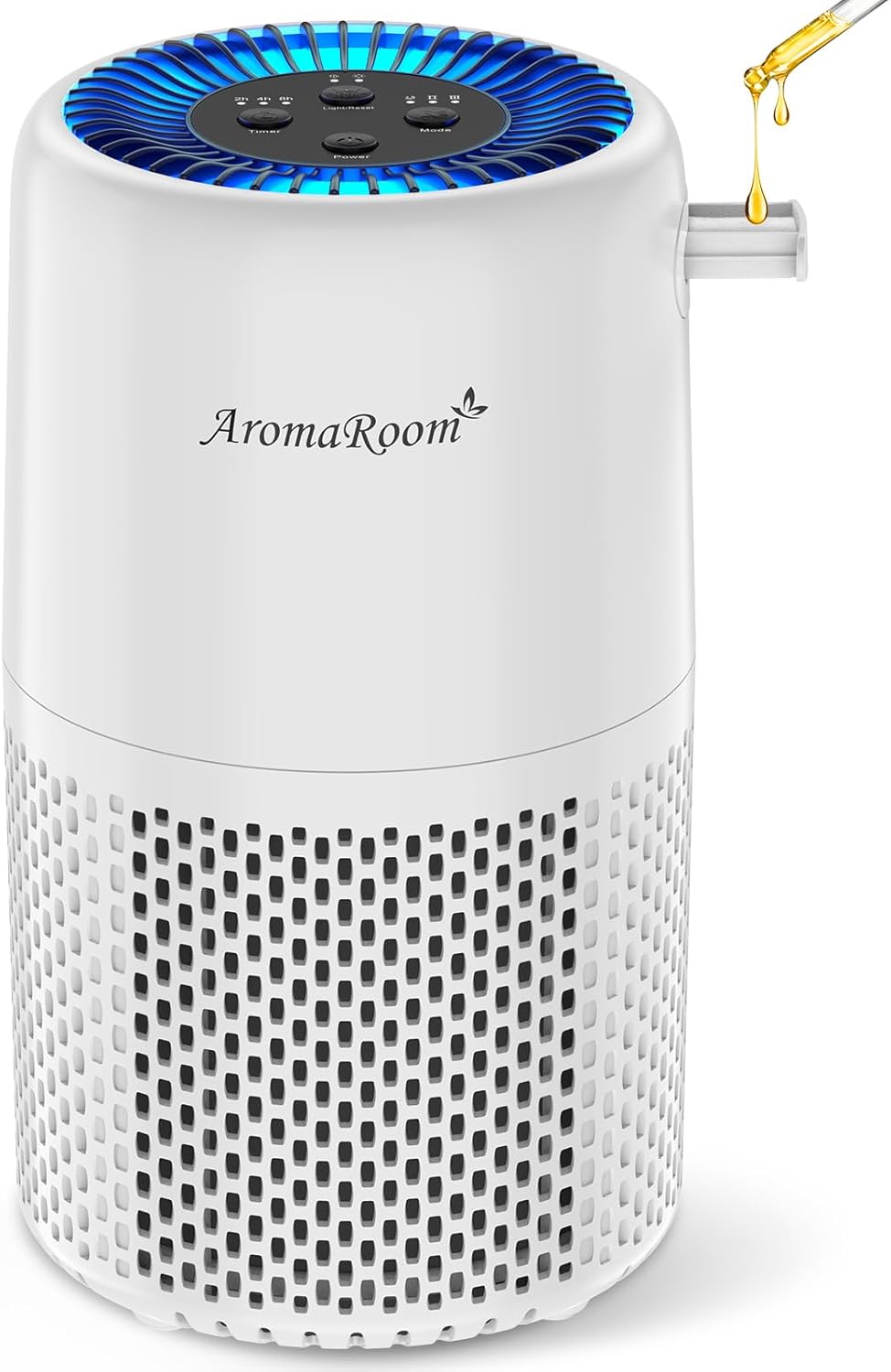
| Filtration | H13 HEPA 3-in-1 |
|---|---|
| Coverage | Circulates air twice/hour in 323 ft² (30 m²) |
| Noise level | 22 dB (sleep mode) |
| Timer | 2/4/8 hours |
The AromaRoom AP103-A is a small, budget-friendly air purifier designed to clean bedrooms and similar spaces. It uses a 3-in-1 H13 HEPA filtration stack with a smoke/remover stage to capture fine particles including dust, pollen, pet dander, and smoke down to 0.1–0.3 microns, and it advertises circulation of a 323 ft² room twice per hour. Practical features include a sleep mode that lowers noise to about 22 dB, three timer options (2/4/8 hours), and an aroma pad for optional fragrance. In typical use it sits on a nightstand or shelf and runs quietly through the night to reduce airborne irritants that can exacerbate nasal congestion and snoring. The unit is compact and easy to move but requires periodic filter replacement for peak performance and should not be used in very humid locations. For the price it delivers robust HEPA filtration and quiet operation, though coverage and long-term durability may be more modest than larger, higher-end models.
Best for: Buyers seeking an affordable bedroom air purifier that runs silently overnight and reduces airborne irritants that can worsen nasal congestion and snoring.
Less Ideal for: People who need whole-house or large-room purification or who prefer units with advanced smart controls and long-life filters should consider larger or higher-end models.
- True H13 HEPA filtration captures particles down to 0.1–0.3 microns
- Quiet sleep mode rated around 22 dB for overnight use
- Aroma pad allows adding essential oils for scent
- Timer function with 2/4/8 hour settings for scheduled runs
- Coverage rate is tailored to small to medium rooms and may not suffice for large open spaces
- Requires regular replacement of the manufacturer-recommended filter every 3–6 months
Verdict: A compact, low-noise HEPA purifier that offers effective bedroom filtration and a scent option at a budget-friendly price.
Levoit Core 300-P

| Filter Type | 3 in 1 Filtration |
|---|---|
| Floor Area | 1073 square_feet |
| Noise Level | 24 db |
| Particle Retention Size | 0.3 micron |
| Wattage | 56 watts |
The Levoit Core 300-P is a small, user-friendly air purifier built around a 3-stage true HEPA filtration system that captures 99.97% of particles down to 0.1–0.3 microns and targets pollen, dust, pet dander, smoke, and VOCs. It is typically used in bedrooms, offices, or living rooms where quiet continuous operation matters; Sleep Mode reduces noise to about 24 dB while the 56W motor and measured CADR values offer reasonably fast room turnover for its class. Controls are touch-based and it includes a timer and filter check indicator for routine maintenance. Practical benefits include verified performance via AHAM testing, CARB and ETL compliance, and a compact footprint that makes placement easy near a bedside or desk. Limits include manual fan-speed control on this model (no Auto Mode) and the need to buy Levoit replacement filters for best performance; it is sized for single-room use rather than whole-house cleaning. For buyers prioritizing a quiet, certificated unit with strong particle removal in bedroom settings, the Core 300-P is a dependable choice.
Best for: Buyers who want a reliable, certificated bedroom air purifier that runs quietly overnight and consistently reduces airborne particles without complicated controls.
Less Ideal for: People seeking whole-house air cleaning, automatic adaptive control, or a unit with integrated smart connectivity should consider other options.
- True HEPA-grade 3-stage filter capturing ~99.97% of 0.1–0.3μm particles
- AHAM verified CADR and multiple safety certifications (CARB, ETL)
- Very quiet Sleep Mode at about 24 dB suitable for bedrooms
- Compact, portable design that is easy to place near sleepers or desks
- Touch controls with timer and filter-replacement indicator for simple maintenance
- No Auto Mode on this model so fan speed must be adjusted manually
- Best performance depends on using official Levoit replacement filters
Verdict: A compact, certification-backed bedroom purifier that quietly and reliably removes fine particles for sleepers who prioritize consistent performance.
Levoit Core 200S-P
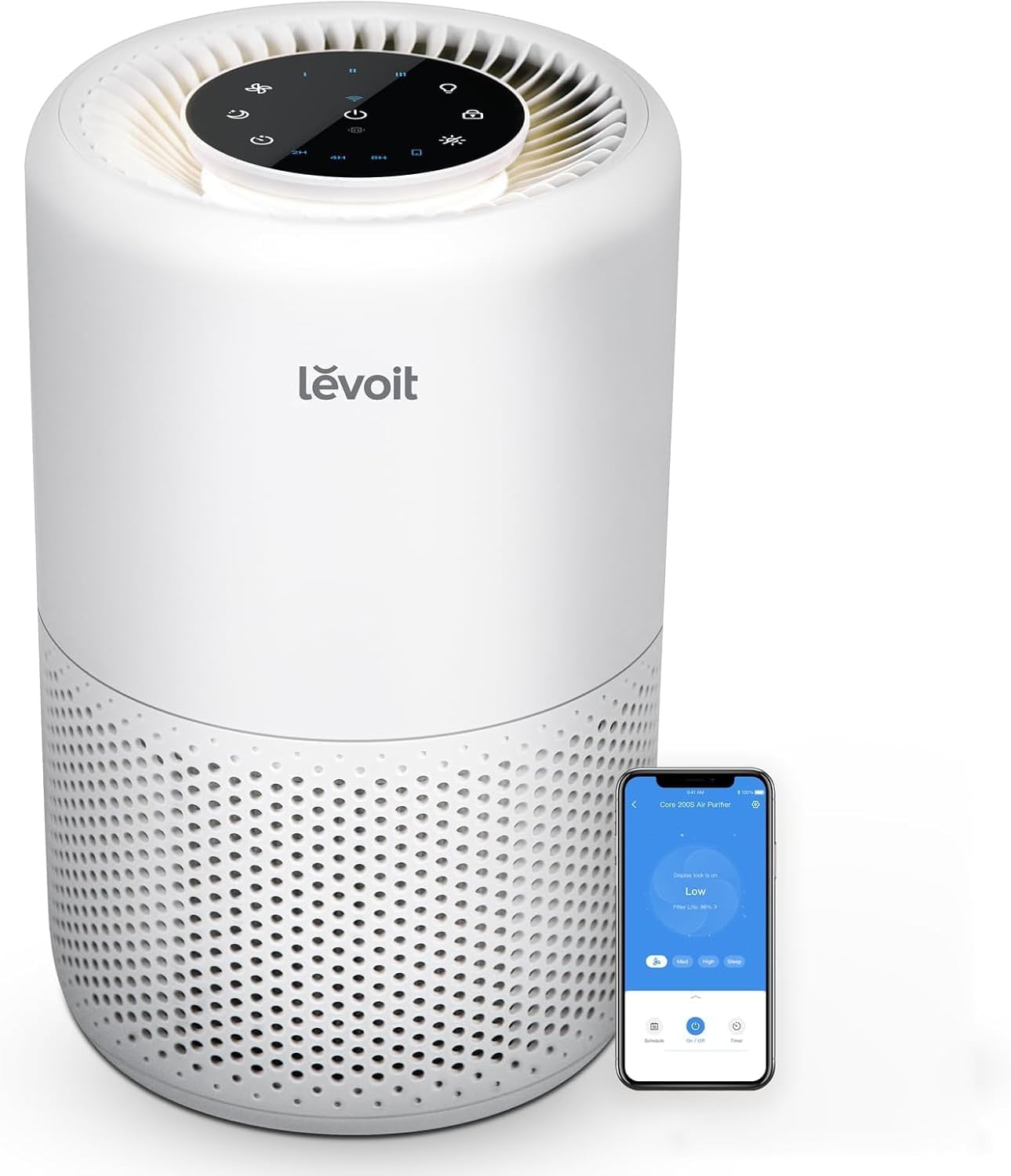
| Coverage | 140 ft² room refresh 4.8×/hour |
|---|---|
| Filtration | 3-stage (Pre-filter, Activated Carbon, HEPA-grade main filter) |
| Noise level | As low as 27 dB |
| Model | Core 200S |
The Levoit Core 200S-P is a compact smart air purifier built for bedrooms, nurseries, and small apartments where quiet, continuous cleaning matters. It pulls air in through a 360° intake and passes it through a nylon pre-filter, activated carbon layer, and a HEPA-grade main filter that captures 99.97% of particles down to 0.1–0.3 microns while also reducing odors. The unit can refresh the air in a 140 ft² room nearly five times per hour and offers app and voice control for scheduling and monitoring filter life. Noise is low enough for sleep, with levels reported down to about 27 dB, and a Display Off button prevents disturbance at night. Practical limitations include its small-room coverage—it is not intended for large open living areas—and the need to replace factory-quality filters periodically to keep performance high. For people concerned about sleep disruption from allergens or pet dander, it provides targeted, quiet filtration with convenient smart controls.
Best for: Buyers who prioritize quiet, effective particle and pet-odor removal in bedrooms or small living spaces and want smart control and filter monitoring for peace of mind.
Less Ideal for: Those who need to clean air in large rooms, whole-floor areas, or open-plan living spaces should consider a higher-capacity purifier.
- Three-stage filtration including HEPA-grade main filter captures fine particles and pet dander
- 360° air intake and motor tuned to refresh air in a 140 ft² room multiple times per hour
- App and voice control for scheduling and filter-life monitoring
- Very quiet operation with a low-noise Sleep Mode and display-off option
- Designed for small rooms so it will be underpowered in large or open-plan spaces
- Requires periodic replacement of the factory-quality filters to maintain HEPA performance
Verdict: A quiet, smart small-room purifier that reliably reduces pet dander and fine particles for better sleep in bedrooms and similar spaces.
VOOPNU HEPA Air Purifier DH-JH12

| Coverage | Up to 1,076 ft² per hour |
|---|---|
| Filter | H13 True HEPA with activated carbon |
| Noise level | As low as 22 dB |
| Speeds | 3 fan speeds |
The VOOPNU DH-JH12 is a small, easy-to-use air purifier built around an H13 true HEPA multi-layer filter and a 360 degree intake that the brand says can cover up to 1,076 sq ft per hour. Controls are simple and suitable for everyday use, with three fan speeds, a timer and a low-noise mode that the listing claims can operate as quietly as 22 dB, which helps if you want background air cleaning while sleeping. A washable pre-filter and activated carbon layers handle larger particles and odors, and a small essential oil tray lets you add mild scent without interfering with the unit. The unit is compact so it fits on a desk or nightstand, but that size also means airflow and CADR will be lower than a full-size room purifier when placed far from the source of odors or allergens. It is certified to several safety standards and intended for continuous operation. For light-to-moderate particle loads and bedroom use where quiet operation matters, this purifier is practical; for very large or heavily polluted spaces you will likely need a larger, higher-CADR model.
Best for: Buyers who want a simple, low-noise bedroom or small-room purifier that runs continuously and prioritizes easy operation and verified certifications over industrial-scale airflow.
Less Ideal for: People who need to clean very large rooms, heavy smoke, or industrial-level pollution should choose a larger purifier with a higher CADR instead.
- H13 true HEPA multi-layer filtration captures fine particles and allergens
- 360° intake design for even room air draw
- Very quiet operation down to 22 dB suitable for bedroom use
- Compact footprint that fits on a desk or nightstand
- Built-in essential oil tray for light scenting
- Compact size limits maximum airflow compared with larger, high-CADR purifiers
- Filter replacement cycle recommended every 3–6 months increases ongoing cost
Verdict: A quiet, compact HEPA purifier well suited for bedrooms and small rooms where low noise and simple operation matter most.
Choosing the Right Air Purifier for Snoring: Key Factors to Consider
Filtration Efficiency And Filter Type
Filtration efficiency determines how well an air purifier removes the tiny particles that can irritate airways and worsen snoring. True HEPA filters capture 99.97% of particles down to 0.3 microns, which includes many allergens, dust, and some droplets that can inflame nasal tissues.
For snoring relief, prioritize purifiers that list true HEPA or HEPA-equivalent performance. Some units add a prefilter to trap larger debris and a carbon layer to address odors, both of which improve perceived air quality in the bedroom. Understand the expected filter lifespan and replacement cost because degraded filters reduce efficiency and can become sources of reintroduced contaminants.
Noise Level And Fan Speeds
Noise is a primary concern in bedroom purifiers because an excessively loud unit can fragment sleep and negate any benefits from cleaner air. Look for manufacturers that publish decibel ratings at different fan speeds and for a dedicated quiet or sleep mode.
Lower speeds usually yield the best tradeoff for nighttime use, maintaining air cleaning while staying under typical bedroom noise thresholds. Variable fan speeds and an actual low-noise sleep setting let you tune performance to the room and your sensitivity to sound. Also consider the character of the noise; a steady white-noise hum is often less disruptive than rattles or tonal fan whines.
Clean Air Delivery Rate And Room Size Compatibility
Clean Air Delivery Rate, or CADR, indicates how quickly a purifier can reduce airborne particulates in a space. To improve breathing and reduce snoring triggers overnight, match the purifier's CADR or recommended room coverage with your bedroom square footage.
Undersized purifiers will run continuously without delivering meaningful reductions in particle concentrations, while oversized units may be noisier than necessary. Check performance claims for bedroom-sized areas and choose a model rated to circulate and filter the room air multiple times per hour for sustained benefit.
Maintenance Requirements And Filter Costs
Maintenance affects both long-term performance and total ownership hassle. Filters that are easy to access and replace encourage on-schedule maintenance, which preserves filtration efficiency critical for reducing nasal inflammation.
Consider how frequently filters require replacement, the availability of replacement parts, and whether the unit has useful indicators for filter end-of-life. Also evaluate whether prefilters are washable or reusable, since that can reduce ongoing costs and simplify upkeep.
Operational Features For Night Use
Nighttime use benefits from features that support uninterrupted, low-effort operation. Useful features include programmable timers, auto mode tied to sensors, dimmable or lockable displays to avoid bright lights, and remote or app control so you can adjust settings without entering the bedroom.
Energy-efficient motors and low power draw are important for devices that run all night. An effective sleep mode balances modest air cleaning with minimal noise and low energy use so the unit can operate continuously without meaningfully raising electricity costs.
How Air Quality Affects Snoring Mechanics
Snoring often stems from partial airway obstruction and inflamed nasal passages. Airborne irritants, such as dust and pet dander, trigger allergic inflammation that can narrow nasal passages and increase the likelihood of mouth breathing and louder snoring. Improving bedroom air quality reduces chronic irritation and can make nasal breathing easier for some people.
- Allergens inflame mucous membranes and increase congestion.
- Cleaner air can reduce nighttime nasal drip and throat irritation.
- Air purifiers address a different cause of snoring than anatomical issues; they may help when inflammation or allergies are a factor.
Placement Tips For Bedroom Use
Where you place a purifier affects its effectiveness. Position the unit near the primary sleeping area but not directly against bedding or curtains that restrict airflow. Ideally place it at least a few feet from the head of the bed and clear of floor clutter to allow full intake and exhaust flow.
- Elevate small units on a stable nightstand or low shelf if floor level has heavy dust.
- Avoid placing purifiers inside closets or behind large furniture that blocks air movement.
- Keep distance from windows that are frequently opened to ensure the purifier can reduce indoor particulates rather than repeatedly cleaning outdoor air.
Combining Purifiers With Other Allergy Controls
An air purifier is one tool among several for reducing snoring caused by allergies or irritation. Use mattress and pillow casings rated for allergens, wash bedding regularly in hot water, and maintain a regular cleaning routine to reduce settled dust and pet hair. Also control humidity: excessively dry air can irritate airways, while very high humidity encourages dust mites and mold. A balanced approach that includes a suitable purifier plus environmental controls yields the best results for minimizing snoring triggers.
- Use allergy-proof bedding covers to limit allergen transfer.
- Regular vacuuming with a HEPA-capable vacuum reduces settled particulates.
- Monitor and adjust bedroom humidity to the 40 to 50 percent range when possible.
Interpreting Noise Specs And Real-World Use
Published decibel numbers are a good starting point but do not tell the whole story about perceived disturbance. Fan tone, intermittent speed changes, and vibration can make a low-decibel unit more bothersome than expected. Look for independent measurements or user feedback focused on sleep use when possible. If you are noise sensitive, test a unit on its lowest setting in your bedroom for at least one night before committing to a long-term placement. Many manufacturers include return windows or trial periods to allow sleep testing, which can be especially useful for this application.
- Compare decibel ratings at different fan speeds rather than only the maximum.
- Place the purifier on a soft mat or stable surface to reduce vibration noises.
- Favor units with a true sleep mode that dims displays and limits fan speed changes.
How We Chose the Best Air Purifier for Snoring
We selected these seven air purifiers based on criteria that matter specifically to people dealing with snoring and nighttime nasal congestion. Key filters included measured particulate removal for small particles and common allergens, verified noise output at typical bedroom fan speeds, and appropriate clean-air delivery rates for bedroom sizes. We prioritized units with true HEPA or equivalent filtration because trapping fine particulates is central to reducing nasal irritation. Fan speed options and quiet modes were required so the device can run through the night without adding disruptive sound. Additional filters included easy access to replacement filters and predictable maintenance intervals, because neglected filters lose effectiveness and can worsen air quality. Energy use and runtime features were considered to ensure continuous overnight operation is practical. We excluded units that rely solely on ionization without particulate capture, devices lacking clear airflow or noise specifications, and purifiers intended only for very large open spaces that cannot operate quietly in a bedroom. The result is a focused list of bedroom-appropriate purifiers that balance filtration, quiet operation, and upkeep.
Our full evaluation process is outlined in our review methodology.
FAQ
Will an air purifier stop me from snoring?
An air purifier can reduce snoring when allergies or nasal irritation are contributing factors, but it will not correct anatomical causes. It often helps by lowering allergen levels and easing nasal inflammation, which may reduce the frequency or volume of snoring for some people.
How loud is too loud for overnight use?
Most people find continuous noise below about 40 decibels acceptable for sleep, though sensitivity varies. Look for published decibel ratings and prioritize units with a dedicated sleep or quiet mode for overnight operation.
Do I need a HEPA filter to help with snoring?
A true HEPA filter or HEPA-equivalent is recommended because it reliably captures the fine particles that commonly trigger allergic responses. Filters that only use ionization without particle capture are not sufficient on their own for reducing particulate-driven irritation.
How often should I replace filters when running overnight?
Replacement frequency depends on filter type and usage, but expect HEPA filters to need replacement every 6 to 12 months in regular use. Pre-filters may be washable and require more frequent attention. Follow manufacturer guidance and use filter indicators if available.
Can I use a purifier with a humidifier to help snoring?
Yes, combining a purifier with a properly set humidifier can be helpful if dry air is irritating nasal passages. Maintain humidity in the recommended range to avoid encouraging mold or dust mites, and ensure both devices are cleaned regularly to prevent microbial growth.
Final Verdict
When shopping for an air purifier focused on reducing snoring, prioritize true particulate filtration, quiet night modes, and capacity matched to your bedroom size. Expect tradeoffs between cleaning speed and noise: higher airflow cleans faster but typically increases sound. Choose a unit that you will run consistently overnight by selecting low-noise operation, manageable maintenance, and clear filter indicators. These priorities will maximize the chance that cleaner air helps reduce inflammation and improves sleep breathing.