
Note: This article contains affiliate links. If you click on these links and make a purchase, we may earn a small commission at no extra cost to you. This helps support our research and content. Read our full affiliate disclosure here.
If you wake up with a blocked nose or struggle with congestion at home, the right air purifier can make a measurable difference in indoor comfort. An air purifier for stuffy nose focuses on removing airborne triggers such as pollen, dust, pet dander, and fine particulate matter that commonly worsen nasal irritation. This guide highlights the top shortlisted air purifiers designed to help reduce congestion and improve sleep and daytime breathing. We evaluated each option for filtration effectiveness, room coverage, and usability to help you pick a model suited to your space and symptoms. Read on for practical buying factors and the attributes that matter most when choosing an air purifier for nasal relief.
Top Picks at a Glance
| Best Overall The best all-around choice for most situations | Winix 5510 Air Purifier |  |
| Best Quality Built to a higher standard if you want something more solid | Coway Mighty AP-1512HH |  |
| Best Value The sweet spot between price and what you get | Honeywell HHT270 Tabletop Air Purifier |  |
| Best Budget The cheapest option that still gets the job done reliably | AromaRoom AP103-A Air Purifier |  |
| Top Rated A top-rated pick with lots of positive feedback | Levoit Core 300-P |  |
| Most Popular A crowd favorite that many people choose with confidence | VOOPNU H13 HEPA Air Purifier DH-JH12 |  |
| Best Seller A high-volume bestseller chosen again and again | Levoit Core 200S-P |  |
Winix 5510 Air Purifier

| Model | 5510 |
|---|---|
| Filtration stages | 4-Stage |
| AHAM verified coverage | 1,882 sq ft in 1 hour |
| Smart features | WiFi, Alexa, Google Home |
The Winix 5510 is a four-stage air purifier built to capture very small particles and reduce household odors in larger rooms. It combines a washable pre-filter, True HEPA filtration that captures particles down to 0.01 microns, and an advanced carbon filter for odors and VOCs, with Winix PlasmaWave technology for additional air treatment. Built-in smart sensors and an AQI LED let the unit run in Auto Mode to adjust fan speed based on real-time air quality, and Sleep Mode lowers noise when the room is dark. The Winix Smart App plus voice support for Alexa and Google Home give remote monitoring and control. Practical benefits include strong particle removal suited to allergy and smoke concerns, effective odor reduction, and automated operation that reduces hands-on management. The main limitations are the need for periodic filter replacement and that high-speed operation can be louder and draw more power, so quiet-room performance depends on running lower speeds or Sleep Mode at night.
Best for: Buyers who want an automated, smart air purifier that handles allergens, smoke, and household odors in larger rooms while offering app control and quiet night operation.
Less Ideal for: People who need a permanently silent unit for bedrooms at maximum cleanup speed or those who want a completely passive filtration system without any plasma or ionization features.
- True HEPA filtration captures particles as small as 0.01 microns for strong allergen and smoke removal
- Advanced carbon filter reduces odors and some VOCs from cooking, pets, and smoke
- Smart sensors and Auto Mode automatically adjust fan speed based on air quality
- App connectivity plus Alexa and Google Home support for remote monitoring and control
- Sleep Mode and low-speed operation deliver very quiet performance for nighttime use
- Filters require replacement over time, adding ongoing maintenance cost
- Higher fan speeds are noticeably louder and use more energy
- PlasmaWave adds active ionization that some buyers may prefer to avoid
Verdict: A smart, four-stage purifier that reliably clears allergens, smoke, and odors from large rooms while offering automated sensing and quiet sleep operation.
Coway Mighty AP-1512HH

| Coverage | Up to 1,748 sq. ft. in 60 minutes |
|---|---|
| HEPA efficiency | 99.97% of 0.3μm particles |
| Filtration stages | Pre-filter, deodorization filter, bipolar device, HEPA |
| Filter lifespan | Up to 1 year |
| Air quality indicator | Built-in LED sensor |
The Coway Mighty AP-1512HH is a room air purifier built to tackle allergens, smoke, pet dander, and odors in medium to large spaces. It uses a four-stage system — washable pre-filter, deodorization filter, HEPA filter, and a bipolar ionizer — and the true HEPA element captures 99.97% of 0.3 micron particles. In practice it runs quietly on low and ramps up automatically when the built-in pollution sensor detects poorer air, while an LED air quality indicator shows conditions at a glance and can be dimmed for sleep. The unit covers up to about 1,748 sq ft in an hour under ideal conditions, and filter-life alerts plus a washable pre-filter make maintenance straightforward. Trade-offs are that peak coverage claims depend on room layout and placement, replacement filters are required for sustained performance, and the bipolar device may concern buyers who prefer passive filtration only. For someone prioritizing measurable cleaning performance and constant automatic adjustment, the Coway delivers consistent, easy-to-use air cleaning for nasal allergy relief and general indoor air improvement.
Best for: Buyers who want measurable, high-performance air cleaning to reduce nasal irritation and allergy triggers and who value automatic sensing and quiet continuous operation.
Less Ideal for: People who need an ultra-compact unit for very small rooms or who prefer a purifier without any ionizing/bipolar technology should consider other options.
- True HEPA filtration that captures 99.97% of 0.3 micron particles
- Auto mode with an indoor pollution sensor for hands-off speed adjustment
- Washable pre-filter and filter-life indicator simplify maintenance
- Air quality LED provides immediate visual feedback and can be turned off for sleeping
- Replacement filters are needed periodically to maintain high filtration performance
- Coverage figure is an idealized 60-minute rate and will vary with room layout and pollutant load
Verdict: Choose the Coway Mighty AP-1512HH when you need strong, sensor-driven HEPA performance to reduce nasal irritation across medium to large rooms.
Honeywell HHT270 Tabletop Air Purifier

| Power Source | Corded Electric |
|---|---|
| Control Method | Touch |
| Filter Type | HEPA-Type |
| Floor Area | 100 |
| Particle Retention Size | 2 micron |
The Honeywell HHT270 is a small, mains-powered tabletop air purifier made for bedroom or office use where space is limited. It uses a HEPA-type dual-action filter with an activated carbon layer to capture dust, pollen, pet dander, dust mite debris and smoke while also helping reduce household odors. Controls are simple touch buttons with three cleaning levels and a filter check/reset light to simplify maintenance. Honeywell rates it to circulate air up to about 4.8 times per hour in a 100 sq ft room and notes it can move air in larger rooms at a lower exchange rate. In practice the compact footprint and quiet operation make it easy to keep near a bedside table or desk; the included genuine Honeywell filter is intended to maintain rated capture efficiency. Trade-offs are its small coverage area—larger rooms will see much lower turnover—and it uses a HEPA-type rather than a true medical-grade HEPA specification, so performance on the smallest particles may be limited compared with larger, higher-CADR units.
Best for: Buyers who want a simple, low-maintenance purifier for a bedroom or small office to reduce allergens and relieve nasal congestion from dust, pollen, or pet dander.
Less Ideal for: People needing high CADR performance for large open-plan rooms or users who require hospital-grade particle removal should consider larger, higher-performance units.
- Compact tabletop design fits on nightstands or desks
- Activated carbon layer helps reduce common household odors
- Three cleaning levels with simple touch controls for easy use
- Filter check/reset indicator simplifies maintenance
- Designed for small rooms so coverage and air changes drop significantly in larger spaces
- Filter is HEPA-type rather than specified true medical-grade HEPA
Verdict: A compact, easy-to-use tabletop purifier that reliably reduces common allergens and odors in small rooms, making it a practical choice for relieving a stuffy nose.
AromaRoom AP103-A Air Purifier
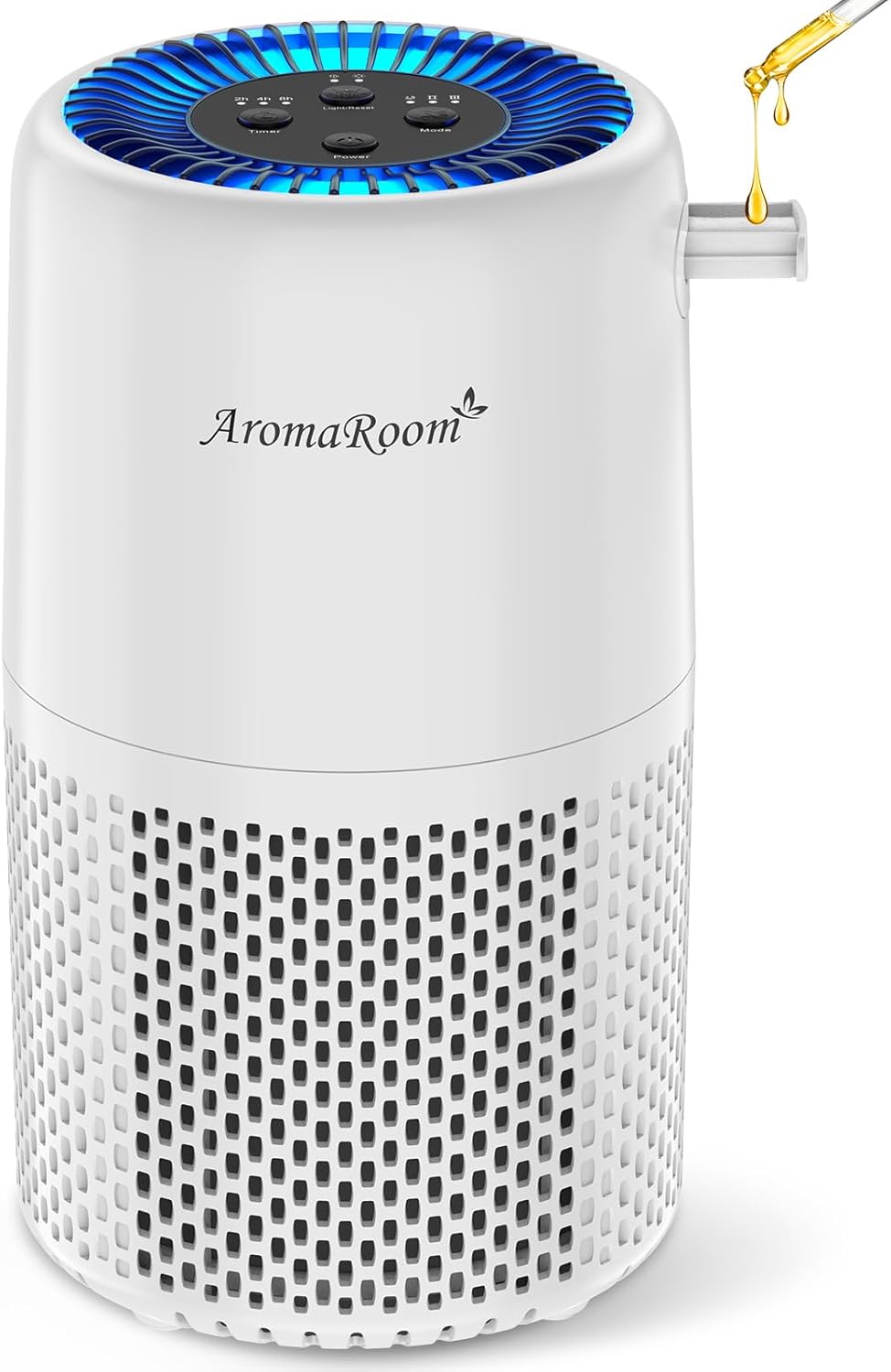
| Filtration | True H13 HEPA 3-in-1 |
|---|---|
| Coverage | Up to 323 ft² (circulates air twice/hour) |
| Noise (sleep) | 22 dB |
| Timer | 2/4/8 hours |
The AromaRoom AP103-A is a small, budget-friendly air purifier designed to reduce airborne particles in bedrooms and living spaces. It uses a True H13 HEPA 3-in-1 filter plus a smoke-specific layer to capture fine dust, pollen, pet dander, and smoke particles down to 0.1–0.3 microns, and it can circulate room air about twice per hour in a 323 ft² space. Practical features include a fragrance pad for light aromatherapy, three timer settings, and a sleep mode that drops noise to around 22 dB on low. Its compact footprint makes it easy to place on nightstands or desks, and it is simple to operate for everyday allergy or congestion relief. Important limits are its coverage and airflow cadence: the twice-per-hour exchange rate is suitable for small to medium rooms but slower than higher-end units, so it may take longer to clear heavy smoke or strong odors. Filters require replacement every 3–6 months for best performance and the unit is not intended for very humid locations like bathrooms.
Best for: Buyers wanting an inexpensive, easy-to-use bedroom or desk air purifier to reduce allergens and mildly smoky or odorous air while prioritizing low noise and simplicity.
Less Ideal for: People needing rapid purification in large open-plan rooms or heavy-smoke situations should choose a higher-capacity purifier with faster air exchange rates.
- True H13 HEPA 3-in-1 filtration captures fine particles including pollen and pet dander
- Includes a smoke-targeted filter layer for wildfire or cooking smoke mitigation
- Very quiet sleep mode at about 22 dB for night use
- Compact size with simple controls and timer settings
- Aroma pad adds optional light fragrance for a more pleasant breathing environment
- Coverage limited to small-to-medium rooms with about two air exchanges per hour
- Requires regular filter replacements every 3–6 months to maintain performance
Verdict: A compact, budget-minded HEPA purifier that quietly improves bedroom air and eases nighttime congestion for small to medium rooms.
Levoit Core 300-P

| Filter Type | 3 in 1 Filtration |
|---|---|
| Floor Area | 1073 square_feet |
| Noise Level | 24 db |
| Particle Retention Size | 0.3 micron |
| Wattage | 56 watts |
The Levoit Core 300-P is a small tower air purifier that uses a 3-stage filtration system with a HEPA-grade original filter to capture 99.97% of particles down to 0.1–0.3 microns. It is intended for bedrooms, living rooms, or offices and can refresh air in a 222 ft² room multiple times per hour thanks to its 143 CFM smoke CADR and 56 W motor. Controls are touch-based with a Sleep Mode that drops noise to about 24 dB and lets you turn off display lights for undisturbed nighttime use. The unit is AHAM verified and meets CARB and ETL safety standards, and Levoit recommends using its genuine replacement filters every 6 to 8 months to maintain performance. Practical limitations are manual fan speed control on this model (no Auto Mode), and filter replacement is essential to keep CADR and filtration claims valid; off-brand filters may reduce effectiveness. Its compact footprint and portable design make it easy to move between rooms but limits coverage compared with larger commercial purifiers.
Best for: Buyers who prioritize a reliable, well-tested purifier for everyday allergy and congestion relief in bedrooms or small living spaces and value quiet, certified performance.
Less Ideal for: People needing whole-house or large open-space purification or users who want automated, sensor-driven fan control should consider larger or smart-enabled units instead.
- True HEPA-grade 3-stage filter capturing 99.97% of 0.1–0.3 μm particles
- AHAM verified CADR ratings for smoke, dust, and pollen supporting measurable room refresh rates
- Very quiet Sleep Mode at about 24 dB for night use
- Compact and portable design fits small rooms and is easy to relocate
- Safety certifications (CARB, ETL) and touch controls with a timer and light-off option
- No Auto Mode on this model so fan speeds must be adjusted manually
- Best performance depends on using genuine Levoit replacement filters
Verdict: If you want a compact, certified HEPA purifier that quietly improves bedroom air and reduces particles that trigger a stuffy nose, the Core 300-P is a reliable choice.
VOOPNU H13 HEPA Air Purifier DH-JH12

| Filtration | H13 True HEPA triple-layer |
|---|---|
| Coverage | Up to 1,076 ft² (laboratory tested) |
| Noise level | As low as 22 dB |
| Speeds | 3 fan speeds and timer |
The VOOPNU DH-JH12 is a small, user-friendly air purifier built around an H13 True HEPA triple-layer filter and a 360° intake to capture common indoor irritants like pet hair, pollen, smoke, and odors. It is used as a continuous-run room purifier and the manufacturer reports it can clean 250 ft² in 15 minutes, making it suitable for bedrooms and living areas where you want faster clearing of airborne particles that can trigger nasal congestion. Controls are simplified to one-tap operation with three fan speeds, a timer, and a quiet low setting that claims operation down to 22 dB, so it can run overnight without disturbing sleep. The unit also includes an essential oil tray for light scenting and carries multiple safety and emissions certifications. Practical limitations are its small footprint and implied reliance on regular filter replacements to sustain performance, and coverage claims are based on laboratory testing that may vary in real homes with complex airflow. For shoppers who value straightforward controls and strong HEPA filtration, it provides solid performance in a compact package.
Best for: Buyers who prioritize proven filtration and easy-to-use operation to reduce airborne triggers that cause stuffy noses and prefer products with many positive user reviews for reassurance.
Less Ideal for: People who need whole-house filtration or integrated smart-home controls should consider larger or connected systems instead.
- H13 True HEPA triple-layer filter captures 99.97% of fine particles
- 360° air intake for even room circulation
- Quiet operation down to 22 dB suitable for nighttime use
- Simple one-tap controls with three speeds and timer for easy daily use
- Essential oil tray adds optional mild scenting without added accessories
- Filter replacement required regularly to maintain stated performance
- Coverage figures are lab-based and may not match complex home conditions
Verdict: A compact, easy-to-use HEPA purifier that reliably reduces airborne irritants in bedrooms and living rooms for shoppers who want proven filtration and social-proof reassurance.
Levoit Core 200S-P
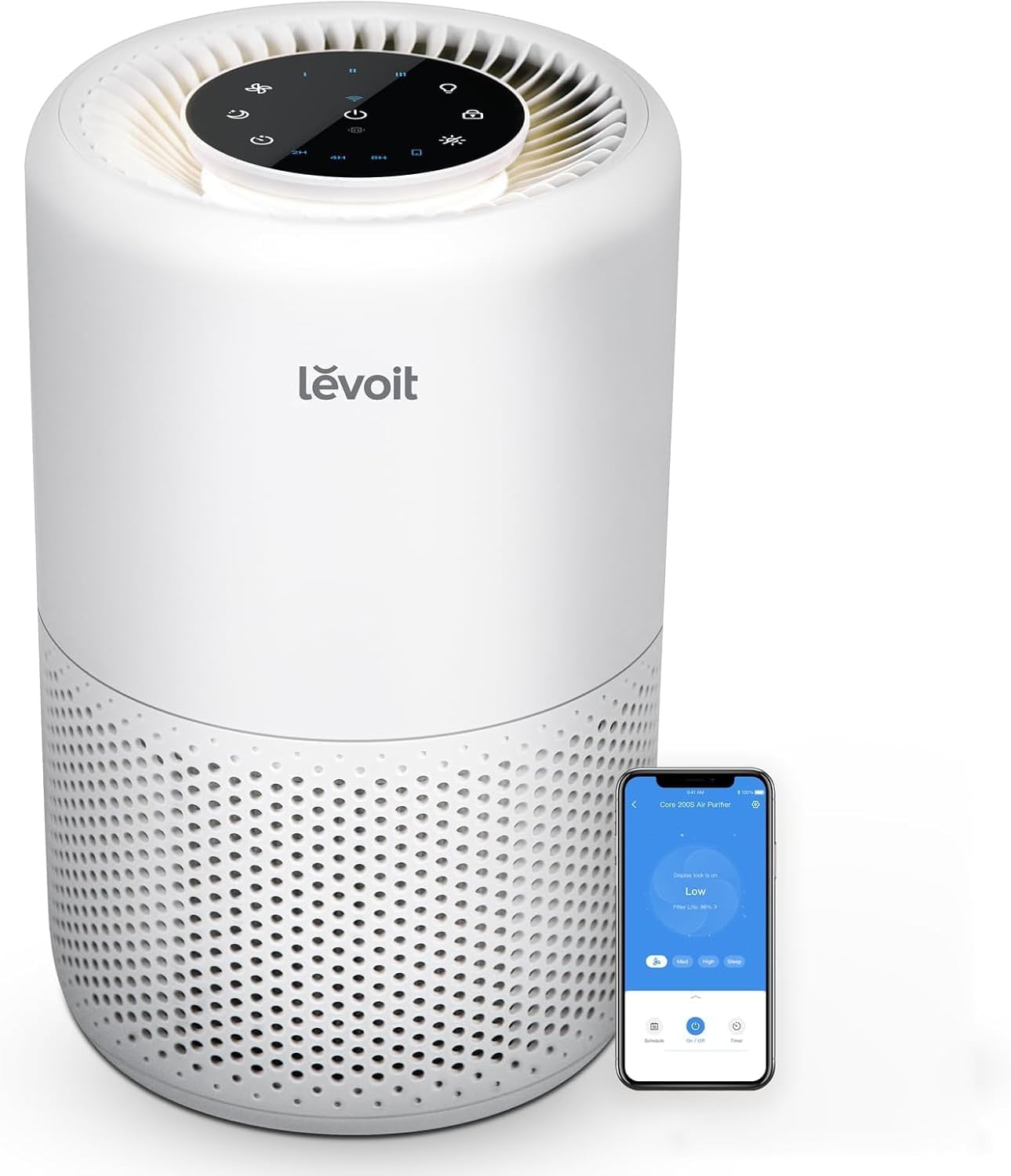
| Room coverage | 140 ft² (refreshed ~4.8×/hr) |
|---|---|
| Filtration | 3-in-1 (pre-filter, activated carbon, HEPA-grade main) |
| Noise level | As low as 27 dB |
| Model | Core 200S |
The Levoit Core 200S-P is a compact, smart-capable air purifier aimed at improving air in small rooms such as bedrooms, nurseries, and apartments. It uses a 3-in-1 filter stack — pre-filter, activated carbon, and a HEPA-grade main filter — to capture large particles, absorb odors and remove 99.97% of particles down to 0.1–0.3 microns. Its 360° intake and high-efficiency motor refresh the air in a 140 ft² room roughly five times per hour, and app and voice control make scheduling and fan adjustments convenient. Noise can be as low as 27 dB, so it is suitable for nighttime use, and a display-off button helps reduce distractions. Practical benefits include straightforward filter monitoring via the app and genuine replacement filters to maintain performance. Limitations to consider are that the unit is sized for small rooms only, so it will not be sufficient for large open living areas, and replacement filters add ongoing cost for peak performance.
Best for: Buyers who prioritize reliable, easy-to-use air cleaning for a bedroom or small living space and want app or voice control plus quiet night operation.
Less Ideal for: People needing whole-home or large-room coverage should choose a larger-capacity purifier instead.
- Three-stage filtration including HEPA-grade main filter for fine particles
- Activated carbon layer helps reduce pet odors and fumes
- Smart app and voice control for scheduling and filter-life monitoring
- Quiet operation down to 27 dB suitable for bedrooms
- Designed for small rooms only and cannot cover large open areas
- Requires periodic replacement of genuine filters to maintain certified performance
Verdict: A quiet, smart, small-room purifier that reliably removes fine particles and pet odors for users who want simple, dependable performance.
Choosing the Right Air Purifier for Stuffy Nose: Key Factors to Consider
Filtration Efficiency and Filter Type
Filtration efficiency determines how well an air purifier captures the particles that trigger nasal congestion. For stuffy noses, look for true HEPA or HEPA-equivalent filters that capture at least 99.97% of particles 0.3 microns in size and also perform well at smaller sizes. Filters that combine a pre-filter with a HEPA stage help trap larger dust and hair so the main filter lasts longer.
Some models pair HEPA with activated carbon layers. The carbon does not remove particles but is important for reducing odors and many volatile organic compounds that can irritate nasal passages. Avoid units that rely only on electrostatic precipitators or ionizers unless they also include robust HEPA-style filtration.
Room Size and Air Changes Per Hour
An air purifier must be sized to the space where you experience congestion. Manufacturers usually list CADR or recommended room size; prioritize units that can achieve multiple air changes per hour for your bedroom or living area. A purifier rated for a small room will not noticeably reduce airborne triggers in a larger open-plan space.
Consider how often you plan to run the device. Continuous overnight operation requires a unit that can quietly deliver sufficient air exchanges at low fan speeds. For larger rooms, a single high-coverage purifier or multiple smaller units may be necessary to maintain low particle counts.
Noise Level and Night Use
Noise matters because many people run purifiers through the night. Excessive fan noise can fragment sleep and offset any benefits of reduced congestion. Check decibel ratings at the manufacturer's low and medium settings and look for devices with quiet or sleep modes that maintain filtration while minimizing sound.
Lower fan speeds are typically quieter but also reduce air change rates, so balance the need for silence with the requirement for adequate filtration. Some units use balanced fans and sound-dampening design to preserve both performance and quiet operation.
Filter Maintenance and Operating Cost
Regular maintenance is required to keep an air purifier effective. Easy-to-find replacement filters, clear replacement intervals, and straightforward filter access make sustained use more likely. Consider how long filters last under typical home conditions and whether replacement reminders are built into the device.
Operating cost includes electricity draw and the frequency of filter replacements. A unit with high annual filter cost or high power use may be less likely to run continuously, which reduces its benefits for congestion relief.
Additional Features That Affect Nasal Comfort
Beyond particle removal, features like activated carbon for odors and VOCs, built-in sensors with auto modes, and programmable timers can help maintain consistently comfortable air. Sensors that detect PM2.5 or VOCs and adjust fan speed automatically ensure the purifier ramps up when pollutant levels rise.
Other conveniences such as remote controls, quiet night lighting, and washable pre-filters improve day-to-day usability. Avoid feature-heavy devices that add little to air quality but complicate operation or maintenance.
How Much CADR You Actually Need
CADR, or Clean Air Delivery Rate, is a practical measure of how quickly an air purifier can reduce particulate concentration in a room. For congestion relief you want a CADR that complements your room size so the unit can perform multiple air changes per hour. As a rule of thumb, calculate your room area and check the unit's recommended coverage and CADR figures, aiming for at least two to four air changes per hour at a moderate fan setting.
Remember that layout and furniture affect airflow. Place the purifier away from walls and obstructions and avoid putting it directly behind curtains or inside enclosed cabinets. In open-plan rooms, consider multiple purifiers or a higher CADR model to maintain uniform air quality.
- Match CADR to room area for 2–4 air changes per hour
- Position units with clear intake and exhaust paths
- Use multiple units in large or segmented spaces
Noise Management Strategies for Nighttime Use
If nighttime quiet is a priority, prioritize models with documented low-decibel sleep modes. Many units publish decibel numbers for low, medium, and high fans. Look for devices that remain under typical bedroom ambient noise levels on their low settings so sleep is not disrupted.
You can also place the unit slightly farther from the bed while ensuring it still serves the intended breathing zone. Some people prefer a small bedside unit with lower coverage for targeted relief, while others keep a larger unit running elsewhere in the room at a low speed.
- Check decibel ratings when comparing models
- Use sleep modes and lower fan speeds overnight
- Position purifier for best balance of airflow and quiet
Filter Types: What to Expect and When to Replace
True HEPA filters are the core of effective particle removal, complemented by pre-filters and activated carbon layers. Pre-filters trap pet hair and large dust, preserving the HEPA element. Carbon layers address odors and many gases but vary widely in capacity and formulation.
Replacement intervals depend on use and local pollution levels. Heavy pollen seasons, pets, or smoke exposure shorten filter life. Look for clear manufacturer guidance and consider models with filter life indicators to avoid degraded performance over time.
- Pre-filters extend HEPA life and are often washable
- Activated carbon helps with odors and VOCs
- Replace HEPA per manufacturer guidance or when indicator signals
Placement Tips to Maximize Nasal Relief
Place the purifier where you breathe most: bedside units or purifiers near seating areas will have the fastest effect on your personal exposure. Avoid corners and tight enclosures that block airflow. A central position with unobstructed intake and outflow usually provides the best room-wide benefit.
If you have multiple problem areas, use portable units in each zone rather than relying on a single distant unit. For shared bedrooms, aim for a purifier that covers the full sleeping area and can run quietly throughout the night.
- Prioritize placement near sleeping or sitting areas
- Avoid blocked intakes and exhausts
- Use multiple units for large or divided rooms
When Activated Carbon Matters
Activated carbon filters do not capture particles but adsorb gases, odors, and many volatile organic compounds. If your nasal irritation is aggravated by strong household odors, cleaning chemicals, or indoor smoking residues, carbon becomes important in addition to HEPA filtration.
Carbon performance varies by weight and cell structure. For persistent odors or chemical sensitivities, choose a unit with a thick or replaceable carbon stage and check replacement guidance since saturated carbon stops removing gases.
- Use carbon stages for odors and VOC reduction
- Check carbon volume and replacement intervals
- Combine HEPA and carbon for comprehensive relief
How We Chose the Best Air Purifier for Stuffy Nose
We prioritized devices and features most likely to reduce nasal congestion and indoor irritants. Primary evaluation criteria included filtration efficiency for particles down to PM2.5 and smaller, verified HEPA-class performance or equivalent. We also measured room coverage by published CADR or recommended room size to ensure a unit could change the air frequently enough to affect indoor symptom triggers. Noise levels at typical night settings were included because loud fans can disrupt sleep even if filtration is excellent. Usability factors such as filter replacement ease, indicator clarity, and simple controls were considered because consistent operation is required to see benefits. Energy use and run-time costs were reviewed to favor units people are willing to run continuously. Finally, we considered additional features that aid nasal comfort such as activated carbon for odors and VOCs and multi-speed or auto modes. We excluded units lacking specified filtration performance or those that rely solely on ionization without substantial particle filtration. We did not include products without published room coverage data or clear filter replacement information. The list emphasizes verifiable specifications and features that directly affect indoor air quality and user convenience.
Our full evaluation process is outlined in our review methodology.
FAQ
Will an air purifier stop a stuffy nose completely?
An air purifier can reduce indoor airborne triggers that worsen congestion, but it may not eliminate a stuffy nose caused by infections, structural issues, or allergens already present in the nasal passages. Continuous use and correct sizing improve the chances of noticeable relief.
How often should I run my purifier to help with congestion?
Run the purifier continuously if possible, especially overnight, to maintain lower particle levels. If 24/7 operation is impractical, run it for several hours before bed and while sleeping to reduce exposure during high-sensitivity periods.
Does activated carbon help with allergy-related nasal symptoms?
Activated carbon reduces odors and many VOCs that can irritate nasal passages, but it does not remove particles like pollen or dust. Combine carbon with a true HEPA stage to address both chemical irritants and particulate allergens.
Are ionizers or ozone generators useful for relieving congestion?
Ionizers and ozone generators are not recommended as primary solutions for nasal relief since they may not remove particles as effectively as HEPA filtration and some can produce ozone, which can irritate airways. Favor units with verifiable particle filtration performance.
How can I tell when a filter needs replacing?
Many purifiers include filter life indicators, or you can follow the manufacturer's time-based guidance. Visible discoloration, reduced airflow, or declining performance on particle sensors are signs a filter should be replaced.
Final Verdict
Choose an air purifier that pairs true HEPA-class particle filtration with adequate room coverage and quiet operation for night use. Balance filter maintenance needs and replacement costs against the device's ability to deliver multiple air changes per hour in the spaces where you experience the most congestion. Prioritize models with activated carbon if odors or VOCs worsen your symptoms, and place units strategically near sleeping or sitting areas to maximize personal exposure reduction. With the right combination of filtration, coverage, and noise performance you can expect meaningful reductions in airborne triggers that contribute to a stuffy nose, making it easier to sleep and breathe comfortably indoors.