
Note: This article contains affiliate links. If you click on these links and make a purchase, we may earn a small commission at no extra cost to you. This helps support our research and content. Read our full affiliate disclosure here.
If you live with cigarette, cigar, or pipe smoke in your home, picking the right air purifier matters for comfort and long-term indoor air quality. Smoke carries fine particles and persistent odors that ordinary filters often struggle to remove. This guide focuses on air purifiers designed to handle tobacco smoke, highlighting units that balance particle capture, activated-carbon odor control, and practical room coverage. Below are our top shortlisted air purifiers for tobacco smoke, chosen for measurable filtration performance and real-world usability. We also explain the evaluation criteria so you can match a unit to your room size and habits.
Top Picks at a Glance
| Best Overall The best all-around choice for most situations | Winix 5510 Air Purifier |  |
| Best Quality Built to a higher standard if you want something more solid | Airpura T700 Air Purifier |  |
| Best Value The sweet spot between price and what you get | GermGuardian 22" Tower AC4825E |  |
| Best Budget The cheapest option that still gets the job done reliably | VOOPNU HEPA Air Purifier DH-JH12 |  |
| Top Rated A top-rated pick with lots of positive feedback | Levoit Core 300-P Air Purifier |  |
| Most Popular A crowd favorite that many people choose with confidence | Levoit Vital 100 Air Purifier |  |
| Best Seller A high-volume bestseller chosen again and again | KNKA APH4000 Air Purifier |  |
Winix 5510 Air Purifier

| Filtration stages | 4-Stage |
|---|---|
| Coverage (AHAM) | Up to 1,882 sq ft in 1 hr |
| HEPA type | True HEPA (captures to 0.01 microns) |
| Smart features | WiFi / Alexa / Google Home compatible |
The Winix 5510 is a 4-stage air purifier built to tackle airborne particles and odors across large rooms, combining a True HEPA filter, advanced carbon deodorization, washable pre-filter, and Winix PlasmaWave technology. It is typically used in living rooms or open-plan spaces where smoke, pet dander, and cooking odors are concerns; built-in smart sensors and an AQI LED keep you informed while Auto Mode adjusts fan speed to match air quality. The unit supports the Winix Smart App and voice assistants for remote monitoring and control, and Sleep Mode dims lights and reduces noise when the room is dark. Practical benefits include AHAM verification for coverage, a visual air quality indicator, and washable pre-filtering that extends HEPA life. Important limitations are that PlasmaWave is a supplemental technology rather than an ozone-free replacement for filtration and that replacement HEPA and carbon filters will be recurring costs to maintain peak smoke and odor removal performance.
Best for: Buyers who want a smart, appliance-grade purifier that handles smoke and household odors across larger living spaces and values automatic sensing and remote control.
Less Ideal for: People who need a purely portable, ultra-compact purifier for very small rooms or those wanting a no-maintenance unit without periodic filter replacements should look elsewhere.
- True HEPA filtration captures very small particles down to 0.01 microns
- Activated carbon filter targets VOCs and household odors from smoke and cooking
- Smart sensors with Auto Mode and AQI indicator adjust performance automatically
- App and voice assistant compatibility permit remote monitoring and control
- Requires periodic HEPA and carbon filter replacements to maintain smoke and odor removal
- PlasmaWave is supportive but does not replace mechanical filtration
Verdict: A feature-rich large-room purifier with True HEPA, carbon odor control, smart sensing, and app control that is well suited to reducing tobacco smoke and household odors.
Airpura T700 Air Purifier
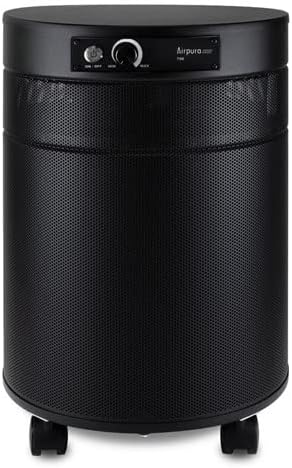
| Manufacturer Suggested Room Size | 2,000 sq.ft |
|---|---|
| Fan Speed | 635 CFM (Free Flow) |
| System Efficiency | 95% of airborne particles ≥ 1 microns |
| Ozone Emissions | No |
The Airpura T700 is built specifically to tackle tobacco smoke and the chemical odors that come with it. It combines a 360° airflow design with a 26-lb activated carbon gas/odor filter and a HEPA barrier that captures about 95% of airborne particles 1 micron and larger, allowing it to service up to 2,000 sq ft at roughly two air exchanges per hour. The unit includes a tar-trapping prefilter that is vacuumable, a replaceable HEPA element, and options for upgraded impregnated carbon for faster chemical binding. In practice the heavy carbon load and high free-flow fan make the T700 much better at removing smoke smell and volatile compounds than typical home purifiers, and the long carbon replacement interval (around 24 months) keeps maintenance relatively infrequent for heavy-duty use. Trade-offs are its large, heavy design and the need to replace sizable filters periodically, so it is more of a permanent room solution than a portable convenience unit.
Best for: Buyers who prioritize high-performance odor and smoke removal in large rooms and want a durable, purpose-built purifier rather than a lightweight consumer model.
Less Ideal for: People needing a compact, lightweight, or highly portable purifier for small rooms or frequent moves should consider smaller units instead.
- Large 26-lb activated carbon filter targets chemical gases and tobacco odors effectively
- HEPA barrier captures roughly 95% of particles ≥1 micron for particle removal
- TarBarrier prefilter traps tars and is vacuumable to extend filter life
- Designed for large spaces with 360° airflow and about 2 air exchanges per hour for 2,000 sq ft
- Large and heavy unit, not convenient to move between rooms
- Replacement filters are substantial and require periodic cost and effort
Verdict: If tobacco smoke and chemical odors are your primary problem in a large room, the Airpura T700 delivers industrial-strength carbon filtration and HEPA particle capture built for that task.
GermGuardian 22" Tower AC4825E

| Room coverage (small) | 153 sq. ft. per 12.5 minutes |
|---|---|
| Room coverage (large) | up to 743 sq. ft. per hour |
| Filter type | True HEPA with activated carbon pre-filter |
| Speeds | Three fan speeds |
The GermGuardian 22" Tower AC4825E is a compact tower purifier that combines a True HEPA filter, activated carbon pre-filter, and optional UV-C light to reduce particles, odors, and certain airborne microbes in living spaces. It is intended for continuous use in bedrooms, living rooms, basements, or offices and circulates air in a 153 sq ft room roughly every 12.5 minutes and can handle larger rooms up to the stated hourly coverage. Three fan speeds, including a quiet sleep mode, let you balance noise and cleaning speed. The carbon pre-filter helps reduce cooking and pet smells and improves initial odor capture, which is useful for smoke control, while the HEPA media captures very small particles down to 0.1 microns. Maintenance requires periodic replacement of the Filter B HEPA/carbon combo and optional UV-C bulb, and performance depends on regular filter changes. The unit is ETL and CARB certified, but its hourly coverage claim for very large rooms assumes unobstructed placement and continuous high-speed operation, so expect diminished clearance in open-plan or heavily smoky environments.
Best for: Buyers who want a reliable, space-saving purifier that combines HEPA particle removal with a carbon stage and simple controls to reduce smoke and household odors in typical rooms.
Less Ideal for: Those needing a heavy-duty solution for continuous, high-volume tobacco smoke in open commercial spaces or multiroom areas should consider larger, higher-CADR systems instead.
- True HEPA filter captures fine particles down to 0.1 microns
- Activated carbon pre-filter reduces common household odors and some smoke compounds
- Optional UV-C light adds an extra layer of airborne microbial reduction
- Three fan speeds including a quiet sleep mode for overnight use
- CARB and ETL certifications provide independent safety verification
- Carbon pre-filter reduces odors but may not eliminate heavy or persistent tobacco smoke on its own
- Hourly coverage for very large rooms requires high fan speed and ideal placement to match listed performance
Verdict: A compact, certified tower purifier that pairs True HEPA filtration with a carbon pre-filter and UV-C option for practical smoke and odor reduction in typical home rooms.
VOOPNU HEPA Air Purifier DH-JH12

| Filtration | H13 True HEPA triple-layer |
|---|---|
| Coverage claim | Up to 1,076 ft² (manufacturer claim) / 250 ft² per 15 minutes (lab-tested) |
| Noise level | 22 dB (quiet setting) |
This compact VOOPNU purifier is built to run continuously in small rooms and bedrooms to reduce smoke, pollen, pet dander, and odors. It uses a 360° intake and an H13 multi-layer filter claimed to capture 99.97% of particulates, and the manufacturer reports laboratory-tested coverage of roughly 250 ft² every 15 minutes. Controls are simple and there is an essential oil tray if you want light scenting while it runs. Noise is very low on the quiet setting at about 22 dB, which makes it suitable for overnight use. The unit is small and portable so you can move it between rooms, but that compact size also means it is best for single rooms rather than open-plan living areas. Replacement filters are proprietary and recommended for best performance, so ongoing filter costs are a consideration if you plan heavy use to tackle persistent tobacco smoke.
Best for: Buyers who need an affordable, low-noise purifier for a single bedroom or small living area to reduce tobacco smoke and everyday pollutants and who prefer a simple, moveable unit.
Less Ideal for: Homes that need continuous purification for large open spaces or multiple rooms where a higher-capacity unit would be more effective.
- H13 true HEPA multi-layer filtration captures most fine particulates including smoke particles
- 360° air intake promotes even room circulation from a small footprint
- Very quiet operation down to about 22 dB suitable for bedroom or overnight use
- Compact and lightweight so it is easy to move and place on desks or nightstands
- Simple controls and an essential oil tray for mild scenting during operation
- Small form factor limits effectiveness in large or open-plan spaces
- Uses proprietary replacement filters which add ongoing operating cost
Verdict: A compact, quiet HEPA purifier that delivers room-level smoke reduction on a budget while keeping operating noise minimal.
Levoit Core 300-P Air Purifier

| Filter Type | 3 in 1 Filtration |
|---|---|
| Floor Area | 1073 square_feet |
| Noise Level | 24 db |
| Wattage | 56 watts |
| Particle Retention Size | 0.3 micron |
The Levoit Core 300-P is a compact, room-focused air purifier built around a 3-stage original filter and an H13-grade HEPA‑style element to capture 99.97% of particles down to 0.1–0.3 microns. It is typically used in bedrooms, living rooms, or home offices to reduce dust, pollen, pet dander, odors, and smoke; the unit is AHAM verified with CADR rates that refresh a 222 ft² room nearly five times per hour. Practical features include a touch control, sleep mode that cuts noise to about 24 dB, a timer, and a clear filter check indicator, and the purifier is CARB and ETL certified for safe indoor use. The 56W motor delivers strong airflow for its size, but the Core 300-P does not include Auto Mode or smart connectivity, so fan speeds must be adjusted manually. Maintenance requires replacing Levoit original filters every 6 to 8 months for best performance and buyers should plan for recurring filter costs. For shoppers who prioritize dependable filtration in medium rooms and quiet nighttime operation, this unit provides proven, low‑noise smoke removal without extras like Wi‑Fi or automatic sensing.
Best for: Buyers who want a reliable, well‑certified purifier that quietly and consistently reduces smoke and fine particles in medium rooms and value proven filtration over smart features.
Less Ideal for: Users who need whole‑house coverage, automatic air quality sensing, or integrated smart home controls should consider larger or smart‑enabled models instead.
- H13-grade HEPA filtration rated to remove 99.97% of 0.1–0.3 μm particles
- AHAM verified CADR with documented smoke, dust, and pollen performance
- Very quiet Sleep Mode at about 24 dB for undisturbed bedrooms
- Compact and portable footprint suitable for medium rooms
- Certifications include CARB and ETL for safe indoor operation
- No Auto Mode or smart connectivity — fan speeds are manual only
- Requires regular replacement of branded Levoit filters every 6–8 months
Verdict: A compact, AHAM‑verified purifier that reliably removes smoke and fine particles in medium rooms while running quietly at night.
Levoit Vital 100 Air Purifier

| CADR | 105 CFM |
|---|---|
| Particle retention size | 0.3 micron |
| Timer | 2 / 4 / 8 hours |
| Noise level | as low as 24 dB |
The Levoit Vital 100 is a small, user-friendly air purifier built to filter common indoor pollutants and light odors. It uses a three-stage system with a washable pre-filter for hair and large debris, an efficient particle filter for dust and pollen, and an activated carbon layer to adsorb cooking smells, pet odors, and smoke-related VOCs. With a reported CADR of 105 CFM and the ability to refresh a typical room once per hour, it suits bedrooms, living rooms, or kitchens where space is limited. Controls are simple with a timer and a display you can turn off for nighttime use, and noise can drop to about 24 dB for near-silent operation while sleeping. Practical downsides are that its coverage claims are best for single rooms rather than whole-house use and the unit requires periodic filter replacements for the main and carbon stages while relying on brand filters for optimal performance. For households concerned about tobacco smoke, the activated carbon helps with odors and some gases, but heavy or persistent smoke in large spaces may need a larger unit or higher CADR.
Best for: Buyers who want a compact, quiet room air purifier that tackles particles and household odors and who prefer products backed by strong customer feedback and verified performance.
Less Ideal for: Homes needing whole-house smoke control or dealing with heavy, continuous tobacco smoke across large open areas should choose a higher-CADR or larger-capacity purifier.
- Three-stage filtration including washable pre-filter, particle filter, and activated carbon for odor and VOC reduction
- Compact footprint with a rear handle makes it easy to move between rooms
- Low noise operation down to 24 dB suitable for bedroom use
- Simple controls with timer and a display-off option for nighttime comfort
- Activated carbon layer reduces odors but may be limited for heavy or continuous tobacco smoke in large rooms
- Requires periodic replacement of main and carbon filters to maintain performance
Verdict: A quiet, compact three-stage purifier with carbon filtration that is a practical bedroom or small-room choice for reducing tobacco smoke odors and everyday airborne particles.
KNKA APH4000 Air Purifier

| Model | APH4000 |
|---|---|
| AHAM Smoke CADR | 226 CFM (384 m³/h) |
| AHAM Pollen CADR | 244 CFM (415 m³/h) |
| Room refresh rate | 4.8x/hr up to 350 ft²; 1x/hr up to 1,695 ft² |
The KNKA APH4000 is a performance-focused air purifier designed to move a lot of air and capture common indoor pollutants. It uses dual front-and-back cartridges with a three-stage stack in each (washable pre-filter, high-efficiency HEPA layer, and activated carbon) to trap hair, dust, pollen, and odors including smoke. AHAM-verified CADR ratings for smoke, pollen, and dust and a high airflow layout—dual intakes and side outlets—help it refresh air more quickly in medium to large rooms, and the manufacturer quotes one full refresh per hour in very large spaces. Practical controls include Auto, Sleep, ECO, and a PET mode that boosts airflow for faster removal of pet dander and odors, plus a real-time AQI display and filter-change indicator. Noise is low in Sleep mode and ECO helps reduce runtime. Expect regular filter replacements every few months to keep odor and smoke capture strong, and note that high-speed operation can draw more power and produce more noise than quiet modes. For smoke-heavy spaces you will want to run it on higher settings and replace carbon/HEPA filters promptly for best results.
Best for: Buyers who want a proven, high-airflow purifier that reliably reduces smoke, dust, and pet-related contaminants while offering simple automated modes and visible air-quality feedback.
Less Ideal for: People seeking a near-silent, ultra-low-maintenance purifier they can rarely service, or those who need a very compact unit for small desks or tight spaces.
- AHAM-verified CADR ratings for smoke, dust, and pollen provide measurable performance.
- Dual intake/outlet airflow design increases circulation for faster air exchanges.
- Three-stage filtration with activated carbon in each cartridge targets odors and smoke particles.
- Multiple modes (Auto, ECO, Sleep, PET) let you balance speed, noise, and energy use.
- Built-in AQI display and filter indicator simplify monitoring and maintenance.
- Carbon and HEPA filters require periodic replacement to maintain smoke odor removal.
- Higher fan speeds increase noise and energy use compared with Sleep or ECO modes.
Verdict: If you need a high-CADR, multi-stage purifier with activated carbon and visible AQI for tackling tobacco smoke in medium to large rooms, this model is a practical choice.
Choosing the Right Air Purifier for Tobacco Smoke: Key Factors to Consider
Filtration Technology
Filtration technology determines how effectively an air purifier captures smoke particles. True HEPA or HEPA-equivalent filters remove fine particulate matter down to 0.3 microns, which captures the ash and tar-laden aerosol that carries much of tobacco smoke's health risk.
Beyond particle filters, look for layered systems that combine prefilters, HEPA, and a dedicated adsorption stage. The quality and grade of the HEPA media plus how the unit seals air through the filter affect real-world performance more than marketing terms alone.
Activated Carbon and Odor Control
Tobacco smoke contains volatile organic compounds and odor-causing molecules that HEPA filters cannot trap. A robust activated-carbon bed or other adsorbent is necessary to reduce lingering smells and lower VOC concentrations.
Pay attention to the quantity and form of the carbon media. Thicker beds, pelletized carbon, or impregnated carbons designed for VOCs perform better and last longer. Replaceable cartridges make maintenance straightforward, but higher-capacity media reduces replacement frequency.
Clean Air Delivery Rate and Coverage
CADR is the practical measure of how quickly an air purifier reduces pollutants in a room. Match the unit's CADR for smoke or fine particles to the square footage and ceiling height of the intended space.
A purifier with insufficient CADR will run constantly without noticeably improving air quality. For rooms where smoking is frequent, choose a unit rated to circulate the full room volume several times per hour to keep particle levels down.
Noise and Daily Use Comfort
Because smoke-prone spaces often require continuous or long-duration use, noise level is a significant comfort factor. Very high fan speeds improve cleaning speed but can be loud and disruptive in living rooms or bedrooms.
Look for units with a wide range of fan settings, a quiet low-speed mode for overnight use, and measured decibel ratings rather than subjective claims. Ease of placement and unobtrusive design also factor into how willingly you will run the unit as needed.
Maintenance, Filter Life, and Operating Cost
Ongoing filter replacement and energy use determine a purifier's lifetime cost and convenience. HEPA filters and carbon cartridges have different service intervals, and usage in a smoke-heavy environment accelerates clogging and saturation.
Consider models with accessible, tool-free filter changes and clear life indicators. Factor in the availability and cost of replacement filters when comparing options, as frequent replacements can add up for regular smokers.
Placement and Airflow Considerations
Effective placement maximizes a purifier's ability to intercept smoke before it spreads through a room. Position units with clear airflow paths, away from obstructions and several feet from walls for optimal intake and discharge.
If smoking occurs in one area of a larger room, use a unit sized for the entire space rather than relying on localized coverage. Multiple smaller units can be useful for multiroom coverage but require coordinating CADR and maintenance across devices.
Why Tobacco Smoke Is Harder to Remove
Tobacco smoke is a complex mixture of ultrafine particles, semi-volatile compounds, and gaseous chemicals. The smallest particles penetrate deep into the lungs, while many odor-causing compounds are gases that bypass particle filters. This dual nature means effective smoke control needs both particle capture and gas-phase adsorption.
Understanding the two-part challenge clarifies why some purifiers reduce visible haze but leave behind odors. Choosing devices with both HEPA-grade filtration and a substantial adsorbent stage will address the major components of smoke simultaneously.
- Ultrafine particles require high-efficiency particle filters.
- Odors and many VOCs need activated-carbon or specialized adsorbents.
- Smoke exposure accelerates filter loading and reduces nominal life.
Sizing a Purifier for Smoking Areas
Calculate the room volume and compare it with the purifier's CADR for smoke or fine particles. For spaces where smoking happens regularly, aim for an air exchange rate that replaces the room air at least 4 to 6 times per hour on moderate fan settings.
If you host smoking in a living room or dedicate an enclosed smoking area, choose a purifier rated above the bare minimum for the room. That headroom helps when multiple people are smoking or when doors open and introduce fresh smoke.
- Estimate room cubic feet rather than just square footage for more accurate matching.
- Higher ceilings require more powerful units or multiple purifiers.
Maintaining Performance Over Time
Performance drops as filters fill with particulate and carbon beds become saturated with VOCs. In a smoke-heavy environment, expect shorter filter life and plan replacements accordingly. Regular prefilter cleaning can extend HEPA life and keep airflow high.
Many units include filter-life indicators based on run hours or airflow sensors. Use these tools and periodically inspect filters visually when smoke exposure is high to prevent bypass and maintain cleaning effectiveness.
- Vacuum or wash washable prefilters on a schedule matching smoking frequency.
- Replace HEPA and carbon elements sooner in high-use scenarios to sustain odor control.
Placement Tips to Maximize Odor Reduction
Place purifiers between the smoking source and the rest of the room to intercept smoke as it travels. Avoid corners or behind furniture that blocks intake. Elevating smaller units a few feet off the floor can help circulate air more evenly.
In shared living spaces, position the purifier where occupants spend most time so the device cleans breathing zones effectively. If smoke enters from outside or adjoining rooms, consider sealing openings or adding an appliance at the airflow path.
- Keep at least a few feet clearance on the sides and top for unrestricted airflow.
- Use multiple units for larger, open-plan spaces instead of relying on one underpowered device.
Addressing Residual Smells and Surface Contamination
Even with a high-performance purifier, smoke deposits on fabrics, walls, and surfaces can keep rooms smelling of tobacco. Combine air cleaning with regular cleaning of soft surfaces, curtains, and HVAC filters to reduce persistent odors.
Consider laundering or steam-cleaning textiles and using odor-neutralizing cleaning products for surfaces. Tackling the source of smells plus active air cleaning yields the best long-term results.
- Wash or treat fabrics that trap smoke particles frequently.
- Vacuum with a HEPA-equipped vacuum to remove embedded particulate from carpets and upholstery.
How We Chose the Best Air Purifier for Tobacco Smoke
We prioritized measurable filtration performance and odor control when selecting products for this list. Key filters included verified particle removal for fine particulate matter, the presence and capacity of activated carbon or other adsorbents for odor and VOC reduction, and a Clean Air Delivery Rate that matches typical room sizes where smoking occurs. Durability and maintenance burden were weighed by filter life and ease of replacement, while noise and energy use were considered for everyday operation. We excluded units that only claim general air cleaning without clear specs for PM2.5, formaldehyde, or VOC/odor reduction. We also filtered out small desktop units whose CADR is inadequate for living rooms and bedrooms. The final list favors balanced combinations of HEPA-grade particle filtration and robust adsorption media, plus usable controls and reliable performance metrics that matter for tobacco-smoke scenarios.
Our full evaluation process is outlined in our review methodology.
FAQ
Will an air purifier remove tobacco smell completely?
Air purifiers with sufficient activated-carbon adsorption can substantially reduce tobacco odor, but they rarely eliminate every trace unless combined with source control and surface cleaning. Carbon beds and VOC-specific media gradually saturate and require replacement to maintain odor removal.
How often should I change filters in a smoke-heavy environment?
Filter life depends on usage and smoke levels, but expect HEPA and carbon filters to require replacement more frequently than in low-smoke homes. Inspect filters monthly and follow manufacturer guidance; plan for shorter intervals if you notice reduced airflow or persistent odors.
Is CADR important for removing smoke?
Yes. CADR indicates how quickly a purifier can reduce particulate concentration in a room. For smoke, prioritize CADR ratings for fine particles and choose a unit sized to swap the room air multiple times per hour to keep visible and airborne particulates down.
Can I rely on a purifier overnight in a bedroom?
Many purifiers have quiet modes suitable for overnight use, but lower fan speeds also reduce cleaning speed. If smoking occurs at night or shortly before sleep, run a higher setting earlier to reduce particle load, then switch to a quiet mode while sleeping.
Do HVAC filters make air purifiers unnecessary?
Central HVAC filters help with whole-house air quality but may not be sufficient for localized smoke events. Portable purifiers positioned near the smoking source provide targeted cleaning and faster reduction of particles and odors in occupied spaces.
Final Verdict
For tobacco smoke, prioritize units that combine high-efficiency particle filtration with a substantial activated-carbon or VOC adsorption stage. Match the purifier's CADR to your room volume and expect higher maintenance in smoke-heavy environments. Balance cleaning speed, noise, and operating cost when choosing a model. Ultimately, select the most powerful purifier you can reasonably run in the smoking area and maintain its filters on a regular schedule to preserve odor control and particle removal. That approach gives the best practical reduction in smoke exposure and lingering smells.