
Note: This article contains affiliate links. If you click on these links and make a purchase, we may earn a small commission at no extra cost to you. This helps support our research and content. Read our full affiliate disclosure here.
If you worry about airborne viruses and bacteria in your home, choosing the right air purifier matters for real-world protection. A focused purifier can reduce airborne particles that carry pathogens, lower allergen loads, and improve respiratory comfort during cold and flu seasons. This guide lists seven shortlisted air purifiers selected for their ability to capture very small particles, deliver adequate room coverage, and support continuous use in living spaces. Below we explain the key performance and usability tradeoffs we considered and outline which features matter most depending on room size, noise tolerance, and maintenance preferences. Read on for the evaluation criteria and practical guidance to match a purifier to your space.
Top Picks at a Glance
| Best Overall The best all-around choice for most situations | WINIX 5510 Air Purifier |  |
| Best Quality Built to a higher standard if you want something more solid | BLUEAIR Classic Pro CP7i |  |
| Best Value The sweet spot between price and what you get | GermGuardian AC4825E Tower Air Purifier |  |
| Best Budget The cheapest option that still gets the job done reliably | FULMINARE H13 HEPA Air Purifier |  |
| Top Rated A top-rated pick with lots of positive feedback | ECOSELF HAP603 Air Purifier |  |
| Most Popular A crowd favorite that many people choose with confidence | Levoit Core 300-P Air Purifier |  |
| Best Seller A high-volume bestseller chosen again and again | Levoit Core 200S-P |  |
WINIX 5510 Air Purifier

| Coverage (AHAM verified) | 1,882 sq ft in 1 hr |
|---|---|
| Filtration stages | 4‑Stage |
| Particle removal | Captures particles down to 0.01 microns |
| Smart features | WiFi, Alexa, Google Home |
| Noise (low) | 23.5 dB |
The Winix 5510 is a smart, four-stage air purifier built for whole‑room cleaning and continuous monitoring. It combines a washable prefilter, True HEPA filter that captures particles down to 0.01 microns, and an advanced carbon odor filter, plus Winix PlasmaWave technology for additional pollutant reduction. The unit uses built‑in sensors and an AQI LED to track air quality and automatically adjusts fan speed in Auto Mode, and it can be controlled remotely through the Winix Smart App and voice assistants. Practical benefits include strong CADR-class performance for large rooms, effective removal of allergens, smoke, and odors, quiet operation in Sleep Mode, and a filter replacement indicator that simplifies maintenance. Limitations to note are that PlasmaWave is not a substitute for medical-grade sterilization, replacement filters are an ongoing cost, and the purifier's size and coverage are geared toward larger spaces rather than compact rooms. For virus and bacteria concerns it offers high filtration efficiency and continuous filtration, but users seeking active sterilization technologies should combine it with other measures like ventilation and surface cleaning.
Best for: Buyers who want a strong, app‑ready purifier that continuously monitors and cleans larger living spaces and values automated, low‑touch operation.
Less Ideal for: People needing compact units for very small rooms, or those who require active, hospital‑grade sterilization technology rather than high‑efficiency filtration alone.
- True HEPA filtration rated to capture particles as small as 0.01 microns for high removal efficiency
- Advanced carbon filter reduces household odors and volatile organic compounds
- Smart sensors and AQI indicator with Auto Mode provide hands‑off speed adjustments based on real‑time air quality
- Winix Smart App and voice assistant compatibility enable remote control and monitoring
- Quiet Sleep Mode for low‑noise overnight operation
- Replacement filters are required periodically and add ongoing maintenance cost
- PlasmaWave is an additive technology and not a certified method for killing viruses or bacteria
Verdict: A powerful, app‑connected HEPA purifier that reliably cleans large rooms and automates air quality management for health‑minded households.
BLUEAIR Classic Pro CP7i

| Floor Area | 650 square_feet |
|---|---|
| Noise Level | 59 db |
| Particle Retention Size | 0.1 |
| Wattage | 6 watts |
| Control Method | App |
The BLUEAIR Classic Pro CP7i is designed for large spaces where fast, consistent air cleaning is critical. It pairs dual fans and dual filters with HEPASilent technology that electrostatically charges particles and mechanical filtration to capture 99.97% of particles down to 0.1 microns, while a carbon layer reduces odors. The unit also cycles a visible 405 nm HINS light to neutralize microbes on the filter and uses RealTrack machine-learning in the app to predict filter life and give replacement alerts. In use the CP7i moves a lot of air—Blueair cites cleaning up to 1,413 sq ft in 30 minutes—and offers numeric and 5-color AQI feedback, auto and eco modes, and app control for scheduling and monitoring. Practical benefits include strong pathogen and particle capture for virus and bacteria reduction, long filter life with connected reminders, and comparatively low energy draw. Trade-offs are its large physical footprint and heavier weight, and higher upfront cost compared with compact purifiers that cover smaller rooms.
Best for: Buyers who prioritize rapid, scientifically backed particle and microbial removal in large living spaces and want app-based monitoring and automated filter-life tracking.
Less Ideal for: People who need a compact, portable purifier for small rooms, travel, or tight budgets should consider smaller, lower-cost models instead.
- HEPASilent dual filtration captures 99.97% of particles down to 0.1 microns
- Dual fans and large inlet/outlets deliver high CADR for rapid cleaning of large rooms
- HINS visible-light cycle adds an extra germ-neutralizing step on the filter
- RealTrack algorithm and app give accurate filter-life tracking and replacement alerts
- Low energy use relative to its airflow (6 watts listed)
- Large and heavy unit that requires a dedicated spot in the room
- Upfront cost is substantially higher than small-room purifiers
Verdict: If you need fast, large-room removal of viruses, bacteria, and fine particles with app monitoring and germ-neutralizing HINS technology, the Classic Pro CP7i is built for that job.
GermGuardian AC4825E Tower Air Purifier

| Model | AC4825E |
|---|---|
| Coverage | Up to 743 sq. ft. (hourly), 153 sq. ft. (every 12.5 min) |
| Filter Type | True HEPA with activated carbon pre-filter |
| Speeds | Three fan speeds |
The GermGuardian AC4825E is a compact tower purifier that combines a True HEPA filter, activated carbon pre-filter, and an optional UV-C sanitizing light to reduce particulates, odors, and airborne microbes in living spaces. It is typically placed in bedrooms, offices, or living rooms and cycles air for a small bedroom roughly every 12.5 minutes or once per hour in larger rooms up to the manufacturer-stated coverage. Three fan speeds including a quiet sleep mode let you balance noise and cleaning speed. The HEPA Pure filter captures very small particles down to 0.1 microns from air passing through the media and the carbon layer helps reduce cooking and pet scents, while the UV-C option adds another layer aimed at airborne microbes. Maintenance is straightforward with compatible factory replacement HEPA, carbon, and UV bulbs available. Limitations include reliance on the optional UV-C for sanitizing effect rather than an integrated measured sterilization rating and that room coverage claims assume ideal placement and closed-room conditions.
Best for: Buyers who want a practical, proven home air purifier that pairs HEPA particle removal with optional UV-C sanitizing and odor reduction for everyday rooms and allergy-season use.
Less Ideal for: People needing hospital-grade sterilization or validated microbial kill-rate data for clinical settings should choose specialized medical equipment instead.
- True HEPA filter captures 99.97% of particles down to 0.1 microns from air passing through the filter media
- Optional UV-C light adds an extra sanitizing layer for airborne microbes
- Activated carbon pre-filter reduces common household scents like cooking and pet odors
- Three fan speeds including a quiet sleep mode provide adjustable noise and airflow control
- Sanitizing benefit depends on optional UV-C bulb and is not presented with a quantified kill-rate
- Room coverage figures assume ideal conditions and closed spaces for the stated air-change rates
Verdict: Choose the GermGuardian AC4825E when you want a compact, user-friendly HEPA purifier with optional UV-C and carbon odor control for practical, everyday reduction of particles and airborne microbes in home rooms.
FULMINARE H13 HEPA Air Purifier

| Filter type | H13 HEPA |
|---|---|
| Recommended room size | 215 ft² / 20 m² |
| Noise level | Around 24 dB (low fan speed) |
| Timers | 2/4/8/10/12 hours |
The FULMINARE H13 is a small, portable air purifier built around an H13 true HEPA filter and 360 degree outlet to circulate room air up to five times per hour in spaces up to about 215 sq ft. It is intended for everyday home use in bedrooms, offices, and living rooms where you want continuous particulate removal without fan noise — the unit offers a near-silent sleep mode around 24 dB and an independent soft night light. Practical controls include multiple timer settings (2, 4, 8, 10, 12 hours) and a simple plug-in power design. The H13 filter grade can capture fine particles and helps reduce airborne bacteria and virus-sized particulates when paired with adequate room circulation, but the unit is sized for single-room coverage so it will not protect larger open-plan areas. Expect periodic filter replacements and to remove the filter plastic before first use. Overall this is a straightforward, budget-friendly purifier for personal rooms where low noise and true HEPA filtration are priorities.
Best for: Buyers looking for an affordable, low-noise purifier to run in a single bedroom or small home office and who prioritize true HEPA filtration and simple controls.
Less Ideal for: People who need whole-house or large open-plan coverage, or those who prefer smart features like Wi-Fi control or app integration.
- H13 true HEPA filter for high-efficiency particle capture
- 360° outlet and dual-channel design for even room circulation
- Very quiet sleep mode near 24 dB suitable for bedrooms
- Multiple timer options and a built-in night light for convenience
- Compact, portable form factor that is easy to place in small rooms
- Coverage limited to about 215 sq ft so not suitable for large open spaces
- Requires periodic filter replacement and initial unwrapping of the filter
Verdict: A budget-friendly, quiet H13 HEPA purifier best suited to bedrooms and small rooms where low noise and true particulate filtration matter.
ECOSELF HAP603 Air Purifier

| Model number | HAP-603 |
|---|---|
| Coverage | Up to 2400 ft² |
| Noise level | 22 dB (Sleep Mode) |
| Air quality sensor | PM2.5 infrared sensor |
The ECOSELF HAP603 is a large-room air purifier built around a True HEPA (H13) filtration system and a 2X-power circulation claim to clean wide open spaces. It is typically placed in living rooms or bedrooms and run continuously on Auto or Smart mode, where an infrared PM2.5 sensor adjusts fan speed based on detected air quality. Notable features include a visible AQI/PM2.5 display, a very quiet 22 dB sleep setting, timer, child lock, and an aromatherapy pad for scenting. Practical benefits are strong particle capture for smoke, pet dander, and allergens, easy maintenance with a filter indicator, and a compact footprint for its claimed coverage. Important limitations are that the stated 2400 ft² coverage depends on placement and room layout, replacement filters are recommended to be brand-specific for peak performance, and the aromatherapy function can add maintenance choices but does not affect filtration efficacy. It is a straightforward option for steady, low-noise air cleaning in larger rooms when paired with regular filter replacements.
Best for: Buyers prioritizing a reliable, low-noise purifier that actively senses air quality and runs unattended in larger living spaces where steady particle removal is the main goal.
Less Ideal for: People who need certified medical-grade pathogen sterilization or portable spot-treatment devices for small rooms should consider alternatives tailored to those specific needs.
- True H13 HEPA filtration for high-efficiency particle capture
- PM2.5 display and infrared sensor for real-time air-quality driven auto operation
- Very quiet 22 dB sleep mode suitable for nighttime use
- Filter indicator and timer simplify routine maintenance and scheduling
- Coverage and 2X circulation claims can vary with room layout and are not guaranteed for every floorplan
- Aromatherapy feature does not improve cleaning performance and adds an extra maintenance step
Verdict: If you want a quiet, sensor-driven HEPA purifier for large rooms that reliably removes particles when maintained with official replacement filters, the HAP603 is a solid choice.
Levoit Core 300-P Air Purifier

| Filter Type | 3 in 1 Filtration |
|---|---|
| Noise Level | 24 db |
| Wattage | 56 watts |
| Particle Retention Size | 0.3 micron |
| Floor Area | 1073 square_feet |
The Levoit Core 300-P is a compact, plug-in HEPA air purifier aimed at bedrooms and living spaces where quiet, consistent filtration matters. It uses a three-stage original filter that Levoit says captures 99.97% of particles down to 0.1–0.3 microns and a 56W motor with a CADR that refreshes a 222 ft² room multiple times per hour or a larger area more slowly. Typical use is continuous daytime or overnight operation on low or sleep mode; the unit's Sleep Mode cuts noise to about 24 dB and turns off display lights for undistracted rest. Controls are touch-based and there is a timer and check-filter indicator for maintenance. The purifier is AHAM verified and CARB and ETL certified, which supports its real-world performance claims, and Levoit recommends using official replacement filters for best results. Limitations include the lack of smart/auto mode on this Core 300-P variant and manual fan-speed control, plus replacement filters are an ongoing consumable cost; it also does not claim active antiviral sanitizing beyond particle capture testing.
Best for: Buyers who prioritize proven filtration performance and independent certifications and want a quiet, easy-to-run purifier for bedrooms or shared living spaces backed by strong social proof.
Less Ideal for: People who need smart features or automatic air-sensing control, or those who require active antiviral sterilization technologies rather than particle filtration alone.
- True HEPA-grade three-stage filter with 99.97% removal efficiency for 0.1–0.3 μm particulates.
- AHAM verified CADR ratings that show measurable room refresh rates for smoke, dust, and pollen.
- Very quiet Sleep Mode (about 24 dB) with display-off option for nighttime use.
- Certified to common safety and indoor-air standards (CARB, ETL) supporting verified performance.
- No built-in Auto Mode or smart connectivity on this model, so fan speed must be adjusted manually.
- Performance depends on using Levoit original replacement filters, which are a recurring expense.
Verdict: Choose the Core 300-P when you want a compact, independently verified HEPA purifier with whisper-quiet operation and proven particulate removal.
Levoit Core 200S-P
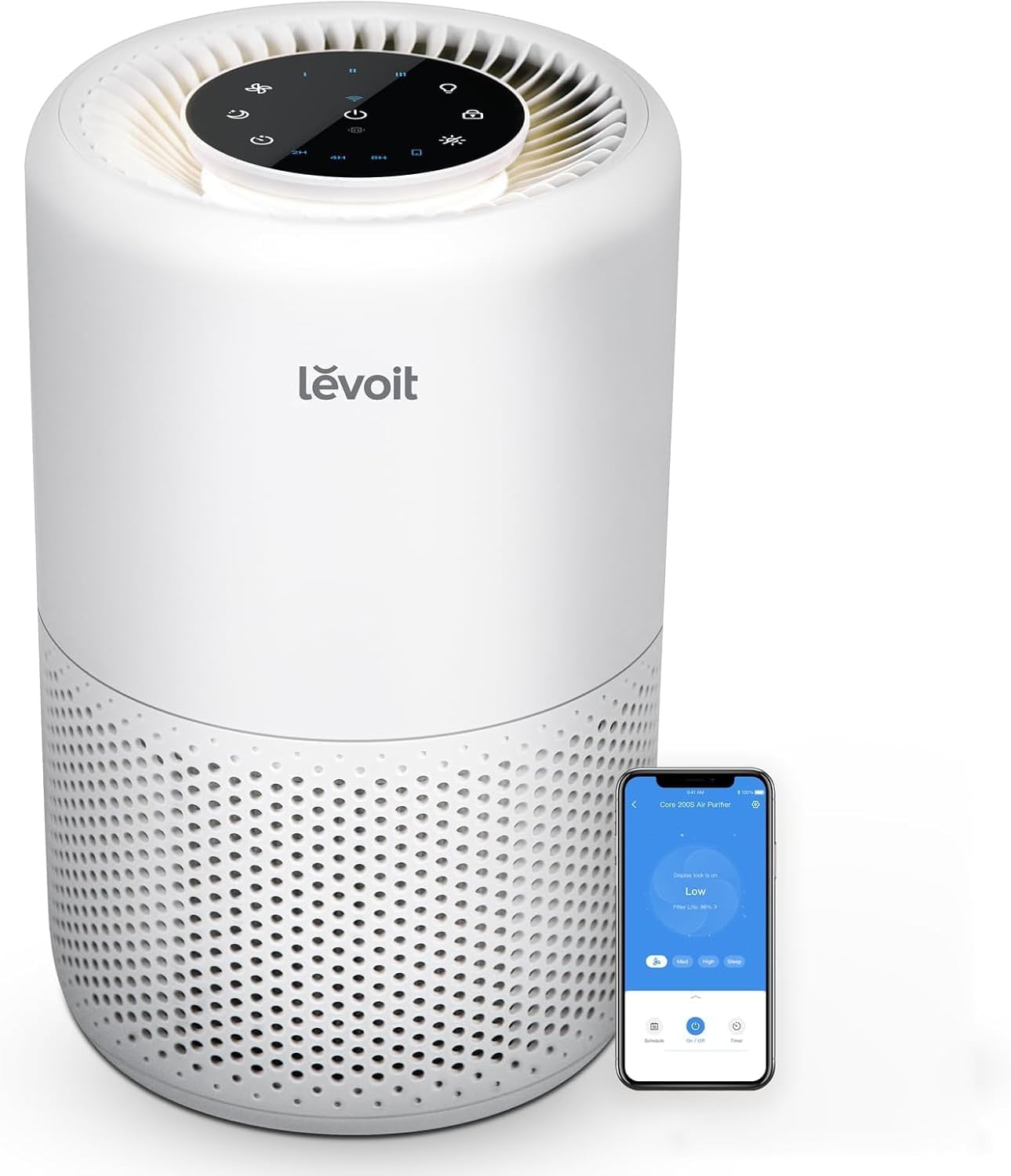
| Model | Core 200S |
|---|---|
| Room coverage | ~140 ft² refreshes 4.8x/hr |
| Filtration | 3-in-1 (Pre, Carbon, HEPA-grade) |
| Noise | As low as 27 dB |
The Levoit Core 200S-P is a small-room air purifier that uses a 3-in-1 filtration stack—pre-filter, activated carbon, and a HEPA-grade main filter—to capture dust, pollen, pet dander, smoke and odors. It pulls air through 360-degree intake and is sized to refresh the air in a roughly 140 ft² room nearly five times per hour, making it suitable for bedrooms, nurseries, and home offices. Smart and voice controls plus an app-based filter life monitor make maintenance straightforward for cautious buyers who want clear indicators of performance. Noise is low enough for overnight use, with a dedicated sleep mode and a display-off button to minimize disturbance. Limits include its small coverage area and reduced throughput compared with larger models, so it is not intended as a whole-home solution, and genuine replacement filters are suggested to maintain verified efficiency. For people focused on improving air quality in a single room and who value simple, monitored operation, the Core 200S-P provides reliable, quiet purification.
Best for: Buyers who prioritize a dependable, easy-to-manage air purifier for a single bedroom or office and want verified cleaning performance with simple smart controls.
Less Ideal for: People seeking a whole-home or large-room purifier or those who need very high CADR for rapid cleaning of large spaces should consider larger units instead.
- Three-stage filtration including HEPA-grade main filter for 0.1–0.3 micron particles
- AHAM-verified performance and rated to refresh air in a 140 ft² room multiple times per hour
- Smart app and voice control with filter-life monitoring for easy maintenance
- Low noise floor and sleep mode make it suitable for bedrooms and overnight use
- Designed for small rooms only and will not effectively purify larger open areas
- Performance depends on using genuine replacement filters to maintain rated efficiency
Verdict: A compact, AHAM-verified purifier with smart monitoring that reliably improves air quality in a single bedroom or office.
Choosing the Right Air Purifier for Viruses and Bacteria: Key Factors to Consider
Filtration Efficiency and Filter Media
High filtration efficiency determines how well a purifier captures the small aerosol particles that can carry viruses and bacteria. Look for true high-efficiency mechanical filters that trap particles down to the submicron range rather than relying solely on vague terms. Filtration media performance affects how often you need replacements and whether the unit can remove both particulate matter and bioaerosols.
Filter type also matters for biological particles. True HEPA-class filters or equivalent mechanical filters provide predictable capture rates, while supplemental technologies such as activated carbon do not replace mechanical filtration for microbes. Consider how the manufacturer rates particle-size capture and whether independent test data or third-party verification is available.
Airflow and Room Coverage (CADR)
A purifier's airflow capacity determines how quickly it can cycle air in a room and reduce airborne concentrations of pathogens. Clean Air Delivery Rate or equivalent room coverage figures tell you how large a space the unit can service effectively. A high-efficiency filter with low airflow will perform worse in practice than a lower-efficiency filter with robust airflow.
Match the unit's recommended room size to your intended location and plan for faster cycling in high-traffic areas. For spaces where viral or bacterial reduction is a priority, aim for models that can complete multiple air changes per hour at realistic fan settings rather than relying on occasional peak speeds.
Noise and Daily Comfort
Because air purifiers often run continuously, noise output is a practical concern. Higher fan speeds deliver faster air cleaning but raise noise. Look for measured decibel ratings at multiple fan speeds and consider how noise interacts with where you will place the unit, for example a bedroom versus a living room.
Some designs reduce perceived noise through larger fans running at lower RPMs or through multi-speed fans that provide a quiet low setting for nighttime use. Assess whether the unit's quiet mode still delivers meaningful air changes for your risk level.
Maintenance, Filter Life, and Running Costs
Maintenance affects both long-term cost and effective filtration. Consider how easy it is to access and replace filters, whether filters are proprietary or widely available, and how frequently they require replacement under typical household conditions.
Long filter life reduces ongoing expense but can indicate denser media that affects airflow and energy use. Also check for clear replacement indicators, washable pre-filters that extend main filter life, and whether replacement parts are straightforward to source.
Energy Use and Continuous Operation
Because air purifiers intended for pathogen reduction should run for extended periods, energy efficiency matters. Compare wattage at typical operating speeds rather than peak draw. Lower energy use reduces operating cost and may allow continuous high-speed operation where needed.
Energy-efficient fans, sleep modes, and certified energy ratings are useful indicators. Balance energy use with purification needs; a slightly higher draw may be acceptable if the unit delivers substantially higher air exchanges per hour.
Safety Features and Indoor Compatibility
Safety and indoor compatibility include electrical safety, absence of harmful byproducts, and physical stability. Avoid devices that produce ozone or rely primarily on unproven chemical sanitization approaches for occupied spaces. Check for safeguards such as tip-over protection, child locks, and certified electrical compliance.
Also consider placement constraints like vertical clearance and proximity to walls or curtains, which affect airflow patterns. A safe, well-placed purifier maximizes real-world effectiveness while minimizing household risks.
Best Room Placement and Setup
Placement determines how effectively a purifier reduces airborne pathogens. For general living areas place the unit centrally if possible, or along the longest airflow path to encourage whole-room circulation. Avoid tucking purifiers into corners or behind furniture where intake or exhaust is obstructed.
- Keep 12 to 24 inches of clearance on intake and exhaust sides.
- Elevate smaller units off the floor slightly if dust accumulation is a concern.
- Place a unit in the primary occupied zone—bedroom for night use, living room for daytime occupancy.
When to Run High Fan Speeds
Run higher fan speeds during and after activities that raise particle levels, such as cooking, receiving visitors, or when someone in the home is symptomatic. For ongoing background protection choose a lower continuous speed that maintains steady air changes with tolerable noise.
A practical rule is to run a higher speed for 20 to 60 minutes following a high-risk event, then revert to a continuous low or medium setting to maintain reduced concentrations.
- High speed for short bursts after gatherings or cleaning.
- Mid to low continuous speed for background reduction.
- Use programmable timers or smart scheduling to automate bursts.
Combining Purifiers with Other Measures
An air purifier reduces airborne concentrations but is not a standalone infection control measure. Combine purifiers with ventilation improvements, surface hygiene, and sensible personal practices for a layered approach. In many homes, increasing outdoor air exchange while running a capable purifier produces the best balance of dilution and removal.
When multiple rooms are in use, consider smaller units in each occupied space rather than a single large unit in one room. This approach maintains localized air quality where people spend time and avoids overreliance on one device to service an entire house.
- Use purifiers with open windows or mechanical ventilation when weather and outdoor air quality allow.
- Place units in occupied rooms rather than unoccupied storage spaces.
- Continue regular surface cleaning and hand hygiene alongside air cleaning.
Maintenance Tips to Keep Filtration Effective
Check pre-filters and washable screens regularly since accumulated coarse dust reduces airflow and strains the main filter. Establish a replacement schedule based on manufacturer guidance and household conditions like pets or smoke exposure.
Use the unit's filter indicators when present, and keep a spare set of filters on hand if you rely on continuous operation. When changing filters, inspect seals and gaskets to maintain a proper airflow path through the filter media.
- Vacuum pre-filters monthly if washable.
- Note allergy season and increase replacement frequency for heavy pollen periods.
- Document filter change dates to avoid forgetting replacements.
How We Chose the Best Air Purifier for Viruses and Bacteria
We prioritized devices that address airborne biological particles through a combination of tested filtration media, adequate airflow, and practical use features. Our selection filters favored units with high-efficiency particulate filtration, measured Clean Air Delivery Rate or reported equivalent airflow metrics, and realistic room coverage claims that match common residential spaces. We also accounted for continuous runtime capability by checking fan motor durability and serviceability features such as filter availability and replacement ease. Additional editorial criteria included noise output at typical operating speeds, energy consumption for continuous operation, and safety features for household environments. Units with unverifiable or vague filtration claims, unserviceable sealed designs that block filter access, or that lacked clear airflow/coverage specifications were excluded. The final picks balance measurable particle-capture potential, day-to-day usability, and predictable upkeep costs, reflecting the dimensions a buyer should weigh when prioritizing viral and bacterial mitigation indoors.
Our full evaluation process is outlined in our review methodology.
FAQ
Can an air purifier completely eliminate viruses in a room?
No purifier can guarantee complete elimination of viruses instantaneously. A high-efficiency purifier reduces airborne concentrations over time, lowering exposure risk, but effectiveness depends on factors such as air changes per hour, room volume, and source strength. Use purifiers as part of a layered approach with ventilation and hygiene.
Do I need a purifier with HEPA filter to address viruses and bacteria?
True high-efficiency mechanical filters that trap very small particles are the most reliable method for removing bioaerosols. Equivalent high-grade mechanical filtration can be effective; avoid units that rely only on unverified or single-technology claims without mechanical filtration backing.
How big of a unit do I need for a bedroom?
Choose a unit whose rated room coverage or CADR supports multiple air changes per hour for your bedroom size. As a rule pick a purifier rated for a slightly larger area than the room to ensure adequate cycling at lower, quieter fan speeds.
Are ozone-generating devices safe for occupied rooms?
Ozone-producing devices are not recommended for occupied indoor spaces because ozone can irritate the respiratory system and does not selectively remove pathogens from air safely. Prefer mechanical filtration solutions that do not emit reactive gases.
How often should I replace filters when running a purifier continuously?
Filter replacement depends on usage and local conditions. In many households continuous operation means checking filters every 3 to 6 months for pre-filters and 6 to 12 months for main filters, but high-dust or smoky environments can shorten that interval. Follow the manufacturer's lifespan guidance and monitor pressure or airflow changes.
Final Verdict
Prioritize filtration efficiency and adequate room coverage when choosing an air purifier for viruses and bacteria. High-quality mechanical filters combined with sufficient airflow and sensible placement deliver the most predictable reduction in airborne particles. Balance noise, maintenance, and energy use to find a unit you will run continuously where it matters most. Ultimately, choose a purifier that matches the rooms you occupy, provides measurable air changes at acceptable sound levels, and offers straightforward maintenance. Used alongside ventilation and basic hygiene, the right purifier can meaningfully lower airborne risk and improve indoor comfort.