
Note: This article contains affiliate links. If you click on these links and make a purchase, we may earn a small commission at no extra cost to you. This helps support our research and content. Read our full affiliate disclosure here.
A good air purifier with a HEPA filter can noticeably reduce airborne allergens, dust, and smoke in your home. Choosing the right unit matters because filtration efficiency, room coverage, and runtime affect how clean the air actually becomes in living rooms, bedrooms, and open-plan spaces. This guide looks at seven carefully shortlisted air purifiers with HEPA filters that fit a range of home sizes and use cases. We evaluated picks for real-world performance, maintenance needs, noise, and energy use. Read on for the factors we used to choose these units and practical guidance to match a purifier to your space.
Top Picks at a Glance
| Best Overall The best all-around choice for most situations | GermGuardian AC4825E 22" Tower Air Purifier |  |
| Best Quality Built to a higher standard if you want something more solid | Sans True HEPA Air Purifier |  |
| Best Value The sweet spot between price and what you get | MOOKA KJ190H Air Purifier |  |
| Best Budget The cheapest option that still gets the job done reliably | VOOPNU HEPA Air Purifier DH-JH12 |  |
| Top Rated A top-rated pick with lots of positive feedback | DREO Air Purifier 338 (DR-HAP008) |  |
| Most Popular A crowd favorite that many people choose with confidence | Levoit Core 300-P Air Purifier |  |
| Best Seller A high-volume bestseller chosen again and again | Levoit Core 200S-P |  |
GermGuardian AC4825E 22" Tower Air Purifier

| Coverage (small room) | 153 sq. ft. per 12.5 minutes |
|---|---|
| Coverage (large room) | Up to 743 sq. ft. per hour |
| Filter type | True HEPA with activated carbon pre-filter |
| Speeds | Three fan speeds |
The GermGuardian AC4825E is a tower air purifier that uses a genuine True HEPA filter plus an activated carbon pre-filter and optional UV-C light to capture airborne particles and reduce odors. It is set up as a plug-in tower unit with three fan speeds including a quiet sleep mode, and is intended to circulate air in a 153 sq ft room roughly every 12.5 minutes and up to 743 sq ft hourly in larger spaces. In everyday use it traps dust, pollen, pet dander and many small particles down to 0.1 microns while the carbon layer helps reduce cooking and pet smells; the UV-C option adds an extra sanitizing step for airborne microbes. The unit is compact and easy to maintain with a straightforward filter replacement path using GermGuardian Filter B and compatible UV bulbs. Expect solid filtration performance for bedrooms, home offices, and living rooms, though it is a basic, no-frills design without advanced smart controls or app connectivity and it needs periodic filter and bulb replacements to keep peak effectiveness.
Best for: Buyers who want reliable, straightforward HEPA filtration for bedrooms, living rooms, or home offices and prioritize proven particle removal and odor reduction over smart features.
Less Ideal for: Users who need app control, voice integration, or highly customizable scheduling and monitoring should consider models with smart connectivity instead.
- True HEPA filter captures very small particles down to 0.1 microns
- Activated carbon pre-filter reduces common household odors
- Optional UV-C light for additional airborne sanitization
- Three fan speeds including a quiet sleep mode for night use
- No smart features or Wi‑Fi control
- Requires periodic replacement of HEPA filter and UV-C bulb
Verdict: A dependable, no-frills HEPA tower purifier that delivers strong particle removal and odor reduction for everyday home spaces.
Sans True HEPA Air Purifier

| Filtration | 3-in-1 pre-filter, True HEPA, activated carbon |
|---|---|
| Coverage | Up to 1,854 sq. ft. |
| Noise | As low as 25 dB (sleep/auto) |
| Particle capture | Down to 0.1 microns |
This Sans air purifier uses a three-stage system — pre-filter, medical-grade True HEPA filter, and an activated carbon layer — to capture fine particles, pet dander, smoke, and odors across very large rooms. It is typically run in living spaces or open-plan areas where coverage and continuous filtration matter; onboard sensors and an auto mode adjust fan speed to match air quality while sleep mode keeps noise levels low. The purifier advertises capture down to 0.1 microns and includes a pet-focused pre-filter that helps reduce hair and dander buildup before it reaches the HEPA element. Activated carbon targets cooking smells, VOCs, and smoke, making it useful after cooking or for homes with mild odor sources. Filter replacement is indicated by an onboard alert and is designed for quick swaps. Expect solid performance for continuous whole-room cleaning, but note the unit is a full-size tower intended for large spaces rather than small-bedroom use and replacement filters add ongoing operating cost.
Best for: Buyers focused on measurable air-cleaning performance in large open spaces who want continuous filtration, sensor-driven auto control, and odor reduction for homes with pets or smoke exposure.
Less Ideal for: Those needing a compact purifier for a small bedroom, personal workspace, or travel should consider smaller, lower-output units instead.
- True HEPA filtration captures particles down to 0.1 microns for high particle removal.
- Activated carbon layer reduces cooking odors, smoke, and common VOCs.
- Smart auto mode and sensors adjust fan speed for energy-efficient continuous operation.
- Sleep mode and low noise operation suitable for nighttime use.
- Coverage rated for very large rooms up to 1,854 sq ft.
- Designed for large-room performance so it may be overpowered and less efficient in small rooms.
- Ongoing cost of replacement filters is required to maintain stated performance.
Verdict: Choose this purifier when you need high-performance HEPA filtration and strong odor removal for very large rooms with automated sensor control.
MOOKA KJ190H Air Purifier

| Coverage claim | 2200 ft² per hour |
|---|---|
| Filter type | H13 True HEPA |
| Pre-filter | Washable |
| Noise (Sleep Mode) | 20 dB |
| Timer | 2/4/6/8 hours |
The MOOKA KJ190H is a home air purifier built around an H13 True HEPA filter and a washable pre-filter to capture pet hair, dust, pollen, and smoke. It uses a built-in PM2.5 sensor with a digital AQI display and an Auto Mode that adjusts fan speed based on measured air quality, plus four adjustable speeds and timers for 2/4/6/8 hour auto-off. Practical features include a washable pre-filter to extend HEPA life, activated carbon for odors, a quiet 20 dB sleep mode for nighttime use, and an essential oil tray for light aromatherapy. The unit is pitched for high airflow with wide dual-side intakes to accelerate cleaning in open layouts or pet homes. Important limitations are typical for this class: filters still require periodic replacement (filter reminder at about 2000 hours) and the aromatherapy feature is not a substitute for dedicated odor control systems. Energy use appears efficient at reported full-speed consumption, but actual run-time and replacement filter costs determine total operating expense.
Best for: Buyers who want a practical, efficient HEPA purifier that minimizes routine costs and automates air cleaning in pet-friendly or open-plan homes.
Less Ideal for: People who need industrial-strength odor removal or a purifier for very large commercial spaces should consider higher-capacity or specialized systems.
- H13 True HEPA filtration for fine particles including smoke and pollen
- Washable pre-filter reduces replacement frequency and catches pet hair
- Built-in PM2.5 sensor with auto mode for hands-off adjustment
- Very quiet 20 dB sleep mode suitable for bedrooms and light sleepers
- Activated carbon layer and aroma tray help reduce odors and add scent control
- Filter replacement still required roughly every 6–12 months depending on use
- Aromatherapy pad provides only light scent and will not eliminate strong odors
Verdict: A cost-conscious HEPA purifier with smart sensing and a washable pre-filter that makes automated, low-maintenance air cleaning practical for pet owners and open homes.
VOOPNU HEPA Air Purifier DH-JH12

| Filter type | H13 True HEPA |
|---|---|
| Coverage | Up to 1,076 ft² per hour |
| Noise level | 22 dB (low) |
| Speeds | 3 speeds |
The VOOPNU DH-JH12 is a compact HEPA air purifier built around an H13 true HEPA triple-layer filter and a 360 degree intake that the brand says captures 99.97% of airborne particles. It is meant for simple, everyday use: plug it in, tap the control panel, and let it run continuously to reduce pet hair, pollen, smoke, and odors in living rooms or bedrooms. The unit covers up to 1,076 sq ft per hour (laboratory tested at 250 sq ft every 15 minutes) and offers three fan speeds, a timer, and a quiet low setting as low as 22 dB for overnight use. A small essential oil tray adds basic scenting capability. Practical benefits include easy placement thanks to the small footprint and a washable or replaceable multi-stage filter system for routine maintenance. Limitations are its compact size and implied lower airflow compared with larger, high-CADR floor units, and the manufacturer advises continuous long-term operation for best results which increases filter replacement frequency and running time. Certifications like ETL, CARB, FCC, and DOE back the safety and emissions claims.
Best for: Buyers looking for an affordable, easy-to-use HEPA purifier for bedrooms or small living spaces who prioritize quiet performance and simple controls over maximum commercial-grade airflow.
Less Ideal for: People needing fastest possible clearing for large open-plan homes or heavy smoke and wildfire events should choose a higher-CADR, larger floor model instead.
- H13 true HEPA triple-layer filtration captures 99.97% of particles
- 360° intake design for even room circulation
- Very quiet operation down to 22 dB suitable for bedrooms
- Compact footprint makes placement on desks or corners easy
- Coverage figures are lab-based and its small physical size suggests lower real-world CADR vs larger units
- Recommended continuous operation increases filter replacement needs and energy use
Verdict: A budget-friendly, quiet HEPA purifier that fits small rooms and daily use where simple operation and low noise matter most.
DREO Air Purifier 338 (DR-HAP008)

| CADR | 115 CFM |
|---|---|
| Filtration | Pre‑filter + HEPA + Activated carbon |
| HEPA efficiency | 99.97% at 0.3 μm |
| Noise level | 18 dB (lowest setting) |
| Energy use | Approx. 125 kWh/year (ENERGY STAR) |
The DREO Air Purifier 338 is a room-focused purifier that uses a 3‑in‑1 filtration stack (pre-filter, true HEPA, activated carbon) and an AHAM‑verified 115 CFM CADR to reduce particles, smoke, pollen, and odors. It is typically placed in bedrooms, living rooms, or near pet areas and runs in Auto, Turbo, Sleep, or Normal modes with four fan speeds to match changing air quality. The built‑in PM2.5 sensor and four‑color LED AQI display give real‑time feedback so the unit raises fan speed automatically when pollution spikes. Practical benefits include fast air circulation from a 360° spiral intake design, very low noise operation down to 18 dB in low/sleep mode, and a scent diffuser option for light fragrance. Energy Star certified efficiency keeps running costs modest. Limitations are that stated coverage claims vary by calculation (room refresh every 12.4 minutes at 178 sq ft vs a larger 856 sq ft figure at 1 ACH), so buyers should match the unit to their typical room size, and replacement filters and aroma pads are ongoing maintenance items to consider.
Best for: Buyers who prioritize consistent, measured purification and a quiet, automated unit for everyday home use will appreciate this model's verified CADR and real‑time monitoring.
Less Ideal for: Large open‑plan spaces where continuous high ACH is required or users who need whole‑house ventilation should consider a higher‑capacity or dedicated whole‑home solution.
- AHAM‑verified 115 CFM CADR for validated cleaning performance
- True HEPA filter captures up to 99.97% of 0.3 μm particles plus activated carbon for odors
- Real‑time PM2.5 sensor with LED AQI display and Auto mode for hands‑off control
- Very quiet operation (as low as 18 dB) suitable for bedrooms
- Coverage claims use different ACH references so usable room size depends on the chosen metric
- Requires periodic replacement filters and optional aroma pads to maintain performance
Verdict: Choose this DREO unit if you want a compact, AHAM‑verified HEPA purifier with quiet, automatic performance and real‑time air quality feedback.
Levoit Core 300-P Air Purifier

| Filter Type | 3 in 1 Filtration |
|---|---|
| Floor Area | 1073 square_feet |
| Noise Level | 24 db |
| Particle Retention Size | 0.3 micron |
| Wattage | 56 watts |
The Levoit Core 300-P is a small, user-friendly air purifier built around a 3-in-1 HEPA-grade filter and a 56W motor that delivers strong airflow for its size. It is typically placed in bedrooms, living rooms, or home offices to reduce dust, pollen, pet dander, smoke, and common household odors; the unit is portable and has touch controls, a timer, and a near-silent Sleep Mode rated at about 24 dB. Practical benefits include AHAM verification for measured cleaning performance, a reported CADR that refreshes a 222 ft² room nearly five times per hour, and an easy filter replacement process using genuine Levoit filters. The display can be turned off for overnight use and the purifier meets CARB and ETL safety standards for home use. Trade-offs are that it lacks smart connectivity and Auto Mode found on some other Core models, so you must change fan speeds manually, and it is optimized for single-room coverage rather than whole-house cleaning.
Best for: Buyers who value proven, independently verified cleaning performance and want a quiet, easy-to-use purifier for bedrooms or living spaces where reliable particle removal and trustworthiness matter.
Less Ideal for: Households needing whole-home or multi-room coverage, or buyers who require Wi-Fi, app control, or automatic air-quality sensing.
- True HEPA-grade 3-in-1 filter captures 99.97% of 0.1–0.3 μm particles
- AHAM-verified CADR with effective cleaning rates for smoke, dust, and pollen
- Very quiet Sleep Mode at about 24 dB for bedroom use
- Compact, lightweight and portable for easy placement and relocation
- Certified to CARB and ETL safety standards
- No smart connectivity or automatic sensing and control
- Best suited to single-room use, not for whole-home coverage
Verdict: A compact, AHAM-verified HEPA purifier that delivers quiet, reliable particle and smoke removal for bedrooms and single rooms where proven performance and low noise are priorities.
Levoit Core 200S-P
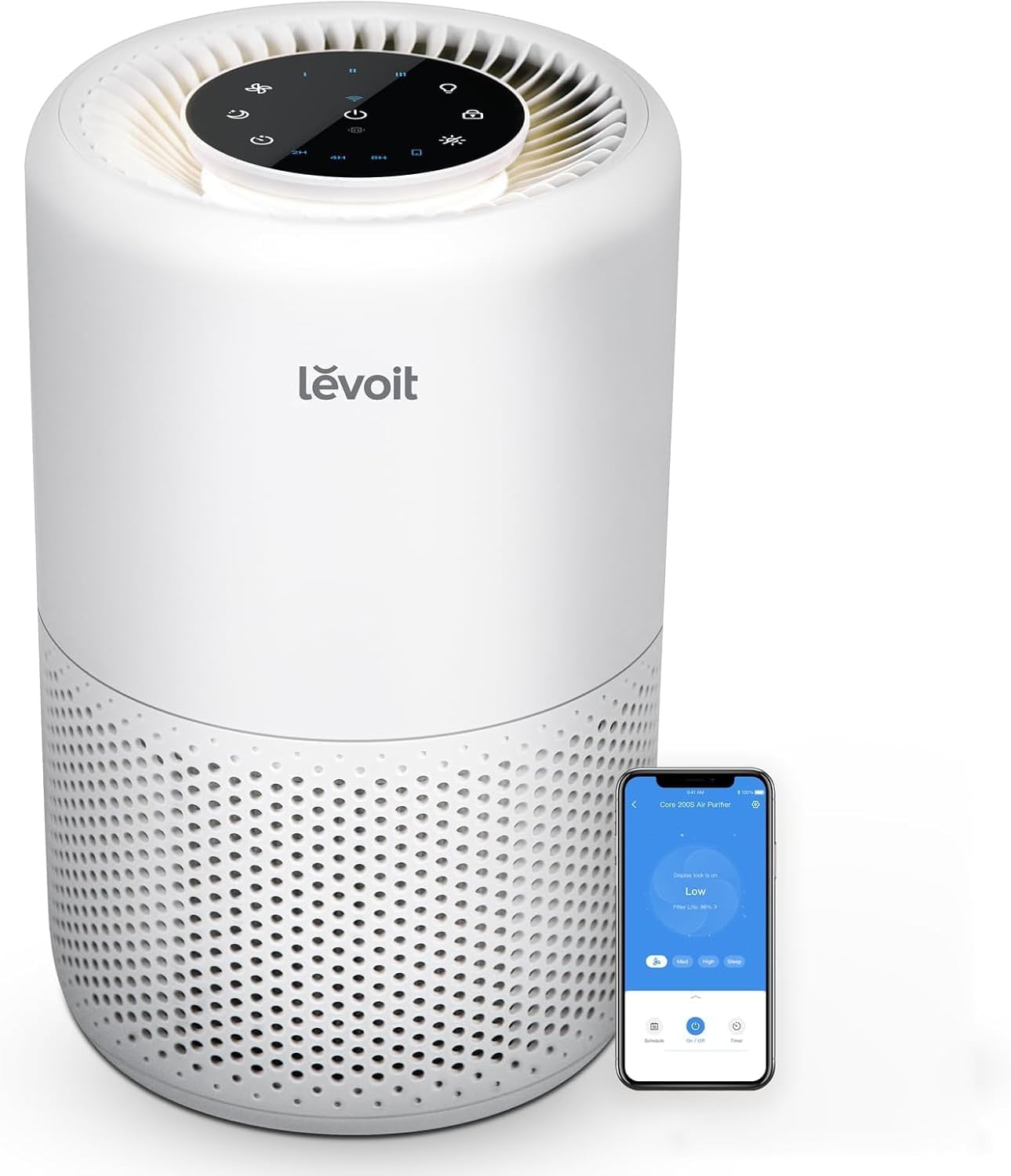
| Item model number | Core 200S |
|---|---|
| AHAM verified coverage | Refreshes air in 140 ft² room 4.8 times/hour |
| Noise level | As low as 27 dB |
| Filtration | 3-in-1: Pre-filter, Activated Carbon, HEPA-grade main filter |
The Levoit Core 200S-P is a compact 3-in-1 air purifier that combines a pre-filter, activated carbon layer, and a HEPA-grade main filter to capture dust, pollen, pet dander, smoke, and common household odors. It is designed for everyday use in bedrooms, nurseries, small apartments, or offices where space is limited and quieter operation matters. The unit pulls air through 360 degree intake and uses a motor tuned to refresh the air in a roughly 140 ft² room multiple times per hour, and the manufacturer rates very low noise down to about 27 dB on sleep mode. Smart and voice control let you monitor and change fan speed or check filter life from the app, and a Display Off button helps keep the bedroom dark at night. Practical benefits include strong filtration for fine particles to 0.1–0.3 microns and activated carbon for odors, plus lightweight portability. Limitations are its intended coverage area—it is not sized for large open-plan living areas—and replacement filters are recommended to maintain AHAM-verified performance over time.
Best for: Buyers who prioritize reliable, low-noise HEPA filtration for bedrooms or small living spaces and want app or voice control for convenient monitoring.
Less Ideal for: People who need to purify large open-plan areas or whole-home spaces should choose a larger-capacity purifier instead.
- HEPA-grade main filter removes 99.97% of particles in the 0.1–0.3 micron range
- Activated carbon layer helps reduce pet odors and common household fumes
- Quiet operation with sleep mode noise as low as 27 dB
- Smart app and voice control for remote monitoring and filter-life tracking
- 360° air intake and compact design refresh a 140 ft² room multiple times per hour
- Coverage area is limited to small rooms and is not suitable for large open spaces
- Requires periodic filter replacements to retain AHAM-verified performance
Verdict: Choose the Core 200S-P if you want a compact, quiet HEPA purifier with smart controls that reliably cleans air in bedrooms and small rooms.
Choosing the Right Air Purifier with HEPA Filter: Key Factors to Consider
Filtration Efficiency and HEPA Rating
A true HEPA filter captures at least 99.97% of particles down to 0.3 microns, which is crucial for reducing pollen, dust mite debris, and many fine particles from indoor air. Higher efficiency directly reduces airborne allergen load and can improve respiratory symptoms for allergy sufferers.
When comparing units, look for clear manufacturer specifications about HEPA rating and whether the filter is certified or independently tested. Filtration efficiency matters most for rooms where occupants have allergies, asthma, or other sensitivities, and it should be weighted heavily when selecting a purifier for health-focused use.
Room Size and Clean Air Delivery Rate (CADR)
Room coverage indicates how well an air purifier will circulate and clean the air in your space. Clean Air Delivery Rate or equivalent airflow metrics show how much filtered air the unit produces per minute and help match a purifier to living rooms, bedrooms, or open-plan areas.
Choose a unit whose rated coverage equals or exceeds the square footage of the intended room at least for a single air change per hour; for better performance, aim for multiple air changes per hour. Undersizing a purifier leads to poor circulation and limited improvement in air quality despite having a high-efficiency filter.
Noise and Day-Night Usability
Noise level affects where and how you can run a purifier. A model that is quiet at low and medium fan speeds is important for sleeping areas or workspaces where background noise is undesirable. Higher fan speeds usually mean louder operation but faster cleaning; assess whether the purifier maintains acceptable sound levels at fan speeds that still deliver meaningful filtration.
Look for published decibel ratings at different fan speeds and consider features like night mode, dimmable displays, or timers to support low-noise overnight use.
Filter Life, Availability, and Maintenance Cost
Filter replacement frequency and cost influence long-term ownership expense and convenience. Some HEPA units combine pre-filters and activated carbon layers that capture larger particles and odors, extending the life of the main HEPA element. Check how easy the filters are to access and whether replacements are commonly available.
Consider expected filter life in months or hours under typical use and whether the manufacturer provides filter life estimates tied to runtime or sensor-based indicators. Replacement cadence affects both operating cost and sustained performance.
Energy Consumption and Continuous Operation
Air purifiers are often run continuously, so energy use matters for ongoing cost and environmental impact. Compare power draw at common fan speeds and whether the unit has energy-saving modes. Lower wattage at effective fan speeds can reduce monthly energy use while maintaining reasonable air changes per hour.
Evaluate whether the purifier supports smart scheduling, timers, or eco modes to limit runtime during low-occupancy periods, which can reduce energy consumption without sacrificing air quality when you need it most.
Matching Purifier Size to Room Layout
Square footage is the starting point, but room shape and airflow barriers matter just as much. High ceilings, open floor plans, and furniture that blocks airflow can reduce effective coverage, so plan for a unit with higher CADR than the bare square footage implies.
If you have connected rooms or open-plan living areas, consider a single higher-capacity purifier placed centrally or multiple smaller units positioned to create balanced circulation. Rooms with many obstructions may need additional air exchanges to achieve the same cleaning effect as an unobstructed room.
- Place the purifier away from walls and obstructions for better intake and discharge.
- Avoid corners and closed cabinets; the unit needs free airflow.
- For long rooms, place the purifier near where occupants spend most time.
Dealing with Odors and VOCs
HEPA filters excel at removing particles but do not capture gases and odors effectively on their own. If you have concerns about cooking smells, pet odors, or volatile organic compounds, choose a model that pairs HEPA filtration with an activated carbon layer or other gas-phase media.
Carbon filter effectiveness varies, and media quantity matters. If odors are intermittent, look for replaceable carbon pre-filters so you can refresh adsorbent media as needed without replacing the HEPA element prematurely.
- Activated carbon helps with smoke, cooking odors, and some VOCs.
- Replace or refresh carbon filters more often than HEPA elements in odor-prone environments.
Sensors, Controls, and Smart Features
Built-in air quality sensors can automatically adjust fan speed based on measured particulate levels, improving convenience and efficiency. Look for units that report PM2.5 or particle counts and show real-time feedback so you can see when pollution spikes and how the purifier responds.
Manual controls, timers, and scheduling are useful if you prefer a fixed runtime pattern. Some units also support app connectivity or voice control, which can be helpful for integration into a smart-home setup, but these features are optional for basic filtration needs.
- Sensors improve responsiveness but verify their accuracy where possible.
- Schedules and timers help reduce energy use while maintaining protection during occupancy.
Placement Tips for Maximum Effectiveness
Place the purifier where people spend the most time, such as near seating areas or beds. Keep it elevated a few inches off the floor if the intake is near the bottom, and ensure the discharge is not blocked by curtains or tall furniture.
For multi-room coverage, consider portable units in each frequently used room rather than relying on a single unit to serve distant spaces. Proper placement often improves performance more than increasing fan speed.
- Avoid placing behind furniture or inside closets.
- Close doors when focusing cleaning power on a single room for best results.
Maintenance Best Practices
Inspect pre-filters regularly and vacuum or wash them if the design allows. Doing so preserves HEPA performance and reduces dust buildup that can force the unit to run harder. Follow manufacturer guidance for filter replacement intervals but adjust based on household conditions like pets or heavy dust.
Keep intake and exhaust grilles free of dust and ensure the unit sits on a level, stable surface. Record filter change dates and consider subscribing to replacement filter reminders if that helps you stay on schedule.
- Mark filter replacement dates in a calendar to avoid missed changes.
- Use genuine replacement filters where possible for best fit and performance.
How We Chose the Best Air Purifier with HEPA Filter
We focused on objective, measurable attributes that determine real-world performance for air purifiers with HEPA filters. Primary evaluation criteria included filtration efficiency on submicron particles, clean air delivery rate relative to stated room coverage, and CADR or equivalent performance metrics. We also weighed noise levels at typical fan speeds, since quiet operation matters for bedrooms and home offices, and considered energy use for continuous operation. Maintenance factors were reviewed, including filter life expectancy and ease of access for replacement, because upkeep affects long-term ownership. Units were excluded if they lacked a true HEPA-rated mechanical filter or did not provide clear performance specifications for particle removal and room size. We prioritized products with verifiable filtration ratings and transparent airflow or CADR data. Additional secondary considerations included build quality, available fan speeds and modes, and safety features such as automatic shutoff or child-lock options. The result is a shortlist of units that balance verified filtration performance with practical everyday use.
Our full evaluation process is outlined in our review methodology.
FAQ
How often should I run an air purifier with a HEPA filter?
Run it continuously if you need constant allergen reduction. For intermittent use, operate higher fan speeds during pollution events and lower speeds overnight. Continuous operation at a moderate speed often provides the best balance of air quality and energy use.
Will a HEPA air purifier remove smoke and cooking odors?
HEPA filters remove smoke particles effectively, but they do not absorb gases or odors. For smells and many VOCs, choose a unit that includes an activated carbon or gas-phase filter in addition to the HEPA element.
Can I rely on the purifier's air quality sensor?
Sensors are useful for real-time feedback, but their accuracy varies. Use sensor readings as a guide for fan speed adjustments, and consider supplementing with a handheld monitor if precise measurement is important.
How do I know what size purifier I need?
Match the unit's rated room coverage or CADR to your room's square footage and ceiling height. When in doubt, choose a unit rated for a slightly larger area than your room to ensure adequate air exchanges.
Are HEPA filters washable or reusable?
True HEPA filters are not washable and should not be cleaned with water because that damages the media. Pre-filters may be washable or vacuumable, but replace the primary HEPA element according to manufacturer recommendations.
Final Verdict
Prioritize filtration efficiency and correct room sizing when choosing an air purifier with a HEPA filter. Balance that core requirement with practical concerns like noise, filter replacement cadence, and energy consumption to fit how and where you will run the unit. If allergies or respiratory sensitivity are the main concern, favor higher-efficiency HEPA ratings and verified CADR to ensure meaningful reductions in airborne particles.