
Note: This article contains affiliate links. If you click on these links and make a purchase, we may earn a small commission at no extra cost to you. This helps support our research and content. Read our full affiliate disclosure here.
If you want to reduce airborne viral particles and improve general indoor air quality, choosing the right air purifier matters. An air cleaner designed with virus-focused filtration and adequate clean-air delivery can lower exposure in shared rooms and make time at home safer and more comfortable. This guide shortlists the seven best air purifiers for viruses across typical home and office spaces. We evaluated units for filtration effectiveness, room coverage, noise, and ongoing operating cost so you can pick a unit suited to your room size and daily use. Read on to see the top options and the criteria used to rank them.
Top Picks at a Glance
| Best Overall The best all-around choice for most situations | Coway Mighty AP-1512HH |  |
| Best Quality Built to a higher standard if you want something more solid | IQAir HealthPro Plus XE |  |
| Best Value The sweet spot between price and what you get | KNKA APH4000 Air Purifier |  |
| Best Budget The cheapest option that still gets the job done reliably | FULMINARE H13 True HEPA Air Purifier |  |
| Top Rated A top-rated pick with lots of positive feedback | ECOSELF HAP603 Air Purifier |  |
| Most Popular A crowd favorite that many people choose with confidence | Levoit Core 300-P Air Purifier |  |
| Best Seller A high-volume bestseller chosen again and again | Levoit Core 200S-P |  |
Coway Mighty AP-1512HH

| Coverage | Up to 1,748 sq. ft. in 60 minutes |
|---|---|
| Filtration stages | Washable prefilter, deodorization filter, bipolar device, HEPA filter |
| HEPA effectiveness | 99.97% of 0.3μm particles |
| Modes | Auto, Eco, Timer |
The Coway Mighty AP-1512HH is a tabletop HEPA air purifier built for continuous home use in medium to large spaces. It pulls air through a washable prefilter, an activated carbon deodorization stage, a bipolar ionizer, and a true HEPA filter that captures 99.97% of 0.3 micron particles, which helps reduce pollen, pet dander, smoke, and many airborne particles linked to illness transmission. The unit runs in Auto mode using an onboard pollution sensor and color LED to adjust fan speed in real time, and it includes Eco and timer modes plus a filter‑change indicator for low maintenance. Practical benefits include broad coverage — advertised to clean up to about 1,748 sq ft in 60 minutes — quiet low‑speed operation suitable for bedrooms, and washable parts that cut running costs. Limitations are that the bipolar ionizer and lab test claims are environment dependent and performance against viruses will vary with room layout, placement, and runtime, and replacement filters are required periodically to maintain peak performance.
Best for: Buyers who want a dependable all‑around purifier for medium to large living spaces and value automatic air quality control and low‑noise operation.
Less Ideal for: People needing a compact travel unit or an industrial solution for very large open areas should consider different form factors or higher‑capacity systems.
- True HEPA filtration rated to capture 99.97% of 0.3 micron particles
- Multi‑stage system including washable prefilter and activated carbon for odors and VOCs
- Auto mode with air quality sensor and LED feedback adjusts fan speed automatically
- Advertised coverage for large rooms with quiet low‑speed operation for sleeping
- Effectiveness against viruses depends on room size, placement, and continuous runtime rather than the unit alone
- Replacement filters add ongoing maintenance cost
Verdict: Choose the Coway Mighty AP-1512HH if you want a reliable, sensor‑driven HEPA purifier that handles medium to large rooms with low noise and broad multi‑stage filtration.
IQAir HealthPro Plus XE

| Coverage | Up to 1125 sq. ft. |
|---|---|
| Filtration efficiency | Filters 99.5% down to 0.003 microns |
| AirVisual App Integration | Yes |
| Sensor-based Operation | Yes |
| Air delivery (example speeds) | Speed 6: 300 cfm / 510 m³/h |
The IQAir HealthPro Plus XE is a high-end air purifier built to remove ultrafine particles down to 0.003 microns using IQAir's HyperHEPA filtration, making it suitable for tackling viruses, smoke, pollen, and other fine pollutants in large spaces. It is typically placed in living rooms, offices, or medical environments where continuous, heavy-duty filtration is needed; the unit moves large volumes of air and is rated for coverage up to about 1,125 sq ft. Notable features include an advanced particle sensor, three smart modes for automatic adjustments, WiFi integration with the AirVisual app, and a redesigned fan system that improves energy efficiency compared with earlier models. Filters have long service lives, so maintenance is infrequent but filter replacements represent an ongoing operating cost. The purifier is relatively large and heavy compared with compact room units, and its premium performance and build quality come with a high upfront cost. For buyers focused on the best possible removal of ultrafine particles and sensor-driven automatic operation, the HealthPro Plus XE delivers measurable, professional-grade air cleaning.
Best for: Buyers who prioritize top-tier removal of ultrafine particles and want a robust, sensor-driven purifier for large rooms or sensitive environments where virus-level protection is a primary concern.
Less Ideal for: Casual users who need a small, portable, or budget unit for a single small room should consider simpler compact purifiers instead.
- HyperHEPA filtration certified to capture ultrafine particles down to 0.003 microns
- Rated coverage for large rooms up to 1,125 sq ft so it can handle whole-room purification
- Smart particle sensor with automatic modes for continuous, hands-off operation
- WiFi and AirVisual app integration for remote monitoring and control
- Redesigned fan system claimed to be more energy efficient than previous models
- High purchase cost compared with typical consumer air purifiers
- Large and heavy cabinet makes placement and moving less convenient
- Filter replacements are long-lived but add ongoing operating expense
Verdict: Choose the HealthPro Plus XE when you need industrial-strength removal of ultrafine particles and app-driven automatic control for large rooms where virus-level protection matters.
KNKA APH4000 Air Purifier

| Item model number | APH4000 |
|---|---|
| AHAM CADR (Smoke/Dust/PM2.5) | 226 CFM (384 m³/h) |
| AHAM CADR (Pollen) | 244 CFM (415 m³/h) |
| Coverage (1 air change/hr) | Up to 1,695 ft² |
| Modes | Pet, Eco, Auto, Sleep, 4 fan speeds |
The KNKA APH4000 is a high-capacity HEPA air purifier built to move large volumes of air and reduce particles quickly. Its AHAM-verified CADR ratings for smoke, dust, and pollen indicate strong performance, and the unit's dual front-and-back filter cartridges with washable pre-filters, high-efficiency HEPA layers, and activated carbon provide multi-stage capture of pet hair, pollen, odors, and fine particulates. The APH4000 uses dual intakes and side outlets to speed circulation and can refresh air multiple times per hour in medium rooms while still providing one-air-change-per-hour coverage in much larger spaces. Practical controls include Pet, Eco, Auto, and Sleep modes plus four fan speeds, an AQI display with color-coded feedback, a child lock, timer, and filter replacement indicator that simplifies upkeep. Noise is low in Sleep mode, and the washable pre-filter reduces replacement cost. Trade-offs are typical for high-flow purifiers: filters will need periodic replacement every few months under heavy use and the unit's strongest settings are louder and use more energy.
Best for: Buyers who prioritize measurable, fast particle removal across rooms and want configurable modes and visible air-quality feedback to keep living spaces cleaner with straightforward maintenance.
Less Ideal for: People who need an ultra-compact or near-silent purifier for tiny bedrooms where high airflow and multi-room coverage are unnecessary.
- AHAM-verified CADR for smoke, dust, and pollen indicating reliable high-speed purification
- Dual intake/outlet design increases room circulation for faster air exchange
- Three-stage filters (washable pre-filter, HEPA, activated carbon) tackle particles and odors
- Multiple modes including Pet, Eco, Auto, and ultra-quiet Sleep mode for flexible use
- Built-in AQI display and filter indicator simplify monitoring and maintenance
- Filters require regular replacement every 3–6 months under typical use
- High fan speeds are louder and consume more power
Verdict: Choose the APH4000 if you want an AHAM-verified, high-flow HEPA purifier that refreshes large rooms quickly while offering mode-driven control and real-time AQI feedback.
FULMINARE H13 True HEPA Air Purifier

| Filter type | H13 HEPA |
|---|---|
| Coverage area | Up to 215 ft² / 20 m² |
| Air changes | Up to 5 times per hour |
| Noise level (low) | Around 24 dB |
| Power | Plug-in (no battery) |
The FULMINARE H13 is a small, portable air purifier built around an H13 True HEPA filter and 360° airflow to refresh air in rooms up to about 215 sq ft. It is intended for bedroom or office use where low noise matters, with a sleep mode that claims operation near 24 dB and an independent night light that doubles as a gentle bedside lamp. The purifier offers multiple timer settings (2, 4, 8, 10, 12 hours) and a plug-in power design, and the cylindrical intake and dual-channel outlet aim to circulate air five times per hour in the stated coverage area. For everyday reduction of particles, pet hair, smoke and common household odors the unit is simple to place and run continuously. Limitations include its coverage ceiling—it is sized for single rooms rather than whole-home virus mitigation—and replacement filters will be required about every three months under typical use. If you need higher airflow or broader square-foot coverage for larger open areas, look to larger units with higher CADR ratings.
Best for: Buyers who want an affordable, quiet bedroom air purifier that reduces particles and odors in a single room and who prioritize low noise and simple operation.
Less Ideal for: People needing whole-house ventilation, high CADR performance for large open areas, or certified medical-grade viral removal should consider larger, higher-capacity purifiers.
- H13 True HEPA filter for high-efficiency particle capture
- 360° air outlet and dual-channel design for even room circulation
- Near-silent sleep mode suitable for bedrooms
- Independent night light and multiple timer options
- Compact and portable for small rooms or desktops
- Intended coverage limited to about 215 sq ft so not suitable for large or open-plan spaces
- No listed CADR or specific viral removal certification in the product details
Verdict: A quiet, budget-friendly H13 HEPA purifier that reliably cleans the air in a single bedroom or small office.
ECOSELF HAP603 Air Purifier

| Coverage | Up to 2400 ft² |
|---|---|
| Noise level | 22 dB (Sleep Mode) |
| Filtration | True HEPA (H13 stated in parts of listing) |
| Controls | Auto Mode, Timer, Fan Speeds, Child Lock |
| Air quality sensor | PM2.5 display with infrared sensor |
The ECOSELF HAP603 is built to clean large living areas and emphasizes continuous, automated air quality control. It uses a True HEPA (H13-level implied) multi-stage filtration and a 2X-power circulation design intended to service up to 2400 ft², removing common airborne particles including smoke, dust, and allergens. A PM2.5 display and infrared sensor feed a smart auto mode that adjusts fan speed based on measured air quality, and there is a very quiet 22 dB sleep mode for nighttime use. Practical additions include a timer, child lock, filter change indicator, and an aromatherapy slot for light scenting. Maintenance is straightforward but requires purchasing ECOSELF replacement filters to maintain factory performance. The unit is marketed with multiple safety and emissions certifications and targets steady, low-noise operation rather than burst high-flow cleaning, so it excels at continuous background purification but may take longer to clear heavy, sudden contamination events compared with high-CADR single-room units.
Best for: Buyers who prioritize steady, reliable background air cleaning for large living areas and value automated sensing and low-noise operation for everyday protection.
Less Ideal for: People who need rapid high-flow clearance for small rooms or immediate heavy smoke removal should consider a high-CADR room-focused purifier instead.
- True HEPA multi-stage filtration designed to capture 99.97% of particles including PM2.5
- Smart PM2.5 display and infrared sensor that automatically adjusts fan speed
- Very quiet 22 dB sleep mode suitable for bedrooms
- Covers up to 2400 ft² with 2X circulation for whole-room background purification
- Filter indicator, timer, and child lock simplify maintenance and daily use
- Large coverage claim may mean slower clearance in very dusty or heavily contaminated rooms
- Requires official ECOSELF replacement filters for optimal performance
- Aromatherapy feature can add scent that some users may not want
Verdict: Choose the HAP603 when you want a quiet, sensor-driven purifier that reliably maintains cleaner air across large living spaces.
Levoit Core 300-P Air Purifier

| Power Source | Corded Electric |
|---|---|
| Filter Type | 3 in 1 Filtration |
| Noise Level | 24 db |
| Wattage | 56 watts |
| Particle Retention Size | 0.3 micron |
The Levoit Core 300-P is a small, user-friendly HEPA air purifier built for bedrooms, living rooms, and other home spaces where quiet operation matters. It uses a 3-in-1 filtration stack with a HEPA-grade filter capable of capturing particles down to 0.1–0.3 microns and a 56W motor that delivers CADR-rated airflow for dust, smoke, and pollen. Typical use is plug-and-play: place it in the room, choose one of the manual fan speeds or Sleep Mode for near-silent 24 dB operation, and use the timer or display-off option at night. Practical benefits include verified AHAM performance metrics, ETL and CARB compliance, and an included preinstalled filter so you can run it immediately. Limitations to note are that this model does not include Auto Mode or smart connectivity, so fan speed adjustments must be made manually, and Levoit recommends using genuine replacement filters for best results and to maintain CADR claims. For buyers focused on proven filtration and quiet night use, it is a straightforward, reliable option.
Best for: Buyers who prioritize proven filtration performance and quiet, distraction-free operation for bedrooms or living spaces and who value third-party verification and strong social proof from many reviewers.
Less Ideal for: Users who want Wi-Fi, app control, or automatic air-sensing adjustments should consider models with smart features instead.
- HEPA-grade 3-in-1 filter captures 99.97% of 0.1–0.3μm particulates as tested by an independent lab
- AHAM-verified CADR ratings for smoke, dust, and pollen with stated room refresh rates
- Very quiet Sleep Mode at about 24 dB suitable for bedroom use
- ETL listed and CARB compliant for certified home use
- Compact and portable design with touch controls and timer/display-off option
- No Auto Mode or smart connectivity on this model, so you must change fan speeds manually
- Manufacturer advises using only official replacement filters to achieve rated performance
Verdict: A reliably tested, quiet HEPA purifier that delivers verified particle removal for home rooms when you want proven performance without smart features.
Levoit Core 200S-P
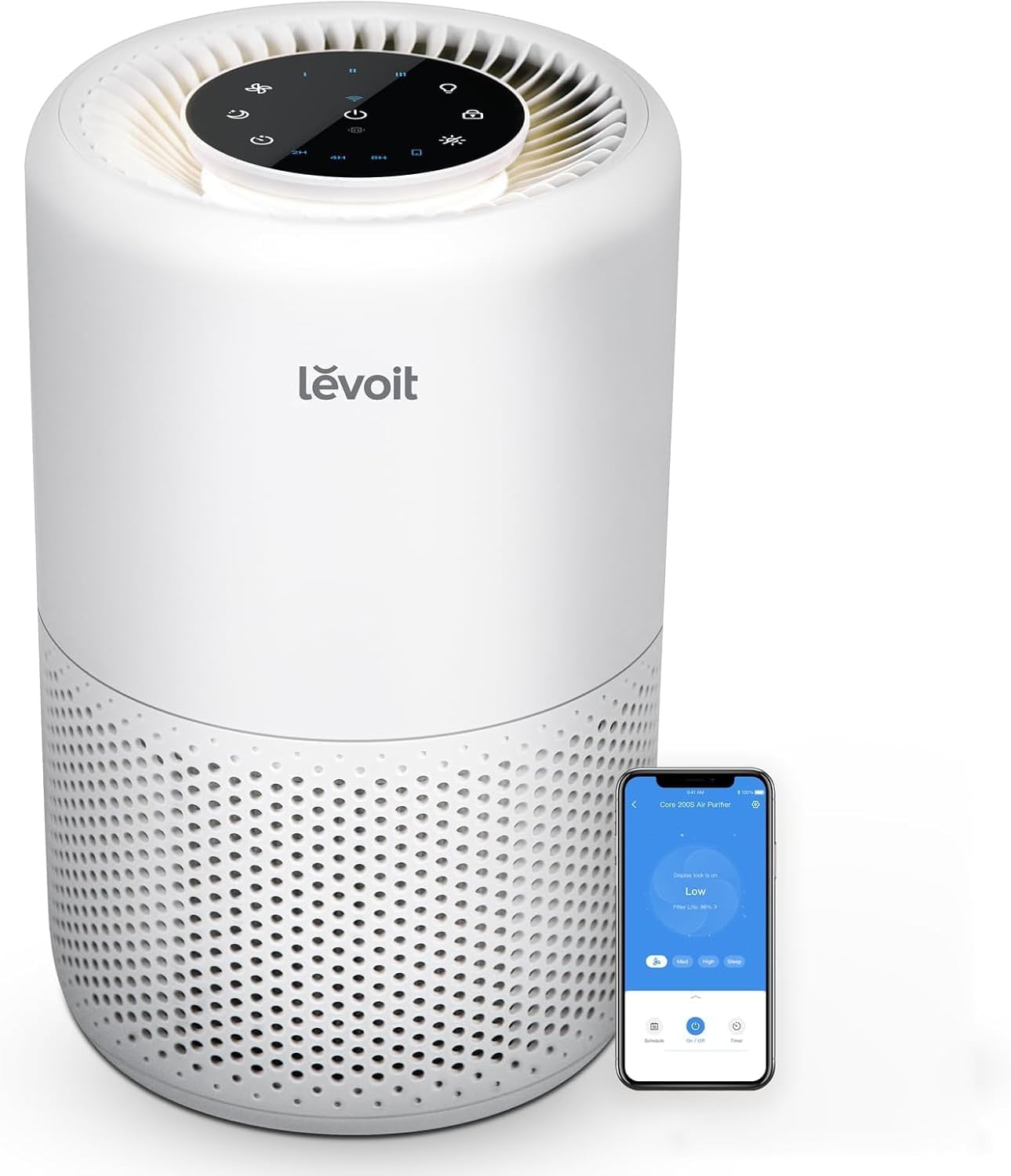
| Model | Core 200S |
|---|---|
| Filtration | 3-in-1 filter (pre-filter, activated carbon, HEPA-grade) |
| Coverage | 140 ft² room refreshes 4.8 times/hour |
| Noise level | As low as 27 dB (Sleep Mode) |
The Levoit Core 200S-P is a small, voice- and app-controllable air purifier built for bedrooms, nurseries, and small apartments where pet dander and odors are a concern. It pulls air through a 360° intake into a three-stage filter stack: a nylon pre-filter, activated carbon layer for smells and VOCs, and a HEPA-grade main filter that captures particles down to 0.1–0.3 microns at 99.97% efficiency. The unit is AHAM-verified and rated to refresh air in a roughly 140 ft² room nearly five times per hour, and the motor runs quietly with sleep mode noise as low as 27 dB. Smart features let you monitor filter life and control the purifier remotely, and a Display Off button eliminates light at night. Its compact footprint makes placement flexible but also limits coverage to small rooms, so multiple units are needed for whole-home protection. Replacement filters are recommended for best performance and are an ongoing maintenance cost.
Best for: Buyers who prioritize proven particle filtration and quiet, smart-controlled operation in bedrooms or small spaces and want a low-risk, well-documented purifier.
Less Ideal for: People seeking to purify large open-plan areas or entire homes with a single machine should look at higher-capacity units instead.
- Three-stage filtration including HEPA-grade main filter that captures 99.97% of 0.1–0.3 micron particles
- AHAM-verified performance and specified refresh rate for a 140 ft² room
- Smart app and voice control with filter-life monitoring
- Very quiet operation with sleep mode down to 27 dB
- 360° air intake and compact footprint for flexible placement
- Coverage is limited to small rooms, not suitable as a single whole-home unit
- Requires regular replacement filters which add to lifecycle cost
Verdict: Choose the Core 200S-P when you want a compact, AHAM-verified purifier with HEPA-grade filtration and smart controls for reliable virus-reducing performance in small rooms.
Choosing the Right Air Purifier for Viruses: Key Factors to Consider
Filtration Efficiency and Filter Type
The single most important factor is the purifier's ability to capture small particles. True HEPA or equivalent filters trap particles down to submicron sizes where viral aerosols travel. Higher-efficiency filters remove a larger percentage of airborne particles per pass, which directly reduces concentration in the room over time.
Filter construction and certification matter because marketing terms vary. Look for true HEPA or clearly stated particle-capture ratings. Some units include prefilters and activated carbon layers; prefilters prolong HEPA life by catching larger dust, while carbon helps remove odors and volatile organic compounds but does not capture particles.
Clean-Air Delivery Rate (CADR) and Room Coverage
CADR or stated room coverage indicates how quickly a purifier can cycle the air in a specific space. A higher CADR means faster reduction of airborne contaminants, which is crucial when the goal is lowering viral load in occupied rooms. Match the CADR or room-size recommendation to the square footage and ceiling height of your space.
Bear in mind that placement affects performance. Even a high-CADR unit will be less effective in an obstructed corner or behind furniture. For continuous protection, choose a unit that can deliver at least two to four air changes per hour in the target room, depending on occupancy and activity level.
Noise Levels and Fan Speeds
Noise determines how likely you are to run the purifier at higher speeds for extended periods. A unit that produces low noise at effective fan speeds is more usable in bedrooms, home offices, and living areas. Look for measured sound levels (dB) at different fan settings rather than vague claims of 'quiet operation.'
Multiple fan speeds and a night mode help balance performance and comfort. If you need near-silent operation while sleeping, check the lowest-speed noise measurement and whether it still provides meaningful air changes.
Maintenance, Filter Cost, and Availability
An effective purifier only helps if filters are replaced on schedule. Consider the frequency of filter changes, the cost of replacement filters, and how easy they are to buy. Long filter life reduces ongoing cost but sometimes requires a larger initial investment.
Also check whether filters are simple to access and replace without tools. Units with clear filter-change indicators and widely available replacement parts reduce the chance that maintenance will be deferred, which would lower filtration performance over time.
Energy Use and Continuous Operation Practicality
Because air purifiers are most effective when run continuously, their power draw affects utility costs and practicality. Energy-efficient motors and fan designs can run longer at a lower cost. Some purifiers offer auto modes that ramp fan speed based on measured particle levels, which can save energy while maintaining protection.
Consider units with ENERGY STAR-like efficiency or low-wattage operation if you plan to run the purifier 24/7. Also evaluate whether the device has programmable schedules or occupancy sensors to reduce needless run time without sacrificing protection.
Sizing Your Air Purifier to the Room
Picking the right size purifier is about matching clean-air delivery to the room's volume. Calculate square footage and multiply by ceiling height to estimate volume, then compare that to the unit's CADR or recommended room coverage to ensure adequate air changes per hour.
If you spend time in multiple connected spaces, consider one larger unit with high CADR or supplement with smaller units placed strategically. Remember that open floor plans require more airflow to achieve the same particle reduction as a single closed room.
- Aim for at least 2 to 4 air changes per hour for general protection.
- Increase target air changes in high-occupancy or higher-risk scenarios.
- Position the unit away from obstructions and off the floor if the design recommends it.
Placement and Practical Setup Tips
Correct placement improves purifier effectiveness. Place the unit where airflow is least obstructed and where occupants spend most time. Avoid corners, tight alcoves, or placing the intake next to curtains or bulky furniture.
Consider power outlet availability and cable routing to avoid tripping hazards. For bedrooms, place the unit near the foot of the bed or along a side wall; for living rooms, central locations or near activity zones work best.
- Keep at least a foot of clearance on all sides unless the manual specifies otherwise.
- Do not block inlet or outlet grills with furniture or drapes.
- Avoid placing purifiers next to strong localized pollution sources that can overwhelm the filter quickly.
Operating Modes and Smart Features
Many modern purifiers include auto modes, air-quality sensors, and app connectivity. Auto modes that increase fan speed when particles rise can provide better protection with less user intervention, but verify the sensor's reliability in real-world conditions.
Timer functions and scheduling are useful to ensure higher filtration during peak occupancy and lower speeds overnight. Some units offer child locks, filter life tracking, and voice-assistant integration, which improve convenience but are secondary to raw filtration performance.
- Prefer validated air-quality sensors rather than lights-only indicators.
- Use schedules to align higher fan speeds with typical occupancy patterns.
- Smart features should not replace checking filter status and following maintenance intervals.
Carbon and Gas-Phase Filtration Considerations
While particle filtration addresses aerosolized viral particles, activated carbon or other gas-phase media help remove odors, VOCs, and some airborne chemical irritants. If indoor sources of odors or chemicals are a concern, choose a unit with a substantial carbon layer in addition to HEPA filtration.
Carbon capacity varies widely. If you have pets, cook indoors frequently, or live in an area with seasonal pollution, a larger or replaceable carbon module will stay effective longer. Remember that carbon does not capture particles, so it complements but does not replace HEPA.
- Check carbon quantity and whether the unit uses replaceable carbon inserts.
- For combined particle and gas concerns, plan on replacing carbon media more frequently.
- Avoid relying solely on ozone-generating technologies for odor control.
Maintenance Best Practices
Regular inspection and timely filter replacement keep performance consistent. Follow the manufacturer's recommended replacement interval but also visually inspect filters for heavy dust loads; high indoor pollution may require earlier changes.
Clean prefilters as recommended to extend HEPA life. Keep intake and outlet grills free from dust buildup and vacuum the area around the unit to prevent recirculation of settled particles.
- Record filter change dates to maintain a schedule.
- Use only recommended replacement filters to preserve performance and avoid leaks.
- Avoid DIY cleaning of HEPA media which can damage the filter and reduce effectiveness.
How We Chose the Best Air Purifier for Viruses
Our selection process focused on features and performance that most directly affect a unit's ability to reduce airborne viral particles and keep indoor air fresh. We prioritized proven filtration stages and verified particle-capture efficiency, then cross-checked clean-air delivery rates against common room sizes to ensure realistic coverage. We also evaluated noise levels for typical fan speeds, because a purifier that is too loud is unlikely to run long enough to matter. Energy use and replacement filter availability informed operational cost and long-term practicality. Ease of use and maintenance were included because complex maintenance reduces consistent operation. Excluded from consideration were units that rely solely on ionization without certified particle filtration or products with unverified claims about inactivating viruses. The final list favors measurables like CADR, HEPA-grade filtration, activated carbon for gases, documented airflow, and sensible user controls. These same dimensions informed the scoring criteria used in each product scorecard.
Our full evaluation process is outlined in our review methodology.
FAQ
Can an air purifier eliminate viruses completely?
No air purifier can guarantee complete elimination of all viruses in a room. High-quality HEPA filtration and adequate air changes reduce airborne concentrations significantly, lowering risk, but they are one layer of protection and work best alongside ventilation and hygiene measures.
How often should I run my air purifier to reduce viral risk?
For continuous protection, run the purifier whenever the room is occupied. Aim for fan speeds that provide multiple air changes per hour. In high-risk situations increase fan speed; in bedrooms use the quietest effective setting for overnight use.
Are ionizers or ozone generators effective against viruses?
Ionizers and ozone generators may claim particle removal or disinfection, but they are not a substitute for true particle filtration. Ozone can be harmful at elevated levels and is not recommended as a primary method for reducing viral exposure. Prefer HEPA-based solutions with documented performance.
Do I need a purifier with a carbon filter for virus concerns?
Carbon filters do not capture viral particles but are useful for removing odors and gaseous pollutants. If viral particle reduction is the main goal, prioritize HEPA efficiency and CADR. Add carbon if you also need odor or VOC control.
How do I know if my purifier is sized correctly for a room?
Compare the unit's CADR or recommended coverage to your room's square footage and ceiling height. Aim for enough clean-air delivery to achieve at least two to four air changes per hour depending on occupancy and risk level.
Final Verdict
When selecting an air purifier for viruses, prioritize true particle-capture performance and enough clean-air delivery for the room you intend to protect. Balance filtration efficiency with realistic noise and operating costs so the unit will run when you need it. Expect tradeoffs: higher CADR and HEPA efficiency usually mean larger units or higher noise and filter costs. Choose the combination of filtration, coverage, and usability that matches your typical occupancy and budget, and follow maintenance recommendations to preserve performance over time.