
Note: This article contains affiliate links. If you click on these links and make a purchase, we may earn a small commission at no extra cost to you. This helps support our research and content. Read our full affiliate disclosure here.
A persistently smelly room can make home life unpleasant and stressful. The right air purifier for a smelly room reduces odor-causing particles, volatile organic compounds, and airborne bacteria so the space feels fresher and more comfortable. This guide narrows the field to seven shortlisted air purifiers that are well suited to tackling odors in typical living spaces. We evaluated units for how effectively they remove smells, how long filters last, and how practical they are for daily use. Read on to see the practical tradeoffs and which features matter most when you need reliable odor control.
Top Picks at a Glance
| Best Overall The best all-around choice for most situations | GermGuardian AC4825E 22" Tower |  |
| Best Quality Built to a higher standard if you want something more solid | Winix 5510 Air Purifier |  |
| Best Value The sweet spot between price and what you get | MOOKA B-D02L Air Purifier |  |
| Best Budget The cheapest option that still gets the job done reliably | MEGAWISE Home Air Purifier EPI810 |  |
| Top Rated A top-rated pick with lots of positive feedback | Levoit Core 300-P |  |
| Most Popular A crowd favorite that many people choose with confidence | Levoit Core Mini-P |  |
| Best Seller A high-volume bestseller chosen again and again | VOOPNU H13 HEPA Air Purifier DH-JH12 |  |
GermGuardian AC4825E 22" Tower

| Coverage (single-cycle) | 153 sq. ft. per 12.5 minutes |
|---|---|
| Maximum room coverage | Up to 743 sq. ft. (hourly) |
| Filter type | True HEPA with activated carbon pre-filter |
| Fan speeds | 3 speeds with sleep mode |
The GermGuardian AC4825E is a compact tower purifier that combines a True HEPA filter, an activated carbon pre-filter, and an optional UV-C light to tackle common indoor air issues like dust, pet dander, odors, and airborne germs. It is typically placed in bedrooms, living rooms, or basements and can cycle air in a 153 sq ft room every 12.5 minutes and treat larger areas up to 743 sq ft on a slower schedule. Three fan speeds including a quiet sleep mode let you balance noise and cleaning power, while the carbon layer helps reduce cooking and pet smells. Maintenance is straightforward with replacement HEPA, carbon, and UV parts available from the manufacturer. Limitations include basic control options without smart connectivity and a tower design that is optimized for room-level coverage rather than whole-house filtration, so you may need multiple units for persistent or very large odor problems.
Best for: Buyers who want a reliable, no-frills room air purifier that reduces allergens and common household odors with simple controls and proven HEPA filtration.
Less Ideal for: People seeking whole-house ventilation, integrated smart-home control, or advanced sensor-driven automation should consider other solutions.
- True HEPA filter captures tiny allergens down to 0.1 microns for measurable particle removal
- Activated carbon pre-filter helps reduce odors from cooking, pets, and household smells
- Optional UV-C light adds a sanitizing layer for additional airborne germ control
- Three fan speeds including a quiet sleep mode let you trade noise for faster cleaning
- Compact tower footprint fits in bedrooms or offices without taking much floor space
- No Wi-Fi or app controls for remote monitoring or scheduling
- Designed for single-room use so larger homes may need multiple units
Verdict: A practical, room-focused purifier that pairs True HEPA filtration with a carbon layer and UV-C option to noticeably reduce odors and allergens in bedrooms and living spaces.
Winix 5510 Air Purifier

| Model | 5510 |
|---|---|
| Filtration | 4-Stage (Pre-filter, True HEPA, Carbon, PlasmaWave) |
| Coverage (AHAM) | Up to 1,882 sq ft in 1 hour |
| Noise (Lowest) | 23.5 dB |
| Smart features | WiFi, Winix Smart App, Alexa, Google Home |
The Winix 5510 is a performance-focused tower air purifier built to tackle allergens, smoke, and household odors in large rooms. It uses a 4-stage system—washable pre-filter, True HEPA that captures particles down to 0.01 microns, and an advanced odor-control carbon filter—plus Winix PlasmaWave technology for additional pollutant reduction. Built-in smart sensors and an AQI indicator let the unit run in Auto Mode and ramp fan speeds as air quality worsens, and Sleep Mode reduces noise when the room is dark. App, Wi‑Fi, and voice assistant support let you monitor and control the unit remotely. The purifier is AHAM verified for large-room coverage and is UL certified, so it is suitable where fast, measured air exchange and effective odor absorption matter. Expect quiet low-speed operation but audible airflow at higher fan settings, and ongoing costs for periodic filter replacement and carbon filter upkeep when odor loads are heavy.
Best for: Buyers who prioritize fast, measurable air cleaning and effective odor reduction in larger rooms and who want app control and automated sensor-driven operation.
Less Ideal for: People who need an ultra-compact or fully silent bedroom unit or those who prefer a no-network appliance without smart features.
- True HEPA filtration captured fine particles down to 0.01 microns for strong allergen and smoke removal
- Advanced carbon odor-control filter reduces VOCs and common household smells
- Smart sensors with AQI indicator and Auto Mode adjust fan speed automatically for performance and efficiency
- Winix Smart App and Wi‑Fi/Alexa/Google Home support for remote monitoring and control
- Higher fan speeds can be noticeably louder than Sleep Mode
- Filters require periodic replacement to maintain peak odor and particle removal
Verdict: If you need rapid, large-room odor removal with sensor-driven performance and smart controls, the Winix 5510 delivers focused, high-capacity cleaning.
MOOKA B-D02L Air Purifier
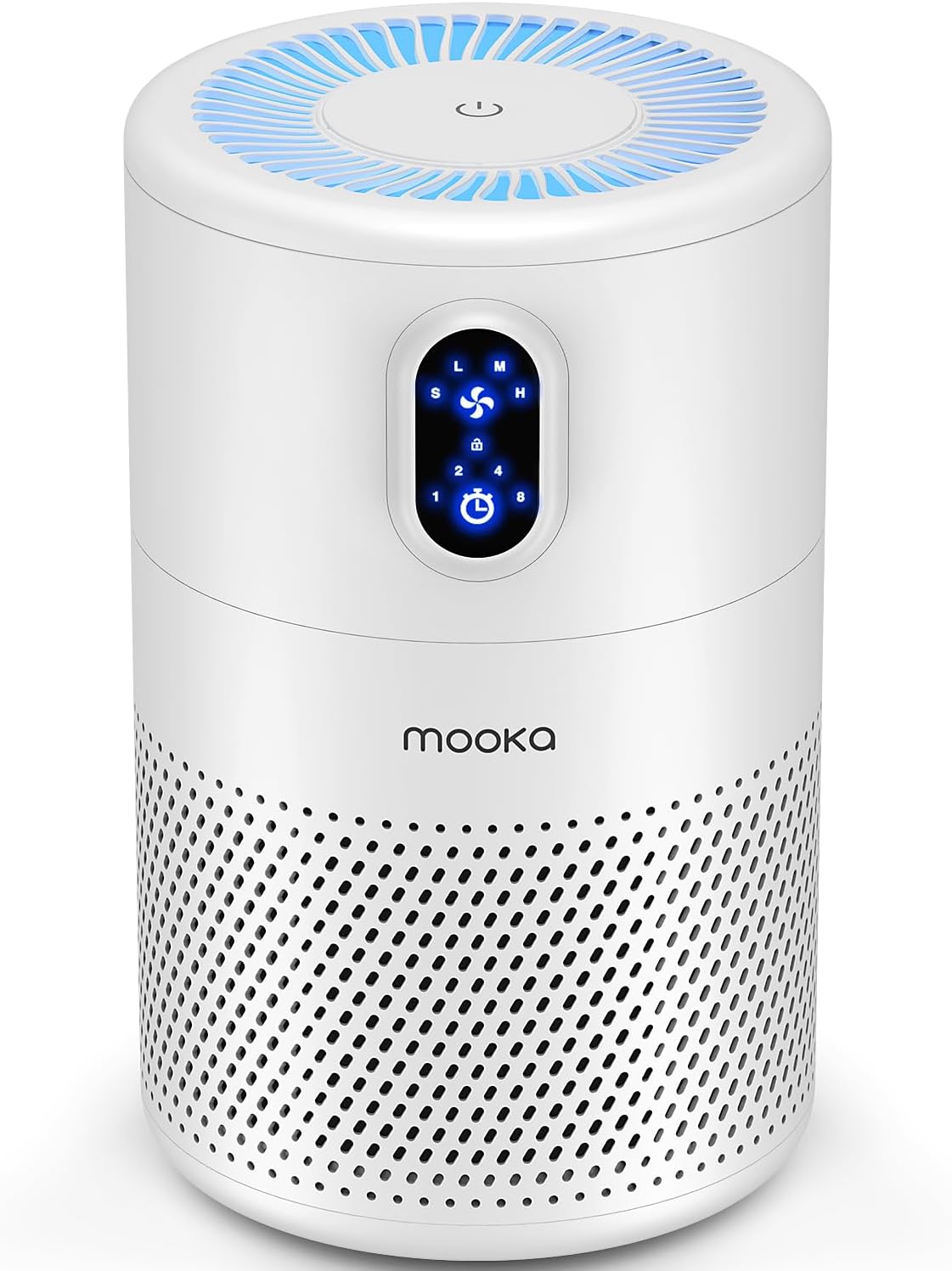
| Filter type | H13 true HEPA + activated carbon + pre-filter |
|---|---|
| Coverage | Up to 1076 sq ft |
| Timer | 1/2/4/8 hours |
| Fan speeds | Sleep/Low/Med/High |
The MOOKA B-D02L is a portable air purifier built around an H13 true HEPA filter plus activated carbon and a washable pre-filter to capture dust, pet hair, pollen, smoke and odors. It is intended for home use in bedrooms, living rooms, offices and other spaces and claims coverage up to 1076 square feet with lower-area higher air-change rates. Controls include four fan speeds, four timer settings, a child lock, and a soft night light that can be turned off. The unit emphasizes quiet, energy-saving operation using a brushless motor with a low noise setting suitable for sleep or work. Practical benefits include easy filter replacement reminders and a compact footprint that fits small to large rooms, while the activated carbon layer helps reduce common household smells. Important limitations are the routine filter maintenance cycle (recommended replacement every 3 to 6 months depending on use) and that real-world performance will depend on room layout and pollutant load rather than the stated maximum coverage figures.
Best for: Buyers who want a practical, quiet purifier that balances strong filtration and odor reduction for living spaces and bedrooms and who prioritize energy efficiency and simple controls.
Less Ideal for: People seeking a no-maintenance device or those unwilling to budget for regular filter replacements should consider alternatives with lower upkeep requirements.
- H13 true HEPA plus activated carbon and pre-filter for particle and odor capture
- Rated to cover very large areas (up to 1076 sq ft) with higher air-change rates in smaller rooms
- Ultra-quiet brushless motor and low-noise sleep mode suitable for overnight use
- Multiple timer and fan-speed settings plus child lock for flexible, safe operation
- Replacement filter interval (3–6 months) means ongoing consumable costs
- Stated coverage depends on room layout and pollutant levels so results may vary
Verdict: A quiet, energy-saving HEPA purifier with activated carbon that is a practical choice for reducing smoke and household odors in living spaces.
MEGAWISE Home Air Purifier EPI810

| Coverage | 215 sq ft |
|---|---|
| Filtration | True HEPA (0.3 μm, 99.97%) |
| Fan speeds | 6 speeds + Sleep Mode |
| Noise level | <25 dB (Sleep Mode) |
The MEGAWISE EPI810 is a small, portable air purifier that uses a True HEPA filter to capture 99.97% of particles down to 0.3 microns and an activated carbon stage to tackle odors and smoke. It draws air through a 360 degree intake and pushes it out via dual-channel airflow, making it suitable for bedrooms, nurseries, or home offices up to about 215 square feet. Users can choose among six fan speeds and a near-silent sleep mode that runs under 25 dB for overnight use, and a negative ion function offers an extra cleaning boost. A practical benefit is the washable filter, which lets you rinse the element and delay replacements, lowering ongoing costs. The unit also includes a filter replacement indicator and simple controls, and its compact, lightweight design fits on nightstands or desks. Limitations include modest coverage compared with larger models and that washable filters can be less effective over time than replaceable multi-stage cartridges, so heavy-smoke situations may still need more powerful purifiers.
Best for: Buyers who prioritize low initial and operating cost and need a compact purifier for bedrooms or small living spaces to reduce odors, smoke, and everyday dust.
Less Ideal for: Those seeking maximum CADR or whole-house odor removal or users with very heavy indoor smoke exposure should choose a larger, higher-capacity unit instead.
- True HEPA filtration captures 99.97% of particles down to 0.3 μm
- Activated carbon plus negative ion function helps reduce odors and smoke
- Six fan speeds including a near-silent sleep mode under 25 dB
- Washable filter reduces replacement frequency and ongoing cost
- 360° intake with dual-channel airflow for even room distribution
- Coverage is limited to medium rooms around 215 sq ft so not ideal for large open areas
- Washable filter may lose effectiveness over many cleanings compared with replaceable multi-stage filters
Verdict: A budget-friendly compact purifier that uses true HEPA, activated carbon, and a washable filter to quietly reduce odors and smoke in small to medium rooms.
Levoit Core 300-P

| Filter Type | 3 in 1 Filtration |
|---|---|
| Floor Area | 1073 square_feet |
| Noise Level | 24 db |
| Particle Retention Size | 0.3 micron |
| Wattage | 56 watts |
The Levoit Core 300-P is a small, user-friendly air purifier built around a three-stage HEPA-grade filter that captures 99.97% of particles down to 0.1–0.3 microns and reduces common indoor contaminants like smoke, pollen, dust, pet dander, and odors. It uses a 56W motor with a CADR that supports effective cleaning cycles for typical bedrooms and living spaces, and it includes a near-silent Sleep Mode that drops noise to about 24 dB for overnight use. Controls are touch-based and the unit offers a timer and a filter check indicator for straightforward maintenance. Practical benefits include portable placement, AHAM verification for measured performance, and CARB/ETL compliance for safe home use. Limitations are that this model lacks smart connectivity or Auto Mode, so you must manually adjust fan speeds rather than relying on automatic air-quality sensing, and optimal coverage and CADR figures are based on Levoit original filters so third-party filters may reduce performance.
Best for: Buyers who prioritize dependable, measured filtration and quiet night-time operation for bedrooms or small living areas and want a straightforward, low-maintenance purifier.
Less Ideal for: People who need Wi-Fi, app control, or automatic air-quality sensing, or those looking to cover very large open-plan spaces as a single unit.
- True HEPA-grade three-stage filter that captures fine particles including smoke and pollen
- AHAM-verified CADR and certifications (CARB, ETL) that back measured cleaning performance
- Very quiet Sleep Mode (around 24 dB) suitable for bedrooms
- Touch controls, timer, and filter check make operation and upkeep simple
- Compact and portable design for easy placement in bedrooms or offices
- No smart connectivity or Auto Mode so fan speed must be adjusted manually
- Coverage and performance specs are tied to Levoit original filters rather than third-party replacements
Verdict: A reliable, AHAM-verified HEPA purifier that quietly removes smoke and odors from bedrooms and small rooms when you want measured, dependable performance.
Levoit Core Mini-P
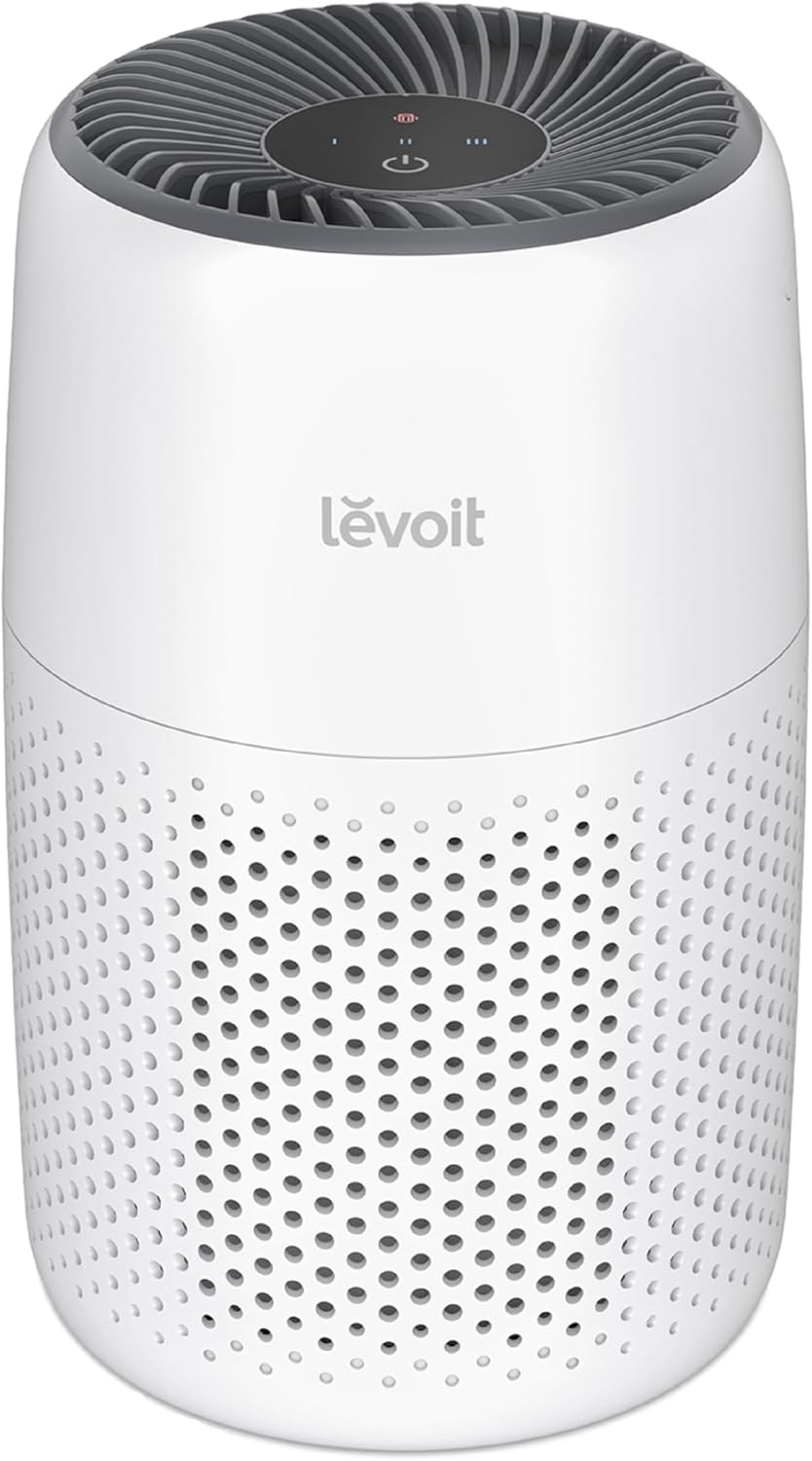
| Rated Power | 7W |
|---|---|
| Noise Level | 27-45dB |
| Particle Retention Size | 0.3 micron |
| Model number | LAP-C161-WUS |
The Levoit Core Mini-P is a small, plug-in air purifier built for personal spaces like bedrooms, dorms, or offices where odors and light pollutants are the main concern. It combines a pre-filter and main HEPA-style filter to capture lint, hair, pet dander, and particles down to 0.3 micron while an included aroma sponge lets you add a couple drops of essential oil for light scenting. The unit runs quietly—manufacturer noise figures sit in the high-20s to mid-40s dB range—so it can operate overnight without being intrusive, and an auto-off display plus a sleep mode reduce distractions. At roughly 7 watts of power the Core Mini-P is energy efficient for continuous use. Important limitations are its small coverage area and modest airflow compared with larger room purifiers, so it works best for targeted odor removal and personal breathing zones rather than whole-room purification; filters and aroma pads require periodic replacement and care to avoid overfilling oils. For a compact, low-noise purifier focused on neutralizing smells and pet dander, the Core Mini-P is a practical choice.
Best for: Buyers who want a discreet, quiet purifier to reduce odors, smoke traces, and pet dander in a single room and who value social-proofed, widely adopted models.
Less Ideal for: If you need to clean large open living areas, multiple connected rooms, or require high CADR performance for heavy smoke, choose a larger-capacity purifier instead.
- Small footprint fits on desks, nightstands, and countertops
- Captures particles down to 0.3 micron with pre-filter plus main filter
- Very quiet operation with a dedicated sleep mode suitable for bedrooms
- Aromatherapy sponge lets you add light scents without a separate diffuser
- Low power draw for continuous overnight use
- Not designed for large rooms or whole-house odor removal
- Requires periodic filter changes and careful use of essential oils to avoid damage
Verdict: A compact, whisper-quiet purifier that effectively tackles odors and light airborne pollutants in small personal spaces.
VOOPNU H13 HEPA Air Purifier DH-JH12

| Filter type | H13 True HEPA triple-layer |
|---|---|
| Coverage (claimed) | Up to 1,076 ft² |
| Noise level | 22 dB (quiet mode) |
| Features | 360° intake, activated carbon stage, essential oil tray |
The VOOPNU DH-JH12 is a small, simple-to-use air purifier built around an H13 true HEPA triple-layer filter and a 360° surround intake. It is intended for continuous operation and is marketed to clean large rooms quickly — the brand lab data cites cleaning 250 sq ft every 15 minutes and a coverage figure up to about 1,076 sq ft. Controls are straightforward with three fan speeds, a timer and an essential oil tray if you want light scenting. The unit runs quietly (as low as 22 dB) and includes an activated carbon stage to tackle odors and pet smells in addition to particulates such as pollen and smoke. Practical strengths are the compact footprint and multiple certifications (DOE, ETL, FCC, CARB, CE, ROHS) that support safety and performance claims. Expect regular filter replacements on the vendor-recommended 3–6 month cycle and continuous runtime for best results; the small enclosure suggests it is optimized for point placement rather than whole-house central filtration. If you need a low-noise, easy-to-operate purifier for odor-prone rooms, this model handles the basics well but depends on sustained use and periodic filter swaps to maintain odor removal performance.
Best for: Buyers who prioritize a fuss-free, certified purifier for bedrooms or odor-prone rooms and want a quiet unit that is easy to place and operate with low setup risk.
Less Ideal for: Homes seeking whole-house or HVAC-level filtration or users who want a no-maintenance device that rarely needs filter replacement should consider other solutions.
- H13 true HEPA triple-layer filter captures 99.97% of fine particulates.
- 360° air intake and activated carbon stage designed to reduce odors and pet smells.
- Very quiet operation down to 22 dB suitable for bedrooms.
- Compact footprint that fits on desks or corners for targeted room cleaning.
- Simple controls and built-in essential oil tray for optional scenting.
- Recommended continuous runtime and frequent filter changes increase ongoing operating cost.
- Coverage claims are lab-derived and performance in larger or heavily soiled spaces may require extended runtime or multiple units.
Verdict: A quietly operating, certified H13 HEPA purifier well suited to risk-averse buyers who want a compact, easy-to-use unit that tackles odors and particulates in single rooms.
Choosing the Right Air Purifier for Smelly Room: Key Factors to Consider
Filtration Technology
Filtration technology determines what the purifier actually removes from the air. For smelly rooms you need a combination that handles volatile organic compounds and odor molecules as well as particulates. High-efficiency particulate filters trap dust and allergens, but odors are primarily sorbed by activated carbon, zeolite, or other gas-phase media. Look for systems where the carbon stage is dense enough and has sufficient surface area to capture odor-causing compounds before the packaged media becomes saturated.
A pure HEPA-only unit will improve air clarity but may leave persistent smells largely unchanged. Some units include catalytic or specialized gas filters that break down VOCs rather than only trapping them. Understanding the specific media used and its maintenance needs will help you predict ongoing performance in a smelly room.
Room Size and Air Exchange Rate
Matching purifier capacity to room volume is essential for meaningful odor reduction. CADR ratings or recommended room-size guidance tell you how quickly a device can cycle the room air. For odor control, faster air exchange reduces the concentration of smell-causing molecules more quickly, so a unit with a higher CADR relative to your room size will clear odors faster and maintain lower background levels.
Consider how the room is used: a small bedroom with occasional odors needs a different throughput than an open-plan living area where smells spread from cooking or pets. Look for units that list effective coverage at multiple fan speeds so you can balance speed and noise.
Filter Life and Replacement Practicalities
How long filters last and how they are replaced affect both cost and ongoing odor performance. Carbon-based media saturates over time, and once saturated it no longer captures gases effectively. Check estimated lifespans for both particle and gas filters under typical use, and understand whether the gas stage is replaceable or rechargeable.
Also consider the cost and availability of replacement filters and whether the unit uses combined cartridges or separate components. Devices with accessible filter indicators and straightforward replacement procedures reduce the risk of users running a saturated filter that no longer controls odors.
Noise Levels and Continuous Use
Odor control often requires running a purifier for extended periods. Noise levels become a critical factor when the unit runs overnight or in living spaces. Review decibel ratings across fan speeds and note whether lower noise modes still provide meaningful air exchange for odor reduction.
Some purifiers use higher airflow at low-frequency noise that may be less intrusive than sharp high-pitched sounds. Consider where the purifier will run most of the time and whether sleep or conversation will be affected by continuous operation.
Placement and Airflow Pattern
Where you place the purifier alters its effectiveness at removing smells. Units that intake and exhaust in specific orientations need clearance to develop proper circulation; putting a purifier in a corner or behind furniture will reduce turnover and allow odors to linger. Ideally, position the device near the source of the smell or along the primary airflow path of the room.
Also think about vertical airflow in rooms with high ceilings and whether the purifier's fan strength and outlet direction will mix air effectively. A model with adjustable louvers or multi-directional outlets can be more flexible in real homes.
Maintenance Features and User Feedback
Maintenance features dictate whether a purifier continues to perform as expected. Useful indicators include filter-replacement timers, air-quality sensors that automatically adjust fan speed, and easily removable filter cartridges. These features reduce the chance of neglected maintenance that leads to declining odor control.
Consider how filters are cleaned or replaced and whether the unit requires periodic vacuuming of pre-filters. Units with simple, tool-free access and clear indicators make it more likely users will keep the system in top working order, preserving odor-removal performance over time.
How Activated Carbon Works Against Household Odors
Activated carbon removes odors through adsorption, where odor molecules stick to the large internal surface area of the carbon media. The effectiveness of this process depends on factors such as carbon pore size distribution, total surface area, and the residence time of air passing through the media.
Thicker or denser carbon beds with more contact time will remove a wider range of volatile compounds. Some manufacturers combine different carbon types or add catalytic coatings to target specific odor families like sulfur compounds or cooking fumes. For persistent smells, consider models with replaceable carbon inserts so you can restore adsorption capacity when needed.
- Adsorption depends on media surface area and contact time
- Different carbons or additives target different VOCs
- Replaceable carbon stages restore odor control over time
When You Need Continuous Operation Versus Intermittent Use
Continuous operation is beneficial when odors are persistent or when sources are constant, such as a smoker in the home or frequent cooking. Running the purifier at a steady lower speed can maintain low odor levels without generating disruptive noise.
Intermittent use is acceptable for occasional smells such as short cooking sessions or temporary sources. During intermittent events, using a higher fan speed for a short period accelerates turnover and clears the odor more quickly. Choose a unit with multiple fan speeds and a reliable timer or auto mode to adapt to both patterns.
- Continuous low-speed operation maintains steady odor control
- High-speed bursts clear strong odors faster
- Auto modes provide a hands-off balance of noise and performance
Smart Features That Help Manage Odors
Air-quality sensors and automatic fan control can optimize odor management by increasing airflow when VOC or particulate readings rise. These features prevent you from running the unit at full power unnecessarily and can extend filter life by adjusting operation to actual conditions.
Connectivity features such as scheduling and remote control make it easier to pre-run the purifier before gatherings or sleep time. While smart features are not required for odor removal, they improve convenience and ensure the unit responds to changing indoor air conditions.
- Sensors trigger higher airflow only when needed
- Scheduling and remote control let you pre-clear rooms
- Smart modes can reduce unnecessary runtime and filter wear
Practical Tips For Reducing Odors Alongside Purification
An air purifier addresses airborne odor molecules but is most effective when combined with source control. Clean fabrics, remove waste promptly, and ventilate when possible to reduce the total odor load the purifier must handle. Addressing the origin of the smell reduces purifier run time and prolongs filter life.
For specific sources like pet odors or cooking, regular cleaning of soft surfaces and prompt laundering helps. Use the purifier to supplement these measures rather than as the sole solution for strong, localized smells.
- Combine purifier use with source removal and cleaning
- Ventilate periodically to lower VOC concentration
- Use targeted cleaning for fabrics and porous surfaces
Placement Strategies for Best Odor Reduction
Position the purifier near likely odor sources or along the room's main airflow path for faster results. Elevated placement on a stable table can help in rooms with furniture that blocks lower airflow paths. Ensure there is recommended clearance around intake and exhaust to prevent short-circuiting airflow.
Avoid placing the unit directly against walls or behind obstructions. If you need to protect the unit, leave several inches of space on all sides and confirm airflow direction so the purifier draws contaminated air from the intended area.
- Place near odor source for faster control
- Keep clearance to allow free intake and exhaust
- Elevate if furniture blocks lower airflow paths
How We Chose the Best Air Purifier for Smelly Room
We focused on attributes that matter specifically for removing persistent odors indoors and for dependable daily operation. Evaluation criteria included: the combination of filtration technologies that target gases and odor molecules, CADR or equivalent clean-air delivery for rooms of different sizes, filter life and replacement cost, airflow and noise performance during continuous use, and ease of maintenance including filter access and indicator systems. We prioritized units that pair an activated carbon or equivalent gas-phase stage with a particulate filter so both odors and particulates are addressed. We excluded devices that rely solely on fragrance, ionization without adequate filtration, or one-off gimmicks that do not provide measurable odor reduction. Units that are undersized for typical bedroom or living-room footprints were also removed. The resulting shortlist balances real-world odor-removal capability with user-friendly features and predictable operating costs.
Our full evaluation process is outlined in our review methodology.
FAQ
Will an air purifier completely remove all types of smells?
Not always. Many odors come from mixtures of particulates and gases. Purifiers with both particulate and gas-phase filtration can significantly reduce a wide range of smells, but strongly saturated sources or deeply embedded odors in fabrics may persist until the source is removed.
How often should I change the carbon filter in a smelly room?
It depends on usage and odor load. In a room with frequent odors, carbon media may need replacement every few months, while light use could allow longer intervals. Follow the manufacturer's guidance and watch for reduced odor performance as the main indicator.
Are ionizers or ozone generators effective for odor removal?
Ionizers can reduce particulates but do not reliably eliminate gases that cause odors. Ozone generators can react with some compounds but may create harmful byproducts and are not recommended for occupied spaces. Choose filtration-based solutions with gas-phase media for safer, consistent odor control.
Can running a purifier continuously damage the filters faster?
Continuous use will wear filters faster than intermittent operation, especially the carbon stage which saturates with VOCs over time. However, running at lower speeds or using auto modes can balance performance and filter longevity while keeping odors under control.
How do I know if my purifier is working on odors?
You can monitor perceived odor reduction over time and check any onboard air-quality indicators if present. A measurable drop in odor during and after operation suggests the purifier is effective. If odors return quickly, the unit may be undersized, or the carbon media may be saturated.
Final Verdict
When choosing an air purifier for a smelly room, prioritize units that combine effective gas-phase media with sufficient airflow for your room size. Balance odor-removal capability against noise, filter replacement practicalities, and where you will place the unit. Remember that purifiers work best alongside source control and regular cleaning. Focus on the filtration mix, CADR relative to room volume, and maintenance features to select a solution that keeps the room smelling fresher with predictable ongoing costs.