
Note: This article contains affiliate links. If you click on these links and make a purchase, we may earn a small commission at no extra cost to you. This helps support our research and content. Read our full affiliate disclosure here.
If you want to reduce smoke smell and keep indoor air comfortable, picking the right air purifier matters. A unit that targets airborne particles and odorous gases can cut lingering cannabis smells, lower irritants that trigger coughing or allergies, and keep shared spaces fresher. This guide covers six shortlisted air purifiers specifically chosen for use around cannabis smoke. We evaluated filtration effectiveness, the ability to handle room sizes, noise during typical operation, and ease of maintenance. Read on to see the factors we considered and how to match a purifier to your room and routines.
Top Picks at a Glance
| Best Overall The best all-around choice for most situations | Winix 5510 Air Purifier |  |
| Best Quality Built to a higher standard if you want something more solid | Nuwave OxyPure Zero Plus |  |
| Best Budget The cheapest option that still gets the job done reliably | MEGAWISE True HEPA Air Purifier EPI810 |  |
| Top Rated A top-rated pick with lots of positive feedback | Jafanda JF260 Air Purifier |  |
| Most Popular A crowd favorite that many people choose with confidence | Levoit Core 200S-P |  |
| Best Seller A high-volume bestseller chosen again and again | Levoit Core Mini-P |  |
Winix 5510 Air Purifier

| Max room coverage | 1,882 sq ft in 1 hr |
|---|---|
| Filtration stages | 4-Stage |
| Particle capture | Down to 0.01 microns |
| Noise (low) | 23.5 dB |
| Smart features | WiFi / Alexa / Google Home |
The Winix 5510 is a four-stage tower air purifier built to tackle airborne particles, odors, and VOCs in larger rooms. It combines a washable pre-filter, True HEPA filtration rated to capture particles down to 0.01 microns, and an advanced carbon deodorization layer to reduce smoke and household odors. Built-in air quality sensors drive an Auto Mode that adjusts fan speed in real time and an AQI LED gives visible feedback; the unit also supports a Smart App for remote control and integrates with voice assistants. Practical benefits include AHAM verification for room coverage and a near-silent Sleep Mode for night use. The PlasmaWave feature offers additional in-room pollutant reduction, though it is supplemental to the main filters rather than a replacement. Expect routine filter replacements for continued performance and some footprint on a room corner given its tower size. For odor-heavy smoke such as cannabis, the large carbon filter and high CADR make it effective at reducing smells and particulates when run at moderate to high speeds.
Best for: Buyers who want a reliable, app‑controllable purifier that can handle smoke and strong odors in larger living spaces while offering automated, low‑effort operation.
Less Ideal for: People needing a ultra-compact travel or desk purifier for very small spaces, or users who want a permanently maintenance-free solution.
- Four-stage filtration including True HEPA to remove very fine particulates
- Advanced carbon deodorization layer aimed at reducing VOCs and strong odors
- Smart sensors with Auto Mode and AQI indicator for hands-off operation
- Winix Smart App and voice assistant compatibility for remote control
- Ultra-quiet Sleep Mode suitable for nighttime use
- PlasmaWave is a supplementary tech and not a substitute for filter maintenance
- Larger footprint relative to compact purifiers may limit placement options
Verdict: Choose the Winix 5510 when you need a smart, high-CADR purifier that cuts smoke and odors across large rooms with automated sensing and app control.
Nuwave OxyPure Zero Plus

| Floor Area | 3210 square_feet |
|---|---|
| Particle Retention Size | 0.09 micron |
| Noise Level | 55 db |
| Wattage | 105 watts |
| Control Method | App |
The Nuwave OxyPure Zero Plus is built to handle very large spaces and heavy pollutant loads with a five-stage tower-style system that includes a stainless-steel pre-filter, ozone emission removal filter, and dual Bio-Guard washable filters. You control it via onboard buttons or the app and can run smart modes, a sleep mode, and an Ultimate Clean setting that pushes the unit to maximum output for fast air turnover. In practice the purifier targets very small particles (rated to 0.09 micron) and lists high contaminant filtration capability, so it is suited to removing smoke, odors, pollen, and fine particulate in open-plan homes, lounges, or spaces used for smoking. The washable reusable filters eliminate recurring HEPA replacement costs, but the unit is substantial and produces noise up to the listed 55 dB at higher speeds. Expect noticeable airflow and filtration performance in large rooms, with the trade-off of a heavier footprint and audible operation when running at top settings.
Best for: Buyers who prioritize strong, fast air cleaning in very large or high-use spaces and want a system that minimizes recurring filter purchases while delivering robust smoke and odor removal.
Less Ideal for: Those needing a compact, ultra-quiet bedroom unit or a lightweight portable purifier for small rooms should consider smaller models instead.
- Rated to cover up to 3,210 sq ft, suitable for extra-large rooms and open spaces.
- Captures particles down to 0.09 micron, addressing smoke and fine particulate effectively.
- Washable stainless-steel pre-filter and reusable Bio-Guard filters reduce ongoing filter replacement costs.
- App control and multiple smart modes including Sleep and Ultimate Clean for flexible operation.
- Larger and heavier than typical home purifiers, so placement and transport are less convenient.
- At higher fan speeds noise can reach the listed 55 dB, which may be noticeable in quiet rooms.
Verdict: If you need powerful smoke and odor removal across very large rooms and want washable, no-replacement filters, this unit delivers strong, cost-efficient performance.
MEGAWISE True HEPA Air Purifier EPI810

| Coverage area | 215 sq ft |
|---|---|
| Filtration | True HEPA (99.97% at 0.3 μm) |
| Fan speeds | 6 speeds |
| Noise level | <25 dB (Sleep Mode) |
The MEGAWISE EPI810 is a compact True HEPA purifier aimed at refreshing air in bedrooms, nurseries, and home offices up to about 215 sq ft. It uses a certified HEPA-level filter to capture particles down to 0.3 μm, and a 360 degree dual-channel airflow helps distribute cleaned air across a small-to-medium room. Controls include six fan speeds, a near-silent sleep mode rated under 25 dB for overnight use, and a negative ion function for additional odor and particulate settling. A washable filter and a replacement indicator lower ongoing costs, and the unit's light weight and small footprint make it easy to move between rooms. Practical limitations are its coverage cap — it is sized for single rooms rather than whole-house cleaning — and that the washable filter may perform differently over time versus replaceable multi-stage cartridges for heavy odor removal. For concentrated strong smells, multiple run cycles or a larger purifier may be needed to see the fastest results.
Best for: Buyers wanting an affordable, portable purifier for a single bedroom or office who prioritize low running costs and quiet overnight operation.
Less Ideal for: People who need fast elimination of very strong odors or coverage for large open-plan areas should choose a higher-capacity unit with dedicated carbon/odor stages.
- True HEPA filtration capturing 99.97% of particles down to 0.3 μm
- 360° dual-channel airflow for even room coverage up to 215 sq ft
- Six fan speeds plus a near-silent sleep mode under 25 dB for overnight use
- Washable filter and replacement indicator reduce recurring filter costs
- Lightweight, compact design is easy to move and fits small spaces
- Not designed for whole-home coverage so larger areas need multiple units or a bigger purifier
- Washable filter may not remove odors as effectively as specialized carbon-heavy replaceable filters
Verdict: A budget-friendly, portable True HEPA purifier that quietly cleans air in single rooms while keeping ongoing costs low with a washable filter.
Jafanda JF260 Air Purifier

| Filtration System | True HEPA 13 & Activated Carbon |
|---|---|
| CADR | 153 CFM / 260 m³/h |
| Coverage | Up to 1190 ft² (one air change/hr) / 595 ft² (two air changes/hr) |
| Noise | As low as 23 dB in Sleep Mode |
| Fan Speeds | 5 levels |
The Jafanda JF260 is a plug-in room air purifier built to move a lot of air quietly for extended use in large spaces. It uses a 3-in-1 filter pack (prefilter, True HEPA and a heavy activated carbon layer) and a CADR around 153 CFM to tackle particles, smoke and odors; the listing claims it filters down to 0.01 microns and the activated carbon is intended to reduce smells. A built-in PM2.5 sensor and an Auto mode let the unit ramp fan speed in response to measured air quality, while a dedicated Sleep mode drops noise to the low 20 dB range for overnight use. Practical benefits include straightforward vertical intake that is easy to place in a corner, multiple fan speeds, and an energy-conscious design for continuous operation. Limitations are typical for this class: filter replacement is a recurring cost and the product does not advertise smart-home integration or app control on this model, so you will manage settings directly at the unit.
Best for: Buyers who prioritize a dependable, continuously running purifier that quietly reduces smoke, pollen and odors in large rooms and prefers simple, sensor-driven automatic operation.
Less Ideal for: People who need integrated smart-home connectivity, programmable schedules via an app, or who want the lowest possible long-term running cost from ultra-high-efficiency commercial units.
- True HEPA plus substantial activated carbon layer for combined particle and odor removal
- Built-in PM2.5 sensor with Auto mode for demand-driven fan speed
- Very low noise Sleep mode suitable for bedrooms or overnight use
- CADR and airflow claims geared to large rooms for faster air changes
- No advertised smart app or voice control on this model
- Ongoing cost and maintenance for replacement filters
Verdict: Choose the Jafanda JF260 when you want a reliable, low-noise HEPA-and-carbon purifier that automatically raises airflow to cut smoke and odors in large rooms.
Levoit Core 200S-P
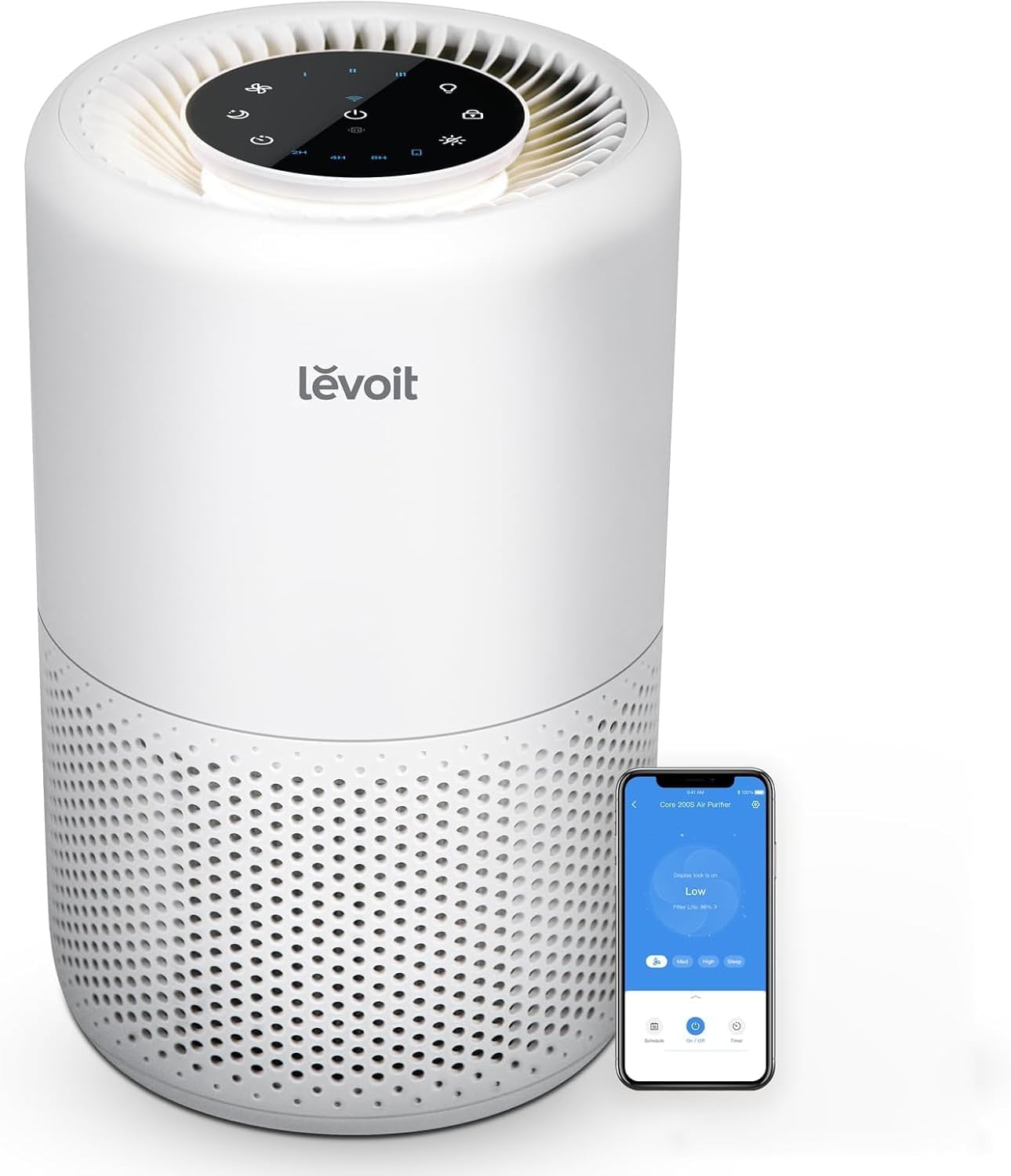
| Coverage | 140 ft² room, 4.8 air changes/hour |
|---|---|
| Filtration | 3-stage (pre-filter, activated carbon, HEPA-grade main filter) |
| Noise level | As low as 27 dB |
| Model | Core 200S |
The Levoit Core 200S-P is a compact smart air purifier built for everyday bedroom, office, or apartment use where space is limited. It draws air in 360 degrees and pushes it through a three-stage filtration stack — a nylon pre-filter, activated carbon layer for odors, and a HEPA-grade main filter that captures 99.97% of particles down to 0.1–0.3 microns. The unit is AHAM-verified for measured room refresh rates and claims to refresh air in a 140 ft² room about 4.8 times per hour, which makes it effective for routine filtration of pollen, smoke, dander, dust, and light household odors. Smart and voice controls plus app monitoring let you check filter life and run schedules remotely, and a low-noise Sleep Mode drops sound levels to about 27 dB for overnight use. The trade-offs are its small coverage area and reliance on genuine replacement filters for best performance, so larger rooms will need a bigger unit and recurring filter purchases are part of ownership. For focused odor and particulate reduction in single rooms, it is a practical, well-rounded choice.
Best for: Buyers who want a compact, proven purifier for a single room and who value verified performance and easy smart controls when making a low-risk purchase decision.
Less Ideal for: People looking to remove heavy odors or particulates across large open-plan areas or entire homes should choose a larger-capacity purifier instead.
- Effective three-stage filtration including activated carbon for odor control
- AHAM-verified performance with specified air changes in a 140 ft² room
- Smart app and voice control plus filter-life monitoring
- Very quiet Sleep Mode down to approximately 27 dB
- Compact footprint suitable for bedrooms and small spaces
- Designed for small rooms only so not suited to whole-home use
- Requires periodic genuine replacement filters to maintain rated performance
Verdict: A compact, AHAM-verified smart purifier that reliably reduces particles and light odors in single rooms while running quietly at night.
Levoit Core Mini-P
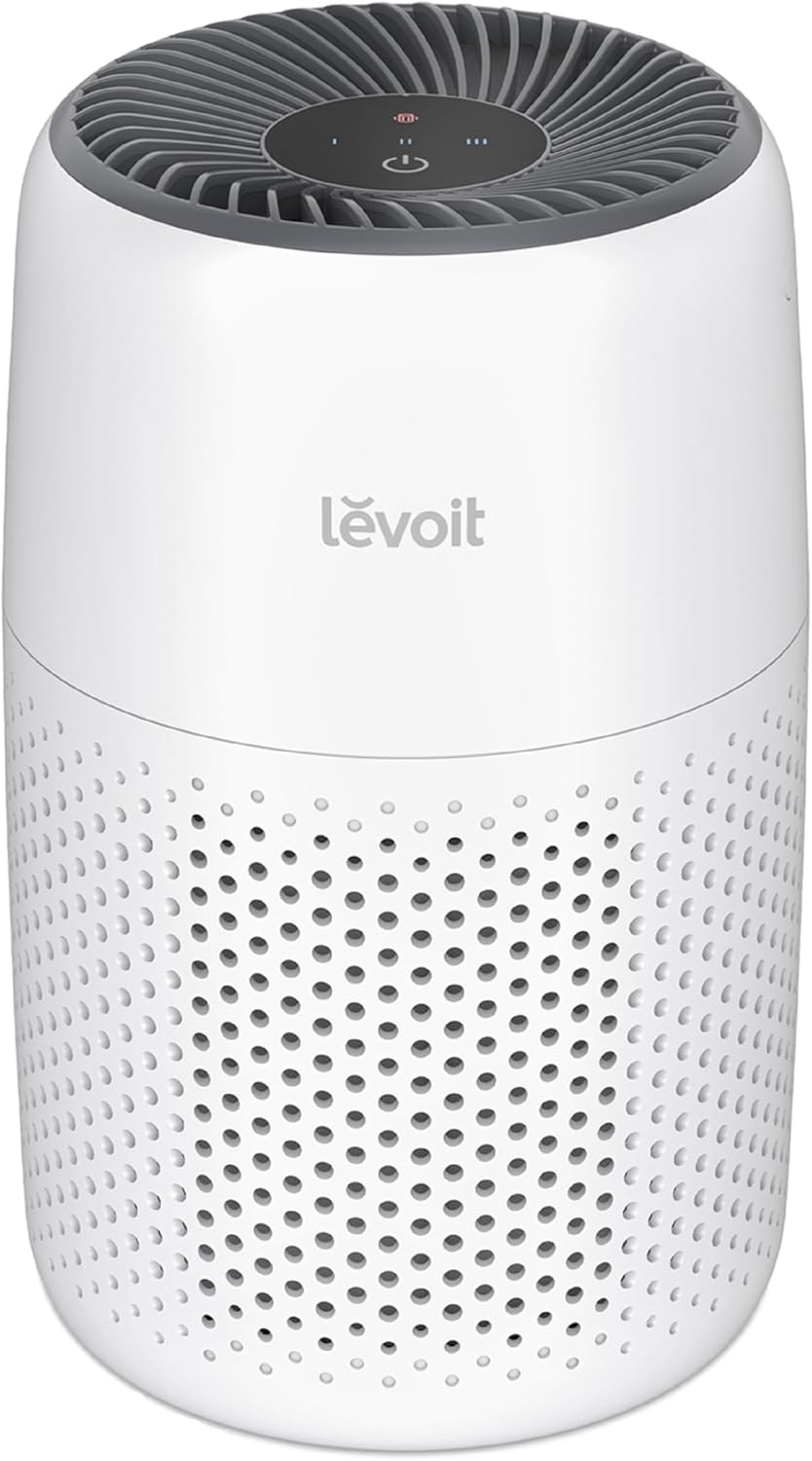
| Rated Power | 7W |
|---|---|
| Noise Level | 27–45 dB |
| Adapter Input | 100–240V, 50/60 Hz |
| AHAM Verification | Yes |
The Levoit Core Mini-P is a small tabletop air purifier meant for bedrooms, offices, and other close-range spaces where you want steady, quiet filtration. It uses a layered pre-filter and main HEPA-grade filter to capture lint, hair, pet dander, smoke and fine particles, and includes a small fragrance sponge for light aromatherapy. The unit is AHAM-verified for performance and offers a sleep mode and an auto-off display for low-interruption nighttime use. Practical benefits include very low noise (rated around 27–45 dB) and low power draw (7W), so it can run continuously without adding noticeable sound or energy cost. Limits are its compact coverage: the Core Mini-P is sized for personal or small-room use rather than whole-home odor removal, and the fragrance pad requires careful dosing to avoid overflow or plastic damage. Filters will need periodic replacement to keep performance optimal, and louder environments can mask its airflow so placement matters for best results.
Best for: Buyers who prioritize reliable, quiet air cleaning in small, personal spaces and want a low-maintenance, energy-efficient purifier that can run overnight without disturbance.
Less Ideal for: People seeking a purifier to clear smoke or strong odors from large living rooms, open-plan areas, or whole-home coverage should choose a larger-capacity unit instead.
- Compact footprint fits on a desk or nightstand
- AHAM-verified cleaning performance for small rooms
- Very low noise operation suitable for sleep mode
- Low power consumption (7W) for 24/7 use
- Intended coverage is small so not suitable for large rooms or whole-home odor removal
- Fragrance sponge must be limited to a few drops to avoid damaging the unit
Verdict: A tiny, AHAM-verified purifier that quietly delivers dependable filtration for personal and small-room use.
Choosing the Right Air Purifier for Weed: Key Factors to Consider
Filtration Stage and Media
Multiple filtration stages matter because cannabis smoke produces both fine particles and odorous gases. A true HEPA stage captures fine particulates such as tar and ash that remain airborne after smoking.
An activated carbon or other gas-phase adsorption stage is essential to reduce odorous compounds and volatile organic compounds associated with smoke. The amount and quality of carbon, and whether it is combined with other sorbents, will affect how long the unit can control smells before performance degrades.
Room Size and Airflow Capacity
Match the purifier's rated room coverage or CADR to the actual room where you will use it. A unit with insufficient coverage will not exchange and filter the air fast enough to noticeably cut smoke and odors.
Consider airflow patterns too. A purifier placed under a table, in a corner, or blocked by furniture will perform below its rating. Plan for placement that allows unobstructed intake and exhaust so the device circulates air through the whole space.
Noise During Typical Use
Many people run purifiers continuously. Fan speed needed to control smoke effectively can be louder than quiet background settings. Check measured noise levels at the speeds you expect to use most often, not just the lowest or highest setting.
If you will use the purifier in a bedroom or living area, aim for units that balance airflow and noise or offer a sleep mode that still provides meaningful air changes at low decibel output.
Filter Lifespan and Replacement Cost
Frequent smoking increases the load on both particulate and carbon filters, shortening service life. Understand manufacturer guidance for replacement intervals under heavier use and what replacement filters cost.
Also look for clear, tool-free access to internal filters. Units that require special tools or difficult disassembly discourage regular maintenance and can lead to reduced performance over time.
Operational Convenience and Controls
User-friendly controls and useful features make it easier to keep a purifier effective. Timers, air-quality sensors that auto-adjust fan speed, and filter-change indicators help maintain steady performance without constant attention.
Consider whether the unit has mobile app control or simple physical buttons and whether those interfaces suit your habits. Remote or smart features can be helpful, but basic reliable controls are often preferable for daily use.
Placement Flexibility and Design
A purifier's size and form factor affect where you can place it. Taller tower designs may offer better vertical airflow, while compact cube units can fit on shelves. Choose a design that allows optimal placement in the specific room where smoking occurs.
Also consider aesthetics and whether the unit will be in plain view. A quiet, unobtrusive design increases the chance you will run the purifier consistently.
How Activated Carbon Works Against Smoke Odors
Activated carbon removes odorous molecules through adsorption. As smoke-laden air passes through a carbon bed, volatile organic compounds and sulfur- or nitrogen-containing molecules bind to the carbon surface, reducing perceived smell.
Not all carbon filters are equal. Thickness, surface area, and whether the carbon is impregnated with additional chemicals affect how quickly it adsorbs odors and how long it lasts under heavy smoking conditions.
- Higher carbon weight generally improves initial odor removal.
- Impregnated carbons target specific chemicals and can boost effectiveness.
- Carbon beds must be replaced periodically because adsorption sites become saturated.
Placement Tips to Maximize Smoke Removal
Place the purifier between the likely source of smoke and the rest of the room, but leave several inches of clearance around intakes and exhausts. This helps capture smoke before it disperses widely.
Avoid placing units behind curtains, under heavy furniture, or in enclosed shelving. Also consider airflow patterns from windows, doors, or HVAC registers so filtered air can circulate rather than short-circuiting.
- Center of activity is often best: near seating or where smoking happens.
- Elevate smaller units onto a table for better reach in a living space.
- Use multiple purifiers in large, irregularly shaped rooms rather than a single oversized unit.
When to Run a Purifier: Continuous Vs. Spot Use
Running a purifier continuously at a low-to-moderate setting provides steady removal of particles and odors and prevents buildup. Continuous operation is especially useful in homes with regular or daily smoking.
Spot-running at higher speeds immediately after smoking can reduce acute odor and particle levels quickly. Combining both approaches gives rapid clearance when needed and ongoing background filtration at quieter settings.
- Continuous low-speed runs maintain baseline air quality.
- Short high-speed bursts right after smoking clear the bulk of residual smoke.
- Use timers or smart controls to automate combined strategies.
Air Sensors and Auto Modes: Are They Helpful?
Onboard air-quality sensors can detect particulates and sometimes VOCs to trigger higher fan speeds automatically. This takes the guesswork out of adjustments and helps the purifier respond to smoking events.
However, sensor placement and sensitivity vary. Some sensors respond mainly to larger particles and may not detect lower-level odors, so auto modes are useful but not a substitute for well-sized filtration and adequate carbon media.
- Prefer units with separate particle and VOC sensing when available.
- Test auto modes in your typical usage to confirm responsiveness.
- Combine sensor-driven adjustments with scheduled runs for best coverage.
Practical Maintenance Tips
Check prefilters regularly. These inexpensive screens trap larger particles and protect HEPA and carbon layers; cleaning or replacing them extends overall filter life.
Keep a replacement schedule based on your smoking frequency. Heavy use may mean changing carbon and HEPA filters sooner than the manufacturer's base estimate.
- Vacuum or wash washable prefilters monthly if used heavily.
- Record filter change dates to track real lifespan under your conditions.
- Store replacement filters in a dry place to preserve carbon freshness until installed.
How We Chose the Best Air Purifier for Weed
We focused on features that directly affect how well a purifier performs in environments with cannabis smoke and persistent odors. Key evaluation criteria included filtration system capability, measured as true HEPA for particulates and dedicated activated carbon or equivalent media for gases and odors; clean air delivery rate (CADR) or rated room coverage to ensure a unit can circulate and filter the air in real-world room sizes; airflow design and fan speeds so the purifier can move enough air without creating excessive noise during regular use. We also assessed noise output at typical settings, since many users will run purifiers while present in the room, and ease of maintenance, including filter replacement frequency and accessibility. We excluded specialty units not intended for residential indoor air, devices without documented filtration media for gases, and products that rely solely on ozone generation as an odor-control strategy. Our shortlist prioritizes balanced performance across particle capture, VOC/odor adsorption, practical airflow, and everyday usability.
Our full evaluation process is outlined in our review methodology.
FAQ
Can an air purifier completely eliminate cannabis smell?
Air purifiers with adequate activated carbon beds can significantly reduce cannabis odor, especially when sized correctly for the room. They rarely make smell zero immediately, so combining source control, ventilation, and a well-maintained purifier gives the best results.
Is a HEPA filter enough to remove smoke smell?
HEPA filters capture particulate matter from smoke but do not adsorb odors or many VOCs. For smell reduction you need a dedicated gas-phase stage such as activated carbon in addition to HEPA.
Will running a purifier produce harmful ozone?
Most modern residential air purifiers use HEPA and carbon filtration and do not generate ozone. Avoid devices that rely on ozone generation for odor control because ozone can be irritating to the respiratory system.
How often should filters be replaced with regular smoking?
Filter life depends on usage and smoke load. Under regular smoking, prefilters may need cleaning monthly and HEPA or carbon filters might require replacement several times a year. Monitor performance and change filters when odor reduction or airflow declines.
Can I use a purifier in a bedroom while sleeping?
Yes, if the purifier can deliver meaningful air changes at low noise levels. Look for sleep modes or low-decibel ratings so the unit removes particles and odors without disturbing rest.
Final Verdict
Prioritize a purifier that combines a true HEPA stage with a robust activated carbon or gas-phase filter and the airflow capacity to match your room size. Expect tradeoffs between noise and speed: higher fan settings clear smoke faster but are louder, while continuous low-speed operation maintains baseline air quality with less disruption. Focus on proper placement, regular maintenance of prefilters and carbon media, and matching CADR to the space. This approach will give the most consistent reduction in smoke particles and odors and help you choose confidently among suitable air purifiers for weed.