
Note: This article contains affiliate links. If you click on these links and make a purchase, we may earn a small commission at no extra cost to you. This helps support our research and content. Read our full affiliate disclosure here.
If you want better indoor air without spending much, choosing the right air purifier under $100 makes a measurable difference in bedroom or office comfort. You need equipment that actually captures common particles, operates quietly where you live or sleep, and won't spike your energy bill. This guide shortlists seven well-suited air purifiers under $100 and explains the practical tradeoffs buyers face. We evaluate filtration effectiveness, noise and energy performance, ease of maintenance, and real-world room coverage to help you pick a compact option that fits your space and routine.
Top Picks at a Glance
| Best Overall The best all-around choice for most situations | GermGuardian AC4825E Tower Air Purifier |  |
| Best Quality Built to a higher standard if you want something more solid | DREO Air Purifier 338 |  |
| Best Value The sweet spot between price and what you get | MOOKA B-D02L Air Purifier |  |
| Best Budget The cheapest option that still gets the job done reliably | FULMINARE H13 HEPA Air Purifier |  |
| Top Rated A top-rated pick with lots of positive feedback | Levoit Core 300-P |  |
| Most Popular A crowd favorite that many people choose with confidence | Levoit Core 200S-P |  |
| Best Seller A high-volume bestseller chosen again and again | VOOPNU Air Purifier DH-JH12 |  |
GermGuardian AC4825E Tower Air Purifier

| Room coverage | 153 sq. ft. (full cycle 12.5 min); up to 743 sq. ft. (hourly) |
|---|---|
| Filter type | True HEPA with activated carbon pre-filter |
| Speeds | Three fan speeds with sleep mode |
| Certifications | CARB Certified, ETL Certified, Zero Ozone Verified |
The GermGuardian AC4825E is a compact tower purifier built around a True HEPA filter that captures 99.97% of airborne particles down to 0.1 microns, combined with an activated carbon pre-filter and an optional UV-C sanitizer for extra germ reduction. It is intended for everyday home use in bedrooms, living rooms, offices, or basements and can cycle air in a 153 sq ft room roughly every 12.5 minutes or handle larger spaces up to 743 sq ft on a slower cycle. Controls are simple with three fan speeds including a quiet sleep mode for nighttime use, and compatible replacement HEPA, carbon, and UV parts make maintenance straightforward. Practical benefits include effective allergen removal, odor reduction from the carbon filter, and a small footprint that fits easily into typical rooms. Trade-offs include a basic control set with no smart connectivity, and when used in very large or extremely polluted spaces it may need to run at higher speeds more often to maintain air quality.
Best for: Buyers who want a straightforward, effective purifier for day-to-day allergy and odor control in bedrooms, living rooms, or offices and prefer proven HEPA performance over extra smart features.
Less Ideal for: People who need Wi-Fi control, automated air-quality sensing, or the highest CADR for very large open-plan homes should consider other models.
- True HEPA filter captures 99.97% of particles down to 0.1 microns
- Activated carbon pre-filter reduces common household odors
- Optional UV-C light adds an extra layer of germ reduction
- Three fan speeds including a quiet sleep mode for nighttime use
- Small tower design fits easily into bedrooms and offices
- No smart features or app connectivity
- May require frequent higher-speed operation in very large or heavily contaminated rooms
Verdict: A practical, proven HEPA tower purifier that delivers reliable allergen and odor reduction for typical bedrooms and living spaces without added smart bells and whistles.
DREO Air Purifier 338

| CADR (CFM) | 115 CFM |
|---|---|
| Coverage (1 ACH) | 856 square_feet |
| HEPA efficiency | 99.97% of 0.3μm |
| Sensor | PM2.5 sensor with LED AQI |
| Modes | Auto, Turbo, Sleep, Normal (4 speeds) |
The DREO Air Purifier 338 is a performance-focused compact unit that moves air efficiently for its size and includes a 3-in-1 filter (pre-filter, true HEPA, activated carbon) to capture particles and reduce odors. It is AHAM verified with a CADR of 115 CFM and uses a 360° spiral intake to speed circulation, so it refreshes small rooms quickly and can handle heavier particle loads like smoke or pet dander. Built-in PM2.5 sensing and an LED AQI display provide real-time feedback, and Auto, Turbo, Sleep, and four manual speeds make it easy to balance cleaning power and noise. HyperSilent motor design and a Sleep mode that dims the display keep nighttime operation unobtrusive. Practical limitations are typical for a compact purifier: peak airflow and CADR are tuned for small to medium spaces rather than large open plans, and replacement filters and aroma pads add ongoing maintenance cost. For buyers wanting verified performance, responsive sensors, and quiet nightly use in bedrooms or small living areas, this unit delivers solid value.
Best for: Buyers who prioritize proven, measurable cleaning performance and want a responsive, quiet purifier for bedrooms or small living areas.
Less Ideal for: Those seeking a single unit to cover large open-plan homes or whole-house purification should consider higher-capacity systems instead.
- AHAM-verified CADR of 115 CFM for validated particle removal performance
- 3-in-1 filter captures up to 99.97% of particles down to 0.3μm and reduces odors with activated carbon
- Real-time PM2.5 sensor and LED AQI display give immediate air-quality feedback
- Multiple modes including Auto and Sleep plus four fan speeds let you balance performance and noise
- Designed for small to medium rooms so not ideal as the sole purifier for large open floor plans
- Requires periodic replacement filters and optional aroma pads which increase lifetime cost
Verdict: A compact, AHAM-verified purifier that delivers measurable, quiet performance for bedrooms and small living spaces under $100.
MOOKA B-D02L Air Purifier

| Coverage | Up to 1076 ft² (1 ACH) / 215 ft² (6 ACH) |
|---|---|
| Filter type | H13 True HEPA + activated carbon + pre-filter |
| Noise level | As low as 20 dB |
| Fan modes | Sleep / Low / Med / High |
The MOOKA B-D02L is a small tower-style air purifier that combines a pre-filter, H13 True HEPA filter, and activated carbon to capture pet hair, pollen, smoke, odors and particles down to 0.3 microns. It is aimed at everyday room use from bedrooms to living rooms and is rated to provide six air changes per hour in a 215 ft² space and one change per hour in a very large 1076 ft² area. Controls are simple: four fan speeds including a very quiet sleep setting, four timer choices, a child lock, and a soft night light that can be switched off. The unit uses a brushless motor for low noise and claims low power consumption, making it suitable for continuous overnight operation. Practical limitations include the small physical footprint and a recommended filter replacement every 3 to 6 months depending on conditions, which means ongoing filter costs and occasional maintenance. For buyers focused on straightforward, low-noise air cleaning in single rooms, this model delivers solid filtration and easy operation at a modest size.
Best for: Buyers who want an affordable, low-noise purifier for single rooms or bedrooms and prioritize straightforward, maintenance-friendly operation over whole-house performance.
Less Ideal for: People needing powerful whole-house cleaning or continuous high air-change rates across multiple large rooms should consider larger, higher-CADR units instead.
- H13 True HEPA plus activated carbon and pre-filter for particle and odor removal
- Low noise operation with brushless motor suitable for sleep or study
- Simple controls with four fan speeds, timer options, and child lock
- Compact footprint fits small rooms and bedrooms without taking much space
- Filter needs replacement every 3–6 months, adding recurring cost
- Coverage claims span a wide range and effectiveness is best in single-room use
Verdict: A quiet, easy-to-use HEPA purifier that gives practical single-room filtration and low running noise for budget-conscious users.
FULMINARE H13 HEPA Air Purifier

| Filter type | H13 HEPA |
|---|---|
| Coverage | Up to 215 ft² / 20 m² |
| Noise level | Around 24 dB (low/sleep mode) |
| Timers | 2, 4, 8, 10, 12 hours |
The FULMINARE H13 is a small, affordable air purifier built for single rooms and bedrooms. It uses an H13 true HEPA filter and a 360 degree outlet with dual-channel airflow to refresh air in spaces up to about 215 ft², making it suitable for typical bedrooms, offices, or living rooms. Controls include a sleep mode that drops noise to around 24 dB, five timer settings, and an independent night light that can double as a soft bedroom lamp for children. Practical benefits include straightforward placement thanks to its portable size, low-noise overnight operation, and the use of a high-efficiency filter that removes particles like pet hair, smoke, and odors. Limitations to keep in mind are its coverage cap—it is intended for rooms near 215 ft²—regular filter replacement is recommended (about every three months under normal use), and it runs from a plug-in adapter rather than battery power which restricts truly cordless placement. For buyers focused on cost and core air-cleaning performance, it delivers solid value in small spaces.
Best for: Buyers on a tight budget who need a compact, no-frills air purifier for a bedroom, home office, or similarly sized room and prioritize quiet overnight performance and simple controls.
Less Ideal for: People who need whole-house or large-room coverage or who want a cordless unit with mobile placement should consider larger or different models.
- H13 true HEPA filter for high-efficiency particle removal
- 360° air outlet with dual-channel airflow for even circulation
- Very quiet sleep mode operation at approximately 24 dB
- Independent night light and multiple timer settings for convenience
- Designed for rooms up to about 215 ft² so not suitable for larger open areas
- Requires regular filter replacement (manufacturer suggests around 3 months)
- Plug-in power only, no battery operation for cordless use
Verdict: A budget-friendly compact purifier that delivers true HEPA filtration and whisper-quiet night operation for single rooms under $100.
Levoit Core 300-P

| Filter Type | 3 in 1 Filtration |
|---|---|
| Floor Area | 1073 square_feet |
| Noise Level | 24 db |
| Particle Retention Size | 0.3 micron |
| Wattage | 56 watts |
The Levoit Core 300-P is a small-room HEPA air purifier built for everyday home use, combining a 3-stage original filter with a 56W motor to move air efficiently through the unit. It is typically placed in bedrooms, living rooms, or offices to cut pollen, dust, pet dander, smoke and odors; Levoit reports CADR figures that refresh a 222 ft² room nearly five times per hour and a 1,073 ft² area once per hour. Practical features include a touch control panel, timer, filter check indicator and a near-silent 24 dB Sleep Mode that keeps nighttime noise to a minimum. The unit is AHAM verified and ETL/CARB certified, which supports consistent, measured performance and regulatory safety. Limitations to be aware of are the lack of smart/auto mode on this model and the recommendation to use genuine Levoit replacement filters for peak results, which adds recurring maintenance costs. Its compact footprint and portability make it easy to move between rooms, but buyers should size expectations to room coverage rather than whole-home cleaning.
Best for: Buyers who prioritize consistent, tested filtration performance and want a compact, quietly running purifier for bedrooms or common rooms where reliable particle removal matters.
Less Ideal for: Users who need built-in smart controls, automatic air-quality sensing, or a permanent whole-home solution should look at larger or connected models instead.
- True HEPA-grade 3-stage filter captures 99.97% of 0.1–0.3 micron particles
- AHAM verified CADR with proven room refresh rates for smoke, dust, and pollen
- Very quiet Sleep Mode at about 24 dB for undisturbed nighttime use
- Compact and portable design is easy to move between rooms
- Certified safety listings (ETL, CARB) and touch controls with timer and filter indicator
- No smart connectivity or Auto Mode on this specific model
- Requires genuine replacement filters for best performance, adding ongoing cost
Verdict: Choose the Core 300-P when you want a compact, AHAM-verified HEPA purifier that delivers reliable, quiet particle removal for bedrooms and small to medium living spaces.
Levoit Core 200S-P
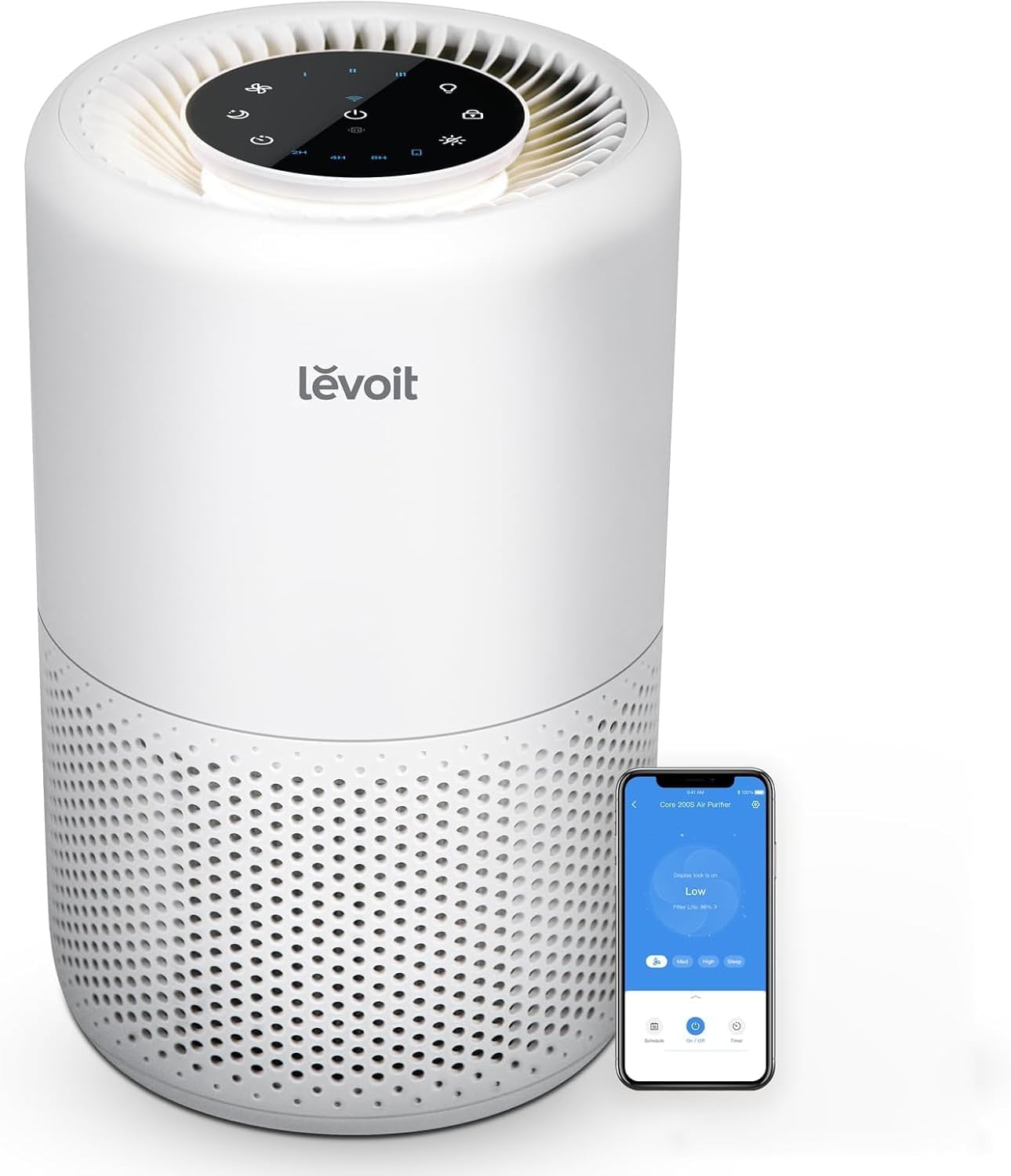
| CADR / Coverage claim | Refreshes 140 ft² ~4.8 times per hour |
|---|---|
| Filtration | 3-stage: pre-filter, activated carbon, HEPA-grade main filter |
| Noise level | As low as 27 dB |
| Model | Core 200S |
The Levoit Core 200S-P is a compact smart air purifier built to clean the air in bedrooms, nurseries, and small apartments. It draws air through a 360° intake and passes it through a nylon pre-filter, activated carbon layer for odors, and a HEPA-grade main filter that captures 99.97% of particles down to 0.1–0.3 microns. The unit is intended for everyday use in rooms around 140 ft² and the manufacturer states it can refresh that space multiple times per hour. Smart and voice controls plus in-app filter-life monitoring make maintenance and remote operation simple, and a sleep mode with noise as low as 27 dB keeps it quiet at night. Practical benefits include effective allergen and pet dander capture, odor reduction, and a small footprint that fits on nightstands. Limitations are its small coverage area—it is not suitable for larger living rooms—and replacement filters are recommended for best performance, which adds ongoing cost. The purifier also focuses on basic filtration rather than advanced features like built-in air quality sensors on some higher-end models.
Best for: Buyers who want a compact, well-reviewed purifier for bedrooms or small apartments and who prioritize proven cleaning performance and easy smart controls.
Less Ideal for: Anyone needing to clean air in large rooms, open-plan living areas, or whole-home coverage should choose a higher-capacity purifier instead.
- Three-stage filtration including HEPA-grade main filter for small-particle capture
- 360° air intake and compact design suited to bedside or desk placement
- Smart app and voice control with filter-life monitoring for convenient operation
- Quiet sleep mode rated down to 27 dB for nighttime use
- Designed for small rooms (about 140 ft²) so not effective for larger open-plan areas
- Ongoing cost for genuine replacement filters to maintain rated performance
Verdict: A compact, smart-equipped purifier that reliably removes pet dander and fine particles in small rooms, making it a safe, low-risk choice under $100.
VOOPNU Air Purifier DH-JH12

| Filter type | H13 True HEPA triple-layer |
|---|---|
| Coverage | Up to 1,076 ft² (lab-tested) |
| Noise level | As low as 22 dB |
| Speeds | 3 fan speeds |
The VOOPNU DH-JH12 is a compact air purifier built around an H13 True HEPA triple-layer filter and 360 degree intake to capture common airborne particles such as pet hair, pollen, smoke, and odors. It is meant for plug-and-play use: set it on a desk or corner, choose one of three fan speeds, and run continuously for steady air cleaning—the manufacturer claims it cleans 250 ft² every 15 minutes. The unit is notably quiet, with a low setting down to about 22 dB, and includes a small essential oil tray if you want scent alongside filtration. Certifications listed (DOE, ETL, FCC, CARB, CE, ROHS) suggest it meets common safety and emissions standards. Practical limits include its compact footprint and small internal filter which will require periodic replacement every few months under normal use, and the purifier's performance claims are lab-derived so results will vary in real rooms. The simple controls and quiet operation make it an easy, low-friction option for daily use in bedrooms, offices, and living areas.
Best for: Buyers who prioritize a straightforward, low-maintenance purifier with quiet operation and safety certifications for everyday use in bedrooms, small living rooms, or home offices.
Less Ideal for: People needing whole-house filtration or fast cleaning in very large or open-plan spaces should consider higher-CADR or larger-capacity models instead.
- H13 True HEPA triple-layer filtration captures 99.97% of common airborne particles.
- 360° surround intake for consistent room circulation from a compact unit.
- Very quiet operation down to approximately 22 dB for bedroom use.
- Simple one-tap controls and three fan speeds make it easy to operate.
- Includes an essential oil tray for optional fragrance without extra accessories.
- Replacement filters are needed regularly and are sold separately.
- Coverage and CADR claims are lab-based and may be lower in real-world, furnished rooms.
Verdict: A quiet, easy-to-use HEPA purifier that offers certified safety and solid everyday filtration for risk-averse buyers shopping under $100.
Choosing the Right Air Purifier: Key Factors to Consider
Filtration Technology and Particle Capture
The core job for any air purifier is to remove airborne particles. Look for units that use a multi-stage approach: a washable prefilter that traps larger debris, followed by a high-efficiency particulate filter media that captures fine particles. True HEPA filters or HEPA-style media capture the smallest common allergens and particulate matter you care about.
Filter efficiency affects how well the unit reduces symptoms for allergy sufferers and how quickly it clears smoke or cooking particulates. Higher-efficiency media usually means better indoor air quality, but be aware that better filtration can require stronger fans or more frequent filter changes, which affects noise and running costs.
Room Coverage and Placement
Declared room coverage indicates how large a space the purifier can reasonably service. Budget purifiers under $100 often target bedrooms, small living rooms, or offices rather than whole apartments. Verify coverage expressed as square feet or a clean-air delivery rate and match that to the intended room.
Placement matters: position the purifier away from walls and obstructions for the best airflow and avoid corners that trap stagnant air. For sleeping areas, choose a unit sized for the bedroom footprint rather than the entire home to keep operation efficient and effective.
Noise Output and Fan Speeds
Noise is a major real-world factor because even effective purifiers can be unusable at night if they are loud. Budget units may be noisier at higher fan speeds, so check for a low or sleep mode that keeps sound levels comfortable while still circulating air.
Multiple fan speeds let you balance performance and comfort: run higher speeds during active cooking or cleaning, then drop to lower settings while sleeping. Also consider the sound profile; some fans produce a steady white-noise tone that is less distracting than rattles or high-pitched whines.
Energy Use and Operating Cost
Running an air purifier continuously adds to your household energy usage. Look for units with modest wattage and efficient motors so they can run overnight without major impact on bills. Models with programmable timers or automatic modes reduce wasted runtime and help limit energy consumption.
Filter replacement frequency and filter cost are part of the ongoing cost picture. A low-cost purifier with expensive, hard-to-find replacement filters can end up costing more over time than a slightly pricier option with common, long-life filters.
Maintenance and Filter Accessibility
Maintenance affects both cost and continued performance. Choose units where filters are easy to access and replace without tools, and where prefilters are washable to extend the life of the main filter. Clear indicators or simple instructions for filter replacement reduce the chance of running a machine with degraded effectiveness.
Also check whether replacement filters are standardized or proprietary. Standard sizes are typically easier and cheaper to source. For users who prefer minimal upkeep, look for simple cleaning routines and durable exterior finishes that resist dust buildup.
Safety Features and Indoor Emissions
Safety matters when a device runs continuously in living spaces. Confirm that the design vents treated air safely and that any ionization or ozone-producing elements are absent or certified within safe emission limits. Budget purifiers sometimes include gimmick features that can introduce undesirable byproducts.
Prioritize units with basic safety certifications and stable housings that resist tipping. Overheat protection and reliable power circuits reduce fire or electrical risk during extended operation.
Sizing Your Purifier to the Room
Calculate the square footage of the room where the purifier will run and check the unit's recommended coverage. For continuous overnight use in bedrooms, choose a purifier rated for the full room rather than a higher-traffic area to ensure adequate air exchanges at low fan speeds.
If you plan to move a small purifier between rooms, be realistic about expectable performance drops. A single small purifier can improve air quality locally, but it will not replace whole-home ventilation or filtration.
- Measure floor area and compare to the purifier's rated coverage
- Expect lower effectiveness in spaces with high ceilings
- Place the unit centrally or where air flows freely for best results
Interpreting Filter Ratings and Replacement Intervals
Filter life is usually specified in months of typical use, but actual life depends on local dust, pet hair, and smoking levels. Look for clear guidance on replacement intervals and whether the prefilter is washable to reduce total filter cost.
Understand that higher-rated filter media may last longer in low-particle environments but could require more frequent replacement if you run the unit on its highest speed often. Budget models frequently rely on economy filters that trade longevity for affordability.
- Check manufacturer guidance for hours or months between filter changes
- Consider washable prefilters to extend main filter life
- Plan for replacement filter costs when budgeting
Operation Modes and Smart Features
Many budget purifiers include basic automatic modes, timers, or multiple speeds. Auto modes that respond to measured particle levels can save energy, but inexpensive sensors may be less precise. Timers and scheduling are useful for running the unit only when needed.
While advanced connectivity is uncommon in this price range, look for features that improve day-to-day usability, such as simple LED indicators, an intuitive control layout, or a quiet night mode for bedrooms.
- Prioritize practical features like timers and sleep mode
- Treat auto-mode performance as a convenience, not a substitute for correct sizing
- Simple controls often outlive gimmicky options
Dealing with Odors and VOCs
Standard particle-focused purifiers address allergens and particulate pollution better than odors and volatile organic compounds. If odor removal is important, look for a model that includes an activated carbon stage, recognizing that these filters saturate and must be replaced regularly.
For persistent chemical odors or high VOC environments, a compact purifier under $100 may only offer limited reduction. In those cases, source control and ventilation are more effective long-term strategies.
- Activated carbon helps with smells but has finite capacity
- Use ventilation and source elimination for strongest odor control
- Expect modest VOC reduction from budget units
Placement and Noise Management in Bedrooms
If you intend to run the purifier overnight, prioritize a sleep mode or low fan speed that maintains some air turnover while staying quiet. Place the unit on a bedside table or nightstand away from direct airflow to avoid drafts during sleep.
Test placement to find the best balance between sound and effectiveness. Sometimes moving the unit a few feet or elevating it on a short stand reduces perceived noise without greatly affecting circulation.
- Run sleep mode at night for a quieter environment
- Avoid placing the unit directly against walls or under shelves
- Elevating the purifier can improve intake and reduce turbulence noise
How We Chose the Best Air Purifier
We filtered candidate units by performance, ongoing cost, and real-world usability to find practical air purifiers under $100. First, we required devices with documented particle filtration or true HEPA-style filtration media designed to remove dust, pollen, pet dander, or smoke particles. We prioritized models with clear room coverage ratings and stated clean air delivery or airflow figures for small rooms. Noise output and power draw were key selection criteria because budget units often sacrifice quiet operation or energy efficiency. We looked for machines with multiple fan speeds and at least one low-noise setting suitable for bedrooms. Maintenance realities influenced choices: availability of washable prefilters, straightforward filter-change access, and common filter form factors help control lifetime cost. We excluded units that only use ozone generation or other air treatments linked to health concerns and any product lacking basic safety certifications. The final list balances measured or reported filtration performance, reasonable room coverage claims, noise and power characteristics, and straightforward upkeep for everyday home use.
Our full evaluation process is outlined in our review methodology.
FAQ
How large of a room can an air purifier under $100 handle?
Budget purifiers typically target small rooms such as bedrooms or offices. Check the stated square-foot coverage or air-change rate and match that to your room; using a unit in larger spaces will reduce its effectiveness.
Will a small air purifier remove cooking smoke and odors?
A compact purifier with a HEPA-style filter can reduce smoke particles, but odors need active charcoal or carbon filters. Even then, strong or persistent cooking odors may require ventilation or a larger purifier for noticeable improvement.
How often should I replace filters in a low-cost purifier?
Replacement intervals depend on use and local pollution levels but commonly range from 3 to 12 months. Washable prefilters can extend main filter life, while constant high-speed operation shortens it.
Are ozone or ionizer features safe in budget air purifiers?
Ozone-generating devices can pose health risks at elevated levels and are not recommended for occupied spaces. Prefer purifiers that rely on mechanical filtration rather than ionization for routine indoor use.
Can I run an air purifier 24/7?
Running continuously is common and often recommended for consistent air quality. To limit energy use, run at a lower fan speed or use a timer and ensure the unit has efficient power use and thermal protections for safe long-term operation.
Final Verdict
When choosing an air purifier under $100, prioritize filtration effectiveness and appropriate room coverage first, then balance noise and energy use against maintenance needs. Expect tradeoffs: compact units excel in small rooms and for targeted use but will not substitute for whole-home ventilation. Focus on models with accessible filters, a quiet low-speed option for overnight use, and straightforward safety features. With those priorities, you can select a budget purifier that meaningfully improves indoor air without introducing ongoing hassles or high running costs.