
Note: This article contains affiliate links. If you click on these links and make a purchase, we may earn a small commission at no extra cost to you. This helps support our research and content. Read our full affiliate disclosure here.
If you spend time in a room without windows, stale air, persistent odors, and higher concentrations of indoor pollutants can make the space feel uncomfortable and unhealthy. Picking the right air purifier for windowless room matters because ventilation is limited, so filtration efficiency, airflow, and quiet operation become more critical than in well-ventilated spaces. This guide shortlists seven top-performing air purifiers suited to windowless rooms and explains the practical tradeoffs to expect. We evaluated each option on measurable performance and user experience metrics you can use to pick the model that best fits your space. Read on for clear buying guidance and the criteria we used to choose these picks.
Top Picks at a Glance
| Best Overall The best all-around choice for most situations | Winix 5510 Air Purifier |  |
| Best Quality Built to a higher standard if you want something more solid | COWAY Mighty AP-1512HH |  |
| Best Value The sweet spot between price and what you get | MOOKA B-D02L Air Purifier |  |
| Best Budget The cheapest option that still gets the job done reliably | FULMINARE H13 HEPA Air Purifier |  |
| Top Rated A top-rated pick with lots of positive feedback | Levoit Core 300-P |  |
| Most Popular A crowd favorite that many people choose with confidence | Levoit Core Mini-P |  |
| Best Seller A high-volume bestseller chosen again and again | VOOPNU HEPA Air Purifier DH-JH12 |  |
Winix 5510 Air Purifier

| Item model number | 5510 |
|---|---|
| AHAM verified coverage | 1,882 sq ft in 1 hr |
| Filtration stages | 4-Stage |
| Smart features | WiFi / Alexa / Google Home |
The Winix 5510 is a four-stage air purifier built for larger indoor spaces and continuous home use. It combines a washable fine-mesh prefilter, True HEPA filter that captures very small particles down to 0.01 microns, and an advanced carbon filter for odors and VOC reduction, while Winix's PlasmaWave technology adds a non-filtered air treatment. Smart sensors feed an AQI indicator and an Auto Mode that adjusts fan speed based on measured air quality, and the unit can be controlled remotely with the Winix Smart App and voice assistants. Sleep Mode mutes lights and lowers noise automatically when the room is dark, which helps for overnight use in windowless rooms where continuous quiet operation matters. The 5510 is AHAM verified for large coverage and reports near-silent operation on low fan speeds, but like other high-CADR purifiers it will be louder on higher speeds and requires periodic filter replacements to keep performance optimal. The combination of smart control, strong filtration, and odor-targeting carbon makes it a practical choice for homes with pets, smoke, or persistent indoor odors.
Best for: Buyers who want a smart, high‑capacity purifier that automatically manages air quality and reduces odors in larger interior rooms without windows.
Less Ideal for: Those seeking an ultra‑compact or ultra‑quiet bedroom unit for very small rooms should consider lower‑CADR, bedroom‑focused models instead.
- Four-stage system with True HEPA captures very small particles and reduces allergens.
- Activated carbon filter for odor and VOC reduction useful in kitchens and homes with pets.
- Smart sensors with Auto Mode and an AQI indicator simplify hands-off operation.
- Winix Smart App and voice assistant support for remote control and monitoring.
- Sleep Mode and low-noise operation suitable for overnight use in windowless rooms.
- Higher fan speeds are noticeably louder, which may be intrusive in very small quiet spaces.
- PlasmaWave is an auxiliary technology and does not replace regular filter maintenance.
Verdict: Choose the Winix 5510 when you need a smart, high‑coverage True HEPA purifier that handles particles and odors for larger windowless rooms.
COWAY Mighty AP-1512HH

| Coverage | Up to 1,748 sq. ft. in 60 minutes |
|---|---|
| Filtration | Washable pre-filter, deodorization filter, bipolar ionizer, HEPA filter |
| HEPA effectiveness | 99.97% of 0.3μm particles |
| Modes | Auto, Eco, Timer |
| Indicators | Air quality LED, filter replacement indicator |
The COWAY Mighty AP-1512HH is a countertop air purifier built to remove airborne particles, odors, and some gases in living spaces. It uses a four-stage system — washable pre-filter, deodorization layer, bipolar ionizer, and a true HEPA filter — to capture fine particles down to 0.3 microns while actively reducing VOCs and odors. An onboard pollution sensor and colored LED provide real-time air quality feedback and an Auto mode adjusts fan speed so the unit ramps up only when needed, which helps balance performance and noise. The washable pre-filter and filter-life indicator simplify maintenance, and Eco mode reduces fan runs for quieter, lower-energy operation. The unit is rated to clean up to about 1,748 sq ft in 60 minutes, so it handles large, enclosed rooms like windowless basements or dens more effectively than small-room purifiers. Trade-offs include the need to replace the HEPA and deodorization filters periodically and that the bipolar ionizer may be a concern for buyers avoiding ion-generating devices.
Best for: Buyers who prioritize measurable cleaning power and continuous air quality monitoring for larger, enclosed rooms like windowless living spaces or basements and want a unit that steps up airflow automatically when pollutants rise.
Less Ideal for: Those who need an ultra-quiet bedroom-only unit for very small rooms or buyers who do not want any ionizing technology in their purifier.
- True HEPA filtration captures 99.97% of 0.3 micron particles.
- Auto and Eco modes with an air quality sensor optimize performance and noise.
- Washable pre-filter reduces maintenance cost and captures larger debris.
- Filter indicator clearly signals when replacements or cleaning are needed.
- Requires periodic replacement of HEPA and deodorization filters to maintain peak performance.
- Includes a bipolar ionizer, which some buyers prefer to avoid due to ion generation concerns.
Verdict: Choose the COWAY Mighty AP-1512HH when you need robust, sensor-driven HEPA performance to keep large windowless rooms consistently clean.
MOOKA B-D02L Air Purifier
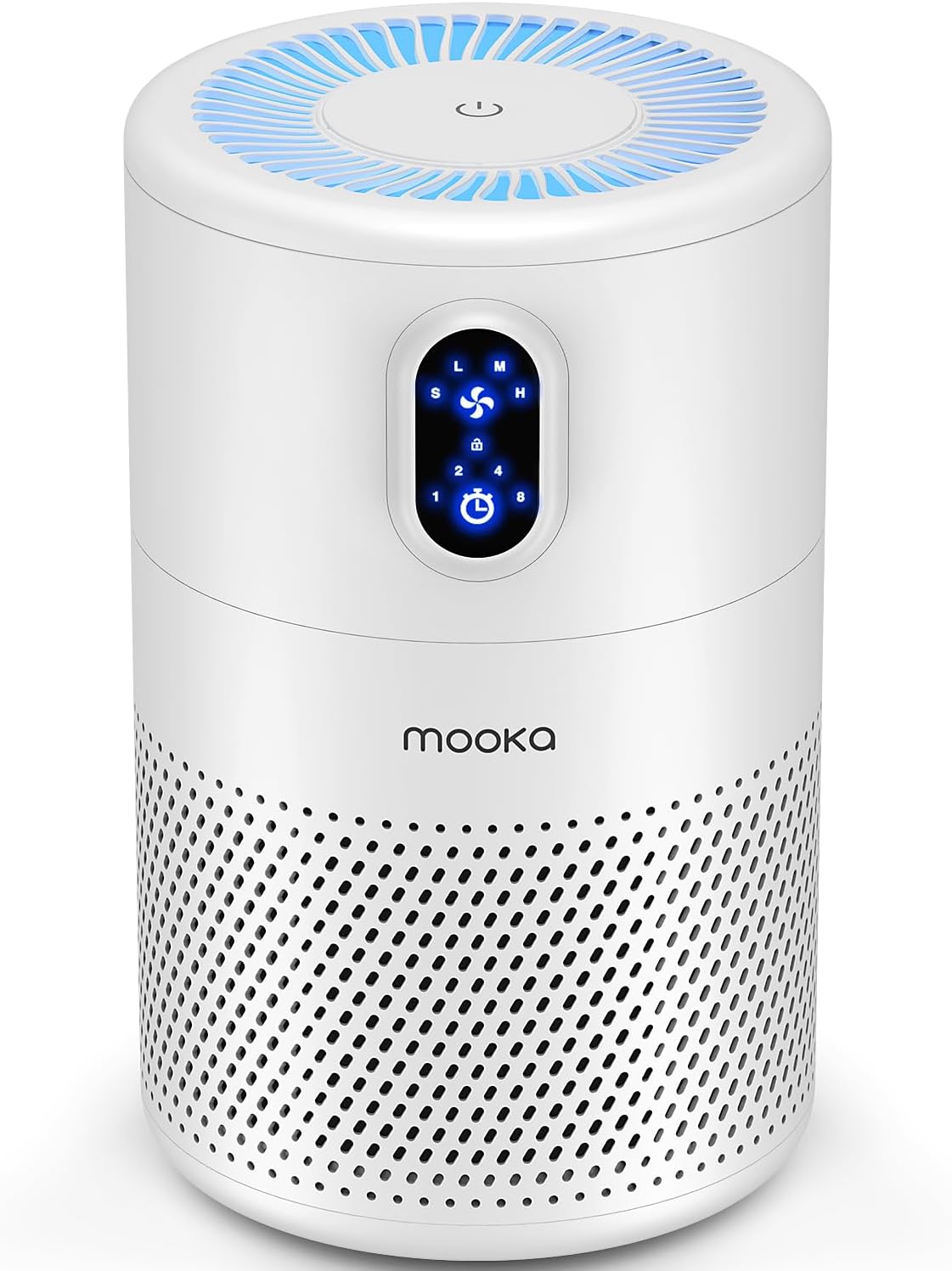
| Effective Area | 1076 sq ft |
|---|---|
| Filter Type | H13 True HEPA + Activated Carbon + Pre-filter |
| Noise Level | ~20 dB (low) described as ultra-quiet |
| Timer Settings | 1/2/4/8 hours |
The MOOKA B-D02L is a countertop air purifier that uses an H13 true HEPA filter plus activated carbon and a pre-filter to capture dust, pollen, pet dander, smoke and odors for rooms up to 1,076 sq ft (rated coverage). It is typically placed in bedrooms, living rooms or windowless spaces where continuous circulation matters; the unit offers four fan speeds, four timer settings (1/2/4/8 hours), a child lock and a soft night light that can be turned off. The brushless DC motor keeps operation very quiet on low, and the low power draw makes it economical to run overnight in a windowless room. Filters are user-replaceable with a recommended 3–6 month interval depending on use, and the unit includes a filter reminder. Practical limitations include the need to replace filters regularly and that advertised large-area coverage assumes multiple air changes per hour only at smaller room sizes, so performance will vary with room layout and placement. The control layout is straightforward and the purifier is easy to set up and move between rooms.
Best for: Buyers who prioritize a quiet, energy-efficient purifier for indoor or windowless rooms and want a simple, feature-focused unit that runs overnight without disturbance.
Less Ideal for: Those who need hospital-grade airflow rates or want a permanently maintenance-free purifier that does not require periodic filter replacements.
- H13 true HEPA plus activated carbon and pre-filter for particle and odor removal
- Rated coverage up to 1,076 sq ft with multiple fan speeds for flexible air changes
- Very quiet brushless motor suitable for overnight use
- Timers, child lock and night light add convenience and safety
- Filter replacement required every 3–6 months which adds ongoing cost
- Large square-foot rating depends on air changes per hour and room layout, so real-world coverage may be smaller
Verdict: A quiet, energy-efficient HEPA purifier that fits windowless rooms and overnight use while delivering flexible fan speeds and timer controls.
FULMINARE H13 HEPA Air Purifier

| Filter type | H13 HEPA |
|---|---|
| Recommended room size | 215 ft² / 20 m² |
| Noise level (low) | Around 24 dB |
| Timers | 2, 4, 8, 10, 12 hours |
This compact FULMINARE unit uses an H13 HEPA filter and 360 degree outlet to refresh air in rooms up to about 215 ft², making it a practical choice for bedrooms or other windowless spaces. It runs on a plug-in adapter and offers multiple fan speeds including a near-silent sleep mode around 24 dB, so it can operate overnight without disturbing light sleepers. The purifier includes an independent night light and selectable timers (2, 4, 8, 10, 12 hours), which is handy for bedroom routines or running the unit only when needed. Its dual-channel design and stated 5 air changes per hour for the target room size means noticeable reduction of pet hair, smoke, and odors when used in the recommended space. Limitations are typical for small portable purifiers: performance is optimized for a single room and filter replacements are required periodically, and feature set is basic compared with smart-connected or larger-capacity models.
Best for: Buyers who need an affordable, quiet purifier for a bedroom or other windowless room and prioritize straightforward, reliable particle filtration over smart features.
Less Ideal for: People who need whole-home purification, advanced air-quality sensors, or app control should consider higher-capacity or smart models instead.
- H13 True HEPA filtration captures fine particles including pet hair, smoke, and odors
- 360° air outlet with dual-channel design claims multiple air changes per hour in rooms up to 215 ft²
- Very low noise in sleep mode (around 24 dB) suitable for overnight use
- Independent night light and five timer settings for flexible bedroom use
- Designed for single-room coverage only and not suitable for larger open areas
- Basic feature set without smart connectivity or advanced monitoring
Verdict: A budget-friendly, quiet H13 HEPA purifier built to keep a single bedroom or windowless room noticeably cleaner without bells and whistles.
Levoit Core 300-P

| Power Source | Corded Electric |
|---|---|
| Filter Type | 3 in 1 Filtration |
| Floor Area | 1073 square_feet |
| Noise Level | 24 db |
| Wattage | 56 watts |
The Levoit Core 300-P is a compact, three-stage HEPA air purifier intended for bedrooms and other indoor rooms, including windowless spaces where ventilation is limited. It pulls air through a prefilter, H13-grade HEPA-style filter, and activated carbon layer to capture 0.1–0.3 micron particles and reduce smoke, pollen, pet dander, and odors. A 56W motor and published CADR figures mean it can refresh a typical 222 ft² room multiple times per hour and still move air in larger open areas. Controls are touch-based with a sleep mode that lowers fan speed and noise to about 24 dB, and the display can be turned off for undisturbed night use. Practical benefits include straightforward maintenance with a single replaceable filter and AHAM, ETL, and CARB certifications that support dependable performance. Limitations are that this model lacks smart Auto Mode and Wi-Fi found on some variants, so fan speed must be adjusted manually, and optimal performance depends on using official replacement filters and replacing them on the recommended schedule.
Best for: Buyers who prioritize a proven, quietly operating purifier for bedrooms or windowless rooms and want a straightforward, low-friction device that reliably reduces allergens and smoke.
Less Ideal for: Anyone who needs built-in smart controls, automatic air-sensing and adjustment, or centralized whole-house purification should consider other options.
- High filtration efficiency for fine particles including smoke and pollen
- AHAM, CARB, and ETL certifications that support reliable, tested performance
- Very quiet Sleep Mode (~24 dB) suitable for bedrooms and nighttime use
- Simple touch controls and an off display option for undisturbed operation
- Compact and portable design with a single user-replaceable 3-stage filter
- No smart connectivity or Auto Mode on this model so fan speeds are manual
- Coverage and CADR figures refer to use with Levoit original filters only
Verdict: A compact, certified HEPA air purifier that delivers quiet, dependable filtration for bedrooms and windowless rooms where reliability matters most.
Levoit Core Mini-P
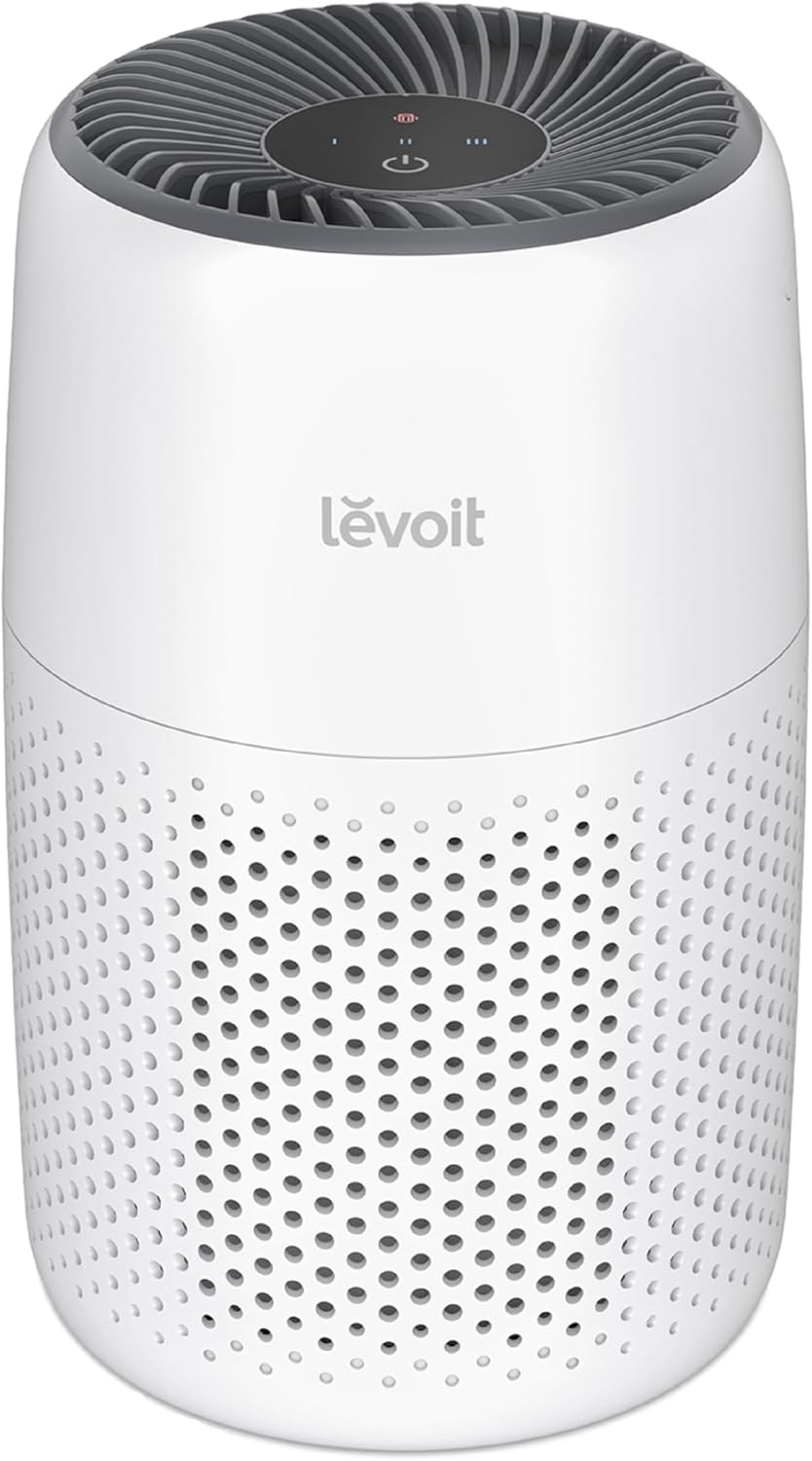
| Rated Power | 7W |
|---|---|
| Noise Level | 27–45 dB |
| Particle Retention Size | 0.3 micron |
| Adapter Input | 100–240V, 50/60 Hz |
The Levoit Core Mini-P is a small plug-in air purifier built for personal spaces like bedrooms, dorms, and windowless rooms where airflow is limited. It combines a pre-filter and a main high-efficiency filter to trap lint, hair, pet dander, smoke particles, and fine dust, and it includes an integrated fragrance sponge for light aromatherapy. The unit runs quietly (advertised noise 27–45 dB) with a sleep mode and auto-off display to minimize disturbance overnight, and its low rated power (7W) makes it energy-efficient for continuous use. Practical benefits include very small footprint for desks or bedside tables and an easy-to-replace filter system. Important limitations are its small coverage area: this is a personal/desktop purifier not intended to clean larger rooms, and the aroma sponge requires careful dosing to avoid damaging plastic parts. Expect modest particle removal speed compared with larger room purifiers, but good performance for close-range use in windowless bedrooms or offices.
Best for: Buyers who prioritize proven, well-reviewed small purifiers for bedrooms or windowless rooms and want a compact, quiet unit backed by broad customer experience.
Less Ideal for: People seeking whole-room or multiroom purification or faster cleaning of larger living spaces should choose a larger-capacity purifier.
- Compact desktop size fits on bedside tables or desks
- High-efficiency main filter captures fine particles and pet dander
- Very quiet operation with a sleep mode for overnight use
- Low power draw (7W) suitable for continuous operation
- Small clean-air delivery suited only to personal or very small rooms
- Aromatherapy sponge can overflow if overfilled and may damage plastic
Verdict: A compact, quiet personal air purifier that reliably cleans close-range air in windowless bedrooms and small workspaces.
VOOPNU HEPA Air Purifier DH-JH12

| Coverage claim | Up to 1,076 ft² |
|---|---|
| Filtration | H13 triple-layer HEPA + activated carbon |
| Noise level | 22 dB (low) |
| Speeds | 3 fan speeds |
This compact VOOPNU purifier is a small, easy-to-place unit meant to reduce airborne particles in single rooms. It draws air through a 360° intake and passes it through an H13 triple-layer filtration stack that the brand says captures 99.97% of particles, which helps with dust, pollen, pet dander, smoke, and odors. The simplified control panel and three fan speeds make daily use straightforward, and a near-silent low setting (around 22 dB) is suited to sleep or continuous operation in windowless bedrooms. A built-in essential oil tray lets you add scent while the unit runs. Practical benefits include a compact footprint for tight spaces, certified safety approvals, and compatibility with factory replacement filters offered in standard or pet-care editions. Important limitations are that rated coverage claims come from manufacturer testing and continuous runtime is recommended for best results, and replacement filters are needed periodically to maintain performance.
Best for: Buyers who prioritize straightforward, low-noise air cleaning for a small or windowless bedroom and prefer a compact, easy-to-use unit backed by safety certifications.
Less Ideal for: Large open-plan spaces or users who need independently verified CADR data for technical comparisons should consider more powerful systems or models with third-party testing.
- H13 triple-layer HEPA filtration capturing up to 99.97% of particles
- 360° air intake for even room circulation
- Very quiet operation down to about 22 dB for overnight use
- Compact footprint fits small or windowless bedrooms and dorm rooms
- Simple controls and multiple fan speeds make it easy to run continuously
- Manufacturer coverage and cleaning rates are based on internal lab testing rather than third-party field results
- Requires periodic filter replacements to maintain stated performance
Verdict: A compact, quiet HEPA purifier that comfortably fits windowless bedrooms and other small rooms where low noise and simple, continuous operation matter most.
Choosing the Right Air Purifier for Windowless Room: Key Factors to Consider
Filtration Type and Efficiency
True HEPA or equivalent filtration matters because windowless rooms trap airborne particles more readily. A certified HEPA filter captures at least 99.97 percent of particles down to 0.3 microns, which includes dust, pollen, and many respiratory aerosols.
Multi-stage systems that add pre-filters and activated carbon improve performance: pre-filters catch larger debris to extend HEPA life, and carbon layers reduce odors and some volatile organic compounds that accumulate in non-ventilated spaces. Look for clear filter specifications so you know what contaminants the unit is designed to remove.
Clean Air Delivery Rate (CADR) and Room Size
CADR indicates how quickly an air purifier can remove particles of specific size ranges from the air and helps match a unit to room volume. In a windowless room you should aim for a unit whose CADR and stated coverage comfortably exceed the room's cubic footage to achieve multiple air changes per hour.
Manufacturers sometimes list square-foot coverage at a given ceiling height; calculate actual volume when possible and prefer purifiers rated for faster air exchange in smaller spaces to compensate for limited ventilation.
Noise Output at Typical Settings
Windowless rooms are often used for sleeping, working, or media viewing, so noise is a major user-experience factor. Noise ratings reported in decibels at different fan speeds can be compared, but perceived distraction depends on frequency and whether the unit emits tonal sounds.
Consider models with a very quiet low or night mode for overnight use and verify that higher speeds do not produce high-frequency tones. Some units use variable-speed fans or sleep settings that balance filtration and acoustic comfort.
Odor and VOC Control
Without window ventilation, odors and volatile organic compounds can build up and linger. An air purifier intended for a windowless room should include an activated carbon stage or dedicated VOC-reducing media to adsorb gases from cooking, cleaning products, or fabrics.
Carbon capacity and design matter: thicker or replaceable carbon layers perform better over time than minimal, integrated coatings. For rooms with persistent smells, choose units where carbon modules are accessible for replacement or upgrade.
Maintenance, Filter Life, and Operating Cost
Filter replacement frequency affects long-term cost and sustained performance. Pre-filters that are washable extend the life of primary filters and reduce running costs. Check estimated filter life in months or operating hours and factor in typical daily runtimes for your space.
Ease of replacing filters, availability of common filter sizes, and clear indicators for replacement reduce downtime and ensure the purifier continues to operate effectively in a room where clean air is harder to achieve.
Placement and Airflow Patterns
In a windowless room you cannot rely on cross-ventilation, so how you position the purifier is important. Units that draw air from all sides or have elevated output help create better circulation and reduce dead zones.
Consider furniture layout, obstructions, and the unit's recommended clearance. Some designs are optimized for corner placement while others perform best when centered. Proper placement ensures the rated CADR translates to actual air exchanges in the occupied area.
How Much Filtration Do You Need for a Windowless Room?
Calculate the room volume and target at least two to four air changes per hour depending on activity. For sleeping or low-activity rooms, two to three air changes per hour often suffices; for small home offices or spaces with odor sources, aim higher to keep air fresh.
Use the CADR and the manufacturer's coverage guidance to estimate how quickly a model will clean the room. If exact volume-based figures are not available, choose a unit rated above your square-foot estimate to provide a performance buffer.
- Measure length times width times ceiling height to get cubic feet.
- Match CADR to room volume to estimate air changes per hour.
- Favor higher-rated units for rooms with persistent odors or heavy particulate sources.
Placement Tips to Maximize Performance
Position the purifier where airflow is least obstructed and not tucked behind large furniture. A unit placed on the floor near a wall may benefit from a small clearance to allow intake. Elevated placement can help distribute cleaned air more evenly if the design supports upward output.
Avoid corners if the unit requires clear airflow on multiple sides. Check the recommended clearances in product literature and allow space for unobstructed intake and exhaust to realize the specified CADR.
- Keep clear space on the intake and outlet sides as recommended.
- Do not block airflow with curtains or large soft furnishings.
- Consider multiple low-capacity units for irregularly shaped or compartmentalized windowless areas.
Managing Odors and VOCs Without Ventilation
Activated carbon filters are the primary defense against odors and many VOCs. For persistent chemical smells from paints, cleaners, or new furniture, choose a purifier with a dedicated carbon stage and check whether carbon modules are replaceable or rechargeable.
For short-term spikes in odors consider running higher fan speeds temporarily, then returning to a lower quiet setting. Continuous low-level operation with adequate carbon capacity reduces the likelihood that odors will linger between cleanings.
- Replace carbon modules according to manufacturer guidance for best odor control.
- Run the unit at higher speeds during and immediately after activities that produce odors.
- Combine source control with filtration when possible, such as using low-VOC products.
Noise Strategies for Sleep and Focus
Look for night or sleep modes that lower fan speed and dim indicators. White-noise characteristics differ by model; some users prefer the steady hum of certain fans while others find tonal variation disruptive. If noise is a priority, verify decibel levels at low settings and seek models with documented quiet operation.
If you need total quiet, place the purifier farther from the bed or workstation while maintaining effective coverage. That tradeoff can reduce perceived sound while still providing improved air quality, but confirm the unit's coverage supports that placement.
- Compare low-speed dB ratings when evaluating models.
- Check for dimmable lights or a full-off display option for sleeping rooms.
- Consider using a bedside white-noise device only if the purifier's sound is distracting.
Energy Use and Continuous Operation Considerations
Windowless rooms often require continuous or near-continuous air cleaning. Look for models with modest power draw on lower settings and programmable timers to reduce energy use when full power is unnecessary. Energy-efficient fans and brushless motors typically result in lower operating costs over time.
If you plan to run the purifier 24/7, check standby power usage and whether the unit supports automatic modes that adjust fan speed based on measured air quality. Automatic control can reduce runtime on higher speeds and save energy while maintaining acceptable air quality.
- Estimate daily runtime to calculate monthly kWh and running cost.
- Prefer automatic or smart modes to avoid unnecessary high-speed operation.
- Look for Energy Star or other efficiency indicators when available.
How We Chose the Best Air Purifier for Windowless Room
We prioritized measurable performance and real-world usability for windowless rooms where natural ventilation is absent. Selection started with units that specify tested clean air delivery rates and compatible room coverage. We favored models with multi-stage filtration that includes true HEPA filtration or equivalent particulate capture, plus activated carbon or odor control where available, because trapped particulates and odors concentrate in non-ventilated spaces. Noise profile under typical operating settings was another key filter since windowless rooms are often used for sleeping or focused work. Energy efficiency and continuous-run reliability were assessed by published power draw and user experience signals. Ease of maintenance mattered too: straightforward filter replacement, clear filter life indicators, and accessible pre-filters reduce upkeep friction. We excluded devices that rely solely on ionization without particulate filtration or that have no verified CADR/coverage data. Final picks balanced filtration effectiveness, low noise, energy use, and maintenance needs to match the practical constraints of windowless rooms.
Our full evaluation process is outlined in our review methodology.
FAQ
Can an air purifier replace ventilation in a windowless room?
An air purifier improves indoor air by removing particles and some gases, but it does not replace fresh outdoor air. Purifiers reduce pollutant concentrations and odors, yet they do not exchange CO2 or supply fresh oxygen, so consider occasional ventilation where possible or ensure other means of air exchange for long-term occupancy.
How often should filters be replaced in a room with no windows?
Replacement frequency depends on usage and pollution sources. In a continuously run purifier housed in a windowless room, pre-filters may need cleaning monthly and primary HEPA or carbon filters may need replacement every 6 to 12 months. Monitor performance and follow indicator prompts if the unit has them.
Is ozone-generation safe for a closed room?
Ozone generators are not recommended for occupied indoor spaces. Ozone can irritate the respiratory system and does not effectively remove particles. For windowless rooms, choose filtration-based purifiers with true HEPA and carbon stages rather than ozone-producing technologies.
Will a purifier help with mold in a windowless room?
Air purifiers with HEPA filters can capture airborne mold spores, which may reduce allergen exposure. However, they do not address the root causes of mold growth such as moisture. If mold is present, control humidity and remediate any sources of dampness in addition to using filtration.
Should I run the purifier on high all the time in a windowless room?
Running at high speed increases air changes but also raises noise and energy use. For continuous comfort, use a moderate or automatic mode that adjusts for detected pollution levels, and run higher speeds temporarily when odors or particulates spike.
Final Verdict
In windowless rooms the priority is maximizing effective air exchanges while minimizing noise and ongoing maintenance burden. Focus on units that combine verified CADR or coverage figures with true HEPA filtration and a meaningful carbon stage for odors. Tradeoffs are inevitable: higher airflow improves cleaning speed but increases sound and energy use, while thicker carbon and HEPA media require periodic replacement. Choose a model whose filtration, noise profile, and maintenance cadence match how you use the room to get clean, comfortable air without unnecessary compromise.