
Note: This article contains affiliate links. If you click on these links and make a purchase, we may earn a small commission at no extra cost to you. This helps support our research and content. Read our full affiliate disclosure here.
Finding the right air purifier for a small office space matters because indoor air quality affects focus, comfort, and employee health. In compact workrooms, you need a unit that balances filtration power with low noise, modest footprint, and easy upkeep. This guide presents seven top-rated air purifiers shortlisted for small office use, each selected for real-world office needs like particulate removal, low operating sound, and manageable maintenance. Below you will find concise evaluations, the criteria we used to judge each unit, and practical advice for sizing and placement so you can pick the best option for your workspace.
Top Picks at a Glance
| Best Overall The best all-around choice for most situations | KNKA APH4000 Air Purifier |  |
| Best Quality Built to a higher standard if you want something more solid | BLUEAIR Blue Pure 511i Max |  |
| Best Value The sweet spot between price and what you get | GermGuardian AC4825E 22" Tower |  |
| Best Budget The cheapest option that still gets the job done reliably | AromaRoom AP100-A Air Purifier |  |
| Top Rated A top-rated pick with lots of positive feedback | ECOSELF HAP609 Air Purifier |  |
| Most Popular A crowd favorite that many people choose with confidence | Levoit Core 300-P Air Purifier |  |
| Best Seller A high-volume bestseller chosen again and again | Levoit Core Mini-P |  |
KNKA APH4000 Air Purifier

| CADR Smoke/Dust/PM2.5 | 226 CFM (384 m³/h) |
|---|---|
| CADR Pollen | 244 CFM (415 m³/h) |
| Recommended room refresh | 4.8 air changes per hour in 350 sq ft |
| Noise (Sleep mode) | 22–24 dB |
The KNKA APH4000 is a mid-size HEPA air purifier built for continuous home or small office use. Its dual front-and-back cartridges combine a washable pre-filter, a high-efficiency HEPA layer, and activated carbon to capture pet hair, dust, pollen, odors, and fine particulates. The unit uses dual intakes and side outlets to promote stronger circulation so it can refresh air in a typical 350 sq ft room almost five times per hour and still provide measurable cleaning in much larger spaces. Controls include Auto, Sleep, ECO, and a PET mode that boosts airflow to deal with dander and smells, while a color AQI display and filter indicator make day-to-day operation straightforward. Noise can be very low in Sleep mode, which helps in office or desk-side settings. Expect routine filter changes every few months and some reduction in efficiency at the outer edges of the claimed maximum coverage. The APH4000 is a capable, user-friendly purifier for focused shared spaces where consistent filtration and visible air-quality feedback matter.
Best for: Buyers who want a reliable, easy-to-use purifier for a small office or shared workspace that emphasizes measurable CADR performance and quiet overnight operation.
Less Ideal for: Large open-plan offices or warehouse areas where whole-room exchanges are required frequently throughout the space.
- AHAM-verified CADR ratings for smoke, dust, and pollen provide measurable cleaning performance
- Dual intake/outlet airflow design increases circulation for faster air exchange
- Three-stage filters (washable pre-filter, HEPA, activated carbon) handle particles and odors
- Multiple modes including PET, ECO, Auto, and a very quiet Sleep mode
- Built-in AQI display and filter indicator simplify monitoring and maintenance
- Filters require periodic replacement and performance depends on timely maintenance
- Largest claimed coverage gives lower exchange efficiency at extreme distances compared with smaller-room operation
Verdict: Choose the KNKA APH4000 for quiet, AHAM-verified filtration in small offices that need dependable particle and odor removal with easy monitoring.
BLUEAIR Blue Pure 511i Max

| Filtration | HEPASilent (mechanical + electrostatic) |
|---|---|
| Particle capture | 99.97% down to 0.1 microns |
| Coverage | Up to 1,138 sq ft per hour |
| Noise level | As low as 19 dB |
The Blueair Blue Pure 511i Max is a compact smart air purifier designed to refresh air in bedrooms, home offices, and small apartments. It combines mechanical and electrostatic HEPASilent filtration to capture 99.97% of particles down to 0.1 microns, removing dust, pollen, pet dander, smoke, and other fine particulates. The unit delivers fast coverage for small spaces — Blueair cites cleaning 237 sq ft in about 12.5 minutes and up to 1,138 sq ft in an hour — and a 360 degree intake helps circulate air efficiently. Built-in sensors and Auto Mode let the purifier raise fan speed when pollutants spike, and the Blueair app provides monitoring, scheduling, and filter reminders. Noise is exceptionally low on the quiet setting, down to about 19 dB, making it suitable for office desks or sleeping areas. On the downside, the compact body means it is optimized for small rooms rather than open-plan offices, and replacement filters add ongoing cost. For a performance-minded buyer who needs strong particle removal, fast room turnover, and quiet operation in a small office footprint, this model performs very well.
Best for: Buyers who prioritize fast, high-efficiency particle removal and quiet operation in a small office or private workspace and want smart monitoring and automatic adjustments.
Less Ideal for: Those who need to clean large open-plan offices or multiple rooms from a single unit should consider higher-capacity models or multiple purifiers instead.
- HEPASilent filtration captures 99.97% of particles down to 0.1 microns
- Covers small rooms quickly (237 sq ft in ~12.5 minutes; up to 1,138 sq ft in one hour)
- Integrated air quality sensors with Auto Mode and app control for remote monitoring
- Very quiet operation as low as 19 dB, suitable for work and sleep environments
- Sized for small rooms, not ideal as the sole unit for large open-plan offices
- Ongoing cost for periodic filter replacements
Verdict: A performance-focused, quiet smart purifier that rapidly removes fine particles in small offices and private workspaces.
GermGuardian AC4825E 22" Tower

| Room coverage (cycle) | 153 sq. ft. per 12.5 minutes; up to 743 sq. ft. per hour |
|---|---|
| Filter type | True HEPA with activated carbon pre-filter |
| Fan speeds | 3 (including sleep mode) |
The GermGuardian AC4825E is a compact tower purifier that uses a True HEPA filter plus an activated carbon pre-filter and optional UV-C light to remove dust, pollen, pet dander, odors, and many airborne particles. It is typically placed on the floor or a low table in a bedroom or office and run continuously on one of three fan speeds; the manufacturer states it cycles the air in a 153 sq ft room about every 12.5 minutes and can serve larger areas up to 743 sq ft on a slower cadence. Practical features include an odor-reducing carbon layer for cooking and pet smells, a quiet sleep mode for night use, and compatibility with factory replacement HEPA, carbon filters, and UV-C bulbs for straightforward maintenance. The unit is CARB and ETL tested and designed for everyday use rather than medical environments. Limitations are its basic control set and the need to replace filters and UV bulbs periodically, plus it is a single-room solution best suited to continuous spot use rather than whole-building filtration.
Best for: A practical buyer who wants a reliable, easy-to-maintain purifier for a small office or single-room workspace and values proven HEPA filtration and low-noise overnight use.
Less Ideal for: Not suitable for buyers who need networked smart controls, integrated air-quality monitoring, or whole-building HVAC-grade filtration.
- True HEPA filter captures 99.97% of particles down to 0.1 microns according to the manufacturer
- Activated carbon pre-filter reduces common household odors and VOC-related smells
- Optional UV-C light provides an additional sanitizing layer
- Three fan speeds including a quiet sleep mode for overnight operation
- Compatible with genuine GermGuardian replacement HEPA, carbon filters, and UV-C bulbs for easy upkeep
- Requires periodic replacement of HEPA, carbon filters, and UV-C bulb to maintain performance
- Controls are basic with no smart connectivity or air-quality sensors
- Performance is oriented to single-room use rather than whole-office central filtration
Verdict: A straightforward, low-noise True HEPA tower purifier that reliably cleans the air in a small office or single-room workspace while remaining easy to maintain.
AromaRoom AP100-A Air Purifier

| Filtration | True HEPA13 3-stage |
|---|---|
| Coverage | Up to 430 ft² room (cycles air twice/hour) |
| Noise level | 22 dB (sleep mode) |
| Model number | AP100-A |
The AromaRoom AP100-A is a small, quiet air purifier built for bedrooms or small office spaces where low noise and simple filtration matter. It uses a brushless motor and 360-degree intake to cycle the air roughly twice an hour in a 430 ft² room and relies on a three-stage True HEPA13 filter to capture particles down to 0.3 microns, which helps reduce pollen, pet dander, smoke, and general particulate pollution. Practical touches include a sleep mode that drops noise to about 22 dB, an aroma pad for adding essential oils, and an RGB night light for ambient lighting. The unit is easy to place on a desk or shelf and the manufacturer recommends replacing the genuine filter every 3 to 6 months for best performance. Trade-offs are its small size and coverage that limit use to single rooms rather than whole floors, and occasional filter replacement adds ongoing cost. For a quiet, feature-friendly purifier for a compact office, this model is a sensible choice.
Best for: Buyers looking for a quiet, compact purifier for a small office or personal workspace who prioritize low noise and simple setup over whole-room coverage.
Less Ideal for: Those needing to clean air for larger or multiple connected workspaces should choose a unit with higher CADR and larger coverage.
- True HEPA13 3-stage filter captures particles down to 0.3 microns
- Brushless motor with 360-degree intake cycles air twice per hour in a 430 ft² room
- Very quiet 22 dB sleep mode suitable for desk or bedroom use
- Built-in aroma pad and RGB night light add convenience and ambiance
- Designed for single-room use so not suitable for larger open-plan offices
- Requires genuine filter replacements every 3–6 months, creating ongoing costs
Verdict: A compact, whisper-quiet HEPA13 purifier with aroma and night-light features that fits small office desks and personal workspaces well.
ECOSELF HAP609 Air Purifier

| Model number | HAP609 |
|---|---|
| Coverage claim | Up to 1800 Ft² |
| Noise level (Sleep Mode) | 20 dB |
| Timer | 1–24 hours |
| Sensor | PM2.5 sensor with numeric display |
The ECOSELF HAP609 is a small, straightforward HEPA air purifier intended for bedrooms or small office spaces. It pulls air in from all directions with a 360 degree intake, runs on an auto setting that responds to a built in PM2.5 sensor, and reports real time air quality via a color ring and numeric PM2.5 display. Daily use is simple: set it to Auto for adaptive fan speed, use the 1–24 hour timer for scheduled runs, or switch to Sleep Mode to dim lights and drop noise to about 20 dB. The unit's strengths are its compact footprint, clear air quality feedback, and near-silent overnight operation. Limitations include the small size, which implies room-size suitability rather than whole-home coverage, and no listed advanced connectivity or app control. Replacement filters and filter life details are not shown in the basic listing, so buyers should confirm ongoing filter costs if long term reliability matters.
Best for: Buyers who prioritize consistent, fuss free air cleaning in a small office or bedroom and want clear, on-device feedback about air quality without extra apps or settings.
Less Ideal for: People needing high airflow for large open plan offices or whole-home coverage should choose a larger-capacity purifier instead.
- 360 degree air intake for more even room circulation
- Built in PM2.5 sensor with real time numeric display and color ring for instant air quality feedback
- Auto mode that adjusts fan speed based on detected pollution
- Very quiet Sleep Mode at about 20 dB and option to disable lights
- 1–24 hour timer for scheduled operation
- Small unit intended for single rooms rather than large open areas
- No mention of Wi Fi or smart app control in the listing
- Filter replacement specifications and life are not provided on the product page
Verdict: A compact, reliable bedroom or small-office HEPA purifier that gives clear real-time air quality feedback and whisper-quiet overnight operation.
Levoit Core 300-P Air Purifier

| Power Source | Corded Electric |
|---|---|
| Filter Type | 3 in 1 Filtration |
| Floor Area | 1073 square_feet |
| Noise Level | 24 db |
| Wattage | 56 watts |
The Levoit Core 300-P is a small, user-friendly air purifier that uses a 3-in-1 original filter with HEPA-grade performance to capture fine particles down to 0.1–0.3 microns and remove dust, pollen, pet dander, smoke, and common odors. It is meant for continuous room use in bedrooms, home offices, or small office spaces where quiet operation matters; Sleep Mode drops noise to about 24 dB and the display can be turned off for undisturbed nights or focused work. The unit is portable and controlled via touch, with a 56 W motor and AHAM-verified CADR figures that support frequent air changes in rooms up to the stated coverage. Practical benefits include straightforward maintenance with a single pre-installed filter and indicators for filter replacement and timed run periods. Important limitations are that this model requires manual fan speed control (no Auto Mode) and only performs as specified with Levoit original filters, which you should replace roughly every 6–8 months to maintain efficiency.
Best for: Buyers who prioritize independently verified performance and quiet operation for small offices or individual workspaces and who value social proof from certifications and large user feedback.
Less Ideal for: Large open-plan offices or users wanting automatic, app-based control and scheduling features should consider higher-capacity or smart models instead.
- True HEPA-grade filtration effective for 0.1–0.3 micron particles with 99.97% efficiency claim.
- Quiet Sleep Mode at approximately 24 dB suitable for bedrooms or focused office work.
- AHAM-verified CADR and safety certifications (ETL, CARB) give independent performance assurance.
- Portable compact design with touch controls and a timer for easy daily use.
- No Auto Mode or smart connectivity on this model, so fan speed must be adjusted manually.
- Best performance depends on using official Levoit replacement filters rather than third-party options.
Verdict: A compact, AHAM-verified purifier that reliably cleans small office rooms with whisper-quiet operation and proven HEPA-grade filtration.
Levoit Core Mini-P
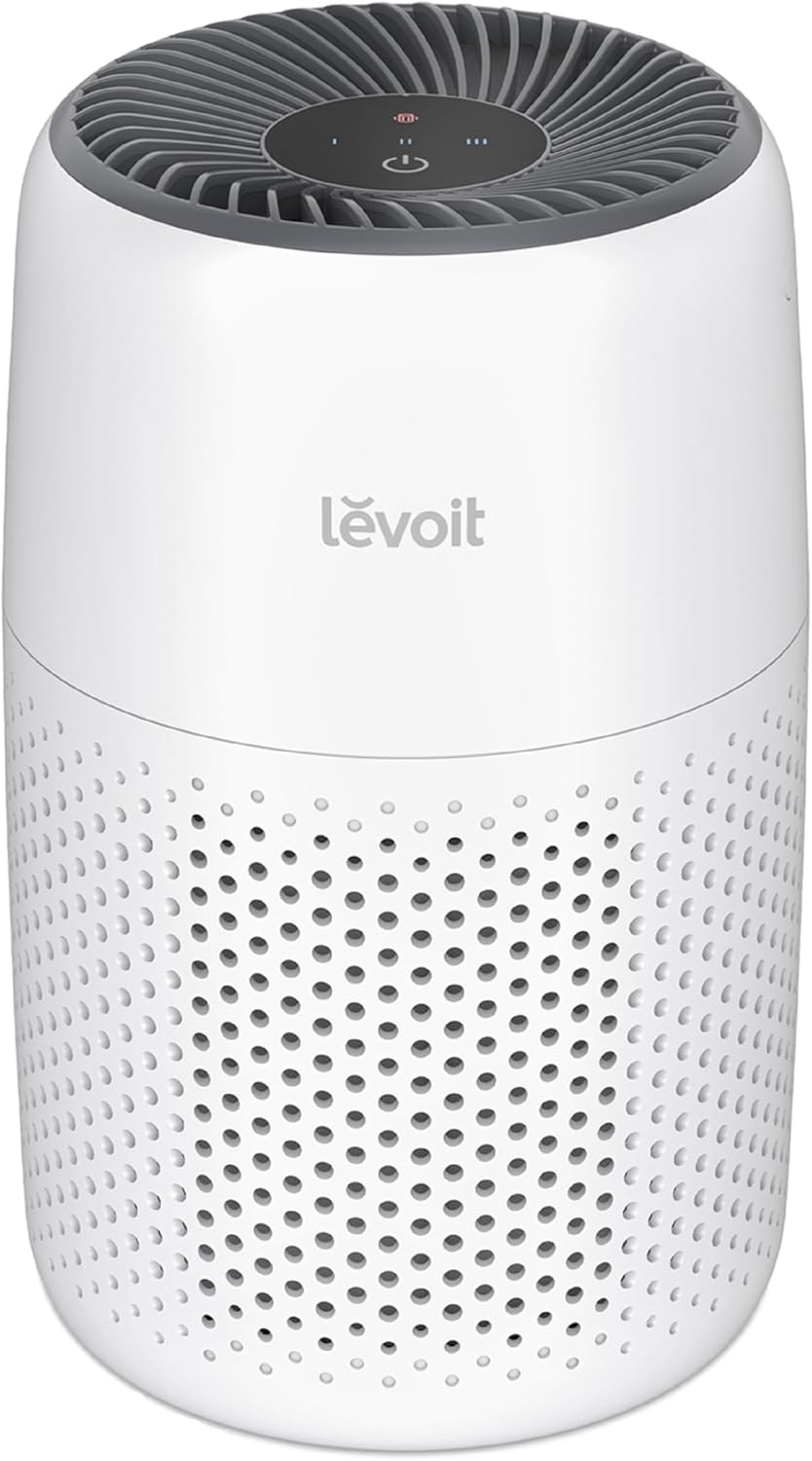
| Rated Power | 7W |
|---|---|
| Noise Level | 27-45dB |
| Adapter Input | 100-240V, 50/60Hz |
| Particle Retention Size | 0.3 micron |
The Levoit Core Mini-P is a small, plug-in desktop air purifier built for bedrooms, offices, and other tight spaces where space and noise matter. It uses a pre-filter plus a main HEPA-style filter to capture lint, pet hair, dust, smoke and common allergens, and it includes an aromatherapy sponge for light scenting. Controls include a sleep mode and an auto-off display so the unit stays unobtrusive during work or rest, and noise is rated quietly in the 27 to 45 dB range depending on fan speed. At 7W rated power it is energy efficient for continuous use and the adapter stores inside the unit for neat placement on a desk. The small footprint makes it easy to move between rooms but also limits the clean-air delivery to very small offices or single-person workstations, so it will not replace a full-room purifier in larger open-plan spaces. Filter replacement and using only a few drops of essential oil are practical considerations for long-term use.
Best for: Buyers who want a low-noise, energy-efficient purifier for a single-person office, bedroom, or desktop and prefer a simple, reliable unit with minimal setup.
Less Ideal for: Large open-plan offices, shared conference rooms, or anyone needing high clean-air delivery for multiple occupants should choose a larger-capacity purifier instead.
- Compact desktop footprint that fits on a desk or nightstand
- Quiet operation with a low noise range suitable for offices and bedrooms
- Multi-stage filtration captures dust, pet dander, and smoke particles
- Low power draw (7W) for continuous, energy-efficient use
- Built-in aromatherapy sponge and concealed adapter for tidy placement
- Designed for very small rooms or single workstations so coverage is limited
- Aromatherapy requires careful dosing to avoid damaging plastic parts
Verdict: A compact, quiet, and energy-efficient purifier that makes sense for a risk-averse buyer needing reliable air cleaning at a single small office workstation.
Choosing the Right Air Purifier for Small Office Space: Key Factors to Consider
Filtration Type and Efficiency
The core of any air purifier is how it removes particles from the air. True HEPA filters capture at least 99.97 percent of particles down to 0.3 microns and are the baseline for removing dust, pollen, and many aerosols. For offices where odors, chemicals, or VOCs are a concern, an activated carbon stage or other gas-phase media reduces smells and gaseous contaminants.
Understanding the filter stages helps you match a unit to specific needs. If allergy relief and particulate reduction are the primary concerns, prioritize stronger particulate filtration. If the office has persistent odors or new-construction off-gassing, look for robust carbon loading in addition to HEPA.
Noise Level and Fan Speeds
Noise performance matters in small offices because an overly loud purifier can disrupt meetings, phone calls, and concentration. Manufacturers report decibel levels at different fan speeds, but perceived disturbance also depends on the frequency spectrum and distance from the unit. Look for units that are quiet at low and medium speeds while still delivering meaningful air changes per hour.
Consider models with detailed speed steps, sleep modes, or automatic sensing that reduces fan speed when the air is good. Placement relative to workstations will affect perceived volume, so quieter units allow flexible placement closer to occupants without distraction.
Room Coverage and CADR
Clean Air Delivery Rate, or CADR, indicates how quickly a purifier reduces smoke, pollen, and dust in a room. For small office spaces, choose a device whose CADR and stated room coverage match or slightly exceed your actual room size to ensure adequate air changes. Undersized units will run continuously at high speed and still leave stale air.
When calculating needs, measure the office floor area and ceiling height to estimate volume. Use the manufacturer CADR and recommended room size as a guide, but prefer slight oversizing rather than underpowered units for sustained workplace use.
Maintenance, Filter Life, and Cost of Ownership
Long-term ownership depends on how often filters must be replaced and how easy that process is. Some units have multi-stage filters where only the prefilter is washable while HEPA and carbon modules require replacement. Check expected filter lifespans measured in months of typical office use, and whether replacement filters are easy to obtain.
Also factor in how simple it is to access filters without tools, whether the unit has indicator lights for replacement, and if the design minimizes accidental dust release during changes. Lower-frequency maintenance reduces downtime and keeps running costs predictable.
Footprint and Placement Flexibility
Small offices have limited floor space, so the purifier footprint and orientation matter. Vertical tower-style units may fit into corners or under desks, whereas wider tabletop or console units require more surface area. Evaluate whether the unit can be wall-mounted or tucked under shelving if floor space is scarce.
Also consider airflow direction. Some purifiers pull air from the bottom and discharge upward, which is efficient for mixing; others blow horizontally and need clear intake/exhaust paths. Choose a size and shape that fits your room layout without obstructing movement or vents.
Smart Features and Controls
Smart controls are convenient in office settings. Features like air-quality sensors, automatic fan-speed adjustment, timers, and Wi-Fi or app control help maintain optimal air quality without manual intervention. Sensor accuracy varies, so look for units that report both particulate counts and VOC/odor indicators when relevant.
However, avoid overvaluing connectivity alone. A smart purifier still needs solid core filtration and quiet operation. If IT policies restrict networked devices, ensure the model has reliable local controls and programmable routines.
Sizing Your Purifier for Typical Small Office Layouts
Measure the floor area and ceiling height to estimate the room volume before selecting a purifier. Small offices commonly range from 80 to 250 square feet; knowing the exact footprint helps you choose a unit with an appropriate CADR so it can complete multiple air changes per hour.
Aim for at least 3 to 5 air changes per hour for general comfort and allergy control. If occupants need higher protection, such as for frequent meetings with external visitors, target the higher end of that range. Remember that furniture and partitions reduce effective circulation, so slightly oversizing helps maintain performance.
- Calculate room volume: square feet multiplied by ceiling height.
- Compare CADR to room size rather than relying solely on 'small' or 'medium' labels.
- Place the unit where airflow is unobstructed and away from corner dead zones.
Placement and Setup Tips to Maximize Efficiency
Place purifiers so they have clear intake and exhaust paths. For most small offices, centering the unit along a wall or near the primary work area balances air cleaning with acceptable noise exposure. Avoid placing the unit directly behind chairs or under desks where airflow is restricted.
If the office has a door that opens frequently, position the purifier near the door to reduce contaminants brought in from shared corridors. In multiworkstation rooms, one central unit often works better than several tiny units scattered around.
- Keep at least a foot of clearance on intake and exhaust sides.
- Avoid blocking vents with curtains, storage, or equipment.
- Test different spots for perceived noise and air freshness before settling on a permanent placement.
Managing Noise Without Sacrificing Clean Air
Balance fan speed and noise by using automatic modes that raise airflow only when sensors detect elevated particulates. During quiet tasks like calls or focused work, switch to low or sleep modes and rely on a slightly oversized CADR to maintain air quality even at reduced fan speeds.
Consider units with measured low-frequency noise performance. High-pitched fans can be more distracting than lower-level broadband noise even at the same decibel reading.
- Use sleep or low modes during calls if the unit's filtration is adequate at those speeds.
- Position the unit farther from occupants when running high production modes to reduce perceived loudness.
- Use acoustic rugs or soft office furnishings to help dampen fan noise reflections in small rooms.
Energy Use and Running Costs for Continuous Operation
Because office purifiers often run for many hours daily, energy efficiency affects operating cost and environmental impact. Compare wattage at expected operating speeds and favor models with efficient motors or ECO modes that reduce power draw while keeping acceptable air turnover.
If you plan to run a purifier 8 to 10 hours a day, small differences in power draw add up over months. Consider units with programmable schedules so they run full power only during occupied periods and conserve energy overnight or on weekends.
- Check energy use at typical office fan settings rather than standby numbers.
- Prefer models with a clear ECO or economy mode for daytime continuous use.
- Factor in filter replacement frequency as part of the total cost of ownership.
Dealing With Odors, VOCs, and Smoking Zones
If the office is prone to smells from kitchens, chemical cleaners, or nearby smoking areas, prioritize a purifier with a substantial activated carbon stage or other gas-phase media. These media adsorb odors and many common volatile organic compounds more effectively than HEPA alone.
Note that carbon filters saturate over time and need replacement to retain effectiveness. For intermittent odor problems, a smaller carbon load might suffice, but persistent gaseous contaminants demand higher carbon capacity and more frequent changes.
- Use carbon-heavy units near kitchens or copier rooms.
- Replace carbon modules according to usage and odor return.
- Combine source control and ventilation with purification for best results.
How We Chose the Best Air Purifier for Small Office Space
We focused on attributes that matter most for small office environments. Our selection filters prioritized true HEPA or equivalent particulate filtration for removing fine dust, pollen, and airborne respiratory aerosols; activated carbon or gas-phase options when odor and VOC control are relevant; and verified clean air delivery rates sized for rooms typical of small offices. Quiet operation at normal work distances was essential, since distracting fans defeat the purpose of a workplace purifier. We also considered energy efficiency and continuous-run reliability so units can operate for full business hours without excessive cost or premature wear. Practical serviceability was another requirement: easy filter access, clear replacement indicators, and widely available replacement filters. Excluded from the list were large commercial-grade units designed for open-plan floors, devices that rely solely on ionization without adequate particulate capture, and hobbyist builds not intended for continuous office use. Each shortlisted purifier met minimum performance and convenience thresholds appropriate for frequent daily operation in small enclosed offices.
Our full evaluation process is outlined in our review methodology.
FAQ
How big a purifier do I need for a 150-square-foot office?
For a 150-square-foot room with standard 8-foot ceilings, choose a purifier rated to cover at least that area with a CADR that supports 3 to 5 air changes per hour. Slightly oversizing the unit helps maintain lower fan speeds and quieter operation while still achieving desired filtration.
Will an air purifier remove VOCs from new furniture or paint?
HEPA filters do not capture most VOCs. To address off-gassing from new furniture or paint, pick a purifier with an activated carbon or other gas-phase filter. For persistent VOC sources, combine purification with increased ventilation and source removal where possible.
Can I run an office purifier 24/7?
Many purifiers are designed for continuous operation, but consider energy use, filter life, and noise. If running nonstop, choose an efficient model with durable fans and plan for more frequent filter replacements. Using timers or occupancy schedules reduces wear and operating cost.
Are built-in air-quality sensors reliable for automatic operation?
Sensors provide useful relative readings and enable automatic fan adjustments, but their accuracy varies by model and sensor type. Treat sensor-driven modes as a convenience; verify performance by observing changes in smell or visible dust and checking manual settings if needed.
How often should I replace HEPA and carbon filters in an office setting?
Replacement intervals depend on usage, pollutant load, and filter design. Typical HEPA life ranges from 6 to 12 months under regular office use, while carbon modules may need replacement more frequently if odors are constant. Rely on manufacturer guidance and replacement indicators where available.
Can purifier placement affect its performance?
Yes. Placing the unit with obstructed intakes or against walls reduces performance. For best results, keep clearances recommended by the manufacturer, avoid corners that trap air, and position the purifier where it can circulate air through the occupied zone.
Final Verdict
For small office spaces, prioritize a purifier that balances effective particulate filtration with low noise and appropriate room coverage. True HEPA filtration, adequate CADR for your room volume, and quiet operation at working distances are the most important dimensions to weigh. Also consider maintenance demands, carbon media for odor control when needed, and the unit footprint relative to available space. Choose a model that slightly exceeds your calculated needs so it can run quietly most of the time and ramp up when necessary. That approach delivers consistent air quality, minimal distraction, and predictable ownership costs for a healthier office environment.