
Note: This article contains affiliate links. If you click on these links and make a purchase, we may earn a small commission at no extra cost to you. This helps support our research and content. Read our full affiliate disclosure here.
If you run an air purifier year-round, filter replacement cost quickly becomes a major part of ownership. Choosing an air purifier with inexpensive, easy-to-find filters can cut annual running costs without sacrificing basic performance. This guide surfaces five shortlisted air purifiers that prioritize low filter cost and practical maintenance. We evaluated units for filter price and availability, filtration performance, and upkeep demands. Read on to see the criteria we used and what matters when you want reliable indoor air cleaning without high recurring expenses.
Top Picks at a Glance
| Best Value The sweet spot between price and what you get | MOOKA PR1 Air Purifier |  |
| Best Budget The cheapest option that still gets the job done reliably | MEGAWISE Home Air Purifier EPI810 |  |
| Top Rated A top-rated pick with lots of positive feedback | WINIX AT40 Air Purifier |  |
| Most Popular A crowd favorite that many people choose with confidence | Levoit Core Mini-P |  |
| Best Seller A high-volume bestseller chosen again and again | VOOPNU HEPA Air Purifier DH-JH12 |  |
MOOKA PR1 Air Purifier

| Coverage | Up to 2200 sq ft (manufacturer claim) |
|---|---|
| Filter type | True H13 HEPA + activated carbon + washable pre-filter |
| Noise level | As low as 26 dB (Sleep mode) |
| Fan speeds | 6 modes including Auto, Pet, Sleep |
The MOOKA PR1 is a large-room air purifier built around a True H13 HEPA filter plus a washable pre-filter and activated carbon stage, intended to remove pet hair, smoke, pollen, and fine particles. It is typically placed in living rooms, bedrooms, or home offices and runs on one of six fan modes including Auto, Pet, and a very quiet Sleep setting around 26 dB. The unit reports PM2.5 levels on a front display and uses an onboard sensor to raise fan speed automatically in Auto mode. Practical touches include a washable pre-filter to lower running costs, a filter replacement reminder and a small aroma pad for fragrance. Trade-offs are that replacement HEPA filters are recommended every 3–6 months for best performance, and the purifier's large coverage claims depend on room layout and placement; users should expect periodic cleaning of the washable filter and occasional fan noise on higher speeds. Certifications like CARB and ETL provide reassurance about safety and no ozone output.
Best for: Buyers who prioritize low ongoing maintenance costs and practical performance for homes with pets or seasonal allergens and want an automatic, sensor-driven purifier for living spaces.
Less Ideal for: Those seeking a truly portable or ultra-compact purifier for small rooms, or buyers who need medical-grade filtration beyond a True H13 HEPA system.
- True H13 HEPA filtration captures particles down to 0.3 microns for effective removal of dust, smoke, pollen and pet dander.
- Washable pre-filter reduces frequency of HEPA replacement and lowers ongoing filter costs.
- Real-time PM2.5 display and Auto mode let the unit adjust fan speed to changing air quality without manual intervention.
- Multiple modes (including Pet and Sleep) provide tailored performance and a very quiet 26 dB sleep option.
- Replacement HEPA filters are recommended every 3–6 months, adding recurring cost.
- Large coverage claims (up to 2200 sq ft) depend on room layout and may not reflect air changes in obstructed spaces.
Verdict: Choose the MOOKA PR1 if you want a sensor-driven large-room purifier with True H13 filtration and a washable pre-filter to cut long-term filter costs.
MEGAWISE Home Air Purifier EPI810

| True HEPA efficiency | 99.97% at 0.3 μm |
|---|---|
| Recommended room size | 215 sq ft |
| Fan speeds | 6 |
| Sleep mode noise | <25 dB |
This compact MEGAWISE purifier uses a True HEPA filter to capture 99.97% of particles down to 0.3 μm and pairs that filtration with 360 degree dual-channel airflow to refresh rooms up to about 215 square feet. It is typically placed on a nightstand, desk, or shelf and used to reduce dust, pet dander, cooking odors, or seasonal smoke. The unit offers six speed settings plus a near-silent sleep mode rated below 25 dB, and a negative ion option for additional air freshness. A practical advantage for budget-minded owners is the washable filter that can be rinsed rather than replaced frequently, and a filter replacement indicator helps you know when to service it. The purifier is small and portable so it is easy to move between rooms, but buyers should expect limited coverage compared with larger whole-room units and should follow the washable-filter care instructions to maintain performance. Noise rises on higher fan speeds and the ion function may not be necessary for all users.
Best for: Buyers looking for a low-cost-to-maintain purifier for bedrooms, nurseries, or home offices who prioritize low running costs and compact portability.
Less Ideal for: People who need whole-house or large open-plan coverage or who prefer strictly replaceable disposable filter systems.
- True HEPA filtration removes 99.97% of particles down to 0.3 μm
- Washable filter reduces ongoing filter replacement costs
- Covers rooms up to 215 sq ft with 360° dual-channel airflow
- Near-silent sleep mode rated under 25 dB for bedroom use
- Six fan speeds and negative ion option provide flexible performance
- Coverage is limited to medium rooms and not suited for large open plans
- Noise increases noticeably on higher fan speeds
- Washable filters require regular maintenance to retain efficiency
Verdict: A compact, budget-friendly HEPA purifier whose washable filter keeps ongoing filter costs low for bedroom and small-room use.
WINIX AT40 Air Purifier

| Coverage (AHAM) | 410 sq ft |
|---|---|
| Large-room CADR | Cleans up to 1,968 sq ft in 1 hour |
| Filtration stages | 4-stage 360° system |
| Included filters | Two all-in-one True HEPA filter sets |
The WINIX AT40 is designed to clean very large rooms quickly using a 360° all-in-one 4-stage filter that Winix says captures particles down to 0.01 microns. It combines a True HEPA stage with activated carbon and PlasmaWave technology, a built-in air quality sensor, and an auto mode that adjusts fan speeds based on detected conditions. The unit is commonly used in living rooms, open-plan spaces, or large bedrooms where continuous monitoring and automatic speed control are valuable. The color-coded LED plus numeric display makes it easy to see current air quality at a glance, and Wi‑Fi connectivity lets you check status, run the purifier, and track filter life from the Winix Smart App. Sleep mode reduces noise for overnight use. Trade-offs are typical for large-capacity purifiers: it is relatively tall and aimed at whole-room coverage rather than being a compact bedside unit, and replacement filter cost and frequency will drive long-term ownership costs despite the included two filter sets that cover initial up to two years of use depending on runtime and air quality.
Best for: Buyers who prioritize a reliable, hands-off purifier for very large rooms and want clear, continuous air quality feedback and remote control.
Less Ideal for: Those needing a small, highly portable bedside purifier or the lowest possible upfront unit cost should consider smaller models instead.
- 360° four-stage True HEPA plus carbon filtration for broad particle and odor removal
- Smart sensor with real-time color-coded air quality display for easy monitoring
- Wi‑Fi and app control for remote operation and filter life tracking
- Auto and Sleep modes for hands-off running and quieter overnight operation
- Large footprint aimed at whole-room coverage rather than compact portability
- PlasmaWave is an additional technology whose benefits vary by environment
Verdict: Choose the WINIX AT40 if you want a robust, app-controllable purifier built to reliably clean very large rooms while providing visible, real-time air quality feedback.
Levoit Core Mini-P
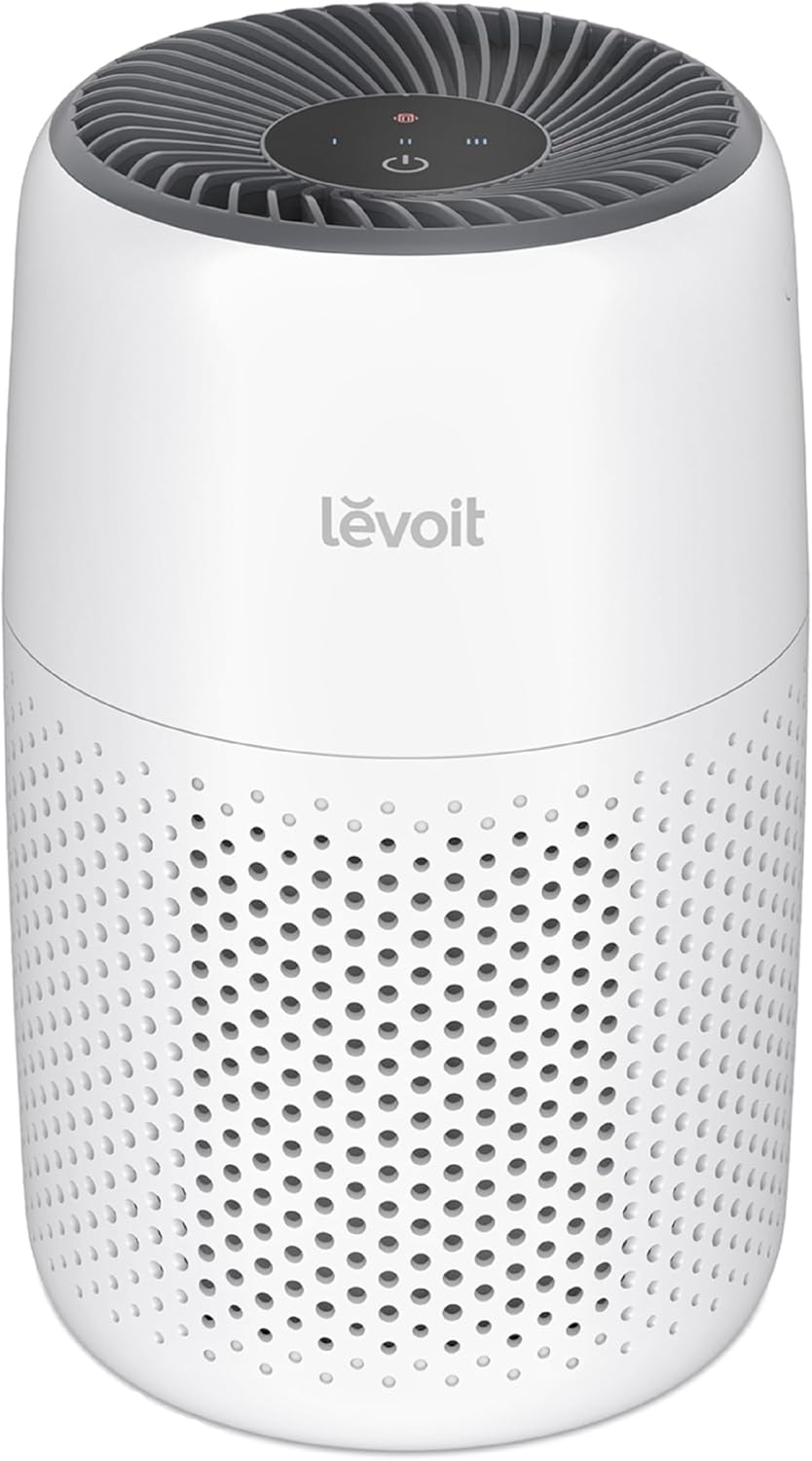
| Rated Power | 7W |
|---|---|
| Noise Level | 27-45dB |
| Adapter Input | 100-240V, 50/60Hz |
The Levoit Core Mini-P is a small, plug-in air purifier made for desks, bedrooms, and other tight spaces where you want continuous background cleaning. It uses a pre-filter plus a main HEPA-style filter to trap lint, pet dander, smoke and fine particles, and includes an aromatherapy sponge for light fragrance. Setup is straightforward — plug it in, drop in the filter and optional aroma pad, and choose between sleep mode and higher fan speeds; reported noise levels fall in the whisper-quiet range so it will not disturb sleep. The unit draws very little power at 7W, making it inexpensive to run, and its compact footprint fits on nightstands or work surfaces. The main limitations are its small coverage area — it is intended for single-room use rather than whole-home cleaning — and the tiny fragrance reservoir that must be used sparingly to avoid overflow. For buyers focused on low operating cost and quiet performance in small rooms, this is a practical, easy-to-use option.
Best for: Buyers who prioritize quiet, low-cost continuous air cleaning for a single room and want reassurance from a well-reviewed, widely adopted model.
Less Ideal for: People needing a purifier for large open-plan spaces or whole-house coverage should look at larger-capacity units instead.
- Compact footprint fits on a desk or nightstand
- Quiet sleep mode suitable for bedrooms
- Includes aromatherapy sponge for light scenting
- Low power draw (7W) keeps operating costs minimal
- Not suitable for large rooms or whole-home air cleaning
- Aromatherapy pad can overflow if overfilled
Verdict: A tiny, energy-efficient purifier that delivers quiet, effective particle and odor reduction for single rooms while keeping filter and running costs low.
VOOPNU HEPA Air Purifier DH-JH12

| Model number | DH-JH12 |
|---|---|
| Filter type | H13 True HEPA |
| Coverage (vendor) | Up to 1,076 ft² |
| Noise level | 22 dB (low) |
The VOOPNU DH-JH12 is a compact air purifier built around an H13 true HEPA triple-layer filter and 360° surround intake to capture airborne particles like pet hair, pollen, smoke, and odors. It is intended for everyday home use on a desk, nightstand, or in a corner and is rated to handle up to about 1,076 square feet based on the vendor lab testing. Controls are intentionally simple with three fan speeds, a timer, and a built-in essential oil tray if you want light scenting. The unit runs quietly at low settings (about 22 dB) so it is suitable for bedrooms. Filters are replaceable on a roughly 3–6 month cycle depending on use, and the purifier carries multiple safety and performance certifications. Trade-offs are its small footprint and modest feature set—there is no app control or advanced air-quality auto mode—so it is best as a straightforward, low-complexity cleaner rather than a smart whole-home centerpiece.
Best for: Buyers who prefer a simple, reliable air cleaner with proven filtration and quiet operation and who value low fuss maintenance and clear certifications.
Less Ideal for: People who want smart home integration, advanced air-quality sensors, or a high-output purifier for consistently smoky or very large open-plan spaces.
- H13 true HEPA triple-layer filter that captures 99.97% of airborne particles
- 360° surround intake for even airflow in compact placement
- Very quiet operation down to about 22 dB suitable for bedrooms
- Simple controls and timer make it easy to run continuously
- Built-in essential oil tray for optional scenting
- No smart features or app control for remote monitoring
- Small physical size limits airflow at higher coverage claims during heavy pollution events
Verdict: A quiet, easy-to-use HEPA purifier that delivers reliable particle filtration with minimal fuss and straightforward maintenance.
Choosing the Right Air Purifier with Cheapest Filters: Key Factors to Consider
Filter Replacement Cost
How much you pay for replacement filters over a year directly affects total ownership cost. Low initial unit price matters less if the filters are expensive or need frequent replacement. Look at typical retail prices for standard replacement packs and estimate annual expense based on the manufacturer's recommended replacement interval.
Also consider whether filters are sold individually or in multi-packs and whether generic or third-party equivalents exist. Multi-pack options and off-brand compatible filters can lower per-filter cost, but verify fit and specification before relying on non-OEM parts.
Filtration Performance and CADR
Filter price should not come at the expense of basic air-cleaning capability. Check the unit's CADR ratings for smoke, dust, and pollen to confirm the purifier can handle your room size. HEPA-grade filtration or equivalent particle removal is important for removing fine particles that affect health and indoor air quality.
Higher CADR means faster air turnover and less strain on the filter, which can also extend filter life if the unit is sized correctly for the space.
Filter Availability and Supply Chain
Cheap filters are only useful if you can actually buy them easily. Products with filters stocked in multiple retailers, sold in multi-packs, or compatible with third-party replacements provide predictable supply and often better pricing. Conversely, units that rely on infrequent or regionally limited supply chains risk spiking replacement costs over time.
Consider how many SKUs exist for the filter type and whether common online or local retailers carry replacements to avoid waiting for shipments or paying premium prices.
Ease of Maintenance and Replacement
Simple, tool-free filter changes reduce the time and hassle of upkeep. Look for purifiers with straightforward access to filters, clear indicators for replacement, and modular designs. If a unit requires disassembly or special screws, you will likely incur higher maintenance effort, which translates to time cost and interrupts use.
Also check whether the unit has washable pre-filters that reduce particulate load on primary filters, because washable parts can significantly lower how often you need to buy replacements.
Energy Use and Operating Cost
Running cost is part of long-term affordability. A fan motor that consumes more power will increase monthly electricity bills, offsetting savings from cheap filters. Compare wattage across typical speed settings and consider whether the purifier includes energy-saving modes or timers.
Some units use more aggressive fan profiles to protect filter life, which can increase energy use. Balancing runtime schedules and selecting appropriate fan speeds for occupancy patterns helps manage both filter longevity and energy expense.
Filter Longevity and Replacement Interval
How long a filter lasts depends on room pollution levels, runtime, and the type of filter. Filters rated for longer service intervals reduce annual part costs even if their unit price is slightly higher. Review manufacturer guidance on months of use and consider local indoor air conditions which may shorten or extend that interval.
Units that provide clear hour meters or usage tracking make it easier to plan replacements and avoid premature changes that raise annual spending.
Estimating True Annual Filter Cost
A realistic annual cost estimate blends filter price, recommended replacement frequency, and how you use the purifier. Start by multiplying the per-filter price by the number of replacements recommended for a year. Add any pre-filter replacements or accessory parts that the manufacturer lists separately.
Remember to factor in potential savings from bulk purchases or compatible third-party filters. If you run the purifier continuously in high-pollution environments, plan for more frequent changes than the nominal interval.
- Calculate for your room size and expected runtime, not the manufacturer's test scenario.
- Include pre-filter and post-filter parts if they have separate replacement schedules.
- Check whether bundles or subscription services offer a genuine per-filter discount.
Sizing the Purifier for Room and Filter Life
An undersized purifier will run at higher fan speeds more often and shorten filter life. Choose a unit with CADR ratings appropriate for the square footage you intend to cover so the device does not need to operate at maximum constantly.
Correct sizing reduces both energy consumption and filter wear. If you have open-plan areas, treat them as a single larger zone rather than multiple small rooms when sizing.
- Match CADR to room area for at least 4 to 5 air changes per hour if allergies or heavy particles are a concern.
- Avoid oversizing to the point of unnecessary cost, but err on the side of a slightly higher CADR rather than too low.
Pre-Filters and Washable Elements
Washable pre-filters trap larger particles and protect main filters, often extending their usable life. Units designed with easy-to-clean pre-filters can noticeably reduce replacement frequency and cost.
Inspect how easy pre-filters are to remove and whether cleaning them requires special care. Regular cleaning of these parts is a low-effort way to reduce consumable spend.
- Look for washable pre-filters that do not degrade with repeated cleaning.
- Confirm manufacturer guidance on cleaning intervals to avoid voiding any recommendations.
Third-Party and Generic Filter Options
Compatible filters from third-party manufacturers can lower ongoing costs, but quality and specification vary. Verify filter dimensions, media type, and any electrostatic or activated-carbon treatments before assuming interchangeability.
Some third-party filters match OEM filtration ratings, while others sacrifice media density for lower cost. When considering generic filters, check return policies and user reviews to ensure consistent performance.
- Compare particle capture ratings and material descriptions between OEM and third-party filters.
- Buy one replacement to test fit and performance before committing to bulk purchases.
Maintenance Habits That Extend Filter Life
Simple habits help filters last longer. Running the purifier at moderate speeds when possible, keeping doors and windows closed in high pollution events, and cleaning pre-filters routinely all reduce particulate load on primary filters.
Also maintain a clean environment by vacuuming and dusting to cut the amount of airborne debris the purifier needs to capture. Good upstream housekeeping can be as effective at lowering filter costs as choosing a low-priced replacement.
- Schedule regular pre-filter cleaning and vacuuming near the purifier intake.
- Use timers and smart schedules to avoid unnecessary continuous high-speed operation.
How We Chose the Best Air Purifier with Cheapest Filters
We focused on real-world ownership costs and practical performance. Primary filters and long-term replacement pricing were the starting point: we looked for units whose standard replacement filters are consistently low-cost and widely available. Next we evaluated filtration effectiveness using clean air delivery rate and particle removal capability to ensure low filter price did not mean ineffective cleaning. Maintenance and ease of replacement were considered so buyers would not face hidden labor or tool costs when changing filters. Energy consumption and recommended replacement intervals influenced total annual cost, and we considered build quality to avoid units that require frequent repairs or ancillary parts. We excluded specialty or OEM-only filters that are rarely stocked or prohibitively expensive, and we excluded units with proprietary consumables that dramatically raise ownership costs. In short, we filtered out options with high recurring costs, limited filter availability, poor CADR relative to room size, or unusually short recommended replacement schedules. The result is a list that balances low filter cost with dependable filtration, reasonable energy use, and simple upkeep.
Our full evaluation process is outlined in our review methodology.
FAQ
How often should I replace filters to balance cost and performance?
Replacement intervals depend on runtime and pollution levels. A common guideline is every 6 to 12 months for primary HEPA filters under typical household use, but heavy use or smoky environments may require changes every 3 to 6 months. Monitor airflow and follow the unit's replacement indicators where present.
Are third-party replacement filters safe to use?
Many third-party filters are safe and reduce cost, but quality varies. Check dimensions and media type and look for independent test data or reputable seller reviews. Consider testing a single non-OEM filter first to ensure fit and performance before buying in bulk.
Will running the purifier on a lower fan speed save filter life?
Running at lower speeds reduces particulate throughput and can extend filter life, but it also lowers air turnover. For routine use, moderate speeds strike a balance between conserving filter life and maintaining adequate air cleaning.
Do washable pre-filters eliminate the need for replacements?
Washable pre-filters reduce how often primary filters need replacing but do not eliminate replacements entirely. They capture larger debris that would otherwise load the main filter, so cleaning them regularly can lengthen the service interval for the main filter.
How does energy use factor into long-term cost comparisons?
Energy consumption contributes to ongoing operating cost and can offset savings from cheap filters. Compare wattage at typical settings and consider how many hours per day the unit will run. Energy-efficient motors and sleep modes help lower total ownership costs.
Final Verdict
When low ongoing cost is your priority, balance filter price with genuine filtration capability and availability. Prioritize units whose replacement filters are inexpensive, widely stocked, and compatible with simple maintenance routines. Remember that correct sizing, washable pre-filters, and sensible runtime habits can reduce the number of replacements you need each year. Choose a purifier that aligns with your room size and runtime patterns, and plan annual costs using realistic replacement intervals. That approach helps you pick a reliable, low-cost option without sacrificing the air-cleaning performance you need.