
Note: This article contains affiliate links. If you click on these links and make a purchase, we may earn a small commission at no extra cost to you. This helps support our research and content. Read our full affiliate disclosure here.
If you suffer from seasonal or indoor allergies, an air quality monitor for allergies can help you spot triggers before symptoms start. The right monitor flags rises in particulate matter, common gases, and humidity changes that often worsen congestion and sneezing. This guide shortlists the top seven options specifically suited to allergy management, focusing on how reliably they detect allergens and how easy they are to use at home. Below we explain the criteria used to select these picks and what matters when you are choosing a monitor to reduce exposures and improve daily comfort.
Top Picks at a Glance
| Best Overall The best all-around choice for most situations | Temtop LKC-1000S+ 2nd |  |
| Best Quality Built to a higher standard if you want something more solid | IQAir AirVisual Pro |  |
| Best Value The sweet spot between price and what you get | Temtop S1 Air Quality Monitor | 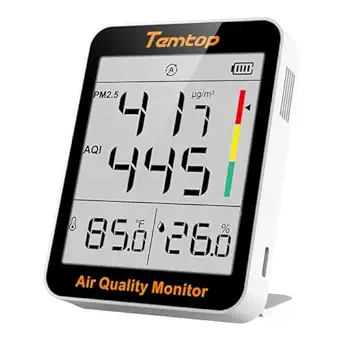 |
| Best Budget The cheapest option that still gets the job done reliably | PinoTec AK3 Air Quality Monitor |  |
| Top Rated A top-rated pick with lots of positive feedback | AQItech 16‑in‑1 Air Quality Monitor AK16C |  |
| Most Popular A crowd favorite that many people choose with confidence | GoveeLife Smart Air Quality Monitor H5106 |  |
| Best Seller A high-volume bestseller chosen again and again | YNAK 16-in-1 Air Quality Monitor AK22A |  |
Temtop LKC-1000S+ 2nd

| Battery Capacity | 3000mAh |
|---|---|
| Battery Life | 6-8h after full charged |
| PM2.5 Measuring Range | 0-999 μg/m³ (Resolution: 0.1μg/m³) |
| HCHO Measuring Range | 0-2 mg/m³ (Resolution: 0.01mg/m³) |
The Temtop LKC-1000S+ 2nd is a portable air-quality meter aimed at giving a broad picture of indoor pollution by tracking PM2.5, PM10, formaldehyde (HCHO), TVOCs, temperature and humidity while calculating AQI. It is typically used on a countertop or carried around the home to spot problem areas, view a 12-hour histogram of PM2.5 trends and export recorded data to a PC via USB for deeper review. Notable features include a laser particle sensor rated for long life, an electrochemical formaldehyde sensor, adjustable data storage intervals and a 3000mAh rechargeable battery for several hours of untethered use. For allergy-focused buyers, the PM2.5/PM10 reporting and real-time AQI color indicators help identify dust and fine particle spikes tied to allergen events. Limitations include consumer-grade VOC and formaldehyde sensors that can be affected by cleaning products or alcohol and modest battery life if you run continuous multi-sensor logging, so for continuous whole-house monitoring you may prefer a mains-powered or networked unit.
Best for: A practical buyer who wants a single portable meter to spot-check homes for particle-related allergy triggers and record short-term events for later analysis.
Less Ideal for: People who need continuous whole-house monitoring or integrated Wi-Fi logging should consider mains-powered or networked monitors instead.
- Measures both PM2.5 and PM10 for particle-sensitive allergy tracking
- Includes formaldehyde and TVOC sensors for broader indoor pollutant detection
- On-device histogram and adjustable storage intervals with USB data export for review and record keeping
- Portable with a rechargeable 3000mAh battery and clear color-coded AQI display
- Laser particle sensor specified with high reported stability and long service life
- Formaldehyde and VOC readings are consumer-grade and can be influenced by nearby solvents or cleaners
- Battery lasts only several hours under continuous multi-sensor use, limiting long-term untethered logging
Verdict: Buy this if you want a portable, all-in-one detector that highlights particle spikes and saves short-term logs to help identify allergy triggers.
IQAir AirVisual Pro

| Sensors | PM2.5, CO2, temperature, humidity |
|---|---|
| Connectivity | Wi-Fi |
| Power | Rechargeable (USB or outlet) |
| Manufacturer | IQAir |
The IQAir AirVisual Pro is a precision indoor air quality monitor aimed at users who want reliable, continuous readings of fine particles and CO2. It uses high-precision laser sensors to report PM2.5 along with CO2, temperature, and humidity, and it logs historical data so you can see trends and identify persistent problems like cooking or wood smoke. The unit connects to Wi-Fi and pairs with IQAir's app so you can view real-time and past air quality data remotely and set customizable alerts when thresholds are exceeded. Its rechargeable design and clear on-device display make it easy to place in living areas or bedrooms, and the device also surfaces outdoor station data for context. The main limitations are the monitor-only role — it does not clean air — and the cost is higher than simple consumer sensors, which may be more than some users need for basic checks. For allergy sufferers who need accurate particle and CO2 tracking, it provides the precise, actionable data that helps target interventions.
Best for: Buyers who prioritize accurate, professional-grade particle and CO2 measurements to diagnose and track indoor air issues and make targeted changes to reduce allergen exposure.
Less Ideal for: Casual users who only want a simple, inexpensive indicator of air quality or those looking for an integrated purifier-monitor combo.
- Professional-grade laser sensors for accurate PM2.5 readings
- Measures CO2, temperature, and humidity alongside PM2.5 for fuller indoor-air context
- Wi-Fi connectivity and companion app with historical data and customizable alerts
- Rechargeable and compact design with clear on-device display
- Monitor-only device that does not include air purification
- Higher price point compared with basic consumer air sensors
Verdict: Choose the AirVisual Pro when you need precise, professional-grade PM2.5 and CO2 monitoring to inform allergy-focused indoor air decisions.
Temtop S1 Air Quality Monitor

| Temperature Accuracy | ±1 degree Celsius |
|---|---|
| Humidity Accuracy | ±5% RH |
| PM2.5 Measuring range | 0-999 µg/m³ |
| Battery Life | ≥20 days (Smart) ≥60 days (Eco) |
The Temtop S1 is a small, battery-powered indoor air quality monitor that shows PM2.5, AQI, temperature, and humidity on a simple segmented display and uses a miniature laser particle sensor for particulate readings. It is designed for spot-checking rooms, moving between nursery, bedroom, office, or travel use, and offers two operating modes: a real-time active mode and an eco mode that stretches standby life to as much as 60 days. Notable practical features include a three-color alert indicator for quick status checks, two-button operation for easy control, and multiple placement options including magnetic attachment. For allergy-focused buyers the accurate PM2.5 sensing and clear AQI readout help identify high-particulate situations like cooking, dusting, or wildfire smoke. Limitations are the basic segment display without detailed graphs or smartphone app connectivity and no VOC or CO2 sensing, so it is best used as a dedicated particulate and comfort monitor rather than a full multi-pollutant system.
Best for: Buyers who want a no-frills, portable monitor to quickly detect particulate spikes and confirm cleaner air during allergy season and daily cleaning routines.
Less Ideal for: Users who need multi-pollutant monitoring, integrated logging, or smart-home connectivity should consider more feature-rich models.
- Accurate PM2.5 readings using a laser particle sensor for spotting allergen-rich air events
- Very long battery life with up to 60 days in eco mode for low-maintenance monitoring
- Simple three-color alert makes air quality easy to interpret at a glance
- Portable, compact design with stand, placement, or magnetic mounting options
- No CO2 or VOC sensing so it does not detect all indoor air hazards
- Segmented display and no companion app limit data logging and trend analysis
Verdict: A compact, low-maintenance PM2.5 and comfort monitor ideal for allergy-focused users who need reliable particulate alerts without daily charging.
PinoTec AK3 Air Quality Monitor

| Power Source | Battery Powered |
|---|---|
| Product Style | CO2,TVOC,HCHO,TEMP,HUMI |
| Built-In Media | 1 |
| Item Weight | 7.68 ounces |
The PinoTec AK3 is a compact, battery-powered air quality meter that gives real-time readings for CO2, formaldehyde, TVOCs, temperature, and humidity on an easy-to-read color LED screen. It is typically used in homes, bedrooms, offices, cars, and small confined spaces to spot elevated gas levels or poor ventilation. The USB-rechargeable 2000 mAh battery and built-in battery indicator make it convenient to move around the house without constantly hunting for a power outlet. Color-coded alerts help you quickly judge overall air quality at a glance, and the display shows individual sensor values for targeted troubleshooting. Practical benefits include portability, multi-gas detection that covers common indoor pollutants linked to allergies, and simple plug-in charging. Limitations are that it does not list an audible alarm and the listing lacks advanced logging or connectivity features for long-term trend tracking, so it is best for spot checks rather than continuous networked monitoring.
Best for: Buyers who want an affordable, portable device to do quick spot checks of common indoor pollutants and ventilation in living spaces and cars.
Less Ideal for: Users who need continuous cloud logging, smart home integration, or high-end laboratory accuracy should consider more advanced, connected monitors.
- Measures five key indoor metrics including CO2, HCHO, TVOC, temperature, and humidity
- Color LED screen provides quick visual status and per-parameter readings
- USB-rechargeable 2000 mAh battery with on-screen battery indicator for portable use
- Small, lightweight design suitable for rooms, cars, and confined spaces
- No listed audible alarm for immediate audible alerts
- No Wi-Fi/Bluetooth or data logging for long-term trend analysis
Verdict: A budget-friendly, portable 5-in-1 monitor that gives fast, easy spot checks of common indoor pollutants and ventilation status.
AQItech 16‑in‑1 Air Quality Monitor AK16C
| Measured parameters | PM1.0, PM2.5, PM10, CO2, TVOC, HCHO, temperature, humidity |
|---|---|
| Display | HD color screen with color-coded readings |
| Sampling interval | Every 1.5 seconds |
| Charging | Type-C fast charging with AC adapter |
| Battery runtime | 4–5 hours |
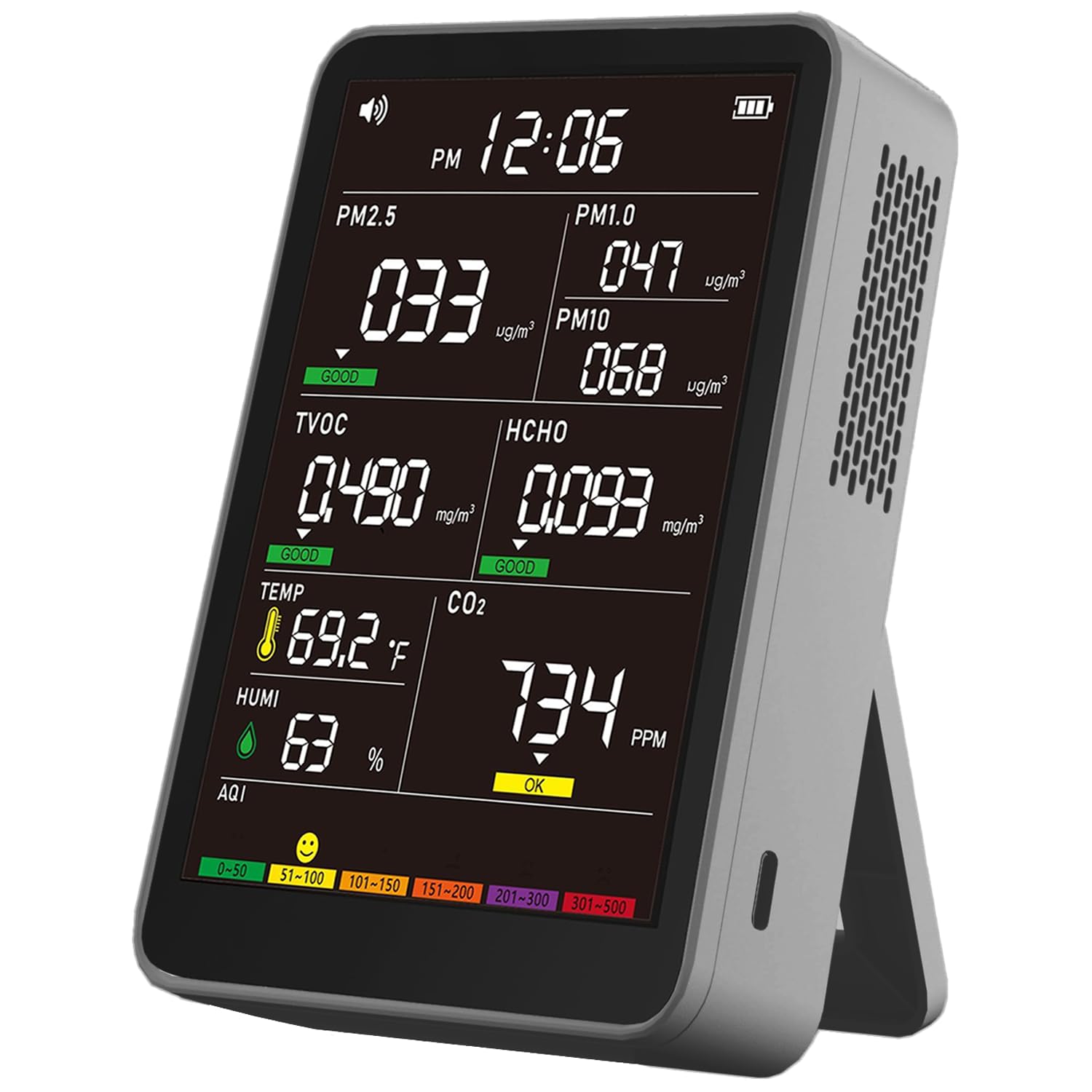
The AQItech AK16C is a compact, portable air quality monitor designed to give continuous, multi-parameter readings for indoor spaces and vehicles. It simultaneously measures PM1.0, PM2.5, PM10, CO2, TVOC, formaldehyde, temperature and humidity, updating every 1.5 seconds and presenting results on a large color display with color-coded levels. One-button operation, an adjustable audio prompt and a quiet sampling mode make it simple to use in bedrooms or offices, and the included Type-C fast charging and AC adapter support 4 to 5 hours of cordless runtime for spot checks. For allergy monitoring the particulate sensors and real-time updates make it easy to spot spikes and decide when to ventilate or run filtration. Limitations include modest battery life for prolonged unattended monitoring and reliance on built-in sensors that may need occasional calibration compared with lab equipment, so it is best used as a reliable, everyday indicator rather than a precision reference instrument.
Best for: Buyers who prioritize dependable, real-time indicators of indoor pollutant levels for everyday allergy management and want an easy-to-use portable unit for rooms and cars.
Less Ideal for: Users seeking continuous multi-day unattended logging without mains power or those needing laboratory-grade calibrated instruments for formal testing.
- Measures a wide set of pollutants (PM1.0/PM2.5/PM10, CO2, TVOC, HCHO) useful for allergy-relevant monitoring
- High-frequency automatic sampling with real-time color-coded display makes spikes easy to spot
- Simple single-button controls and quiet sampling mode are user-friendly for bedrooms and offices
- Includes Type-C fast charging and an AC adapter for quick recharges and portable use
- Battery supports only about 4–5 hours of continuous use, so it needs frequent recharging for long monitoring sessions
- Built-in sensors can drift over time and may require calibration for laboratory-grade accuracy
Verdict: A practical, easy-to-use multi-parameter monitor that gives fast, color-coded air quality alerts ideal for daily allergy management.
GoveeLife Smart Air Quality Monitor H5106

| PM2.5 Accuracy | ±15 µg/m³ (0–100 µg/m³) |
|---|---|
| Temperature Accuracy | ±0.54°F |
| Humidity Accuracy | ±3%RH |
| Response Time | 2 seconds |
| Included Components | Air quality monitor, Type-C cable |
The GoveeLife H5106 is a countertop air quality monitor that tracks PM2.5, temperature, and humidity and refreshes readings every two seconds for near real-time awareness. It is typically plugged in and used in bedrooms, living rooms, or home offices to watch allergen-linked fine particulate levels and indoor comfort conditions. The unit shows readings on an LED display with selectable clock, bright and night modes, and a four-level air quality indicator for at-a-glance status. Wi‑Fi and Bluetooth connectivity let you view historical data on the app, export up to two years of records, and automate compatible GoveeLife purifiers, humidifiers, and fans to respond to poor air. The sensor reports PM2.5 accuracy and response specs that are reasonable for consumer monitors, but it has no internal battery so placement is limited by a power outlet and the device requires 2.4 GHz Wi‑Fi for remote features. For allergy monitoring it gives quick, continuous feedback and app history, though users who need professional-grade calibration or battery-powered portability should look elsewhere.
Best for: Buyers who prioritize quick, continuous feedback and remote history to monitor indoor particulate levels and link readings to smart home actions for allergy control.
Less Ideal for: People who need portable or battery-powered monitoring for travel or multi-room use, or those seeking laboratory-grade calibrated instruments.
- Fast 2-second refresh for near real-time PM2.5, temperature, and humidity readings
- Wi‑Fi and Bluetooth connectivity with remote monitoring and two years of data export
- LED display with adjustable bright/night modes and a simple four-level air quality indicator
- Can automate compatible GoveeLife purifiers, humidifiers, and fans based on readings
- Requires a constant power connection because it has no internal battery
- Only supports 2.4 GHz Wi‑Fi which may require router adjustments for some homes
Verdict: A fast, app-connected indoor monitor that gives allergy-conscious users near real-time PM2.5, temperature, and humidity tracking and automated responses with other GoveeLife devices.
YNAK 16-in-1 Air Quality Monitor AK22A

| Detects | CO2, PM2.5, PM1.0, PM10, HCHO, TVOC, Temp, Humidity, AQI |
|---|---|
| Display | 7-inch LED, 3 brightness levels |
| Alerts | 7 AQI alert buzzers, mute button |
| Power | USB-C with charging adapter |
This YNAK 16-in-1 air quality monitor is a tabletop meter designed for continuous indoor use and shows a wide set of readings on a large 7-inch display. It measures CO2, PM2.5, PM1.0, PM10, HCHO, TVOC, temperature, humidity and reports an AQI with seven distinct alert buzzers, so you can see particulate and gas hazards relevant to allergy sufferers at a glance. The external high-precision sensors and direct air sampling aim for quick response to changing conditions, and three brightness settings plus a mute button make the unit easy to use in bedrooms or living areas. It runs from a USB-C power source and ships with an adapter and cable. Limitations include no mention of app connectivity or data logging for long-term trend tracking and the product relies on built-in sensors that may need careful placement and occasional calibration to keep readings accurate in the long term. For everyday allergy monitoring it provides clear, immediate alerts and readable measurements without a steep learning curve.
Best for: Buyers who prioritize clear, immediate indoor air readings and audible alerts to reduce allergy exposure and prefer a simple plug-and-play tabletop device for bedrooms or common rooms.
Less Ideal for: Users who need smartphone integration, historical data logging, or advanced exportable reports for long-term air-quality tracking.
- Large 7-inch display with three brightness settings for easy at-a-glance readings
- Monitors multiple allergy-relevant parameters including PM1.0, PM2.5, PM10, CO2, HCHO and TVOC
- Seven configurable AQI alert buzzers provide immediate audible warnings for deteriorating air
- Includes USB-C cable and charging adapter for simple power setup
- No listed smartphone app or cloud logging for long-term trend analysis
- Sensor accuracy and calibration may drift over time and require careful placement
Verdict: A straightforward tabletop monitor that delivers clear multi-pollutant readings and loud AQI alerts for people focused on reducing allergy triggers indoors.
Choosing the Right Air Quality Monitor for Allergies: Key Factors to Consider
Sensor Types and What They Measure
Different sensors detect different triggers. Optical particle counters measure particulate matter such as PM2.5 and PM10, which are the particles most commonly linked to respiratory irritation and allergy symptoms. Some monitors also include sensors for volatile organic compounds and CO2, which can indicate poor ventilation or chemical irritants that aggravate sensitive users.
Choosing a monitor with the right sensor mix matters because it determines which exposures you can actually detect. For allergy-focused use, prioritize accurate PM2.5 readings and clear separation of particle sizes so you can tell if symptoms align with fine-particle spikes such as smoke, pollen fragments, or pet dander.
Response Time and Reporting Frequency
How quickly a monitor updates matters when you need to identify short-term events like cooking, vacuuming, or opening a window. Devices that sample frequently and report near real-time readings make it easier to correlate activities with symptom onset.
Longer averaging times can smooth out spikes and hide brief but intense exposures that may trigger symptoms. Look for monitors with configurable reporting intervals or those that provide both instant readings and time-averaged trends for context.
Data Accessibility and Trend Analysis
Access to historical data helps you spot patterns across days and weeks, such as higher indoor PM2.5 during certain activities or times of day. Good apps or web dashboards let you filter by pollutant type, export logs, and view graphs that reveal recurring problems.
If you plan to track improvements after changes like adding an air purifier or adjusting ventilation, ensure the monitor stores sufficient history locally or in the cloud and that exporting or sharing results is straightforward.
Alerting, Alarms, and Notifications
Timely alerts let you act before symptoms develop or worsen. Monitors with adjustable thresholds, push notifications, or audible alarms help you respond to rising pollutant levels—turn on an exhaust fan, close windows, or run an air cleaner.
Customizable alerts are useful because sensitivity varies between individuals. A parent managing a child with asthma may want tighter thresholds than someone with mild seasonal sniffles, so look for devices that let you set personalized triggers.
Placement, Size, and Power Options
Where you place the monitor affects what it senses. A small unit placed on a bedroom nightstand will better represent sleeping exposure than one tucked high on a bookshelf. Size and noise level can influence where a device lives, and battery versus mains power affects placement flexibility.
Consider whether you need a portable monitor to move between rooms or a plug-in unit for continuous monitoring in one spot. Also check whether the housing and footprint fit your living spaces without becoming intrusive.
Calibration and Long-Term Reliability
Sensors can drift over time, so calibration approach and expected maintenance matter. Some monitors offer automatic calibration against reference networks or software updates that improve accuracy; others require occasional manual checks or have replaceable sensor modules.
For long-term allergy management, choose monitors with documented calibration methods or reliable firmware support to ensure readings remain trustworthy over months and years.
Where to Place Your Monitor for Allergy Tracking
Place monitors where you spend the most time and where symptoms commonly occur. For many people this is the bedroom during sleep hours, but living rooms and home offices are also important if you spend significant daytime hours there.
Avoid placing the device directly next to windows, ventilation registers, kitchens, or bathrooms unless you want to capture event-driven spikes from cooking, open windows, or showers. Instead, position monitors at breathing height in a central location within the room for representative readings.
- Bedroom: on a nightstand or dresser near the bed at about 3 feet off the floor.
- Living area: on a side table or shelf away from HVAC vents and direct sunlight.
- Near suspected sources: temporarily place the monitor near pets, a fireplace, or an open window to confirm if those affect readings.
How to Interpret PM2.5 and VOC Readings
PM2.5 is the metric most closely linked to airborne particles that aggravate respiratory systems. Low-level increases may not cause immediate symptoms but repeated exposure can worsen chronic conditions. Understand both instantaneous peaks and daily averages to form a full picture.
VOC readings indicate chemical irritants that can produce headaches, throat irritation, or worsen allergy-like symptoms. Recognize that different monitors report VOCs in different scales; use baseline readings from your home as a reference and watch for sudden changes rather than absolute values.
- Watch for spikes during activities like cooking, vacuuming, or burning candles.
- Use trends to determine if ventilation changes reduce VOC levels over time.
Using Monitors with Air Purifiers and Ventilation
An air quality monitor tells you whether an air purifier or ventilation strategy is actually reducing pollutant levels. Place the monitor near the breathing zone rather than directly next to the purifier intake or outlet for a realistic assessment.
When testing purifiers, run the device at different fan speeds and monitor how quickly PM2.5 drops. Use saved logs to compare before-and-after conditions and verify that the purifier or ventilation change produces sustained improvements rather than short-lived effects.
- Test purifiers by inducing a controlled spike, then observe decay rate with the purifier on.
- For whole-home ventilation systems, sample in key rooms to identify uneven airflow or areas that remain problematic.
Common Limitations to Keep in Mind
Consumer-grade monitors provide useful directional information but may not match laboratory instruments in absolute accuracy. Expect some variance between units and treat readings as indicators rather than absolute truth.
Certain sensors struggle with very high humidity or dense smoke and may report skewed particle counts. Use multiple indicators—PM trends, VOC spikes, and perceived symptoms—together to make informed decisions about interventions.
- Avoid relying on a single reading; look for patterns over hours or days.
- If you detect persistent problems, combine monitoring with source control, cleaning, and improved ventilation for best results.
Privacy and Data Sharing Considerations
Many modern monitors use cloud services and apps that store historical readings. Consider whether you are comfortable with cloud backups and what personal data might be associated with device usage.
If privacy matters, look for devices that offer local-only data storage or export options so you retain control over logs. Check app permissions and data policies where possible before setting up automatic uploads.
- Use export features to keep local copies of readings if needed.
- Review app privacy settings to limit sharing or third-party integrations.
How We Chose the Best Air Quality Monitor for Allergies
We focused on features that directly affect allergy management at home. Core evaluation criteria included sensor accuracy for particulate matter and common gaseous irritants, responsiveness and reporting frequency, and the device's ability to separate fine particles (PM2.5) from larger dust that matters for allergy sufferers. We also weighed usability factors such as app clarity, local alerts, and whether the device offers long-term trend logging to spot recurring triggers. Practical considerations included build quality and placement flexibility so the monitor can sit where you need it most, and power options for continuous use. We checked data interoperability and whether the device supports exporting or viewing historical readings because that helps identify patterns tied to cleaning, ventilation, or weather changes. Devices lacking reliable PM2.5 sensing or with opaque data reporting were excluded. Units that only reported vague "air quality" indices without clear pollutant breakdowns were also filtered out.
Our full evaluation process is outlined in our review methodology.
FAQ
Can an air quality monitor detect pollen?
Monitors do not identify pollen by species but can detect increases in particulate matter that often correspond with pollen events. When outdoor pollen is high, monitors may show higher PM readings indoors if pollen infiltrates through windows or on clothing.
How often should I check readings if I have seasonal allergies?
Check readings daily for baseline trends and during known high-risk activities or times of day. For short events, review minute-by-minute or 5-minute updates if the monitor supports them to correlate spikes with specific activities.
Will a monitor tell me if my air purifier is working?
Yes. A monitor can show whether particulate levels drop after you turn on a purifier. For meaningful results, place the monitor in the breathing zone and compare before-and-after trends rather than instantaneous values near the purifier.
Do VOC readings mean I have an allergy trigger?
VOC spikes indicate chemical irritants or poor ventilation and can aggravate respiratory symptoms, but they do not diagnose allergies. Use VOC trends together with symptom patterns to determine if ventilation or source control is needed.
How do humidity and temperature affect allergy-related readings?
High humidity can influence sensor performance and promote mold growth, which worsens allergy symptoms. Temperature and humidity also affect particle behavior and perceived comfort, so monitor these alongside pollutant metrics to get a complete picture.
Final Verdict
Prioritize monitors that accurately report PM2.5, provide timely alerts, and store clear trend data for review. Balance portability and placement needs against the desire for continuous monitoring, and favor devices with transparent reporting so you can correlate readings with symptoms and interventions. Ultimately, choose a monitor that fits how you live and that helps you take practical steps to reduce exposures. With reliable sensing and straightforward alerts, you can more confidently identify triggers and measure the impact of changes in cleaning, ventilation, or air cleaning.