
Note: This article contains affiliate links. If you click on these links and make a purchase, we may earn a small commission at no extra cost to you. This helps support our research and content. Read our full affiliate disclosure here.
If cigarette smoke is a concern in your home, an air quality monitor can give you objective data and timely alerts so you can act fast. The right monitor helps you spot fine particulate spikes, persistent secondhand smoke, and trends that point to problem rooms or times of day. This guide shortlists the top options for detecting cigarette smoke, with a focus on sensor accuracy, alarm responsiveness, and practical features for everyday use. Read on to see the monitors we considered and which evaluation criteria mattered most before the product list.
Top Picks at a Glance
| Best Overall The best all-around choice for most situations | BREATHE Airmonitor Plus |  |
| Best Quality Built to a higher standard if you want something more solid | Qingping Air Monitor 2 CGS2 |  |
| Best Value The sweet spot between price and what you get | Temtop S1 Air Quality Monitor | 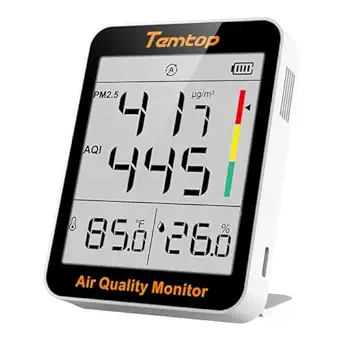 |
| Best Budget The cheapest option that still gets the job done reliably | PinoTec AK3 Air Quality Monitor |  |
| Top Rated A top-rated pick with lots of positive feedback | Temtop LKC-1000S+2nd Air Monitor |  |
| Most Popular A crowd favorite that many people choose with confidence | Amazon Smart Air Quality Monitor |  |
| Best Seller A high-volume bestseller chosen again and again | GoveeLife Smart Air Quality Monitor H5106 |  |
BREATHE Airmonitor Plus

| Monitors | CO2, PM1, PM2.5, PM10, TVOC, HCHO, Temperature, Humidity |
|---|---|
| CO2 sensor | NDIR, ±50 ppm accuracy |
| Data history | Up to 90 days, CSV export |
| Connectivity | 2.4 GHz Wi‑Fi |
| Power source | USB-C corded electric (built-in battery for portable use) |
The BREATHE Airmonitor Plus is a compact 8-in-1 indoor air quality monitor designed for home, office, or classroom use, combining an NDIR CO2 sensor, laser particle sensing for PM1/PM2.5/PM10, and dedicated TVOC and formaldehyde detection. It displays real-time readings on a color screen and pairs with the Breathe Tech app over 2.4 GHz Wi-Fi to log up to 90 days of data and export CSV files for deeper analysis. The Gen 2 model adds longer portable battery life and USB-C operation so you can use it unplugged for short inspections or keep it continuously powered for ongoing monitoring. Practical benefits include configurable alerts for CO2 and PM2.5, quick app setup, and the ability to correlate spikes with activities like smoking, cooking, or poor ventilation. Important limitations are the short built-in battery for long-term portable use and reliance on the app for extended history and alert configuration, so continuous monitoring requires a USB power connection and Wi-Fi. For detecting cigarette smoke, the combination of PM and VOC/formaldehyde sensors gives actionable signals, though interpreting specific pollutant sources still needs context from placement and activity patterns.
Best for: Buyers who want a balanced, all-purpose indoor monitor that flags particulate and chemical spikes from cigarette smoke and other household activities while offering app-based history for comparison.
Less Ideal for: Users who need long-duration battery-powered monitoring without access to USB power or those wanting a single-sensor device focused only on CO2 or professional-grade lab equipment.
- Monitors eight parameters including CO2, PM1/PM2.5/PM10, TVOC and formaldehyde for a broad picture of indoor air
- Professional-grade NDIR CO2 sensor with ±50 ppm accuracy for reliable occupancy-related readings
- Pairs with a mobile app to view graphs, set alerts, and export up to 90 days of data in CSV format
- Compact and portable with USB-C power and short-term battery operation for spot checks
- Built-in battery lasts only a few hours, so continuous monitoring requires leaving it plugged in
- Full historical logging and alert customization depend on the companion app and Wi-Fi connection
Verdict: Airmonitor Plus is a versatile, app-backed air quality monitor that balances particulate and VOC detection to help spot and track cigarette smoke indoors.
Qingping Air Monitor 2 CGS2

| Power Source | Battery Powered |
|---|---|
| Sensor Type | Photoelectric |
The Qingping Air Monitor 2 is a countertop air-quality detector built for frequent, at-a-glance readings and remote logging. It displays seven metrics on a 4-inch IPS touchscreen with auto-brightness and color-coded indicators, and it can export 30 days of historical data to the Qingping+ app over 2.4GHz or 5GHz Wi‑Fi. The unit uses a photoelectric PM sensor that is magnetically removable for replacement and pairs that particulate data with CO2 and VOC indexes so you can distinguish particle spikes from gas-based pollution. Practical benefits include a clear, responsive touch interface, a rechargeable battery for short portable use, and firmware updates through the app. Limits to keep in mind are that it does not measure formaldehyde and the internal battery only supports about three hours unplugged, so it is best used continuously on USB power for long-term monitoring. For tracking cigarette smoke the fast-refreshing PM readings and replaceable PM sensor make it well suited to spot short-term smoke events and follow cleanup efforts.
Best for: Buyers who need a responsive, performance-focused monitor to detect and log particulate spikes from sources like cigarette smoke and who value clear touchscreen controls and exportable historical data.
Less Ideal for: Users who need all-day portable monitoring without a power connection or those who require formaldehyde readings as part of their indoor pollution assessment.
- Measures seven metrics including PM2.5/PM10, CO2, eTVOC, temperature, humidity and noise for comprehensive indoor air insight
- High-resolution 4-inch touchscreen with auto-brightness and color-coded indicators for fast interpretation
- Replaceable PM sensor simplifies maintenance and helps preserve accuracy over time
- Wi‑Fi support and Qingping+ app let you view readings remotely and export 30 days of historical data
- Battery life is limited to about three hours when unplugged, so continuous monitoring requires USB power
- Does not measure formaldehyde, which may be relevant for some indoor pollution assessments
Verdict: A fast, app-connected monitor with replaceable PM sensing that is well suited to spot and log cigarette smoke events when used plugged in.
Temtop S1 Air Quality Monitor

| PM2.5 Measuring range | 0-999 µg/m³ |
|---|---|
| Battery Life | ≥20 days (Smart) ≥60 days (Eco) |
| Humidity Measuring range | 0-99.9% RH |
| Temperature Measuring range | 14-140°F |
The Temtop S1 is a small, battery-powered air quality monitor that displays PM2.5, AQI, temperature, and humidity on a simple segment screen and uses a laser particle sensor for particulate readings. It is designed for quick spot checks and continuous monitoring in rooms like bedrooms, nurseries, or offices and offers two operating modes: an active mode for near real-time readings and an eco mode that extends standby to around 60 days. A three-color indicator gives an at-a-glance view of air quality and the two-button control makes operation straightforward. The unit is portable, can stand or magnetically attach to surfaces, and warns you when particulate levels rise, which is useful for detecting cigarette smoke in small spaces. Limitations include a basic display without graphs or historical logging and no CO2 or VOC sensing, so it is best as a particulate-focused, low-friction tracker rather than a full multi-parameter indoor air station.
Best for: Someone who wants a low-maintenance, portable device to monitor particulate levels and get fast alerts about smoke or poor air in living spaces.
Less Ideal for: Users who need comprehensive indoor air diagnostics with CO2, VOC, or formaldehyde readings or who want app connectivity and historical data tracking.
- Measures PM2.5 and reports AQI for particulate-focused detection
- Long battery life with eco mode up to about 60 days
- Simple two-button interface and three-color alert for quick use
- Compact and portable with stand or magnetic mounting options
- No CO2 or VOC sensors so it cannot detect gases associated with smoke or indoor combustion
- Segment display is basic and lacks data logging or graphing features
Verdict: A compact, battery-friendly PM2.5 monitor that gives fast, portable detection of cigarette smoke and other particulate spikes.
PinoTec AK3 Air Quality Monitor

| Power Source | Battery Powered |
|---|---|
| Product Style | CO2,TVOC,HCHO,TEMP,HUMI |
| Built-In Media | 1 |
The PinoTec AK3 is a compact, battery-powered air quality meter designed for quick, on-the-spot readings of CO2, formaldehyde (HCHO), TVOC, temperature, and humidity. It uses built-in sensors and a color LED screen to show real-time numbers and an overall color-coded status so you can immediately tell when levels shift. The rechargeable 2000 mAh battery and USB charging make it easy to move between rooms or use in a car without hunting for replacement cells. For tracking cigarette smoke, TVOC readings and the visual alerting help flag increases in airborne pollutants, while CO2 and humidity readings give extra context about ventilation. Limitations include the basic alarm functionality and the compact sensor package, which is good for spot checks but not a substitute for continuous, high-precision monitoring in large spaces or professional testing. The simple interface and low weight make it a practical budget option for homeowners who want fast feedback on indoor air after smoking events or while ventilating a room.
Best for: Buyers on a tight budget who want a portable, easy-to-read device to detect spikes in smoke-related VOCs and check ventilation quickly in rooms and cars.
Less Ideal for: Users who need laboratory-grade accuracy, continuous long-term monitoring for large spaces, or advanced alarm/configuration options should consider higher-end or professional instruments.
- Measures five parameters including CO2, formaldehyde, TVOC, temperature, and humidity
- Rechargeable 2000 mAh battery with USB charging for portable use
- Color LED display provides easy-to-read, at-a-glance air quality status
- Small and lightweight for spot checks around the home or in a car
- No dedicated audible alarm and limited alert customization
- Compact consumer sensors are better for indicative readings than professional-grade precision
Verdict: A low-cost, portable 5-in-1 monitor that gives quick, color-coded feedback on smoke-related pollutants and ventilation so budget-minded users can spot trouble and act fast.
Temtop LKC-1000S+2nd Air Monitor

| Battery Capacity | 3000mAh |
|---|---|
| Battery Life | 6-8h after full charged |
| PM2.5 Measuring Range | 0-999 μg/m³ |
| HCHO Measuring Range | 0-2 mg/m³ |
| Input | DC5V/1A |
The Temtop LKC-1000S+2nd is a handheld air quality monitor built to track particles and common indoor pollutants that matter for cigarette smoke detection. It uses a laser particle sensor for PM2.5 and PM10, an electrochemical HCHO sensor, and VOC sensing to provide real-time AQI, particulate counts, temperature, and humidity on a clear display. Typical use is spot-checking rooms, monitoring over a few hours with its histogram, or recording continuously and exporting up to three months of data via USB for later analysis. Practical benefits include a large 3000mAh battery for mobile use, adjustable data storage intervals, and particle sensor longevity rated up to 20,000 hours. The device is positioned as a reliability-minded option with sensors tested for strong correlation under lab conditions, but like other consumer monitors its formaldehyde and VOC readings can be affected by nearby alcohols, cleaners, or air fresheners and require correct placement with unobstructed vents. It is a solid choice when you need straightforward particle and VOC awareness and the ability to save or export measurement logs.
Best for: Buyers who prioritize dependable, repeatable particle and pollutant measurements for indoor smoke assessment and want the ability to record and export data for verification or tracking.
Less Ideal for: Users who need lab-grade gas analysis or continuous multi-day monitoring without recharging should consider professional instruments or monitors with longer run times.
- Measures PM2.5 and PM10 with a laser particle sensor and provides real-time AQI
- Includes formaldehyde and VOC sensing for broader smoke-related pollutant detection
- Large 3000mAh battery supports portable use and 6–8 hours runtime per charge
- Adjustable data storage intervals and USB data export for log review and analysis
- Durable particle sensor rated for up to 20,000 hours of use
- Formaldehyde and VOC readings can be influenced by alcohols, cleaners, and air fresheners, which may affect accuracy in some environments
- Battery life of 6–8 hours may require frequent charging for long-term continuous monitoring
Verdict: A reliable, portable monitor that gives smoke-focused particle, VOC, and formaldehyde readings with exportable logs for verification.
Amazon Smart Air Quality Monitor

| Measured pollutants | PM2.5, VOCs, CO, humidity, temperature |
|---|---|
| Connectivity | Alexa app integration and Echo announcements |
| Power | Plug-in (mains) |
The Amazon Smart Air Quality Monitor is a compact plug-in sensor designed to track five indoor air factors—PM2.5, VOCs, carbon monoxide, humidity, and temperature—and surface that information in the Alexa app and via a color-coded LED. It is typically used in living rooms, kitchens, or smoking-prone areas to detect particulate and gas changes and trigger notifications or Alexa routines that can turn on purifiers, fans, or thermostats. Setup is straightforward: plug it in, open the Alexa app, and follow the connection prompts. The device gives real-time alerts to your phone and can announce poor air quality on Echo devices, which is useful for fast response to cigarette smoke or other indoor pollution. Limitations include reliance on the Alexa ecosystem for full functionality and a compact sensor array that reports a combined air-quality score rather than offering advanced logging and analysis tools professionals might expect. For everyday households that want quick, automated alerts and easy integration with smart home gear, this monitor is practical and unobtrusive.
Best for: People who want a simple, voice-integrated way to detect and respond to cigarette smoke and common indoor pollutants and who prefer devices that work within the Alexa smart-home ecosystem.
Less Ideal for: Anyone who needs standalone professional monitoring, deep data export, or a platform-independent device should consider a dedicated air-quality monitor with advanced logging instead.
- Monitors PM2.5, VOCs, CO, humidity, and temperature in one compact unit
- Color-coded LED and Alexa app score make air quality easy to understand at a glance
- Real-time phone notifications and Echo announcements for quick alerts
- Can automate compatible devices via Alexa routines to respond to poor air quality
- Simple plug-and-play setup with the Alexa app
- Depends on the Alexa ecosystem for alerts, automations, and detailed history
- Not a professional-grade logger; limited advanced analysis and exportable data
Verdict: If you use Alexa and want fast, automated alerts for cigarette smoke and everyday indoor pollutants, this plug-in monitor is an easy, integrated choice.
GoveeLife Smart Air Quality Monitor H5106

| PM2.5 Accuracy | ±15 µg/m³ (0–100 µg/m³) / ±15% (100–1000 µg/m³) |
|---|---|
| Temperature Accuracy | ±0.54°F |
| Humidity Accuracy | ±3%RH |
| Response Time | 2 seconds |
| Included Components | Air quality monitor, Type‑C cable |
The GoveeLife H5106 is a compact, powered air quality monitor that continuously reports PM2.5, temperature, and humidity and updates readings as quickly as every two seconds. It is typically wall‑plugged or left on a shelf and used for remote monitoring via the Govee app over 2.4 GHz Wi‑Fi or Bluetooth; the device also shows readings on an LED display with selectable bright and night modes. Notable features include stated PM2.5 accuracy (±15 µg/m³) and the ability to link with compatible Govee smart appliances so purifiers or humidifiers can react automatically when levels change. The monitor stores and exports historical data (up to two years) for trend checks and troubleshooting. Limitations for risk‑averse buyers include the need for continuous power since there is no internal battery and the requirement to use 2.4G Wi‑Fi for cloud features, which may complicate setup on 5G-only networks. The small footprint and simple app control make it practical for bedrooms, living rooms, or near entryways to detect cigarette smoke and track indoor particulate trends.
Best for: Buyers who want a simple, reliable indoor monitor to catch and track smoke particles over time and prefer remote app access and device automation for peace of mind.
Less Ideal for: Users who need a battery‑powered or fully portable detector or those who cannot provide a 2.4 GHz Wi‑Fi connection should consider alternatives.
- Measures PM2.5, temperature, and humidity with a fast 2‑second refresh rate
- Stated PM2.5 accuracy of ±15 µg/m³ for practical smoke detection
- Wi‑Fi and Bluetooth connectivity with remote monitoring and data export
- LED display with selectable bright and night modes for easy local readout
- Can automate compatible Govee purifiers and humidifiers based on readings
- Requires continuous power via USB‑C and has no internal battery for portable use
- Cloud features require 2.4 GHz Wi‑Fi which excludes 5G‑only networks
Verdict: If you need a steady, app‑connected monitor to detect and track cigarette smoke indoors and trigger smart appliances, this plug‑in GoveeLife model delivers fast updates and useful automation.
Choosing the Right Air Quality Monitor for Cigarette Smoke: Key Factors to Consider
Sensor Type and Sensitivity
Not all air quality sensors detect cigarette smoke equally. Combustion from cigarettes produces fine particulate matter, notably PM2.5, plus a range of volatile organic compounds. A monitor that includes a laser-based particle sensor tuned for PM2.5 will detect the tiny particles that travel deep into the lungs. A separate VOC sensor can help identify the chemical signature of smoke, though VOC readings are often broader and less specific.
Higher sensitivity reduces false negatives during brief smoke events and improves trend detection over days or weeks. Expect faster response times and clearer spikes with better sensors, which makes it easier to link a smoke event to a specific room or time.
Alerting and Notification Options
How a monitor notifies you determines whether you catch short smoke events. Local alarms provide immediate, audible or visual warnings that are useful when you are home. Mobile notifications or email alerts extend monitoring to when you are away, which is important if guests or roommates smoke in your absence.
Configurable threshold settings let you decide what level of PM2.5 or VOC triggers an alert. Look for devices that let you set custom thresholds, choose notification types, and send repeated reminders if levels remain elevated. Timely alerts reduce exposure by prompting ventilation or source control as soon as smoke appears.
Placement and Power Options
Effective monitoring depends on where you place the device and how it is powered. Smoke can be highly localized, so having a portable monitor or multiple monitors for high-risk rooms yields more useful coverage than a single fixed unit. Monitors with battery power or USB options give more placement flexibility versus devices that require a fixed outlet.
Consider whether the monitor's size or mounting options will fit the intended room. A compact tabletop monitor works well on shelves or counters, while a wall-mountable unit may be better for long-term, unobtrusive monitoring in corridors or near potential sources.
Data Logging and Historical Reporting
Short smoke spikes matter, but so do patterns. A monitor with local logging or cloud-based history lets you review when smoke events occurred and how long they lasted. This is valuable for identifying habits, pinpointing rooms, and discussing mitigation with household members.
Look for intuitive trend charts, exportable logs, or summaries that show daily and weekly averages. Devices that aggregate data and present easy-to-read timelines make it simpler to see if an intervention, such as improved ventilation, is reducing exposure over time.
Placement Accuracy and Room Coverage
A single reading does not represent an entire home. Air mixing, ventilation, and room geometry affect how smoke spreads. Monitors placed near doors, windows, or ventilation intakes can produce misleading readings if you expect them to reflect whole-house air.
Think about where smoking is most likely to occur and place monitors accordingly rather than relying on a single central unit. If you need whole-home insight, plan for multiple monitors in living areas and sleeping spaces to capture accurate exposure levels.
Calibration, Maintenance, and Lifespan
Sensors drift over time and may lose sensitivity. Monitors that support periodic calibration, either automatically or via user-initiated routines, maintain accuracy longer. Some devices provide reminders for sensor replacement or firmware updates that preserve performance.
Consider maintenance needs, such as filter changes for devices that include filtration or simple dusting for laser sensors. A monitor that is easy to clean and has replaceable components will remain reliable over several years, which is important for a continuous indoor air quality strategy.
How Cigarette Smoke Shows Up on Monitors
Cigarette smoke typically appears as a rapid spike in PM2.5 readings and a simultaneous increase in VOC levels on monitors that measure both. PM2.5 sensors pick up the tiny combustion particles, while VOC sensors register the range of chemicals released. Short, sharp spikes often indicate active smoking, whereas sustained elevated readings may point to lingering secondhand smoke or poor ventilation.
Understanding the sensor readouts helps you act: open windows and doors for short spikes, or identify and eliminate persistent sources when the monitor shows continuous elevation.
- PM2.5 spike: usually immediate during smoking
- VOCs rise: indicates chemical compounds in the air
- Sustained elevation: suggests poor ventilation or repeated smoking events
- Short pulses vs long trends: different responses required
Best Placement Practices for Accurate Readings
Place monitors at breathing height in the room where smoking is most likely to occur. Avoid corners, floors, and direct drafts from windows or HVAC vents that can skew readings. For bedrooms, position the unit near the center or close to the head of the bed to reflect occupant exposure during sleep.
If you rely on a single monitor for a larger apartment, move it between rooms to build a picture of where smoke appears. For continuous whole-home monitoring, install additional units in living rooms and bedrooms rather than depending on one device.
- Breathing height placement yields representative exposure levels
- Keep away from direct vents and open windows
- Use multiple monitors for larger homes or to capture source rooms
Interpreting Readings and Setting Thresholds
Not every elevation in PM2.5 or VOCs is caused by cigarette smoke. Cooking, candles, fireplaces, and outdoor pollution can also affect sensors. To reduce false alarms, observe patterns and correlate spikes with activities. Some monitors let you label events or annotate the timeline to improve interpretation.
Set thresholds that balance sensitivity and nuisance alerts. A lower threshold catches smaller smoke events but may generate more false positives. Adjust thresholds based on your household tolerance and whether you need immediate action or trend monitoring.
- Correlate spikes with activities to confirm sources
- Use annotations or notes when possible to build an activity log
- Start with conservative thresholds, then refine to match your home
Using Data to Reduce Exposure
Once you have reliable readings, use them to guide behavior changes and ventilation strategies. Short-term responses include opening windows, using exhaust fans, or asking occupants to smoke outdoors. Long-term steps may include relocating smoking areas, improving HVAC filtration, or increasing air changes per hour in problem rooms.
Regularly review logged data to measure whether mitigation steps are working. If levels remain high despite interventions, consider more permanent changes like adding portable air cleaners with HEPA filtration in frequently affected rooms.
- Short-term: ventilate immediately after spikes
- Medium-term: change indoor habits and designate outdoor smoking zones
- Long-term: improve filtration and increase room air changes
Privacy, Connectivity, and Local Display Options
Monitors vary in how they handle data. Some store logs locally and display readings on a built-in screen, while others rely on cloud services and phone apps for history and alerts. If privacy is a concern, favor devices that offer local-only logging or clear data export controls.
Connectivity options affect convenience. Wi-Fi models provide remote alerts and long-term cloud charts, while Bluetooth and standalone displays reduce network dependency. Choose the connectivity level that matches your comfort with cloud services and your need for remote notifications.
- Local display: immediate readings without connectivity
- Wi-Fi/cloud: remote alerts and long-term trend charts
- Bluetooth: local phone access without cloud storage
How We Chose the Best Air Quality Monitor for Cigarette Smoke
We prioritized monitors that reliably detect the fine particles and volatile compounds associated with cigarette smoke, then filtered for real-world usability and long-term value. Key evaluation criteria included sensor type and sensitivity, since accurate detection of PM2.5 and related VOCs is essential for spotting smoke events. We also looked at alerting and reporting features to ensure the device notifies occupants promptly and logs trends that help identify sources. Build quality and placement flexibility were considered to make sure a monitor performs well in living rooms, bedrooms, and smaller apartments. Battery life and power options matter for placement and continuous monitoring, so we favored devices with practical power profiles. Connectivity and data access were evaluated for users who want phone alerts or local displays without constant app dependence. We excluded devices that only report generic indoor conditions without PM2.5 or VOC sensing, and omitted units lacking repeatable calibration or documented sensitivity to combustion particles. The final shortlist favors devices that balance laboratory-grade detection features with easy installation and dependable notifications.
Our full evaluation process is outlined in our review methodology.
FAQ
Can an air quality monitor specifically identify cigarette smoke?
Monitors cannot name cigarette smoke with absolute certainty, but devices that measure PM2.5 and VOCs can detect the characteristic particle spikes and chemical increases associated with smoking. Cross-checking with timing and activity patterns improves confidence.
How quickly do monitors respond to a smoke puff in a room?
Response times depend on sensor type and placement, but laser-based PM2.5 sensors typically register spikes within seconds to a few minutes. Faster detection is more likely when the monitor is placed near the smoking area and not blocked by walls or furniture.
Will cooking or candles trigger false smoke readings?
Yes. Cooking, candles, incense, and fireplaces produce PM2.5 and VOCs similar to cigarette smoke, which can cause spikes. Distinguish sources by noting activity timing and by using multiple monitors or annotations to correlate events.
Do monitors need calibration or maintenance to stay accurate?
Many optical sensors can drift over time and benefit from periodic calibration, firmware updates, or cleaning. Follow the manufacturer's maintenance guidance and consider devices that support calibration or have user-replaceable parts to maintain long-term accuracy.
Can I use one monitor to represent my whole home?
A single monitor gives a localized view and may not represent whole-home exposure, especially in multiroom layouts. For more complete coverage, place additional units in bedrooms and main living areas or move a portable monitor between rooms to build a fuller picture.
Final Verdict
Choose a monitor that prioritizes PM2.5 sensitivity and useful alerting features if cigarette smoke is your main concern. Balance placement flexibility and data logging so you can both catch short events and review longer trends. Expect tradeoffs: more sensitive sensors and cloud-connected features increase visibility but may require more maintenance or network access. Focus on the sensors, notification options, and practical placement to reduce exposure confidently.