
Note: This article contains affiliate links. If you click on these links and make a purchase, we may earn a small commission at no extra cost to you. This helps support our research and content. Read our full affiliate disclosure here.
A properly controlled attic fan prevents moisture buildup, reduces heat stress on roofing, and helps maintain a more even indoor temperature. If you are looking specifically for an attic fan with humidistat and thermostat, you want a device that responds to both temperature and humidity swings rather than a simple single-trigger unit. The right choice reduces condensation risk in cold months and limits extreme heat in summer while keeping energy use reasonable. This guide shortlists the top attic fans with integrated humidistats and thermostats, explaining the practical tradeoffs and the evaluation criteria used to select them. Read on to find options suited to ventilation needs, noise sensitivity, and common attic layouts before the product list below.
Top Picks at a Glance
| Best Overall The best all-around choice for most situations | Master Flow ERV6 Attic Fan |  |
| Best Value The sweet spot between price and what you get | VEVOR 16 Inch Shutter Exhaust Fan |  |
| Best Budget The cheapest option that still gets the job done reliably | GAF Master Flow EGV6HT Gable Fan |  |
| Top Rated A top-rated pick with lots of positive feedback | QuietCool AFG SMT PRO-2.0 |  |
| Most Popular A crowd favorite that many people choose with confidence | QuietCool AFG SMT ES-3.0 |  |
Master Flow ERV6 Attic Fan

| Power Source | Corded Electric |
|---|---|
| Room Type | Attic |
| Special Features | w/Thermostat & Humidistat (HT1) |
| Mounting Type | Roof Mount |
| Air Flow Capacity | 1500 cfm |
The Master Flow ERV6 is a roof-mounted powered attic exhaust fan designed to lower attic temperatures and control humidity using the included HT1 humidistat and thermostat controller. It delivers 1500 CFM through a galvanized steel dome housing with a powder-coated finish and a screened intake to help keep animals out. The fan is hard-wired and operated by push-button control, making it a straightforward install for a qualified electrician on compatible roof types; it is not suitable for tile roofing. In use the high-efficiency motor and adjustable thermostat let the unit run only when temperature or humidity thresholds are reached, which can reduce cooling loads in summer. The plastic blades are lighter weight than metal alternatives but are matched to the motor for balanced airflow. Expect a durable, weather-resistant installation and effective attic ventilation, while planning professional wiring and confirming roof compatibility before purchase.
Best for: Buyers who want an automated attic ventilation solution that reduces heat and humidity with a factory-style controller and durable construction for whole-attic use.
Less Ideal for: Homeowners with tile roofs or those wanting a simple plug-in or temporary fan solution should look elsewhere.
- 1500 CFM airflow suitable for ventilating medium to large attics
- Includes HT1 humidistat and thermostat for automatic temperature and humidity control
- Galvanized steel dome and powder-coated finish for weather resistance
- Built-in screen helps prevent animals from entering the attic
- Requires hard‑wiring and likely professional installation
- Not compatible with tile roofing systems
Verdict: Choose the ERV6 if you want a durable, roof‑mounted attic fan with built-in thermostat and humidistat to automate ventilation and help lower attic temperatures.
VEVOR 16 Inch Shutter Exhaust Fan
| Air Flow Capacity | 2900 cfm |
|---|---|
| Blade Length | 16 inches |
| Motor Type | EC |
| Wattage | 98 watts |
| Number of Speeds | 10 |
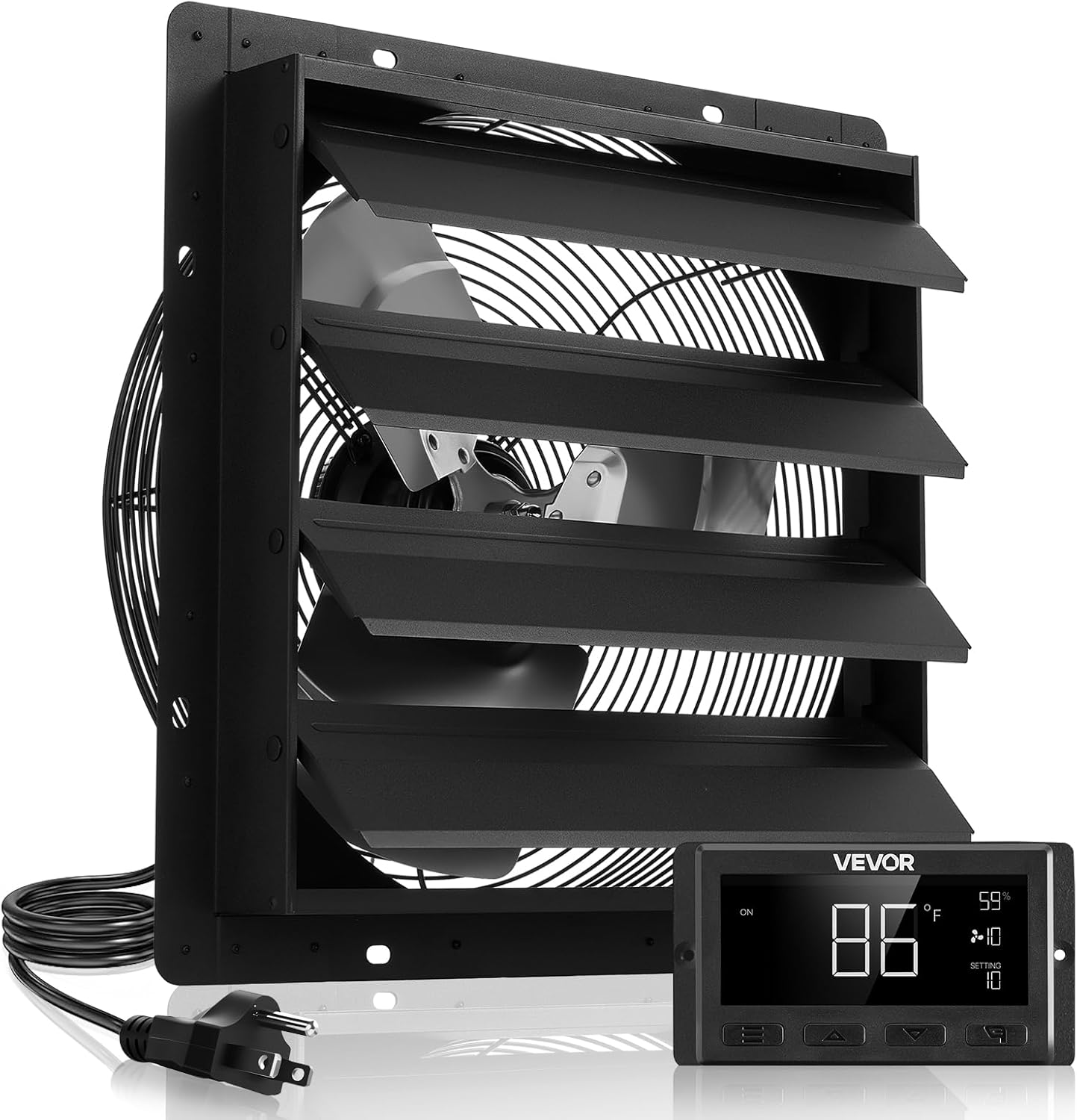
The VEVOR 16 Inch Shutter Exhaust Fan is a heavy‑duty wall‑mount unit designed to move large volumes of air and automate ventilation based on temperature and humidity. It pairs a metal shuttered housing and a 3‑blade fan driven by an EC motor that runs at about 1400 RPM and draws 98 watts to deliver roughly 2900–3000 CFM. The included controller supports smart programming, temperature and humidity triggers, up to 10 speed settings, timer modes, and an alarm so the fan can ramp up or down automatically as conditions change. In use it is suited to attics, garages, sheds, and greenhouses where rapid venting and weather protection matter; shutters close when power is off to keep out rain and debris. Practical strengths are the durable metal construction and high airflow for quick heat and moisture removal, plus the humidistat/thermostat automation that reduces manual intervention. Expect noticeable noise at higher speeds and a mains voltage wiring requirement, and installation requires a proper wall opening and secure mounting for outdoor exposure.
Best for: Buyers who want a robust, automated ventilation solution to quickly clear heat and moisture from attics, garages, or greenhouses and who prioritize durable construction and programmable humidistat/thermostat control.
Less Ideal for: People needing near‑silent indoor fans, plug‑and‑play window units, or those unwilling to modify a wall opening or handle 240V wiring should consider other options.
- Very high airflow (around 2900–3000 CFM) that quickly removes heat and humidity
- Integrated temperature and humidity controller with programmable modes and 10 speed levels
- Durable all‑metal, powder‑coated housing and automatic shutters for weather protection
- EC motor that balances power and efficiency for sustained operation
- Noise level can reach around 70 dB at higher speeds, which may be loud near living spaces
- Requires hardwired installation to 240V and a proper wall cutout, so professional fitment may be needed
Verdict: Choose this fan if you need a high‑capacity, weather‑resistant wall exhaust with built‑in temperature and humidity automation to actively control attic or garage climates.
GAF Master Flow EGV6HT Gable Fan

| Power Connector Type | Hard Wired |
|---|---|
| Voltage | 120 volts |
| Cooling Method | forced air |
| Air Flow Capacity | 1600 cfm |
The GAF Master Flow EGV6HT is a hard-wired gable-mount attic fan that uses forced-air cooling to exhaust hot, humid air from attic spaces. It installs at a house gable and includes a humidistat and thermostat for automated operation, plus mounting brackets for a straightforward fit. The fan is rated at 1600 CFM, which is sufficient to ventilate large attics and can help lower cooling load when sized correctly for your space. Its metal construction promises durability for outdoor exposure, but the unit is heavier and requires hard-wired electrical hookup, so professional or experienced DIY installation is likely. The built-in controls reduce the need for separate controllers and make the fan responsive to temperature and humidity swings. Expect reliable airflow and energy savings when paired with adequate intake vents, though the unit does not list variable speed control and will run at its rated output when activated.
Best for: Buyers looking for a no-frills, condition-controlled attic exhaust fan that delivers strong airflow and integrates humidity and temperature sensing to reduce cooling costs.
Less Ideal for: Those who need ultra-quiet operation, plug-and-play installation, or fine-grained speed control should consider other ventilators or models with variable-speed technology.
- High airflow at 1600 CFM suitable for large attic spaces
- Includes humidistat and thermostat for automatic, condition-based operation
- Durable metal construction designed for exterior gable mounting
- Ship-ready mounting brackets simplify physical installation
- Requires hard-wired connection which may need an electrician
- No advertised variable speed or quiet-mode options
Verdict: A powerful, budget-friendly gable attic fan with built-in humidistat and thermostat for automated ventilation control.
QuietCool AFG SMT PRO-2.0
| Air Flow Capacity | 1945 cfm |
|---|---|
| Number of Speeds | 2 |
| Wattage | 120 watts |
| Motor Type | PSC |
| Control Method | App |
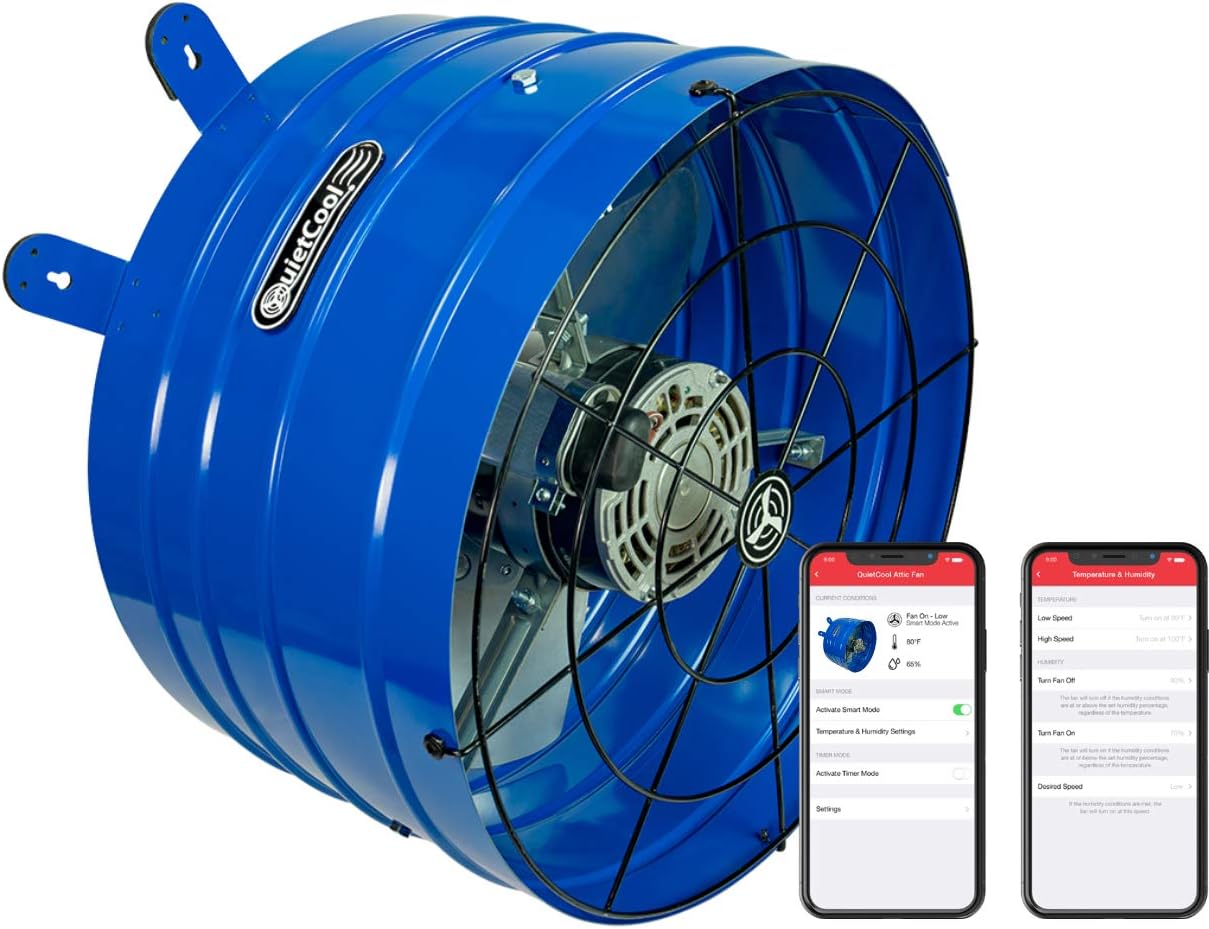
The QuietCool AFG SMT PRO-2.0 is a plug-and-play gable attic fan designed to lower attic temperature and humidity using a two-speed PSC motor and smart app control. It delivers up to 1,945 CFM on high while drawing about 120 watts, and includes a built-in thermostat and humidistat so the unit can run automatically to prevent excessive heat and moisture buildup. Typical use is mounting in a gable vent, plugging in, and setting temperature or humidity presets from the app to manage attic climate day and night. Notable features include the smart control hub with presets, a fire safety shut-off, and included vent covers for a cleaner installation. The practical benefits are straightforward: high airflow for rapid attic exchange, reduced attic temperatures that can ease HVAC load, and humidity control to limit mold risk. Limitations are the two-speed PSC motor which lacks the efficiency and fine-grain speed control of ECM or DC motors, and the product is intended for gable installations rather than roof mount locations.
Best for: Buyers who prioritize reliable, automated attic climate control and want a straightforward, app-managed solution to reduce attic heat and humidity without complex wiring or setup.
Less Ideal for: Homes that require roof-mount ventilation or shoppers seeking the highest electrical efficiency and variable-speed motor control should consider other options.
- Smart app control with temperature and humidity presets for automated operation
- High airflow up to 1,945 CFM for effective attic ventilation
- Plug-and-play installation with included smart control hub and vent covers
- Built-in thermostat and humidistat reduce mold risk and help protect roofing
- Two-speed PSC motor offers coarser control and lower efficiency than ECM or DC motors
- Designed for gable mount only, not suitable for roof-mount installations
Verdict: Choose this smart gable attic fan if you want dependable, app-driven thermostat and humidistat control to keep attic temperature and moisture reliably in check.
QuietCool AFG SMT ES-3.0

| Air Flow Capacity | 2801 cfm |
|---|---|
| Number of Speeds | 3 |
| Motor Type | brushless ECM |
| Control Method | App |
| Power Source | ac |
The QuietCool AFG SMT ES-3.0 is a plug-and-play gable attic fan designed to lower attic temperature and humidity using a three-speed brushless ECM motor and smart app control. Install it in a gable vent, plug into standard power, then use the QuietCool app or on-unit thermostat/humidistat to set presets for daytime cooling or winter ice prevention. On high it moves up to 2801 CFM while drawing modest power thanks to the ECM motor, and built-in anti-vibration mounting tabs reduce vibration transmission. The smart features let you monitor attic temperature and humidity remotely and trigger the fan automatically, which helps reduce A/C cycling and limits moisture that can lead to mold. Expect straightforward operation and substantial airflow, but note the unit is a gable-mount exhaust fan so it requires appropriate venting and sizing for your attic to be effective, and the noise spec (45 dB) means it is audible during high-speed operation. The plug-and-play design simplifies installation for homeowners comfortable with mounting and vent penetration, while the 15-year manufacturer warranty provides long-term reassurance.
Best for: Homeowners who want automated attic climate control and prefer a proven product with smart monitoring and long manufacturer support.
Less Ideal for: Homes without gable vents or buyers who need a near-silent solution for living-space-adjacent installations should consider other ventilation options.
- Smart app control with thermostat and humidistat for automated operation and remote monitoring
- High airflow up to 2801 CFM for rapid attic ventilation
- Brushless ECM motor for efficient, multi-speed operation and lower electrical draw
- Plug-and-play design with standard electrical plug simplifies installation
- Built-in mounting tabs with anti-vibration pads reduce install vibration transfer
- Requires appropriate gable venting and correct sizing to achieve stated cooling performance
- 45 dB noise at rated condition can be noticeable when running at higher speeds
Verdict: Choose this smart gable fan when you want app-based thermostat and humidistat control plus high CFM airflow to actively lower attic temperature and moisture.
Choosing the Right Attic Fan with Humidistat and Thermostat: Key Factors to Consider
Control Precision
How precisely the humidistat and thermostat respond matters because tight control prevents both attic moisture problems and unnecessary cycling. A unit with finely adjustable setpoints and minimal hysteresis keeps humidity within a safe band and avoids repeated on/off cycles that wear the motor.
Precise control also affects comfort indirectly. When humidity is allowed to climb in cooler weather, condensation can form on rafters and insulation, promoting mold and reducing insulation performance. Look for controls that specify setpoint ranges, differential settings, and whether the humidistat is automatic or manually calibrated.
Airflow Capacity Relative to Attic Size
A fan's cubic feet per minute rating is a starting point, but real-world performance depends on static pressure from ducting, louvers, and screen grilles. Choosing a fan with adequate CFM for the attic volume ensures the device refreshes air often enough to control temperature and moisture.
Underpowered fans will run constantly without achieving ventilation goals, increasing wear and energy draw. Oversized fans may cycle more and create negative pressure problems unless properly balanced with intake vents. Match the fan's rated airflow to your attic square footage and check manufacturer guidance on recommended air changes per hour.
Noise And Mounting Impact
Attic fans operate near living spaces, so bearing noise and vibration transmission are important. Look for quoted decibel levels at typical distances, sound-dampening mounts, and motor types that run smoothly. Lower RPM fans with higher-efficiency motors can deliver similar airflow with less noise.
Mounting method matters too. Roof-mounted units transfer vibration into the structure differently than gable or soffit installations. Consider vibration isolators and whether the fan's housing design limits resonance to protect both structure and occupant comfort.
Durability And Motor Type
Continuous exposure to attic temperatures and occasional humidity spikes demands robust motor and housing construction. Motors rated for continuous duty, sealed bearings, and corrosion-resistant housings extend service life. Brushless or permanently lubricated motors typically require less maintenance than older brushed types.
Also consider protection against moisture intrusion for electrical components and whether the unit has thermal overload protection. Durable construction reduces the chance of premature failure and the need for disruptive replacement or repairs.
Installation Complexity And Access
How the fan mounts and connects affects both upfront cost and future maintenance. Simpler drop-in or roof-flange models reduce install time, while retrofit installations behind existing vents may require carpentry, flashing changes, or electrical upgrades. Evaluate required clearances, wiring needs, and whether the humidistat or thermostat is remote-mountable for convenient sensor placement.
Accessibility for cleaning, replacing filters, or servicing the motor should influence selection. Units that allow safe attic access to controls and components without removing major roofing elements will be easier and cheaper to maintain long term.
How Humidistats And Thermostats Work Together
Humidistats and thermostats coordinate to trigger ventilation based on two different environmental cues. The thermostat responds to air temperature, usually turning the fan on when temperatures exceed a setpoint, while the humidistat measures relative humidity and activates ventilation when moisture rises above a preset threshold.
Well-designed systems prioritize humidity control when condensation risk is present and temperature control when heat buildup threatens insulation or roof decking. Some units allow one sensor to take precedence or require both conditions to be met before activation. Think about the typical climate cycles in your area to decide which behavior suits your attic best.
- Thermostat prevents heat-related roof damage during hot spells
- Humidistat reduces condensation and mold risk in humid or cold seasons
- Configurable priority modes help tailor control to seasonal needs
Siting The Sensor For Reliable Readings
Sensor placement determines how accurately the controls reflect attic conditions. Mounting the humidistat near common condensation points, like roof sheathing or the attic floor near bathroom exhausts, gives earlier warning of moisture accumulation. Thermostats should be positioned away from direct sun or localized heat sources to avoid false triggers.
If the humidistat or thermostat is remote-mountable, place the sensors where they represent average attic conditions rather than extremes. Avoid locations directly adjacent to vents, soffits, or attic ducts where airflow can create misleading readings.
- Place humidistat near insulation or suspected moisture ingress areas
- Keep thermostat away from direct sunlight and localized heat sources
- Use remote sensor cable length and mounting options to achieve representative placement
Power And Wiring Considerations
Attic fans require appropriate electrical supply and wiring practices. Confirm the circuit capacity, wiring gauge, and whether a dedicated circuit is recommended for continuous-running or high-draw motors. Some fans offer low-voltage control wiring for the humidistat and thermostat, while others need line-voltage sensors or a relay interface.
If you plan to connect the fan to a home automation system or a timed control, check for compatible control inputs or available relay outputs. Properly rated conduit and weatherproof enclosures for roof-mounted units are essential to meet electrical safety standards.
- Verify circuit capacity and wire gauge before installation
- Decide between line-voltage or low-voltage sensor configurations
- Consider relay or smart controls for advanced scheduling or integration
Seasonal Settings And Preventing Over-Ventilation
Seasonal adjustment of setpoints prevents unnecessary heat loss in winter and avoids overly dry conditions indoors. In cold months, overly aggressive ventilation can draw warm moist air from conditioned spaces into the attic cavity and increase heating demand. Raise humidity or temperature thresholds during winter to prevent excess cycling.
Over-ventilation can also draw conditioned air through gaps and reduce comfort. Pair attic fan controls with proper air-sealing practices in the attic floor and ensure intake vents provide balanced airflow so the fan can operate efficiently without creating problematic negative pressure.
- Increase thresholds in winter to reduce unwanted heat loss
- Pair ventilation with attic air sealing to prevent conditioned air leakage
- Monitor seasonal behavior after installation and adjust controls as needed
Maintenance Tips For Reliable Dual-Control Fans
Regular inspection keeps both humidistat and thermostat functioning correctly. Clean debris from intake and exhaust openings, inspect sensor housings for dust or corrosion, and verify that electrical connections remain tight. Lubricate or inspect motor bearings if the design specifies service intervals.
Test control setpoints periodically with a hand-held hygrometer and thermometer to confirm accurate readings. Replace sensors or recalibrate if drift is observed. Proper maintenance extends the lifespan of the fan and keeps attic conditions stable.
- Inspect vents and louvers at least annually
- Check sensor calibration with portable instruments
- Keep wiring and mounts free of corrosion and debris
How We Chose the Best Attic Fan with Humidistat and Thermostat
We prioritized measurable control and long-term attic protection when assembling this list. Key evaluation criteria included the accuracy and adjustability of the humidistat and thermostat controls, the fan's airflow capacity at realistic static pressures, and compatibility with typical attic ventilation layouts. We also considered motor durability and electrical efficiency since continuous or frequent cycling can shorten component life and increase running costs. Noise output matters in homes where bedrooms share ceilings with the attic, so we assessed decibel ratings and fan design features that reduce vibration. Finally, we checked ease of installation and access for maintenance to minimize retrofitting time and recurring service costs. We excluded basic single-trigger attic fans that only respond to temperature, units without independent humidity sensing, and designs intended strictly for whole-house ventilation rather than attic-only use. Products with unclear control specifications or lacking documented airflow curves were not considered. The resulting shortlist focuses on fans that deliver reliable dual-parameter control, measurable airflow, manageable noise, and straightforward installation.
Our full evaluation process is outlined in our review methodology.
FAQ
Will an attic fan with a humidistat prevent mold?
A fan with a humidistat reduces the risk of mold by lowering relative humidity during moist conditions. It is not a complete solution alone; proper attic insulation, air sealing, and addressing sources of moisture are also necessary to prevent mold growth.
Should the humidistat or the thermostat trigger the fan first?
Which should trigger first depends on local climate and failure risks. In humid climates the humidistat often takes priority to prevent condensation, while in very hot climates the thermostat may be more important to control attic temperatures. Look for units that let you configure priority or differential settings.
Can I install the sensors myself?
Many humidistats and thermostats are designed for homeowner installation, but wiring and roof penetrations can require electrical and weatherproofing knowledge. If you are unsure about wiring, circuit capacity, or flashing details, consult a qualified electrician or roofer.
How do I size an attic fan for my space?
Start with attic volume and target air changes per hour, then select a fan whose rated CFM meets that requirement under realistic static pressure. Account for intake vent area and any ducting losses so the fan can achieve the intended airflow without excessive runtime.
Will the fan run constantly in humid weather?
A correctly configured humidistat should prevent constant running by setting a threshold above normal background humidity. However, prolonged humid conditions can lead to longer run times. Adjusting the setpoint or adding differential control can reduce frequent cycling.
Final Verdict
When choosing an attic fan with humidistat and thermostat, prioritize accurate dual-parameter control, appropriate airflow for your attic size, and a durable motor that tolerates frequent cycling. Noise, ease of installation, and sensor placement are practical considerations that influence long-term satisfaction. Balance humidity and temperature thresholds seasonally and pair the fan with good attic air sealing to avoid unintended energy loss. With those tradeoffs in mind, select a unit whose control features and airflow performance best match your ventilation goals and the specific conditions of your attic.