
Note: This article contains affiliate links. If you click on these links and make a purchase, we may earn a small commission at no extra cost to you. This helps support our research and content. Read our full affiliate disclosure here.
A bathroom without a window needs reliable ventilation to prevent mold, lingering odors, and dampness that can damage finishes. The right bathroom exhaust fan moves moist air out of the room, lowers relative humidity quickly after showers, and helps preserve paint, grout, and fixtures. This guide shortlists the top seven bathroom exhaust fans suited for windowless bathrooms. Each pick was chosen for real-world performance in small to medium bathrooms, focusing on airflow capacity, sound level, and installation practicality. Read on to see which designs and features match your ventilation goals.
Top Picks at a Glance
| Best Overall The best all-around choice for most situations | KAZE APPLIANCE SNP100 |  |
| Best Quality Built to a higher standard if you want something more solid | Panasonic WhisperValue DC FV-0510VS1 |  |
| Best Value The sweet spot between price and what you get | Fanspex BPT Series 110 CFM Fan |  |
| Best Budget The cheapest option that still gets the job done reliably | QWORK 4-Inch Wall Exhaust Fan |  |
| Top Rated A top-rated pick with lots of positive feedback | Broan-NuTone AE110 Bathroom Fan |  |
| Most Popular A crowd favorite that many people choose with confidence | Broan-NuTone 50 CFM Exhaust Fan 688ES |  |
| Best Seller A high-volume bestseller chosen again and again | Amico Bathroom Exhaust Fan BPT13-13EN2A |  |
KAZE APPLIANCE SNP100

| Air Flow Capacity | 100 cfm |
|---|---|
| Noise Level | 0.8 sones |
| Wattage | 23 watts |
| Motor Type | Brushless |
| Voltage | 120 volts |
The KAZE APPLIANCE SNP100 is a ceiling-mounted bathroom exhaust fan meant to clear moisture and odors from small to medium bathrooms. It delivers 100 CFM airflow using a brushless motor while operating at a quiet 0.8 sones, so it removes humidity without adding distracting noise. Installation is designed for standard 9 x 9 inch ceiling openings and does not require attic access, which speeds retrofit installs in homes without easy overhead entry. The unit is Energy Star certified and runs on 23 watts, so it is relatively efficient in continuous or timer use, and it includes a detachable 4-inch duct with a backdraft damper. Controls are simple push-button with one speed, and the product notes an app control option for remote operation. Practical limitations are the single-speed design and absence of integrated light or heater, so you may need additional fixtures for multi-function bathrooms; modest installation adjustments could be needed if replacing a nonstandard existing fan. The SNP100 is best when you want a quiet, efficient, no-attic-access replacement focused on ventilation performance rather than extra features.
Best for: Buyers wanting a quiet, energy-efficient exhaust fan that installs without attic access and prioritizes steady moisture removal in windowless bathrooms.
Less Ideal for: Homes needing multi-function fixtures with integrated lighting or variable-speed control or bathrooms larger than the fan's recommended coverage.
- 100 CFM airflow effective for small to medium bathrooms
- Low noise at 0.8 sones for discreet continuous operation
- Energy Star certified and 23-watt power draw for efficient performance
- No-attic-access installation fits standard 9 x 9 inch ceiling openings
- Brushless motor and included duct with backdraft damper for reliable ventilation
- Single-speed operation limits control over ventilation intensity
- No integrated lighting or heater functions included
Verdict: Choose the SNP100 when you need a quiet, energy-efficient ceiling fan that removes moisture effectively from windowless bathrooms without requiring attic access.
Panasonic WhisperValue DC FV-0510VS1

| Air Flow Capacity | 100 cfm |
|---|---|
| Number of Speeds | 3 |
| Noise Level | 0.9 sones |
| Wattage | 11.1 watts |
| Motor Type | DC |
The Panasonic WhisperValue DC FV-0510VS1 is a ceiling exhaust fan built for steady, quiet ventilation in bathrooms lacking windows. It uses a DC (ECM) motor and an airflow selector that lets you pick 50, 80, or 100 CFM to match room size and ducting, while reported noise levels as low as 0.3 sones keep operation unobtrusive. Installation includes a Flexi-Fast bracket and a shallow housing profile that fits tighter joist spaces, and the unit comes with grille and mounting hardware. At 11.1 watts on its higher setting the fan is energy efficient and meets Energy Star specifications, which helps reduce running cost for continuous or frequent use. The motor-backed 6 year warranty adds reassurance for heavy-duty ventilation needs. Limitations are the standard three-speed switch control rather than integrated humidity sensing and the need to plan duct routing for optimal performance; buyers should also confirm the housing depth fits their ceiling cavity. For bathrooms without windows this fan balances strong airflow with very low noise for continuous ventilation needs.
Best for: Buyers who prioritize strong, quiet continuous ventilation for windowless bathrooms and want an energy-efficient, reliable fan backed by a long motor warranty.
Less Ideal for: Users who need automatic humidity-triggered control, smart/home integration, or multi-function fan/light combos should consider other models.
- Selectable airflow (50/80/100 CFM) for matching room ventilation needs
- Quiet operation down to 0.3 sones, suitable for bathrooms where low noise matters
- Energy Star certified DC motor delivers efficient power use at low wattage
- Includes Flexi-Fast bracket and grille for easier ceiling installation
- 6 year motor warranty provides long-term reliability reassurance
- Control is limited to a three-speed switch rather than automatic humidistat or motion options
- Requires verifying ceiling cavity depth and duct plan for optimal performance
Verdict: Choose this fan when you need a durable, energy-efficient ceiling exhaust that delivers strong, very quiet ventilation for a bathroom without a window.
Fanspex BPT Series 110 CFM Fan

| Air Flow Capacity | 110 cfm |
|---|---|
| Noise Level | 1 sones |
| Wattage | 26 watts |
| Motor Type | Brushless Pure Copper Motor |
| Voltage | 110 volts |
This Fanspex BPT Series ceiling exhaust fan is a compact, ceiling-mount unit designed to clear moisture and odors from bathrooms and other small rooms. It delivers 110 CFM airflow at a reported 1.0 sones, which makes it suitable for windowless bathrooms where continuous or periodic ventilation is needed without a loud motor. The unit uses a brushless pure copper motor that is permanently lubricated and thermally protected, so it should run reliably and with lower maintenance than basic shaded-pole motors. At 26 watts it is noticeably lower power than many fans, so it will consume less energy during extended runs. Installation requires a roughly 9.1" to 9.8" housing clearance, and the fan ships with wiring joints and screws to simplify mounting. Limitations to consider are the single-speed control and push-button/dial interface, which limit ventilation flexibility compared with timer or humidity-sensing models, and the physical housing size that may not fit every existing ceiling opening without modification. For straightforward, quiet extraction in small to medium baths this unit offers a sensible balance of airflow, low noise, and energy efficiency.
Best for: Homeowners looking for a quiet, energy-efficient replacement exhaust fan to improve air circulation in a windowless bathroom and who prioritize reliability and low running cost over advanced automation.
Less Ideal for: People who want multi-speed control, humidity-triggered operation, or plug-and-play retrofit models sized to nonstandard openings without any ceiling work.
- 110 CFM airflow suitable for small to medium bathrooms
- Quiet 1.0 sones rating that keeps noise low during operation
- Brushless pure copper motor with thermal protection and permanent lubrication for durability
- Low power draw at 26 watts for energy-efficient continuous use
- Includes basic installation hardware and wiring connectors
- Single-speed control and basic push-button/dial switch limit ventilation control options
- Housing requires a specific clearance (around 9.1"–9.8") which may need ceiling modification
- No built-in humidity sensor or timer for automated operation
Verdict: A quiet, energy-efficient ceiling exhaust fan that provides reliable 110 CFM ventilation for windowless bathrooms where low noise and low power draw matter most.
QWORK 4-Inch Wall Exhaust Fan

| Wattage | 12 watts |
|---|---|
| Noise Level | 42 db |
| Mounting Type | Wall Mount |
| Special Features | Anti-Backflow Check Valve, Pull Cord Switch, Overheat Protection, Removable Filter |
This compact QWORK wall exhaust fan provides simple, energy-efficient ventilation for small bathrooms or other windowless rooms. It runs on 12 watts and produces about 42 dB of noise, making it noticeable but not overly loud in tight spaces. The unit is constructed from ABS plastic and uses a sealed copper-bearing motor with built-in overheat protection for longer life and safer operation. Installation is wall-mount only and includes a bracket and pull cord for on/off control, while a removable lattice filter and anti-backflow check valve help keep airflow clean and prevent reverse drafts. Because it has a single power level it is best for continuous or on-demand basic extraction rather than variable-speed control, and the fixed 4-inch size limits its effective airflow to small bathrooms, closets, or grow tent vents. For buyers seeking a low-cost, easy-to-install exhaust solution for rooms without windows, this fan covers the essentials with modest sound and energy use.
Best for: Buyers on a tight budget who need a straightforward, low-power exhaust fan for a small windowless bathroom or similar compact space and value easy installation and simple maintenance.
Less Ideal for: Homes needing high CFM extraction, larger bathrooms, or users who want quiet, multi-speed, or smart-controlled ventilation should consider higher-capacity models.
- Low power consumption (12W) for energy-conscious operation
- Includes anti-backflow check valve to prevent outside drafts
- Removable filter for straightforward cleaning and maintenance
- Sealed copper-bearing motor with overheat protection for durability
- Single-speed operation with no variable fan control
- 4-inch size limits airflow capacity to small rooms
Verdict: A budget-friendly, low-power wall exhaust fan that delivers essential ventilation and easy maintenance for small windowless bathrooms.
Broan-NuTone AE110 Bathroom Fan

| Air Flow Capacity | 110 cfm |
|---|---|
| Noise Level | 1 sones |
| Wattage | 23.4 watts |
| Installation Type | retrofit |
| Power Source | AC |
The Broan-NuTone AE110 is a compact, reliability-focused bathroom exhaust fan designed to remove steam and odors from rooms up to about 105 sq ft. It delivers 110 CFM from a single-speed blower while running quietly at roughly 1.0 sones, and its ENERGY STAR qualification and 23.4 watt draw make it an efficient choice for continuous or frequent use. The InVent housing and included non-metallic damper/duct connector simplify retrofit installs because the unit mounts to inboard joists and can be fitted entirely from the room side without attic access. TrueSeal damper technology reduces air leakage compared with many competitors, helping limit backdrafts and improve home energy performance. The unit is UL listed for use over tubs and showers with a GFCI circuit and uses an LED light type when lighting is present. Trade-offs are a fixed single speed with no variable airflow and a basic button/wall control interface, so it is best where straightforward, quiet ventilation is the priority rather than advanced controls or multi-speed operation.
Best for: Homeowners who want a durable, no-frills exhaust fan that reliably clears moisture and odors in bathrooms without a window and can be installed from the room side.
Less Ideal for: Users who need adjustable airflow, smart controls, or multi-function combos like integrated heaters or adjustable lighting should look at more feature-rich models.
- 110 CFM airflow clears steam and odors for bathrooms up to about 105 sq ft
- Low noise operation at around 1.0 sones suitable for frequent or continuous use
- ENERGY STAR certified for efficient power draw (23.4 watts)
- Room-side retrofit installation with compact housing and included duct connector
- TrueSeal damper reduces air leakage and backdrafts compared to standard dampers
- Single-speed operation with no variable or selectable CFM settings
- Basic control scheme (button/wall control) lacks advanced features or timers
Verdict: Choose the AE110 when you need a quietly powerful, energy-efficient exhaust fan with straightforward room-side retrofit installation for a windowless bathroom.
Broan-NuTone 50 CFM Exhaust Fan 688ES
| Air Flow Capacity | 50 cfm |
|---|---|
| Noise Level | 2 sones |
| Wattage | 55 watts |
| Motor Type | AC |
| Installation Type | No-Cut Ceiling Mount |
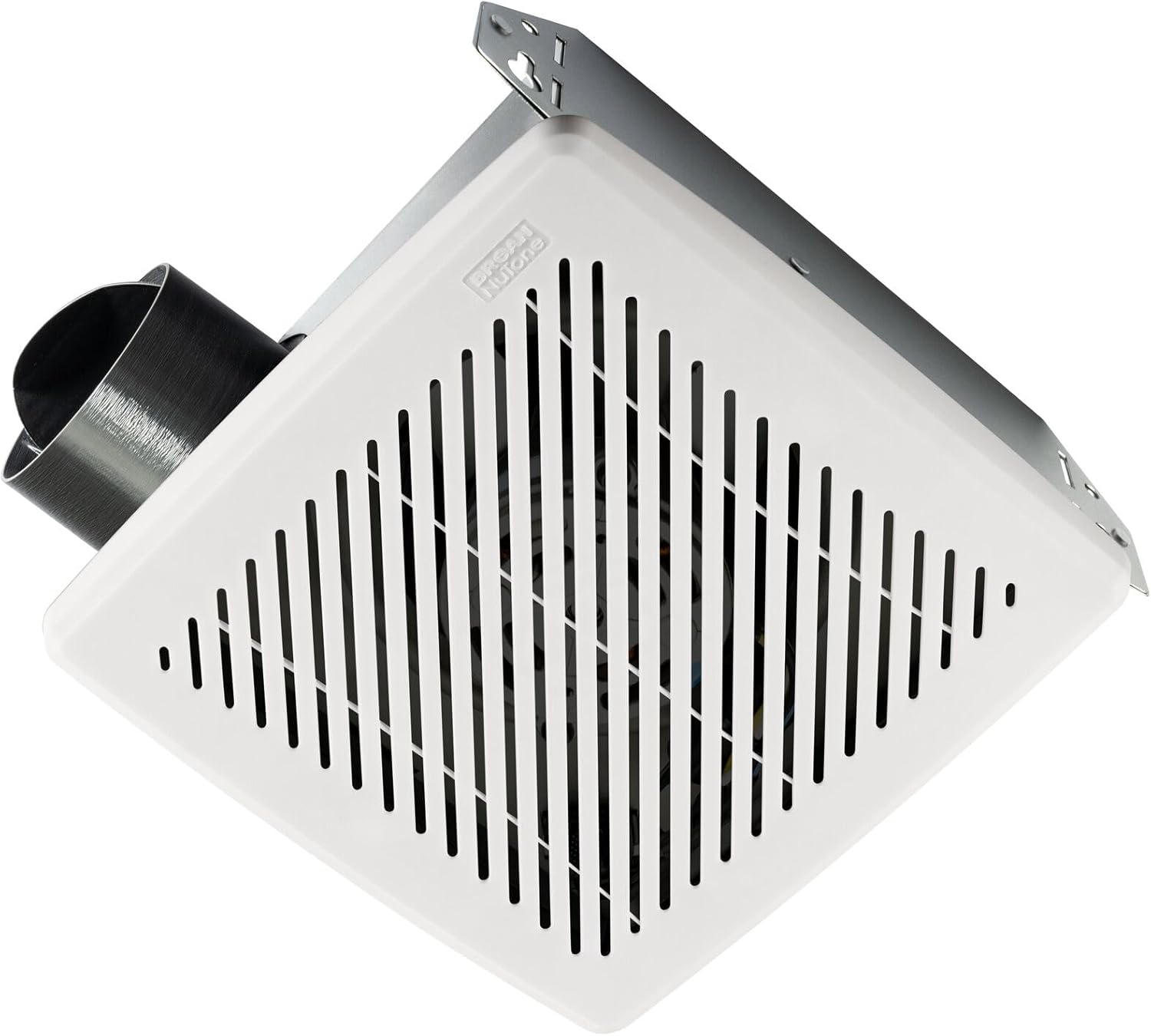
The Broan-NuTone 688ES is a compact ceiling exhaust fan designed to clear moisture and odors from small bathrooms and powder rooms. It delivers 50 CFM of airflow at about 2.0 sones, which is quiet enough for regular use while still providing effective ventilation for rooms up to roughly 45 sq ft. The unit uses an AC motor with a permanently lubricated, removable motor assembly that simplifies servicing and cleaning, and its galvanized steel housing and foldable mounting flanges make no-cut ceiling installation possible without attic access. The modern white louvered grille snaps on with springs for a tidy finished look. Being Energy Star certified and rated at 55 watts, it is more efficient than many older fans, but the single-speed control limits flexibility when you want higher or lower ventilation rates. The 3 inch duct and compact footprint suit retrofit installs, yet larger bathrooms will need a higher-capacity model. For small, windowless bathrooms this fan balances low noise, simple installation, and proven reliability, with the main compromise being the fixed single-speed performance.
Best for: Buyers who value quiet, efficient ventilation and want an easy retrofit solution for a small, windowless bathroom backed by broad positive reviews and established brand reliability.
Less Ideal for: Larger bathrooms, multiuser master baths, or installations that require adjustable fan speeds or higher CFM for heavy moisture loads should consider higher-capacity or multi-speed units.
- Energy Star certification for better efficiency than older fans
- Compact housing and foldable mounting flanges allow no-cut ceiling installations
- Removable, permanently lubricated motor assembly for easier servicing
- Low noise level around 2.0 sones suitable for small bathrooms
- Modern louvered grille with spring-mounted cover gives a clean ceiling finish
- Single-speed operation offers no adjustable ventilation level
- 50 CFM is only suitable for small bathrooms up to about 45 sq ft
Verdict: A quiet, energy-efficient, and easy-to-install 50 CFM exhaust fan that is a solid, low-noise choice for small windowless bathrooms.
Amico Bathroom Exhaust Fan BPT13-13EN2A

| Noise Level | 1 sones |
|---|---|
| Air Flow Capacity | 80 cfm |
| Wattage | 23 watts |
| Voltage | 120 volts |
| Control Method | Touch |
This Amico ceiling exhaust fan is a retrofit-style unit designed to move up to 80 CFM of air while running at a low 1.0 sones, so it removes steam and odors without making the bathroom feel noisy. It mounts between ceiling joists and includes brackets and a 4-inch duct connection, making it suitable for straightforward replacements where attic access is not needed. The unit runs on 23 watts and uses a touch control; its metal and polycarbonate construction and UL listing speak to solid safety and durability. Practical benefits include efficient moisture removal for bathrooms up to about 80 square feet and a compact housing that fits typical ceiling cutouts. Limitations are the single-speed control and modest airflow, which means it is not ideal for very large bathrooms or where adjustable fan speeds are required. Installation in tight or unusual joist layouts may still need some carpentry or a professional installer. For buyers prioritizing quiet, reliable extraction in a standard secondary bathroom, this model is a sensible, low-risk choice.
Best for: Buyers who want a low-noise, reliable replacement exhaust fan for a standard bathroom without a window and who prefer a straightforward, safety-certified product with minimal fuss.
Less Ideal for: Those needing variable speeds, higher airflow for large master bathrooms, or advanced features like timers, humidity sensors, or integrated lighting should look elsewhere.
- Quiet operation at 1.0 sones suitable for minimal disruption
- 80 CFM airflow adequate for typical bathrooms up to ~80 sq ft
- Compact retrofit housing with included mounting brackets for easier replacement
- UL listed construction and metal/polycarbonate build for safety and durability
- Single-speed control limits ventilation flexibility
- 80 CFM may be underpowered for larger or heavily used bathrooms
Verdict: A quiet, UL-listed retrofit exhaust fan that reliably vents small to medium windowless bathrooms with minimal noise and hassle.
Choosing the Right Bathroom Exhaust Fan for Bathroom Without Window: Key Factors to Consider
Proper Airflow Capacity
Choosing a fan with the right airflow capacity matters because a windowless bathroom depends entirely on mechanical ventilation to remove humid air. Airflow is measured in cubic feet per minute (CFM). For typical small bathrooms, aim for a minimum CFM that matches the room size and expected shower use. A fan with too little CFM will take too long to clear humidity, leaving surfaces damp and raising the risk of mold.
Oversizing the fan can create unnecessary noise and increase energy use, so balance CFM against room volume and ceiling height. Consider intermittent high-CFM or timed boost functions if the room is frequently used by multiple occupants or has heavy steam production.
Noise Level and Acoustic Comfort
Noise influences whether a fan will actually be used. Fans are rated in sones; lower numbers mean quieter operation. In a windowless bathroom, a very quiet fan encourages leaving it on long enough to clear moisture without being disruptive to adjacent living spaces. Assess sones at typical operating speeds, not just maximum output, because many fans run continuously or on timers.
Also consider whether the fan's motor mounts or housing minimize vibration transfer to joists and ductwork. Quiet fans may cost more up front but deliver better long-term results because they are more likely to stay on during and after showers.
Ducting and Installation Constraints
Installation constraints strongly affect performance and suitability. Windowless bathrooms often require routing ductwork through ceilings, attics, or long runs to reach an exterior vent. Length, number of bends, and duct diameter all reduce effective airflow, so pick a fan rated to overcome typical duct resistances in your home.
Check whether the fan supports standard duct sizes, has flexible mounting brackets for retrofit or new construction, and whether the housing fits available joist spacing. If attic access is limited, consider models designed for easier in-ceiling installation or with remote motors.
Moisture Resistance and Longevity
Bathroom fans constantly face high humidity and sometimes direct steam exposure. Materials, motor type, and protective coatings determine how well a fan resists corrosion and breakdown. Look for sealed or thermally protected motors and housings that do not trap water.
Long-lasting fans reduce the chance of failure that would otherwise allow moisture buildup and damage. Consider whether components like grilles and filters are easy to remove for cleaning to prevent performance degradation over time.
Control Options and Features
Controls determine how effectively a fan is used. Timers, humidity sensors, and occupancy sensors can ensure the fan runs long enough to clear moisture without relying on manual operation. Humidity-based controls automatically extend run time until relative humidity drops below a set point, which is especially helpful in windowless bathrooms.
Other useful features include variable speeds for quiet continuous ventilation, integrated lighting for combined fixtures, and compatibility with wall switches or smart home controls. Choose features that match how you use the space and how much automation you want.
Energy Use and Efficiency
Since fans may run frequently or continuously, energy efficiency affects operating cost and environmental impact. Look for motors and designs that deliver the needed CFM at lower wattage. High-efficiency motors and ENERGY STAR-rated options typically use less power and generate less heat.
Efficient fans with good airflow-to-watt ratios also allow longer run times without large electricity draws, making features like continuous low-speed ventilation or humidity-triggered boosts more practical for daily use.
Sizing Your Fan to Bathroom Volume
Calculate required airflow by matching fan CFM to room volume and use. For typical bathrooms, a simple rule of thumb multiplies ceiling height and floor area to get cubic feet, then selects a fan that exchanges that volume within a few minutes. Larger showers, jetted tubs, or multiple daily occupants call for higher CFM.
If duct runs are long or include bends, boost the nominal CFM to compensate for static pressure loss. Small increases in rated airflow can make a big difference in real-world extraction performance.
- Measure ceiling height and floor area to estimate room volume.
- Add CFM capacity for heavy steam or frequent multiple users.
- Account for duct length and bends when selecting rated CFM.
Mounting Options: Ceiling Vs Wall Vs Inline
Ceiling-mounted fans are the most common for bathrooms and exhaust directly into attic or roof ducting. Wall-mounted units can be used when ceiling access is limited or when a shorter exterior run is possible. Inline fans place the motor in the attic or crawlspace and use remote grilles in the bathroom, which reduces in-room noise and can improve airflow for long ducts.
Consider structural access, local building codes, and whether you need a combined light-fan unit to replace an existing fixture. Inline fan installations often require more planning but can pay off with quieter operation.
- Ceiling mounts are straightforward but may transmit noise into living spaces below.
- Inline fans keep noise out of the room but need attic space and longer ducting.
- Wall mounts can shorten duct runs but require suitable exterior wall placement.
Using Humidity Sensors and Timers Effectively
Humidity sensors and timers ensure the fan removes moisture even if occupants forget to switch it on. A humidity-sensing fan activates when relative humidity rises above a set point and runs until levels drop. Timers let the fan continue for a fixed interval after the bathroom is vacated, which is useful for short showers.
For continuous background ventilation, use a low-speed setting or a fan with an economy mode. Combining a humidity sensor with a delayed-off timer provides both responsiveness to high humidity and extended clearing time without manual control.
- Set humidity sensors to sensible thresholds to avoid constant cycling.
- Use timers of at least 10 to 20 minutes for steam-heavy bathrooms.
- Continuous low-speed modes are helpful for homes prone to persistent dampness.
Maintaining Performance: Cleaning and Upkeep
Regular maintenance keeps airflow high and noise low. Dust and lint build-up on grilles and fan blades reduce performance and can unbalance the motor. Inspect and clean the grille, housing, and duct connection at least annually, more often in dusty environments.
Replace or service any worn bearings, seals, or mounting hardware to avoid vibration. If a fan has a replaceable filter or light assembly, follow manufacturer guidance for safe replacement frequency.
- Turn off power before cleaning interior components.
- Vacuum grilles and use a damp cloth for washable parts.
- Check duct connections for leaks that reduce extraction efficiency.
Addressing Condensation and Backdrafts
Without proper exhaust routing, warm moist air can condense in ducts or pull cold air back into the room. Use insulated duct runs in unconditioned attics to reduce condensation and choose duct layouts that minimize horizontal runs where water can collect.
Backdraft dampers prevent outside air from entering when the fan is off. Ensure the exterior vent has a tight-sealing damper and that ducts slope slightly toward the exterior when feasible to allow any condensate to drain out.
- Insulate ducts in unconditioned spaces to limit condensation.
- Install a backdraft damper or use vent caps with built-in flaps.
- Avoid long flat runs where condensate can accumulate.
How We Chose the Best Bathroom Exhaust Fan for Bathroom Without Window
We evaluated options based on measurable ventilation performance, acoustic comfort, durability, installation flexibility, energy efficiency, and maintenance needs. Airflow capability was a primary filter since windowless bathrooms rely entirely on mechanical ventilation; we prioritized fans with sufficient cubic feet per minute (CFM) for common room sizes and for rapid moisture removal. Acoustic performance was the next key criterion because noisy fans are often turned off, defeating their purpose. We looked for low sone ratings and quieter operation across typical operating speeds. Installation considerations included ceiling or wall mounting options, ducting compatibility, and whether retrofit or new-construction brackets were available. Durability and resistance to humidity were assessed through material specifications and motor types that tolerate continuous or repeated use. Energy efficiency and any built-in controls that reduce run time were also important. Finally, ease of cleaning and available replacement parts informed the selection to ensure long-term upkeep is straightforward. We excluded units designed only for decorative ambiance or those intended for whole-house ventilation systems that are impractical for single-room installation. The final list represents models that balance measured airflow, low noise, and practical installation for windowless bathrooms.
Our full evaluation process is outlined in our review methodology.
FAQ
How big a fan do I need for a windowless bathroom?
Size by room volume and use. For most small bathrooms, choose a fan rated to move enough CFM to exchange the air several times during and after a shower. Increase rated CFM for larger rooms, high ceilings, or heavy steam use.
Can I run a bathroom fan continuously in a windowless bathroom?
Yes. Running a fan continuously on a low speed can control background humidity and reduce mold risk. Choose an energy-efficient fan designed for continuous operation and check ventilation rates to ensure adequate airflow without excessive energy use.
Are humidity sensors worth it for windowless bathrooms?
Often they are. Humidity sensors automatically run the fan when moisture rises, ensuring adequate ventilation without relying on manual switching. They are particularly helpful in bathrooms that are used infrequently or where occupants forget to run the fan.
How important is duct size and routing for performance?
Very important. Duct diameter, length, and number of bends significantly affect airflow. Use the largest practical duct size, minimize turns, and avoid compressing flexible ducting to preserve the fan's rated performance.
Can I install an inline fan if I have limited attic access?
Inline fans require attic or crawlspace access for installation. If access is limited, consider ceiling or wall-mounted options designed for retrofit installs. Consult local codes and a qualified installer to evaluate feasibility.
Final Verdict
For bathrooms without windows, prioritize a fan that delivers the right airflow for the room, operates quietly enough to stay on, and is durable in high-humidity conditions. Factor in duct routing and installation constraints so the fan can achieve its rated performance in your home. Balance airflow, noise, and control features like humidity sensors or timers to match your daily habits. Choosing a fan with proper CFM, low sones, and sensible controls will keep a windowless bathroom dry, odor-free, and low-maintenance over the long term.