
Note: This article contains affiliate links. If you click on these links and make a purchase, we may earn a small commission at no extra cost to you. This helps support our research and content. Read our full affiliate disclosure here.
If you want a bathroom exhaust fan that actually helps cool a room, you need to focus on units that move a lot of air while remaining quiet and energy efficient. Not all bathroom fans are built with cooling or whole-room ventilation in mind, so choosing the right model affects comfort, humidity control, and energy usage. This guide shortlists six top options for using bathroom exhaust fans for room cooling and explains the technical and practical reasons each type made the cut. We evaluate airflow capacity, noise, energy draw, mounting and ducting considerations, and build quality to help you pick a model that fits your space and installation constraints. Read on for the criteria we used and the buying factors that matter most.
Top Picks at a Glance
| Best Overall The best all-around choice for most situations | Broan-NuTone AE110 Bathroom Fan |  |
| Best Quality Built to a higher standard if you want something more solid | Panasonic WhisperCeiling FV-30VQ3 |  |
| Best Value The sweet spot between price and what you get | Amico Bathroom Exhaust Fan BPT13-13EN2A |  |
| Best Budget The cheapest option that still gets the job done reliably | Broan-NuTone 50 CFM Exhaust Fan 688ES |  |
| Top Rated A top-rated pick with lots of positive feedback | KAZE APPLIANCE SNP100 |  |
| Most Popular A crowd favorite that many people choose with confidence | iLIVING 12" Shutter Exhaust Fan |  |
Broan-NuTone AE110 Bathroom Fan

| Air Flow Capacity | 110 cfm |
|---|---|
| Noise Level | 1 sones |
| Wattage | 23.4 watts |
| Voltage | 120 |
| Installation Type | retrofit |
The Broan-NuTone AE110 is a compact, ENERGY STAR qualified exhaust fan intended to remove moisture and odors from bathrooms and similar rooms. It delivers 110 CFM at a low noise level of 1.0 sones, which is strong enough to clear steam and fogged mirrors in spaces up to roughly 105 square feet. The housing is designed for room-side retrofit installation so you can replace an existing fan without attic access, and the included non-metallic damper/duct connector and TrueSeal damper help reduce air leakage and backdrafts. At 23.4 watts it is energy efficient for continuous or regular use, and the LED-compatible design fits modern lighting setups. Limitations are its single-speed operation and lack of built-in timer or humidity control, so you will need a separate wall switch or smart control if you want delayed run or variable ventilation. The unit is UL listed for over-tub/shower use with a GFCI circuit, which adds installation flexibility.
Best for: Buyers who want a reliable, energy-efficient replacement fan that removes moisture quickly and can be installed from the room side without attic access.
Less Ideal for: If you need multi-speed control, built-in humidity sensing, timers, or combined light/heater features, choose a model that includes those functions instead.
- High airflow at 110 CFM effective for clearing steam and odors in medium bathrooms
- Quiet operation rated 1.0 sones for less intrusive continuous or intermittent use
- ENERGY STAR qualified and low wattage for energy-efficient ventilation
- Room-side retrofit installation design avoids attic access and simplifies replacement
- TrueSeal damper reduces air leakage and helps prevent backdrafts
- Single-speed fan with no built-in timer or humidity sensor
- No integrated light or heater options in this model’s standard configuration
Verdict: Choose the AE110 when you want a quiet, energy-efficient 110 CFM fan that simplifies retrofit installation and reliably clears bathroom steam.
Panasonic WhisperCeiling FV-30VQ3

| Air Flow Capacity | 290 cfm |
|---|---|
| Noise Level | 2 sones |
| Wattage | 64 |
| Voltage | 120 volts |
| Motor Type | Brushless |
The Panasonic WhisperCeiling FV-30VQ3 is a ceiling-mounted exhaust fan that moves up to 290 CFM while keeping noise low at about 2.0 sones, making it suitable for bathrooms where strong ventilation and low noise both matter. It uses a wide, double-tapered blower wheel and a totally enclosed condenser motor to produce high airflow at reduced RPMs, so the unit clears humidity and cools a room more effectively than smaller fans while remaining noticeably quiet. The housing is heavy-gauge galvanized steel with a built-in damper to block backdrafts and the permanently lubricated motor and brushless design aim for long service life. Installation is user-friendly with a 6-inch duct adapter, adjustable mounting bracket and detachable fan/motor assembly for access. Important limits: it is a single-speed, hardwired-style fan without integrated lighting or humidity sensing, and requires proper ducting to realize the rated airflow and room cooling benefits. For rooms that need continuous high airflow and low noise, this model delivers reliable performance.
Best for: Buyers who prioritize strong, quiet ventilation for bathrooms or small rooms and want a durable, performance-focused exhaust fan designed for continuous use.
Less Ideal for: People who need multi-speed control, integrated lighting, or smart humidity sensing built into the fan should consider other options.
- High airflow at 290 CFM for rapid humidity removal and room air exchange
- Low noise operation around 2.0 sones thanks to a wide blower wheel and reduced RPM design
- Durable construction with galvanized steel housing and permanently lubricated motor
- Built-in backdraft damper to prevent outside air infiltration
- Single-speed control limits flexibility for lower flow or staged ventilation
- No integrated light, timer, or humidity sensor included
Verdict: Choose this fan when you need high CFM cooling with very low noise and a durable, long-life motor for continuous ventilation.
Amico Bathroom Exhaust Fan BPT13-13EN2A

| Air Flow Capacity | 80 cfm |
|---|---|
| Noise Level | 1 sones |
| Wattage | 23 watts |
| Voltage | 120 volts |
| Control Method | Touch |
The Amico BPT13-13EN2A is a compact ceiling-mounted bathroom exhaust fan designed for retrofit jobs where attic access is not available. It delivers 80 CFM airflow at a quiet 1.0 sones, so it removes steam and moisture effectively without adding noticeable noise to the room. The unit runs on 120 V, draws about 23 watts, and installs on standard 4-inch ducting with included mounting brackets for securing between ceiling joists or directly to a joist. A touch control and single-speed operation keep operation simple, and the metal and polycarbonate construction with a modern grille and UL listing give it a solid safety and finish profile. For cooling-focused use, the fan helps lower humidity and reduce the perception of stuffiness after showers, but its 80 CFM output is best for small to medium bathrooms rather than large spaces where higher CFM is needed for noticeable temperature change. Its single-speed design also limits airflow control compared with multi-speed or variable fans.
Best for: Buyers who want a straightforward, quiet retrofit exhaust fan to control humidity and reduce stuffiness in small to medium bathrooms and value easy installation without attic access.
Less Ideal for: People looking to actively cool larger bathrooms or tailor airflow with multiple speeds should consider higher-CFM or multi-speed units instead.
- Quiet operation at 1.0 sones suitable for bathrooms where low noise matters
- 80 CFM airflow removes steam and moisture effectively in small to medium bathrooms
- Compact housing fits standard 4-inch duct and retrofit ceiling openings without attic access
- Simple touch control and single-speed operation make it easy to use
- Single-speed only, so airflow cannot be adjusted for stronger ventilation or quieter low-speed operation
- 80 CFM is modest and may be insufficient for larger bathrooms or for significant room cooling
Verdict: A quiet, easy-to-install 80 CFM ceiling exhaust fan that keeps humidity down and improves comfort in small to medium bathrooms.
Broan-NuTone 50 CFM Exhaust Fan 688ES
| Air Flow Capacity | 50 cfm |
|---|---|
| Noise Level | 2 sones |
| Wattage | 55 watts |
| Motor Type | AC |
| Installation Type | No-Cut Ceiling Mount |
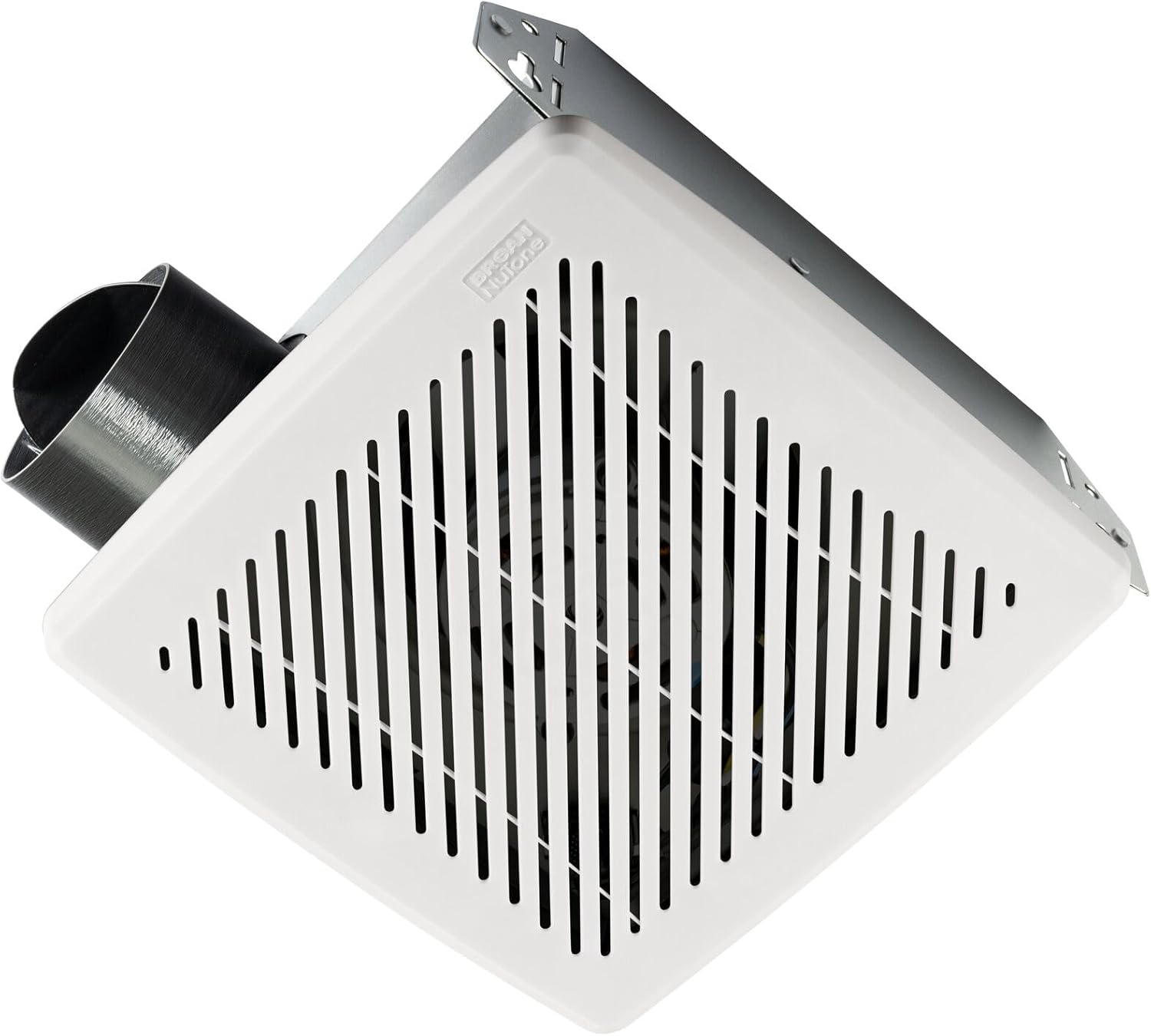
The Broan-NuTone 688ES is a small, no-frills ceiling exhaust fan intended for compact bathrooms and powder rooms. It delivers 50 CFM of airflow at about 2.0 sones, enough to clear humidity and odors from spaces up to roughly 45 sq ft without being overly loud. The unit uses an AC motor with a removable, permanently lubricated motor assembly for easier service and cleaning, and its galvanized steel housing with foldable mounting flanges enables a no-cut ceiling mount that can be installed quickly in minutes. The modern louvered grille and painted white finish keep the look unobtrusive in most ceilings. As a budget-focused, Energy Star certified option, it prioritizes efficient ventilation and simple installation over extra features — there are no lights, heaters, or variable-speed controls. For room cooling specifically it helps remove warm, humid air which can improve perceived comfort, but its 50 CFM rating limits how quickly it moves larger volumes of air compared with higher-CFM models. If you want straightforward, economical ventilation for a small bathroom, this model is a practical, serviceable choice.
Best for: Buyers who need an affordable, energy-efficient exhaust fan for a small bathroom or powder room and value quick, simple installation and low running cost.
Less Ideal for: Homes needing faster room cooling or large bathrooms where higher airflow, variable speeds, or additional features like lights and heaters are required.
- Energy Star certified for efficient operation
- Compact housing with foldable mounting flanges enables no-cut ceiling installation
- Removable, permanently lubricated motor assembly for easier service and cleaning
- Quiet enough for small rooms at about 2.0 sones
- Fixed single-speed operation limits airflow control
- 50 CFM capacity is modest so it moves air more slowly than higher-CFM fans
Verdict: A budget-friendly, Energy Star 50 CFM ceiling exhaust fan that delivers efficient, quiet ventilation and very easy installation for small bathrooms.
KAZE APPLIANCE SNP100

| Air Flow Capacity | 100 cfm |
|---|---|
| Noise Level | 0.8 sones |
| Wattage | 23 watts |
| Motor Type | Brushless |
| Power Source | AC |
The KAZE APPLIANCE SNP100 is a ceiling-mounted bathroom exhaust fan that delivers 100 CFM of airflow while running at a low 0.8 sones, making it a solid choice for keeping small to medium bathrooms drier and fresher without a noisy blower. It installs into a standard 9 x 9 inch ceiling opening and is designed so attic access is not required, which simplifies replacement projects and retrofits. The unit uses a brushless motor and a detachable 4-inch duct with a backdraft damper, and it is rated ETL and Energy Star certified for efficient operation at about 23 watts. Practical benefits include noticeably reduced humidity and odors, very quiet continuous or intermittent ventilation, and lower standby power draw. Limitations to consider are the single-speed control without integrated humidity sensing on the basic model and the need to confirm fit if replacing a nonstandard ceiling cutout. For buyers prioritizing quiet, efficient, and easy-to-install ventilation for cooling and moisture control in bathrooms up to roughly 100 square feet, the SNP100 performs reliably.
Best for: Homeowners who want a dependable, low-noise exhaust fan that reduces humidity and aids room cooling with minimal installation hassle and steady, energy-efficient performance.
Less Ideal for: People who need multi-speed ventilation, integrated humidity sensing, or precise variable airflow for large bathrooms or specialty cooling setups should consider other options.
- Delivers 100 CFM airflow suitable for bathrooms up to about 100 sq ft
- Very quiet operation at 0.8 sones, suitable for continuous use
- Energy Star certified and uses about 23 watts for efficient running
- No-attic-access installation simplifies retrofit into standard ceiling openings
- Brushless motor and ETL certification indicate durable, safe operation
- Single-speed operation limits fine-grained control compared with multi-speed or variable fans
- May require minor ceiling adjustments if replacing a nonstandard-sized fan opening
Verdict: Choose the SNP100 when you want a quiet, energy-efficient, and easy-to-install exhaust fan that reliably lowers bathroom humidity and supports room cooling.
iLIVING 12" Shutter Exhaust Fan

| Air Flow Capacity | 960 cfm |
|---|---|
| Wattage | 65 watts |
| Speed | 1650 rpm |
| Number of Power Levels | 3 |
| Control Method | App / Thermospeed controller |
The iLIVING 12" Shutter Exhaust Fan is a wall-mounted ventilation unit built to move a lot of air in garages, workshops, greenhouses, and larger bathrooms where cooling and moisture removal are needed. It delivers up to 960 CFM using three deep-pitch aluminum blades driven by a permanently lubricated, thermally protected motor and offers three power levels plus a variable Thermospeed controller that can switch the fan on and off at a set temperature. The enclosed automatic shutters close when the fan is off, helping keep out insects and weather, and the unit is built from galvanized alloy steel and aluminum for corrosion resistance. At 65 watts and about 65 dB noise, it is noticeably louder than small bathroom fans but provides much higher airflow and coverage up to the stated 1400 sq ft. Installation requires hardwiring and a standard NEMA 5-15 plug reference, so plan for electrical hookup and a proper wall opening. This fan is practical where high exchange rates and thermostatic control matter more than quiet operation or discreet styling.
Best for: Buyers who prioritize strong ventilation and automated temperature control for larger bathrooms or utility spaces and want a robust, long-running exhaust solution backed by user reviews.
Less Ideal for: Those looking for a near-silent or decorative bathroom fan for small rooms or renters who cannot modify walls and run new wiring should consider quieter or easier-to-install alternatives.
- High airflow rated at 960 CFM suitable for rapid air exchange in large rooms
- Thermostat and variable-speed Thermospeed controller for automated temperature-based operation
- Automatic enclosed shutters keep out insects and protect the motor when off
- Durable galvanized steel and aluminum construction with UL/cUL listing
- Permanently lubricated, thermally protected motor reduces maintenance needs
- Noise level around 65 dB makes it louder than typical bathroom fans
- Requires hardwiring and a proper wall opening for installation
Verdict: Choose this fan when you need powerful, thermostatically controlled wall exhaust airflow to cool and ventilate large bathrooms or utility spaces rapidly.
Choosing the Right Bathroom Exhaust Fan for Room Cooling: Key Factors to Consider
Airflow Capacity (CFM)
Airflow capacity, measured in cubic feet per minute, determines how quickly a fan can replace the air in a room. For room cooling you will usually need higher CFM than for simple moisture removal because cooling relies on moving a larger volume of warm air out and bringing cooler air in from elsewhere.
Consider both the rated CFM and how that rating holds up under typical duct lengths and bends. A fan with a high free-air CFM can lose significant output once connected to longer ducts or restrictive grilles, so check for static pressure performance or manufacturer data showing CFM at common duct resistances.
Noise Output
Noise matters when a fan runs for extended periods as part of cooling. Look for low sones or decibel ratings at operating speeds, and pay attention to how noise is described across the frequency range. A fan that lists low dBA but produces tonal whine can still be disruptive.
Also consider installation factors that affect perceived noise, such as whether the housing mounts on a vibration-isolating bracket, whether the motor is remote or inline, and whether insulated ducting or a sound baffle can be used to reduce transmission into living spaces.
Energy Use and Motor Type
Energy consumption affects running cost and how practical it is to run the fan for longer cooling cycles. Brushless DC motors are typically more efficient and quieter than shaded-pole or PSC motors, and they often allow variable-speed control which can optimize power draw versus airflow.
Assess whether the fan supports multi-speed operation or external speed controls, and whether it is compatible with common bathroom switches or thermostats if you plan to run it based on temperature rather than occupancy.
Mounting, Ducting, and Installation Constraints
How a fan installs will determine whether it can deliver its rated performance in your layout. Ceiling-mounted housings, remote inline fans, and housings designed for joist-mounting each have tradeoffs for airflow, accessibility, and noise.
Check required clearances, whether the fan fits between joists without additional framing, and what duct size is recommended. Using undersized ducts or too many bends will reduce effective airflow and diminish cooling capability. Also confirm whether the unit comes with adjustable mounting brackets or vibration isolators to simplify retrofit installations.
Grille Design and Air Distribution
The grille and diffuser affect both airflow pattern and resistance. A restrictive grille will reduce delivered CFM and concentrate noise, while a wide, low-resistance design spreads airflow more evenly and can improve perceived cooling.
Consider whether the grille is easy to remove for cleaning, whether it has integrated backdraft dampers to prevent reverse flow, and whether its aesthetic and finish fit your bathroom so you do not end up replacing it later.
Maintenance and Durability
Long-term durability and ease of maintenance determine whether the fan will keep performing. Motors that are accessible for cleaning or replacement reduce lifecycle cost and downtime. Look for corrosion-resistant housings and washable grilles if the installation is in a humid environment.
Also consider the availability of replacement parts such as grills, motors, or dampers, and whether the fan has a modular design that allows servicing without removing the entire housing from the ceiling.
Choosing Between Inline and Ceiling-Mounted Options
Inline fans position the blower in the attic or an accessible cavity away from the bathroom, which often reduces perceived noise and allows larger motors for higher airflow. They can be a good choice when you need sustained exhaust for cooling larger spaces, provided you can route ductwork cleanly to the inlet and outlet.
Ceiling-mounted housings keep the blower directly above the room, which simplifies ducting and installation but can transfer more noise into the space. For tighter installations, choose models with vibration-isolating mounts and quieter motor technologies.
- Inline: lower in-room noise, higher installation complexity.
- Ceiling: simpler install, may deliver more direct noise.
- Consider attic space, access panels, and duct run length when choosing.
Using Fan Speed and Controls for Conditional Cooling
Variable-speed fans let you tune airflow to meet cooling needs without running at full power constantly. Running at a moderate speed for longer periods often produces better perceived cooling than short, high-speed bursts because it promotes steady air exchange.
Consider controls that integrate with timers, thermostats, or separate speed switches. A temperature-triggered controller can start the fan only when the room exceeds a set threshold, saving energy while delivering cooling when needed.
- Look for multi-speed or DC motor fans for fine control.
- Pair with timers or thermostats for automated operation.
- Avoid single-speed units if you plan to run the fan for long cooling cycles.
Duct Design Tips That Preserve Airflow
Duct choices have a major impact on delivered CFM. Use the largest practical duct diameter recommended by the fan to reduce resistance. Smooth-walled ducting typically offers less friction than flexible or accordion-style ducts.
Minimize bends and long runs, and use gradual turns if direction changes are necessary. Properly seal joints and use a backdraft damper sized for the flow to prevent reverse air and heat infiltration when the fan is off.
- Prefer 4 inch or larger diameter ducts when capacity requires it.
- Avoid excessive bends and keep runs as short as possible.
- Seal seams with appropriate tape and consider insulated ducts where condensation is possible.
Temperature and Humidity Considerations
Fans that move air effectively will lower perceived temperature by increasing air exchange, but they do not cool air like an air conditioner. For best results, use the exhaust fan to promote cross-ventilation when cooler outdoor air is available or when HVAC can supply cooler replacement air.
In humid climates, prioritize fans with good moisture-handling and corrosion-resistant components because constant humidity and warm air exchanges can accelerate wear. If humidity control is primary, make sure the selected fan can maintain adequate air changes per hour for the room size.
- Use fans alongside natural ventilation or HVAC to maximize cooling benefit.
- Ensure materials and motor design resist humidity-related degradation.
- Monitor humidity if condensation or mold risk is a concern.
Retrofit Vs New Construction Installation Choices
Retrofit installations often face space constraints and limited attic access. Look for ultra-shallow housings or designs that allow installation from below the ceiling without extensive framing changes. Check whether additional vibration isolation is needed to reduce transmitted noise to the living space.
New construction gives more flexibility to place larger housings or inline units in conditioned attic spaces, use insulated ducting, and plan routing for optimal airflow. If you are planning new wiring or controls, coordinate with electrical work to accommodate multi-speed switches or smart controllers.
- Retrofit: prioritize compact housings and easy-access grilles.
- New construction: plan duct runs and isolated mounting points.
- Verify electrical requirements before finalizing the install location.
How We Chose the Best Bathroom Exhaust Fan for Room Cooling
We focused on measurable performance and real-world installation factors that determine whether a bathroom exhaust fan will help cool a room. Core evaluation criteria included airflow capacity at realistic static pressure, measured noise levels in sones or decibels, and energy consumption under typical operating conditions. We also weighed installation flexibility, including mounting options and duct compatibility, plus durability and serviceability such as fan motor type and ease of access for cleaning or replacement. Products that only listed nominal airflow without backing it up with testing or specific static pressure ratings were excluded. Units intended solely for spot ventilation in very small rooms were deprioritized if they could not sustain meaningful air changes in larger bathrooms or adjacent spaces. The editorial process favored options that balanced high cubic feet per minute output with acceptably low noise and reasonable energy use, because those factors most directly affect comfort when using an exhaust fan for room cooling. In short, we selected units that deliver verifiable airflow, quiet operation, sensible energy draw, and flexible installation to perform well as cooling-capable bathroom exhaust fans.
Our full evaluation process is outlined in our review methodology.
FAQ
Can a bathroom exhaust fan actually cool a room?
A bathroom exhaust fan can lower perceived room temperature by increasing air exchange, especially if it draws in cooler outdoor or conditioned air. However, it does not reduce air temperature like an air conditioner and works best as part of cross-ventilation.
What CFM do I need to use an exhaust fan for room cooling?
Required CFM depends on room volume and desired air changes per hour. For meaningful cooling beyond moisture control, select a fan with higher CFM than typical small-bath values and account for reductions from duct length and bends.
Are inline fans quieter than ceiling-mounted units?
Often yes. Inline fans place the blower away from the room, reducing in-room noise, but overall system noise also depends on ducting, mounting, and grille design. Proper isolation and insulated ducts further reduce perceived sound.
Should I use insulated ducting for an exhaust fan used for cooling?
Insulated ducting helps prevent condensation when warm, moist air moves through cooler spaces, and it can reduce heat gain or loss along the run. Use insulated ducting in unconditioned attics or when long runs pass through cold spaces.
Is a DC motor worth the extra cost for a bathroom exhaust fan?
DC motors typically offer higher efficiency, quieter operation, and better variable-speed control, which can be worthwhile if you plan to run the fan for extended cooling cycles. The benefit depends on runtime patterns and sensitivity to noise and energy use.
Final Verdict
When choosing a bathroom exhaust fan for room cooling, prioritize verified airflow at realistic duct conditions and low noise output. Balance energy-efficient motor technology and mounting options with the ducting you can install, because these factors determine how effectively the fan moves warm air out and cooler air in. Decide whether an inline or ceiling-mounted solution fits your installation constraints, plan ducts to minimize resistance, and choose controls that let you run the fan efficiently. Focus on measurable CFM, noise ratings, and installation compatibility to select a fan that will reliably improve comfort without creating new problems.