
Note: This article contains affiliate links. If you click on these links and make a purchase, we may earn a small commission at no extra cost to you. This helps support our research and content. Read our full affiliate disclosure here.
A battery-powered thermostat gives you flexible placement, straightforward installation, and continued climate control during power interruptions. If you want a thermostat that does not require a c-wire or hardwired power, these models offer practical alternatives for older homes, rented spaces, or rooms where running new wiring is impractical. The right pick can still deliver responsive temperature control, useful scheduling, and long battery life without complex setup. This guide shortlists seven top battery-powered thermostats and explains how we evaluated them. We focused on battery performance, installation ease, and core usability so you can pick a thermostat that fits your wiring situation and daily comfort needs.
Top Picks at a Glance
| Best Overall The best all-around choice for most situations | Honeywell Home RTH7600D Thermostat |  |
| Best Quality Built to a higher standard if you want something more solid | LUX PSD011B Thermostat |  |
| Best Value The sweet spot between price and what you get | SASWELL T21 Programmable Thermostat |  |
| Best Budget The cheapest option that still gets the job done reliably | Climapeak CP110 Thermostat |  |
| Top Rated A top-rated pick with lots of positive feedback | Hualans Non-programmable Thermostat |  |
| Most Popular A crowd favorite that many people choose with confidence | LUX PSD010B Heat-Only Thermostat |  |
| Best Seller A high-volume bestseller chosen again and again | Google Nest Thermostat |  |
Honeywell Home RTH7600D Thermostat

| Power Source | Battery Powered |
|---|---|
| Temperature Control Type | Heating and Cooling |
| Connectivity Technology | Wired |
| Screen Size | 15.24 centimeters |
| Number of Batteries | 1 AAA batteries required. |
The Honeywell Home RTH7600D is a straightforward 7-day programmable touchscreen thermostat built to automate home temperature schedules without fuss. You program daily schedules using a large backlit touch display and the menu-driven interface, and the thermostat shows current and set temperatures at the same time for quick checks. Smart Response Technology learns how long your system takes to reach setpoints so rooms are comfortable at the scheduled times, and Auto Changeover switches between heating and cooling when needed. The unit runs on one AAA battery or can be wired to 24V systems and includes alerts for filter changes and low batteries plus a compressor restart delay to protect equipment. Installation is described as do-it-yourself friendly and compatibility is broad for common heating and heat-pump systems. Limitations are that it is a basic programmable model without Wi-Fi, app control, or advanced connectivity, so remote scheduling and energy reporting are not available.
Best for: Buyers who want a reliable, easy-to-program battery-powered thermostat that automates weekday and weekend schedules and focuses on straightforward in-home control rather than remote or smart features.
Less Ideal for: Users who need remote access, home automation integration, or cloud-based energy tracking should consider a smart Wi-Fi thermostat instead.
- Large backlit touchscreen for easy programming and simultaneous display of current and set temperatures
- Smart Response Technology that learns system run times to hit setpoints on schedule
- 7-day menu-driven programming with four periods per day for flexible schedules
- Battery-powered operation with optional 24V wired connection for installation flexibility
- No Wi-Fi or remote app control for away adjustments or energy insights
- Does not provide multi-zone or smart-home integration features
Verdict: Choose the RTH7600D if you want a dependable, battery-capable touchscreen thermostat that simplifies weekly scheduling and delivers predictable in-home comfort without smart features.
LUX PSD011B Thermostat

| Controller Type | Touch Button |
|---|---|
| Specific Uses For Product | Air Conditioner, Boiler, Furnace |
| Power Source | Battery Powered |
| Display Type | LCD |
| Number of Batteries | 2 AA batteries required. (included) |
The LUX PSD011B is a simple, battery-powered digital thermostat designed for 1 heat/1 cool systems and basic heating setups like gas, oil, electric, or single-stage heat pumps. It installs as a wall-mounted, non-programmable controller and uses two AA batteries so it keeps working during power outages and on systems without 24V power. The large LED-illuminated LCD and soft touch buttons make setpoint changes and temperature readouts easy from across a room, and adjustable temperature stops let you limit the range for consistent comfort. Connectivity protocol and BACnet MS/TP listing suggests compatibility with certain building control systems, though this model lacks advanced scheduling or Wi-Fi app control despite a listed connectivity technology. The unit is best when you need reliable, no-frills temperature control and straightforward operation; if you want remote control, programmable schedules, or energy-optimization features you will need a different model.
Best for: Buyers who prioritize straightforward, reliable temperature control and need a battery-powered wall thermostat that is quick to install and operate without programming.
Less Ideal for: Those who want Wi-Fi app control, advanced scheduling, multi-stage system support, or energy-optimization features should look at programmable or smart thermostats instead.
- Battery powered so it works without C-wire and during power outages
- Large illuminated LCD for easy reading in low light
- Simple non-programmable interface is quick to use and easy to set up
- Adjustable temperature stops provide control over allowable setpoints
- No programmable schedules or smartphone remote control
- Not suitable for multi-stage HVAC systems or advanced zoning
Verdict: Choose the LUX PSD011B when you need a dependable, battery-powered, no-frills thermostat that delivers fast manual control for single-stage heating and cooling systems.
SASWELL T21 Programmable Thermostat
| System Type | 1H/1C single‑stage, heat pump (no aux) |
|---|---|
| Power Source | 24VAC or 2×AA batteries |
| Display Type | LCD |
| Control Method | Push Button, Touch |
| Programmable | 5+2 weekly schedule |
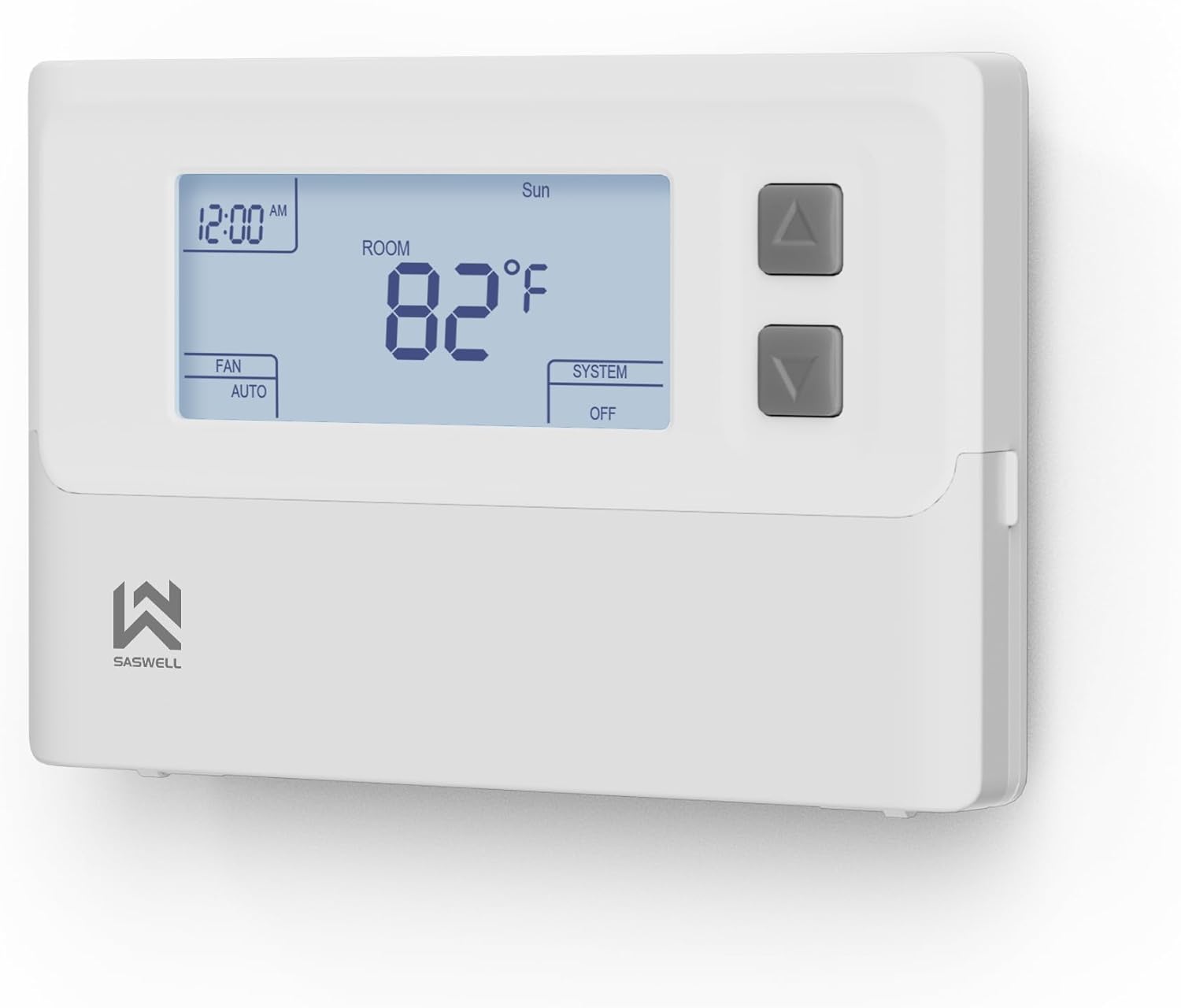
The SASWELL T21 is a straightforward programmable thermostat for single‑stage HVAC systems and simple heat pumps that do not use auxiliary heat. It installs as a wall unit and runs on either 24VAC or two AA batteries, so it works when a C‑wire is not available although the manufacturer recommends adding one for stability. The T21 offers a backlit LCD, push‑button controls with a protective cover, memory retention through power loss, and 5+2 weekday/weekend scheduling for energy savings. It is designed for DIY installation and lists broad compatibility with gas, electric, and oil furnaces, boilers, hydronic systems, and 750 mV gas fireplaces while excluding line‑voltage, electric baseboard, and multi‑stage/auxiliary‑heat heat pumps. Practical benefits include simple programming for routine temperature setbacks and a compact, easy‑to‑read interface that keeps accidental changes to a minimum. Limitations are its lack of Wi‑Fi or smart‑home integration and its scope restricted to single‑stage setups, so it is not suitable for systems needing advanced staging or remote control features.
Best for: Buyers who want a reliable, budget‑minded programmable thermostat that is easy to install and saves energy through scheduled setbacks without needing a C‑wire or smart features.
Less Ideal for: Users who need Wi‑Fi remote control, multi‑stage or dual‑fuel system support, or compatibility with line‑voltage and electric baseboard heating should look elsewhere.
- Runs on 24VAC or two AA batteries so it can be used without a C‑wire
- 5+2 programmable schedule for weekday/weekend temperature setbacks
- Backlit LCD and protected push‑button controls reduce accidental changes
- Memory retention preserves settings during power outages
- Covers common single‑stage systems including heat pumps without auxiliary heat and hydronic boilers
- No Wi‑Fi or app connectivity for remote control or scheduling
- Not compatible with multi‑stage systems, electric baseboard, line‑voltage, or heat pumps with auxiliary/emergency heat
Verdict: A practical, easy‑to‑install programmable thermostat for single‑stage systems that offers battery operation and simple weekday/weekend scheduling without smart features.
Climapeak CP110 Thermostat

| Controller Type | Non-Programmable |
|---|---|
| Power Source | Battery, AC |
| Voltage | 24 VAC |
| Display Type | Digital |
| Number of Batteries | 2 AAA (included) |
The Climapeak CP110 is a straightforward non-programmable wall thermostat designed for 1 heat/1 cool conventional single-stage systems. It is powered by 24VAC or two included AAA batteries so it can be installed where a common wire is not available, and the blue backlit digital display is large and easy to read. Setup uses push-button controls with options for temperature calibration, selectable compressor delay protection, and a low battery indicator, which help fine-tune comfort and protect equipment. The unit supports basic temperature swings and shows room temperature across a useful range for homes. Limitations include no programming schedule, no compatibility with multistage systems or heat pumps, and a simple feature set compared with smart or programmable thermostats, so it only covers essential control needs. For buyers looking for an inexpensive, battery-capable replacement that is easy to read and install, this keeps things simple and reliable.
Best for: Buyers seeking an inexpensive, no-frills replacement thermostat that is easy to install and read on battery power for a basic single-stage HVAC setup.
Less Ideal for: Homes with multistage heating/cooling, heat pump systems, or buyers who want programmable schedules or smart connectivity.
- Works with or without a common wire using 2 included AAA batteries
- Large blue backlit digital display that is easy to read
- Selectable compressor delay protection and temperature calibration for equipment safety and comfort
- Non-programmable so no daily or weekly scheduling
- Not compatible with multistage systems or heat pump setups
Verdict: A compact, budget-friendly battery or 24VAC thermostat that replaces basic single-stage systems with a clear backlit display and simple controls.
Hualans Non-programmable Thermostat

| Controller Type | Digital, Non-programmable |
|---|---|
| Power Source | 2 AA batteries or 24VAC |
| Compatibility | 1H/1C and heat pump systems |
| Temperature Accuracy | ±1°F |
| Display | Backlit digital LCD |
This Hualans non-programmable thermostat is a simple, reliability-focused controller that delivers precise temperature hold without Wi-Fi or apps. It runs on two AA batteries or can be hardwired to 24VAC with batteries as backup, making it flexible for DIY installs and power interruptions. Setup is intentionally straightforward: a clear nine-terminal layout, wire labels, wall plate, and included screws let most homeowners complete installation in under 30 minutes without an electrician. The large backlit LCD and ±1°F NTC sensor make set point and room temperature easy to read and accurate day or night. Because it is non-programmable, controls are limited to manual adjustments via slide switches and buttons, so there is no scheduling or remote control. It supports conventional 1H/1C systems and heat pumps and stores settings through power loss, which is helpful for long-term stability. If you want a no-frills, dependable thermostat that replaces an older unit and minimizes ongoing maintenance, this model does the job well.
Best for: Buyers who prioritize dependable, low-maintenance temperature control and want a fuss-free, easy-to-install replacement that just works without apps or network setup.
Less Ideal for: Users seeking scheduling, Wi-Fi connectivity, remote control, or smart-home integration should consider programmable or smart thermostats instead.
- Battery or 24VAC operation with batteries as backup provides uninterrupted service during outages
- Clear backlit LCD and ±1°F NTC sensor for accurate, easy-to-read temperature control
- Nine labeled terminals and included hardware make DIY installation quick and straightforward
- Simple, no-app interface eliminates connectivity issues and software maintenance
- Non-programmable design means no scheduling, remote access, or smart home integration
- Basic controls may feel limited to users who want advanced HVAC features
Verdict: Choose this thermostat if you want a simple, battery-powered replacement that provides accurate, dependable temperature control without Wi-Fi or ongoing maintenance.
LUX PSD010B Heat-Only Thermostat

| Controller Type | Push Button |
|---|---|
| Connectivity Technology | Wi-Fi |
| Power Source | Battery Powered |
| Display Type | LCD |
| Number of Batteries | 2 AA batteries required (included) |
The LUX PSD010B is a basic, nonprogrammable wall thermostat made for heat-only systems such as boilers, gas fireplaces, and in-floor radiant heating. It runs on two AA batteries and has a clear backlit LCD and push-button controls so you can set and read temperature easily without wiring for a fan. The unit also offers Wi-Fi connectivity and app control for remote adjustments, which is uncommon at this price and useful for quick setpoint changes when you are away from the thermostat. Installation is straightforward for someone comfortable with low-voltage wiring and includes mounting hardware and batteries. Its simplicity is the main selling point: no scheduling features to learn and a compact rectangular design that fits most interiors. Limitations are the lack of a programmable schedule and that it only supports heat-only configurations, so it is not suitable for systems requiring cooling or multi-stage control. If you need full programmable or multi-function control, look elsewhere.
Best for: Buyers who want a straightforward, reliable thermostat to replace or control a single heat-only system and prefer simple operation with optional remote control via app.
Less Ideal for: People who need programmable schedules, multi-stage HVAC control, or combination heating and cooling management should choose a more capable thermostat.
- Battery powered with included AA batteries for installation without hardwiring to house power
- Clear, backlit LCD and simple push-button controls for easy reading and adjustments
- Designed specifically for heat-only systems like boilers and fireplaces, avoiding unnecessary features
- Includes mounting hardware and basic installation accessories
- Nonprogrammable so it cannot run daily schedules or automated setbacks
- Only supports heat-only setups and will not control cooling or complex HVAC systems
Verdict: Choose the LUX PSD010B if you need a no-frills, battery-powered thermostat that reliably controls heat-only systems with easy setup and optional remote app control.
Google Nest Thermostat
| Connectivity Technology | Bluetooth, Wi-Fi |
|---|---|
| Power Source | Battery Powered |
| Display Type | LCD |
| Control Type | Remote Control, Voice Control |
| Specific Uses For Product | Heat Pump |
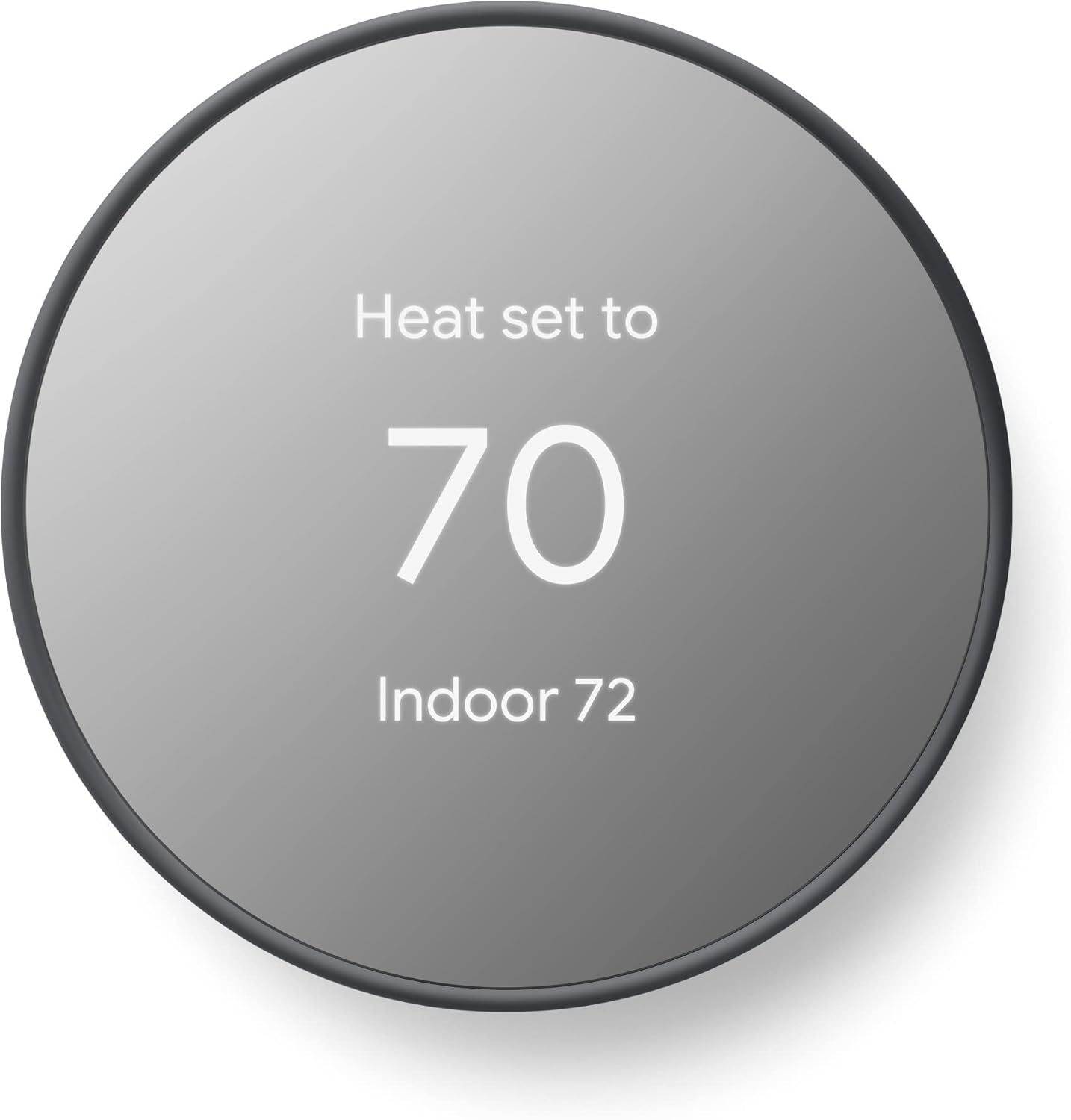
The Google Nest Thermostat is a compact, battery-powered smart thermostat designed for easy self-installation and everyday temperature control. It connects over Wi-Fi and Bluetooth so you can change settings from the Google Home app or with voice commands through compatible assistants, and the touch bar on the side provides quick local control. The thermostat learns basic routines through manual programming and app tools like Quick Schedule and Savings Finder to suggest schedule tweaks that can reduce energy use, and it can automatically set an Eco Temperature when it detects nobody is home. It also provides HVAC monitoring alerts to flag potential system issues. Practical strengths include simple app setup, broad smart-home integration, and Energy Star certification for efficiency. Limitations for some homes are that certain HVAC setups may require a C wire or a power accessory and some advanced features rely on working internet and compatible voice devices, so fully offline households will see reduced functionality.
Best for: Buyers who prioritize a simple-to-install, energy-minded smart thermostat with app and voice control and want dependable, mainstream smart-home integration.
Less Ideal for: Homes without consistent Wi-Fi or users who need an electrically powered thermostat without any chance of requiring a C wire or additional power accessory.
- Wireless control via Google Home app and voice assistants for remote temperature adjustments
- Energy-saving features like Eco Temperature and Savings Finder to suggest schedule improvements
- Easy self-installation designed to take about 30 minutes with included mounting hardware
- Provides HVAC monitoring alerts to help detect potential issues early
- May require a C wire or power accessory for some HVAC systems
- Some features need active internet and compatible voice devices to work fully
Verdict: A user-friendly, battery-powered smart thermostat that makes remote app control and modest energy savings easy for mainstream homeowners.
Choosing the Right Battery-Powered Thermostat: Key Factors to Consider
Battery Life and Type
Battery life determines how often you need to replace cells and directly affects long-term upkeep. Thermostats that run on AA or AAA batteries often let you swap cells quickly, while units using proprietary packs may require sourcing replacement modules. Consider both estimated runtime in months or years and whether the thermostat provides clear low-battery warnings.
Also think about standby power draw from the display and wireless features. A thermostat with aggressive power-saving modes or a dimmable display will typically last longer between changes, which matters if the unit controls an infrequently used space or if you prefer minimal maintenance.
Installation Simplicity
The whole point of a battery-powered thermostat is easier installation, so check how the device mounts, whether it requires line-voltage isolation, and how wiring terminals are labeled. A compact backplate, simple screw terminals, and clear wiring diagrams reduce installation time and errors.
If you are replacing an existing low-voltage thermostat, confirm that the new unit accepts the same terminal labels. Some models include adapter harnesses for quick swapouts. Also consider whether the thermostat includes a robust wall anchor or optional trim plate to hide paint or drywall defects from the previous install.
HVAC Compatibility
Battery-powered thermostats are suitable for many residential low-voltage systems, but not all setups are identical. Verify compatibility with single-stage and multi-stage heating or cooling, heat-pump systems, and accessories like humidifiers or zone valves if you need them. Some thermostats specifically omit support for certain configurations or require additional adapters.
Documentation that lists supported system types and terminal mappings is helpful. If you have a heat pump or a two-transformer system, double-check how the thermostat handles reversing valves and dual-transformer inputs to avoid control issues.
Control Features and Scheduling
Decide which control features matter most: simple manual setback, multi-event weekly schedules, or presence-aware hold functions. Basic programmable schedules can save energy without complexity, while more advanced scheduling and adaptive recovery can keep comfort consistent with less manual input.
Some battery models provide remote control through an app or wireless remote, which adds convenience but can increase power draw. Balance the convenience of extra features against their impact on battery life when making a selection.
Display, Interface, and Usability
A clear, readable display and intuitive interface reduce operator errors and make daily adjustments quicker. Backlit screens, large fonts, and simple button layouts matter especially on small or frequently adjusted thermostats.
Also consider menu depth and feedback for status messages such as mode, fan control, and battery warnings. If multiple household members will use the thermostat, straightforward controls and lockable settings can prevent accidental changes while keeping essential functions accessible.
Wiring and Terminal Basics
Understanding your existing wiring is the first step before swapping in a battery-powered thermostat. Most residential low-voltage systems use a common set of labeled terminals such as R, W, Y, G, and C. Battery-powered units typically do not require a C terminal, but you should still confirm that the unit accepts the wiring your system uses.
Take a photo of the old thermostat wiring before disconnecting anything. That photo provides a reliable reference if you need to match terminals during installation. When in doubt, consult the system's furnace or air handler wiring diagram for terminal functions.
- R: 24V supply from transformer
- W: Heat call
- Y: Cooling call
- G: Fan control
- C: Common (not required for battery models)
When to Choose a Battery-Powered Unit
Opt for a battery-powered thermostat if running a new C-wire is difficult, you are in a rental or temporary space, or you need a simple replacement without electrician work. Battery units are also useful in outbuildings and zones where a wired connection would be cost-prohibitive.
Avoid battery-only models if your HVAC system requires constant power for advanced features or if you need tight integration with whole-home smart systems that depend on continuous connectivity.
- Best for older homes without a common wire
- Good for secondary zones and rental units
- Less ideal when advanced always-on connectivity is required
Maintaining Battery-Powered Thermostats
Regular maintenance mainly involves checking and replacing batteries before they fail. Look for models with convenient front access panels or tool-free battery compartments to minimize hassle. Establish a schedule to check battery status seasonally, and set calendar reminders if the thermostat does not offer automatic low-battery notifications.
Keep the thermostat dust-free and avoid placing it where direct sunlight or drafts will skew temperature readings. Periodic review of scheduling and calibration will help maintain accurate comfort levels and energy use.
- Replace batteries at the start of heating and cooling seasons if unsure
- Wipe display and vents to prevent dust buildup
- Verify temperature calibration annually
Balancing Features With Battery Drain
Extra features such as Wi-Fi connectivity, color displays, and motion sensors improve convenience but increase power consumption. If long battery life is a priority, favor models with efficient power management, screen dimming, or limited wireless duty cycles. Some thermostats offer optional battery-sparing modes that disable always-on features in exchange for extended runtime.
When selecting a unit, weigh how often you will use remote features against the need for infrequent battery changes. For users who rarely adjust settings remotely, a simpler interface that preserves power may be preferable.
- Turn off nonessential wireless features to extend battery life
- Prefer monochrome or low-power displays for lengthy runtime
- Use scheduled automation to reduce constant manual overrides
Troubleshooting Common Issues
If the thermostat is unresponsive, first check battery orientation and voltage. Weak batteries can cause erratic behavior, inaccurate temperature readings, and loss of programming. Replace batteries with known-good cells and test again before deeper troubleshooting.
If the HVAC system does not respond to thermostat calls, verify correct terminal connections and inspect the furnace or air handler for blown fuses or tripped protection. Consult the thermostat's manual for diagnostic indicators and LED error codes, which can simplify fault isolation.
- Confirm fresh batteries and correct orientation
- Check terminal connections and wiring photos
- Inspect HVAC fuse and control board indicators
How We Chose the Best Battery-Powered Thermostat
We assembled a shortlist of battery-powered thermostats by prioritizing criteria that matter for homeowners and renters who need non-hardwired solutions. First, battery life and power efficiency were primary considerations, since longer intervals between replacements reduce maintenance and avoid service interruptions. Second, installation simplicity and compatibility with common low-voltage heating and cooling systems were evaluated to ensure most users can install the unit without running new wiring or hiring an electrician. Third, control features such as programmable schedules, manual override, and basic remote control capabilities were assessed for everyday usefulness. Fourth, reliability and user interface quality were weighed, focusing on clear displays and straightforward menus that minimize fumbling during setup and daily use. Finally, durability and build quality were considered to ensure the unit will hold up to repeated battery changes and typical household conditions. We excluded thermostats that require external power sources, professional-only installation, or are designed exclusively for commercial HVAC systems. The selection emphasizes practical residential fitment and measurable specs rather than brand cachet or premium smart-home ecosystems.
Our full evaluation process is outlined in our review methodology.
FAQ
How long do batteries typically last in a battery-powered thermostat?
Battery life often ranges from several months to a few years depending on usage, display type, and additional features. Simple, non-networked units with low-power displays tend to last the longest, while thermostats with Wi-Fi or color screens require more frequent replacements.
Can a battery-powered thermostat control a heat pump?
Many battery-powered thermostats support basic heat pump functions, but compatibility varies. Check that the thermostat supports reversing valve control and the specific terminal layout your heat pump requires before installing.
Will a battery-powered thermostat keep settings during a power outage?
Yes. Since they do not depend on house power, battery-powered thermostats continue to control heating and cooling during power outages. However, features that rely on external networks or hubs will be unavailable until power or connectivity is restored.
Do battery-powered thermostats need a C-wire?
Most battery-powered models are designed to operate without a C-wire, which is a common reason buyers choose them. Still, some advanced battery thermostats offer optional C-wire support to enable additional features or reduce battery drain.
How do I know when to replace thermostat batteries?
Replace batteries when the thermostat displays a low-battery warning or if you notice sporadic behavior or missed schedules. As a preventive measure, many owners swap batteries at the start of the heating and cooling seasons to avoid unexpected failures.
Final Verdict
Battery-powered thermostats are a practical solution when running a common wire is impractical or you need a straightforward replacement. Prioritize long battery life, clear installation instructions, and compatibility with your HVAC type to reduce hassle and ensure reliable control. Weigh tradeoffs between advanced features and power consumption: choose a simpler, lower-power model if you want minimal maintenance, or accept more frequent battery changes for remote access and richer displays. With those priorities in mind, you can confidently select a thermostat that fits your home and keeps your climate comfortable.