
Note: This article contains affiliate links. If you click on these links and make a purchase, we may earn a small commission at no extra cost to you. This helps support our research and content. Read our full affiliate disclosure here.
Choosing the right heating and cooling thermostat affects comfort, utility costs, and how much time you spend adjusting settings. The right thermostat keeps indoor temperatures steady, responds accurately to setpoints, and fits your wiring and installation constraints so you do not end up with compatibility headaches. This guide presents six shortlisted thermostats that represent reliable options for most homes and heating systems. Below you will find concise explanations of the evaluation criteria used, practical buying factors to weigh for your home, and focused guidance to help you pick the best thermostat for steady comfort and efficient operation.
Top Picks at a Glance
| Best Overall The best all-around choice for most situations | Amazon Smart Thermostat |  |
| Best Quality Built to a higher standard if you want something more solid | Sensi Smart Thermostat ST55 |  |
| Best Value The sweet spot between price and what you get | Honeywell Home X2P Programmable Thermostat RTH20B |  |
| Best Budget The cheapest option that still gets the job done reliably | Miuputake STN601 Thermostat |  |
| Top Rated A top-rated pick with lots of positive feedback | Heagstat H701W Single-Stage Thermostat |  |
| Most Popular A crowd favorite that many people choose with confidence | Google Nest Thermostat |  |
Amazon Smart Thermostat
| C-wire required | Yes |
|---|---|
| Works with | Alexa and Ring |
| Manufacturer tech | Honeywell Home technology |
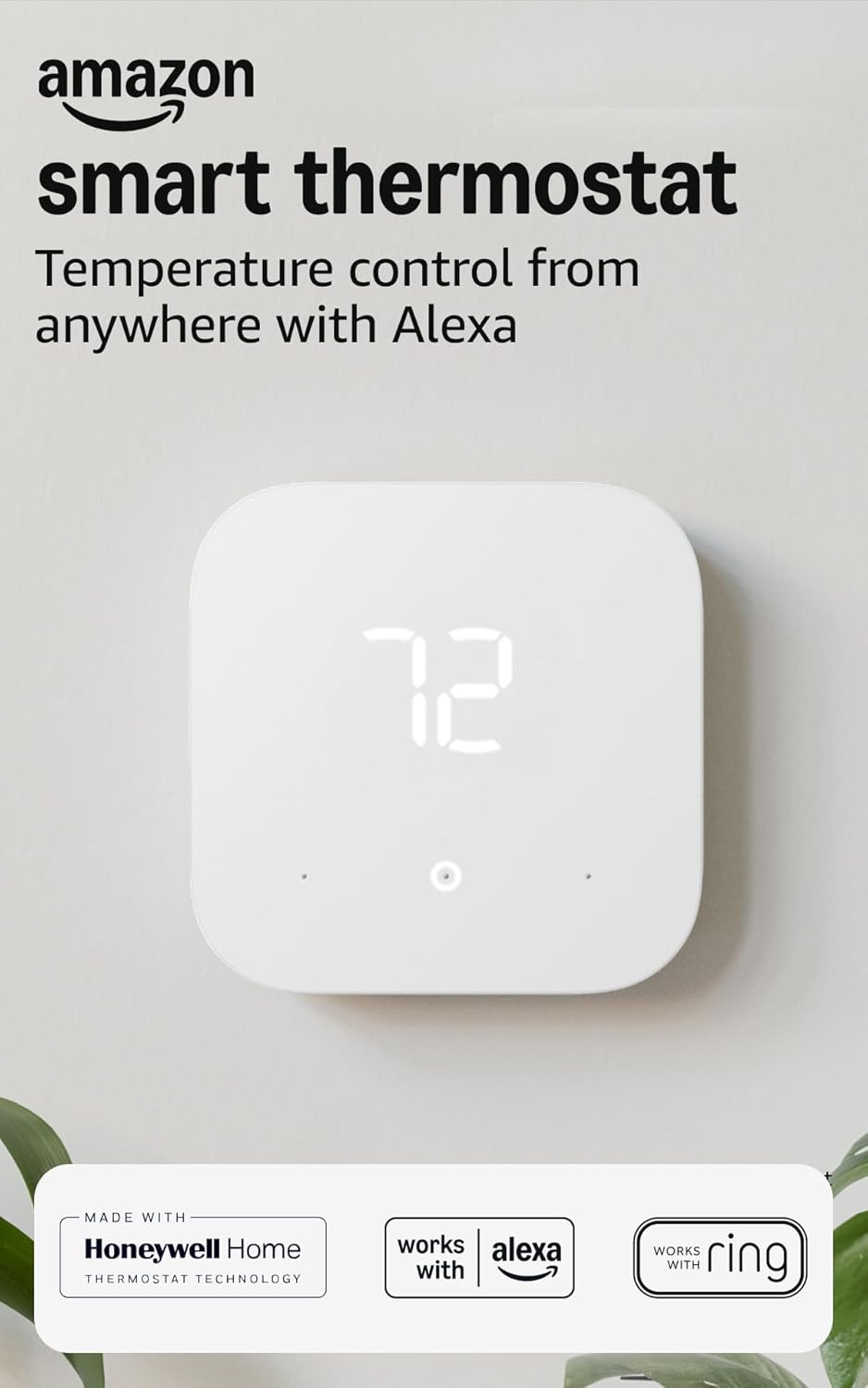
The Amazon Smart Thermostat is a straightforward Wi‑Fi thermostat that replaces a conventional wall thermostat to give schedule-based and remote control through the Alexa app. It supports creating home, away, and sleep schedules, and can tie into Alexa devices for presence-based or temperature-triggered adjustments and routines. Installation is intended for DIY with a required C‑wire and step-by-step guidance in the app, and the unit leverages Honeywell Home thermostat technology for core control reliability. The practical benefits are energy savings from programmable schedules and Alexa automation, plus mobile control when you are away. Limitations include the reliance on Alexa for advanced features and the need for a C‑wire, which may require extra wiring work in older homes, and it does not advertise advanced zoning hardware or proprietary sensors in the box. For buyers seeking a simple, voice-integrated upgrade from a manual thermostat, it covers the essentials without a lot of extras.
Best for: Buyers who want an easy, voice-first upgrade to a manual thermostat and prioritize simple scheduling, remote app control, and Alexa automation.
Less Ideal for: People who need multi-zone hardware, standalone advanced sensors, or who do not use Alexa or smart home ecosystems.
- Simple Alexa integration for voice control and routines
- Programmable home, away, and sleep schedules for automated energy savings
- Remote temperature monitoring and control via the Alexa app
- Built on Honeywell Home thermostat technology for basic reliability
- Requires a C‑wire which may need additional wiring in older homes
- Advanced zoning or extra sensor support is not included
Verdict: Choose this thermostat if you want a simple, Alexa-centered smart replacement that adds scheduling and remote control to save energy without extra complexity.
Sensi Smart Thermostat ST55

| Connectivity Technology | Wi‑Fi |
|---|---|
| Controller Type | Amazon Alexa, Apple HomeKit, Google Assistant, SmartThings, Vera |
| Power Source | Corded Electric |
| Temperature Control Type | Programmable, Smart/Remote |
| Energy Certification | Energy Star Certified |
The Sensi Smart Thermostat ST55 is a wall‑mounted Wi‑Fi thermostat designed to replace a conventional programmable thermostat and add remote control, scheduling, and usage reporting. It pairs with Alexa, Google Assistant, Apple HomeKit and SmartThings and is aimed at straightforward DIY installs using the included mounting hardware and app guidance; a common wire is not required in most setups. The Sensi app provides remote access, energy‑use reports and maintenance alerts, while the unit's physical buttons and LED display keep local control simple. Energy Star certification and built‑in scheduling features are useful for reducing HVAC runtime, and the product emphasizes data privacy and manufacturer HVAC expertise. Limitations include a modest screen and simple button controls rather than a large color touchscreen, and reliance on 2.4 GHz Wi‑Fi which may require router adjustments in some networks. For buyers focused on smart control and efficiency without pro installation, Sensi delivers solid, practical performance.
Best for: Buyers who prioritize dependable smart control and measurable energy savings and want a thermostat they can install themselves without contracting an HVAC technician.
Less Ideal for: Users who want a large color touchscreen, advanced on‑device controls, or need support for dual‑band Wi‑Fi out of the box.
- Works with major voice assistants and smart home platforms for flexible remote control
- Energy Star certified with scheduling and usage reports to help reduce HVAC energy use
- Easy DIY installation with app guidance and included mounting hardware
- Includes filter and maintenance alerts to help protect system performance
- Smaller LED screen and button controls are less feature rich than touchscreen competitors
- Requires 2.4 GHz Wi‑Fi only, which can be limiting on some modern networks
Verdict: Choose the Sensi ST55 if you want a reliable, DIY smart thermostat that focuses on energy savings and broad smart‑home compatibility.
Honeywell Home X2P Programmable Thermostat RTH20B

| Compatibility | Single-Stage, 1 Heat/1 Cool |
|---|---|
| Scheduling | 5-2 day or non-programmable option |
| Power Source | 2 AA batteries (C-wire supported) |
| Display Type | Backlit LCD |
The Honeywell Home X2P (RTH20B) is a straightforward programmable thermostat aimed at simplifying daily temperature control for single-stage 1 heat/1 cool systems. Installation is typical for a battery-powered wall thermostat and it uses two AA batteries, with an optional C-wire for continuous power. The large backlit LCD and clear fonts make reading and adjusting settings easy, and the 5-2 day scheduling lets you set weekday and weekend programs or choose a non-programmable mode. Useful extras include a change-filter reminder and selectable display settings, and the device supports common conventional systems such as forced air and hot water heat while excluding electric baseboard heat. Expect reliable basic scheduling and clear feedback rather than smart-home integrations or advanced energy reporting. This unit is best when you want a dependable, no-nonsense programmable thermostat that prioritizes easy setup and daily usability over remote app control or learning algorithms.
Best for: Buyers who want a practical, reliable programmable thermostat that simplifies daily temperature scheduling and emphasizes easy installation and clear on-device controls.
Less Ideal for: Users seeking smart thermostats with remote app control, learning features, or integrations with home automation platforms should look elsewhere.
- Large backlit LCD with clear font for easy viewing and adjustments
- 5-2 day scheduling plus non-programmable option for flexible routines
- Change-filter reminder and selectable display settings for simple maintenance
- Battery powered with optional C-wire support for varied installation scenarios
- No Wi-Fi app control or remote access for adjustments away from home
- Not compatible with electric baseboard heating systems
Verdict: Choose this thermostat if you want a simple, dependable programmable unit that makes daily scheduling and on-device control easy without smart-home complexity.
Miuputake STN601 Thermostat

| Controller Type | Push Button |
|---|---|
| Temperature Control Type | Manual |
| Power Source | 24VAC or 2 AAA batteries |
| Display Type | LCD with backlight |
The Miuputake STN601 is a straightforward, budget-friendly nonprogrammable thermostat for single-stage heat/cool systems and a variety of forced-air and hydronic setups. It installs on a universal sub-base with large terminal blocks, so most DIYers can wire and mount it in about 30 minutes, and the backlit LCD plus simple button controls make everyday adjustments easy. Notable features include selectable compressor delay protection, adjustable temperature swing for better energy use, Celsius/Fahrenheit switching, and a low-battery indicator, and the unit can run on 24VAC or two AAA batteries when a common wire is not available. Practical benefits are clear: simple operation, broad compatibility with common residential systems, and energy-oriented settings without the complexity of a programmable unit. Limitations are that it is not suitable for heat pump systems with auxiliary/emergency heat, dual fuel setups, line-voltage or baseboard electric heat, mini-splits, or 12V RV systems, and it lacks scheduling, remote control, or smart-home integration that programmable thermostats provide.
Best for: Buyers who want a low-cost, no-frills thermostat that is easy to install and operate and who prioritize straightforward temperature control over scheduling or smart features.
Less Ideal for: Users who need programmable schedules, smartphone control, smart-home integration, or who have line-voltage, electric baseboard, mini-split, or dual-fuel heating systems.
- Wide compatibility with common forced-air, hot water, steam, and heat-only systems
- Simple DIY installation with universal sub-base and large terminal blocks
- Dual power options: 24VAC or two AAA batteries so no C-wire is needed for most systems
- Backlit LCD and easy button controls for straightforward daily use
- Nonprogrammable design with no scheduling or remote/smart features
- Not compatible with heat pumps that use auxiliary/emergency heat, electric baseboard, line-voltage, or mini-split systems
Verdict: A compact, budget-friendly manual thermostat that covers common single-stage residential heating and cooling needs without the complexity of programmable or smart controls.
Heagstat H701W Single-Stage Thermostat
| Controller Type | Non-Programmable |
|---|---|
| Systems | Conventional 1 Heat / 1 Cool Single-Stage |
| Power | 24VAC or 2 AAA batteries |
| Display Size | 4.5 inches |
| Temperature Control Range | 44°F to 90°F |
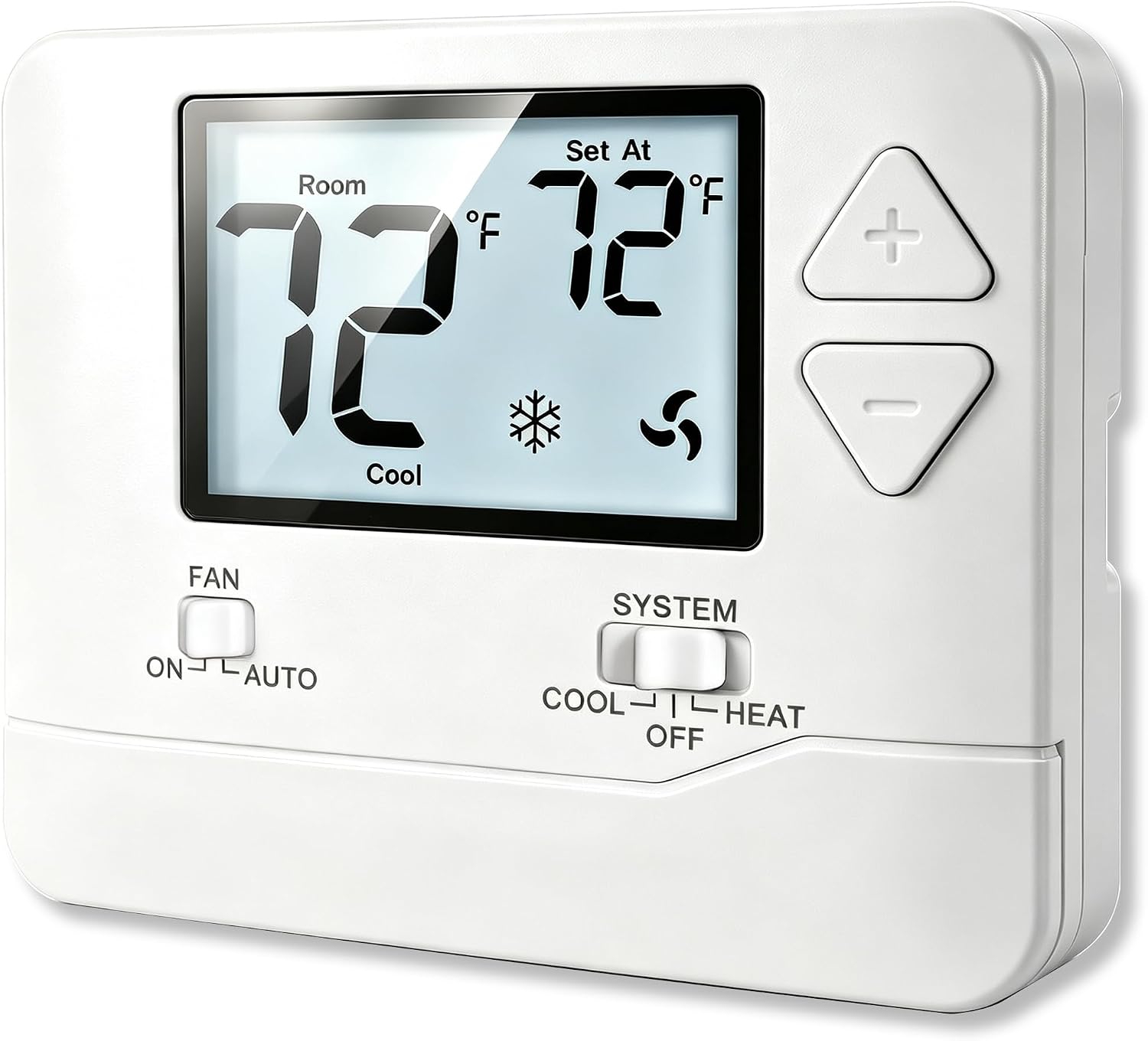
The Heagstat H701W is a straightforward manual thermostat built for conventional 1 heat/1 cool single-stage systems. It provides basic mode selection (Heat/Off/Cool), a large 4.5 in backlit LCD for easy reading, and physical button controls that make daily adjustments simple for any household. Installation supports standard RH/RC, W, Y, G and C terminals and can run on 24VAC or two AAA batteries for homes without a C-wire, while built-in features such as temperature calibration, adjustable swing (0.2 to 2F), and a selectable 5-minute compressor delay help tune comfort and protect HVAC equipment. The unit is intentionally nonprogrammable, so it is best for users who want one-touch manual control rather than scheduling or smart-home integration. Practical limitations include lack of compatibility with multi-stage systems, heat pumps, or many specialty terminals, and no remote or Wi-Fi control. For homeowners needing a reliable, no-frills replacement thermostat that emphasizes simple operation and basic protection features, this model delivers solid, predictable performance.
Best for: Homeowners who want a dependable, easy-to-use replacement thermostat for a conventional single-stage HVAC system and prefer manual control over schedules or smart features.
Less Ideal for: Users who need multi-stage or heat pump compatibility, remote access, programmable schedules, or smart-home integration should look elsewhere.
- Supports common RH/RC, W, Y, G and C terminals for easy hookup
- Dual power options: 24VAC hardwiring or two AAA batteries for C-wire-free installs
- Large 4.5-inch backlit LCD improves readability in low light
- Adjustable temperature swing and manual calibration enable fine temperature control
- Selectable 5-minute compressor delay provides basic protection for HVAC compressors
- Nonprogrammable with no Wi-Fi or smart-home integration
- Incompatible with multi-stage systems, heat pumps, and many specialty terminal types
Verdict: Choose the H701W when you need a reliable, no-frills manual thermostat for a single-stage system that prioritizes simple operation and basic equipment protection.
Google Nest Thermostat
| Connectivity Technology | Bluetooth, Wi-Fi |
|---|---|
| Power Source | Battery Powered |
| Display Type | LCD |
| Control Type | Remote Control, Voice Control |
| Number of Batteries | 2 A batteries required (included) |
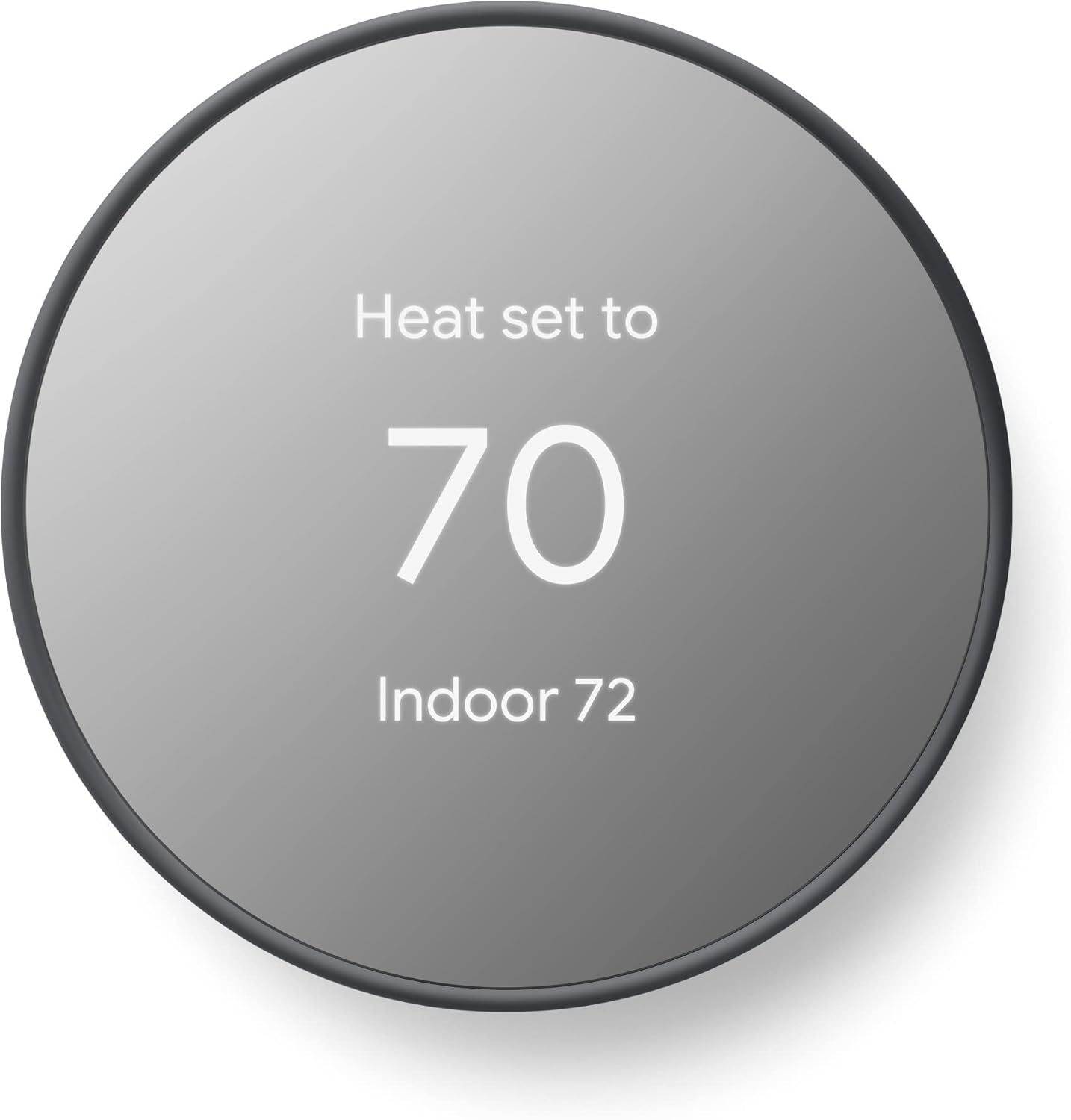
The Google Nest Thermostat is a compact smart thermostat designed to make temperature control simple through the Google Home app, voice assistants, or the touch bar on the unit. It is typically installed on a wall in place of a standard thermostat and can be set up in about 30 minutes for most homes; it works with many HVAC systems and often without a C wire. In daily use it creates schedules, switches to an Eco temperature when the home is empty, and sends HVAC alerts that can flag potential system issues. Connectivity includes dual‑band Wi‑Fi and Bluetooth Low Energy, and it is battery powered with two included A batteries. Practical benefits include remote adjustments from a phone, Savings Finder suggestions for energy tweaks, and compatibility with Google Assistant and Matter-certified voice platforms. Limits to consider are that some less common or line-voltage systems are incompatible, voice control and remote features require working internet, and advanced energy programs like Nest Renew are restricted by geography and utility participation.
Best for: Buyers who want a straightforward smart thermostat that simplifies scheduling and remote control while leaning on proven user feedback and manufacturer support.
Less Ideal for: Homes with line-voltage heating, unusual control wiring, or owners who need enterprise-grade HVAC diagnostics and features tied to professional services.
- Remote control and scheduling via the Google Home app for adjustments from anywhere
- Works with Google Assistant and Matter-certified voice assistants for hands‑free control
- Energy features like Eco Temperature and Savings Finder help reduce wasted heating and cooling
- Designed for easy DIY installation and compatible with a wide range of HVAC systems
- Not compatible with some line-voltage or uncommon HVAC systems and may need a C wire
- Advanced grid-tied features and some alerts require geographic or utility eligibility and internet
Verdict: A user-friendly smart thermostat that delivers reliable app and voice control plus energy-saving features for most standard home HVAC systems.
Choosing the Right Heating and Cooling Thermostat: Key Factors to Consider
Control Accuracy and Temperature Sensing
A thermostat's ability to sense and maintain the set temperature directly affects comfort and system runtime. Differences between the thermostat's sensing location and occupied spaces can cause short cycling or persistent temperature offsets.
Look for thermostats that allow temperature calibration or averaging between internal sensors and additional remote sensors. Accurate control reduces overshoot and wasted heating or cooling cycles, which improves comfort and lowers energy use over time.
Installation and Wiring Compatibility
Most residential thermostats use low-voltage wiring, but system configurations vary widely. Confirm whether your system is conventional forced-air, heat pump, multi-stage, or uses separate control circuits for humidification or zoning.
Thermostats that clearly document required wires and support common setups simplify installation. Some units need a common 24V C-wire to power display and smart features; others provide power-stealing or include an adapter. Consider how comfortable you are with wiring work or whether you will hire a technician.
Scheduling, Automation, and Learning Modes
Programmable schedules and automation let a thermostat reduce energy use without manual intervention. Basic weekly schedules are sufficient for many households, while adaptive or learning modes can fine-tune setpoints based on your behavior and local runtime patterns.
Evaluate whether the scheduler supports multiple daily setpoints, zone-based control if needed, and temporary hold modes for guests or irregular schedules. Automation that integrates with sunrise/sunset, geofencing, or occupancy sensors can provide additional convenience and savings.
Energy Management and Reporting
Energy features matter if your goal is to lower utility bills or track HVAC performance. Useful capabilities include runtime reports, estimated energy impact of setpoint changes, and alerts for abnormal system behavior.
Thermostats that offer actionable feedback help you identify inefficient operation, such as excessive short cycling or persistent temperature drift. If you participate in utility demand-response programs, confirm compatibility and opt-in requirements.
User Interface and Remote Access
A clear local interface reduces day-to-day frustration when adjusting setpoints or viewing current temperatures. Look for readable displays, simple menus, and tactile controls if you prefer physical interaction.
Remote access via a well-designed app or integration with home automation platforms adds convenience for adjustments while away and for receiving alerts. Reliability of cloud services and clarity of mobile controls should factor into your selection.
Durability and Long-Term Support
Thermostats are long-lived home components, so firmware update support and robust hardware matter. Devices that receive periodic updates can improve connectivity and add features without hardware changes.
Check the manufacturer's documentation on expected firmware maintenance and whether the device can be serviced or reset easily. Durable components and a straightforward mounting system reduce the risk of future replacement due to mechanical or electronic failure.
Choosing Between Programmable and Adaptive Thermostats
Programmable thermostats let you create fixed daily or weekly schedules. They are predictable and give you direct control over setpoint timing, which is helpful if your household follows a regular routine. Programmable models are easiest to manage for users who prefer explicit schedules over automated behavior.
- Good for households with consistent daily routines
- Direct control over heating and cooling intervals
- Often simpler to configure without cloud access
When to Consider Remote Sensors
Remote temperature or occupancy sensors can improve comfort by reporting conditions from frequently used rooms rather than the thermostat's mounting location. This is especially important if your thermostat is in a hallway, near a heat source, or in a location that does not reflect typical living-area temperatures.
- Improves temperature balance across living spaces
- Can be used to prioritize conditioned rooms when occupied
- Helpful for homes with uneven heat distribution
Integrating the Thermostat with Home Automation
If you use a smart home platform, choose a thermostat that supports the integrations you rely on. Native compatibility can enable scenes, routines, and voice control that coordinate HVAC with lighting and occupancy sensors. For automation use, verify whether the thermostat offers local control or depends solely on cloud services, since local control reduces latency and improves reliability during internet outages.
- Check for voice assistant or automation platform compatibility
- Prefer devices that offer local control options for critical functions
- Use automation to align HVAC with occupancy and window-opening sensors
Placement Tips for Accurate Readings
Thermostat placement affects sensing accuracy. Mount units on interior walls away from direct sunlight, drafts, or heat sources such as vents, appliances, or exterior doors. Height also matters; install the device at a representative walking height, typically around five feet above the floor, so the sensor reads air at living level. If ideal placement is not possible, consider remote sensors or calibration options to correct for known biases.
- Avoid exterior walls and direct sunlight
- Keep clear of nearby registers and appliances
- Install about five feet above the floor for representative readings
Power Options and the C-Wire Question
Many modern thermostats require a continuous 24V power source commonly called a C-wire. If your current thermostat lacks a C-wire, some replacement options use power-stealing methods or include an adapter. Understand the trade-offs: power-stealing can cause intermittent behavior on some HVAC systems, while an adapter or running a new C-wire provides the most reliable power. Confirm compatibility with your system before purchasing and plan for electrician assistance if running new wiring is necessary.
- Verify whether your system has an existing C-wire
- Consider adapter kits if running a wire is impractical
- Power-stealing solutions are convenient but may have rare reliability issues
How We Chose the Best Heating and Cooling Thermostat
We started by focusing on thermostats designed to manage both heating and cooling systems and prioritized models that deliver accurate temperature control and straightforward installation. Key evaluation dimensions included control accuracy under real-world thermostat placement, ease of installation for common residential wiring setups, and the clarity and usability of programming and scheduling features. We also measured compatibility with common HVAC control types, such as conventional single-stage and multi-stage systems, fan control options, and support for heat pump configurations. Energy management features were assessed, including smart scheduling, setback support, and any learning algorithms that meaningfully reduce runtime without sacrificing comfort. Usability and remote control were considered next: we favored thermostats with intuitive local controls and reliable remote access via apps or home automation systems. Durability and build quality rounded out the list, focusing on devices that maintain calibration and settings over time. Products were excluded if they lacked clear wiring compatibility information, required uncommon proprietary wiring modules, or did not support basic scheduling. The resulting selections balance accurate temperature control, broad system compatibility, installation simplicity, useful energy features, and clear user interfaces.
Our full evaluation process is outlined in our review methodology.
FAQ
Will a new thermostat work with my existing heating and cooling system?
Often yes, but it depends on the control wiring and the type of HVAC system. Check whether your system is a conventional furnace/AC, a heat pump, or a multi-stage setup, and confirm the thermostat supports that configuration.
Do I need a C-wire to install a modern thermostat?
Many modern units do need a C-wire for reliable power, though some alternatives use power-stealing or include an adapter. If your system lacks a C-wire, choose a thermostat that documents alternative power options clearly.
Can remote sensors fix uneven temperatures in my home?
Remote sensors can improve comfort by reporting conditions from occupied rooms, but they do not change the underlying distribution of heat. They help the thermostat control toward conditions where people actually are rather than a single wall-mounted sensor.
Is a learning thermostat always better than a programmable one?
Not necessarily. Learning thermostats can reduce manual programming by adapting to patterns, but if you have an irregular schedule or prefer explicit control, a programmable thermostat with manual scheduling may suit you better.
How much energy can a thermostat save me?
Savings vary based on your home, climate, and how you use the thermostat. Using setbacks, smart scheduling, and ensuring accurate control typically reduces runtime and can lower energy use, but exact savings depend on behavioral and system factors.
Final Verdict
Focus on compatibility, control accuracy, and the kinds of scheduling or automation that match how you live. If installation complexity is a concern, prioritize models with clear wiring guidance or included adapters. For households seeking maximum hands-off savings, favor thermostats with reliable automation or learning modes and remote sensor support. Balance usability and energy features against installation needs to make a confident choice. Picking a thermostat that fits your wiring and control expectations will deliver steady comfort and more predictable energy use over years of service.